Financial analysis
Programme BBA
Subject Management
Semester Sixth
Session No. 02
Topic Financial Statement: Objectives/uses and
Limitation
Created by Santhosh Prabhu M
Objectives of Financial Statements
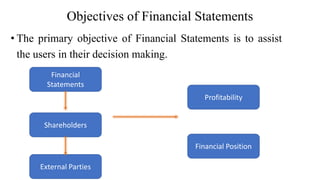
• The primary objective of Financial Statements is to assist
the users in their decision making.
Financial
Statements
External Parties
Shareholders
Profitability
Financial Position
Objectives of Financial Statements
• True & Fair view of financial position
• To provide information about economic resources and
obligation of a business
• To provide information about the earning capacity of the
business.
• To provide information about cash flows.
• To judge effectiveness of management.
• Information about activities of business affecting the society.
To increase the understandability of the end users.
End users means the owners, for whom the financial statements are
prepared. All the laws, regulations, accounting standards, accounting
framework, etc. are here to ensure the understandability of the end
users.
To form basis for decisions of the stakeholders.
Stakeholders means the owners, directors, customers, suppliers,
employees, workman, government, finance providers and the public at
large.
The various parties interested in the analysis of financial
statements are :
• Investors
• Management
• Trade unions
• Lenders
• Suppliers and trade creditors
• Tax authorities
• Researchers
• Employees
• Government and their agencies
• Stock exchange
Limitations of Financial Statements:
The limitations of financial statements are those factors that a user
should be aware of before relying on them to an excessive extent.
Knowledge of these factors could result in a reduction of invested funds
in a business, or actions taken to investigate further.
The following are all limitations of financial statements.
Financial Statements Lack in basis for projection:
FS are historical in nature and therefore the analysis of FS would
relate only to the past.
 Financial statements is only a tool and not the final remedy:
In the analysis of FS the personal judgement of the analyst is
more important therefore he should not depend on the single ratios
before reaching any conclusion.
Financial Statements Are Not Adjusted for Inflation:
If the inflation rate is relatively high, the amounts associated with assets
and liabilities in the balance sheet will appear inordinately low, since
they are not being adjusted for inflation. This mostly applies to long-
term assets.
Financial Statements ignores qualitative aspect:
It does not show the efficiency, profitability and technical know-
how of its employees and managers.
 Different interest of parties:
The FS cannot meet the purpose of all the parties interested in
them for e.g., investors, management, employees are mainly interested
in the profitability of the business.
Financial Statements May Not Be Comparable:
If a user wants to compare the results of different companies, their
financial statements are not always comparable, because the entities use
different accounting practices. These issues can be located by examining
the disclosures that accompany the financial statements.
Revision:
oObjectives/Uses of Financial Statement
oLimitations of Financial Statement

Financial analysis Types of analysis statement

  • 1.
    Financial analysis Programme BBA SubjectManagement Semester Sixth Session No. 02 Topic Financial Statement: Objectives/uses and Limitation Created by Santhosh Prabhu M
  • 2.
    Objectives of FinancialStatements • The primary objective of Financial Statements is to assist the users in their decision making. Financial Statements External Parties Shareholders Profitability Financial Position
  • 3.
    Objectives of FinancialStatements • True & Fair view of financial position • To provide information about economic resources and obligation of a business • To provide information about the earning capacity of the business. • To provide information about cash flows. • To judge effectiveness of management. • Information about activities of business affecting the society.
  • 4.
    To increase theunderstandability of the end users. End users means the owners, for whom the financial statements are prepared. All the laws, regulations, accounting standards, accounting framework, etc. are here to ensure the understandability of the end users. To form basis for decisions of the stakeholders. Stakeholders means the owners, directors, customers, suppliers, employees, workman, government, finance providers and the public at large.
  • 5.
    The various partiesinterested in the analysis of financial statements are : • Investors • Management • Trade unions • Lenders • Suppliers and trade creditors • Tax authorities • Researchers • Employees • Government and their agencies • Stock exchange
  • 6.
    Limitations of FinancialStatements: The limitations of financial statements are those factors that a user should be aware of before relying on them to an excessive extent. Knowledge of these factors could result in a reduction of invested funds in a business, or actions taken to investigate further. The following are all limitations of financial statements. Financial Statements Lack in basis for projection: FS are historical in nature and therefore the analysis of FS would relate only to the past.
  • 7.
     Financial statementsis only a tool and not the final remedy: In the analysis of FS the personal judgement of the analyst is more important therefore he should not depend on the single ratios before reaching any conclusion. Financial Statements Are Not Adjusted for Inflation: If the inflation rate is relatively high, the amounts associated with assets and liabilities in the balance sheet will appear inordinately low, since they are not being adjusted for inflation. This mostly applies to long- term assets.
  • 8.
    Financial Statements ignoresqualitative aspect: It does not show the efficiency, profitability and technical know- how of its employees and managers.  Different interest of parties: The FS cannot meet the purpose of all the parties interested in them for e.g., investors, management, employees are mainly interested in the profitability of the business.
  • 9.
    Financial Statements MayNot Be Comparable: If a user wants to compare the results of different companies, their financial statements are not always comparable, because the entities use different accounting practices. These issues can be located by examining the disclosures that accompany the financial statements.
  • 10.
    Revision: oObjectives/Uses of FinancialStatement oLimitations of Financial Statement