FINANCIAL MANAGEMENT
TYPES OF LEVERAGES
SNEKA R S
I MBA IT & FINANCE
LEVERAGE
 LEVERAGE is the use of borrowed funds (debt) for
funding the acquisition of assets in the hope that the
income of the new asset or capital gain would surpass
the cost of borrowing
TYPES OF LEVERAGE
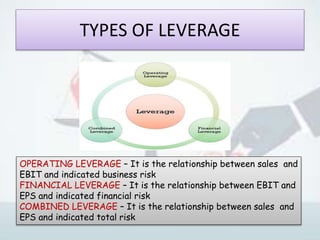
OPERATING LEVERAGE – It is the relationship between sales and
EBIT and indicated business risk
FINANCIAL LEVERAGE – It is the relationship between EBIT and
EPS and indicated financial risk
COMBINED LEVERAGE – It is the relationship between sales and
EPS and indicated total risk
OPERATIONAL LEVERAGE
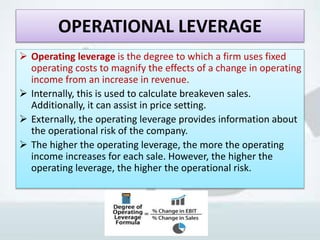
 Operating leverage is the degree to which a firm uses fixed
operating costs to magnify the effects of a change in operating
income from an increase in revenue.
 Internally, this is used to calculate breakeven sales.
Additionally, it can assist in price setting.
 Externally, the operating leverage provides information about
the operational risk of the company.
 The higher the operating leverage, the more the operating
income increases for each sale. However, the higher the
operating leverage, the higher the operational risk.
FINANCIAL LEVERAGE
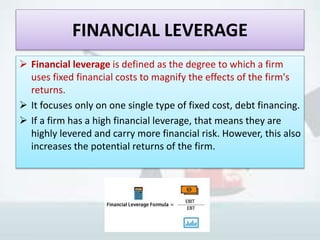
 Financial leverage is defined as the degree to which a firm
uses fixed financial costs to magnify the effects of the firm's
returns.
 It focuses only on one single type of fixed cost, debt financing.
 If a firm has a high financial leverage, that means they are
highly levered and carry more financial risk. However, this also
increases the potential returns of the firm.
COMBINED LEVERAGE
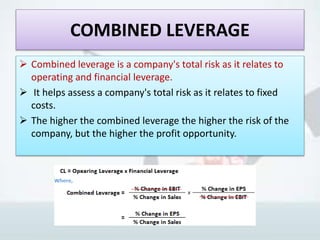
 Combined leverage is a company's total risk as it relates to
operating and financial leverage.
 It helps assess a company's total risk as it relates to fixed
costs.
 The higher the combined leverage the higher the risk of the
company, but the higher the profit opportunity.
TYPES OF LEVERAGE - FINANCIAL MANAGEMENT

TYPES OF LEVERAGE - FINANCIAL MANAGEMENT

  • 1.
    FINANCIAL MANAGEMENT TYPES OFLEVERAGES SNEKA R S I MBA IT & FINANCE
  • 2.
    LEVERAGE  LEVERAGE isthe use of borrowed funds (debt) for funding the acquisition of assets in the hope that the income of the new asset or capital gain would surpass the cost of borrowing
  • 3.
    TYPES OF LEVERAGE OPERATINGLEVERAGE – It is the relationship between sales and EBIT and indicated business risk FINANCIAL LEVERAGE – It is the relationship between EBIT and EPS and indicated financial risk COMBINED LEVERAGE – It is the relationship between sales and EPS and indicated total risk
  • 4.
    OPERATIONAL LEVERAGE  Operatingleverage is the degree to which a firm uses fixed operating costs to magnify the effects of a change in operating income from an increase in revenue.  Internally, this is used to calculate breakeven sales. Additionally, it can assist in price setting.  Externally, the operating leverage provides information about the operational risk of the company.  The higher the operating leverage, the more the operating income increases for each sale. However, the higher the operating leverage, the higher the operational risk.
  • 5.
    FINANCIAL LEVERAGE  Financialleverage is defined as the degree to which a firm uses fixed financial costs to magnify the effects of the firm's returns.  It focuses only on one single type of fixed cost, debt financing.  If a firm has a high financial leverage, that means they are highly levered and carry more financial risk. However, this also increases the potential returns of the firm.
  • 6.
    COMBINED LEVERAGE  Combinedleverage is a company's total risk as it relates to operating and financial leverage.  It helps assess a company's total risk as it relates to fixed costs.  The higher the combined leverage the higher the risk of the company, but the higher the profit opportunity.