ANALYSIS OF
LEVERAGE
TEAM :-
ISHA
S.YUSRA JAMAL
SAMRJEET KAUR
Introduction
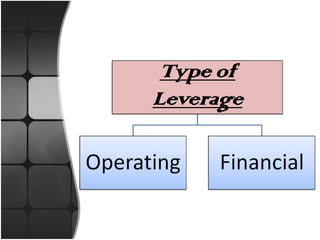
• Leverage provides the Framework for
Financing Décisions of a Firm.
• It May Be définie as the Employment of an
Assest or Source of Funds for which the
Firm has to pay a Fixed Cost , or Fixed
Return.
• Deleveraging is the action of reducing
borrowings.
• A key measure of leverage is the debt to
GDP ratio.
Break-Even (BE) Point
• Quantity where Total Revenue equals Total
Cost
• Company has no Profit or Loss
• BE = FC / P – VC
• A leveraged firm has a high BE point
• A non-leveraged firm has a low BE point
Risk in the Context of
Leverage
• Leverage influences stock price
Alters the risk/return relationship in an equity
investment
• Measures of performance
Operating income (EBIT or Earnings Before Interest
and Taxes)
• Unaf f ect ed by leverage because it is
calculat ed prior t o t he deduct ion f or
int erest
Return on Equity (ROE) is Earnings after Taxes ÷
Stockholders’ Equity
Earnings per Share (EPS) is Earnings after Taxes ÷
number of shares
• I nvest ors regard EPS as an import ant
indicat or of f ut ure prof it abilit y
Risk in the Context of
Leverage
• Redefining Risk for Leverage-Related Issues
• Leverage-related risk is variation in ROE and
EPS:
1. Business risk—variation in EBIT
2. Financial risk—additional variation in ROE
and EPS brought about by financial leverage.
• An aggressive or highly leveraged firm has high
fixed costs (and a relatively high break-even
point)
• A conservative or non-leveraged firm has low
fixed costs (and a relatively low break-even
point)
Business and Financial
Risk
Operating Leverage
• It is associated with asset acquisition or investment
activities.
• It may be defined as the ability to use fixed operating costs
to magnify the effect of changes in sales on its operating
profits(EBIT).
• Refers to the amount of fixed costs in the cost structure.
• Fixed and Variable Costs and Cost Structure.
• Fixed costs don’t change with the level of sales, while
variable costs do
– Fixed costs include rent, depreciation, utilities,
salaries
– Variable costs include direct labor, direct
materials, sales commissions
• The mix of fixed and variable costs in a firm’s operations is
its cost structure
The Effect of Operating
Leverage
• As volume moves away from Breakeven(Used t o
det ermine t he level of act ivit y a f irm must
achieve t o st ay in business in t he long run),
profit or loss increases faster with more operating leverage
• The Risk Effect
More operating leverage leads to larger variations in
EBIT, or business risk
• The Effect on Expected EBIT
• Thus, when a firm is operating above breakeven, more
operating leverage implies higher operating profit
 I f a f irm is relat ively sure of it s operat ing
level, it is in t he f irm’s best int erest s t o
t rade variable cost s f or f ixed cost
(assuming t he f irm is operat ing above
Breakeven Diagram at High and
Low Operating Leverage
The Degree of Operating
Leverage (DOL)—A
Measurement
• Operating leverage amplifies changes in sales volume
into larger changes in EBIT
• DOL relates relative changes in volume (Q) to relative
changes in EBIT.
DOL = %change in EBT %change in Sales
DOL = Sales – Variable Costs EBIT
example
A company is perfectly selling 5000 units of a
product @ Rs 20 per unit. If variable cost is Rs 6
per unit & fixed operational cost are Rs 80000.
Find DOL
sol :- sales = 20*5000 = 100000
VC = 30000
contribution = 70000
(-) FC = 80000
EBIT = 10000
therefore, DOL = 70000/10000 = 7%
Financial Leverage
• Measure of the amount of debt used by a firm.
• a  in EBIT (or OI) → a larger  in EPS.
• Financial Leverage measures the sensitivity of a firm’s
earnings per share to a  in operating income.
• Used as a means of increasing the return to common
shareholders.
• Financial leverage magnifies changes in EBIT into larger
changes in ROE and EPS
• The degree of financial leverage (DFL) relates relative
changes in EBIT to relative changes in EPS.
• An easier method of calculating DFL is:-
EBIT
DFL =
EBIT - Interest
Degree of Financial Leverage
(DFL)
• Degree of Financial Leverage -- The percentage
change in a firm’s earnings per share (EPS) resulting from a
1 percent change in operating profit.
DFLDFL =
Percentage change in
earnings per share (EPS)
Percentage change in
operating profit (EBIT)
% EPS
DFL = or % EPS = DFL % EBIT
% EBIT
∆
∆ × ∆
∆
Financial Risk
• Financial Risk ---- The added variability in earnings
per share (EPS) -- plus the risk of possible insolvency --
that is induced by the use of financial leverage.
• Debt increases the probability of cash insolvency over an
all-equity-financed firm.
Total Firm Risk
The Compounding Effect of
Operating Leverage and
Financial Leverage
example
Ques :- a company’s EBIT= 10000 & it has 5%
bonds for Rs 40000 & preference shares =
20000. Calculate DFL
Sol:- EBIT = 10000
(-) Interest = 2000
EBT = 8000
Therefore DFL = 10000/8000 = 1.25
Example
Ques :-A co. having a total capital of Rs 10 lacs
with 60% as bonds @10% as equity. The
expected sales of firm = 20000 units @20
per unit, VC = 10 per period, fixed
operational cost = Rs 50000, calcualte DOL,
DFL & DCL
Sol:- Sales = 400000
VC = 200000
Contri = 200000
(-) FC = 50000
Example contd....
EBIT = 150000
(-) Int =60000
EBT = 90000
Therefore, DOL = 200000/150000 = 1.33
DFL = 150000/90000 = 1.67
DCl = DFL*DOL = 2.22
Leverage

Leverage

  • 1.
  • 2.
    Introduction • Leverage providesthe Framework for Financing Décisions of a Firm. • It May Be définie as the Employment of an Assest or Source of Funds for which the Firm has to pay a Fixed Cost , or Fixed Return. • Deleveraging is the action of reducing borrowings. • A key measure of leverage is the debt to GDP ratio.
  • 4.
    Break-Even (BE) Point •Quantity where Total Revenue equals Total Cost • Company has no Profit or Loss • BE = FC / P – VC • A leveraged firm has a high BE point • A non-leveraged firm has a low BE point
  • 5.
    Risk in theContext of Leverage • Leverage influences stock price Alters the risk/return relationship in an equity investment • Measures of performance Operating income (EBIT or Earnings Before Interest and Taxes) • Unaf f ect ed by leverage because it is calculat ed prior t o t he deduct ion f or int erest Return on Equity (ROE) is Earnings after Taxes ÷ Stockholders’ Equity Earnings per Share (EPS) is Earnings after Taxes ÷ number of shares • I nvest ors regard EPS as an import ant indicat or of f ut ure prof it abilit y
  • 6.
    Risk in theContext of Leverage • Redefining Risk for Leverage-Related Issues • Leverage-related risk is variation in ROE and EPS: 1. Business risk—variation in EBIT 2. Financial risk—additional variation in ROE and EPS brought about by financial leverage. • An aggressive or highly leveraged firm has high fixed costs (and a relatively high break-even point) • A conservative or non-leveraged firm has low fixed costs (and a relatively low break-even point)
  • 7.
  • 8.
    Operating Leverage • Itis associated with asset acquisition or investment activities. • It may be defined as the ability to use fixed operating costs to magnify the effect of changes in sales on its operating profits(EBIT). • Refers to the amount of fixed costs in the cost structure. • Fixed and Variable Costs and Cost Structure. • Fixed costs don’t change with the level of sales, while variable costs do – Fixed costs include rent, depreciation, utilities, salaries – Variable costs include direct labor, direct materials, sales commissions • The mix of fixed and variable costs in a firm’s operations is its cost structure
  • 9.
    The Effect ofOperating Leverage • As volume moves away from Breakeven(Used t o det ermine t he level of act ivit y a f irm must achieve t o st ay in business in t he long run), profit or loss increases faster with more operating leverage • The Risk Effect More operating leverage leads to larger variations in EBIT, or business risk • The Effect on Expected EBIT • Thus, when a firm is operating above breakeven, more operating leverage implies higher operating profit  I f a f irm is relat ively sure of it s operat ing level, it is in t he f irm’s best int erest s t o t rade variable cost s f or f ixed cost (assuming t he f irm is operat ing above
  • 10.
    Breakeven Diagram atHigh and Low Operating Leverage
  • 11.
    The Degree ofOperating Leverage (DOL)—A Measurement • Operating leverage amplifies changes in sales volume into larger changes in EBIT • DOL relates relative changes in volume (Q) to relative changes in EBIT. DOL = %change in EBT %change in Sales DOL = Sales – Variable Costs EBIT
  • 12.
    example A company isperfectly selling 5000 units of a product @ Rs 20 per unit. If variable cost is Rs 6 per unit & fixed operational cost are Rs 80000. Find DOL sol :- sales = 20*5000 = 100000 VC = 30000 contribution = 70000 (-) FC = 80000 EBIT = 10000 therefore, DOL = 70000/10000 = 7%
  • 13.
    Financial Leverage • Measureof the amount of debt used by a firm. • a  in EBIT (or OI) → a larger  in EPS. • Financial Leverage measures the sensitivity of a firm’s earnings per share to a  in operating income. • Used as a means of increasing the return to common shareholders. • Financial leverage magnifies changes in EBIT into larger changes in ROE and EPS • The degree of financial leverage (DFL) relates relative changes in EBIT to relative changes in EPS. • An easier method of calculating DFL is:- EBIT DFL = EBIT - Interest
  • 14.
    Degree of FinancialLeverage (DFL) • Degree of Financial Leverage -- The percentage change in a firm’s earnings per share (EPS) resulting from a 1 percent change in operating profit. DFLDFL = Percentage change in earnings per share (EPS) Percentage change in operating profit (EBIT) % EPS DFL = or % EPS = DFL % EBIT % EBIT ∆ ∆ × ∆ ∆
  • 15.
    Financial Risk • FinancialRisk ---- The added variability in earnings per share (EPS) -- plus the risk of possible insolvency -- that is induced by the use of financial leverage. • Debt increases the probability of cash insolvency over an all-equity-financed firm.
  • 16.
  • 17.
    The Compounding Effectof Operating Leverage and Financial Leverage
  • 18.
    example Ques :- acompany’s EBIT= 10000 & it has 5% bonds for Rs 40000 & preference shares = 20000. Calculate DFL Sol:- EBIT = 10000 (-) Interest = 2000 EBT = 8000 Therefore DFL = 10000/8000 = 1.25
  • 19.
    Example Ques :-A co.having a total capital of Rs 10 lacs with 60% as bonds @10% as equity. The expected sales of firm = 20000 units @20 per unit, VC = 10 per period, fixed operational cost = Rs 50000, calcualte DOL, DFL & DCL Sol:- Sales = 400000 VC = 200000 Contri = 200000 (-) FC = 50000
  • 20.
    Example contd.... EBIT =150000 (-) Int =60000 EBT = 90000 Therefore, DOL = 200000/150000 = 1.33 DFL = 150000/90000 = 1.67 DCl = DFL*DOL = 2.22

Editor's Notes

  • #12 DOL = Sales – Variable Costs/ EBIT
  • #15 DFL