NET INCOME
APPROACH
BY : SIMI.P M
Net Income (NI) approach
• This theory was propounded by David Durand and also known as Fixed ke theory.
• According to this approach the value of the firm is increase and decrease overall
cost of capital by increasing the proportion of debt financing in capital structure.
• It is due to the fact that debt is generally a cheaper source of finance because:
1) interest rate is lower than the dividend rate
2) benefit of tax because int. is deductible expense.
•
Cont…
• both the cost of debt and cost of equity are independent of the capital
structure; they remain constant regardies of how much debt the firm uses.
As the result ,the overall cost of capital decline and the firm value increases
with the debt.
• This approach has no basis in reality; the optium capital structure would be
100 % debt financing under NI approach.
Cont…
• ie., cost of debt = interest market value of debt
cost of equity= earnings available to shareholders , market value of
shares outstanding
value of the firm = market value of debt + market value of equity.
• accordingly, under this approach, the firm’s overall cost of capital or
expected rate of return (WACC) is expressed as:
cost of capital = net operating income value of firm.
formula
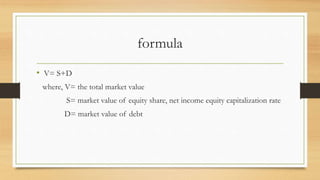
• V= S+D
where, V= the total market value
S= market value of equity share, net income equity capitalization rate
D= market value of debt
Assumptions of NI approach
• There are no taxes
• The cost of debt is less than the cost of equity
• The uses of debt does not change the risk perception of the investors.
if the firm is using equity capital alone , the composite cost of capital will
equal to cost of equity and the value of the firm will be minimum.
.
Net income approach

Net income approach

  • 1.
  • 2.
    Net Income (NI)approach • This theory was propounded by David Durand and also known as Fixed ke theory. • According to this approach the value of the firm is increase and decrease overall cost of capital by increasing the proportion of debt financing in capital structure. • It is due to the fact that debt is generally a cheaper source of finance because: 1) interest rate is lower than the dividend rate 2) benefit of tax because int. is deductible expense. •
  • 3.
    Cont… • both thecost of debt and cost of equity are independent of the capital structure; they remain constant regardies of how much debt the firm uses. As the result ,the overall cost of capital decline and the firm value increases with the debt. • This approach has no basis in reality; the optium capital structure would be 100 % debt financing under NI approach.
  • 4.
    Cont… • ie., costof debt = interest market value of debt cost of equity= earnings available to shareholders , market value of shares outstanding value of the firm = market value of debt + market value of equity. • accordingly, under this approach, the firm’s overall cost of capital or expected rate of return (WACC) is expressed as: cost of capital = net operating income value of firm.
  • 5.
    formula • V= S+D where,V= the total market value S= market value of equity share, net income equity capitalization rate D= market value of debt
  • 6.
    Assumptions of NIapproach • There are no taxes • The cost of debt is less than the cost of equity • The uses of debt does not change the risk perception of the investors. if the firm is using equity capital alone , the composite cost of capital will equal to cost of equity and the value of the firm will be minimum. .