Lev Vygotsky
‘The Zone Of Proximal Development’
ZPD
“A world devoid of thought is a dead
thing, and a thought unembodied by
a word remains in shadow”
- Lev Zygotsky 1934
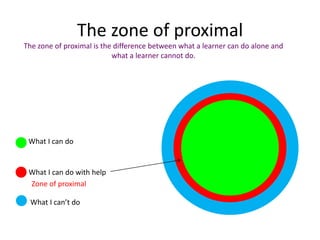
What I can do with help
What I can’t do
What I can do
Zone of proximal
The zone of proximal is the difference between what a learner can do alone and
what a learner cannot do.
The zone of proximal
• Lev Vygotsky is a Soviet psychologist and social
constructivist.
• He stated that “A child follows an adults example and
gradually develops the ability to do certain tasks
without help or assistance.”
• Lev Vygotsky also describes the zone of proximal as
“the distance between the actual.”
MKO – More Knowledgeable Other
• The MKO is someone who is perceived as
being more knowledgeable about a task then
someone else.
• It can be a parent or teacher, but can just as
easily be one of the child’s peers.
• He thought that children benefit more when
helped by a child as opposed to an adult. The
other child benefits, too, as teaching someone
reinforces their own mental pathways about a
task.
Scaffolding
• Scaffolding lays the foundations for future
learning
• To learn more, children must have a basis to
learn on.
• For example, they have to know that a dog is a
dog, before they can link what a dog looks like
to the word, and the fact that a dog goes
woof-woof.
Zygotsky and Social Interaction
• Zygotsky believed that communication helped
with all types of learning.
• He realised that children’s language developed
through social interaction and that social
interaction helps them develop other
necessary skills.
• Because of this, he placed a very high level of
importance on how families and other
children influence learning.
https://play.kahoot.it/#/k/5eaf04bd-
9c4c-4a73-925f-b470ffb501cc

Lev vygotsky

  • 1.
    Lev Vygotsky ‘The ZoneOf Proximal Development’ ZPD
  • 2.
    “A world devoidof thought is a dead thing, and a thought unembodied by a word remains in shadow” - Lev Zygotsky 1934
  • 3.
    What I cando with help What I can’t do What I can do Zone of proximal The zone of proximal is the difference between what a learner can do alone and what a learner cannot do. The zone of proximal
  • 4.
    The zone ofproximal • Lev Vygotsky is a Soviet psychologist and social constructivist. • He stated that “A child follows an adults example and gradually develops the ability to do certain tasks without help or assistance.” • Lev Vygotsky also describes the zone of proximal as “the distance between the actual.”
  • 5.
    MKO – MoreKnowledgeable Other • The MKO is someone who is perceived as being more knowledgeable about a task then someone else. • It can be a parent or teacher, but can just as easily be one of the child’s peers. • He thought that children benefit more when helped by a child as opposed to an adult. The other child benefits, too, as teaching someone reinforces their own mental pathways about a task.
  • 6.
    Scaffolding • Scaffolding laysthe foundations for future learning • To learn more, children must have a basis to learn on. • For example, they have to know that a dog is a dog, before they can link what a dog looks like to the word, and the fact that a dog goes woof-woof.
  • 7.
    Zygotsky and SocialInteraction • Zygotsky believed that communication helped with all types of learning. • He realised that children’s language developed through social interaction and that social interaction helps them develop other necessary skills. • Because of this, he placed a very high level of importance on how families and other children influence learning.
  • 8.

Editor's Notes

  • #3 AQA A-Level Psychology Book 2 Launton, J and Willard, E (2015) Hodder Education, London 159-163
  • #6 How Children Learn, L, Pond (2006) Practical Pre-school Books, London 39-41