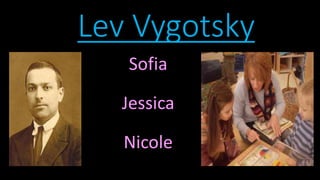
Lev Vygotsky 
Sofia 
Jessica 
Nicole
1. You need to provide very brief information on the 
background of the theorist 
• He was born on November 17th 1886 and died on June 11th 1934 
• He was born in Orsha, a city in the western region of Russia. 
• He attended Moscow State University, where he graduated with a degree in law 
in 1917. 
• He studied a range of topics white attending university, including sociology, 
linguistics, psychology and philosophy. 
• Back in Gomel, Vygotsky taught logic and psychology at a local college 
• In 1924, he joined the Moscow Institute of Experimental Psychology. 
• He was a teacher and researcher for nine years. 
• Vygotsky was a psychologist who made significant advancements in the field of 
child development. Vygotsky’s short career focused on child development, 
developmental psychology, and educational philosophy.
2. What area of development their ideas address 
E.G gender differences/social needs/emotional 
needs? 
• The work of Vygotsky was focused on theory in cognitive development, which is 
the study of how children use their brains. 
• His work particularly has become known as the Social Development Theory. 
Vygotsky’s main theories address social interaction in the development of 
cognition. 
• He believed that “the community plays a central role in the process of making 
meaning”. Simplypsychology.org 2007
3. A brief description of their theory (idea) 
• Lev Vygotsky research showed that children’s social needs related to 
their cognitive development. Relationships with adults have to be 
positive and supportive in order to encourage children to be problem 
solvers and thinkers and to develop their language. 
• This interaction with adults is described in his devised zone of proximal 
development . 
• The zone of proximal indicates the point where an adult needs to 
interact with a child when they see the potential for them to extend 
their learning (Taylor, 2012)
4. How does this theory effect the development of 
children? 
• According to Vygotsky, until children learn to use mental tools, such as using their 
brains and intellect, their learning is largely controlled by the environment; they 
only notice the things that are brightest or loudest, and they can remember 
something only if has been repeated many times. 
• After children master mental intellect, they become in charge of their own 
learning, by attending and remembering in an intentional and purposeful way. In 
the same way that using certain mental tools can transform children’s cognitive 
behaviors, using other mental tools can transform their physical, social, and 
emotional behaviors. 
• Once children learn how to use their brain to view and make sense of the world 
around them, they can transform their external behaviour and minds, which leads 
to the emergence of higher functions. Children can then become “master of their 
own behaviour”
5.Positive aspects of the theory 
• One of Vygotsky’s colleagues, psychologist Kurt Lewin, was known to have 
said, “There is nothing more practical than a good theory” about Vygotsky’s 
theory. Because it is based on an inclusive theory of learning and 
development. 
• Tools of the mind, 2014 Another important feature of this theory is the key 
term scaffolding. When an adult provides support for a child, they will 
adjust the amount of help they give depending on their progress. For 
example, a child learning to walk might at first have both their hands held 
and pulled upwards. 
• As they learn to support their own weight, the mother might hold both 
their hands loosely, then one hand, and eventually the child will learn to 
walk independently.
Bibliography 
• 1- http://www.goodtherapy.org/famous-psychologists/lev-vygotsky.html# 
GoodTherapy.org, 2007-2014 
• 2- http://www.simplypsychology.org/vygotsky.html Saul McLeod published 
2007 updated 2014 
• 3- http://www.toolsofthemind.org/philosophy/vygotskian-approach/ 2014 
• 4- Children and Young People’s Workforce, Baker B, Beith K, Byers E, Daly M, 
Forbes S, Griffin S, Marshall H, Essex, 2012. 
• 5- http://www.toolsofthemind.org/philosophy/vygotskian-approach/ 
2014 and http://psychohawks.wordpress.com/2010/11/03/theories-of-cognitive- 
development-lev-vygotsky/ November 2010

Lev vygotsky powerpoint

  • 1.
    Lev Vygotsky Sofia Jessica Nicole
  • 2.
    1. You needto provide very brief information on the background of the theorist • He was born on November 17th 1886 and died on June 11th 1934 • He was born in Orsha, a city in the western region of Russia. • He attended Moscow State University, where he graduated with a degree in law in 1917. • He studied a range of topics white attending university, including sociology, linguistics, psychology and philosophy. • Back in Gomel, Vygotsky taught logic and psychology at a local college • In 1924, he joined the Moscow Institute of Experimental Psychology. • He was a teacher and researcher for nine years. • Vygotsky was a psychologist who made significant advancements in the field of child development. Vygotsky’s short career focused on child development, developmental psychology, and educational philosophy.
  • 3.
    2. What areaof development their ideas address E.G gender differences/social needs/emotional needs? • The work of Vygotsky was focused on theory in cognitive development, which is the study of how children use their brains. • His work particularly has become known as the Social Development Theory. Vygotsky’s main theories address social interaction in the development of cognition. • He believed that “the community plays a central role in the process of making meaning”. Simplypsychology.org 2007
  • 4.
    3. A briefdescription of their theory (idea) • Lev Vygotsky research showed that children’s social needs related to their cognitive development. Relationships with adults have to be positive and supportive in order to encourage children to be problem solvers and thinkers and to develop their language. • This interaction with adults is described in his devised zone of proximal development . • The zone of proximal indicates the point where an adult needs to interact with a child when they see the potential for them to extend their learning (Taylor, 2012)
  • 5.
    4. How doesthis theory effect the development of children? • According to Vygotsky, until children learn to use mental tools, such as using their brains and intellect, their learning is largely controlled by the environment; they only notice the things that are brightest or loudest, and they can remember something only if has been repeated many times. • After children master mental intellect, they become in charge of their own learning, by attending and remembering in an intentional and purposeful way. In the same way that using certain mental tools can transform children’s cognitive behaviors, using other mental tools can transform their physical, social, and emotional behaviors. • Once children learn how to use their brain to view and make sense of the world around them, they can transform their external behaviour and minds, which leads to the emergence of higher functions. Children can then become “master of their own behaviour”
  • 6.
    5.Positive aspects ofthe theory • One of Vygotsky’s colleagues, psychologist Kurt Lewin, was known to have said, “There is nothing more practical than a good theory” about Vygotsky’s theory. Because it is based on an inclusive theory of learning and development. • Tools of the mind, 2014 Another important feature of this theory is the key term scaffolding. When an adult provides support for a child, they will adjust the amount of help they give depending on their progress. For example, a child learning to walk might at first have both their hands held and pulled upwards. • As they learn to support their own weight, the mother might hold both their hands loosely, then one hand, and eventually the child will learn to walk independently.
  • 7.
    Bibliography • 1-http://www.goodtherapy.org/famous-psychologists/lev-vygotsky.html# GoodTherapy.org, 2007-2014 • 2- http://www.simplypsychology.org/vygotsky.html Saul McLeod published 2007 updated 2014 • 3- http://www.toolsofthemind.org/philosophy/vygotskian-approach/ 2014 • 4- Children and Young People’s Workforce, Baker B, Beith K, Byers E, Daly M, Forbes S, Griffin S, Marshall H, Essex, 2012. • 5- http://www.toolsofthemind.org/philosophy/vygotskian-approach/ 2014 and http://psychohawks.wordpress.com/2010/11/03/theories-of-cognitive- development-lev-vygotsky/ November 2010