

Over the course of the semester, I have been exposed
to many theories about children and how they learn
and process information. I am thankful that the
educational system, while far from perfect, has made
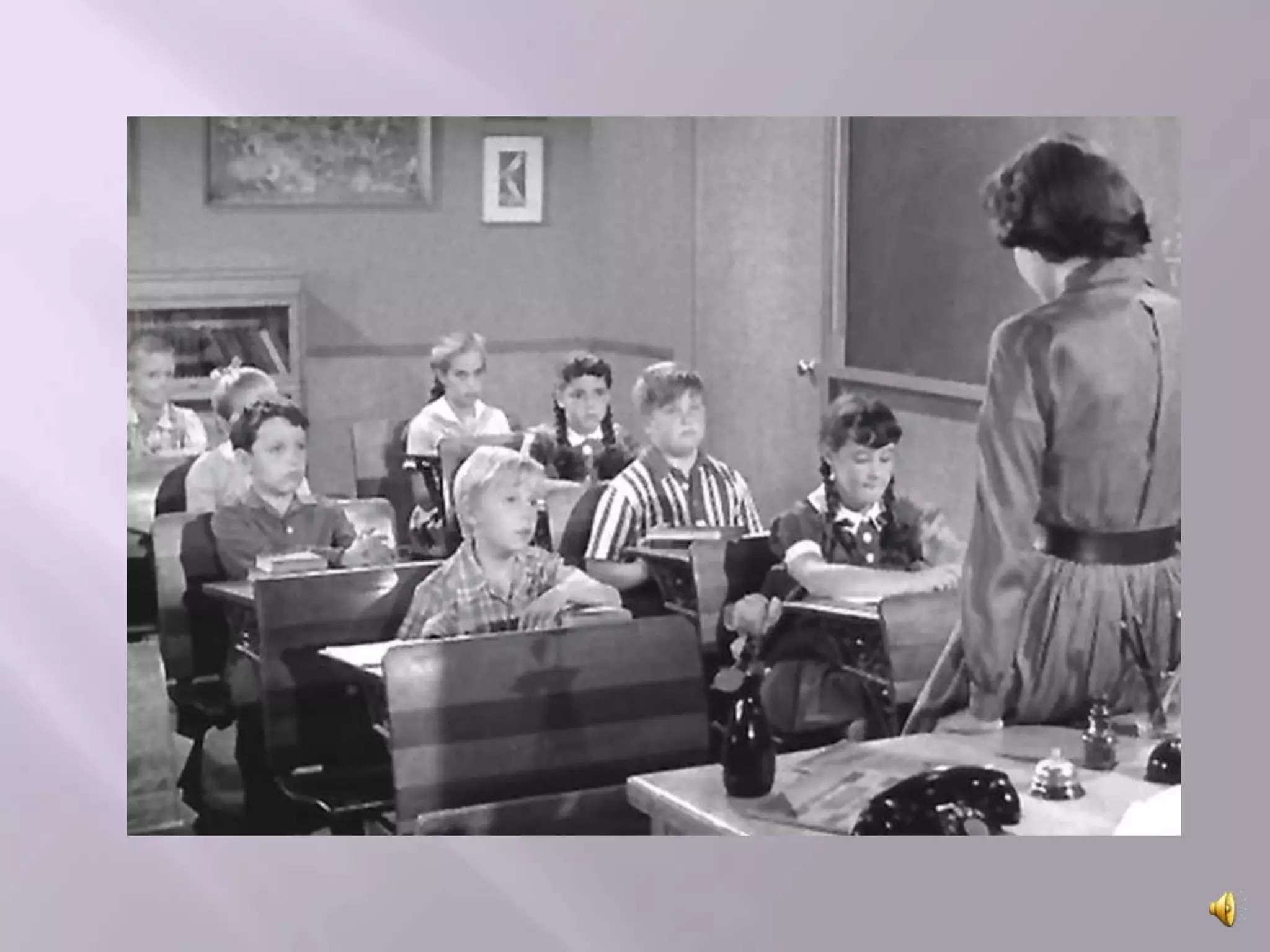
an effort to move from the “Leave it to Beaver” style
of teaching to new and innovative methods. From
Gardner’s Multiple Intelligences to the Montessori
way of teaching, the educational system has come a
long way from the 1950’s mainstream way of
teaching. While all of the theories and principles are
very valid, the one that resonates the most with me is
Lev Vygotsky’s Sociocultural Theory.


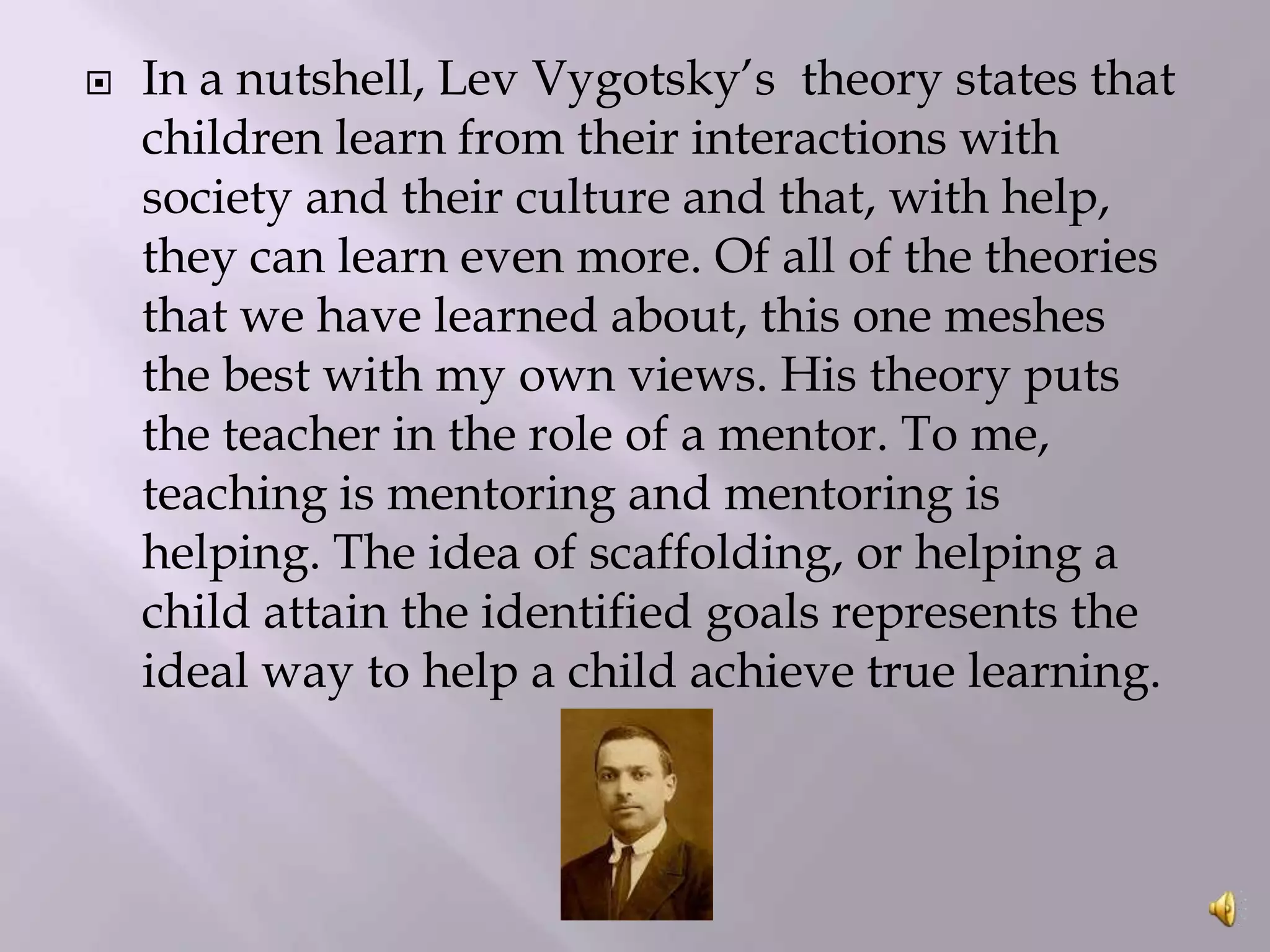
In a nutshell, Lev Vygotsky’s theory states that
children learn from their interactions with
society and their culture and that, with help,
they can learn even more. Of all of the theories
that we have learned about, this one meshes
the best with my own views. His theory puts
the teacher in the role of a mentor. To me,
teaching is mentoring and mentoring is
helping. The idea of scaffolding, or helping a
child attain the identified goals represents the
ideal way to help a child achieve true learning.


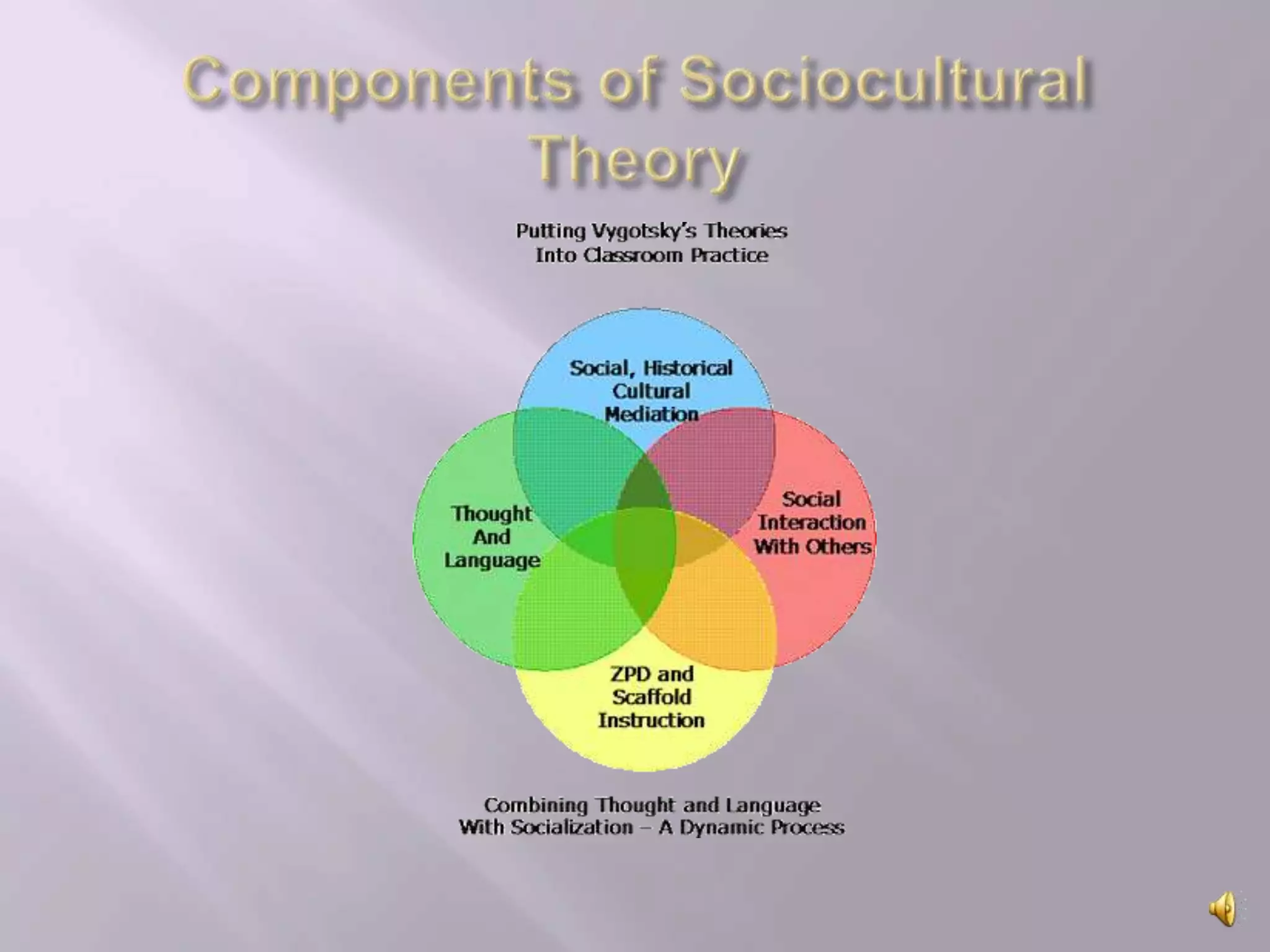
Social interaction is critical for cognitive
development. Related to this is the idea of Zone
of Proximal Development (ZPD). Some skills
an individual can perform independently;
other skills can be performed if the individual
has assistance. Skills that can be performed
with assistance are said to be within an
individual’s ZPD. The ZPD is the theoretical
basis for scaffolding.
-www. teachersgarden.com/professionalresources/learningtheorists.html


[Children’s] understanding of this world
comes, in part, from the values and beliefs of the
adults and other children in their lives
(Mooney, 2006).


“…children need to learn more than a set of facts and
skills. They need to master a set of mental tools—tools
of the mind.”
http://www.toolsofthemind.org/philosophy/vygotskianapproach/



“Play” is an integral part of a child’s learning


“A child’s greatest achievements are possible in
play, achievements that tomorrow will become her
basic level of real action.” - Vygotsky


“…understanding the relationship between
theory and practice is realizing that the student is
more important than the teacher in determining
what is learned.”
(www. education.com/reference/article/theories of learning)


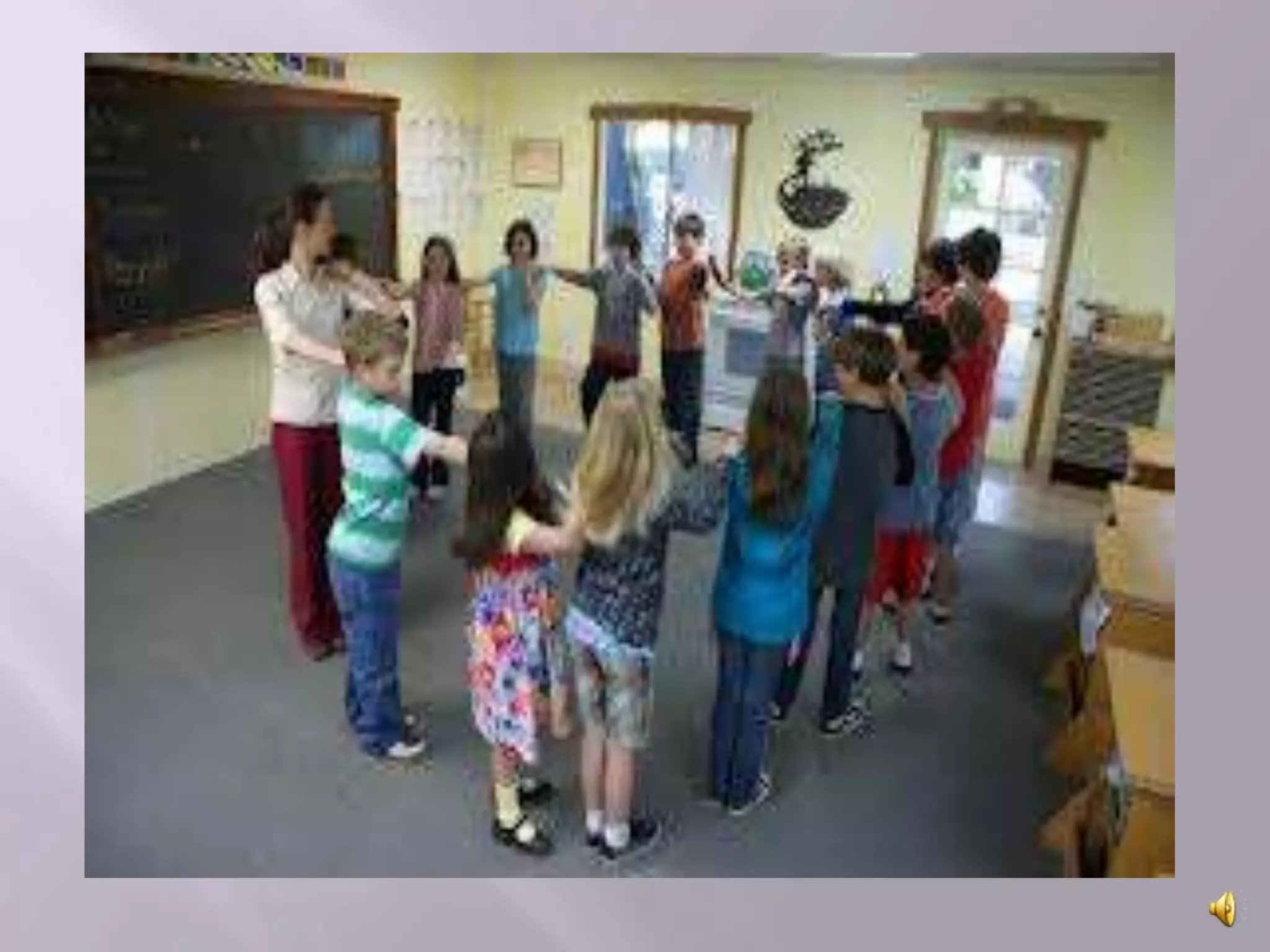
The best way to implement Vgotsky’s theory is
through group work, so this is the strategy I
plan to use the most. The group work can be
accomplished in several ways, but three jump
immediately to mind.




Peer to peer
Parents/family
Community
Students work in pairs or small groups
• Provides students the opportunity to share with one
another their ideas, views and opinions
• Non threatening, relaxed environment assures that
students feel comfortable asking questions and putting
forth ideas
• Students more likely to listen to one another
Teacher’s Role:
• Identify goals that students need to meet and what
work needs to be accomplished. Provide higher level of
assistance than peers are able demonstrating
Vygotsky’s theory that students can attain higher levels
with assistance from a more competent individual.
•





Bring parents/family into classroom to assist students
in learning
Provides a safe and secure environment
Especially effective for ELLs

Teacher’s Role:
 Use the resource of family to help students attain
their educational goals. Use these members as the
more competent individuals to assist the students,
thereby increasing their ZPD. Again, this fits into
Vygotsky’s theory because it utilizes the student’s
strongest connection, that of family, to create
scaffolding that the student can build on to meet the
identified goals. For ELLs, they are also able to learn
in their primary language.
Bringing community members into the class
introduces students to a larger “family” than
what they find when they go home.
 Accomplishes many of the same objectives as
formal family members, but provides extra
scaffolding.
 Introduces students to new ways of thinking
and problem solving
Teacher’s Role:
 The same as utilizing formal family members.











Bringing family and community members into the
classroom has the added benefit of exposing students
to new and different cultures and diversity.
It exposes students to different ways of thinking and
different possible solutions.
It creates a student driven classroom where the
likelihood of students buying into their education is
greatly increased. This in turn increases interest in
learning.
It creates higher standards which in turn lead to
greater accomplishments.
Produces well rounded, confident individuals who
grow into high producing adults.


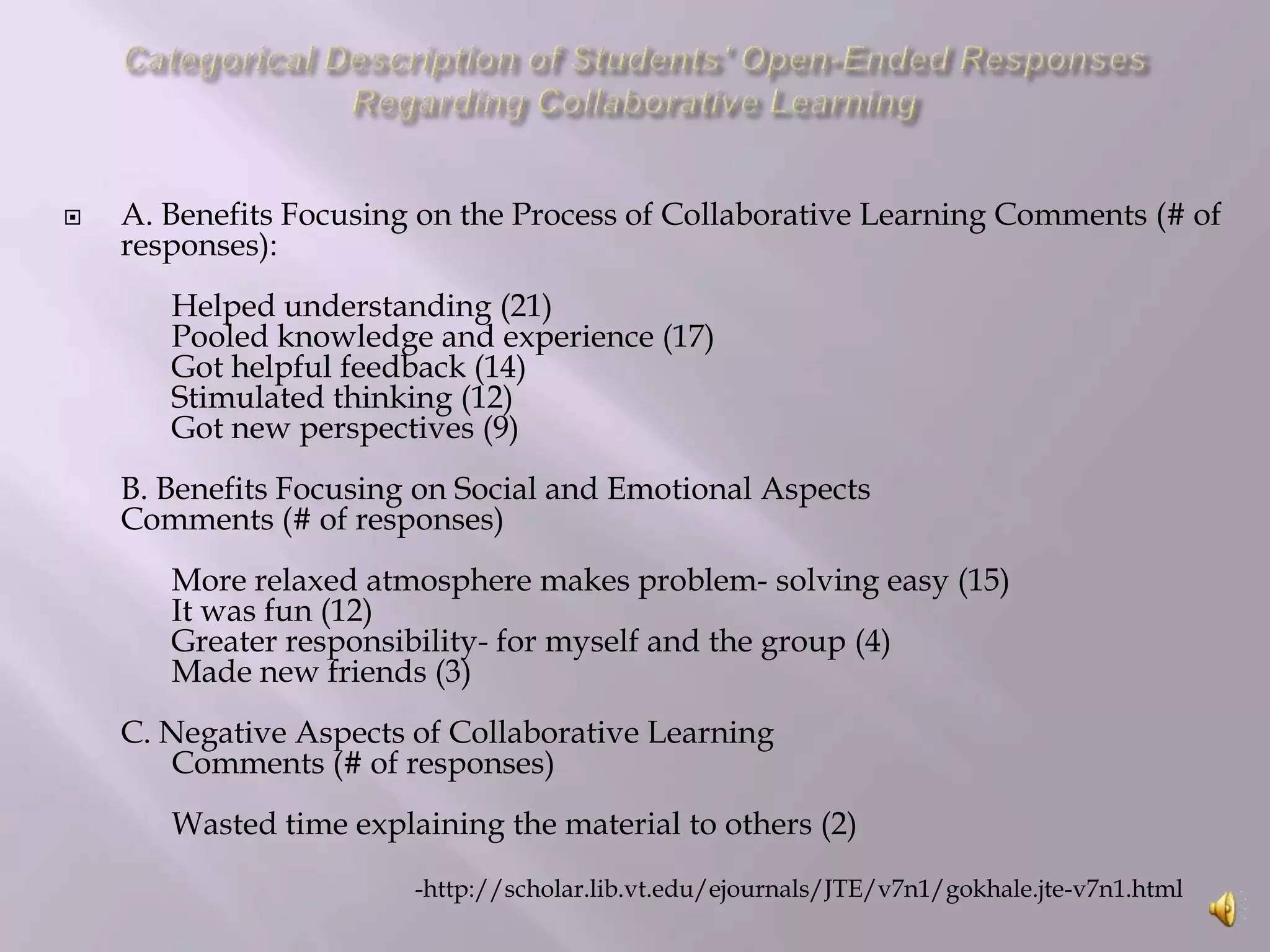
A. Benefits Focusing on the Process of Collaborative Learning Comments (# of
responses):

Helped understanding (21)
Pooled knowledge and experience (17)
Got helpful feedback (14)
Stimulated thinking (12)
Got new perspectives (9)
B. Benefits Focusing on Social and Emotional Aspects
Comments (# of responses)
More relaxed atmosphere makes problem- solving easy (15)
It was fun (12)
Greater responsibility- for myself and the group (4)
Made new friends (3)
C. Negative Aspects of Collaborative Learning
Comments (# of responses)
Wasted time explaining the material to others (2)
-http://scholar.lib.vt.edu/ejournals/JTE/v7n1/gokhale.jte-v7n1.html


While Vygotsky’s theory works best in small
groups, there is ample opportunity to
incorporate individual work as well. The
individual work can also be used as
assessments. Working alone will show the
teacher what the student actually knows and
also how much the student’s actual
development has increased.










www.teachersgarden.com/professionalresources/
learningtheorists.html
http://scholar.lib.vt.edu/ejournals/JTE/v7n1/go
khale.jte-v7n1.html
Mooney, C. (2006). Theories of childhood an
introduction to Dewey Montessori Erikson Piaget &
Vygotsky. St. Paul, MN: Merrill/Prentice Hall.
www.education.com/reference/article/theoriesof-learning
www.toolsofthemind.org/philosophy/vygotskian
-approach/

Vygotsky’s sociocultural theory of learning

  • 2.
     Over the courseof the semester, I have been exposed to many theories about children and how they learn and process information. I am thankful that the educational system, while far from perfect, has made an effort to move from the “Leave it to Beaver” style of teaching to new and innovative methods. From Gardner’s Multiple Intelligences to the Montessori way of teaching, the educational system has come a long way from the 1950’s mainstream way of teaching. While all of the theories and principles are very valid, the one that resonates the most with me is Lev Vygotsky’s Sociocultural Theory.
  • 5.
     In a nutshell,Lev Vygotsky’s theory states that children learn from their interactions with society and their culture and that, with help, they can learn even more. Of all of the theories that we have learned about, this one meshes the best with my own views. His theory puts the teacher in the role of a mentor. To me, teaching is mentoring and mentoring is helping. The idea of scaffolding, or helping a child attain the identified goals represents the ideal way to help a child achieve true learning.
  • 7.
     Social interaction iscritical for cognitive development. Related to this is the idea of Zone of Proximal Development (ZPD). Some skills an individual can perform independently; other skills can be performed if the individual has assistance. Skills that can be performed with assistance are said to be within an individual’s ZPD. The ZPD is the theoretical basis for scaffolding. -www. teachersgarden.com/professionalresources/learningtheorists.html
  • 8.
     [Children’s] understanding ofthis world comes, in part, from the values and beliefs of the adults and other children in their lives (Mooney, 2006).  “…children need to learn more than a set of facts and skills. They need to master a set of mental tools—tools of the mind.” http://www.toolsofthemind.org/philosophy/vygotskianapproach/  “Play” is an integral part of a child’s learning  “A child’s greatest achievements are possible in play, achievements that tomorrow will become her basic level of real action.” - Vygotsky
  • 9.
     “…understanding the relationshipbetween theory and practice is realizing that the student is more important than the teacher in determining what is learned.” (www. education.com/reference/article/theories of learning)
  • 10.
     The best wayto implement Vgotsky’s theory is through group work, so this is the strategy I plan to use the most. The group work can be accomplished in several ways, but three jump immediately to mind.    Peer to peer Parents/family Community
  • 11.
    Students work inpairs or small groups • Provides students the opportunity to share with one another their ideas, views and opinions • Non threatening, relaxed environment assures that students feel comfortable asking questions and putting forth ideas • Students more likely to listen to one another Teacher’s Role: • Identify goals that students need to meet and what work needs to be accomplished. Provide higher level of assistance than peers are able demonstrating Vygotsky’s theory that students can attain higher levels with assistance from a more competent individual. •
  • 12.
       Bring parents/family intoclassroom to assist students in learning Provides a safe and secure environment Especially effective for ELLs Teacher’s Role:  Use the resource of family to help students attain their educational goals. Use these members as the more competent individuals to assist the students, thereby increasing their ZPD. Again, this fits into Vygotsky’s theory because it utilizes the student’s strongest connection, that of family, to create scaffolding that the student can build on to meet the identified goals. For ELLs, they are also able to learn in their primary language.
  • 13.
    Bringing community membersinto the class introduces students to a larger “family” than what they find when they go home.  Accomplishes many of the same objectives as formal family members, but provides extra scaffolding.  Introduces students to new ways of thinking and problem solving Teacher’s Role:  The same as utilizing formal family members. 
  • 14.
         Bringing family andcommunity members into the classroom has the added benefit of exposing students to new and different cultures and diversity. It exposes students to different ways of thinking and different possible solutions. It creates a student driven classroom where the likelihood of students buying into their education is greatly increased. This in turn increases interest in learning. It creates higher standards which in turn lead to greater accomplishments. Produces well rounded, confident individuals who grow into high producing adults.
  • 15.
     A. Benefits Focusingon the Process of Collaborative Learning Comments (# of responses): Helped understanding (21) Pooled knowledge and experience (17) Got helpful feedback (14) Stimulated thinking (12) Got new perspectives (9) B. Benefits Focusing on Social and Emotional Aspects Comments (# of responses) More relaxed atmosphere makes problem- solving easy (15) It was fun (12) Greater responsibility- for myself and the group (4) Made new friends (3) C. Negative Aspects of Collaborative Learning Comments (# of responses) Wasted time explaining the material to others (2) -http://scholar.lib.vt.edu/ejournals/JTE/v7n1/gokhale.jte-v7n1.html
  • 16.
     While Vygotsky’s theoryworks best in small groups, there is ample opportunity to incorporate individual work as well. The individual work can also be used as assessments. Working alone will show the teacher what the student actually knows and also how much the student’s actual development has increased.
  • 17.
         www.teachersgarden.com/professionalresources/ learningtheorists.html http://scholar.lib.vt.edu/ejournals/JTE/v7n1/go khale.jte-v7n1.html Mooney, C. (2006).Theories of childhood an introduction to Dewey Montessori Erikson Piaget & Vygotsky. St. Paul, MN: Merrill/Prentice Hall. www.education.com/reference/article/theoriesof-learning www.toolsofthemind.org/philosophy/vygotskian -approach/