Unit HSC M3
Safeguarding and protection in
health and social care
Week 2
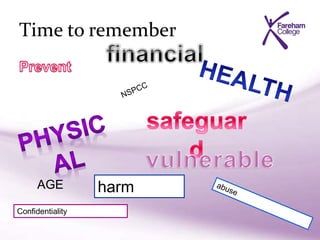
Time to remember
AGE
Confidentiality
harm
Learning Outcomes
• Identify three examples of support available
for people experiencing harm, abuse or
neglect
• Describe actions to take when there are
concerns about harm, abuse or neglect
• Explain the actions to take if an individual
alleges that they are being abused
Recap
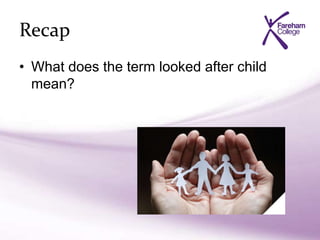
• What does the term looked after child
mean?
Looked after children
• This term is used for children and young people
who are the subject of a care order by the court.
• Care orders may be compulsory if a child or
young person needs safeguarding from harm.
• Children may also be taken into care voluntarily
(accommodated).
Board Blast
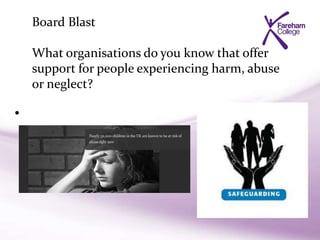
What organisations do you know that offer
support for people experiencing harm, abuse
or neglect?
•
Sources of Support
NSPCC (National Society for the
Prevention of cruelty to Children)
Victim support
ChildLine
Kidscape
Action on Elder Abuse
Age UK
The Samaritans
Womans Aid
Love Later Life
Have you met your
objectives?
Action to take if there are suspicions
that an individual is being abused
• Everybody working in a health and social
care environment has a Duty of care to
react appropriately when faced with
suspicions or allegations of abuse.
• Duty of care, in any setting, is the level of
service that is expected, as a minimum, to
be provided.
Procedures to follow if you
suspect a case of abuse.
Remember confidentiality
Small group activity- mind map or flow chart
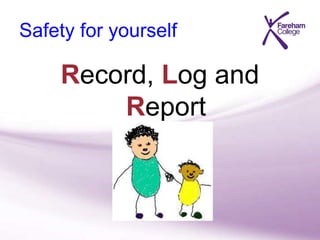
Safety for yourself
Record, Log and
Report
Have you met your
objectives?
CQC
• If your suspicions of abuse involve your
manager or another member of staff in
authority you may need to talk over your
concerns with CQC or safeguarding officer
at the local authority.
Unit HSC M3
Safeguarding and protection in
health and social care
Week 2
Time to Think…………………
Family Buses
Learning Outcomes
• Discuss evidence of poor practice in a
nursing home setting
• Describe the responsibilities of the health
and social care practitioner in relation to
whistleblowing
Small Group Activity
• Look at the statements you have been
given in relation to a child reporting abuse
and put them under the headings:-
• Actions to take
• Actions NOT to take
Undercover Report
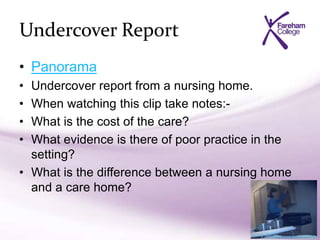
• Panorama
• Undercover report from a nursing home.
• When watching this clip take notes:-
• What is the cost of the care?
• What evidence is there of poor practice in the
setting?
• What is the difference between a nursing home
and a care home?
Unit HSC M3
Safeguarding and protection in
health and social care
Week 2
Time to Think…………
• Times Table Bingo
Learning Outcomes
• Discuss evidence of poor practice in a
nursing home setting
• Explain safety and quality assurance
requirements in relation to the
administration of medication
• Describe the responsibilities of the health
and social care practitioner in relation to
whistleblowing
Medication
• NO health or social care worker should
give out medication without training.
• Administration of medicines document.
Recap-The health and social
care workers role.
• Safeguarding is everyone’s responsibility
and you must never assume that
somebody else will recognise and report
what you have seen or heard.
• As a health and social care practitioner
you must always work within policies and
procedures.
Small Group Feedback
• Remember the UNCRC (The United Nations
Convention on the Rights of the Child,) say that
children have the right to be safe from any violence,
abuse or neglect.
• Case Study:-
• Amal is 5 years old and has cerebral palsy
and has restricted mobility. What
procedures do you need to follow if you
suspect Amal is being neglected.
Cerebralpalsy
The Public Interest Disclosure
Act 1998
• The Act protects workers who whistleblow
from victimisation by their manager or
employer.
Have you met your
objectives?
Unit HSC M3
Safeguarding and protection in
health and social care
Week 2
Time to think…………
• Words from the letters in :-
• maltreatment
Meaning- Maltreatment means to treat
someone or something badly. This can
include violent or cruel behaviour
towards them
Placement Q&A
• News from Placements
December 20th- not required in placement BUT must
let placement know.
Learning Outcomes
• Describe the responsibilities of the
health and social care practitioner in
relation to whistleblowing
• Describe how the health and social
care practitioner safeguards
individuals
• Produce a creative resource to
demonstrate the NSPCC underwear
rule
Recap-Board Blast
• D3- Outline four types of abuse.
Give a definition of each.
For example- physical abuse means
when a service user is kicked,
punched………
• Practitioners must report the poor practice
that they have witnessed to their supervisor
or named member of staff responsible for
safeguarding.
• It is good practice to write up your concerns
and give full details of the event or events.
• If you whistle blow you are legally protected
and will be fully supported by your supervisor
or manager.
• Share your concerns with the Care Quality
Commission (CQC)
Whistleblowing- what can you remember?
Individual Task
• Write a paragraph about the responsibilities of the
health and social care practitioner in relation to
whistleblowing.
If you referred to Whistleblowing in HSC M1- Please add also covered in
HSC M1- 2.2 at the bottom of your paragraph in your assignment.
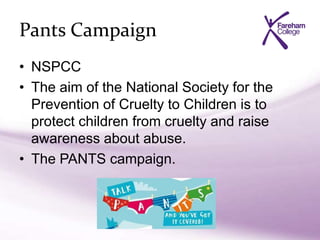
Pants Campaign
• NSPCC
• The aim of the National Society for the
Prevention of Cruelty to Children is to
protect children from cruelty and raise
awareness about abuse.
• The PANTS campaign.
NSPCC
Decorate your pants!!!!
Pants
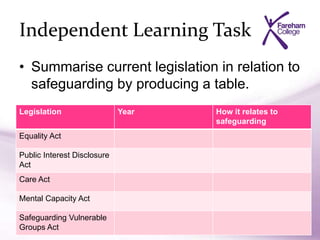
Independent Learning Task
• Summarise current legislation in relation to
safeguarding by producing a table.
Legislation Year How it relates to
safeguarding
Equality Act
Public Interest Disclosure
Act
Care Act
Mental Capacity Act
Safeguarding Vulnerable
Groups Act
Have you met your
objectives?
Evidence
• When abuse is suspected or alleged it is
vital that any potential evidence is
preserved.
• The evidence may also be required in a
court of law.
• Abuse is a crime, and evidence will be
required in order to help secure
convictions.
Matching Game
• In your groups match the type of evidence
to the description.
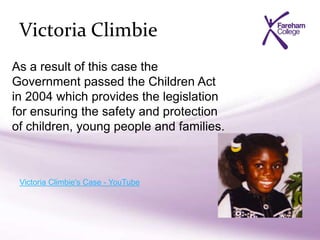
Victoria Climbie
Victoria Climbie's Case - YouTube
As a result of this case the
Government passed the Children Act
in 2004 which provides the legislation
for ensuring the safety and protection
of children, young people and families.
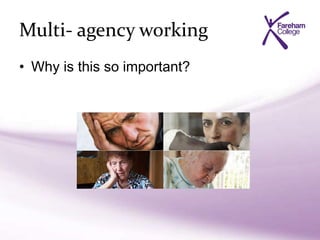
Multi- agency working
• Why is this so important?
Have you met your
objectives?
Unit HSC M3
Safeguarding and protection in
health and social care
1st December 2016
Time to Think……..
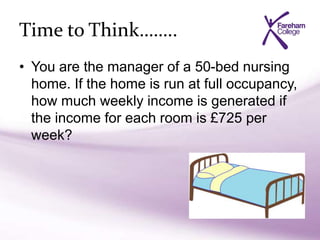
• You are the manager of a 50-bed nursing
home. If the home is run at full occupancy,
how much weekly income is generated if
the income for each room is £725 per
week?
Learning Outcomes
• Explain the importance of an
accessible complaints procedure for
reducing the likelihood of abuse.
• Describe unsafe practices that may
affect the well-being of individuals
• Identify ways to ensure that evidence
of abuse is preserved
Recap
• C2- Describe actions to take if harm or
abuse is suspected or disclosed.
Remember to include:-
• Working within policies and procedures
• Lines of reporting
• Preservation of evidence
• Confidentiality
• Listening, non-judgemental
Civil and Human Rights
• Abuse is a violation of civil and human
rights.
• An accessible complaints procedure is an
essential part of providing a framework to
safeguard and protect adults.
• Complaints procedures will be in the
employers policies and procedures.
Recap
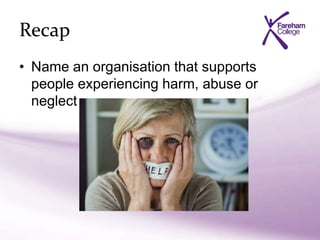
• Name an organisation that supports
people experiencing harm, abuse or
neglect
Actions to take if suspected
abuse has been reported but
nothing has been done.
• The Public Interest Disclosure Act 1998
protects workers who ‘ blow the whistle’
from victimisation by their manager or
employer.
• Failings at Winterbourne View Care Home
were initially not believed but people
persisted in complaining.
Winterbourne View Care Home
Care workers must always……
Role in
safeguarding
Have you met your
objectives?
Unsafe Practices
• Poor working practices
• Resource difficulties
• Operational difficulties
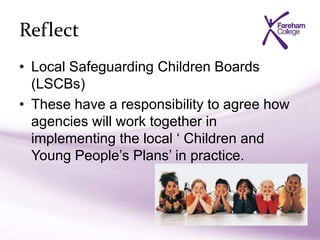
Reflect
• Local Safeguarding Children Boards
(LSCBs)
• These have a responsibility to agree how
agencies will work together in
implementing the local ‘ Children and
Young People’s Plans’ in practice.

Safeguarding week 2

  • 1.
    Unit HSC M3 Safeguardingand protection in health and social care Week 2
  • 2.
  • 3.
    Learning Outcomes • Identifythree examples of support available for people experiencing harm, abuse or neglect • Describe actions to take when there are concerns about harm, abuse or neglect • Explain the actions to take if an individual alleges that they are being abused
  • 4.
    Recap • What doesthe term looked after child mean?
  • 5.
    Looked after children •This term is used for children and young people who are the subject of a care order by the court. • Care orders may be compulsory if a child or young person needs safeguarding from harm. • Children may also be taken into care voluntarily (accommodated).
  • 6.
    Board Blast What organisationsdo you know that offer support for people experiencing harm, abuse or neglect? •
  • 7.
    Sources of Support NSPCC(National Society for the Prevention of cruelty to Children) Victim support ChildLine Kidscape Action on Elder Abuse Age UK The Samaritans Womans Aid Love Later Life
  • 8.
    Have you metyour objectives?
  • 9.
    Action to takeif there are suspicions that an individual is being abused • Everybody working in a health and social care environment has a Duty of care to react appropriately when faced with suspicions or allegations of abuse. • Duty of care, in any setting, is the level of service that is expected, as a minimum, to be provided.
  • 10.
    Procedures to followif you suspect a case of abuse. Remember confidentiality Small group activity- mind map or flow chart
  • 11.
  • 12.
    Have you metyour objectives?
  • 13.
    CQC • If yoursuspicions of abuse involve your manager or another member of staff in authority you may need to talk over your concerns with CQC or safeguarding officer at the local authority.
  • 14.
    Unit HSC M3 Safeguardingand protection in health and social care Week 2
  • 15.
  • 16.
    Learning Outcomes • Discussevidence of poor practice in a nursing home setting • Describe the responsibilities of the health and social care practitioner in relation to whistleblowing
  • 17.
    Small Group Activity •Look at the statements you have been given in relation to a child reporting abuse and put them under the headings:- • Actions to take • Actions NOT to take
  • 18.
    Undercover Report • Panorama •Undercover report from a nursing home. • When watching this clip take notes:- • What is the cost of the care? • What evidence is there of poor practice in the setting? • What is the difference between a nursing home and a care home?
  • 19.
    Unit HSC M3 Safeguardingand protection in health and social care Week 2
  • 20.
  • 21.
    Learning Outcomes • Discussevidence of poor practice in a nursing home setting • Explain safety and quality assurance requirements in relation to the administration of medication • Describe the responsibilities of the health and social care practitioner in relation to whistleblowing
  • 23.
    Medication • NO healthor social care worker should give out medication without training. • Administration of medicines document.
  • 24.
    Recap-The health andsocial care workers role. • Safeguarding is everyone’s responsibility and you must never assume that somebody else will recognise and report what you have seen or heard. • As a health and social care practitioner you must always work within policies and procedures.
  • 25.
    Small Group Feedback •Remember the UNCRC (The United Nations Convention on the Rights of the Child,) say that children have the right to be safe from any violence, abuse or neglect. • Case Study:- • Amal is 5 years old and has cerebral palsy and has restricted mobility. What procedures do you need to follow if you suspect Amal is being neglected. Cerebralpalsy
  • 26.
    The Public InterestDisclosure Act 1998 • The Act protects workers who whistleblow from victimisation by their manager or employer.
  • 27.
    Have you metyour objectives?
  • 28.
    Unit HSC M3 Safeguardingand protection in health and social care Week 2
  • 29.
    Time to think………… •Words from the letters in :- • maltreatment Meaning- Maltreatment means to treat someone or something badly. This can include violent or cruel behaviour towards them
  • 30.
    Placement Q&A • Newsfrom Placements December 20th- not required in placement BUT must let placement know.
  • 31.
    Learning Outcomes • Describethe responsibilities of the health and social care practitioner in relation to whistleblowing • Describe how the health and social care practitioner safeguards individuals • Produce a creative resource to demonstrate the NSPCC underwear rule
  • 32.
    Recap-Board Blast • D3-Outline four types of abuse. Give a definition of each. For example- physical abuse means when a service user is kicked, punched………
  • 33.
    • Practitioners mustreport the poor practice that they have witnessed to their supervisor or named member of staff responsible for safeguarding. • It is good practice to write up your concerns and give full details of the event or events. • If you whistle blow you are legally protected and will be fully supported by your supervisor or manager. • Share your concerns with the Care Quality Commission (CQC) Whistleblowing- what can you remember?
  • 34.
    Individual Task • Writea paragraph about the responsibilities of the health and social care practitioner in relation to whistleblowing. If you referred to Whistleblowing in HSC M1- Please add also covered in HSC M1- 2.2 at the bottom of your paragraph in your assignment.
  • 35.
    Pants Campaign • NSPCC •The aim of the National Society for the Prevention of Cruelty to Children is to protect children from cruelty and raise awareness about abuse. • The PANTS campaign.
  • 36.
  • 37.
    Independent Learning Task •Summarise current legislation in relation to safeguarding by producing a table. Legislation Year How it relates to safeguarding Equality Act Public Interest Disclosure Act Care Act Mental Capacity Act Safeguarding Vulnerable Groups Act
  • 38.
    Have you metyour objectives?
  • 39.
    Evidence • When abuseis suspected or alleged it is vital that any potential evidence is preserved. • The evidence may also be required in a court of law. • Abuse is a crime, and evidence will be required in order to help secure convictions.
  • 40.
    Matching Game • Inyour groups match the type of evidence to the description.
  • 41.
    Victoria Climbie Victoria Climbie'sCase - YouTube As a result of this case the Government passed the Children Act in 2004 which provides the legislation for ensuring the safety and protection of children, young people and families.
  • 42.
    Multi- agency working •Why is this so important?
  • 43.
    Have you metyour objectives?
  • 44.
    Unit HSC M3 Safeguardingand protection in health and social care 1st December 2016
  • 45.
    Time to Think…….. •You are the manager of a 50-bed nursing home. If the home is run at full occupancy, how much weekly income is generated if the income for each room is £725 per week?
  • 46.
    Learning Outcomes • Explainthe importance of an accessible complaints procedure for reducing the likelihood of abuse. • Describe unsafe practices that may affect the well-being of individuals • Identify ways to ensure that evidence of abuse is preserved

  • 47.
    Recap • C2- Describeactions to take if harm or abuse is suspected or disclosed. Remember to include:- • Working within policies and procedures • Lines of reporting • Preservation of evidence • Confidentiality • Listening, non-judgemental
  • 48.
    Civil and HumanRights • Abuse is a violation of civil and human rights. • An accessible complaints procedure is an essential part of providing a framework to safeguard and protect adults. • Complaints procedures will be in the employers policies and procedures.
  • 49.
    Recap • Name anorganisation that supports people experiencing harm, abuse or neglect
  • 50.
    Actions to takeif suspected abuse has been reported but nothing has been done. • The Public Interest Disclosure Act 1998 protects workers who ‘ blow the whistle’ from victimisation by their manager or employer. • Failings at Winterbourne View Care Home were initially not believed but people persisted in complaining. Winterbourne View Care Home

  • 51.
    Care workers mustalways…… Role in safeguarding
  • 52.
    Have you metyour objectives?
  • 53.
    Unsafe Practices • Poorworking practices • Resource difficulties • Operational difficulties
  • 54.
    Reflect • Local SafeguardingChildren Boards (LSCBs) • These have a responsibility to agree how agencies will work together in implementing the local ‘ Children and Young People’s Plans’ in practice.