Unit HSC M3
Safeguarding and protection in
health and social care
Week 1
Time to Think…………
• Times Table Bingo
Learning Outcomes
• Identify the meaning of safeguarding and
protection
• Describe the various aspects of
safeguarding in health and social care
• Assess why a safe environment is
important for service users
Introduction
• Safeguarding
• Central to providing a high quality service
in health and social care.
• Protection of health, well-being and human
rights
• Why do we need clear guidelines to
follow?
Who are we protecting?
• Protecting from harm and abuse
• Children
• Vulnerable person/adults-
This is anyone aged 18 and over who needs
Community Care Services because of
mental or other disability, age or illness.
They may be unable to take care of
themselves or unable to protect themselves
against significant harm or exploitation.
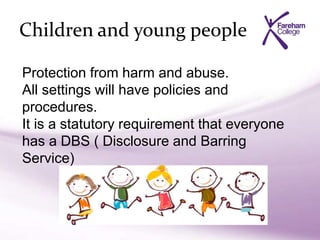
Children and young people
Protection from harm and abuse.
All settings will have policies and
procedures.
It is a statutory requirement that everyone
has a DBS ( Disclosure and Barring
Service)
Safeguarding bubbles
Small Group Task
Everyone who works or is on placement in
health and social care has a responsibility to
safeguard the users of the service.
Lets consider aspects of safeguarding
Have you met your
objectives?
Feedback from Task
Have you met your
objectives?
Reflect
Unit HSC M3
Safeguarding and protection in
health and social care
Week 1
Time to think…………
• Words from the letters in :-
• threatening
Learning Outcomes
• Summarise legislation in relation to
safeguarding and protection
• Describe legislation in relation to children
and young people.
• Explain legislation, policies and
procedures in relation to adults in health
and social care.
Recap-Board Blast
• What legislation can you remember from
HSC M1?
Paired Task
• You will be given a legislation to research
using Health and Social Care books and
you need to produce a poster with
information on in your OWN words relating
it to safeguarding and protection of adults
and children.
Presentations
Have you met your
objectives?
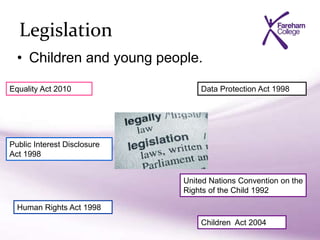
Legislation
• Children and young people.
Equality Act 2010
Children Act 2004
Human Rights Act 1998
Data Protection Act 1998
Public Interest Disclosure
Act 1998
United Nations Convention on the
Rights of the Child 1992
Know why children and young people
might need to be looked after
Looked after children
• This term is used for children and young people
who are the subject of a care order by the court.
• Care orders may be compulsory if a child or
young person needs safeguarding from harm.
• Children may also be taken into care voluntarily
(accommodated).
© Hodder Education 2011
Know why children and young people
might need to be looked after
Who might need to be looked after?
• Those whose parents have mental health problems or
who suffer from mental health issues themselves
• Children who are neglected
• Children who have learning disabilities or special needs
• Young people in trouble with the law
• Those with non-accidental injuries
• Those who are, or whose parents are, substance
abusers
• Children in households where there is domestic violence
• Disabled children needing short-break care.
© Hodder Education 2011
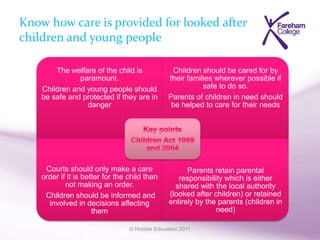
Know how care is provided for looked after
children and young people
The welfare of the child is
paramount.
Children and young people should
be safe and protected if they are in
danger
Children should be cared for by
their families wherever possible if
safe to do so.
Parents of children in need should
be helped to care for their needs
Courts should only make a care
order if it is better for the child than
not making an order.
Children should be informed and
involved in decisions affecting
them
Parents retain parental
responsibility which is either
shared with the local authority
(looked after children) or retained
entirely by the parents (children in
need)
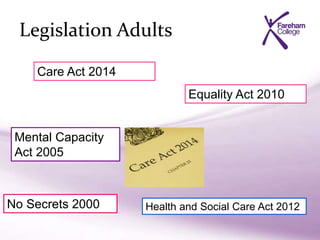
Legislation Adults
Care Act 2014
Health and Social Care Act 2012
Mental Capacity
Act 2005
Equality Act 2010
No Secrets 2000
Reflect
• Write a question about your learning today
that you could ask a class member.
Unit HSC M3
Safeguarding and protection in
health and social care
Week 1
Time to think…………..
• http://www.transum.org/software/SW/Start
er_of_the_day/starter_November2.asp
Learning Outcomes
• Explain the codes of practice for social
care workers in relation to safeguarding
and protection.
Code Of Practice
• Watch the following clip and make notes.
• Code of Practice
• Why is a code of practice important for a
service user?
• What information does it give you about
your practice?
• How does it help the workforce?
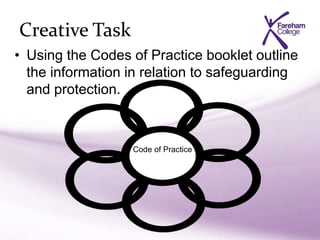
Creative Task
• Using the Codes of Practice booklet outline
the information in relation to safeguarding
and protection.
Code of Practice
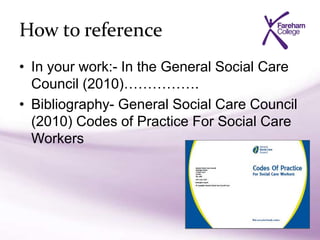
How to reference
• In your work:- In the General Social Care
Council (2010)…………….
• Bibliography- General Social Care Council
(2010) Codes of Practice For Social Care
Workers
Have you met your
objectives?
Unit HSC M3
Safeguarding and protection in
health and social care
Week 1
Time to think………..
• Word square- All that you have to do is make
dictionary words of any length from the letters in
the grid – the bigger the better!
• The only restriction is that the word must contain
the central letter.
O S V
E F E
I N F
Placement Q&A
• News from Placements
December 20th- not required in placement BUT must
let placement know.
Learning Outcomes
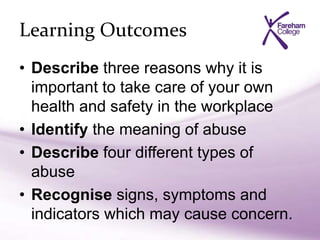
• Describe three reasons why it is
important to take care of your own
health and safety in the workplace
• Identify the meaning of abuse
• Describe four different types of
abuse
• Recognise signs, symptoms and
indicators which may cause concern.
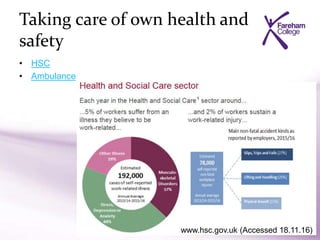
Taking care of own health and
safety
• HSC
• Ambulance
www.hsc.gov.uk (Accessed 18.11.16)
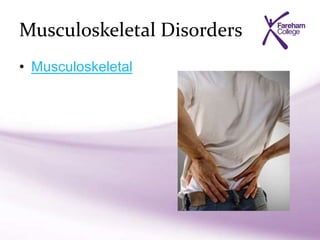
Musculoskeletal Disorders
• Musculoskeletal
Paragraph writing
• Using the information gathered answer the
following question:-
• Explain why it is important to take care of
your own health while working in health
and social care.
Have you met your
objectives?
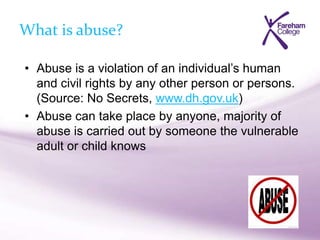
What is abuse?
• Abuse is a violation of an individual’s human
and civil rights by any other person or persons.
(Source: No Secrets, www.dh.gov.uk)
• Abuse can take place by anyone, majority of
abuse is carried out by someone the vulnerable
adult or child knows
SMALL GROUP ACTIVITY
• You will be given a type of abuse ,as a group
think what this means and produce a graffiti
board with words and/or pictures that explain the
term and give examples of the indicators.
• Physical
• Neglect
• Sexual
• Emotional
• Financial
• Bullying
What are the types of abuse?
Have you met your
objectives?
Unit HSC M3
Safeguarding and protection in
health and social care
Week 1
Time to Think……………
Learning Outcomes
• Identify the meaning of abuse
• Describe four different types of
abuse
• Recognise signs, symptoms and
indicators which may cause concern.
Recap
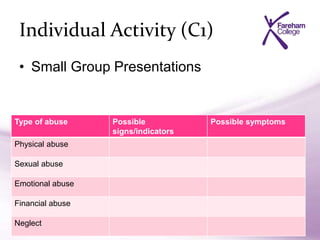
Individual Activity (C1)
• Small Group Presentations
Type of abuse Possible
signs/indicators
Possible symptoms
Physical abuse
Sexual abuse
Emotional abuse
Financial abuse
Neglect
© Hodder Education 2011
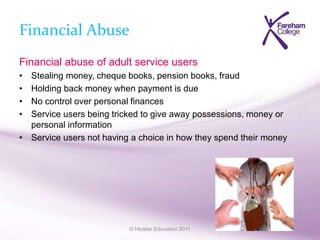
Financial Abuse
Financial abuse of adult service users
• Stealing money, cheque books, pension books, fraud
• Holding back money when payment is due
• No control over personal finances
• Service users being tricked to give away possessions, money or
personal information
• Service users not having a choice in how they spend their money
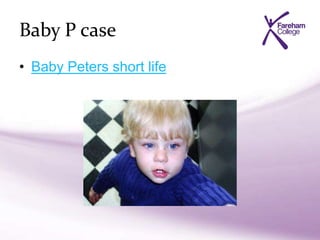
Baby P case
• Baby Peters short life
Have you met your
objectives?
Reflect
• Case Study question
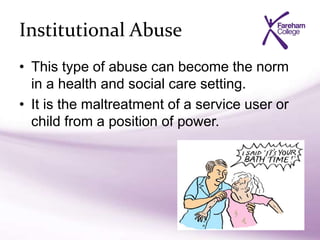
Institutional Abuse
• This type of abuse can become the norm
in a health and social care setting.
• It is the maltreatment of a service user or
child from a position of power.
© Hodder Education 2011
Institutional abuse of service users
• All service users put to bed at same time
• All service users given meals with no choice of menu
• Personal hygiene done as routine and with no element of
personal choice on the part of the service user
• Strict routines imposed to benefit staff
• Independence, choice and dignity of service users
removed
• Service users controlled by the organisation
Review

Safeguarding week 1

  • 1.
    Unit HSC M3 Safeguardingand protection in health and social care Week 1
  • 2.
  • 3.
    Learning Outcomes • Identifythe meaning of safeguarding and protection • Describe the various aspects of safeguarding in health and social care • Assess why a safe environment is important for service users
  • 4.
    Introduction • Safeguarding • Centralto providing a high quality service in health and social care. • Protection of health, well-being and human rights • Why do we need clear guidelines to follow?
  • 5.
    Who are weprotecting? • Protecting from harm and abuse • Children • Vulnerable person/adults- This is anyone aged 18 and over who needs Community Care Services because of mental or other disability, age or illness. They may be unable to take care of themselves or unable to protect themselves against significant harm or exploitation.
  • 6.
    Children and youngpeople Protection from harm and abuse. All settings will have policies and procedures. It is a statutory requirement that everyone has a DBS ( Disclosure and Barring Service)
  • 7.
    Safeguarding bubbles Small GroupTask Everyone who works or is on placement in health and social care has a responsibility to safeguard the users of the service. Lets consider aspects of safeguarding
  • 8.
    Have you metyour objectives?
  • 9.
  • 10.
    Have you metyour objectives?
  • 11.
  • 12.
    Unit HSC M3 Safeguardingand protection in health and social care Week 1
  • 13.
    Time to think………… •Words from the letters in :- • threatening
  • 14.
    Learning Outcomes • Summariselegislation in relation to safeguarding and protection • Describe legislation in relation to children and young people. • Explain legislation, policies and procedures in relation to adults in health and social care.
  • 15.
    Recap-Board Blast • Whatlegislation can you remember from HSC M1?
  • 16.
    Paired Task • Youwill be given a legislation to research using Health and Social Care books and you need to produce a poster with information on in your OWN words relating it to safeguarding and protection of adults and children.
  • 17.
  • 18.
    Have you metyour objectives?
  • 19.
    Legislation • Children andyoung people. Equality Act 2010 Children Act 2004 Human Rights Act 1998 Data Protection Act 1998 Public Interest Disclosure Act 1998 United Nations Convention on the Rights of the Child 1992
  • 20.
    Know why childrenand young people might need to be looked after Looked after children • This term is used for children and young people who are the subject of a care order by the court. • Care orders may be compulsory if a child or young person needs safeguarding from harm. • Children may also be taken into care voluntarily (accommodated).
  • 21.
    © Hodder Education2011 Know why children and young people might need to be looked after Who might need to be looked after? • Those whose parents have mental health problems or who suffer from mental health issues themselves • Children who are neglected • Children who have learning disabilities or special needs • Young people in trouble with the law • Those with non-accidental injuries • Those who are, or whose parents are, substance abusers • Children in households where there is domestic violence • Disabled children needing short-break care.
  • 22.
    © Hodder Education2011 Know how care is provided for looked after children and young people The welfare of the child is paramount. Children and young people should be safe and protected if they are in danger Children should be cared for by their families wherever possible if safe to do so. Parents of children in need should be helped to care for their needs Courts should only make a care order if it is better for the child than not making an order. Children should be informed and involved in decisions affecting them Parents retain parental responsibility which is either shared with the local authority (looked after children) or retained entirely by the parents (children in need)
  • 23.
    Legislation Adults Care Act2014 Health and Social Care Act 2012 Mental Capacity Act 2005 Equality Act 2010 No Secrets 2000
  • 24.
    Reflect • Write aquestion about your learning today that you could ask a class member.
  • 25.
    Unit HSC M3 Safeguardingand protection in health and social care Week 1
  • 26.
    Time to think………….. •http://www.transum.org/software/SW/Start er_of_the_day/starter_November2.asp
  • 27.
    Learning Outcomes • Explainthe codes of practice for social care workers in relation to safeguarding and protection.
  • 28.
    Code Of Practice •Watch the following clip and make notes. • Code of Practice • Why is a code of practice important for a service user? • What information does it give you about your practice? • How does it help the workforce?
  • 29.
    Creative Task • Usingthe Codes of Practice booklet outline the information in relation to safeguarding and protection. Code of Practice
  • 30.
    How to reference •In your work:- In the General Social Care Council (2010)……………. • Bibliography- General Social Care Council (2010) Codes of Practice For Social Care Workers
  • 31.
    Have you metyour objectives?
  • 32.
    Unit HSC M3 Safeguardingand protection in health and social care Week 1
  • 33.
    Time to think……….. •Word square- All that you have to do is make dictionary words of any length from the letters in the grid – the bigger the better! • The only restriction is that the word must contain the central letter. O S V E F E I N F
  • 34.
    Placement Q&A • Newsfrom Placements December 20th- not required in placement BUT must let placement know.
  • 35.
    Learning Outcomes • Describethree reasons why it is important to take care of your own health and safety in the workplace • Identify the meaning of abuse • Describe four different types of abuse • Recognise signs, symptoms and indicators which may cause concern.
  • 36.
    Taking care ofown health and safety • HSC • Ambulance www.hsc.gov.uk (Accessed 18.11.16)
  • 37.
  • 38.
    Paragraph writing • Usingthe information gathered answer the following question:- • Explain why it is important to take care of your own health while working in health and social care.
  • 39.
    Have you metyour objectives?
  • 40.
    What is abuse? •Abuse is a violation of an individual’s human and civil rights by any other person or persons. (Source: No Secrets, www.dh.gov.uk) • Abuse can take place by anyone, majority of abuse is carried out by someone the vulnerable adult or child knows
  • 41.
    SMALL GROUP ACTIVITY •You will be given a type of abuse ,as a group think what this means and produce a graffiti board with words and/or pictures that explain the term and give examples of the indicators.
  • 43.

    • Physical • Neglect •Sexual • Emotional • Financial • Bullying What are the types of abuse?
  • 44.
    Have you metyour objectives?
  • 45.
    Unit HSC M3 Safeguardingand protection in health and social care Week 1
  • 46.
  • 47.
    Learning Outcomes • Identifythe meaning of abuse • Describe four different types of abuse • Recognise signs, symptoms and indicators which may cause concern.
  • 48.
  • 49.
    Individual Activity (C1) •Small Group Presentations Type of abuse Possible signs/indicators Possible symptoms Physical abuse Sexual abuse Emotional abuse Financial abuse Neglect
  • 50.
    © Hodder Education2011 Financial Abuse Financial abuse of adult service users • Stealing money, cheque books, pension books, fraud • Holding back money when payment is due • No control over personal finances • Service users being tricked to give away possessions, money or personal information • Service users not having a choice in how they spend their money
  • 51.
    Baby P case •Baby Peters short life
  • 52.
    Have you metyour objectives?
  • 53.
  • 54.
    Institutional Abuse • Thistype of abuse can become the norm in a health and social care setting. • It is the maltreatment of a service user or child from a position of power.
  • 55.
    © Hodder Education2011 Institutional abuse of service users • All service users put to bed at same time • All service users given meals with no choice of menu • Personal hygiene done as routine and with no element of personal choice on the part of the service user • Strict routines imposed to benefit staff • Independence, choice and dignity of service users removed • Service users controlled by the organisation
  • 56.