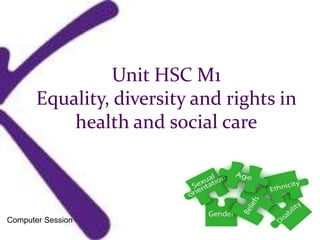
Unit HSC M1
Equality, diversity and rights in
health and social care
Day 1
Department Expectations
Housekeeping (toilets, fire drill, register)
Bags under desks neatly
Water only on your tables
Paper and pen at the ready
Phones away and on silent mode
Respect everyone at all times
Uniform and lanyard
Time to Think………….
• Words from the letters in
• inspirational
Timer
Nick
Learning Outcomes
• Describe the terms equality, diversity and
inclusion and why they are important in
health and social care.
• Identify a physical and sensory disability
• Explain how to work in an inclusive way
Small Group Task
What is the definition of :
1. Equality
2. Diversity
3. Inclusion
Give examples to support your
definition
Equality / Inequality
• Equality is about treating people fairly, regardless of
their differences, by ensuring they have access to the
same opportunities as others. It also means being able
and supported to reach your potential.
• Inequality is when people aren’t given equal
opportunities and rights. They are treated unfairly and
experience discrimination.
Unit HSC M1
Equality, diversity and rights in
health and social care
Tuesday am
Time to Think…………..
Learning Outcomes
• Describe the terms equality, diversity and
inclusion and why they are important in
health and social care.
• Identify a physical and sensory disability
• Explain how to work in an inclusive way
Inclusion
Inclusion
Inclusion is about accepting people regardless
of their differences
Diversity
• Diversity is about variety. Respecting
differences and valuing everyone.
• Care settings reflect the diversity of the
population.
• Working with and getting to know a diverse
range of people enables health and social
care workers to develop their knowledge
and understanding of different ways of
thinking, living and the reasons for different
behaviours.
Small Group Task
• People differ in respect of their:-
• Diet
• Religious faith
• Need for modesty and dignity
• Communication
• How?
Group Feedback
Have you met your
objectives?
Reflect-Disability
• Discussion- Valuing and including disabled
SERVICE USERS in all activities, services
and places should be embedded
throughout our society.
Kahoot
Unit HSC M1
Equality, diversity and rights in
health and social care
Computer Session
Time to Think……
• What does the term equality mean?
Learning Outcomes
• Describe in detail one legislation relating
to equality, diversity and inclusion.
• Summarise how national initiatives
promote anti-discriminatory practice
• Discuss the importance of the legislation
that underpins inclusion for organisations
and services
ICT Paired Task
• You will be given a legislation to research
and you need to produce a PowerPoint
with information on.
• A reference must be included on your
PowerPoint.
• PowerPoint to be emailed to
Stephanie.couper@fareham.ac.uk
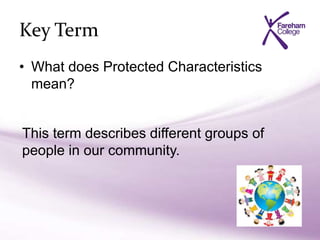
Key Term
• What does Protected Characteristics
mean?
This term describes different groups of
people in our community.
Have you met your
objectives?
Unit HSC M1
Equality, diversity and rights in
health and social care
Day 2
Time to think………..
• Word square- All that you have to do is
make dictionary words of any length from
the letters in the grid – the bigger the
better! The only restriction is that the word
must contain the central letter.
Learning Outcomes
• Describe how learning about cultures and
religions develops an inclusive society
• Outline and describe behaviours that may
contribute to inclusive practice.
Feedback- Home Learning
Task
• People differ in respect of their:-
Diet
Religious faith
Need for modesty and dignity
Communication
Feedback from Induction Learning Task
Different cultures
Knowledge of individuals
beliefs and cultures is
important in developing an
inclusive practice.
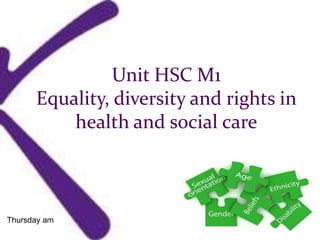
Unit HSC M1
Equality, diversity and rights in
health and social care
Thursday am
Time to think………..
• A calorie is a unit of measurement.
• How many calories in a banana?
• How many calories in Big Mac?
Learning Outcomes
• Outline and describe behaviours that may
contribute to inclusive practice.
• Explain two barriers to equality and
inclusion
• It's the difference
What could be a barrier to
EQUALITY and INCLUSION
Board Blast
What could be a barrier to
EQUALITY and INCLUSION
• Discrimination
• Poor quality of care from service providers
• Being provided with the wrong services or
medication.
• Not being given choice
• Feeling isolated because family lives abroad
• Incorrect signposting to services
• Lack of resources, interpreters, specialist
equipment.
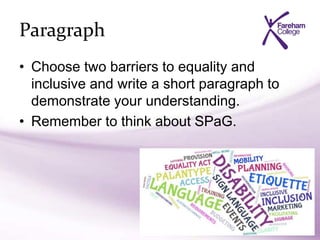
Paragraph
• Choose two barriers to equality and
inclusive and write a short paragraph to
demonstrate your understanding.
• Remember to think about SPaG.
Have you met your
objectives?
Inclusive Practice
How do health and social care practitioners contribute
to inclusive practice?
Moral Code- A set of rules/guidelines that an
organisation outlines to ensure standards of behaviour
employees exhibit is correct
Ethical code- To ensure behaviour is professional
and fair
Code of conduct- Made to outline behaviour and
attitudes at work. Code of Conduct for Healthcare
Support Workers and Adult Social care Workers in
England .
Reflect
• Skills for Health
Unit HSC M1
Equality, diversity and rights in
health and social care
Day 4
Starter
• Put together the jigsaw.
Learning Outcomes
• Demonstrate PowerPoint presentations
relating to legislation
• Outline the barriers to inclusion including
subjects around the protected
characteristics
• Describe how as a practitioner you
contribute to inclusive practice in a Health
and Social Care setting
Board Blast
• Can you name any legislation, policies,
codes of practice relating to equality ,
diversity and inclusion.
Small Group Activity
• Name the protected characteristics under
The Equality Act 2010.
Equality Act 2010
• Nine Protected Characteristics
Equality Act 2010
• Makes it law that public bodies, like
schools, must encourage good relations
and ensure everyone has equality of
opportunity!
• This helps to make sure everyone has an
equal chance to make the most of their
lives and talents!
Individual needs
Complete the sentences –
• To meet my individual needs you need
to…………………
• Respecting my wishes shows
that……………
• Treating me the same as everyone else is
demonstrating to me that………….
How do we make an
inclusive environment?
• Attitudes in the environment
• Equipment we use
• Resources we provide
• How we access the environment
• Removing barriers
Active Learning
• Use your inclusive umbrella to describe
how as a practitioner you contribute to
inclusive practice with examples.
Have you met your
objectives?
DIS Task
• How can YOU support people with a
hearing impairment and what charities
offer support to people who are deaf.
• Learn how to sign your own name using
British Sign Language

Unit hsc m1 equality

  • 1.
    Unit HSC M1 Equality,diversity and rights in health and social care Day 1
  • 2.
    Department Expectations Housekeeping (toilets,fire drill, register) Bags under desks neatly Water only on your tables Paper and pen at the ready Phones away and on silent mode Respect everyone at all times Uniform and lanyard
  • 3.
    Time to Think…………. •Words from the letters in • inspirational Timer Nick
  • 4.
    Learning Outcomes • Describethe terms equality, diversity and inclusion and why they are important in health and social care. • Identify a physical and sensory disability • Explain how to work in an inclusive way
  • 5.
    Small Group Task Whatis the definition of : 1. Equality 2. Diversity 3. Inclusion Give examples to support your definition
  • 6.
    Equality / Inequality •Equality is about treating people fairly, regardless of their differences, by ensuring they have access to the same opportunities as others. It also means being able and supported to reach your potential. • Inequality is when people aren’t given equal opportunities and rights. They are treated unfairly and experience discrimination.
  • 7.
    Unit HSC M1 Equality,diversity and rights in health and social care Tuesday am
  • 8.
  • 10.
    Learning Outcomes • Describethe terms equality, diversity and inclusion and why they are important in health and social care. • Identify a physical and sensory disability • Explain how to work in an inclusive way
  • 11.
    Inclusion Inclusion Inclusion is aboutaccepting people regardless of their differences
  • 12.
    Diversity • Diversity isabout variety. Respecting differences and valuing everyone. • Care settings reflect the diversity of the population. • Working with and getting to know a diverse range of people enables health and social care workers to develop their knowledge and understanding of different ways of thinking, living and the reasons for different behaviours.
  • 13.
    Small Group Task •People differ in respect of their:- • Diet • Religious faith • Need for modesty and dignity • Communication • How?
  • 14.
  • 15.
    Have you metyour objectives?
  • 16.
    Reflect-Disability • Discussion- Valuingand including disabled SERVICE USERS in all activities, services and places should be embedded throughout our society.
  • 17.
  • 18.
    Unit HSC M1 Equality,diversity and rights in health and social care Computer Session
  • 19.
    Time to Think…… •What does the term equality mean?
  • 20.
    Learning Outcomes • Describein detail one legislation relating to equality, diversity and inclusion. • Summarise how national initiatives promote anti-discriminatory practice • Discuss the importance of the legislation that underpins inclusion for organisations and services
  • 21.
    ICT Paired Task •You will be given a legislation to research and you need to produce a PowerPoint with information on. • A reference must be included on your PowerPoint. • PowerPoint to be emailed to Stephanie.couper@fareham.ac.uk
  • 22.
    Key Term • Whatdoes Protected Characteristics mean? This term describes different groups of people in our community.
  • 23.
    Have you metyour objectives?
  • 24.
    Unit HSC M1 Equality,diversity and rights in health and social care Day 2
  • 25.
    Time to think……….. •Word square- All that you have to do is make dictionary words of any length from the letters in the grid – the bigger the better! The only restriction is that the word must contain the central letter.
  • 26.
    Learning Outcomes • Describehow learning about cultures and religions develops an inclusive society • Outline and describe behaviours that may contribute to inclusive practice.
  • 27.
    Feedback- Home Learning Task •People differ in respect of their:- Diet Religious faith Need for modesty and dignity Communication Feedback from Induction Learning Task
  • 28.
    Different cultures Knowledge ofindividuals beliefs and cultures is important in developing an inclusive practice.
  • 29.
    Unit HSC M1 Equality,diversity and rights in health and social care Thursday am
  • 30.
    Time to think……….. •A calorie is a unit of measurement. • How many calories in a banana? • How many calories in Big Mac?
  • 31.
    Learning Outcomes • Outlineand describe behaviours that may contribute to inclusive practice. • Explain two barriers to equality and inclusion
  • 32.
    • It's thedifference
  • 33.
    What could bea barrier to EQUALITY and INCLUSION Board Blast
  • 34.
    What could bea barrier to EQUALITY and INCLUSION • Discrimination • Poor quality of care from service providers • Being provided with the wrong services or medication. • Not being given choice • Feeling isolated because family lives abroad • Incorrect signposting to services • Lack of resources, interpreters, specialist equipment.
  • 35.
    Paragraph • Choose twobarriers to equality and inclusive and write a short paragraph to demonstrate your understanding. • Remember to think about SPaG.
  • 36.
    Have you metyour objectives?
  • 37.
    Inclusive Practice How dohealth and social care practitioners contribute to inclusive practice? Moral Code- A set of rules/guidelines that an organisation outlines to ensure standards of behaviour employees exhibit is correct Ethical code- To ensure behaviour is professional and fair Code of conduct- Made to outline behaviour and attitudes at work. Code of Conduct for Healthcare Support Workers and Adult Social care Workers in England .
  • 38.
  • 39.
    Unit HSC M1 Equality,diversity and rights in health and social care Day 4
  • 40.
  • 41.
    Learning Outcomes • DemonstratePowerPoint presentations relating to legislation • Outline the barriers to inclusion including subjects around the protected characteristics • Describe how as a practitioner you contribute to inclusive practice in a Health and Social Care setting
  • 42.
    Board Blast • Canyou name any legislation, policies, codes of practice relating to equality , diversity and inclusion.
  • 44.
    Small Group Activity •Name the protected characteristics under The Equality Act 2010.
  • 45.
    Equality Act 2010 •Nine Protected Characteristics
  • 46.
    Equality Act 2010 •Makes it law that public bodies, like schools, must encourage good relations and ensure everyone has equality of opportunity! • This helps to make sure everyone has an equal chance to make the most of their lives and talents!
  • 47.
    Individual needs Complete thesentences – • To meet my individual needs you need to………………… • Respecting my wishes shows that…………… • Treating me the same as everyone else is demonstrating to me that………….
  • 48.
    How do wemake an inclusive environment? • Attitudes in the environment • Equipment we use • Resources we provide • How we access the environment • Removing barriers
  • 49.
    Active Learning • Useyour inclusive umbrella to describe how as a practitioner you contribute to inclusive practice with examples.
  • 50.
    Have you metyour objectives?
  • 51.
    DIS Task • Howcan YOU support people with a hearing impairment and what charities offer support to people who are deaf. • Learn how to sign your own name using British Sign Language