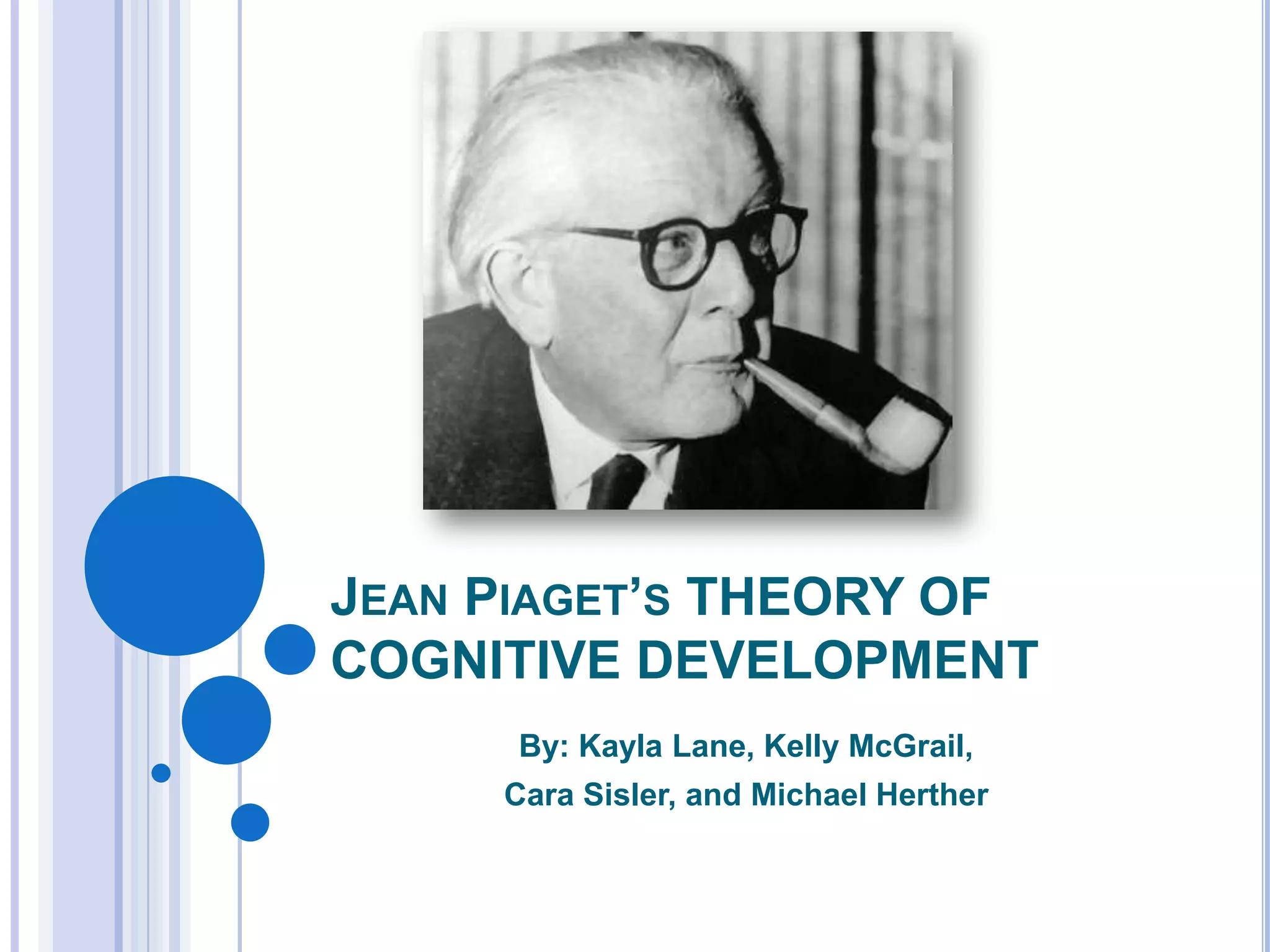
JEAN PIAGET’S THEORY OF
COGNITIVE DEVELOPMENT
      By: Kayla Lane, Kelly McGrail,
     Cara Sisler, and Michael Herther
PIAGET’S BEGINNINGS


      CHILD
     PRODIGY
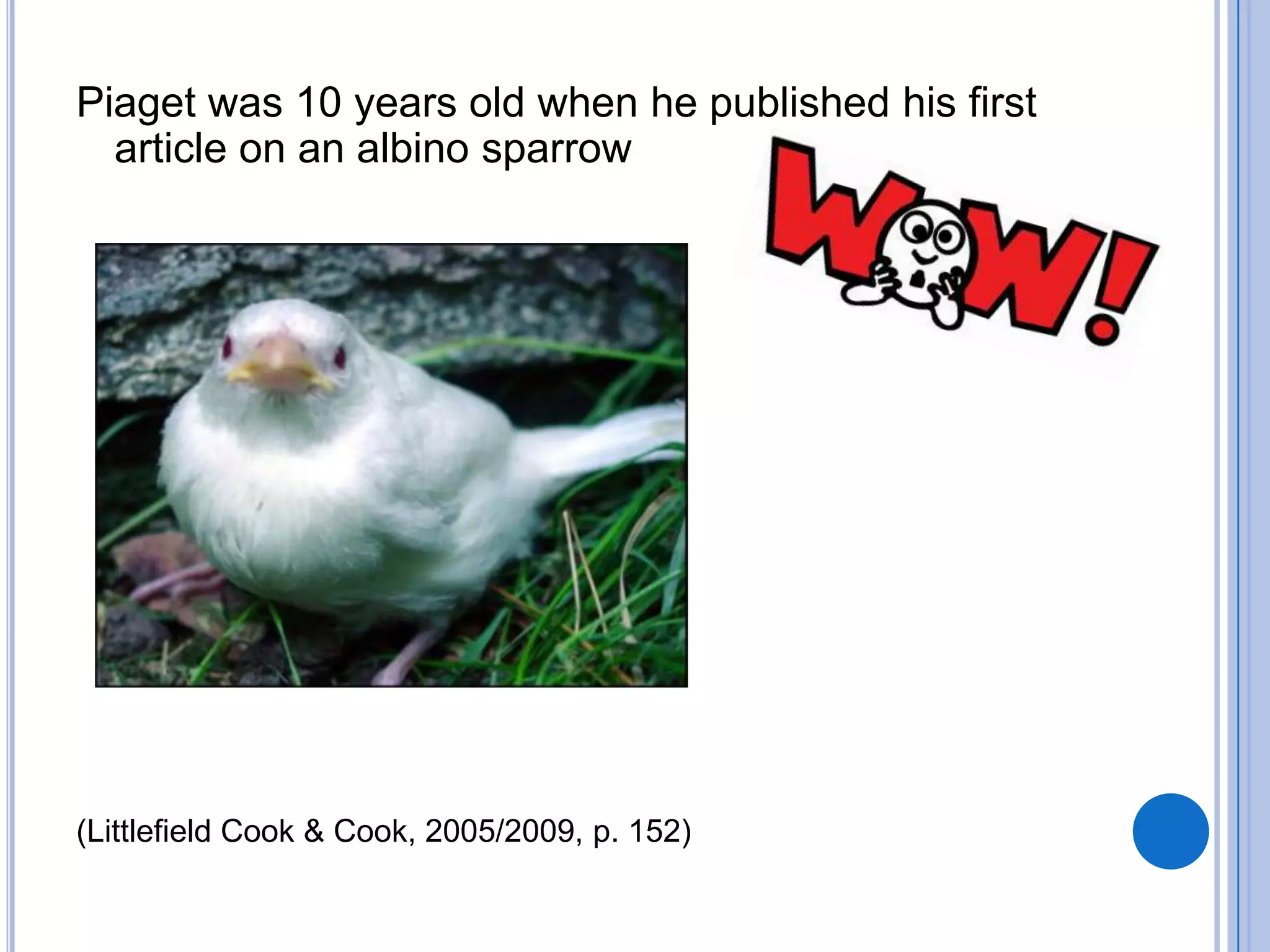
Piaget was 10 years old when he published his first
  article on an albino sparrow


(Littlefield Cook & Cook, 2005/2009, p. 152)
BINET LABORATORY
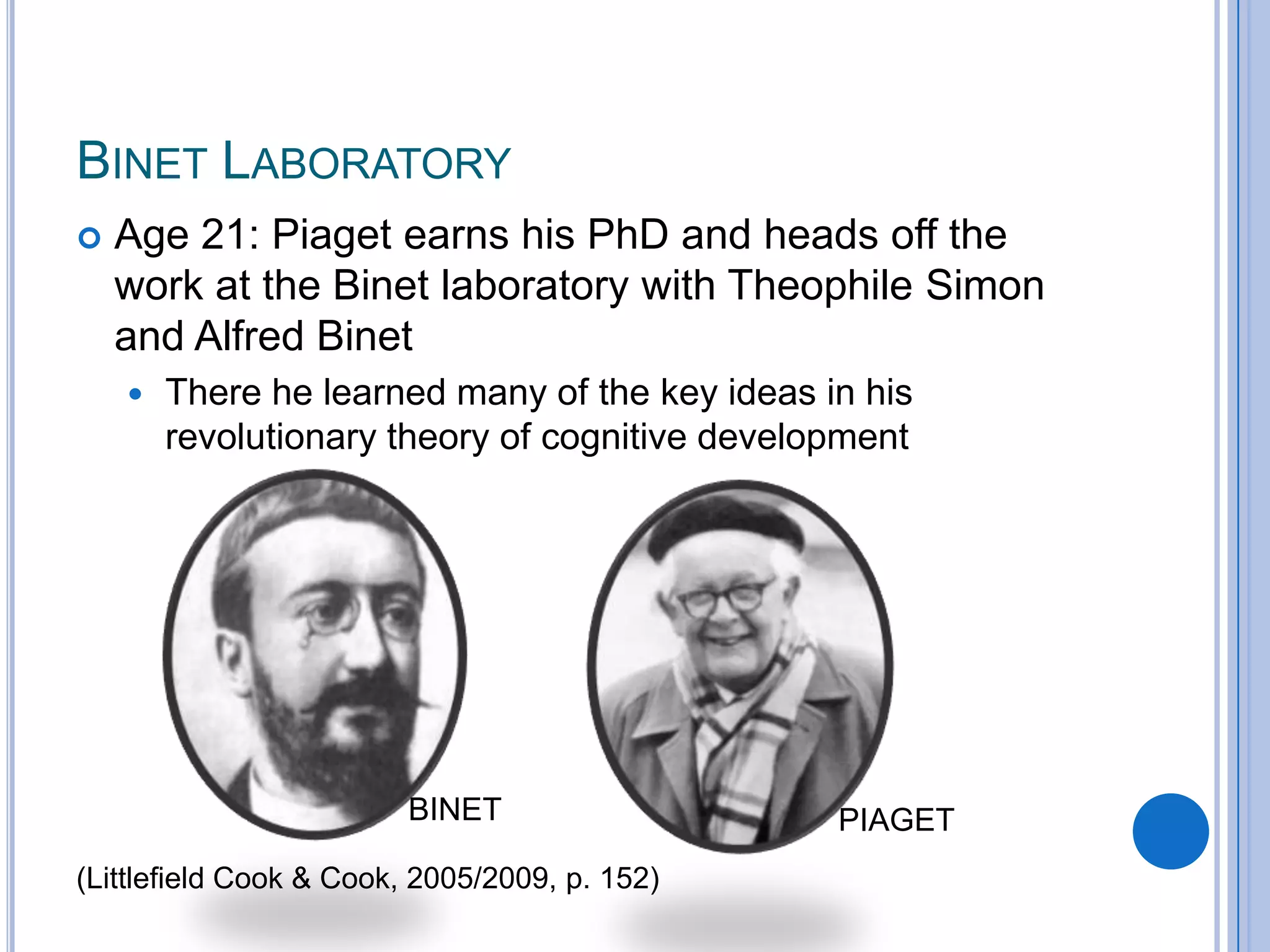
   Age 21: Piaget earns his PhD and heads off the
    work at the Binet laboratory with Theophile Simon
    and Alfred Binet
       There he learned many of the key ideas in his
        revolutionary theory of cognitive development


                         BINET                  PIAGET
(Littlefield Cook & Cook, 2005/2009, p. 152)
THEORY OF
COGNITIVE
DEVELOPMENT


4 Stages
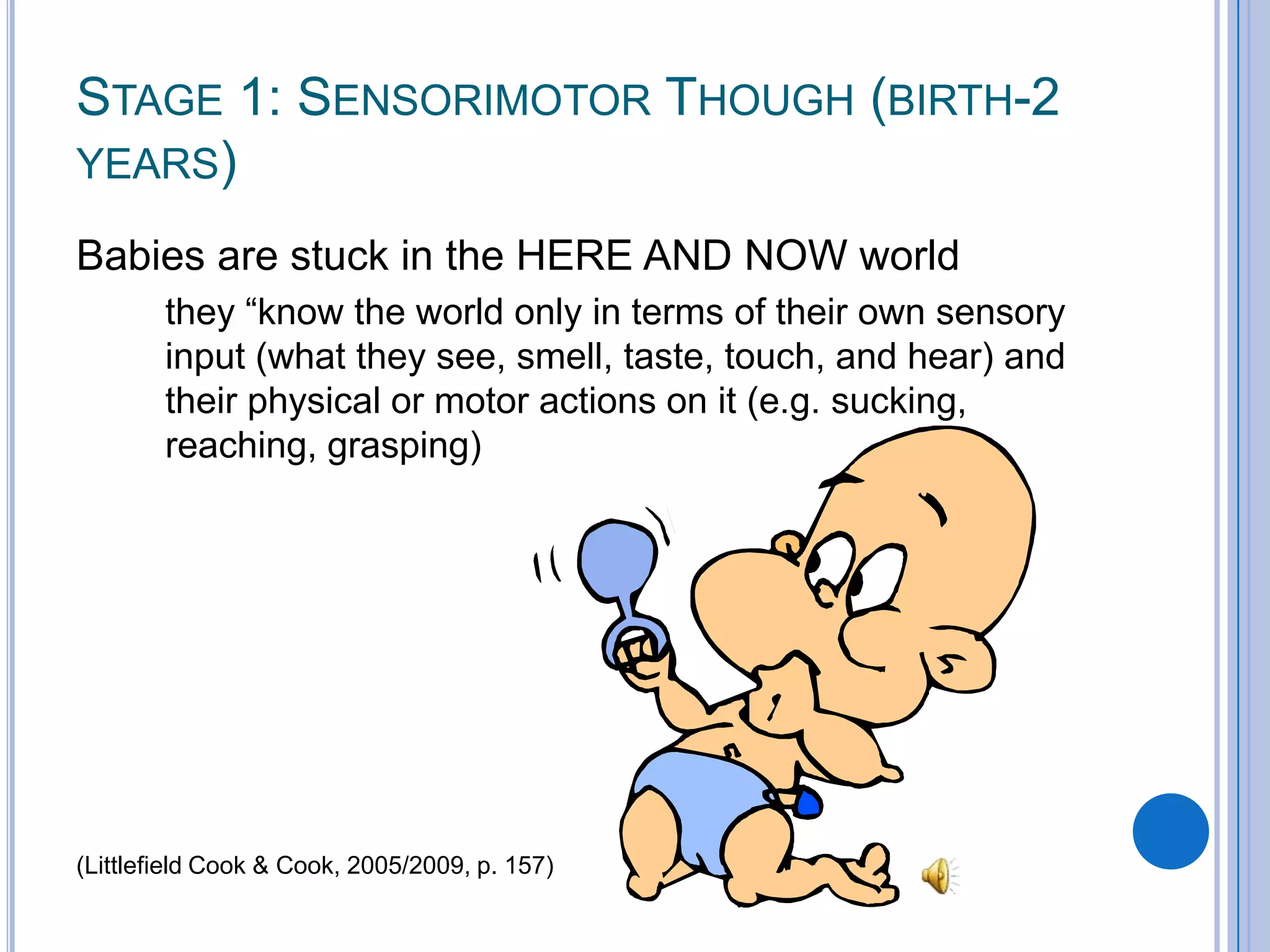
STAGE 1: SENSORIMOTOR THOUGH (BIRTH-2
YEARS)

Babies are stuck in the HERE AND NOW world
        they “know the world only in terms of their own sensory
        input (what they see, smell, taste, touch, and hear) and
        their physical or motor actions on it (e.g. sucking,
        reaching, grasping)


(Littlefield Cook & Cook, 2005/2009, p. 157)
Babies lack REPRESENTATIONAL THOUGHT or
 ability to think through the use of symbols


        CAN YOU THINK
           WITHOUT
          WORDS??

(Littlefield Cook & Cook, 2005/2009, p. 158)
NO! of course not!
      That’s why Piaget says babies cannot think!

   Evidence of representational thought emerges from
    the use of language and
         ObJeCt PeRmAnEnCe
              “the fact that objects, events, or even people
               continue to exist when they are not in the infants
               direct line of sensory or motor action” (Littlefield Cook
               & Cook, 2005/2009, p. 159)


The understanding of object permanence marks the
  change into…
PREOPERATIONAL
THOUGHT


Stage 2 (2-7 years)
PREOPERATIONAL THOUGHT IS
CHARACTERIZED BY:


 Intuitive Though – logic bases only on experiences
 Symbols in

 Egocentrism

 lack of conservation
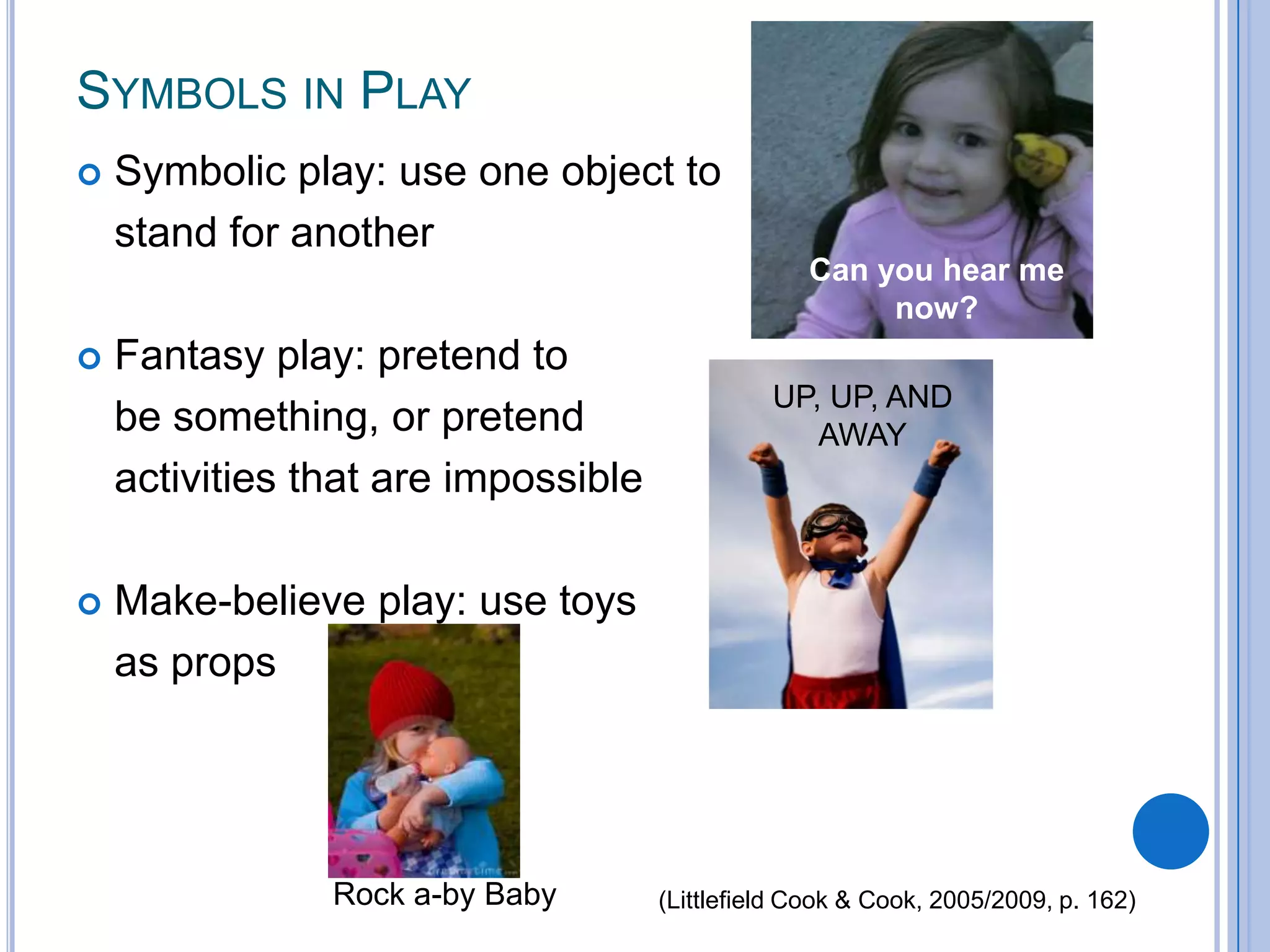
SYMBOLS IN PLAY
   Symbolic play: use one object to
    stand for another
                                                  Can you hear me
                                                       now?
   Fantasy play: pretend to
                                               UP, UP, AND
    be something, or pretend                      AWAY
    activities that are impossible

   Make-believe play: use toys
    as props


                Rock a-by Baby       (Littlefield Cook & Cook, 2005/2009, p. 162)
EGOCENTRICSM:
  “child’s inability to take in                others
              perspective”

(Littlefield Cook & Cook, 2005/2009, p. 163)
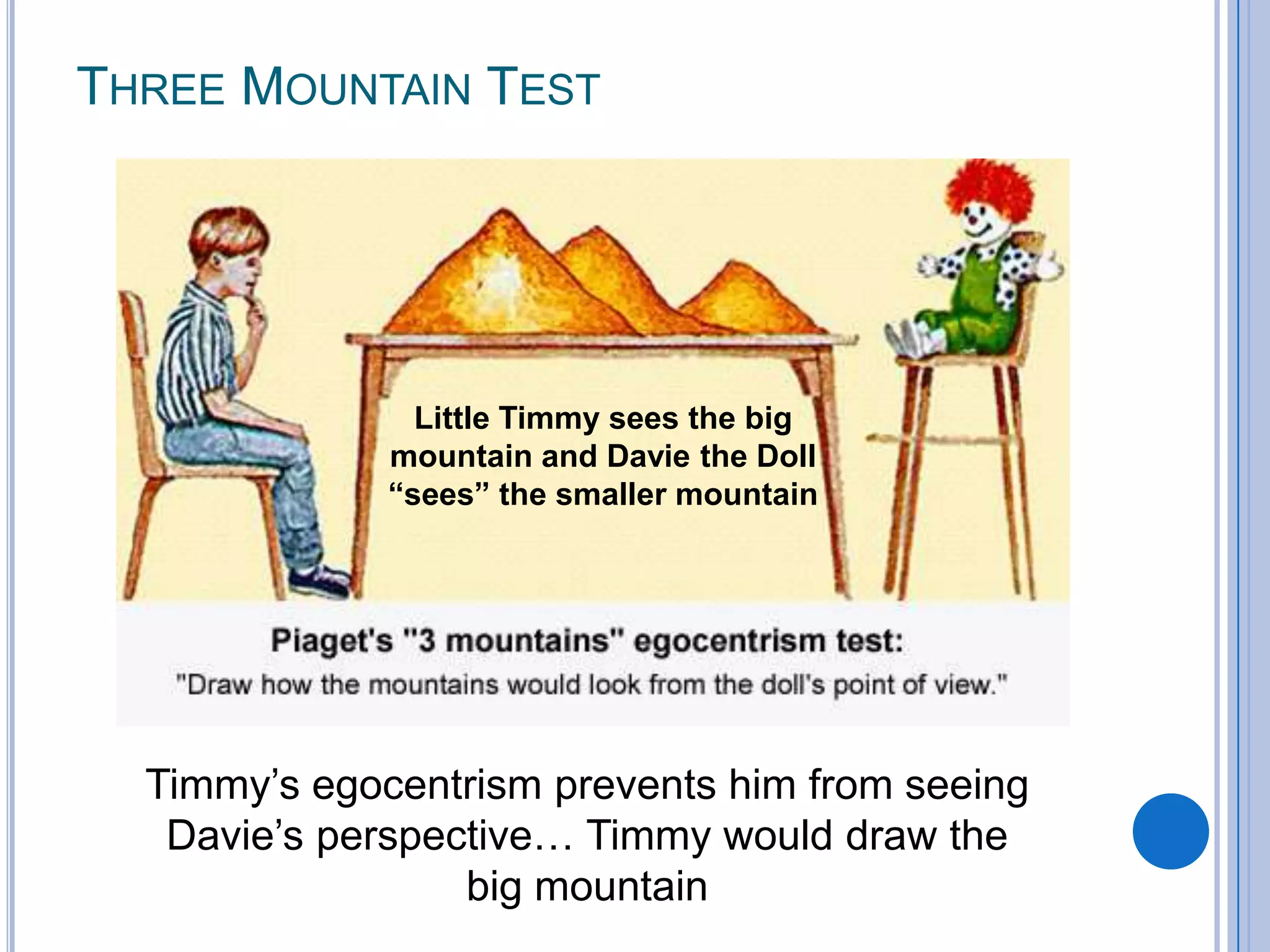
THREE MOUNTAIN TEST


                Little Timmy sees the big
              mountain and Davie the Doll
              “sees” the smaller mountain


  Timmy’s egocentrism prevents him from seeing
   Davie’s perspective… Timmy would draw the
                  big mountain
CONSERVATION
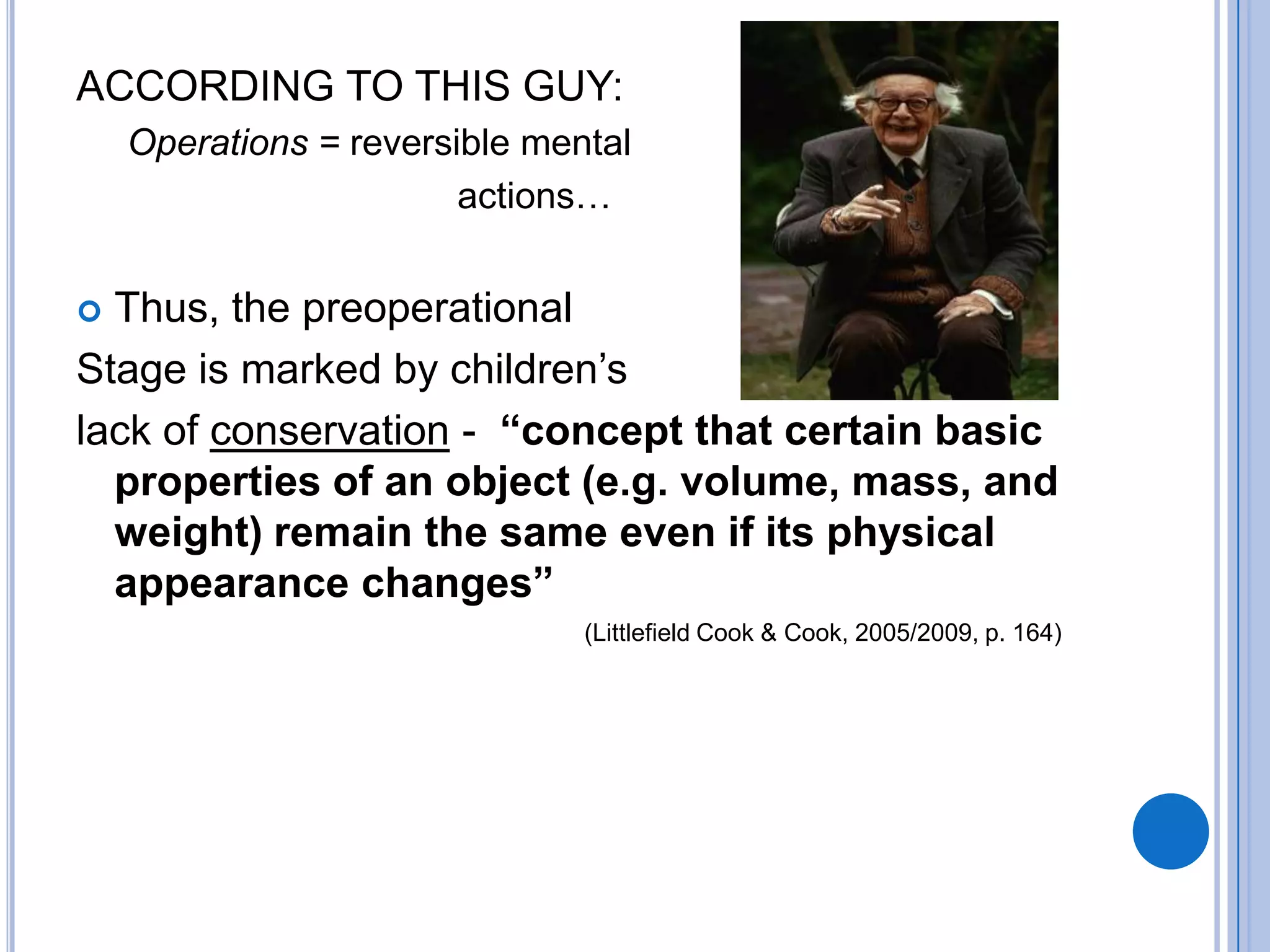
ACCORDING TO THIS GUY:
    Operations = reversible mental
                        actions…


 Thus, the preoperational
Stage is marked by children’s
lack of conservation - “concept that certain basic
  properties of an object (e.g. volume, mass, and
  weight) remain the same even if its physical
  appearance changes”
                               (Littlefield Cook & Cook, 2005/2009, p. 164)
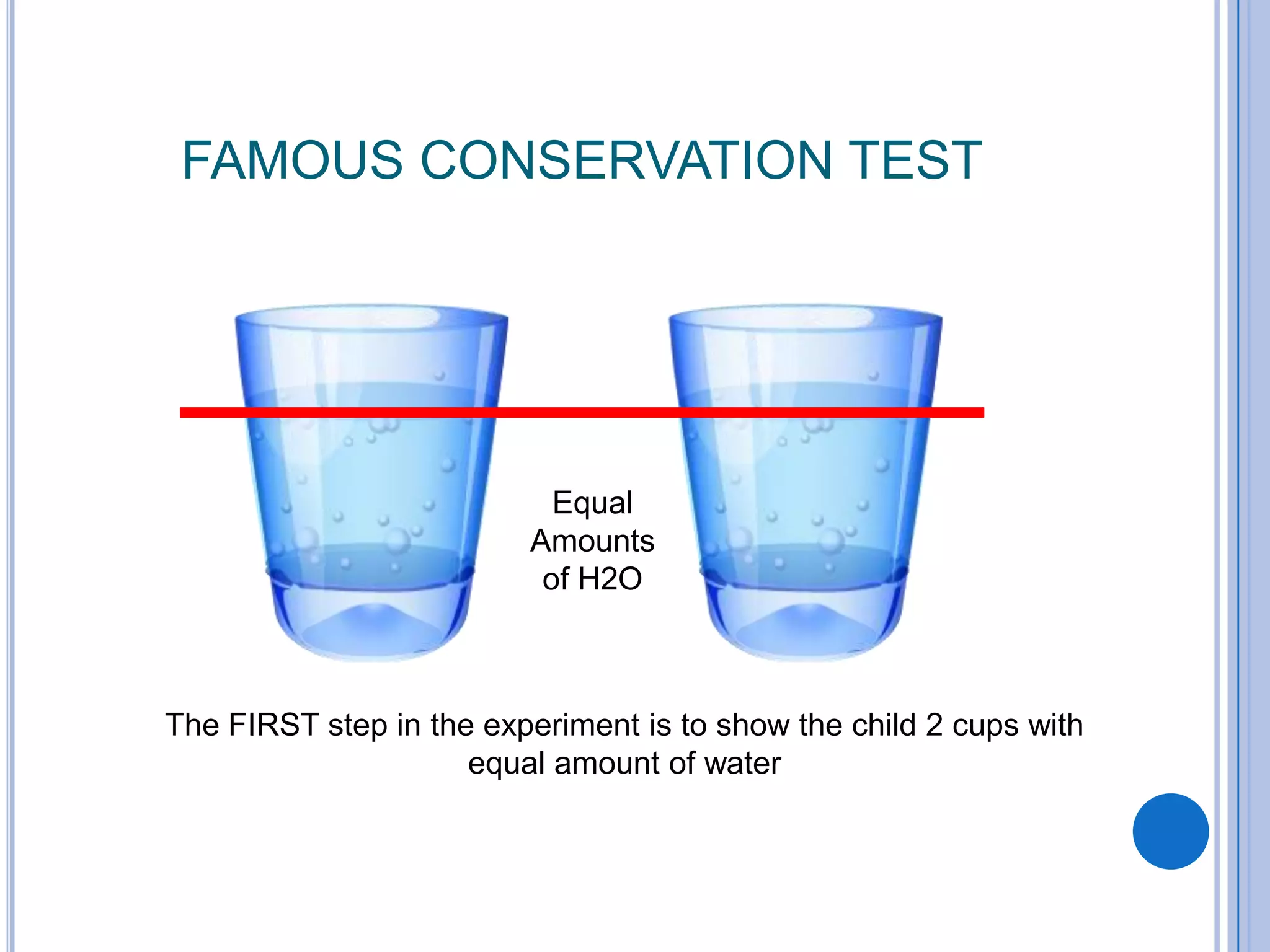
FAMOUS CONSERVATION TEST


                           Equal
                         Amounts
                          of H2O


The FIRST step in the experiment is to show the child 2 cups with
                     equal amount of water
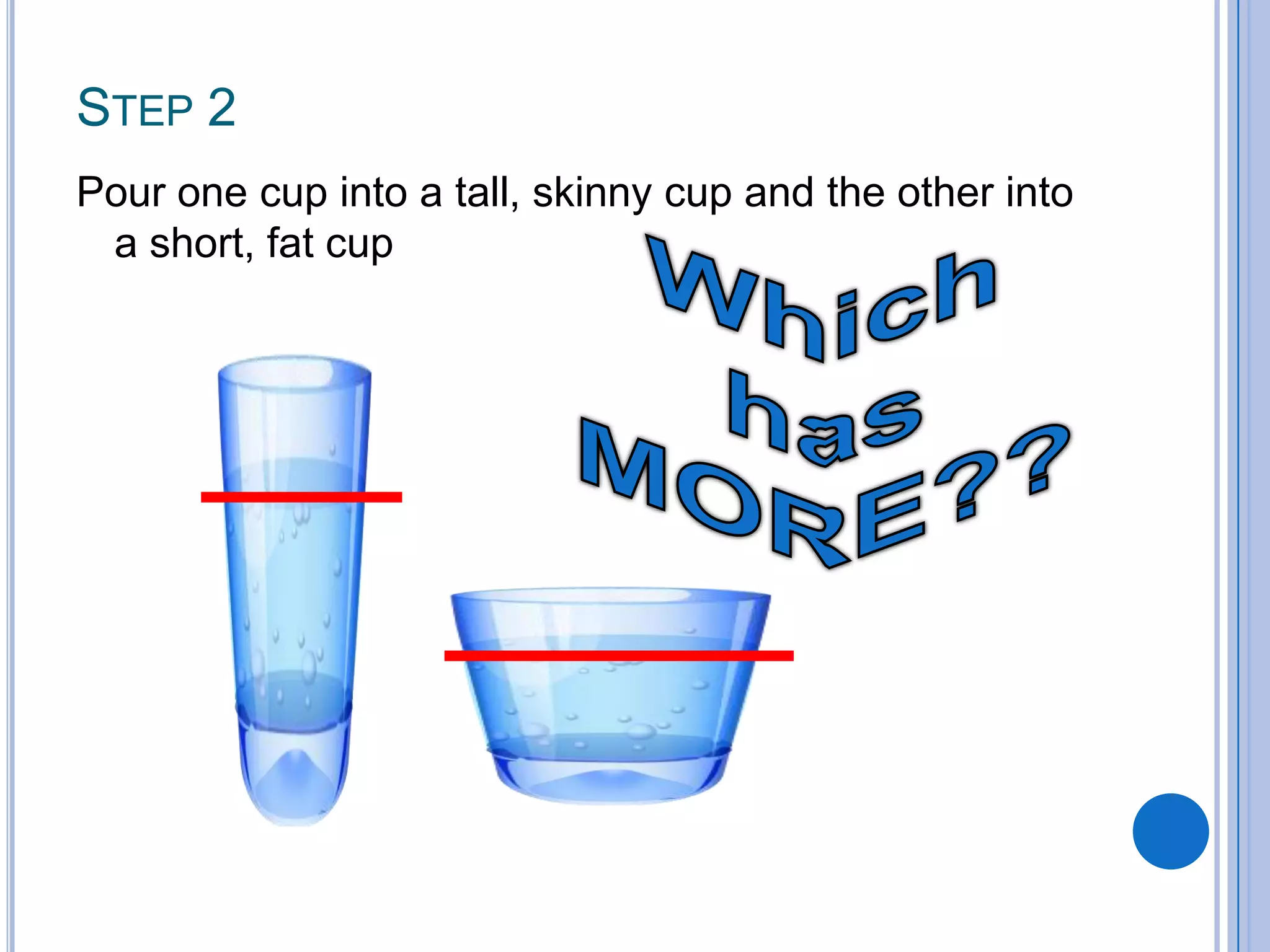
STEP 2
Pour one cup into a tall, skinny cup and the other into
 a short, fat cup
STEP 3
a                              child would conclude
that the tall skinny class had more water because the
  level of water was higher.


       THE UNDERSTANDING OF
   CONSERVATION PRINCIPLES SENDS
   THAT PRECIOUS LITTLE CHILD RIGHT
         INTO THE WORLD OF…
CONCRETE
OPERATIONAL
THOUGHT


          Stage 3
      (7-11 years)
Logic is “still tied closely to concrete materials,
  contexts, and situations”
                        (Littlefield Cook & Cook, 2005/2009, p. 166)


   Characterized by:
     ytilibisreveR
     Logical   abilities: class inclusion
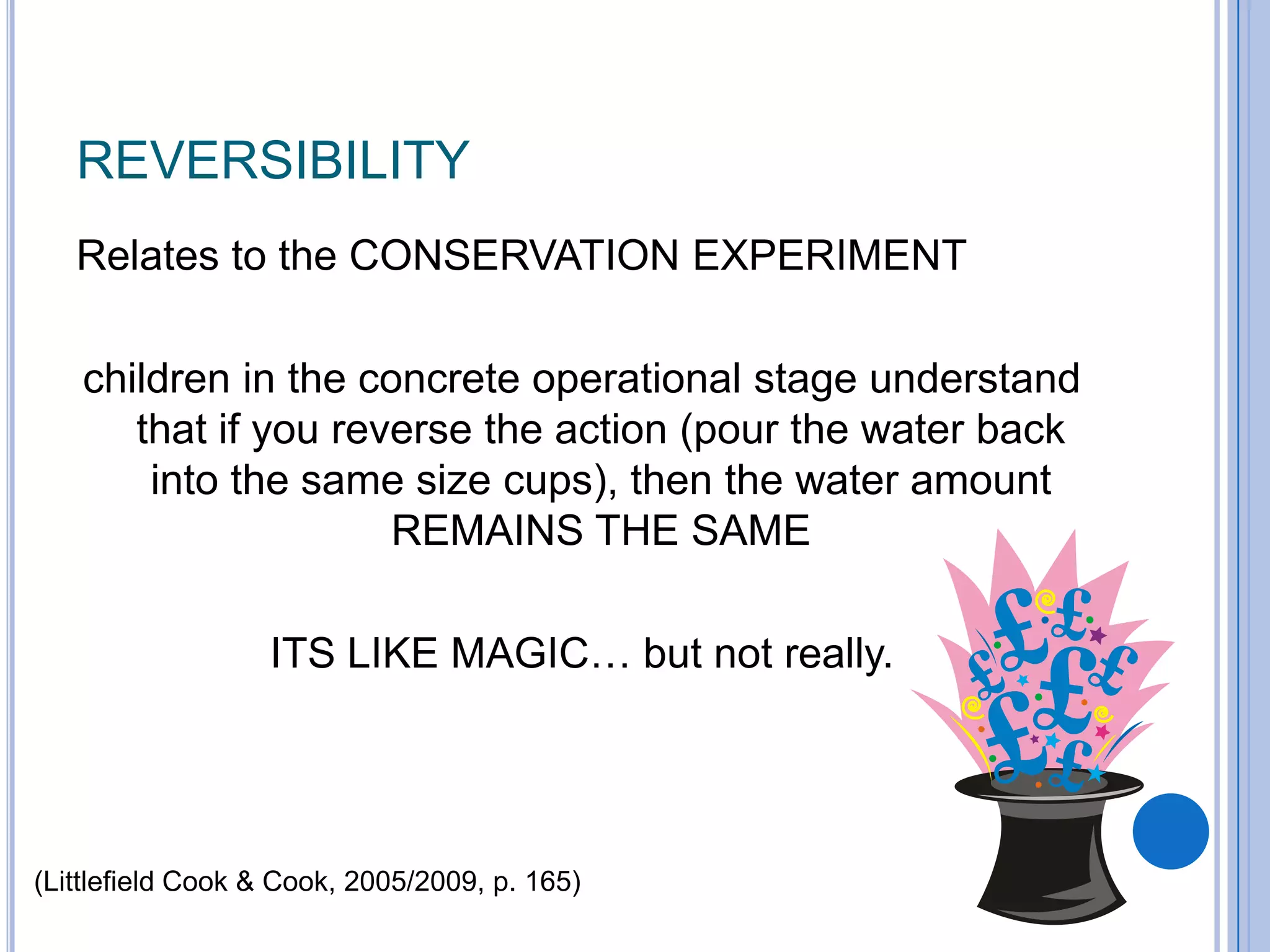
REVERSIBILITY
   Relates to the CONSERVATION EXPERIMENT

   children in the concrete operational stage understand
      that if you reverse the action (pour the water back
       into the same size cups), then the water amount
                     REMAINS THE SAME

                  ITS LIKE MAGIC… but not really.


(Littlefield Cook & Cook, 2005/2009, p. 165)
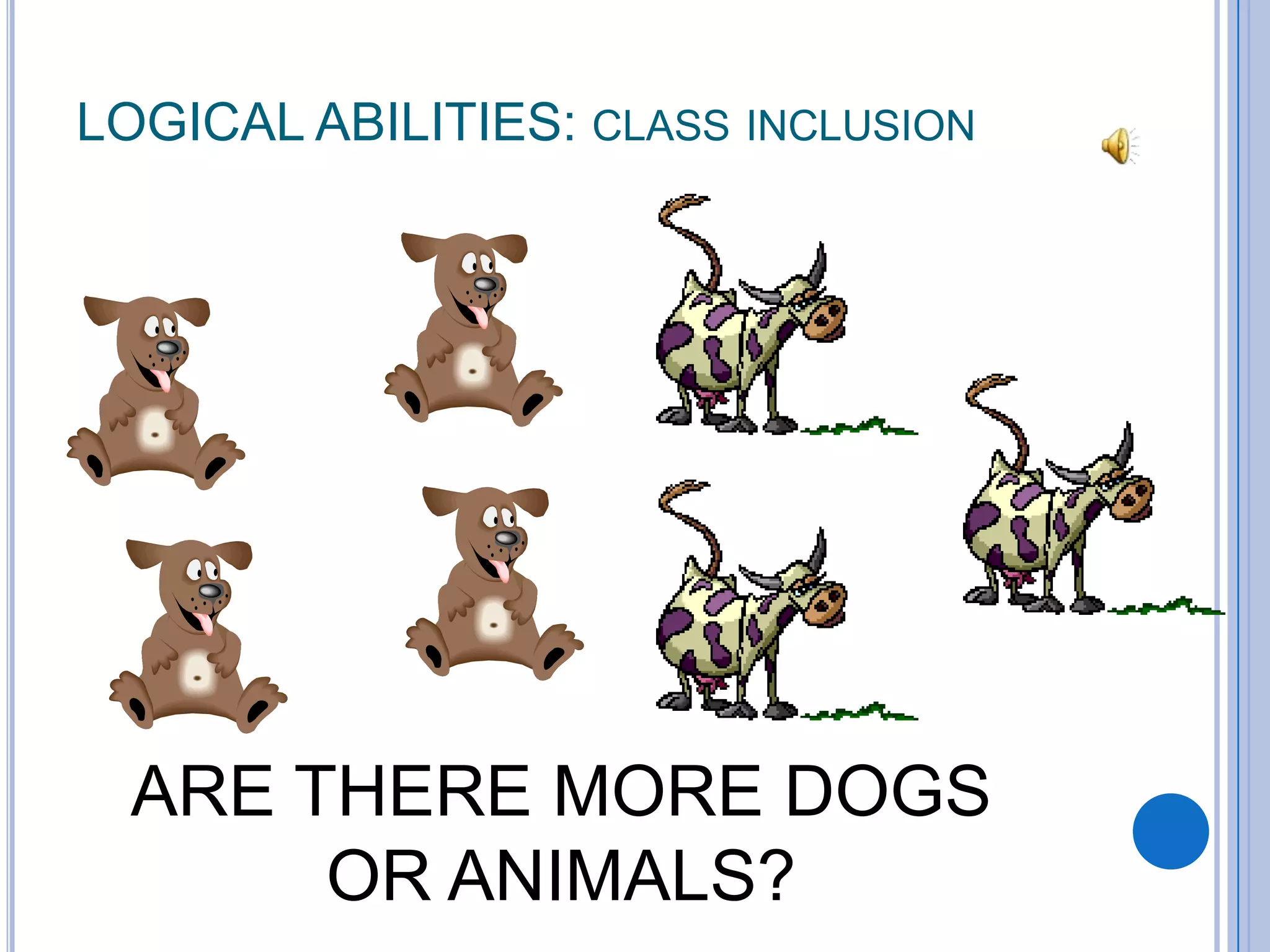
LOGICAL ABILITIES: CLASS INCLUSION


  ARE THERE MORE DOGS
       OR ANIMALS?
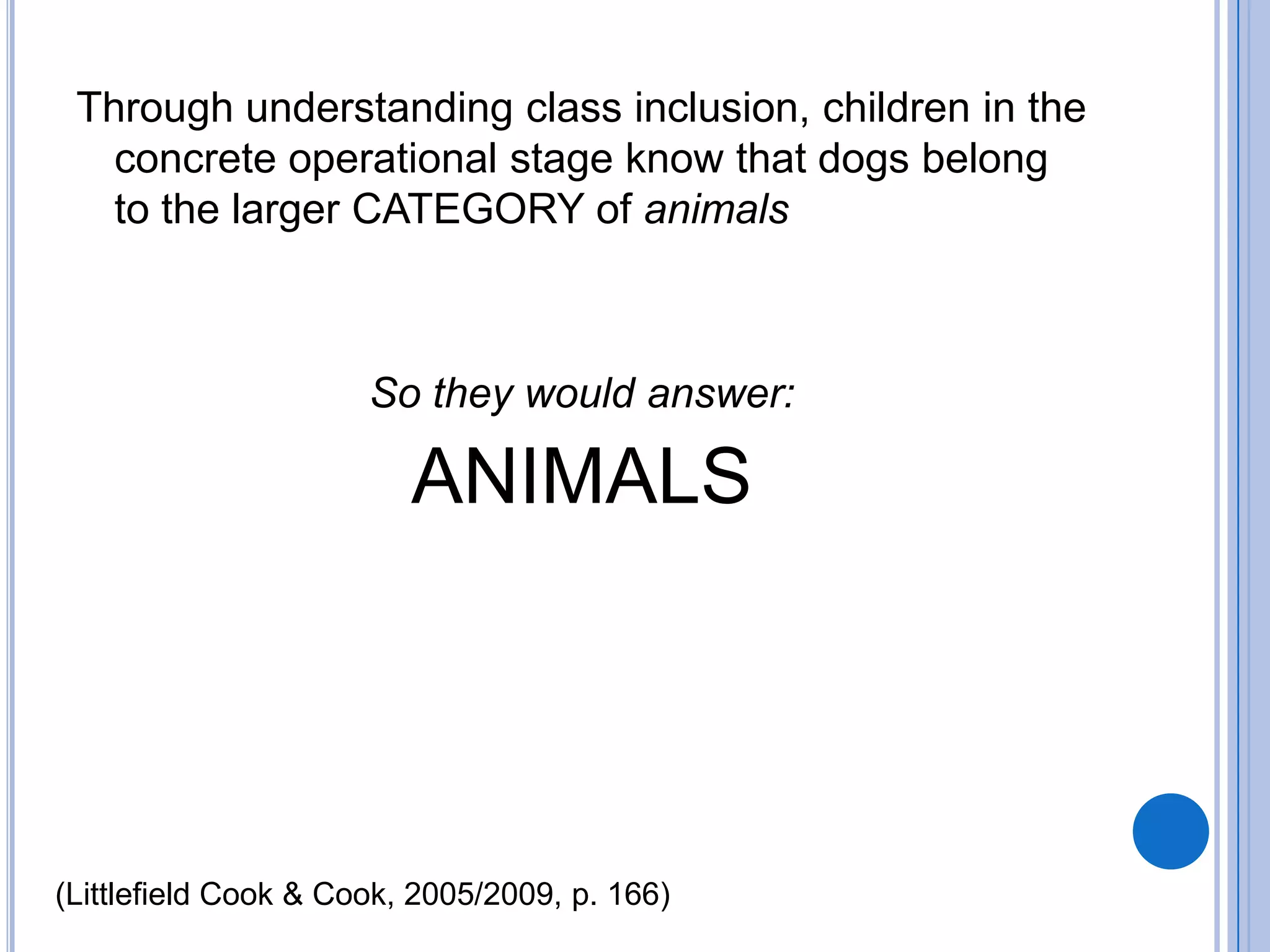
Through understanding class inclusion, children in the
   concrete operational stage know that dogs belong
   to the larger CATEGORY of animals


                      So they would answer:

                         ANIMALS


(Littlefield Cook & Cook, 2005/2009, p. 166)
FORMAL
OPERATIONAL
THOUGHT

       Stage 4 (age 12 and up)
• 5 important higher-level cognitive
abilities
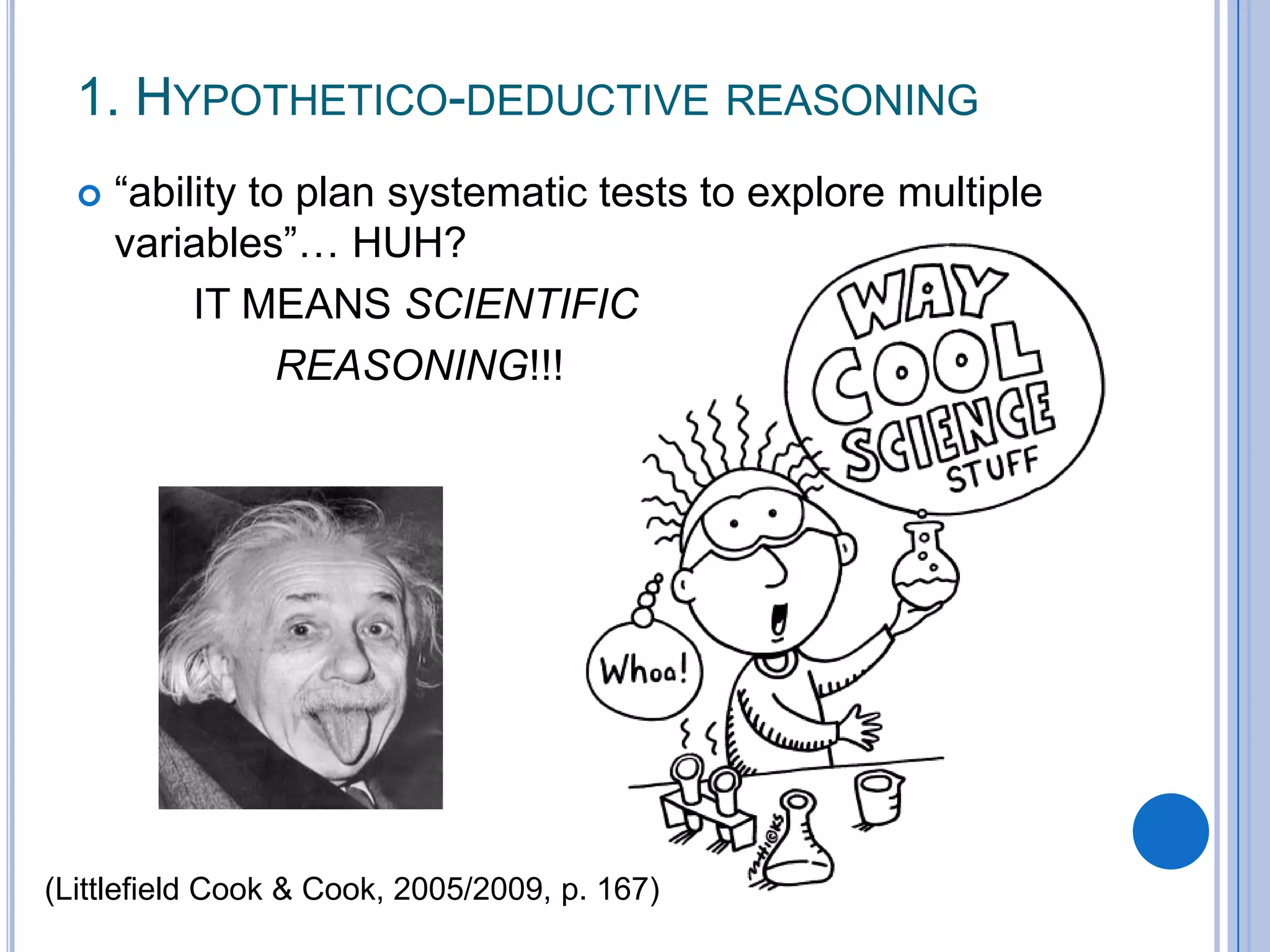
1. HYPOTHETICO-DEDUCTIVE REASONING
     “ability to plan systematic tests to explore multiple
      variables”… HUH?
           IT MEANS SCIENTIFIC
                 REASONING!!!


(Littlefield Cook & Cook, 2005/2009, p. 167)
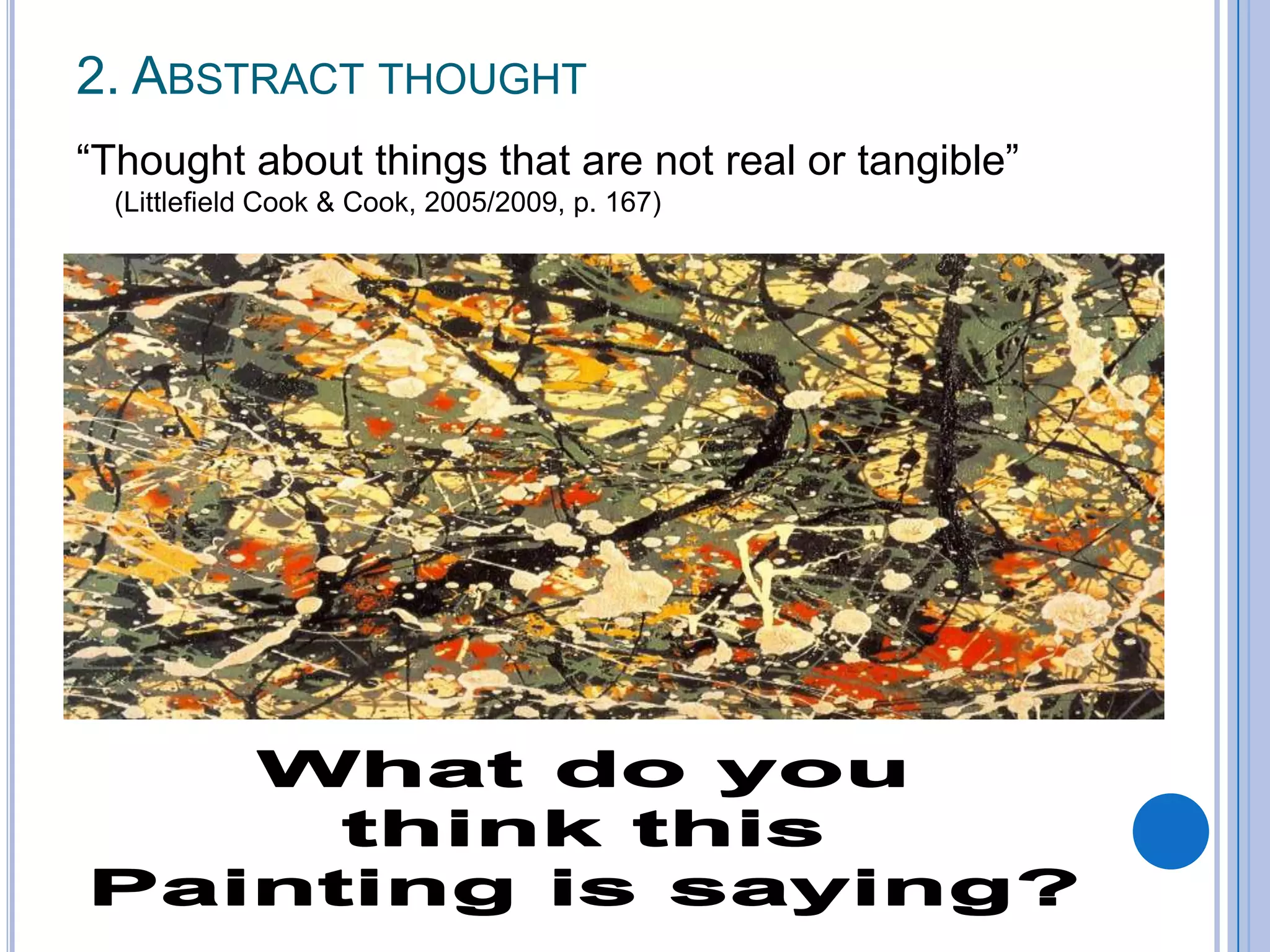
2. ABSTRACT THOUGHT
“Thought about things that are not real or tangible”
  (Littlefield Cook & Cook, 2005/2009, p. 167)
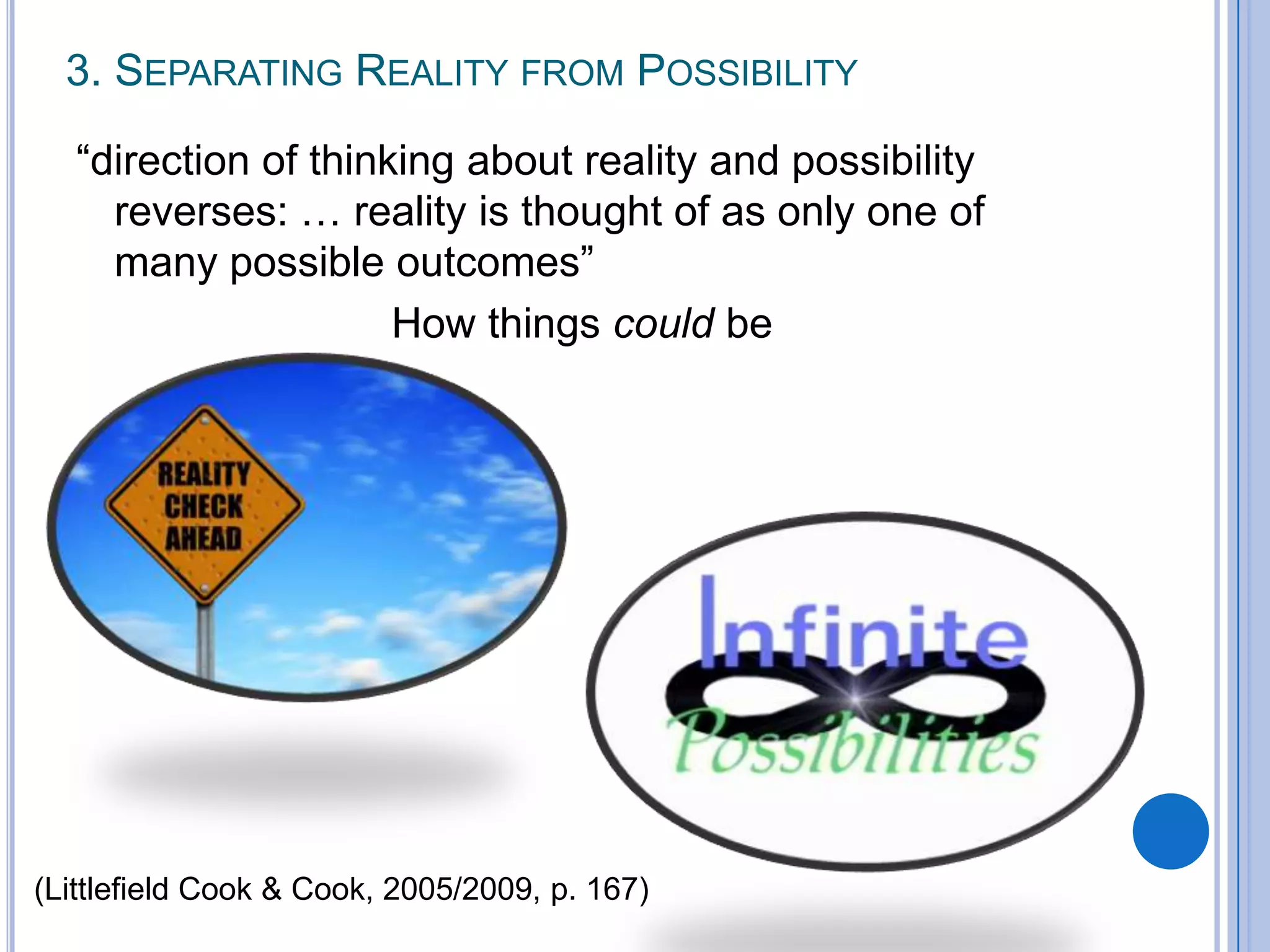
3. SEPARATING REALITY FROM POSSIBILITY

   “direction of thinking about reality and possibility
     reverses: … reality is thought of as only one of
     many possible outcomes”
                      How things could be


(Littlefield Cook & Cook, 2005/2009, p. 167)
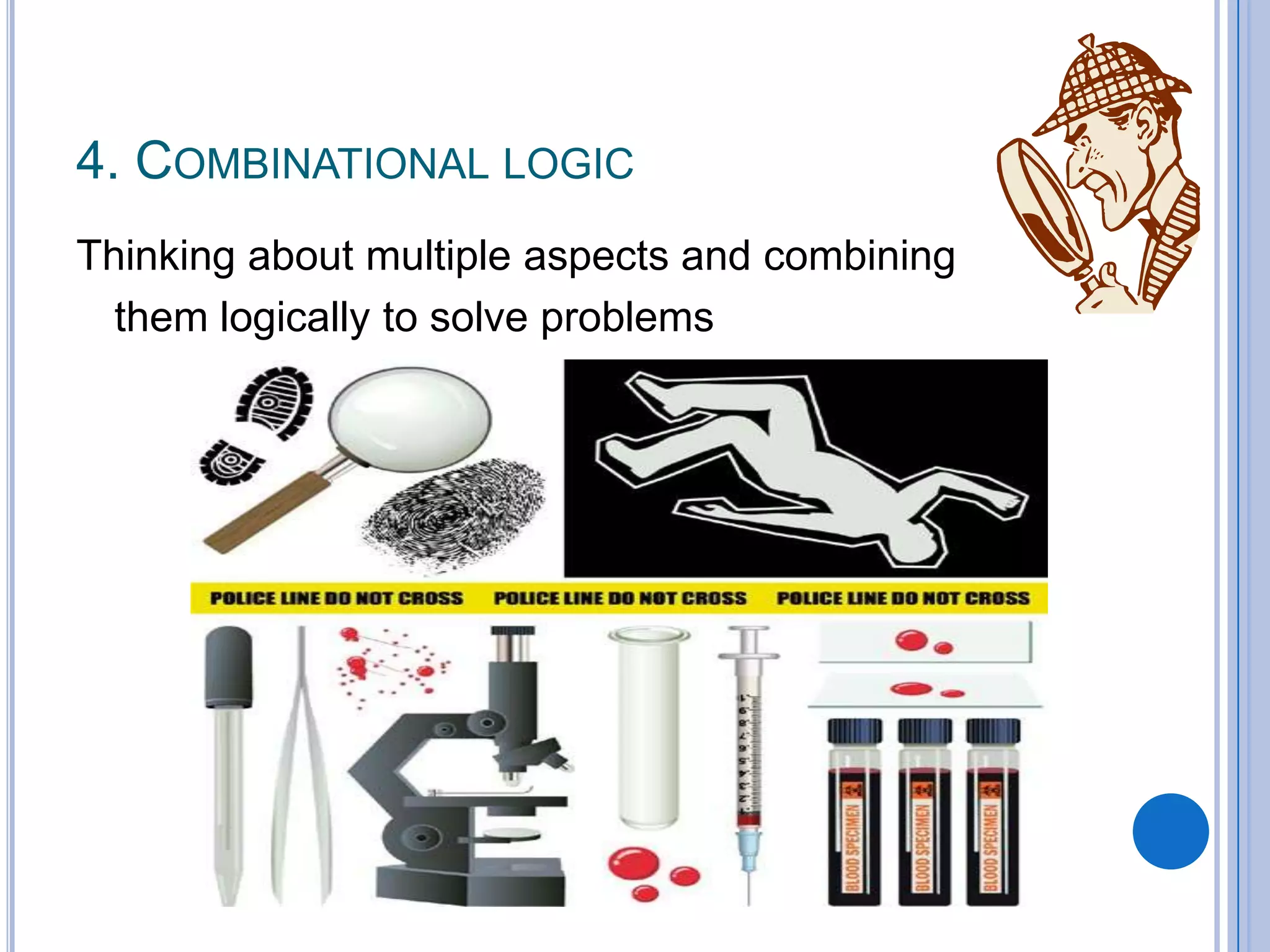
4. COMBINATIONAL LOGIC
Thinking about multiple aspects and combining
  them logically to solve problems
5. REFLECTIVE THINKING
 Thinking about your own thinking
WHAT IF A CHILD DOES NOT DEVELOP AS
 PIAGET EXPLAINED?


 IN MOST CASES, CHILDREN WITH
 COGNITIVE DISABILITIES DO NOT
 SUCCESSFULLY COMPLETE ALL
 OF PIAGET’S STAGES OF
 COGNITIVE DEVELOPMENT
COGNITIVE
DISABILITIES
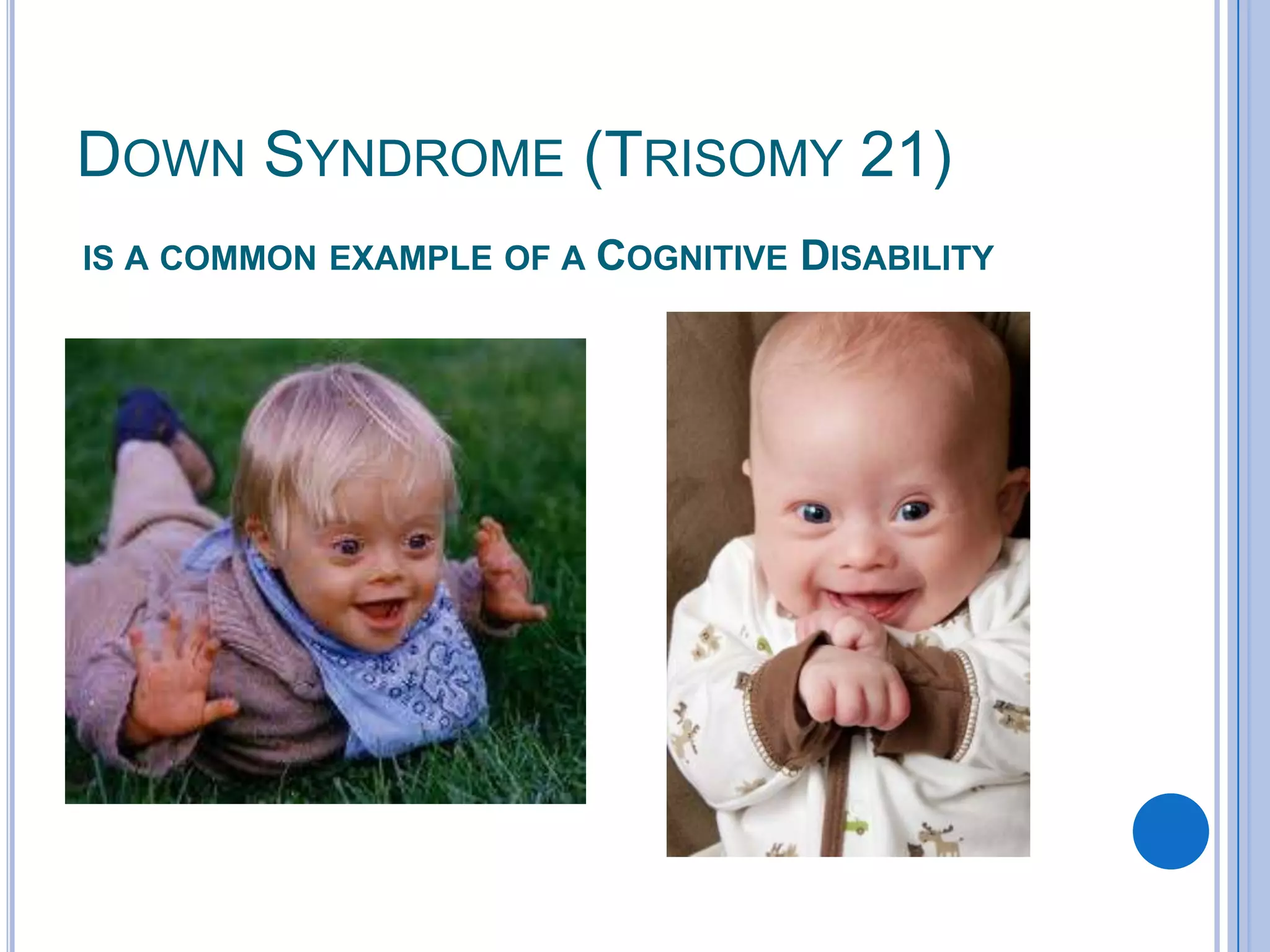
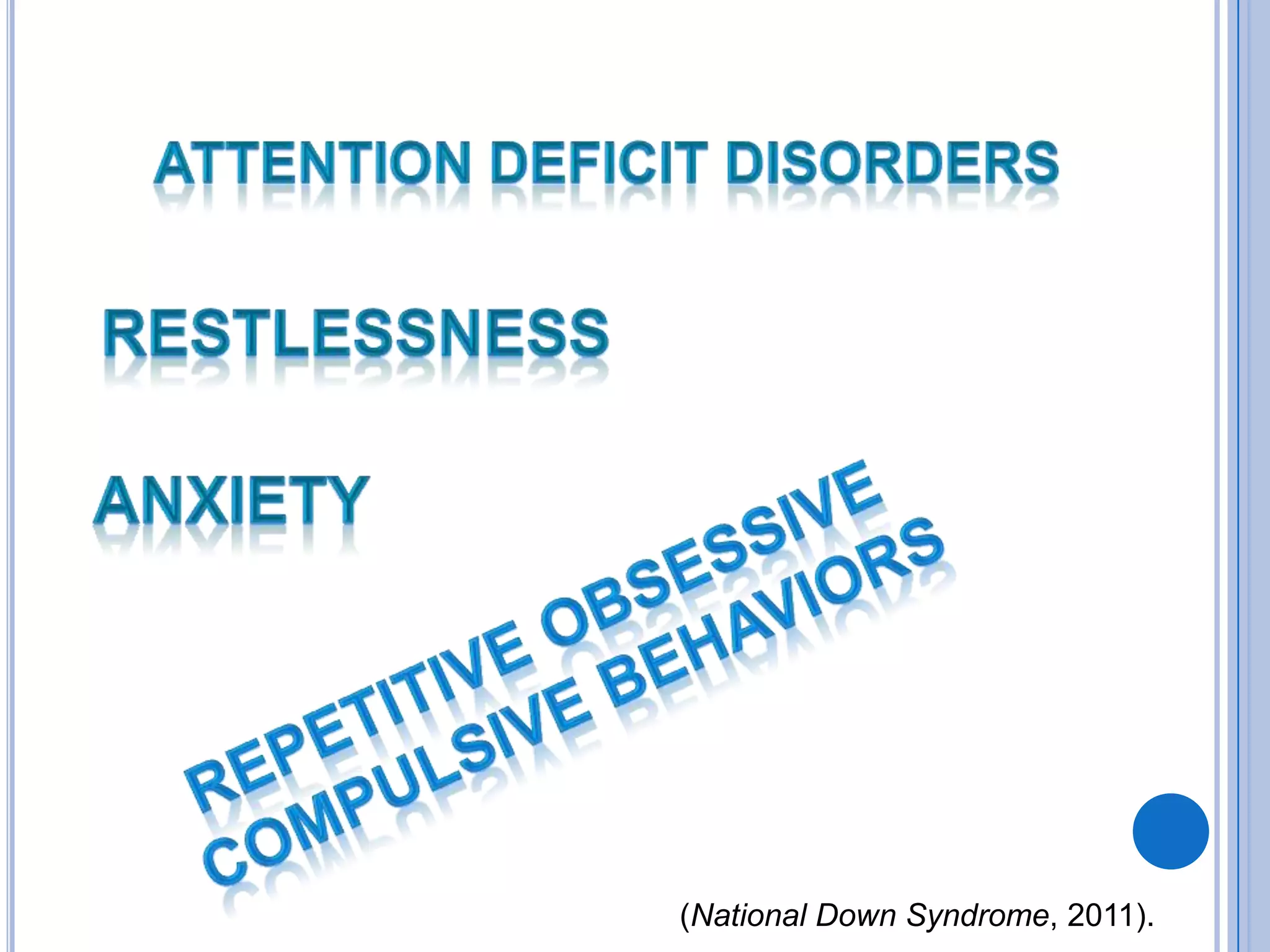
DOWN SYNDROME (TRISOMY 21)
IS A COMMON EXAMPLE OF A   COGNITIVE DISABILITY
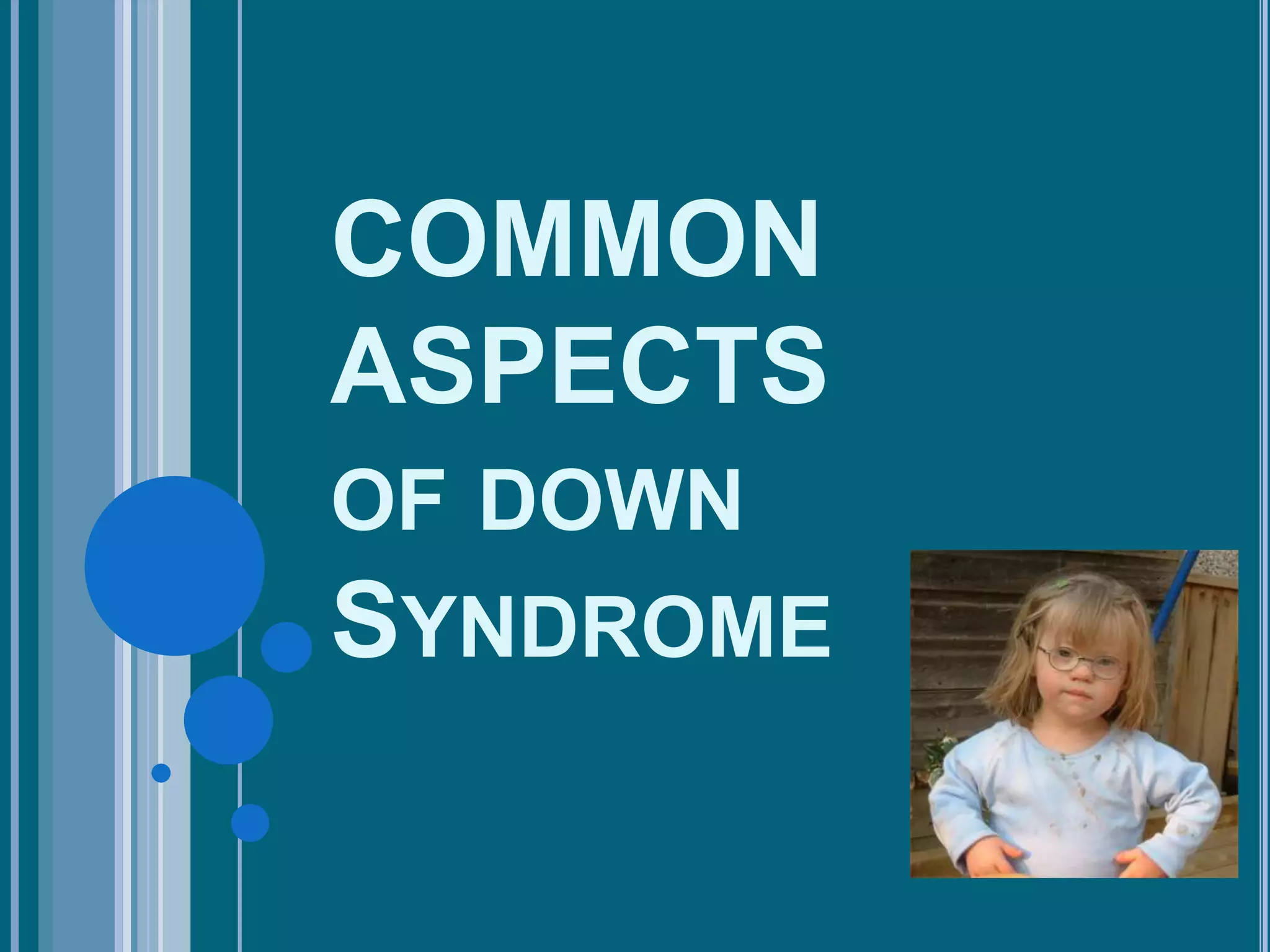
COMMON
ASPECTS
OF DOWN
SYNDROME
(National Down Syndrome, 2011).
FOR MORE INFORMATION ON
PIAGET
 Berk, L.E.(2007). Development through the
          lifespan: Fourth Edition. Illinios: Pearson
          Education, Inc.


 Hall, C. E. Nordby, V.J. (1974). A guide to
           pyschologists and their concepts. San
           Fransico: Freeman and Company.


 Malott, R.W. Whaley,D.L.(1976). Pyschology. New
          York: Harper and Row, Publishers, Inc.


 Wadsworth, B.J.(1996). Piaget’s theory of cognitive
 and affective development:        Fifth Ed. New York:
 Logman Publishers,       U.S.A.
REFERENCES
Littlefield Cook, J., & Cook, G. (2009). Cognitive
          development: Piagetian and sociocultural
          views. in Child development principles    and
perspectives (2nd ed., pp. 151-183).        Boston :
Pearson Education, Inc. (Original           work
published 2005)


National down syndrome society - mental health
        issues and down syndrome. (2011).
        Retrieved November 30, 2011, from
        National Down Syndrome Society website:

Jean Piaget's Theory of Cognitive Development

  • 1.
    JEAN PIAGET’S THEORYOF COGNITIVE DEVELOPMENT By: Kayla Lane, Kelly McGrail, Cara Sisler, and Michael Herther
  • 2.
  • 3.
    Piaget was 10years old when he published his first article on an albino sparrow (Littlefield Cook & Cook, 2005/2009, p. 152)
  • 4.
    BINET LABORATORY  Age 21: Piaget earns his PhD and heads off the work at the Binet laboratory with Theophile Simon and Alfred Binet  There he learned many of the key ideas in his revolutionary theory of cognitive development BINET PIAGET (Littlefield Cook & Cook, 2005/2009, p. 152)
  • 5.
  • 6.
    STAGE 1: SENSORIMOTORTHOUGH (BIRTH-2 YEARS) Babies are stuck in the HERE AND NOW world they “know the world only in terms of their own sensory input (what they see, smell, taste, touch, and hear) and their physical or motor actions on it (e.g. sucking, reaching, grasping) (Littlefield Cook & Cook, 2005/2009, p. 157)
  • 7.
    Babies lack REPRESENTATIONALTHOUGHT or ability to think through the use of symbols CAN YOU THINK WITHOUT WORDS?? (Littlefield Cook & Cook, 2005/2009, p. 158)
  • 8.
    NO! of coursenot! That’s why Piaget says babies cannot think!  Evidence of representational thought emerges from the use of language and ObJeCt PeRmAnEnCe  “the fact that objects, events, or even people continue to exist when they are not in the infants direct line of sensory or motor action” (Littlefield Cook & Cook, 2005/2009, p. 159) The understanding of object permanence marks the change into…
  • 9.
  • 10.
    PREOPERATIONAL THOUGHT IS CHARACTERIZEDBY:  Intuitive Though – logic bases only on experiences  Symbols in  Egocentrism  lack of conservation
  • 11.
    SYMBOLS IN PLAY  Symbolic play: use one object to stand for another Can you hear me now?  Fantasy play: pretend to UP, UP, AND be something, or pretend AWAY activities that are impossible  Make-believe play: use toys as props Rock a-by Baby (Littlefield Cook & Cook, 2005/2009, p. 162)
  • 12.
    EGOCENTRICSM: “child’sinability to take in others perspective” (Littlefield Cook & Cook, 2005/2009, p. 163)
  • 13.
    THREE MOUNTAIN TEST Little Timmy sees the big mountain and Davie the Doll “sees” the smaller mountain Timmy’s egocentrism prevents him from seeing Davie’s perspective… Timmy would draw the big mountain
  • 14.
  • 15.
    ACCORDING TO THISGUY: Operations = reversible mental actions…  Thus, the preoperational Stage is marked by children’s lack of conservation - “concept that certain basic properties of an object (e.g. volume, mass, and weight) remain the same even if its physical appearance changes” (Littlefield Cook & Cook, 2005/2009, p. 164)
  • 16.
    FAMOUS CONSERVATION TEST Equal Amounts of H2O The FIRST step in the experiment is to show the child 2 cups with equal amount of water
  • 17.
    STEP 2 Pour onecup into a tall, skinny cup and the other into a short, fat cup
  • 18.
    STEP 3 a child would conclude that the tall skinny class had more water because the level of water was higher. THE UNDERSTANDING OF CONSERVATION PRINCIPLES SENDS THAT PRECIOUS LITTLE CHILD RIGHT INTO THE WORLD OF…
  • 19.
    CONCRETE OPERATIONAL THOUGHT Stage 3 (7-11 years)
  • 20.
    Logic is “stilltied closely to concrete materials, contexts, and situations” (Littlefield Cook & Cook, 2005/2009, p. 166)  Characterized by:  ytilibisreveR  Logical abilities: class inclusion
  • 21.
    REVERSIBILITY Relates to the CONSERVATION EXPERIMENT children in the concrete operational stage understand that if you reverse the action (pour the water back into the same size cups), then the water amount REMAINS THE SAME ITS LIKE MAGIC… but not really. (Littlefield Cook & Cook, 2005/2009, p. 165)
  • 22.
    LOGICAL ABILITIES: CLASSINCLUSION ARE THERE MORE DOGS OR ANIMALS?
  • 23.
    Through understanding classinclusion, children in the concrete operational stage know that dogs belong to the larger CATEGORY of animals So they would answer: ANIMALS (Littlefield Cook & Cook, 2005/2009, p. 166)
  • 24.
    FORMAL OPERATIONAL THOUGHT Stage 4 (age 12 and up) • 5 important higher-level cognitive abilities
  • 25.
    1. HYPOTHETICO-DEDUCTIVE REASONING  “ability to plan systematic tests to explore multiple variables”… HUH? IT MEANS SCIENTIFIC REASONING!!! (Littlefield Cook & Cook, 2005/2009, p. 167)
  • 26.
    2. ABSTRACT THOUGHT “Thoughtabout things that are not real or tangible” (Littlefield Cook & Cook, 2005/2009, p. 167)
  • 27.
    3. SEPARATING REALITYFROM POSSIBILITY “direction of thinking about reality and possibility reverses: … reality is thought of as only one of many possible outcomes” How things could be (Littlefield Cook & Cook, 2005/2009, p. 167)
  • 28.
    4. COMBINATIONAL LOGIC Thinkingabout multiple aspects and combining them logically to solve problems
  • 29.
    5. REFLECTIVE THINKING Thinking about your own thinking
  • 30.
    WHAT IF ACHILD DOES NOT DEVELOP AS PIAGET EXPLAINED? IN MOST CASES, CHILDREN WITH COGNITIVE DISABILITIES DO NOT SUCCESSFULLY COMPLETE ALL OF PIAGET’S STAGES OF COGNITIVE DEVELOPMENT
  • 31.
  • 32.
    DOWN SYNDROME (TRISOMY21) IS A COMMON EXAMPLE OF A COGNITIVE DISABILITY
  • 33.
  • 34.
  • 35.
  • 36.
    FOR MORE INFORMATIONON PIAGET Berk, L.E.(2007). Development through the lifespan: Fourth Edition. Illinios: Pearson Education, Inc. Hall, C. E. Nordby, V.J. (1974). A guide to pyschologists and their concepts. San Fransico: Freeman and Company. Malott, R.W. Whaley,D.L.(1976). Pyschology. New York: Harper and Row, Publishers, Inc. Wadsworth, B.J.(1996). Piaget’s theory of cognitive and affective development: Fifth Ed. New York: Logman Publishers, U.S.A.
  • 37.
    REFERENCES Littlefield Cook, J.,& Cook, G. (2009). Cognitive development: Piagetian and sociocultural views. in Child development principles and perspectives (2nd ed., pp. 151-183). Boston : Pearson Education, Inc. (Original work published 2005) National down syndrome society - mental health issues and down syndrome. (2011). Retrieved November 30, 2011, from National Down Syndrome Society website: