PIAGET’S STAGES OF COGNITIVE
DEVELOPMENT
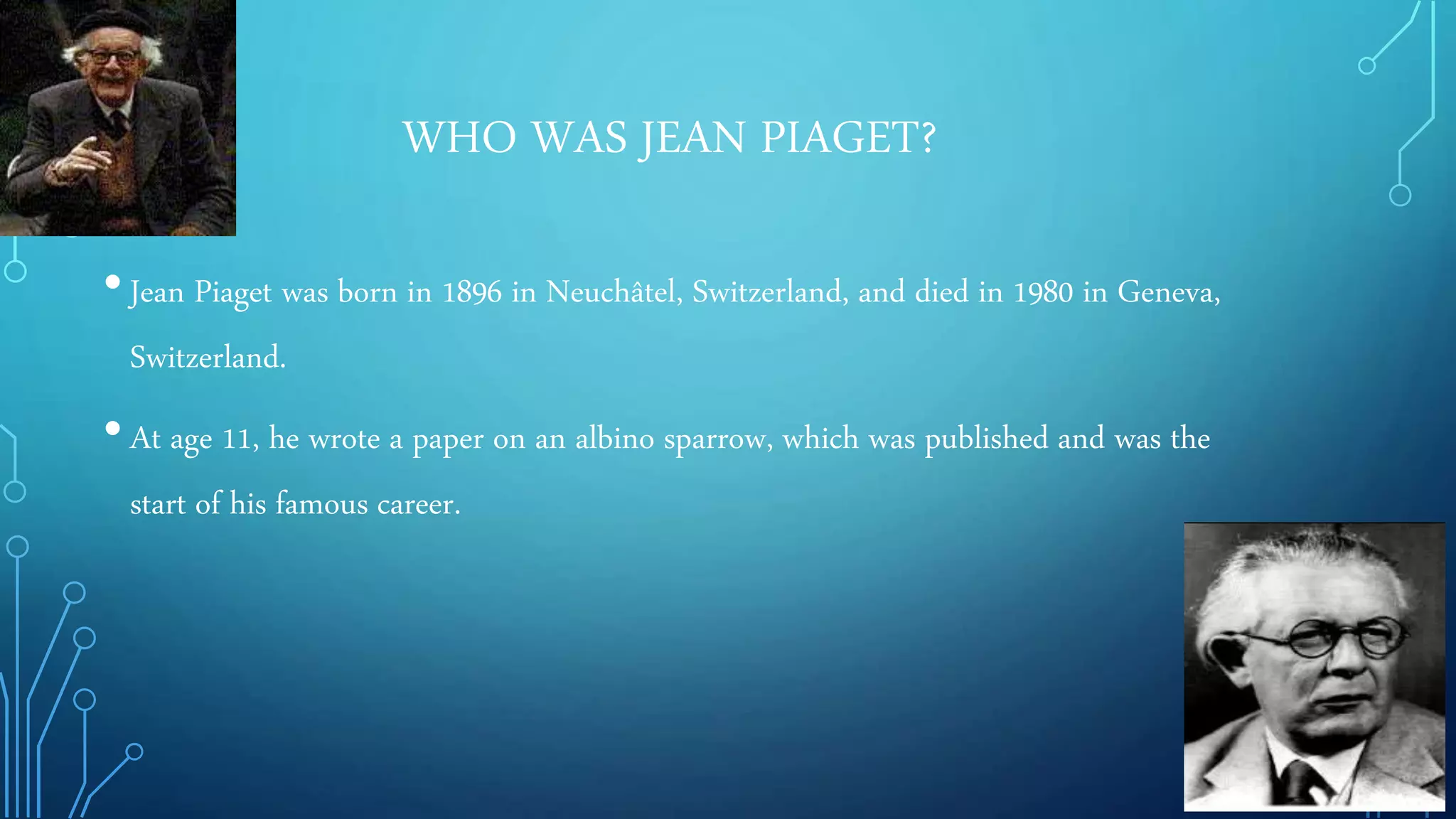
WHO WAS JEAN PIAGET?
•Jean Piaget was born in 1896 in Neuchâtel, Switzerland, and died in 1980 in Geneva,
Switzerland.
•At age 11, he wrote a paper on an albino sparrow, which was published and was the
start of his famous career.
• After graduating high school, he attended the University of Zurich, where he became
interested in psychoanalysis.
• He married in 1923 and had three children, Jacqueline, Lucienne and Laurent.
• Piaget studied his children’s intellectual development from infancy.
• While studying his children, Piaget developed theories concerning how children learn.
• His theory of Cognitive Development consists of four stages of intellectual development.
BASIC COGNITIVE CONCEPTS
•SCHEMA
•ASSIMILATION
•ACCOMMODATION
•EQUILIBRATION
SCHEMA
it refers to the cognitive structures by which individuals
intellectually adapt to and organize their environment
it is an individual’s way to understand or create meaning
about a thing or experience
a representation of a plan or theory in the form of an
outline or model.
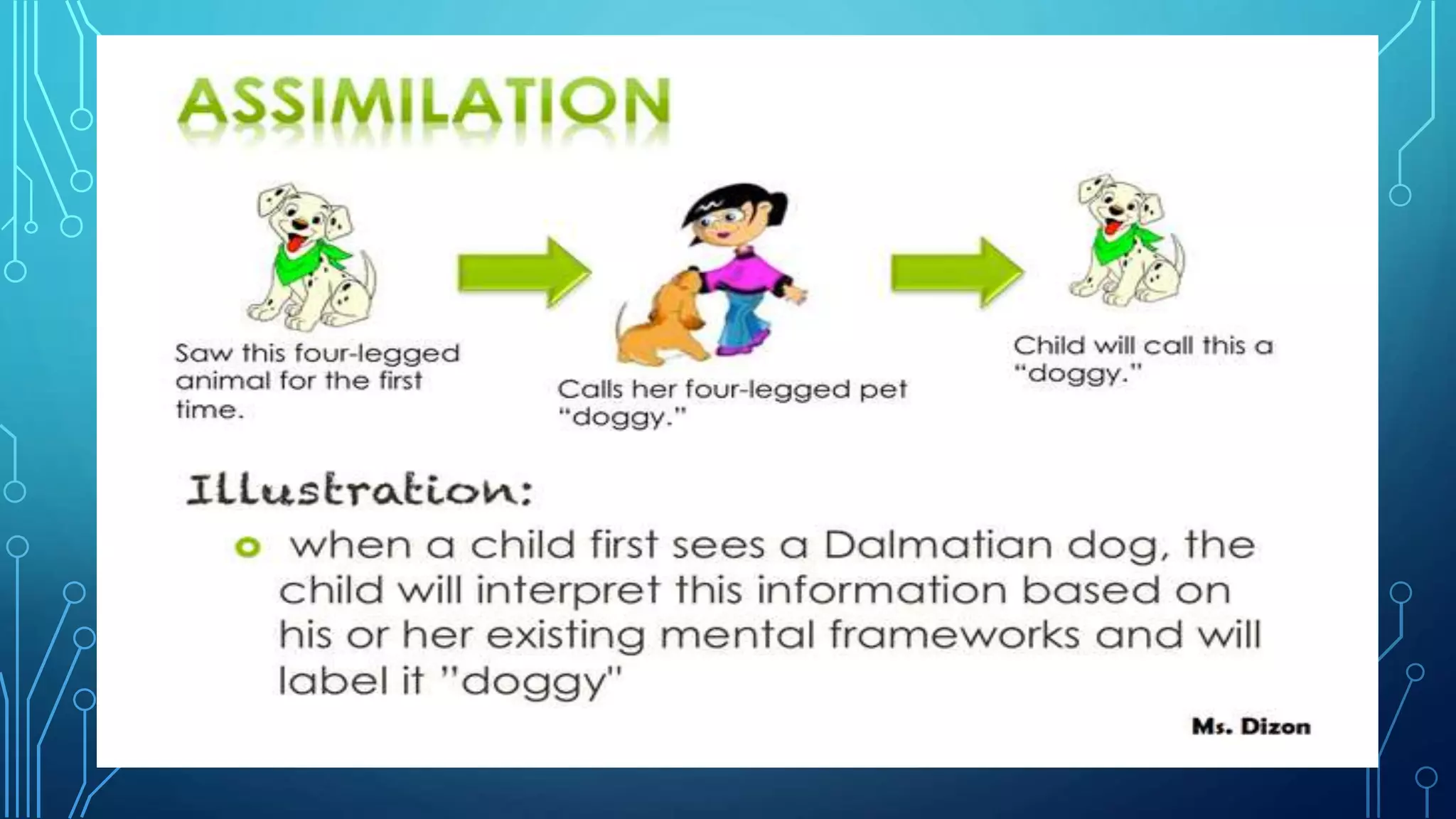
ASSIMILATION
is the process of fitting a new experience into an existing or
previously created cognitive structure or schema
simply the process of incorporating new information into a pre-
existing schema.
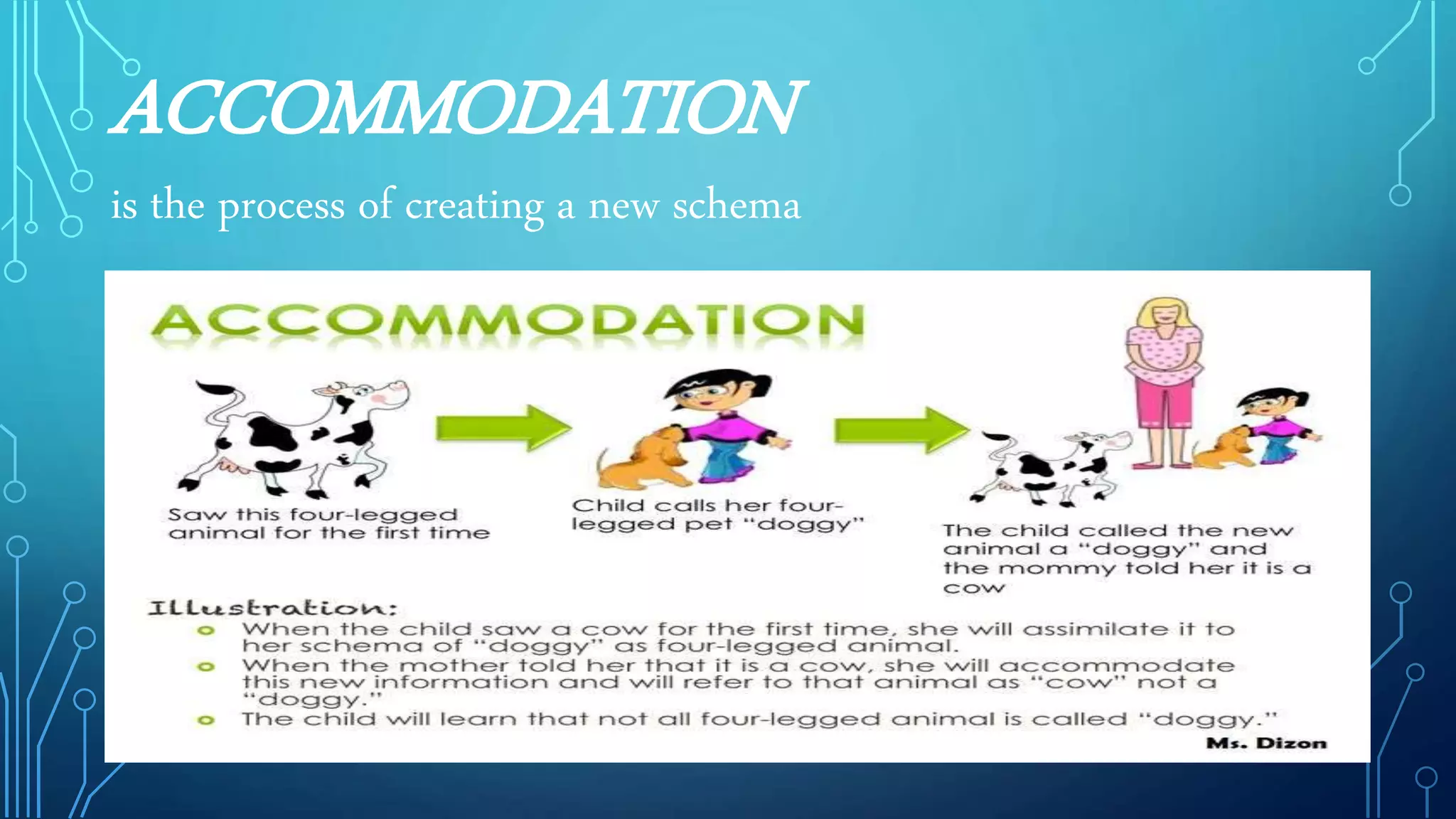
ACCOMMODATION
is the process of creating a new schema
EQUILIBRATION
it is achieving proper balance between assimilation and
accommodation
when our experiences do not match our schemata or cognitive
structures, we experience cognitive disequilibrium. This means there is a
discrepancy between what is perceives and what is understood
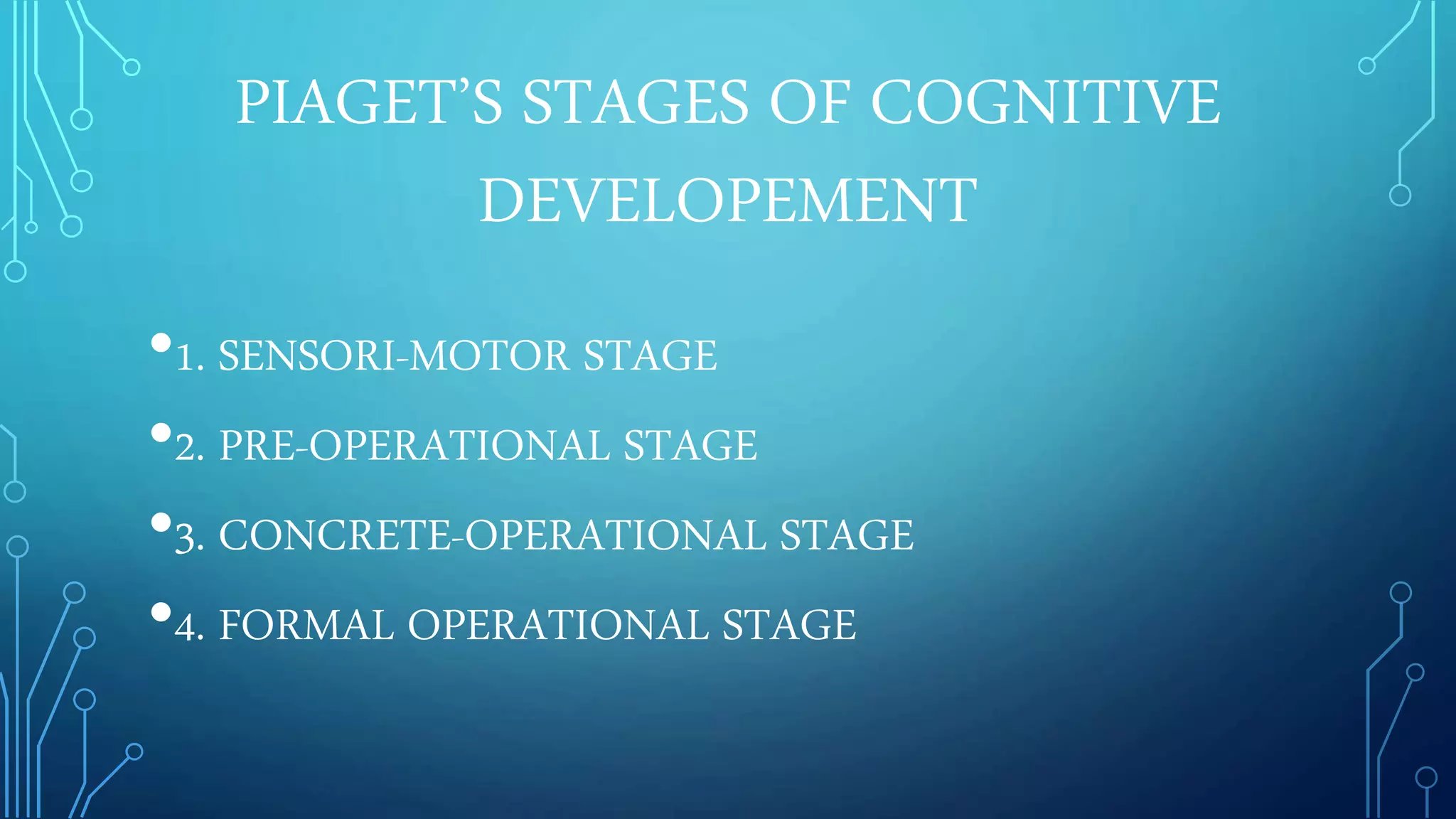
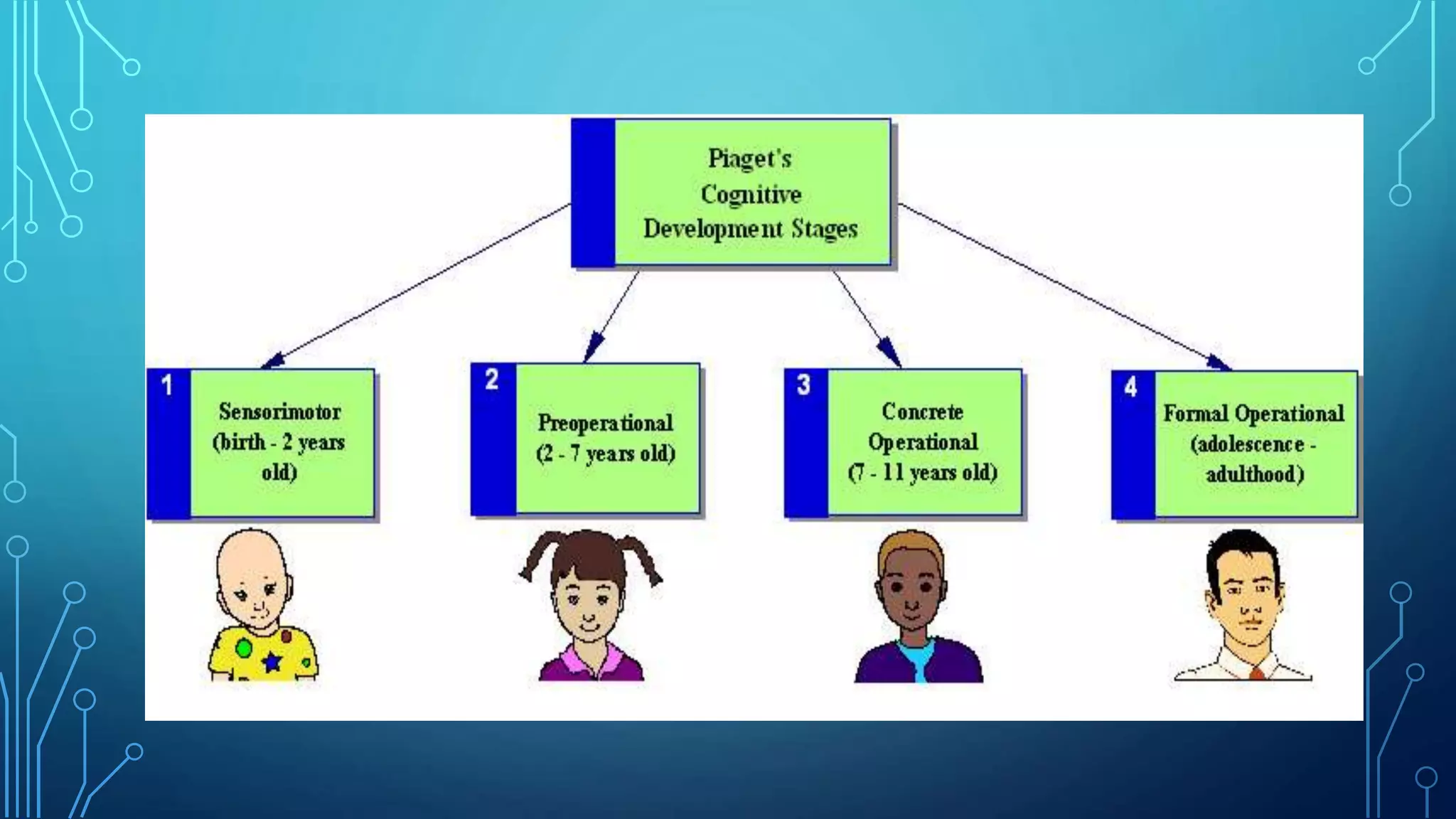
PIAGET’S STAGES OF COGNITIVE
DEVELOPEMENT
•1. SENSORI-MOTOR STAGE
•2. PRE-OPERATIONAL STAGE
•3. CONCRETE-OPERATIONAL STAGE
•4. FORMAL OPERATIONAL STAGE
Stage1: Sensorimotor Stage
STAGE 1- SENSORI-MOTOR STAGE
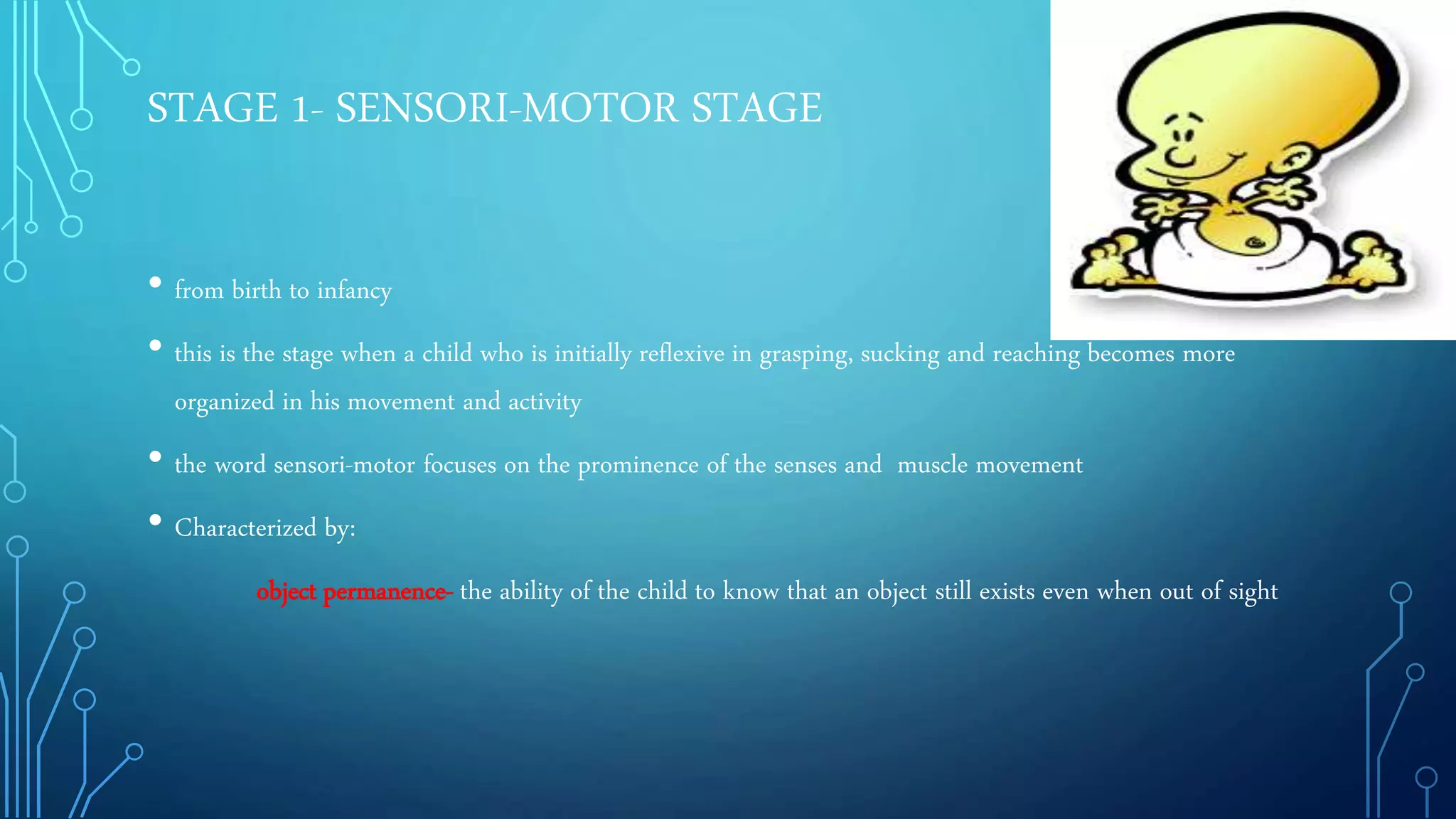
• from birth to infancy
• this is the stage when a child who is initially reflexive in grasping, sucking and reaching becomes more
organized in his movement and activity
• the word sensori-motor focuses on the prominence of the senses and muscle movement
• Characterized by:
object permanence- the ability of the child to know that an object still exists even when out of sight
The child uses only innate reflexes.
For example, if a nipple or dummy is put into a baby’s mouth, they will reflexively suck on it. If an object is
placed in their palm, the hand will automatically grab it.
These reflexes have the sole function of keeping the child alive.
1. Reflexes (0-1 month)
The child now has a fixation with it’s own body with regards to behavior(what Piaget refers to
as primary behavior); they will perform actions repeatedly on themselves (like sucking their own
hand).
They also begin to refine reflexes here to form more complex versions of them.
2. Primary Circular Actions (1-4 months)
They notice that they can actually influence events in their world, for example they can drop a teddy which
bashes a ball on the floor.
Although this occurs, the infant will not make conscious connections between what they do and the
consequences, they merely observe that their actions have interesting effects.
At around 4 months, the child begins to take an interest in their environment (their behavior
3. Secondary Circular Reactions (4-8 months)
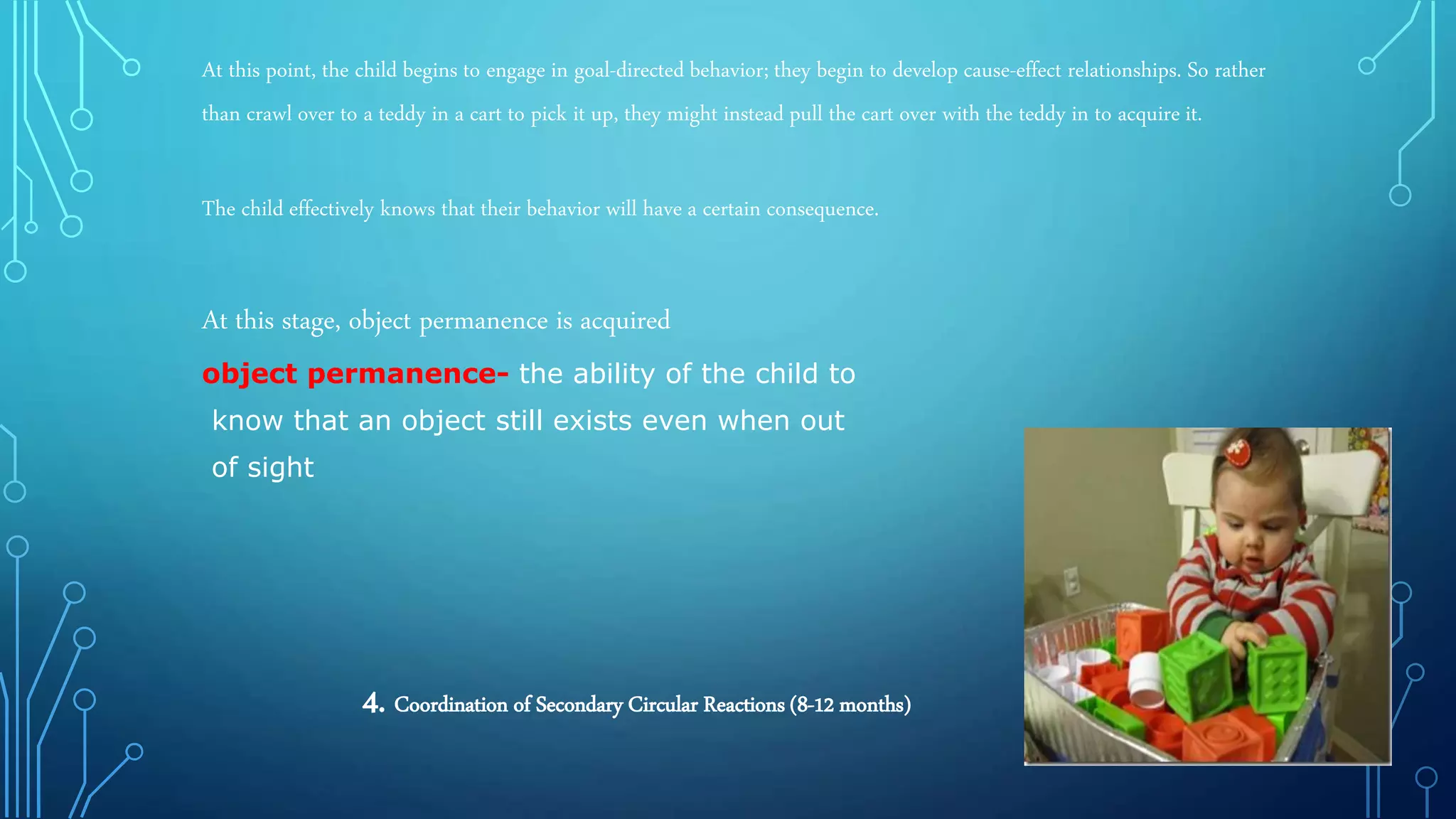
At this point, the child begins to engage in goal-directed behavior; they begin to develop cause-effect relationships. So rather
than crawl over to a teddy in a cart to pick it up, they might instead pull the cart over with the teddy in to acquire it.
The child effectively knows that their behavior will have a certain consequence.
At this stage, object permanence is acquired
object permanence- the ability of the child to
know that an object still exists even when out
of sight
4. Coordination of Secondary Circular Reactions (8-12 months)
At this stage, children like to use creativity and flexibility with their previous
behaviors, and the result of their experimentation often leads to different outcomes.
So rather than grabbing a box,
they might instead try to tilt or
manipulate it.
5. Tertiary Circular Reactions (12-18 months)
At this stage, the child develops symbolic thought and the ability to mentally represent objects in their head.
Normally, the child would need to resort to trial-and-error to achieve a desired effect.
Now, however, the child can ‘plan’ to some extent and mentally construct the consequences of an action in their head.
Of course, predictions are not
always accurate, but it is a
step up from trial-and-error.
6. Symbolic/Mental Representation (18-24 months)
Stage 2: Preoperational Stage
STAGE 2- PRE-OPERATIONAL STAGE
•children usually go through this stage between the age of two to seven years old.
•at this stage the child can now make mental representations and is able to pretend
•the child is now ever closer to the use of symbols
•learns to use language and to represent objects by images and words
This stage is highlighted with the following:
•SYMBOLIC FUNCTION- is the ability to represent objects and events. a
symbol is a thing that represents something else
• EGOCENTRISM- this is the tendency of the child to only see his point of
view and to assume that everyone also has his same point of view.
•CENTRATION- refers to the tendency of the child to only focus on one aspect of
a thing or event and exclude other aspects
•IRREVERSIBILITY- refers to inability to reverse thinking
•ANIMISM- refers to the tendency of the child to attribute human like traits or
characteristics to inanimate objects
•TRANSDUCTIVE REASONING- refers to the pre-operational child’s type of
reasoning that is neither inductive or deductive
Stage 3: Concrete Operational Stage
STAGE 3- CONCRETE-OPERATIONAL STAGE
• covers the ages between 8-11 years old
• characterized by the ability of the child to think logically but only in terms of concrete objects
• achieves conservation of number (age 6), mass (age 7), and weight (age 9)
• classifies objects according to several features and can order them in series along a single
dimension such as size
•DECENTRING- this refers to the ability of the child to perceive the different features
of objects and situations
no longer is the child focused or limited to one aspect or dimension
•REVERSIBILITY- during this stage the child can now follow that certain operations can
be done in reverse
•SERIATION- this is the ability to order or arrange things in a series based on one
dimension such as weight, volume or size
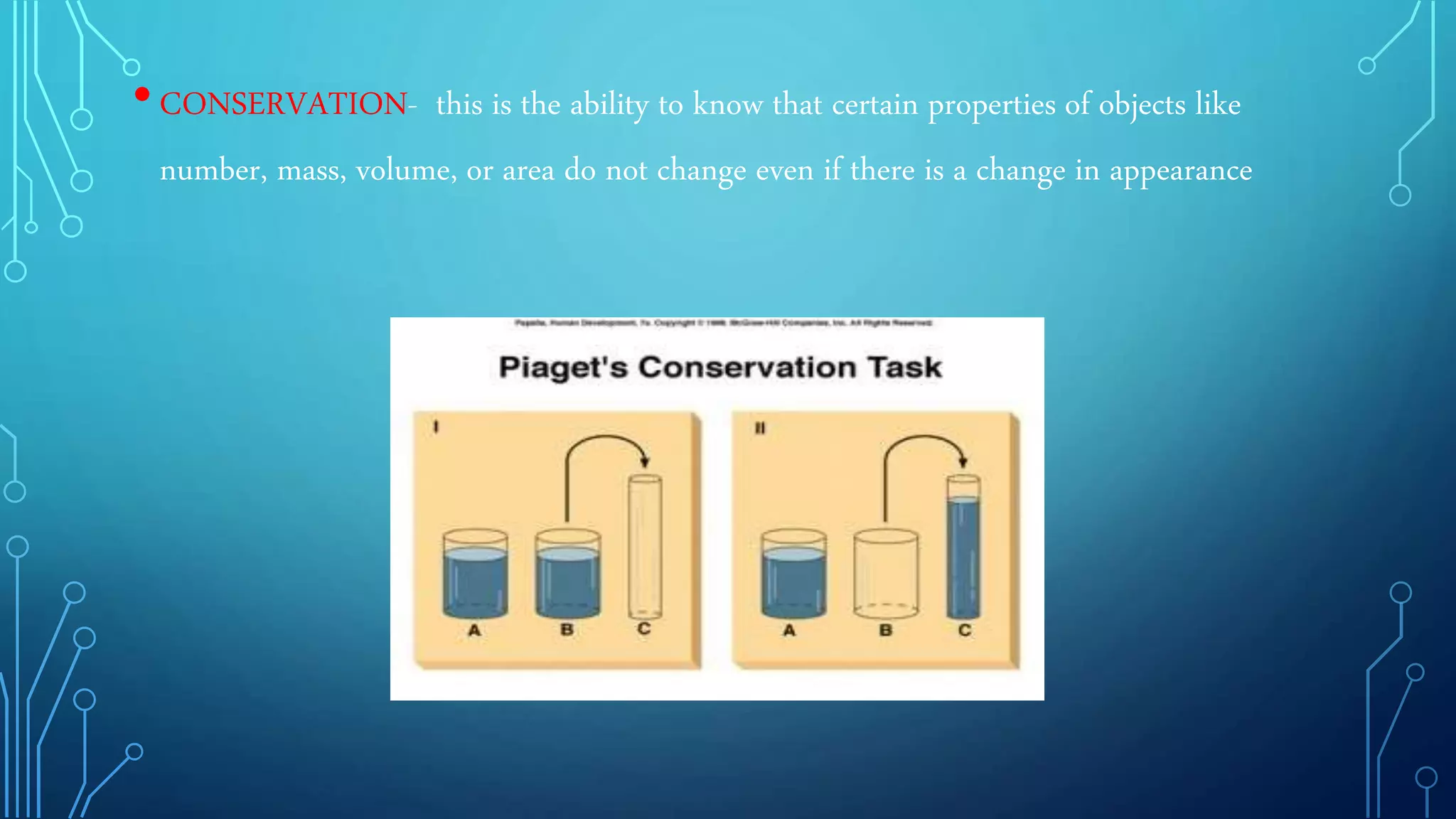
•CONSERVATION- this is the ability to know that certain properties of objects like
number, mass, volume, or area do not change even if there is a change in appearance
Stage 3: Formal Operational Stage
STAGE 4- FORMAL OPERATIONAL STAGE
•begins around 12 and is fully achieved at age if 15
•thinking becomes more logical
•they can now solve abstract problems and can hypothesize
CHARACTERISTICS OF FORMAL OPERATIONAL STAGE
•HYPOTHETICAL REASONING- this is the ability to come up with different
hypothesis about a problem and to gather and weigh data in order to make a final
decision or judgment
the individuals can now deal with “what if” questions
•ANALOGICAL REASONING- the ability to perceive the relationship in one instance
and then use that relationship to narrow down possible answers in another similar
situation or problem
the individual in the formal operations stage can make an analogy
•DEDUCTIVE REASONING- this is the ability to think logically by applying a general
rule to a particular instance or situation
Example: All countries near the north pole have cold temperatures. Greenland is near the
north pole . Therefore, Greenland has cold temperature.
From Piaget’ s findings and comprehensive theory, we can derive the following principles:
1. Children will provide different explanations of reality at different
stages of cognitive development
2. Cognitive development is facilitated by providing activities or
situations that engage learners and require adaptation
3. Learning materials and activities should involve the appropriate
level of motor or mental operations for a child of given age; avoid
asking students to perform tasks that are beyond their current
cognitive capabilities
4. Use teaching methods that actively involve students and present
challenges
THANK YOU!

Piaget's Cognitive Development Theory

  • 1.
    PIAGET’S STAGES OFCOGNITIVE DEVELOPMENT
  • 2.
    WHO WAS JEANPIAGET? •Jean Piaget was born in 1896 in Neuchâtel, Switzerland, and died in 1980 in Geneva, Switzerland. •At age 11, he wrote a paper on an albino sparrow, which was published and was the start of his famous career.
  • 3.
    • After graduatinghigh school, he attended the University of Zurich, where he became interested in psychoanalysis. • He married in 1923 and had three children, Jacqueline, Lucienne and Laurent. • Piaget studied his children’s intellectual development from infancy. • While studying his children, Piaget developed theories concerning how children learn. • His theory of Cognitive Development consists of four stages of intellectual development.
  • 4.
  • 5.
    SCHEMA it refers tothe cognitive structures by which individuals intellectually adapt to and organize their environment it is an individual’s way to understand or create meaning about a thing or experience a representation of a plan or theory in the form of an outline or model.
  • 6.
    ASSIMILATION is the processof fitting a new experience into an existing or previously created cognitive structure or schema simply the process of incorporating new information into a pre- existing schema.
  • 8.
    ACCOMMODATION is the processof creating a new schema
  • 9.
    EQUILIBRATION it is achievingproper balance between assimilation and accommodation when our experiences do not match our schemata or cognitive structures, we experience cognitive disequilibrium. This means there is a discrepancy between what is perceives and what is understood
  • 10.
    PIAGET’S STAGES OFCOGNITIVE DEVELOPEMENT •1. SENSORI-MOTOR STAGE •2. PRE-OPERATIONAL STAGE •3. CONCRETE-OPERATIONAL STAGE •4. FORMAL OPERATIONAL STAGE
  • 12.
  • 13.
    STAGE 1- SENSORI-MOTORSTAGE • from birth to infancy • this is the stage when a child who is initially reflexive in grasping, sucking and reaching becomes more organized in his movement and activity • the word sensori-motor focuses on the prominence of the senses and muscle movement • Characterized by: object permanence- the ability of the child to know that an object still exists even when out of sight
  • 14.
    The child usesonly innate reflexes. For example, if a nipple or dummy is put into a baby’s mouth, they will reflexively suck on it. If an object is placed in their palm, the hand will automatically grab it. These reflexes have the sole function of keeping the child alive. 1. Reflexes (0-1 month)
  • 15.
    The child nowhas a fixation with it’s own body with regards to behavior(what Piaget refers to as primary behavior); they will perform actions repeatedly on themselves (like sucking their own hand). They also begin to refine reflexes here to form more complex versions of them. 2. Primary Circular Actions (1-4 months)
  • 16.
    They notice thatthey can actually influence events in their world, for example they can drop a teddy which bashes a ball on the floor. Although this occurs, the infant will not make conscious connections between what they do and the consequences, they merely observe that their actions have interesting effects. At around 4 months, the child begins to take an interest in their environment (their behavior 3. Secondary Circular Reactions (4-8 months)
  • 17.
    At this point,the child begins to engage in goal-directed behavior; they begin to develop cause-effect relationships. So rather than crawl over to a teddy in a cart to pick it up, they might instead pull the cart over with the teddy in to acquire it. The child effectively knows that their behavior will have a certain consequence. At this stage, object permanence is acquired object permanence- the ability of the child to know that an object still exists even when out of sight 4. Coordination of Secondary Circular Reactions (8-12 months)
  • 18.
    At this stage,children like to use creativity and flexibility with their previous behaviors, and the result of their experimentation often leads to different outcomes. So rather than grabbing a box, they might instead try to tilt or manipulate it. 5. Tertiary Circular Reactions (12-18 months)
  • 19.
    At this stage,the child develops symbolic thought and the ability to mentally represent objects in their head. Normally, the child would need to resort to trial-and-error to achieve a desired effect. Now, however, the child can ‘plan’ to some extent and mentally construct the consequences of an action in their head. Of course, predictions are not always accurate, but it is a step up from trial-and-error. 6. Symbolic/Mental Representation (18-24 months)
  • 20.
  • 21.
    STAGE 2- PRE-OPERATIONALSTAGE •children usually go through this stage between the age of two to seven years old. •at this stage the child can now make mental representations and is able to pretend •the child is now ever closer to the use of symbols •learns to use language and to represent objects by images and words
  • 22.
    This stage ishighlighted with the following: •SYMBOLIC FUNCTION- is the ability to represent objects and events. a symbol is a thing that represents something else • EGOCENTRISM- this is the tendency of the child to only see his point of view and to assume that everyone also has his same point of view.
  • 23.
    •CENTRATION- refers tothe tendency of the child to only focus on one aspect of a thing or event and exclude other aspects •IRREVERSIBILITY- refers to inability to reverse thinking •ANIMISM- refers to the tendency of the child to attribute human like traits or characteristics to inanimate objects •TRANSDUCTIVE REASONING- refers to the pre-operational child’s type of reasoning that is neither inductive or deductive
  • 24.
    Stage 3: ConcreteOperational Stage
  • 25.
    STAGE 3- CONCRETE-OPERATIONALSTAGE • covers the ages between 8-11 years old • characterized by the ability of the child to think logically but only in terms of concrete objects • achieves conservation of number (age 6), mass (age 7), and weight (age 9) • classifies objects according to several features and can order them in series along a single dimension such as size
  • 26.
    •DECENTRING- this refersto the ability of the child to perceive the different features of objects and situations no longer is the child focused or limited to one aspect or dimension •REVERSIBILITY- during this stage the child can now follow that certain operations can be done in reverse •SERIATION- this is the ability to order or arrange things in a series based on one dimension such as weight, volume or size
  • 27.
    •CONSERVATION- this isthe ability to know that certain properties of objects like number, mass, volume, or area do not change even if there is a change in appearance
  • 28.
    Stage 3: FormalOperational Stage
  • 29.
    STAGE 4- FORMALOPERATIONAL STAGE •begins around 12 and is fully achieved at age if 15 •thinking becomes more logical •they can now solve abstract problems and can hypothesize
  • 30.
    CHARACTERISTICS OF FORMALOPERATIONAL STAGE •HYPOTHETICAL REASONING- this is the ability to come up with different hypothesis about a problem and to gather and weigh data in order to make a final decision or judgment the individuals can now deal with “what if” questions •ANALOGICAL REASONING- the ability to perceive the relationship in one instance and then use that relationship to narrow down possible answers in another similar situation or problem the individual in the formal operations stage can make an analogy
  • 31.
    •DEDUCTIVE REASONING- thisis the ability to think logically by applying a general rule to a particular instance or situation Example: All countries near the north pole have cold temperatures. Greenland is near the north pole . Therefore, Greenland has cold temperature.
  • 32.
    From Piaget’ sfindings and comprehensive theory, we can derive the following principles: 1. Children will provide different explanations of reality at different stages of cognitive development 2. Cognitive development is facilitated by providing activities or situations that engage learners and require adaptation 3. Learning materials and activities should involve the appropriate level of motor or mental operations for a child of given age; avoid asking students to perform tasks that are beyond their current cognitive capabilities 4. Use teaching methods that actively involve students and present challenges
  • 33.