Jean Piaget
COGNITIVE DEVELOPMENT
Ani Vadakke Purayil
M.Com, M.Ed. NET(Com),NET(Edu),SET
Faculty
Department of Teacher Education
Kannur University
Kannur, Kerala.
anivpknr@gmail.com
mage courtesy: JGI/Jamie Grill / Blend Images / Getty Images
Cognition
The term cognition is derived from the Latin word
“cognoscere” which means “to know” or “to
recognise” or “to conceptualise”.
It refers to the mental processes by an organism learns,
remembers, understands, perceives, solves problems
and thinks about a body of information.
Cognition progresses in stages with increasing levels of
complexity and hence the phrase “cognitive
development” which is the stages a child goes through
conceptualizing the world at different age levels.
Cognition refers to all activity, processes, and products of
the mind.
Cognitive Development
The term cognitive development refers to the
process of growth and change in
intellectual/mental abilities such as thinking,
reasoning and understanding.
Cognitive development is a field of study in
neuroscience and psychology focusing on a
child's development in terms of information
processing, conceptual resources, perceptual
skill, language learning, and other aspects of
brain development
It includes the acquisition and consolidation of
knowledge. Infants draw on social-emotional,
language, motor, and perceptual experiences and
abilities for cognitive development.
Cognitive development is the construction of
thought processes, including remembering,
problem solving , and decision-making, from
child hood through adolescence to adulthood
It refers to how a person perceives, thinks, and
gains understanding of his or her world
through the interaction of genetic and learned
factors.
Among the areas of cognitive development are
information processing, intelligence ,
reasoning , language development and
memory .
They are attuned to relationships between
features of objects, actions, and the physical
environment. But they are particularly
attuned to people.
Parents, family members, friends, teachers, and
caregivers play a vital role in supporting the
cognitive development of infants by providing
the healthy interpersonal or social-emotional
context in which cognitive development
unfolds
Cognitive Development describes how these
mental processes develop from birth until
adulthood.
The acquisition of the ability to think, reason,
and problem solve.
It is the process by which people's thinking
changes across the life span.
Cognitive Development is gradual orderly,
changes by which mental process become
more complex and sophisticated
Piaget’s Developmental Psychology
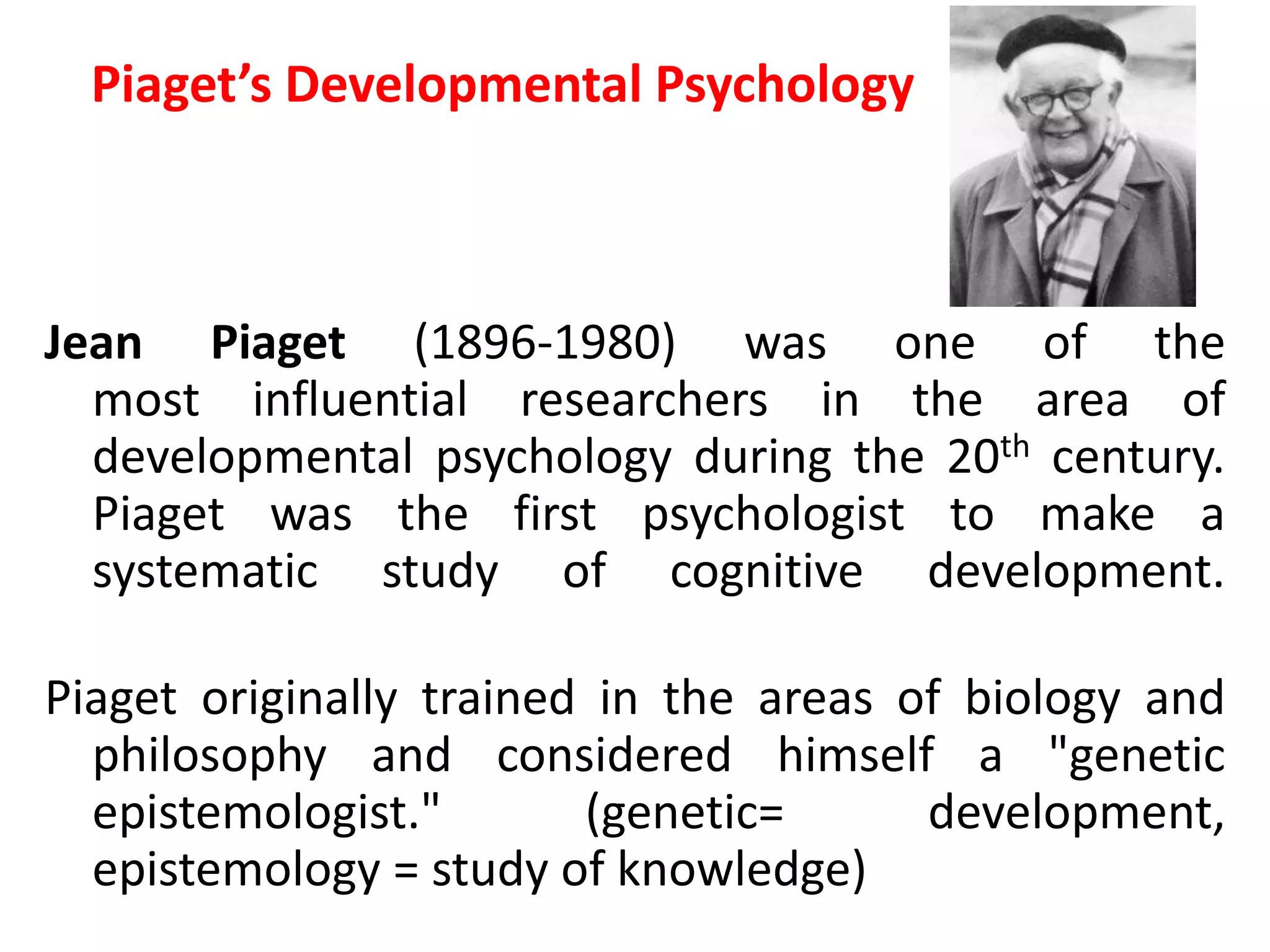
Jean Piaget (1896-1980) was one of the
most influential researchers in the area of
developmental psychology during the 20th century.
Piaget was the first psychologist to make a
systematic study of cognitive development.
Piaget originally trained in the areas of biology and
philosophy and considered himself a "genetic
epistemologist." (genetic= development,
epistemology = study of knowledge)
He was mainly interested in the biological
influences on "how we come to know." He
believed that what distinguishes human beings
from other animals is our ability to do "abstract
symbolic reasoning.“
According to Piaget, children are born with a very
basic mental structure (genetically inherited
and evolved) on which all subsequent learning
and knowledge is based.
Piaget designed a proper framework to understand the
structure , functioning and development of the
cognitive network of the human mind. He pointed
that there are two aspects of human mind :
cognitive structure and cognitive functioning
The development of human intellectual abilities take
place as a result of the organization and
reorganization of certain pattern of behaviour called
schema . Schemas constitute the structural units of
human mind i.e., cognitive structure
The process of organisation of theses structural units
take place by three different activities –assimilation ,
accommodation and equilibration. These activities
constitute the functional aspects of human mind.
• Piaget studied cognitive development by
observing children in particular, to examine how
their thought processes change with age.
• He pioneered a way of thinking about how
children grow psychologically.
• It is the growing apprehension and adaptation
to the physical and social environment.
• Piaget rejected the idea that learning was the
passive assimilation of the knowledge.
• He proposed that learning is dynamic process
comprising successive stages of adaptation to
reality.
The essential development of cognition is the
establishment of new schemes. Assimilation and
accommodation are both processing of the ways
of cognitive development. The equilibration is
the symbol of a new stage of the cognitive
development.
Basic assumptions of Development
• A person has hereditary organic reactions
• He is naturally active
• He is born without mind
• He Needs to adapt to environment
• To adapt, he organizes thinking into
Structures (schemas)
Constructivist Approach
Jean Piaget’s theory remains the standard against which all other theories are
judged and often labeled constructivist because it depicts children as
constructing knowledge for themselves .
Piaget’s theory is often described as a constructivist view. According to
constructivists, people interpret their environments and experiences in
light of the knowledge and experiences they already have. People do not
simply take in an external reality and develop an unchanged, exact mental
copy of objects or events. Instead, they build (or “construct”) their own
individual understandings and knowledge.
Individuals construct their own knowledge during the course of interaction
with the environment. Thinking is an active process whereby people
organize their perceptions of the world
Children are seen as
• Active
• Learning many important lessons on their own
• Intrinsically motivated to learn
• Generating hypotheses, performing experiments, drawing conclusions
.
Schemas
• Schemas are the basic structural units of human
mind . They constitute patterns of behaviour that an
individual use in dealing with objects in his
environment . Piaget called the schema the basic
building block of intelligent behavior – a way of
organizing knowledge.
• A schema can be defined as a set of linked mental
representations of the world, which we use both to
understand and to respond to situations.
• Schemas are mental or cognitive structures which
enables a person to adapt and to organise the
environment.
• Schemas are categories of knowledge that help us
to interpret and understand the world.
• For example, at birth the schema of a baby is
reflexive in nature such as sucking and grasping.
The sucking reflex is a schema and the infant will
suck on whatever is put in its mouth such as a
nipple or a finger.
• The infant is unable to differentiate because it
has only a single sucking schema. Slowly, the
infant learns to differentiate where milk-
producing objects are accepted while non-milk
objects are rejected.
• At this point, the infant has two sucking
schemas, one for milk-producing objects and one
for non-milk producing objects.
Assimilation
• Assimilation is using an existing schema to deal with a new object
or situation. The process of taking in new information into our
previously existing schema’s is known as assimilation. Assimilation
which is using an existing schema to deal with a new object or
situation.
• It is the process of taking in new information into our already
existing schemas is known as assimilation. The process is somewhat
subjective because we tend to modify experiences and information
slightly to fit in with our preexisting beliefs
It’s a kind of matching between the already existing cognitive structure
and the environmental needs as they arise.
• Eg: A child sees a Donkey for the first time and immediately calls it
a Horse. Thus, the child has assimilated into his schema that this
animal is a Horse.
• Another example of assimilation would be when an infant uses a
sucking schema that was developed by sucking on a small bottle
when attempting to suck on a larger bottle.
Accommodation
Accommodation involves modifying existing
schemas, or ideas, as a result of new
information or new experiences. New
schemas may also be developed during this
process.
• The boy who had assimilated the Donkey as a
Horse will eventually accommodate more
information and thus realize the different
characteristics between a Horse and a Donkey.
The child will learn that the Donkey is not a
Donkey but a Horse, an accommodated ability.
Equilibration
According to Piaget’s theory , optimal level of
intellectual functioning take s place when there is
a balance between assimilation and
accommodation. This process of maintaining
this balance is termed as Equilibration. The
cognitive structure change from one stage to
another by the process of equilibration,
maintaining child and his changing environment.
As children progress through the stages of cognitive
development, it is important to maintain a
balance between applying previous knowledge
(assimilation) and changing behavior to account
for new knowledge (accommodation).
Equilibration helps explain how children can
move from one stage of thought into the next
Adaptation:
• Assimilation and accommodation are the two
sides of adaptation. It is the ability of the
person to adjust to the environment and to
interact with it.
• It’s a process that takes place through direct
interaction with the environment.
• Adaptation occurs as a result of two
complementary processes, Assimilation and
Accommodation.
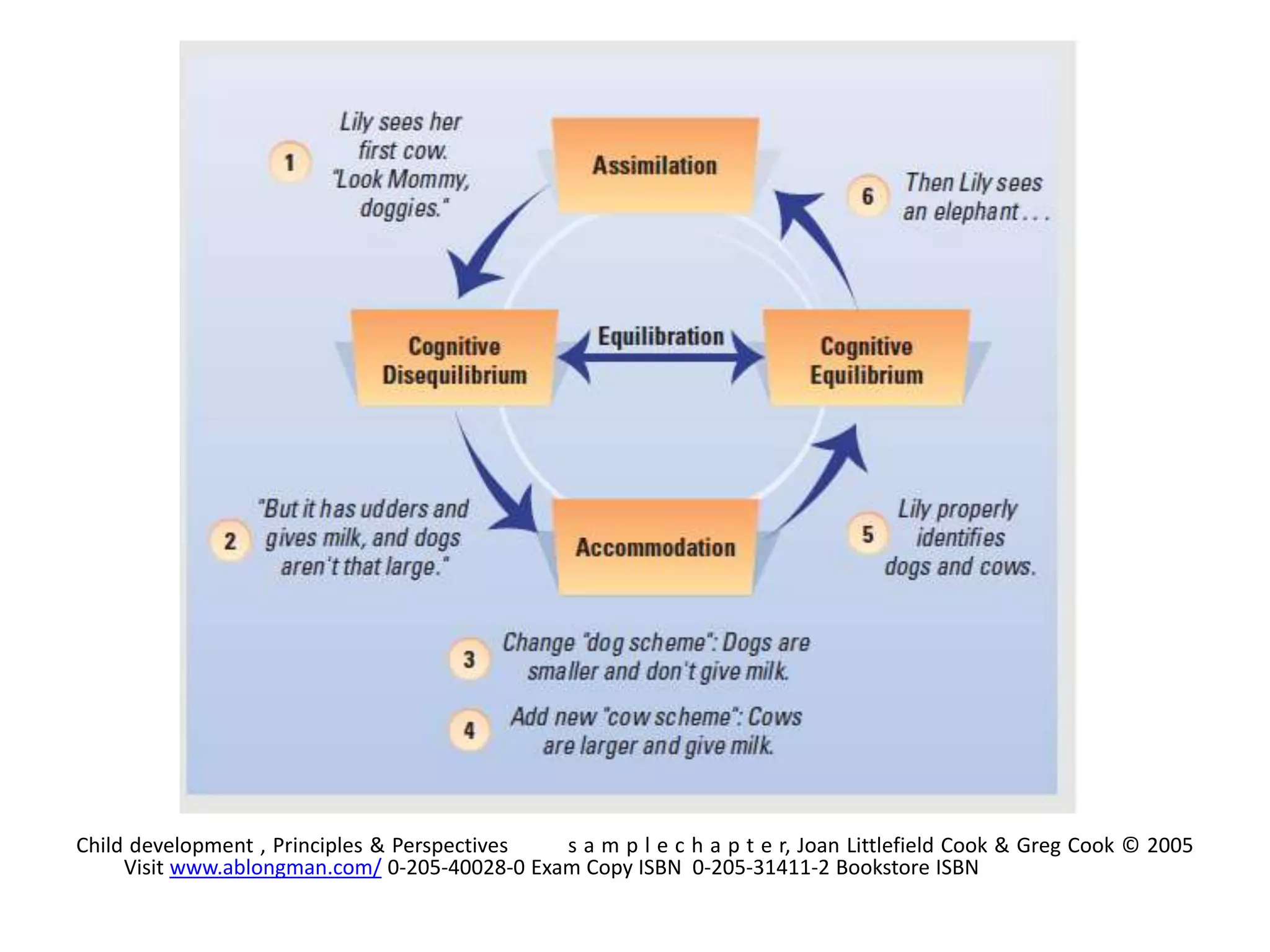
In the cycle of adaptation and equilibration, a
new experience is first assimilated into an
existing scheme. If it doesn’t fit properly,
cognitive disequilibrium results.
Accommodating (adjusting) the scheme brings
the child to cognitive equilibrium, until a new
assimilation challenges the scheme again.
Child development , Principles & Perspectives s a m p l e c h a p t e r, Joan Littlefield Cook & Greg Cook © 2005
Visit www.ablongman.com/ 0-205-40028-0 Exam Copy ISBN 0-205-31411-2 Bookstore ISBN
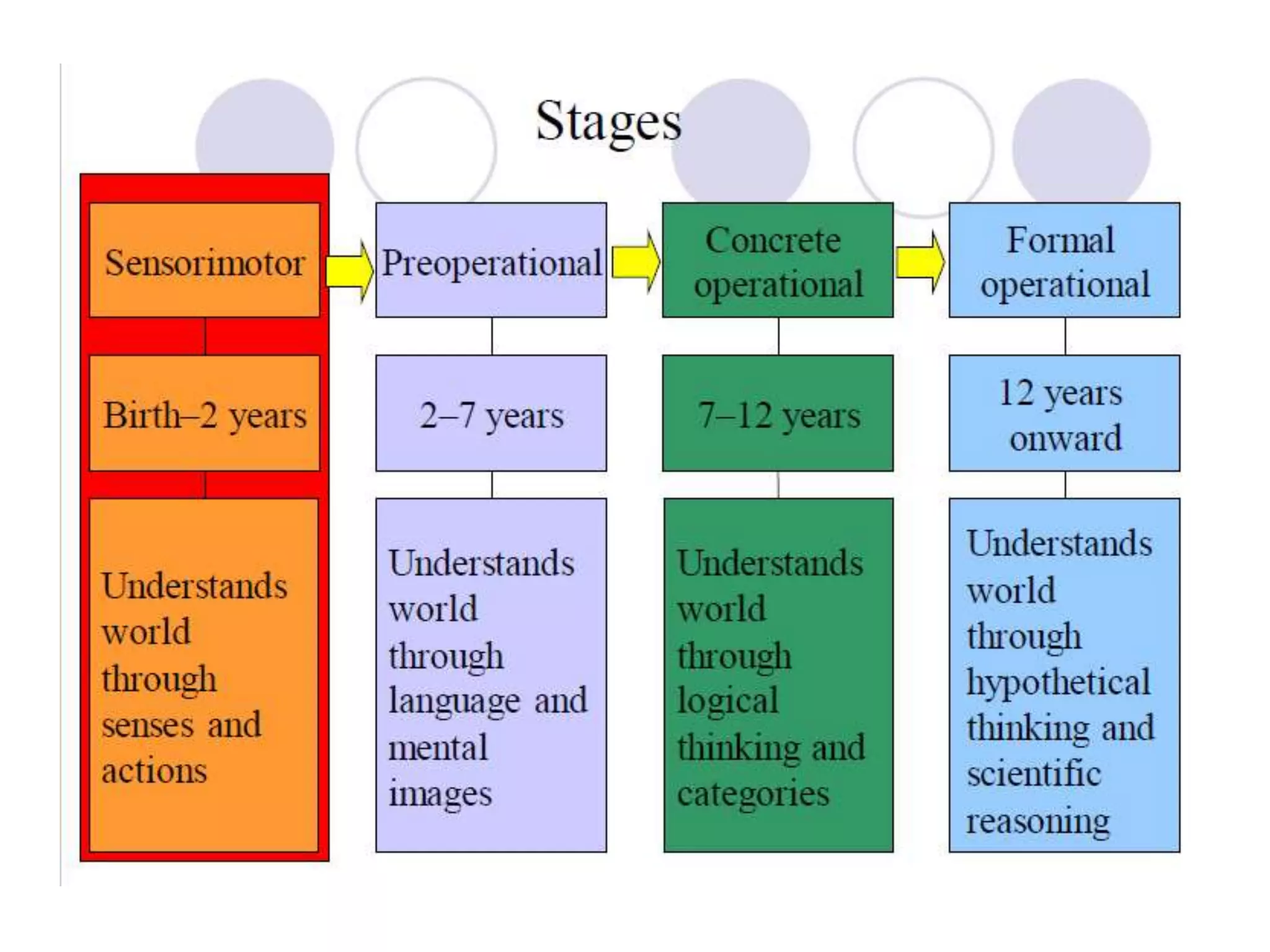
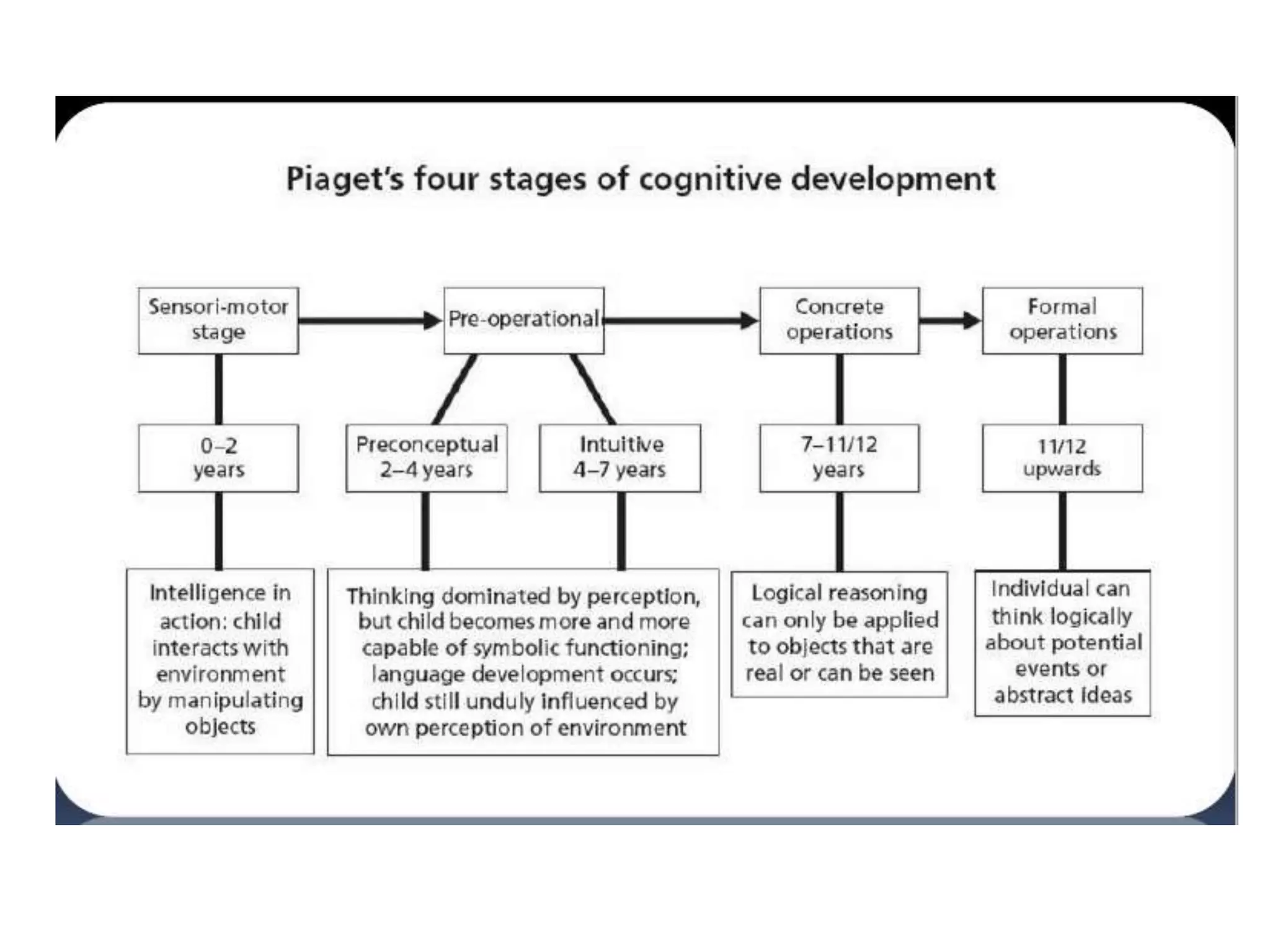
Piaget’s Stages of Cognitive Development
• 1.Sensorimotor Stage
• 2.Preoperational Stage
• 3.Concrete Operational Stage
• 4.Formal Operational Stage
Stage 1: Sensorimotor Thought (Birth to 2 Years)
The first stage of Piaget’s theory starts from birth
to approximately age 2 and is centered on the
infant trying to make sense of the world. During
this stage, the child's knowledge is limited to
sensory perceptions and simple motor activities.
e.g. looking, sucking, grasping.
Sub-stages of the Sensorimotor Stage:
It can be divided into 6 separate sub-stages.
According to Piaget, infants can engage only in
sensorimotor thought. That is, they know the world
only in terms of their own sensory input (what they
can see, smell, taste, touch, and hear) and their
physical or motor actions on it (e.g., sucking,
reaching, and grasping). They do not have internal
mental representations of the objects and events
that exist outside their own body.
• Representational, symbolic thought gradually
emerges as the stage progresses.
• Object permanence develops as the stage
progresses.
1. Reflexes (0-1 month): In the first month of life,
infants’ behaviors reflect innate reflexes—automatic
responses to particular stimuli. The child
understands the environment purely through inborn
reflexes such as suckling, grasping, knee-jerking.
These are the reactive functions that infants
essentially exit the womb with.
2. Primary Circular Reactions (1-4 months): It
involves coordinating sensation and new schemas. In
the first few months of life, infants’ behaviors are
focused almost exclusively on their own bodies (in
Piaget’s terminology, the behaviors are primary) and
are repeated over and over again (i.e., they are
circular). Infants also begin to refine their reflexes
and combine them into more complex actions.
3. Secondary Circular Reactions (4-8 months): In this stage the
child become more aware of and more responsive to the
outside world (their behaviors become secondary), and they
begin to notice that their behaviors can have interesting effects
on the objects around them. The child becomes more focused
on the world and begins to intentionally repeat an action in
order to trigger a response in the environment.
4. Coordination of Reactions (8-12 months): The child starts to
show clearly intentional actions. The child may also combine
schemas in order to achieve a desired effect. After repeatedly
observing that certain actions lead to certain consequences,
infants gradually acquire knowledge of cause-effect
relationships.
• Object Permanence
Another acquisition at this sub-stage is object permanence,
means knowing that an object still exists, even if it is hidden.
According to Piaget, Object Permanence is a child's awareness
or understanding that objects continue to exist even though
they cannot be seen or heard.
5. Tertiary Circular Reactions (12-18 months): Piaget
believed this marks the developmental starting
point for curiosity and interest in novelty.
• For example: A child may try out different sounds or
actions as a way of getting attention from a
caregiver.
6. Early Representational Thought (18-24 months):
• Piaget proposed that in the latter half of the second
year, young children develop symbolic thought, the
ability to represent and think about objects and
events in terms of internal, mental entities, or
symbols.
• They may “experiment” with objects in their minds,
first predicting what will happen if they do
something to an object, then transforming their
plans into action.
Preoperational Stage (2 to 7 yrs) (Toddler and Early Childhood)
• Piaget’s second stage, preoperational thought, features the flourishing
use of mental representations and the beginnings of logic (intuitive
thought).
• This stage begins when the child starts to use symbols and language.
This is a period of developing language and concepts. So, the child is
capable of more complex mental representations i.e. words and images.
He is still unable to use ‘operations’, i.e. logical mental rules, such as the
rules of arithmetic. It is divided into two sub-stages:
• 1. Preconceptual stage (2 to 4 years): Here, cognitive development
becomes increasingly dominated by symbolic activity. The child can use
symbols to stand for actions; a toy doll stands for a real baby or the
child role-plays mummy or daddy. Language also develops during this
stage. According to Piaget, language development is based on children’s
mental representational ability—their ability to let a symbol (e.g., a
word) stand for an object in the environment.
• 2. Intuitive stage (5 to 7 years): This stage is characterized by the way in
which children base their knowledge on what they feel or sense to be
true, yet they cannot explain the underlying principles behind what they
feel or sense.
• The following are the key features of this stage:
• 1. Egocentrism: The child’s thoughts and communications
are typically egocentric i.e. about themselves or his/her
point of view. It is the inability to see the world through
anyone else’s eyes except on his own. According to Piaget,
the egocentric child assumes that other people see, hear,
and feel exactly the same as the child does.
• 2. Animism: Treating inanimate objects as living ones. E.g.:
Children bathing, dressing and feeding their dolls as if they
are alive.
• 3. Centration: It refers to the tendency to focus on only
one aspect of a situation, problem or object, and so
cannot see the big picture. Centration is noticed in
conservation: the awareness that altering a substance's
appearance does not change its basic properties. Children
at this stage are unaware of conservation.
• Symbols in Artwork.
• Preoperational children’s increasing ability to use mental
representation is also seen clearly in the artwork they produce. To
produce such artwork, the child must have mental representations
• Pretend (or symbolic) Play
• Toddlers often pretend to be people they are not (e.g. superheroes,
policeman), and may play these roles with props that symbolize real
life objects. Children may also invent an imaginary playmate.
• Watch children engaged in play, and you will soon see clear evidence of
symbol use. In symbolic play children use one object to stand for
another, such as when they pretend that a blanket is a magic carpet or
a banana is a telephone.
• Artificialism
• This is the belief that certain aspects of the environment are
manufactured by people (e.g. clouds in the sky).
• Irreversibility
• This is the inability the reverse the direction of a sequence of events to
their starting point.
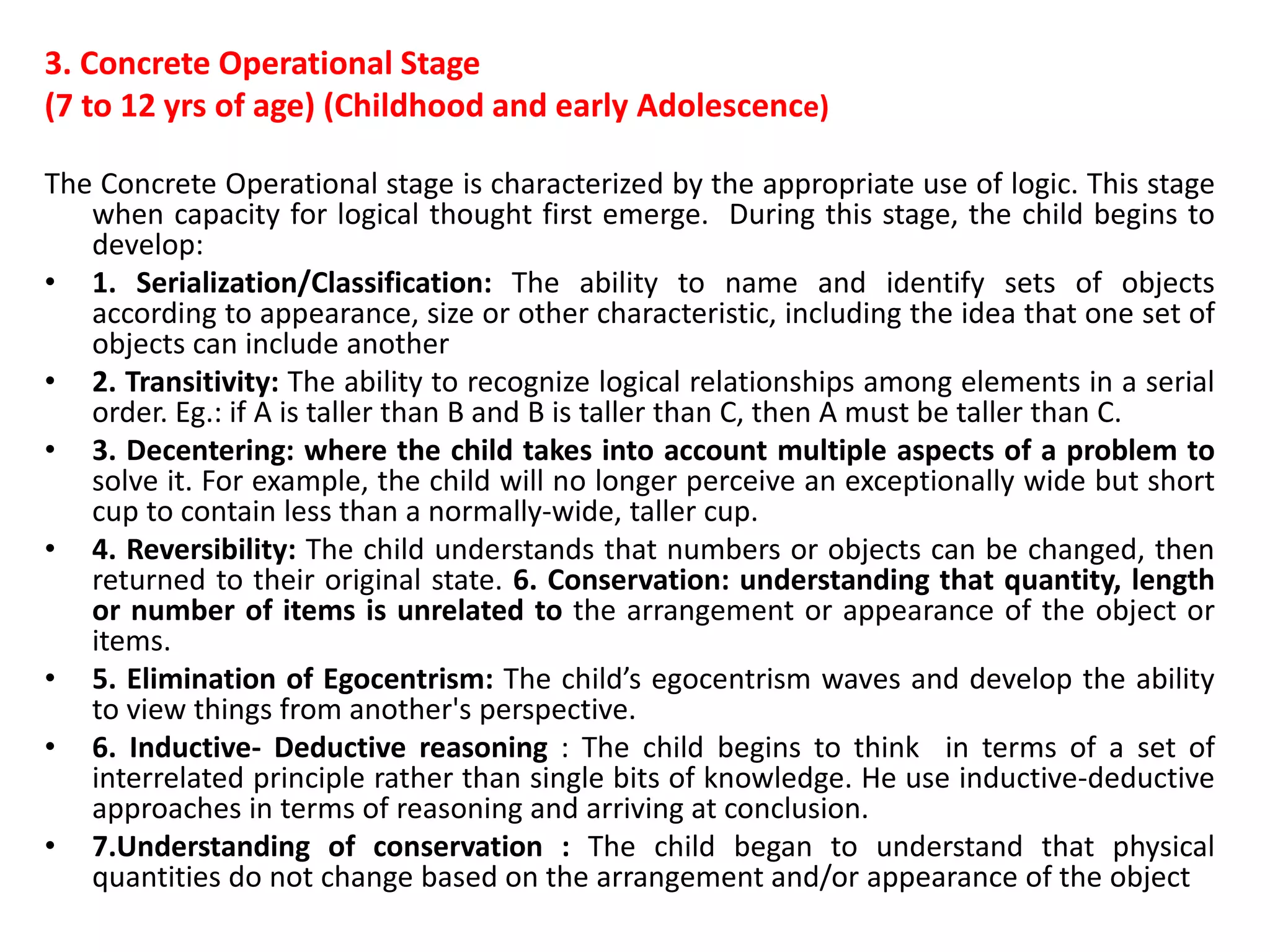
Conservation refers to the idea that a quantity remains the same despite changes in
appearance. At this stage, capabilities for logical reasoning are limited and the child’s
thought processes are dominated by the immediate sensory impressions. This
characteristic can be illustrated by asking the child to solve a liquid conservation
problem
3. Concrete Operational Stage
(7 to 12 yrs of age) (Childhood and early Adolescence)
The Concrete Operational stage is characterized by the appropriate use of logic. This stage
when capacity for logical thought first emerge. During this stage, the child begins to
develop:
• 1. Serialization/Classification: The ability to name and identify sets of objects
according to appearance, size or other characteristic, including the idea that one set of
objects can include another
• 2. Transitivity: The ability to recognize logical relationships among elements in a serial
order. Eg.: if A is taller than B and B is taller than C, then A must be taller than C.
• 3. Decentering: where the child takes into account multiple aspects of a problem to
solve it. For example, the child will no longer perceive an exceptionally wide but short
cup to contain less than a normally-wide, taller cup.
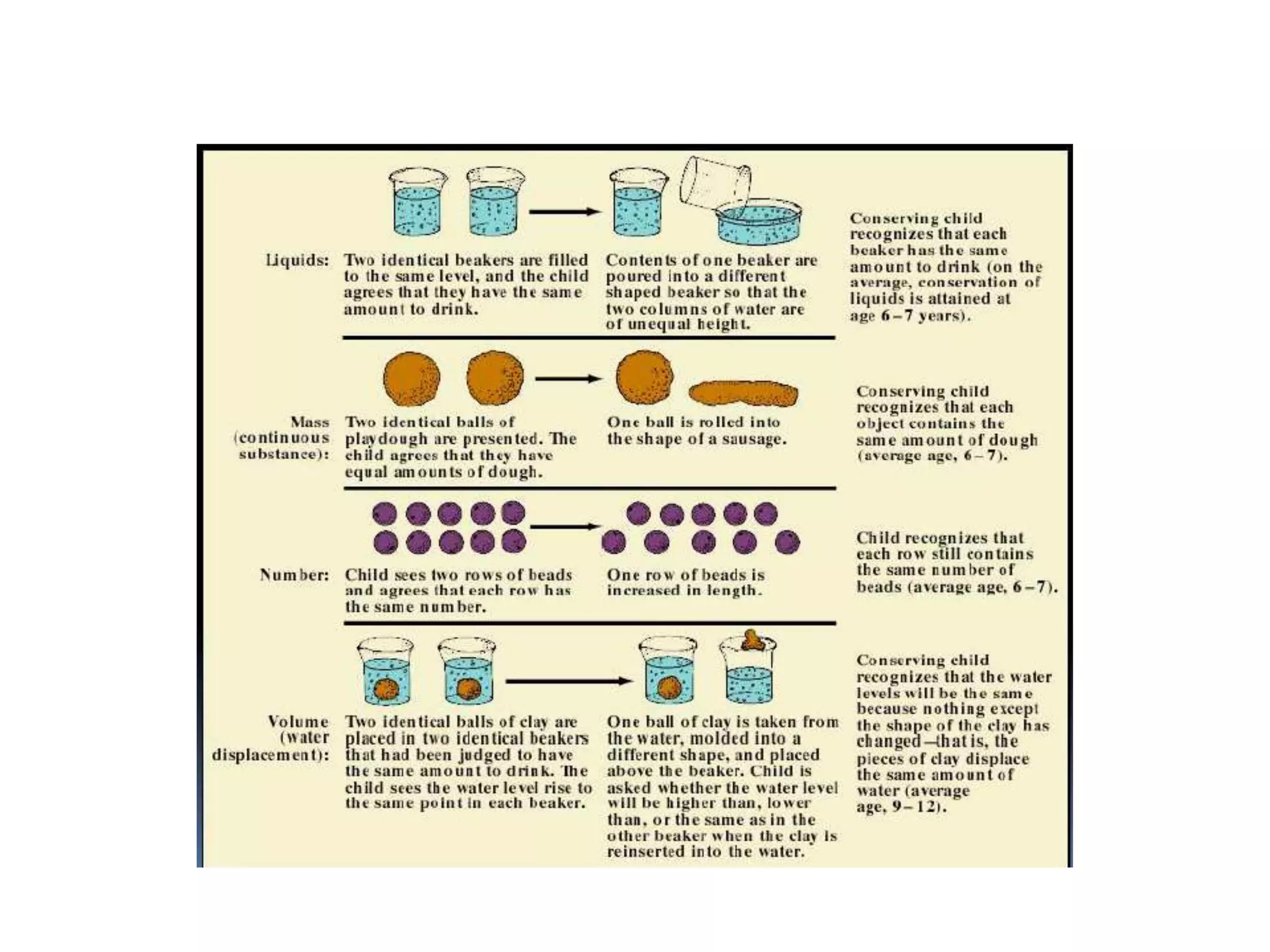
• 4. Reversibility: The child understands that numbers or objects can be changed, then
returned to their original state. 6. Conservation: understanding that quantity, length
or number of items is unrelated to the arrangement or appearance of the object or
items.
• 5. Elimination of Egocentrism: The child’s egocentrism waves and develop the ability
to view things from another's perspective.
• 6. Inductive- Deductive reasoning : The child begins to think in terms of a set of
interrelated principle rather than single bits of knowledge. He use inductive-deductive
approaches in terms of reasoning and arriving at conclusion.
• 7.Understanding of conservation : The child began to understand that physical
quantities do not change based on the arrangement and/or appearance of the object
4 Formal Operational Stage
(from 12 yrs and up) (Adolescence and Adulthood)
This is the most complete stage of development. Ability to deal
with abstract concepts and abstract reasoning develops by about
age 11. Intellectually the child can and should be treated as an
adult. The high order intellectual development/functioning is
occurred in this stage . According Piaget , after the expiry of the
formal operation stage the child may reach full intellectual
potential.
•Successful communication, in other words, requires a feel for
the child’s stage of intellectual development.
•They are now aware that others think, but usually, in new
expressions of egocentrism, presume that they and others are
thinking about the same thing. Because young adolescents are
experiencing tremendous biologic changes in growth and sexual
development, they are preoccupied with these events.
In this stage, the individual’s
• At this stage, the adolescent or young adult begins to think
abstractly and reason about hypothetical problems.
• Teens begin to think more about moral, philosophical,
ethical, social, and political issues that require theoretical
and abstract reasoning.
• Begin to use deductive logic, or reasoning from a general
principle to specific information.
• thought becomes increasingly flexible and abstract, i.e., can
carry out systematic experiments.
• ability to systematically solve a problem in a logical and
methodical way.
• Understand that nothing is absolute; everything is relative.
• Understand that the rules of any games or social system are
developed by man by mutual agreement and hence could
be changed or modified.
Educational Implications:
• Piaget’s theory provides valuable information and advice on curriculum planning and
structuring the schemas.
• Learning and development are the net result of interaction between a persons cognitive
structure and functioning of their children. This type of knowledge may prove quite
beneficial to them in dealing with the children and planning their training and education
• It focus on child centered education by giving educational experience suitable to learners
cognitive structure
• Useful in providing learning experiences in tune with the mental abilities of the child.
• Emphasis on discovery approach in learning.
• Curriculum should provide specific educational experience based on children’s
developmental level.
• Arrange classroom activities so that they assist and encourage self-learning.
• Do not treat children as miniature adults; they think and learn differently from adults.
• Practical learning situations.
• Simple to Complex and Project method of teaching.
• Co-curricular activities have equal importance as that of curricular experiences in the
cognitive development of children.
• Major goals of education are equal to the creative and critical thinking.

Cognitive development Piaget

  • 1.
    Jean Piaget COGNITIVE DEVELOPMENT AniVadakke Purayil M.Com, M.Ed. NET(Com),NET(Edu),SET Faculty Department of Teacher Education Kannur University Kannur, Kerala. anivpknr@gmail.com mage courtesy: JGI/Jamie Grill / Blend Images / Getty Images
  • 2.
    Cognition The term cognitionis derived from the Latin word “cognoscere” which means “to know” or “to recognise” or “to conceptualise”. It refers to the mental processes by an organism learns, remembers, understands, perceives, solves problems and thinks about a body of information. Cognition progresses in stages with increasing levels of complexity and hence the phrase “cognitive development” which is the stages a child goes through conceptualizing the world at different age levels. Cognition refers to all activity, processes, and products of the mind.
  • 3.
    Cognitive Development The termcognitive development refers to the process of growth and change in intellectual/mental abilities such as thinking, reasoning and understanding. Cognitive development is a field of study in neuroscience and psychology focusing on a child's development in terms of information processing, conceptual resources, perceptual skill, language learning, and other aspects of brain development It includes the acquisition and consolidation of knowledge. Infants draw on social-emotional, language, motor, and perceptual experiences and abilities for cognitive development.
  • 4.
    Cognitive development isthe construction of thought processes, including remembering, problem solving , and decision-making, from child hood through adolescence to adulthood It refers to how a person perceives, thinks, and gains understanding of his or her world through the interaction of genetic and learned factors. Among the areas of cognitive development are information processing, intelligence , reasoning , language development and memory .
  • 5.
    They are attunedto relationships between features of objects, actions, and the physical environment. But they are particularly attuned to people. Parents, family members, friends, teachers, and caregivers play a vital role in supporting the cognitive development of infants by providing the healthy interpersonal or social-emotional context in which cognitive development unfolds
  • 6.
    Cognitive Development describeshow these mental processes develop from birth until adulthood. The acquisition of the ability to think, reason, and problem solve. It is the process by which people's thinking changes across the life span. Cognitive Development is gradual orderly, changes by which mental process become more complex and sophisticated
  • 7.
    Piaget’s Developmental Psychology JeanPiaget (1896-1980) was one of the most influential researchers in the area of developmental psychology during the 20th century. Piaget was the first psychologist to make a systematic study of cognitive development. Piaget originally trained in the areas of biology and philosophy and considered himself a "genetic epistemologist." (genetic= development, epistemology = study of knowledge)
  • 8.
    He was mainlyinterested in the biological influences on "how we come to know." He believed that what distinguishes human beings from other animals is our ability to do "abstract symbolic reasoning.“ According to Piaget, children are born with a very basic mental structure (genetically inherited and evolved) on which all subsequent learning and knowledge is based.
  • 9.
    Piaget designed aproper framework to understand the structure , functioning and development of the cognitive network of the human mind. He pointed that there are two aspects of human mind : cognitive structure and cognitive functioning The development of human intellectual abilities take place as a result of the organization and reorganization of certain pattern of behaviour called schema . Schemas constitute the structural units of human mind i.e., cognitive structure The process of organisation of theses structural units take place by three different activities –assimilation , accommodation and equilibration. These activities constitute the functional aspects of human mind.
  • 10.
    • Piaget studiedcognitive development by observing children in particular, to examine how their thought processes change with age. • He pioneered a way of thinking about how children grow psychologically. • It is the growing apprehension and adaptation to the physical and social environment. • Piaget rejected the idea that learning was the passive assimilation of the knowledge. • He proposed that learning is dynamic process comprising successive stages of adaptation to reality.
  • 11.
    The essential developmentof cognition is the establishment of new schemes. Assimilation and accommodation are both processing of the ways of cognitive development. The equilibration is the symbol of a new stage of the cognitive development.
  • 12.
    Basic assumptions ofDevelopment • A person has hereditary organic reactions • He is naturally active • He is born without mind • He Needs to adapt to environment • To adapt, he organizes thinking into Structures (schemas)
  • 13.
    Constructivist Approach Jean Piaget’stheory remains the standard against which all other theories are judged and often labeled constructivist because it depicts children as constructing knowledge for themselves . Piaget’s theory is often described as a constructivist view. According to constructivists, people interpret their environments and experiences in light of the knowledge and experiences they already have. People do not simply take in an external reality and develop an unchanged, exact mental copy of objects or events. Instead, they build (or “construct”) their own individual understandings and knowledge. Individuals construct their own knowledge during the course of interaction with the environment. Thinking is an active process whereby people organize their perceptions of the world Children are seen as • Active • Learning many important lessons on their own • Intrinsically motivated to learn • Generating hypotheses, performing experiments, drawing conclusions .
  • 14.
    Schemas • Schemas arethe basic structural units of human mind . They constitute patterns of behaviour that an individual use in dealing with objects in his environment . Piaget called the schema the basic building block of intelligent behavior – a way of organizing knowledge. • A schema can be defined as a set of linked mental representations of the world, which we use both to understand and to respond to situations. • Schemas are mental or cognitive structures which enables a person to adapt and to organise the environment. • Schemas are categories of knowledge that help us to interpret and understand the world.
  • 15.
    • For example,at birth the schema of a baby is reflexive in nature such as sucking and grasping. The sucking reflex is a schema and the infant will suck on whatever is put in its mouth such as a nipple or a finger. • The infant is unable to differentiate because it has only a single sucking schema. Slowly, the infant learns to differentiate where milk- producing objects are accepted while non-milk objects are rejected. • At this point, the infant has two sucking schemas, one for milk-producing objects and one for non-milk producing objects.
  • 16.
    Assimilation • Assimilation isusing an existing schema to deal with a new object or situation. The process of taking in new information into our previously existing schema’s is known as assimilation. Assimilation which is using an existing schema to deal with a new object or situation. • It is the process of taking in new information into our already existing schemas is known as assimilation. The process is somewhat subjective because we tend to modify experiences and information slightly to fit in with our preexisting beliefs It’s a kind of matching between the already existing cognitive structure and the environmental needs as they arise. • Eg: A child sees a Donkey for the first time and immediately calls it a Horse. Thus, the child has assimilated into his schema that this animal is a Horse. • Another example of assimilation would be when an infant uses a sucking schema that was developed by sucking on a small bottle when attempting to suck on a larger bottle.
  • 17.
    Accommodation Accommodation involves modifyingexisting schemas, or ideas, as a result of new information or new experiences. New schemas may also be developed during this process. • The boy who had assimilated the Donkey as a Horse will eventually accommodate more information and thus realize the different characteristics between a Horse and a Donkey. The child will learn that the Donkey is not a Donkey but a Horse, an accommodated ability.
  • 18.
    Equilibration According to Piaget’stheory , optimal level of intellectual functioning take s place when there is a balance between assimilation and accommodation. This process of maintaining this balance is termed as Equilibration. The cognitive structure change from one stage to another by the process of equilibration, maintaining child and his changing environment. As children progress through the stages of cognitive development, it is important to maintain a balance between applying previous knowledge (assimilation) and changing behavior to account for new knowledge (accommodation). Equilibration helps explain how children can move from one stage of thought into the next
  • 19.
    Adaptation: • Assimilation andaccommodation are the two sides of adaptation. It is the ability of the person to adjust to the environment and to interact with it. • It’s a process that takes place through direct interaction with the environment. • Adaptation occurs as a result of two complementary processes, Assimilation and Accommodation.
  • 20.
    In the cycleof adaptation and equilibration, a new experience is first assimilated into an existing scheme. If it doesn’t fit properly, cognitive disequilibrium results. Accommodating (adjusting) the scheme brings the child to cognitive equilibrium, until a new assimilation challenges the scheme again.
  • 21.
    Child development ,Principles & Perspectives s a m p l e c h a p t e r, Joan Littlefield Cook & Greg Cook © 2005 Visit www.ablongman.com/ 0-205-40028-0 Exam Copy ISBN 0-205-31411-2 Bookstore ISBN
  • 22.
    Piaget’s Stages ofCognitive Development • 1.Sensorimotor Stage • 2.Preoperational Stage • 3.Concrete Operational Stage • 4.Formal Operational Stage Stage 1: Sensorimotor Thought (Birth to 2 Years) The first stage of Piaget’s theory starts from birth to approximately age 2 and is centered on the infant trying to make sense of the world. During this stage, the child's knowledge is limited to sensory perceptions and simple motor activities. e.g. looking, sucking, grasping.
  • 23.
    Sub-stages of theSensorimotor Stage: It can be divided into 6 separate sub-stages. According to Piaget, infants can engage only in sensorimotor thought. That is, they know the world only in terms of their own sensory input (what they can see, smell, taste, touch, and hear) and their physical or motor actions on it (e.g., sucking, reaching, and grasping). They do not have internal mental representations of the objects and events that exist outside their own body. • Representational, symbolic thought gradually emerges as the stage progresses. • Object permanence develops as the stage progresses.
  • 24.
    1. Reflexes (0-1month): In the first month of life, infants’ behaviors reflect innate reflexes—automatic responses to particular stimuli. The child understands the environment purely through inborn reflexes such as suckling, grasping, knee-jerking. These are the reactive functions that infants essentially exit the womb with. 2. Primary Circular Reactions (1-4 months): It involves coordinating sensation and new schemas. In the first few months of life, infants’ behaviors are focused almost exclusively on their own bodies (in Piaget’s terminology, the behaviors are primary) and are repeated over and over again (i.e., they are circular). Infants also begin to refine their reflexes and combine them into more complex actions.
  • 25.
    3. Secondary CircularReactions (4-8 months): In this stage the child become more aware of and more responsive to the outside world (their behaviors become secondary), and they begin to notice that their behaviors can have interesting effects on the objects around them. The child becomes more focused on the world and begins to intentionally repeat an action in order to trigger a response in the environment. 4. Coordination of Reactions (8-12 months): The child starts to show clearly intentional actions. The child may also combine schemas in order to achieve a desired effect. After repeatedly observing that certain actions lead to certain consequences, infants gradually acquire knowledge of cause-effect relationships. • Object Permanence Another acquisition at this sub-stage is object permanence, means knowing that an object still exists, even if it is hidden. According to Piaget, Object Permanence is a child's awareness or understanding that objects continue to exist even though they cannot be seen or heard.
  • 26.
    5. Tertiary CircularReactions (12-18 months): Piaget believed this marks the developmental starting point for curiosity and interest in novelty. • For example: A child may try out different sounds or actions as a way of getting attention from a caregiver. 6. Early Representational Thought (18-24 months): • Piaget proposed that in the latter half of the second year, young children develop symbolic thought, the ability to represent and think about objects and events in terms of internal, mental entities, or symbols. • They may “experiment” with objects in their minds, first predicting what will happen if they do something to an object, then transforming their plans into action.
  • 27.
    Preoperational Stage (2to 7 yrs) (Toddler and Early Childhood) • Piaget’s second stage, preoperational thought, features the flourishing use of mental representations and the beginnings of logic (intuitive thought). • This stage begins when the child starts to use symbols and language. This is a period of developing language and concepts. So, the child is capable of more complex mental representations i.e. words and images. He is still unable to use ‘operations’, i.e. logical mental rules, such as the rules of arithmetic. It is divided into two sub-stages: • 1. Preconceptual stage (2 to 4 years): Here, cognitive development becomes increasingly dominated by symbolic activity. The child can use symbols to stand for actions; a toy doll stands for a real baby or the child role-plays mummy or daddy. Language also develops during this stage. According to Piaget, language development is based on children’s mental representational ability—their ability to let a symbol (e.g., a word) stand for an object in the environment. • 2. Intuitive stage (5 to 7 years): This stage is characterized by the way in which children base their knowledge on what they feel or sense to be true, yet they cannot explain the underlying principles behind what they feel or sense.
  • 28.
    • The followingare the key features of this stage: • 1. Egocentrism: The child’s thoughts and communications are typically egocentric i.e. about themselves or his/her point of view. It is the inability to see the world through anyone else’s eyes except on his own. According to Piaget, the egocentric child assumes that other people see, hear, and feel exactly the same as the child does. • 2. Animism: Treating inanimate objects as living ones. E.g.: Children bathing, dressing and feeding their dolls as if they are alive. • 3. Centration: It refers to the tendency to focus on only one aspect of a situation, problem or object, and so cannot see the big picture. Centration is noticed in conservation: the awareness that altering a substance's appearance does not change its basic properties. Children at this stage are unaware of conservation.
  • 29.
    • Symbols inArtwork. • Preoperational children’s increasing ability to use mental representation is also seen clearly in the artwork they produce. To produce such artwork, the child must have mental representations • Pretend (or symbolic) Play • Toddlers often pretend to be people they are not (e.g. superheroes, policeman), and may play these roles with props that symbolize real life objects. Children may also invent an imaginary playmate. • Watch children engaged in play, and you will soon see clear evidence of symbol use. In symbolic play children use one object to stand for another, such as when they pretend that a blanket is a magic carpet or a banana is a telephone. • Artificialism • This is the belief that certain aspects of the environment are manufactured by people (e.g. clouds in the sky). • Irreversibility • This is the inability the reverse the direction of a sequence of events to their starting point.
  • 30.
    Conservation refers tothe idea that a quantity remains the same despite changes in appearance. At this stage, capabilities for logical reasoning are limited and the child’s thought processes are dominated by the immediate sensory impressions. This characteristic can be illustrated by asking the child to solve a liquid conservation problem
  • 31.
    3. Concrete OperationalStage (7 to 12 yrs of age) (Childhood and early Adolescence) The Concrete Operational stage is characterized by the appropriate use of logic. This stage when capacity for logical thought first emerge. During this stage, the child begins to develop: • 1. Serialization/Classification: The ability to name and identify sets of objects according to appearance, size or other characteristic, including the idea that one set of objects can include another • 2. Transitivity: The ability to recognize logical relationships among elements in a serial order. Eg.: if A is taller than B and B is taller than C, then A must be taller than C. • 3. Decentering: where the child takes into account multiple aspects of a problem to solve it. For example, the child will no longer perceive an exceptionally wide but short cup to contain less than a normally-wide, taller cup. • 4. Reversibility: The child understands that numbers or objects can be changed, then returned to their original state. 6. Conservation: understanding that quantity, length or number of items is unrelated to the arrangement or appearance of the object or items. • 5. Elimination of Egocentrism: The child’s egocentrism waves and develop the ability to view things from another's perspective. • 6. Inductive- Deductive reasoning : The child begins to think in terms of a set of interrelated principle rather than single bits of knowledge. He use inductive-deductive approaches in terms of reasoning and arriving at conclusion. • 7.Understanding of conservation : The child began to understand that physical quantities do not change based on the arrangement and/or appearance of the object
  • 33.
    4 Formal OperationalStage (from 12 yrs and up) (Adolescence and Adulthood) This is the most complete stage of development. Ability to deal with abstract concepts and abstract reasoning develops by about age 11. Intellectually the child can and should be treated as an adult. The high order intellectual development/functioning is occurred in this stage . According Piaget , after the expiry of the formal operation stage the child may reach full intellectual potential. •Successful communication, in other words, requires a feel for the child’s stage of intellectual development. •They are now aware that others think, but usually, in new expressions of egocentrism, presume that they and others are thinking about the same thing. Because young adolescents are experiencing tremendous biologic changes in growth and sexual development, they are preoccupied with these events.
  • 34.
    In this stage,the individual’s • At this stage, the adolescent or young adult begins to think abstractly and reason about hypothetical problems. • Teens begin to think more about moral, philosophical, ethical, social, and political issues that require theoretical and abstract reasoning. • Begin to use deductive logic, or reasoning from a general principle to specific information. • thought becomes increasingly flexible and abstract, i.e., can carry out systematic experiments. • ability to systematically solve a problem in a logical and methodical way. • Understand that nothing is absolute; everything is relative. • Understand that the rules of any games or social system are developed by man by mutual agreement and hence could be changed or modified.
  • 37.
    Educational Implications: • Piaget’stheory provides valuable information and advice on curriculum planning and structuring the schemas. • Learning and development are the net result of interaction between a persons cognitive structure and functioning of their children. This type of knowledge may prove quite beneficial to them in dealing with the children and planning their training and education • It focus on child centered education by giving educational experience suitable to learners cognitive structure • Useful in providing learning experiences in tune with the mental abilities of the child. • Emphasis on discovery approach in learning. • Curriculum should provide specific educational experience based on children’s developmental level. • Arrange classroom activities so that they assist and encourage self-learning. • Do not treat children as miniature adults; they think and learn differently from adults. • Practical learning situations. • Simple to Complex and Project method of teaching. • Co-curricular activities have equal importance as that of curricular experiences in the cognitive development of children. • Major goals of education are equal to the creative and critical thinking.

Editor's Notes

  • #31 Start: Conservation refers to the idea that a quantity remains the same despite changes in appearance. At this stage, capabilities for logical reasoning are limited and the child’s thought processes are dominated by the immediate sensory impressions. This characteristic can be illustrated by asking the child to solve a liquid conservation problem Fig A Two beakers are filled to the same level with water. The subject sees that they are equal. Fib B The liquid of one container is poured into a tall tube (or a flat dish). The subject is asked whether each contains the same amount. -The child is first shown two equal size glasses with water in them. -The child agrees that both contain the same amount of water. -Then the contents of one glass are poured into a taller, narrower glass while the child watches. -Now when asked which container has more water, the child will usually say that the tall one does. His/ Her impressions are dominated by the greater height of the water in the tall glass.
  • #36  By carefully questioning a large number of children from several age groups, Piaget was able to identify four methods of reasoning that are age related and, in his opinion, represent different “stages” of intellectual growth. 1. The sensorimotor period, extending from birth to 2 years of age; 2. The preoperational period, from 2 to 7 years; a) Preconceptual Stage (Two to Four yrs) b) Intuitive Stage (Ages four to Seven yrs) 3. The concrete operational period from about age 7 to puberty; 4. The period of formal operations, this runs from adolescence through adulthood. Like the other developmental stages, it is important to realize that the time frame is variable, especially for the later ones. The sequence of the stages however is fixed. Some adults never reach the last stage