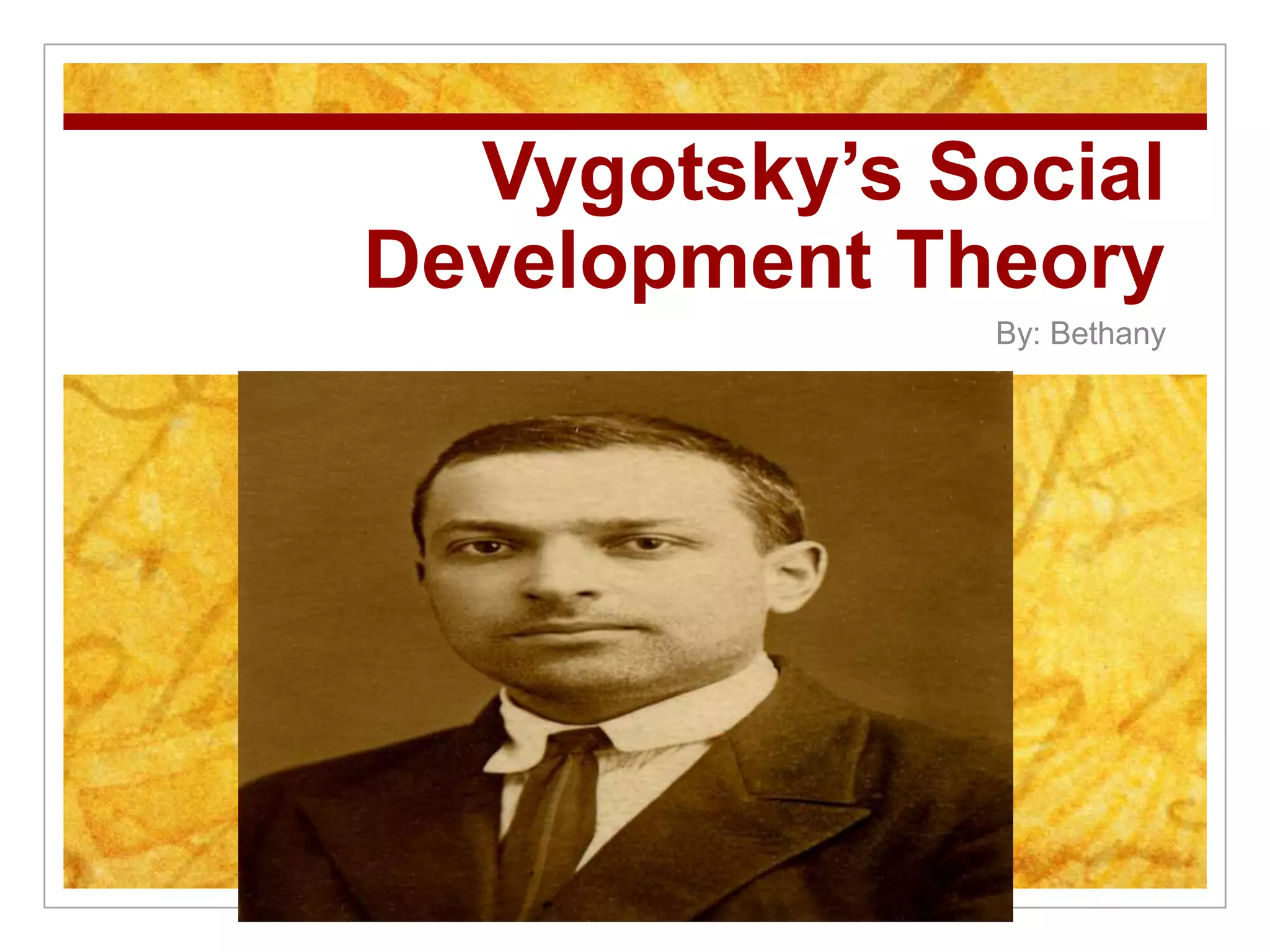
Vygotsky’s Social
Development Theory
              By: Bethany
Key Points
   Vygotsky's theories stress the fundamental role of social
    interaction in the development of cognition Vygotsky, 1978), as
    he believed strongly that community plays a central role in the
    process of "making meaning.”

   Social interaction plays a fundamental role in the process of
    cognitive development.

   Vygotsky places considerably more emphasis on social factors
    contributing to cognitive development
Zone of Proximal
              Development
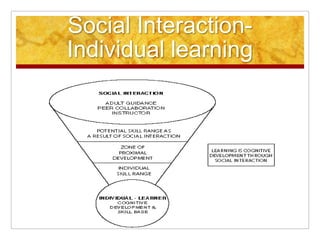
   “Vygotskybelieved that this life long process of development was
    dependent on social interaction and that social learning actually
    leads to cognitive development. This phenomena is called the
    Zone of Proximal Development . Vygotsky describes it as "the
    distance between the actual development level as determined by
    independent problem solving and the level of potential
    development as determined through problem solving under adult
    guidance or in collaboration with more capable peers" (Vygotsky,
    1978). In other words, a student can perform a task under adult
    guidance or with peer collaboration that could not be achieved
    alone. The Zone of Proximal Development bridges that gap
    between what is known and what can be known. Vygotsky
    claimed that learning occurred in this zone.”
Social Interaction-
Individual learning
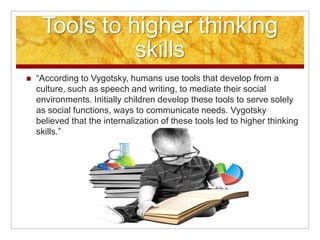
Tools to higher thinking
               skills
   “According to Vygotsky, humans use tools that develop from a
    culture, such as speech and writing, to mediate their social
    environments. Initially children develop these tools to serve solely
    as social functions, ways to communicate needs. Vygotsky
    believed that the internalization of these tools led to higher thinking
    skills.”
Cultural Development
   He states: “Every function in the child’s cultural development
    appears twice: first, between people (interpsychological) and
    then inside the child (intrapsychological). This applies equally to
    voluntary attention, to logical memory, and to the formation of
    ideas. All the higher functions originate as actual relationships
    between individuals” (Vygotsky, 1978, p.57).
Vygotsy’s Theories
    Vygotsky suggested that teachers should learn the
     level of each child's cognitive/social development
     and build or construct their learning experience
     from there on. (textbook pg 81)

    This process is also know as Scaffolding

    Scaffolding is an instructional technique whereby
     the teacher models the desired learning strategy or
     task, then gradually shifts responsibility to the
     students.
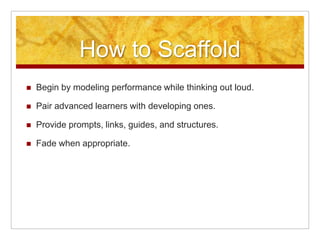
How to Scaffold
   Begin by modeling performance while thinking out loud.

   Pair advanced learners with developing ones.

   Provide prompts, links, guides, and structures.

   Fade when appropriate.
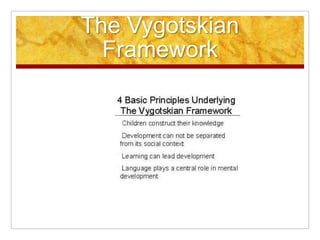
The Vygotskian
  Framework
Vygotskyv.s Piaget

   “Vygotsky's ideas and theories are often compared to Jean Piaget,
    especially his cognitive- developmental theory. They had a conflict
    explaining that development concepts should not be taught until
    children are in the appropriate developmental stage. Opposing
    Vygotsky's zone of proximal development, Piaget believed that the
    most important source of cognition is the children themselves. But
    Vygotsky argued that the social environment could help the child's
    cognitive development. The social environment is an important
    factor which helps the child culturally adapt to new situations when
    needed. Both Vygotsky and Piaget had the common goal of finding
    out how children master ideas and then translate them into
    speech.”
Conclution
   I agree with Vygotsky's theory over Piaget’s theory. The child’s
    cultural setting and environment greatly effects their learning That
    teacher and students should work collaboratively to learn from
    each other. That are social interactions with are peers is
    extremely important to our learning process. Social interaction
    really do play a essential role in the process of cognitive
    development. We all are learning from each other and our
    surrounding and that is what we take into our lives.
Credits
   http://members.iinet.net.au/~aamcarthur/4_Mar_2008_files/Vygotskys
    _Social_Development_Theory.pdf

   http://www.learning-theories.com/vygotskys-social-learning-
    theory.html

   http://mennta.hi.is/starfsfolk/solrunb/vygotsky.htm

   http://www.ncrel.org/sdrs/areas/issues/students/learning/lr1scaf.htm

   http://www.muskingum.edu/~psych/psycweb/history/vygotsky.htm

   http://vygotsky-vision.wikispaces.com/B.+Scaffolding

Learning Theorys

  • 1.
  • 2.
    Key Points  Vygotsky's theories stress the fundamental role of social interaction in the development of cognition Vygotsky, 1978), as he believed strongly that community plays a central role in the process of "making meaning.”  Social interaction plays a fundamental role in the process of cognitive development.  Vygotsky places considerably more emphasis on social factors contributing to cognitive development
  • 3.
    Zone of Proximal Development  “Vygotskybelieved that this life long process of development was dependent on social interaction and that social learning actually leads to cognitive development. This phenomena is called the Zone of Proximal Development . Vygotsky describes it as "the distance between the actual development level as determined by independent problem solving and the level of potential development as determined through problem solving under adult guidance or in collaboration with more capable peers" (Vygotsky, 1978). In other words, a student can perform a task under adult guidance or with peer collaboration that could not be achieved alone. The Zone of Proximal Development bridges that gap between what is known and what can be known. Vygotsky claimed that learning occurred in this zone.”
  • 4.
  • 5.
    Tools to higherthinking skills  “According to Vygotsky, humans use tools that develop from a culture, such as speech and writing, to mediate their social environments. Initially children develop these tools to serve solely as social functions, ways to communicate needs. Vygotsky believed that the internalization of these tools led to higher thinking skills.”
  • 6.
    Cultural Development  He states: “Every function in the child’s cultural development appears twice: first, between people (interpsychological) and then inside the child (intrapsychological). This applies equally to voluntary attention, to logical memory, and to the formation of ideas. All the higher functions originate as actual relationships between individuals” (Vygotsky, 1978, p.57).
  • 7.
    Vygotsy’s Theories  Vygotsky suggested that teachers should learn the level of each child's cognitive/social development and build or construct their learning experience from there on. (textbook pg 81)  This process is also know as Scaffolding  Scaffolding is an instructional technique whereby the teacher models the desired learning strategy or task, then gradually shifts responsibility to the students.
  • 8.
    How to Scaffold  Begin by modeling performance while thinking out loud.  Pair advanced learners with developing ones.  Provide prompts, links, guides, and structures.  Fade when appropriate.
  • 9.
    The Vygotskian Framework
  • 10.
    Vygotskyv.s Piaget  “Vygotsky's ideas and theories are often compared to Jean Piaget, especially his cognitive- developmental theory. They had a conflict explaining that development concepts should not be taught until children are in the appropriate developmental stage. Opposing Vygotsky's zone of proximal development, Piaget believed that the most important source of cognition is the children themselves. But Vygotsky argued that the social environment could help the child's cognitive development. The social environment is an important factor which helps the child culturally adapt to new situations when needed. Both Vygotsky and Piaget had the common goal of finding out how children master ideas and then translate them into speech.”
  • 11.
    Conclution  I agree with Vygotsky's theory over Piaget’s theory. The child’s cultural setting and environment greatly effects their learning That teacher and students should work collaboratively to learn from each other. That are social interactions with are peers is extremely important to our learning process. Social interaction really do play a essential role in the process of cognitive development. We all are learning from each other and our surrounding and that is what we take into our lives.
  • 12.
    Credits  http://members.iinet.net.au/~aamcarthur/4_Mar_2008_files/Vygotskys _Social_Development_Theory.pdf  http://www.learning-theories.com/vygotskys-social-learning- theory.html  http://mennta.hi.is/starfsfolk/solrunb/vygotsky.htm  http://www.ncrel.org/sdrs/areas/issues/students/learning/lr1scaf.htm  http://www.muskingum.edu/~psych/psycweb/history/vygotsky.htm  http://vygotsky-vision.wikispaces.com/B.+Scaffolding