∗ Vygotsky placed more emphasis on social
contributions to the process of development
∗ He focused on the connections between people and
the sociocultural context in which they act and
interact in shared experiences.
∗ According to Vygotsky, humans use tools that
develop from a culture, such as speech and writing, to
mediate their social environments. Initially children
develop these tools to serve solely as social functions,
ways to communicate needs.
About the Theory
∗ Lev Vygotsky was born November 17, 1896 in
Orsha, a city in the western region of the
Russian Empire. He attended Moscow State
University, where he graduated with a degree
in law in 1917. His formal work in psychology
did not begin until 1924 when he attended the
Institute of Psychology in Moscow and began
collaborating with Alexei Leontiev and
Alexander Luria. His interests in Psychology
were quite diverse, but often centered on
topics of child development and education.
He also explored such topics as the
psychology of art and language development.
Discovered By:
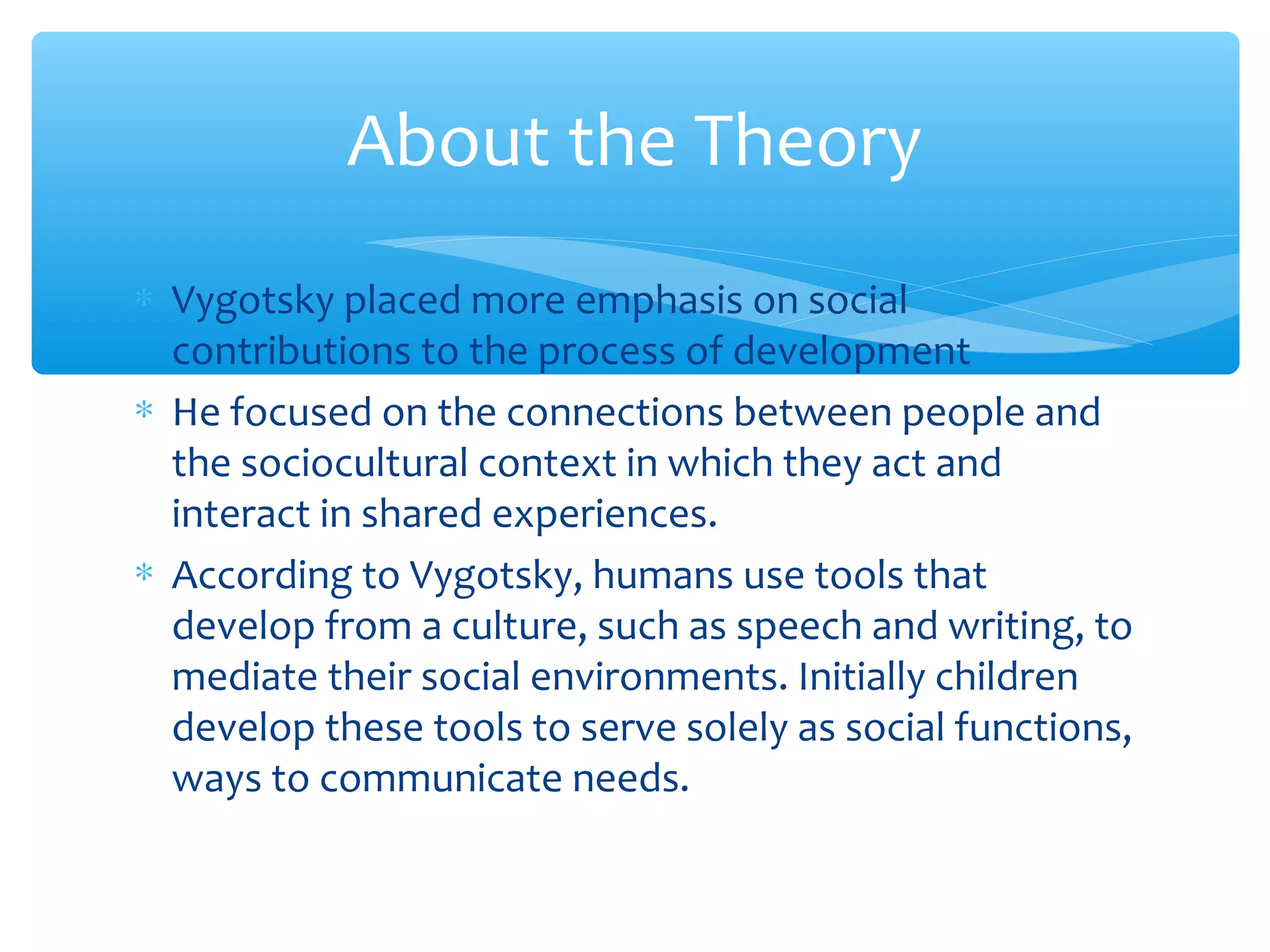
∗ Social Interaction
∗ The More Knowledgeable Other (MKO)
∗ Zone of Proximal Development
3 Major Themes
∗ Vygotsky felt social learning anticipates
development. He states: “Every function in the
child’s cultural development appears twice: first,
on the social level, and later, on the individual
level; first, between people (interpsychological)
and then inside the child (intrapsychological).”
∗ He believes that young children are curious and
actively involved in their own learning and the
discovery and development of new
understandings.
Social Interaction
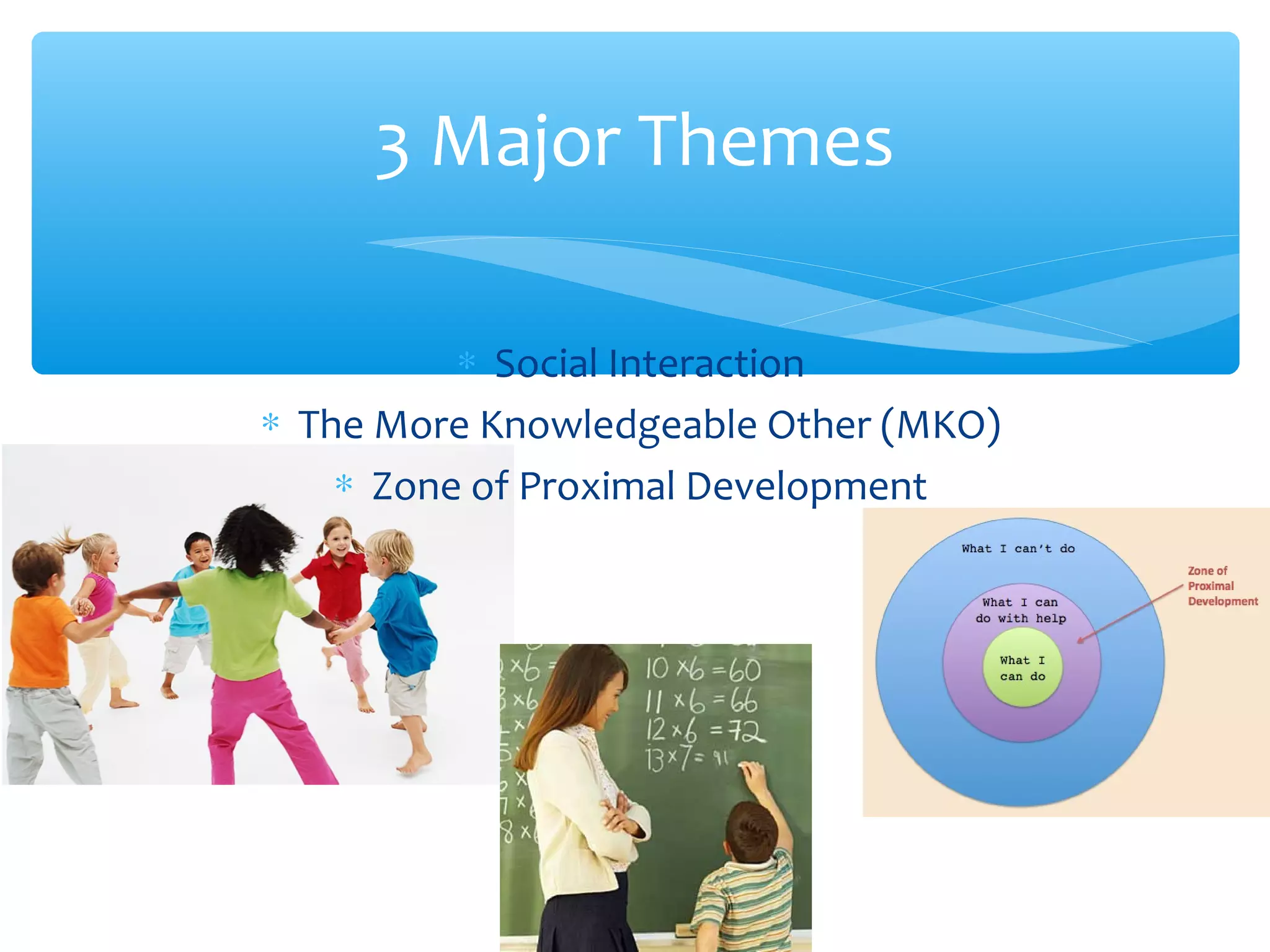
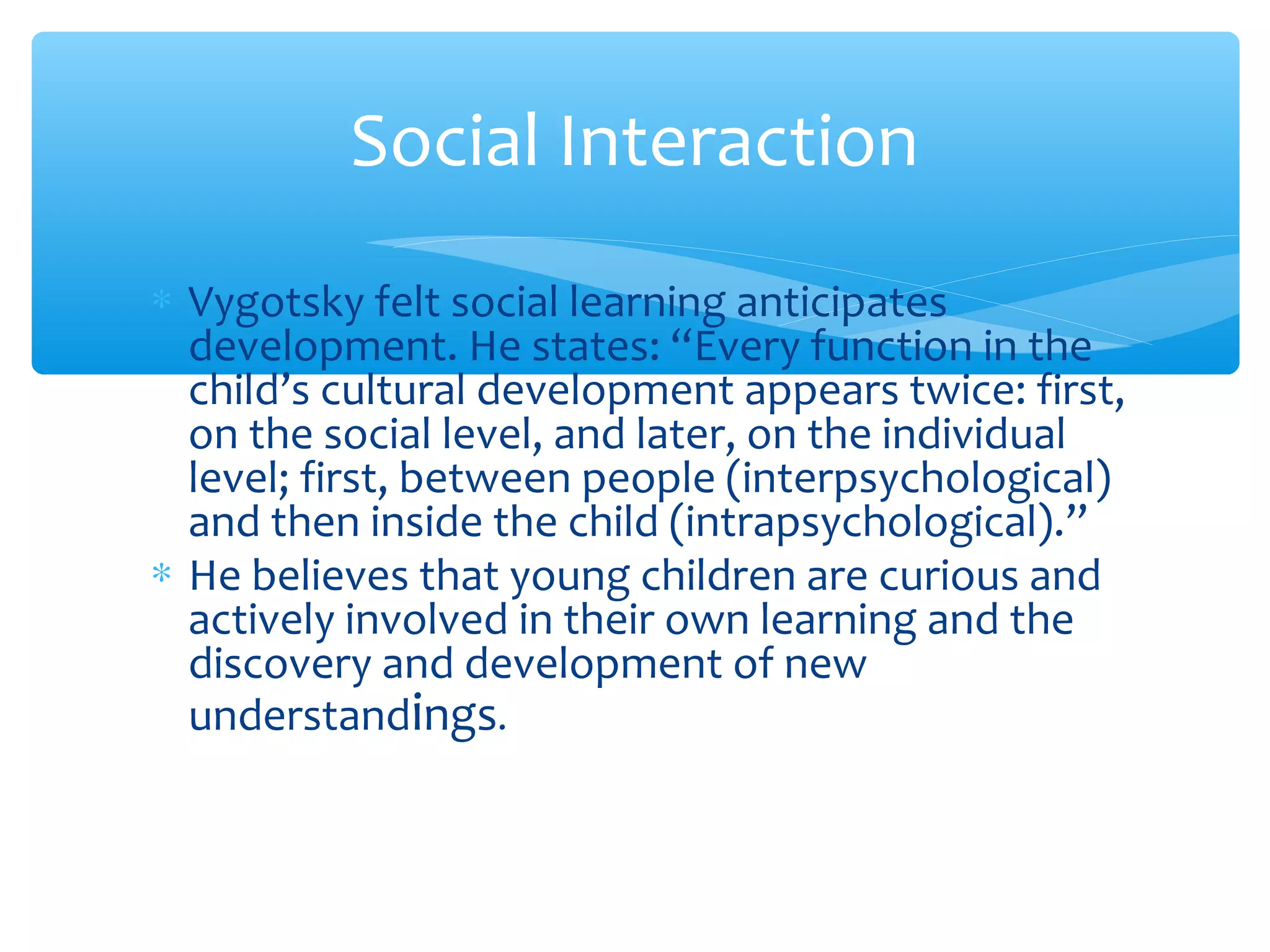
∗ MKO refers to someone who has a better understanding
or a higher ability level than the learner, with respect to a
particular task, process, or concept.
∗ For example: Teachers, Other adults, Advanced students,
sometimes even computers.
∗ Many times, a child's peers or an adult's children may be
the individuals with more knowledge or experience.
∗ For example: Who would know more about the latest teen
music group, how to be the newest black ops game, or
what is the latest dance moves, a child or their parent?
The More Knowledgeable Other
(MKO)
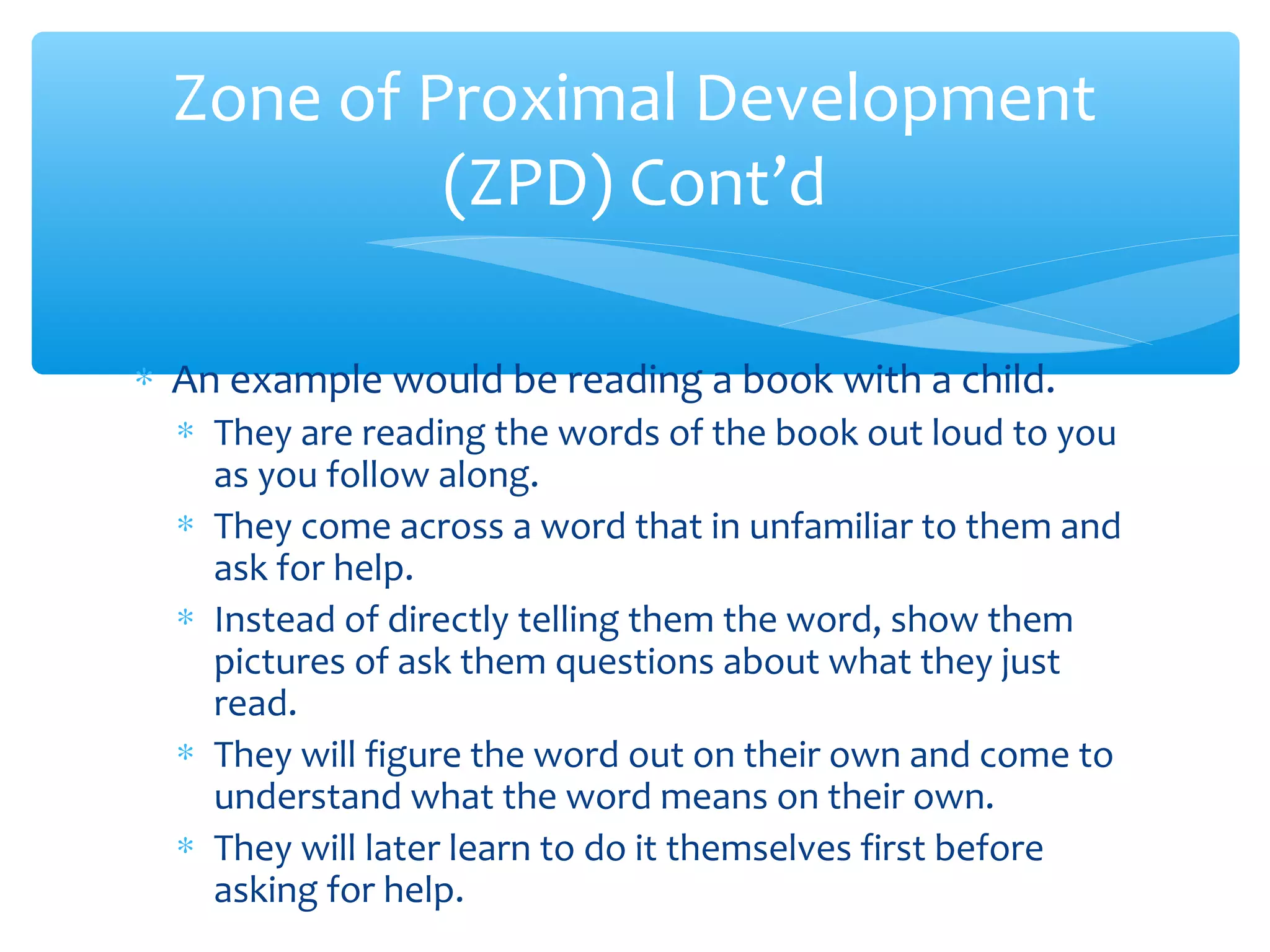
∗ This is an important concept that relates to the
difference between what a child can achieve
independently and what a child can achieve with
guidance and encouragement from a skilled partner.
According to Vygotsky learning occurs here.
∗ Vygotsky sees the ZPD as the area where the most
sensitive instruction or guidance should be given,
allowing the child to develop skills they will then use
on their own, developing higher mental functions.
Zone of Proximal Development
(ZPD)
∗ An example would be reading a book with a child.
∗ They are reading the words of the book out loud to you
as you follow along.
∗ They come across a word that in unfamiliar to them and
ask for help.
∗ Instead of directly telling them the word, show them
pictures of ask them questions about what they just
read.
∗ They will figure the word out on their own and come to
understand what the word means on their own.
∗ They will later learn to do it themselves first before
asking for help.
Zone of Proximal Development
(ZPD) Cont’d
∗ 1: Vygotsky places more emphasis on culture affecting/shaping
cognitive development - this contradicts Piaget's view of
universal stages and content of development. (Vygotsky does
not refer to stages in the way that Piaget does).
∗ 2: Vygotsky places considerably more emphasis on social factors
contributing to cognitive development (Piaget is criticized for
underestimating this).
∗ 3: Vygotsky places more emphasis on the role of language in
cognitive development (again Piaget is criticized for lack of
emphasis on this).
Vygotsky's theory differs from that
of Piaget in a number of important
ways:
http://www.simplypsychology.org/vygotsky.html
∗ Technology can be used to facilitate learning within
the ZPD.
∗ Online activities and projects can encourage the co-
operation of students even when not in the classroom.
∗ Teachers can use videos and interactive worksheets to
engage their students and assist them through
scaffolding.
Teachers and Social Development
Theory with Technology
∗ Even without technology, the basic ideas are the
same.
∗ Students work better in groups according to Vygotsky,
so group projects from art all the way to presentations
on the latest math systems learned are a great way to
get kids learning.
∗ Scaffolding can be done with real world objects and
interactions, not just technological ones.
Teachers and Social Development
Theory without Technology
∗ Technology provides
∗ internet, library databases, and chat rooms, technology
resources
∗ students will be able to use an endless amount of resource's.
Being able to share information provides classroom opinions.
∗ The classroom, based on Vygotsky
∗ provides groups for peer instruction, collaboration, and small
group instruction.
∗ The environment of the classroom, the design of material to
be learn would promote and encourage student interaction
and collaboration.
∗ Leading into a classroom community.
Students and Social Development
Theory with Technology

Social Learning Theory

  • 2.
    ∗ Vygotsky placedmore emphasis on social contributions to the process of development ∗ He focused on the connections between people and the sociocultural context in which they act and interact in shared experiences. ∗ According to Vygotsky, humans use tools that develop from a culture, such as speech and writing, to mediate their social environments. Initially children develop these tools to serve solely as social functions, ways to communicate needs. About the Theory
  • 3.
    ∗ Lev Vygotskywas born November 17, 1896 in Orsha, a city in the western region of the Russian Empire. He attended Moscow State University, where he graduated with a degree in law in 1917. His formal work in psychology did not begin until 1924 when he attended the Institute of Psychology in Moscow and began collaborating with Alexei Leontiev and Alexander Luria. His interests in Psychology were quite diverse, but often centered on topics of child development and education. He also explored such topics as the psychology of art and language development. Discovered By:
  • 4.
    ∗ Social Interaction ∗The More Knowledgeable Other (MKO) ∗ Zone of Proximal Development 3 Major Themes
  • 5.
    ∗ Vygotsky feltsocial learning anticipates development. He states: “Every function in the child’s cultural development appears twice: first, on the social level, and later, on the individual level; first, between people (interpsychological) and then inside the child (intrapsychological).” ∗ He believes that young children are curious and actively involved in their own learning and the discovery and development of new understandings. Social Interaction
  • 6.
    ∗ MKO refersto someone who has a better understanding or a higher ability level than the learner, with respect to a particular task, process, or concept. ∗ For example: Teachers, Other adults, Advanced students, sometimes even computers. ∗ Many times, a child's peers or an adult's children may be the individuals with more knowledge or experience. ∗ For example: Who would know more about the latest teen music group, how to be the newest black ops game, or what is the latest dance moves, a child or their parent? The More Knowledgeable Other (MKO)
  • 7.
    ∗ This isan important concept that relates to the difference between what a child can achieve independently and what a child can achieve with guidance and encouragement from a skilled partner. According to Vygotsky learning occurs here. ∗ Vygotsky sees the ZPD as the area where the most sensitive instruction or guidance should be given, allowing the child to develop skills they will then use on their own, developing higher mental functions. Zone of Proximal Development (ZPD)
  • 8.
    ∗ An examplewould be reading a book with a child. ∗ They are reading the words of the book out loud to you as you follow along. ∗ They come across a word that in unfamiliar to them and ask for help. ∗ Instead of directly telling them the word, show them pictures of ask them questions about what they just read. ∗ They will figure the word out on their own and come to understand what the word means on their own. ∗ They will later learn to do it themselves first before asking for help. Zone of Proximal Development (ZPD) Cont’d
  • 9.
    ∗ 1: Vygotskyplaces more emphasis on culture affecting/shaping cognitive development - this contradicts Piaget's view of universal stages and content of development. (Vygotsky does not refer to stages in the way that Piaget does). ∗ 2: Vygotsky places considerably more emphasis on social factors contributing to cognitive development (Piaget is criticized for underestimating this). ∗ 3: Vygotsky places more emphasis on the role of language in cognitive development (again Piaget is criticized for lack of emphasis on this). Vygotsky's theory differs from that of Piaget in a number of important ways: http://www.simplypsychology.org/vygotsky.html
  • 10.
    ∗ Technology canbe used to facilitate learning within the ZPD. ∗ Online activities and projects can encourage the co- operation of students even when not in the classroom. ∗ Teachers can use videos and interactive worksheets to engage their students and assist them through scaffolding. Teachers and Social Development Theory with Technology
  • 11.
    ∗ Even withouttechnology, the basic ideas are the same. ∗ Students work better in groups according to Vygotsky, so group projects from art all the way to presentations on the latest math systems learned are a great way to get kids learning. ∗ Scaffolding can be done with real world objects and interactions, not just technological ones. Teachers and Social Development Theory without Technology
  • 12.
    ∗ Technology provides ∗internet, library databases, and chat rooms, technology resources ∗ students will be able to use an endless amount of resource's. Being able to share information provides classroom opinions. ∗ The classroom, based on Vygotsky ∗ provides groups for peer instruction, collaboration, and small group instruction. ∗ The environment of the classroom, the design of material to be learn would promote and encourage student interaction and collaboration. ∗ Leading into a classroom community. Students and Social Development Theory with Technology

Editor's Notes

  • #3 1ST LINE----SOCIOCULTURALEMPHASIZES ON IMPORTANCE OF SOCIETY AND CULTURE IN PROMOTING COGNITIVE DEVELOPMENT Cultural-historical theory of cognitive development--- role or culture in development of higher mental functions----- SUCH AS SPEECH AND REASONING
  • #4 Attended moscow state university His formal work in psychology begin in 1924 He collaborated with alexei Leontiev and `Alexander Luria Topics were centered in child development and education
  • #6 THIRD ASSUMPTION--- COMPLEX MENTAL ACTIVITIES BEGIN IN SOCIAL ACTIVITIES WHAT THEY LEARN THEY WILL INTERNALIZE--- THEN USE IT INDEPENDENTLY EXAMPLE;; THE FATHER READS A BOOK ABOUT TRANSPORTATION--- SHE WILL BEGIN TO CLASSIFY THESE ITEMS HERSELF WHEN SHE SEES CARS, TRUCKS AND BOATS IN REAL LIFE SETTINGS; EXAMPLE WHAT ARE THEY TALKING ABOUT ARE JUST MODES OF TRANSPORTATION BUT WHEN A CHILD SEES ONE SHE MAY CLASSIFY WHO USES A CAR, TRUCK OR WHEN TO USE IT
  • #7 2 LEVELS ON THIS STAGE; ACTUAL DEVELOPMENT--- UPPER LIMIT A CHILD CAN PERFORM LEVEL OF POTENTIAL DEVELOPMENT--- UPPER LIMIT A CHILD CAN PERFORM WITH THE ASSISTANCE OF A MORE COMPETENT INDIVIDUAL EXAMPLE: A CHILD KNOWS– WHERE TO PUT THE BLOCKS ( ACTUAL DEV) BUT DOESN’T KNOW HOW TO.. THE FATHER WILL ASSIST ( LEVEL OF POTENTIAL DEVELOPMENT)
  • #8 -- PROMOTES MAXIMUM COGNITIVE GROWTH --USES IMAGINATION--- READ A BOOK– SHOW PIC– THEY WILL PUT MEANING ON IT
  • #11 SCAFFOLDING- STAGING