   
   Language is a social concept that
    is developed through social
    interactions. According to Lev
    Vygotsky, a 20th-century Soviet
    psychologist,           language
    acquisition involves not only a
    child's exposure to words but
    also an interdependent process
    of growth between thought and
    language. Vygotsky's influential
    theory of the "zone of proximal
    development"      asserts    that
    teachers should consider a
    child's prospective learning
    power before trying to expand
    the child's grasp of language.
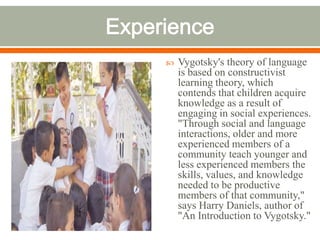
   Vygotsky's theory of language
    is based on constructivist
    learning theory, which
    contends that children acquire
    knowledge as a result of
    engaging in social experiences.
    "Through social and language
    interactions, older and more
    experienced members of a
    community teach younger and
    less experienced members the
    skills, values, and knowledge
    needed to be productive
    members of that community,"
    says Harry Daniels, author of
    "An Introduction to Vygotsky."
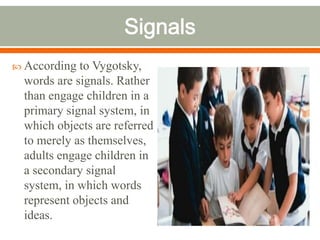
 According  to Vygotsky,
  words are signals. Rather
  than engage children in a
  primary signal system, in
  which objects are referred
  to merely as themselves,
  adults engage children in
  a secondary signal
  system, in which words
  represent objects and
  ideas.
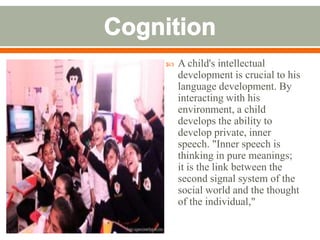
   A child's intellectual
    development is crucial to his
    language development. By
    interacting with his
    environment, a child
    develops the ability to
    develop private, inner
    speech. "Inner speech is
    thinking in pure meanings;
    it is the link between the
    second signal system of the
    social world and the thought
    of the individual,"
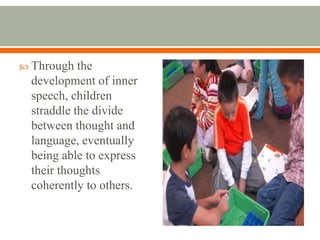
 Through  the
 development of inner
 speech, children
 straddle the divide
 between thought and
 language, eventually
 being able to express
 their thoughts
 coherently to others.
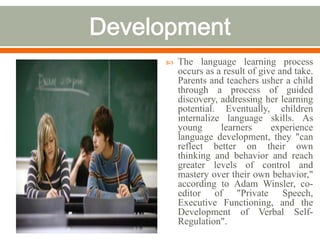
   The language learning process
    occurs as a result of give and take.
    Parents and teachers usher a child
    through a process of guided
    discovery, addressing her learning
    potential. Eventually, children
    internalize language skills. As
    young      learners      experience
    language development, they "can
    reflect better on their own
    thinking and behavior and reach
    greater levels of control and
    mastery over their own behavior,"
    according to Adam Winsler, co-
    editor of "Private Speech,
    Executive Functioning, and the
    Development of Verbal Self-
    Regulation".
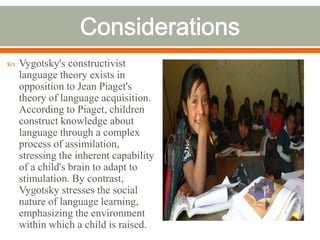
   Vygotsky's constructivist
    language theory exists in
    opposition to Jean Piaget's
    theory of language acquisition.
    According to Piaget, children
    construct knowledge about
    language through a complex
    process of assimilation,
    stressing the inherent capability
    of a child's brain to adapt to
    stimulation. By contrast,
    Vygotsky stresses the social
    nature of language learning,
    emphasizing the environment
    within which a child is raised.

Vygotsky and language development

  • 1.
  • 2.
    Language is a social concept that is developed through social interactions. According to Lev Vygotsky, a 20th-century Soviet psychologist, language acquisition involves not only a child's exposure to words but also an interdependent process of growth between thought and language. Vygotsky's influential theory of the "zone of proximal development" asserts that teachers should consider a child's prospective learning power before trying to expand the child's grasp of language.
  • 3.
    Vygotsky's theory of language is based on constructivist learning theory, which contends that children acquire knowledge as a result of engaging in social experiences. "Through social and language interactions, older and more experienced members of a community teach younger and less experienced members the skills, values, and knowledge needed to be productive members of that community," says Harry Daniels, author of "An Introduction to Vygotsky."
  • 4.
     According to Vygotsky, words are signals. Rather than engage children in a primary signal system, in which objects are referred to merely as themselves, adults engage children in a secondary signal system, in which words represent objects and ideas.
  • 5.
    A child's intellectual development is crucial to his language development. By interacting with his environment, a child develops the ability to develop private, inner speech. "Inner speech is thinking in pure meanings; it is the link between the second signal system of the social world and the thought of the individual,"
  • 6.
     Through the development of inner speech, children straddle the divide between thought and language, eventually being able to express their thoughts coherently to others.
  • 7.
    The language learning process occurs as a result of give and take. Parents and teachers usher a child through a process of guided discovery, addressing her learning potential. Eventually, children internalize language skills. As young learners experience language development, they "can reflect better on their own thinking and behavior and reach greater levels of control and mastery over their own behavior," according to Adam Winsler, co- editor of "Private Speech, Executive Functioning, and the Development of Verbal Self- Regulation".
  • 8.
    Vygotsky's constructivist language theory exists in opposition to Jean Piaget's theory of language acquisition. According to Piaget, children construct knowledge about language through a complex process of assimilation, stressing the inherent capability of a child's brain to adapt to stimulation. By contrast, Vygotsky stresses the social nature of language learning, emphasizing the environment within which a child is raised.