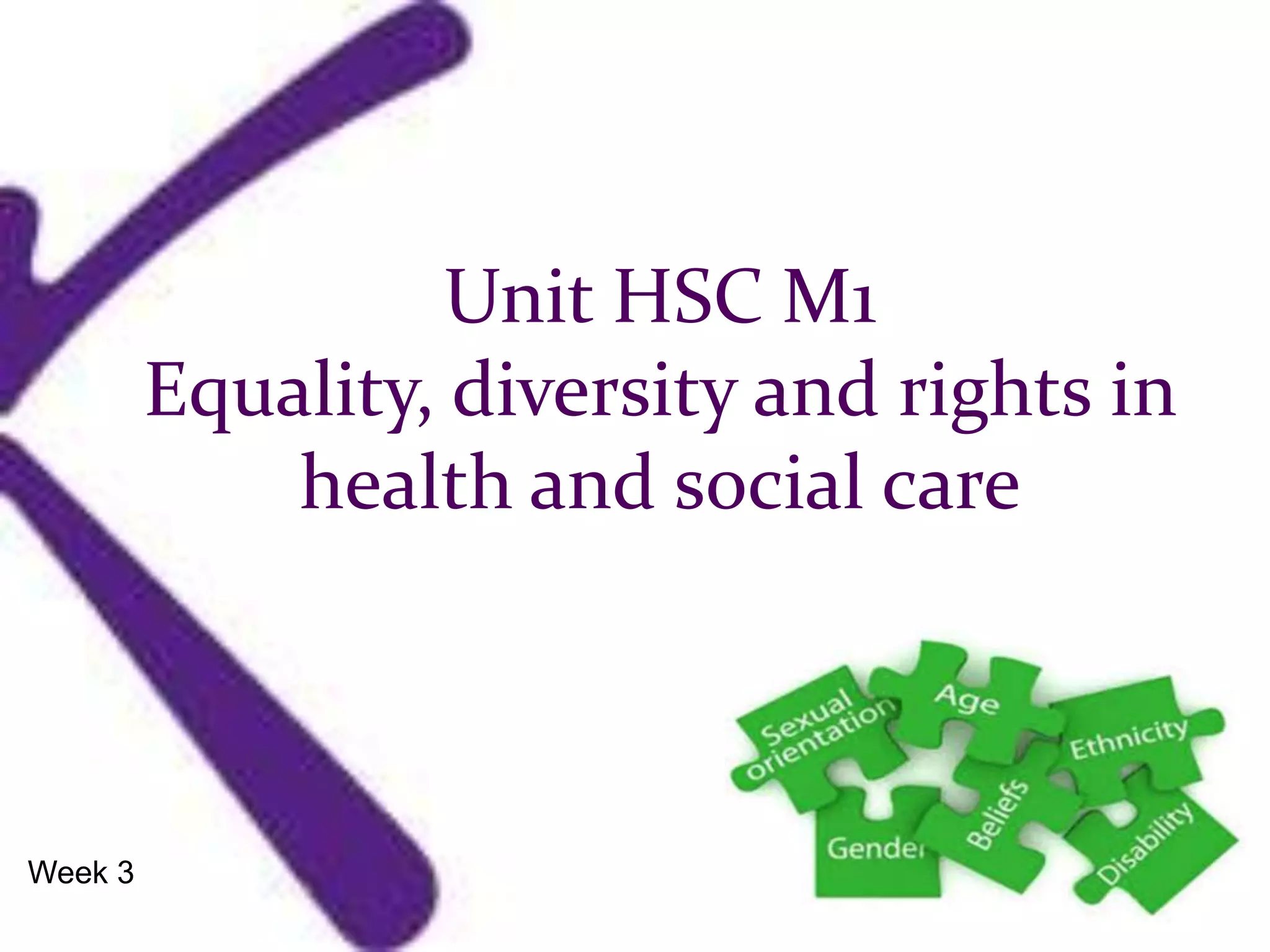
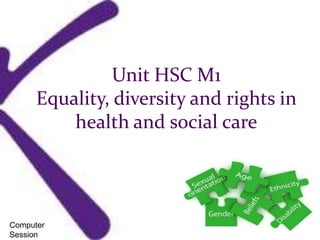
Unit HSC M1
Equality, diversity and rights in
health and social care
Week 3
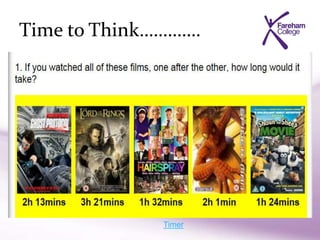
Time to Think………….
Timer
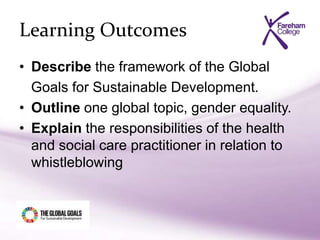
Learning Outcomes
• Describe the framework of the Global
Goals for Sustainable Development.
• Outline one global topic, gender equality.
• Explain the responsibilities of the health
and social care practitioner in relation to
whistleblowing
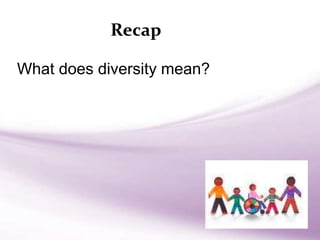
Recap
What does diversity mean?
Global Goals
• The Global Goals for Sustainable
Development are a plan developed by the
United Nations and agreed upon by 193
world leaders to work towards achieving
by 2030 :
• i. Fight global inequality.
• ii. End extreme poverty.
• iii. And respect our planet
• Global Goals
Discuss
• What does gender equality mean?
• Do you think there is gender inequality in
the world?
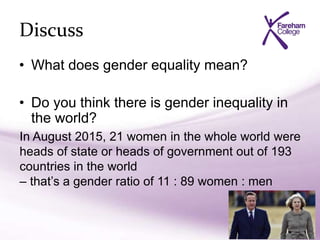
In August 2015, 21 women in the whole world were
heads of state or heads of government out of 193
countries in the world
– that’s a gender ratio of 11 : 89 women : men
Who am I?
• Once upon a time, there was a young girl who loved going to
school. However, she lived in an area where some political
leaders didn’t want her to go to school. They used to attack the
schools and try to stop girls going to school.
• So one day this young girl, who was only eleven years old at the
time, started to make speeches and write blogs saying that girls
should be allowed to go to school as well.
• However, the people in power, who didn’t want girls to go to
school, wanted to frighten her to stop her telling people these
things. They knew lots of people around the world were listening
to what she was saying, so they made it clear that they would
harm her if she kept saying these things.
• The young girl did not stop saying her opinions. So one day, when
she was fourteen years old, a man came onto the bus when she
was on her way back from school and shot her. The bullet hit her
head. Luckily, this young girl did not die.
Inspirational
• Nobel Peace Prize 2014
Have you met your
objectives?
Creative Task
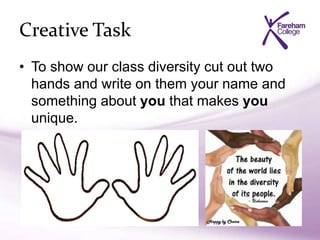
• To show our class diversity cut out two
hands and write on them your name and
something about you that makes you
unique.
Approaches to challenge discrimination
Whistleblowing
• Whistleblowing is the term used to describe when a
practitioner tells someone about a concern over a
colleague who demonstrates poor practice.
• This concern can range from a colleague who is negligent
and putting service users in danger to a colleague who is
bullying or abusing service users.
• The practitioner who is whistleblowing must not ignore
poor practice, they have a duty to report their concerns.
Have you met your
objectives?
Unit HSC M1
Equality, diversity and rights in
health and social care
Computer
Session
Time to think………..
• Words from the letters in
discrimination
Learning Outcomes
• Summarise the main duties of the Care
Quality Commission (CQC)
Recap
• Name a piece of legislation in relation to
equality, diversity and inclusion.
Individual Tasks- Computer
Room
• Put together a FactSheet on the duties
and main responsibilities of Care Quality
Commission (CQC).
• Use the Care Quality Commission website
to look up a care home.
• You then need to complete a course on
Health Education England
Unit HSC M1
Equality, diversity and rights in
health and social care
Day 2
Time to think………..
• Word square- All that you have to do is
make dictionary words of any length from
the letters in the grid – the bigger the
better! The only restriction is that the word
must contain the central letter.
V
LR
TA E
L
Learning Outcomes
• Explain the responsibilities of the health
and social care practitioner in relation to
whistleblowing
• Interpret a report from the CQC
• Recognise the importance of CQC and
their role in promoting a consistent
approach in providing high-quality care
• Describe two approaches to challenge
discrimination
• Practitioners must report the poor practice
that they have witnessed to their supervisor
or named member of staff responsible for
safeguarding.
• It is good practice to write up your concerns
and give full details of the event or events.
• If you whistle blow you are legally protected
and will be fully supported by your supervisor
or manager.
• Share your concerns with the Care Quality
Commission (CQC) or Ofsted.
Whistleblowing
Read the article
Group activity
• Discuss how you would feel if you suspected poor
practice and needed to whistle blow on a
colleague?
• Consider:
• Policies and procedures
• Your working relationship with your supervisor or
named member of staff for safeguarding
• Your working relationship with the colleague you
were reporting
• The service users who were in danger of harm or
abuse because of poor practice.
Individual Task
Write a paragraph answering the following:-
Have you met your
objectives?
Small Group Activity
• Let’s look at reports recently carried out by
the Care Quality Commission (CQC)
• Produce a mind map showing :-
• The name of the organisation the report is
about
• Overall rating
• Points highlighted by the CQC relating to
equality, diversity and inclusion
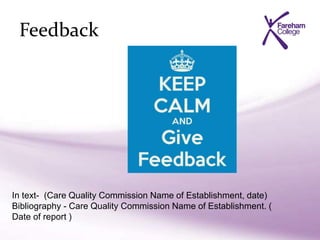
Feedback
In text- (Care Quality Commission Name of Establishment, date)
Bibliography - Care Quality Commission Name of Establishment. (
Date of report )
Have you met your
objectives?
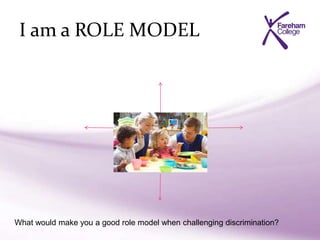
I am a ROLE MODEL
What would make you a good role model when challenging discrimination?
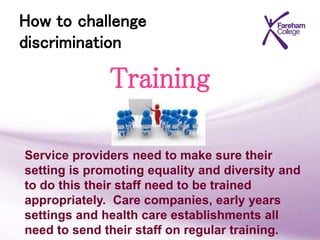
How to challenge
discrimination
Training
Service providers need to make sure their
setting is promoting equality and diversity and
to do this their staff need to be trained
appropriately. Care companies, early years
settings and health care establishments all
need to send their staff on regular training.
Kahoot!
• Quiz Time
Have you met your
objectives?
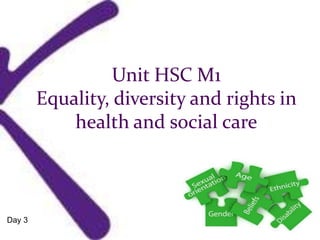
Unit HSC M1
Equality, diversity and rights in
health and social care
Day 3
Time to Think…………
• Times Table Bingo
Learning Outcomes
• Describe how a practitioners own values
can influence delivery of care
• Explain how a professional relationship is
different from a personal relationship
Inspirational!
• Shanntol Ince
Energy within
Recap
• What does whistleblowing mean?
Understand discrimination
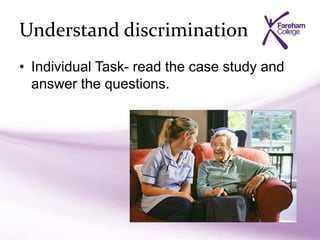
• Individual Task- read the case study and
answer the questions.
Care Assistant
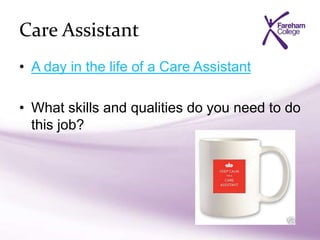
• A day in the life of a Care Assistant
• What skills and qualities do you need to do
this job?
Have you met your
objectives?
Why is a working relationship
different from a personal
relationship?
Individual Task
• Why is being impartial an important part of
promoting equality?
• What a paragraph to answer the question.
Have you met your
objectives?
Unit HSC M1
Equality, diversity and rights in
health and social care
Day 4
Monday Visit
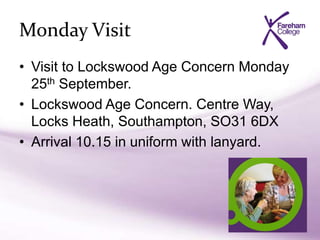
• Visit to Lockswood Age Concern Monday
25th September.
• Lockswood Age Concern. Centre Way,
Locks Heath, Southampton, SO31 6DX
• Arrival 10.15 in uniform with lanyard.
Armchair Aerobics!
• She wears Red Feathers
Learning Outcomes
Describe the meaning of the term self-
awareness.
Explain how self-awareness can affect
delivery of care
Describe interaction with individuals that
respects their beliefs, culture, values and
preferences.
Recap-ICT session
• Care Quality Commission
• Feedback from yesterdays activity
Care Quality Commission
What is self-awareness
• Self-awareness is not only the
fundamental skill underpinning reflective
practice. It also is crucial for understanding
and developing good interpersonal skills
and building therapeutic relationships with
patients / clients and their families
(Bulman & Schutz 2004).
Self-Awareness
Who are you?
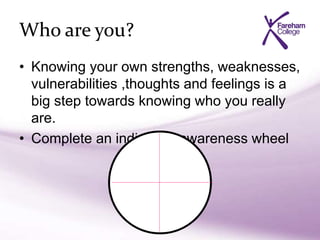
• Knowing your own strengths, weaknesses,
vulnerabilities ,thoughts and feelings is a
big step towards knowing who you really
are.
• Complete an individual awareness wheel
Question
• How can Self- awareness influence
delivery of care?
Have you met your
objectives?
Discussion
• Beverley has been taking her 4-year-old son
Linton to the local playgroup. Linton has
autism and can behave in unpredictable and
unusual ways.
• After a few weeks, the person in charge of
the playgroup says that other parents have
concerns about his behaviour, and that
perhaps it would be better if she took Linton
to a specialist playgroup.
Case Study
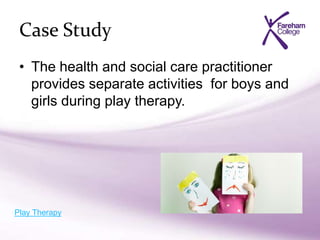
• The health and social care practitioner
provides separate activities for boys and
girls during play therapy.
Play Therapy
Employment skills
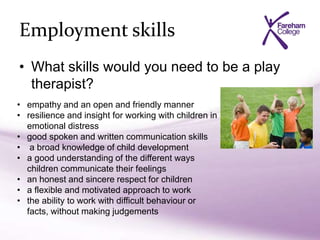
• What skills would you need to be a play
therapist?
• empathy and an open and friendly manner
• resilience and insight for working with children in
emotional distress
• good spoken and written communication skills
• a broad knowledge of child development
• a good understanding of the different ways
children communicate their feelings
• an honest and sincere respect for children
• a flexible and motivated approach to work
• the ability to work with difficult behaviour or
facts, without making judgements
Directed Study Task
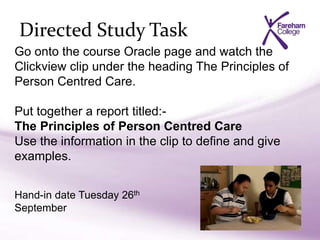
Go onto the course Oracle page and watch the
Clickview clip under the heading The Principles of
Person Centred Care.
Put together a report titled:-
The Principles of Person Centred Care
Use the information in the clip to define and give
examples.
Hand-in date Tuesday 26th
September

Unit hsc m1 equality week 3

  • 1.
    Unit HSC M1 Equality,diversity and rights in health and social care Week 3
  • 2.
  • 3.
    Learning Outcomes • Describethe framework of the Global Goals for Sustainable Development. • Outline one global topic, gender equality. • Explain the responsibilities of the health and social care practitioner in relation to whistleblowing
  • 4.
  • 5.
    Global Goals • TheGlobal Goals for Sustainable Development are a plan developed by the United Nations and agreed upon by 193 world leaders to work towards achieving by 2030 : • i. Fight global inequality. • ii. End extreme poverty. • iii. And respect our planet • Global Goals
  • 6.
    Discuss • What doesgender equality mean? • Do you think there is gender inequality in the world? In August 2015, 21 women in the whole world were heads of state or heads of government out of 193 countries in the world – that’s a gender ratio of 11 : 89 women : men
  • 7.
    Who am I? •Once upon a time, there was a young girl who loved going to school. However, she lived in an area where some political leaders didn’t want her to go to school. They used to attack the schools and try to stop girls going to school. • So one day this young girl, who was only eleven years old at the time, started to make speeches and write blogs saying that girls should be allowed to go to school as well. • However, the people in power, who didn’t want girls to go to school, wanted to frighten her to stop her telling people these things. They knew lots of people around the world were listening to what she was saying, so they made it clear that they would harm her if she kept saying these things. • The young girl did not stop saying her opinions. So one day, when she was fourteen years old, a man came onto the bus when she was on her way back from school and shot her. The bullet hit her head. Luckily, this young girl did not die.
  • 8.
  • 9.
    Have you metyour objectives?
  • 10.
    Creative Task • Toshow our class diversity cut out two hands and write on them your name and something about you that makes you unique.
  • 11.
    Approaches to challengediscrimination Whistleblowing • Whistleblowing is the term used to describe when a practitioner tells someone about a concern over a colleague who demonstrates poor practice. • This concern can range from a colleague who is negligent and putting service users in danger to a colleague who is bullying or abusing service users. • The practitioner who is whistleblowing must not ignore poor practice, they have a duty to report their concerns.
  • 12.
    Have you metyour objectives?
  • 13.
    Unit HSC M1 Equality,diversity and rights in health and social care Computer Session
  • 14.
    Time to think……….. •Words from the letters in discrimination
  • 15.
    Learning Outcomes • Summarisethe main duties of the Care Quality Commission (CQC)
  • 16.
    Recap • Name apiece of legislation in relation to equality, diversity and inclusion.
  • 17.
    Individual Tasks- Computer Room •Put together a FactSheet on the duties and main responsibilities of Care Quality Commission (CQC). • Use the Care Quality Commission website to look up a care home. • You then need to complete a course on Health Education England
  • 18.
    Unit HSC M1 Equality,diversity and rights in health and social care Day 2
  • 19.
    Time to think……….. •Word square- All that you have to do is make dictionary words of any length from the letters in the grid – the bigger the better! The only restriction is that the word must contain the central letter. V LR TA E L
  • 20.
    Learning Outcomes • Explainthe responsibilities of the health and social care practitioner in relation to whistleblowing • Interpret a report from the CQC • Recognise the importance of CQC and their role in promoting a consistent approach in providing high-quality care • Describe two approaches to challenge discrimination
  • 21.
    • Practitioners mustreport the poor practice that they have witnessed to their supervisor or named member of staff responsible for safeguarding. • It is good practice to write up your concerns and give full details of the event or events. • If you whistle blow you are legally protected and will be fully supported by your supervisor or manager. • Share your concerns with the Care Quality Commission (CQC) or Ofsted. Whistleblowing Read the article

  • 22.
    Group activity • Discusshow you would feel if you suspected poor practice and needed to whistle blow on a colleague? • Consider: • Policies and procedures • Your working relationship with your supervisor or named member of staff for safeguarding • Your working relationship with the colleague you were reporting • The service users who were in danger of harm or abuse because of poor practice. Individual Task Write a paragraph answering the following:-
  • 23.
    Have you metyour objectives?
  • 24.
    Small Group Activity •Let’s look at reports recently carried out by the Care Quality Commission (CQC) • Produce a mind map showing :- • The name of the organisation the report is about • Overall rating • Points highlighted by the CQC relating to equality, diversity and inclusion
  • 25.
    Feedback In text- (CareQuality Commission Name of Establishment, date) Bibliography - Care Quality Commission Name of Establishment. ( Date of report )
  • 26.
    Have you metyour objectives?
  • 27.
    I am aROLE MODEL What would make you a good role model when challenging discrimination?
  • 28.
    How to challenge discrimination Training Serviceproviders need to make sure their setting is promoting equality and diversity and to do this their staff need to be trained appropriately. Care companies, early years settings and health care establishments all need to send their staff on regular training.
  • 29.
  • 30.
    Have you metyour objectives?
  • 31.
    Unit HSC M1 Equality,diversity and rights in health and social care Day 3
  • 32.
  • 33.
    Learning Outcomes • Describehow a practitioners own values can influence delivery of care • Explain how a professional relationship is different from a personal relationship
  • 34.
  • 35.
    Recap • What doeswhistleblowing mean?
  • 36.
    Understand discrimination • IndividualTask- read the case study and answer the questions.
  • 37.
    Care Assistant • Aday in the life of a Care Assistant • What skills and qualities do you need to do this job?
  • 38.
    Have you metyour objectives?
  • 39.
    Why is aworking relationship different from a personal relationship?
  • 40.
    Individual Task • Whyis being impartial an important part of promoting equality? • What a paragraph to answer the question.
  • 41.
    Have you metyour objectives?
  • 42.
    Unit HSC M1 Equality,diversity and rights in health and social care Day 4
  • 43.
    Monday Visit • Visitto Lockswood Age Concern Monday 25th September. • Lockswood Age Concern. Centre Way, Locks Heath, Southampton, SO31 6DX • Arrival 10.15 in uniform with lanyard.
  • 44.
    Armchair Aerobics! • Shewears Red Feathers
  • 45.
    Learning Outcomes Describe themeaning of the term self- awareness. Explain how self-awareness can affect delivery of care Describe interaction with individuals that respects their beliefs, culture, values and preferences.
  • 46.
    Recap-ICT session • CareQuality Commission • Feedback from yesterdays activity Care Quality Commission
  • 47.
    What is self-awareness •Self-awareness is not only the fundamental skill underpinning reflective practice. It also is crucial for understanding and developing good interpersonal skills and building therapeutic relationships with patients / clients and their families (Bulman & Schutz 2004). Self-Awareness
  • 48.
    Who are you? •Knowing your own strengths, weaknesses, vulnerabilities ,thoughts and feelings is a big step towards knowing who you really are. • Complete an individual awareness wheel
  • 49.
    Question • How canSelf- awareness influence delivery of care?
  • 50.
    Have you metyour objectives?
  • 51.
    Discussion • Beverley hasbeen taking her 4-year-old son Linton to the local playgroup. Linton has autism and can behave in unpredictable and unusual ways. • After a few weeks, the person in charge of the playgroup says that other parents have concerns about his behaviour, and that perhaps it would be better if she took Linton to a specialist playgroup.
  • 52.
    Case Study • Thehealth and social care practitioner provides separate activities for boys and girls during play therapy. Play Therapy
  • 53.
    Employment skills • Whatskills would you need to be a play therapist? • empathy and an open and friendly manner • resilience and insight for working with children in emotional distress • good spoken and written communication skills • a broad knowledge of child development • a good understanding of the different ways children communicate their feelings • an honest and sincere respect for children • a flexible and motivated approach to work • the ability to work with difficult behaviour or facts, without making judgements
  • 54.
    Directed Study Task Goonto the course Oracle page and watch the Clickview clip under the heading The Principles of Person Centred Care. Put together a report titled:- The Principles of Person Centred Care Use the information in the clip to define and give examples. Hand-in date Tuesday 26th September

Editor's Notes

  • #23 Teacher notes: This activity requires learners to voice their thoughts on how they would feel if they were in this situation. Careful setting of groups would be required so that learners feel confident to say how they feel.