MODULE 5:
Vgotsky Socio-cultural
Theory

Pamela G. Virtusio
Uniting

Batangas Eastern Colleges
College of Education
Vygotsky’s Socio-Cultural Theory
Pamela G. Virtusio

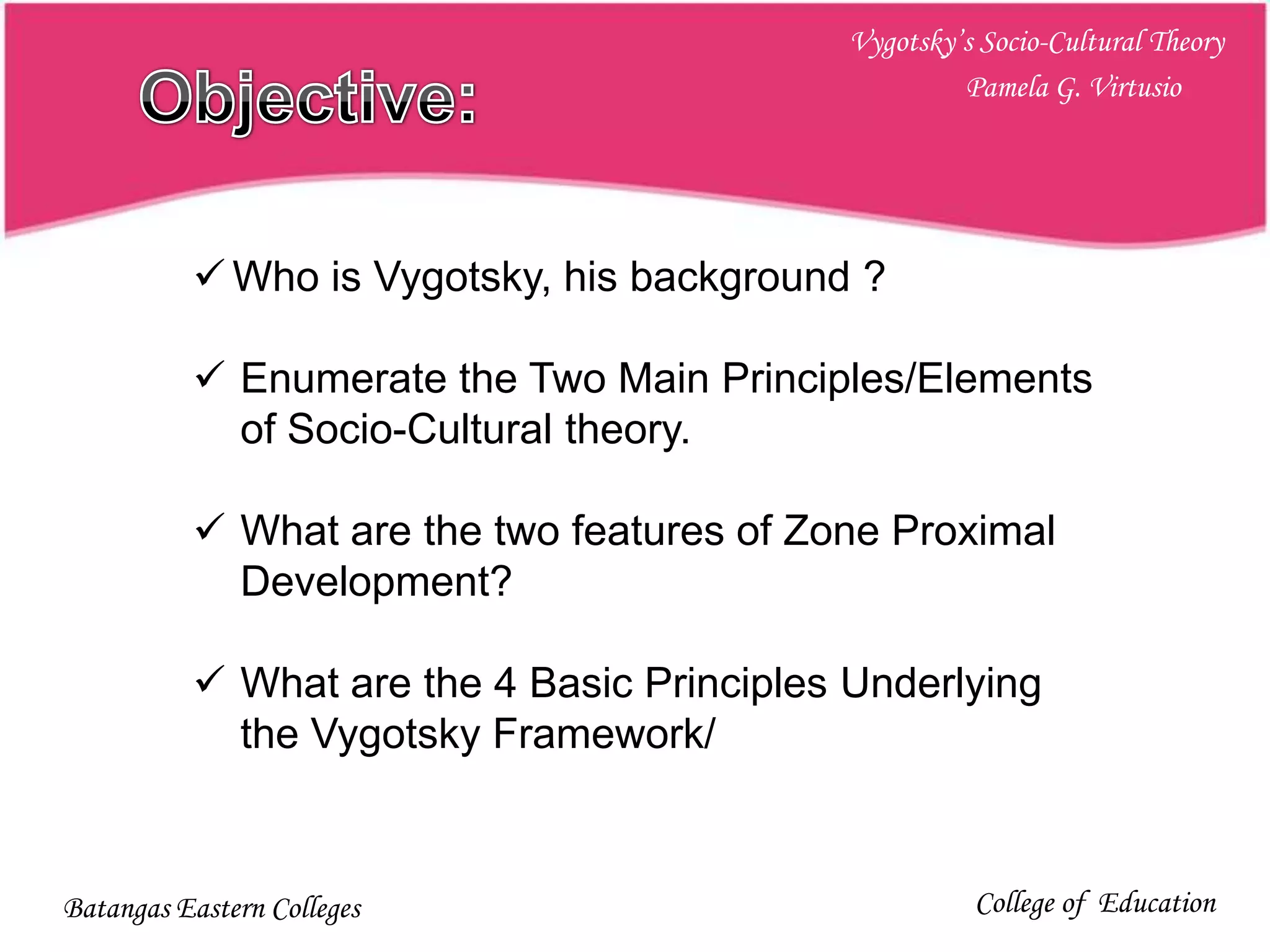
 Who is Vygotsky, his background ?
 Enumerate the Two Main Principles/Elements
of Socio-Cultural theory.

 What are the two features of Zone Proximal
Development?
 What are the 4 Basic Principles Underlying
the Vygotsky Framework/

Batangas Eastern Colleges

College of Education
Vygotsky’s Socio-Cultural Theory
Pamela G. Virtusio

 “The Mozart of Psychology”
 Lev Semonovich Vygotsky was born in Western Russia on November 5, 1986.His
father, Semi L’vovich, founded the “Society of Education in Gomel”, and held a
wide range of active interest including foreign language, history, literature,
theater and arts. His mother was educated as teacher.
 In 1917, he graduated from Moscow University with a degree in Law.
 Vygotsky completed 270 scientific articles,numerous,lectures and 10 books
based on a wide range of Marxist-based psychological and teaching theories.
 He is considered a seminal thinker in psychology, and much of his work is still
discovered and explored today.
 He died on June 10, 1934 at 37 after long battle with TB.
Batangas Eastern Colleges

College of Education
Vygotsky’s Socio-Cultural Theory
Pamela G. Virtusio

Vygotsky Theory is that social interaction plays a very
important in cognitive development.
Did not focus on the individual child but on the child as
a product of social interaction, especially with adults.
Focus on dynamic interactions rather than child by
himself.
People thinking differs dramatically between cultures
because different cultures stress different things.
Batangas Eastern Colleges

College of Education
Vygotsky’s Socio-Cultural Theory
Pamela G. Virtusio

1. The More Knowledgeable Other (MKO)
 Refers to anyone who has better understanding
or higher ability level than the learner.
 Normally thought of as being a teacher, trainer,
or older, adult, but MKO could also peers , a
younger person, even computers.

Batangas Eastern Colleges

College of Education
Vygotsky’s Socio-Cultural Theory
Pamela G. Virtusio

2. Zone of Proximal Development
 Difference between what child can accomplish
alone and s/he can accomplish with the
guidance of another.

Batangas Eastern Colleges

College of Education
Vygotsky’s Socio-Cultural Theory
Pamela G. Virtusio

I. Scaffolding
• Appropriate assistance given by the teacher to
assist the learner accomplish a task.
• Requires that an instructor shows example how
to solve a problem, while controlling the
learning environment so that students can take
things step by step expanding their knowledge
without excessive frustration.
Batangas Eastern Colleges

College of Education
Vygotsky’s Socio-Cultural Theory
Pamela G. Virtusio

II.

Reciprocal Teaching
• A highly successful teaching method, it provides
an environment of open dialogue between
student and teacher which goes beyond a simple
question and answer session.

Batangas Eastern Colleges

College of Education
Vygotsky’s Socio-Cultural Theory
Pamela G. Virtusio

1) Children construct their knowledge.
2) Development cannot be separated from its social
context.
3) Learning is mediated.
4) Language plays a central role in mental
development.

Batangas Eastern Colleges

College of Education
Vygotsky’s Socio-Cultural Theory
Pamela G. Virtusio

1. Lower Mental Function
 Are those with which we are born, are the
natural functions and are genetically
determined.
2. Higher Mental Function
 Are acquired and developed through social
interaction.

Batangas Eastern Colleges

College of Education
Vygotsky’s Socio-Cultural Theory
Pamela G. Virtusio

 Sociocultural theory considers learning as a
semiotic process where participation in sociallymediated activities is essential.
 Social interaction emphasized that effective
learning happens through participation in social
activities, making the social context of learning
crucial.
 Vgotsky theory was important in education since
these works provide tools for the development of
individuals learning.
Batangas Eastern Colleges

College of Education
Vygotsky’s Socio-Cultural Theory
Pamela G. Virtusio

Vygotsky’s Socio-Cultural Theory

References
Facilitating Learning A metacognition process, Maria Rita D. Lucas & Brenda
Corpuz, Publishedd by Lorimar Publishing,coyright 2007
www.slideshare.com

www.youtube.com

Batangas Eastern Colleges

College of Education
Vygotsky’s Socio-Cultural Theory
Pamela G. Virtusio

Batangas Eastern Colleges

College of Education

Vygotsky socio cultural theory

  • 1.
    MODULE 5: Vgotsky Socio-cultural Theory PamelaG. Virtusio Uniting Batangas Eastern Colleges College of Education
  • 2.
    Vygotsky’s Socio-Cultural Theory PamelaG. Virtusio  Who is Vygotsky, his background ?  Enumerate the Two Main Principles/Elements of Socio-Cultural theory.  What are the two features of Zone Proximal Development?  What are the 4 Basic Principles Underlying the Vygotsky Framework/ Batangas Eastern Colleges College of Education
  • 3.
    Vygotsky’s Socio-Cultural Theory PamelaG. Virtusio  “The Mozart of Psychology”  Lev Semonovich Vygotsky was born in Western Russia on November 5, 1986.His father, Semi L’vovich, founded the “Society of Education in Gomel”, and held a wide range of active interest including foreign language, history, literature, theater and arts. His mother was educated as teacher.  In 1917, he graduated from Moscow University with a degree in Law.  Vygotsky completed 270 scientific articles,numerous,lectures and 10 books based on a wide range of Marxist-based psychological and teaching theories.  He is considered a seminal thinker in psychology, and much of his work is still discovered and explored today.  He died on June 10, 1934 at 37 after long battle with TB. Batangas Eastern Colleges College of Education
  • 4.
    Vygotsky’s Socio-Cultural Theory PamelaG. Virtusio Vygotsky Theory is that social interaction plays a very important in cognitive development. Did not focus on the individual child but on the child as a product of social interaction, especially with adults. Focus on dynamic interactions rather than child by himself. People thinking differs dramatically between cultures because different cultures stress different things. Batangas Eastern Colleges College of Education
  • 5.
    Vygotsky’s Socio-Cultural Theory PamelaG. Virtusio 1. The More Knowledgeable Other (MKO)  Refers to anyone who has better understanding or higher ability level than the learner.  Normally thought of as being a teacher, trainer, or older, adult, but MKO could also peers , a younger person, even computers. Batangas Eastern Colleges College of Education
  • 6.
    Vygotsky’s Socio-Cultural Theory PamelaG. Virtusio 2. Zone of Proximal Development  Difference between what child can accomplish alone and s/he can accomplish with the guidance of another. Batangas Eastern Colleges College of Education
  • 7.
    Vygotsky’s Socio-Cultural Theory PamelaG. Virtusio I. Scaffolding • Appropriate assistance given by the teacher to assist the learner accomplish a task. • Requires that an instructor shows example how to solve a problem, while controlling the learning environment so that students can take things step by step expanding their knowledge without excessive frustration. Batangas Eastern Colleges College of Education
  • 8.
    Vygotsky’s Socio-Cultural Theory PamelaG. Virtusio II. Reciprocal Teaching • A highly successful teaching method, it provides an environment of open dialogue between student and teacher which goes beyond a simple question and answer session. Batangas Eastern Colleges College of Education
  • 9.
    Vygotsky’s Socio-Cultural Theory PamelaG. Virtusio 1) Children construct their knowledge. 2) Development cannot be separated from its social context. 3) Learning is mediated. 4) Language plays a central role in mental development. Batangas Eastern Colleges College of Education
  • 10.
    Vygotsky’s Socio-Cultural Theory PamelaG. Virtusio 1. Lower Mental Function  Are those with which we are born, are the natural functions and are genetically determined. 2. Higher Mental Function  Are acquired and developed through social interaction. Batangas Eastern Colleges College of Education
  • 11.
    Vygotsky’s Socio-Cultural Theory PamelaG. Virtusio  Sociocultural theory considers learning as a semiotic process where participation in sociallymediated activities is essential.  Social interaction emphasized that effective learning happens through participation in social activities, making the social context of learning crucial.  Vgotsky theory was important in education since these works provide tools for the development of individuals learning. Batangas Eastern Colleges College of Education
  • 12.
    Vygotsky’s Socio-Cultural Theory PamelaG. Virtusio Vygotsky’s Socio-Cultural Theory References Facilitating Learning A metacognition process, Maria Rita D. Lucas & Brenda Corpuz, Publishedd by Lorimar Publishing,coyright 2007 www.slideshare.com www.youtube.com Batangas Eastern Colleges College of Education
  • 13.
    Vygotsky’s Socio-Cultural Theory PamelaG. Virtusio Batangas Eastern Colleges College of Education