Presented by:
Jenina Pauline Cardenas
  Mark Francis Astom
        BSEd- II
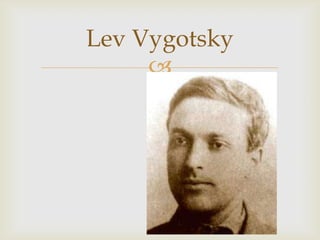
Lev Vygotsky
     
Vygotsky believes that…
          
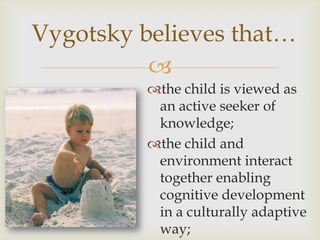
          the child is viewed as
           an active seeker of
           knowledge;
          the child and
           environment interact
           together enabling
           cognitive development
           in a culturally adaptive
           way;
Vygotsky believes that…
          
        the mind is
         perceived to be
         socially constructed;
        the child is born
         with basic
         attentional,
         perceptual and
         memory capacities;
Vygotsky believes that…
          
          development occurs
           as a direct result of
           contact with the
           environment;
          language and
           thought develop
           independently, but
           eventually merge and
           interact.
Vygotsky believes that…
          
           children must
            speak to
            themselves in a self
            guiding and
            directing way-
            initially aloud and
            later internally
1. Self-Regulation
              
Development involves the
 internalization of signs acquired by
 an individual from others so that
 he can solve problems by himself
2. Zone of Proximal
    Development
        
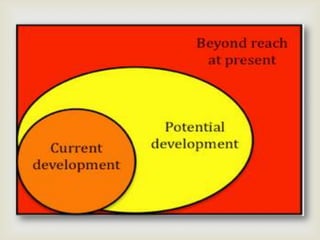
     refers to the tasks a
      child is unable to
      complete alone, but is
      able to complete with
      the assistance of an
      adult.

The teacher gives a
 learning experience
 for a specific child at a
 level just beyond
 his/her current level
 of performance.

3. Scaffolding
      
    In order for a child
     to learn new
     concepts or skills
     the teacher must
     provide scaffolds
     for the learning
     experience.

Like scaffolding on a
 building, supports are withdrawn as
 individual competence
 develops. Scaffolding may include
 physical presence and prompts along
 with more specific metacognitive
 strategies.
Educational Implications
          
Child as an active participant in the learning
 process.
Importance of individual difference.
Assist children in discovery.
Teachers should guide learning through
 explanation, demonstration and verbal
 prompts.

 Tailor lessons to each child's zone of proximal
  development.
 Early childhood – promote teacher/child and
  child/child interactions.
 Promote fantasy play.
 Within the learning environment focus on literacy
  activities.
 Use prompts, reminders, increase independence,
  give information, use cooperative learning and
  reciprocal teaching strategies.
Vygotsky also believed
        that…
          
Language is the most important tool
 for gaining this social knowledge
Children can learn a lot via language
“Words play a central part
not only in the development
   of thought but in the
   historical growth of
consciousness as a whole.”

  “The speech structures


Vygotsky's Cognitive development

  • 1.
    Presented by: Jenina PaulineCardenas Mark Francis Astom BSEd- II
  • 2.
  • 3.
    Vygotsky believes that…  the child is viewed as an active seeker of knowledge; the child and environment interact together enabling cognitive development in a culturally adaptive way;
  • 4.
    Vygotsky believes that…  the mind is perceived to be socially constructed; the child is born with basic attentional, perceptual and memory capacities;
  • 5.
    Vygotsky believes that…  development occurs as a direct result of contact with the environment; language and thought develop independently, but eventually merge and interact.
  • 6.
    Vygotsky believes that…  children must speak to themselves in a self guiding and directing way- initially aloud and later internally
  • 7.
    1. Self-Regulation  Development involves the internalization of signs acquired by an individual from others so that he can solve problems by himself
  • 8.
    2. Zone ofProximal Development  refers to the tasks a child is unable to complete alone, but is able to complete with the assistance of an adult.
  • 9.
     The teacher givesa learning experience for a specific child at a level just beyond his/her current level of performance.
  • 10.
  • 11.
    3. Scaffolding  In order for a child to learn new concepts or skills the teacher must provide scaffolds for the learning experience.
  • 12.
     Like scaffolding ona building, supports are withdrawn as individual competence develops. Scaffolding may include physical presence and prompts along with more specific metacognitive strategies.
  • 13.
    Educational Implications  Child as an active participant in the learning process. Importance of individual difference. Assist children in discovery. Teachers should guide learning through explanation, demonstration and verbal prompts.
  • 14.
      Tailor lessonsto each child's zone of proximal development.  Early childhood – promote teacher/child and child/child interactions.  Promote fantasy play.  Within the learning environment focus on literacy activities.  Use prompts, reminders, increase independence, give information, use cooperative learning and reciprocal teaching strategies.
  • 15.
    Vygotsky also believed that…  Language is the most important tool for gaining this social knowledge Children can learn a lot via language
  • 16.
    “Words play acentral part not only in the development of thought but in the historical growth of consciousness as a whole.” “The speech structures
  • 17.