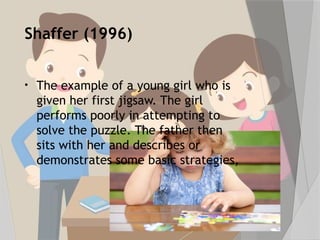
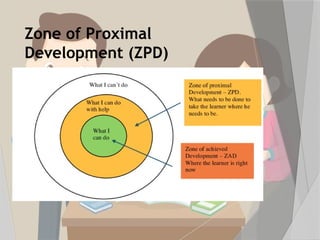
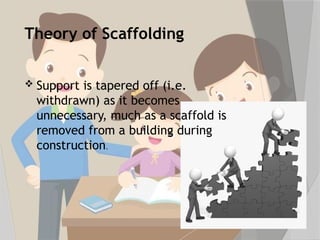
Lev Vygotsky, a prominent Russian psychologist, developed the sociocultural theory emphasizing the critical role of social interaction in children's cognitive development. Key concepts include the more knowledgeable other (MKO) and the zone of proximal development (ZPD), which describe how guided learning with a skilled partner enhances children's learning. Vygotsky's theories have significant educational applications, including scaffolding, reciprocal teaching, and collaborative learning strategies, though they face criticism for cultural universality and the emphasis on verbal instruction.