Copyright 2010, John Wiley & Sons, Inc.
Chapter 20
Nutrition and
Metabolism
Copyright 2010, John Wiley & Sons, Inc.
Nutrients
 Nutrients are chemicals the body uses for
growth, maintenance, and repair
 Essential nutrients: ones needed in the diet
because the body cannot make sufficient
amounts to meet body needs.
 There are six major types of nutrients:
carbohydrates, lipids, proteins, minerals,
vitamins, and water.
Copyright 2010, John Wiley & Sons, Inc.
Healthy Eating
 4 Cal/ gram for protein or carbohydrate
 9 Cal/gram for lipids
 Experted-suggested dietary calories:
 50-60% Calories from carbohydrate
 Should be <15% monosaccharides
 <30% from fats (mostly triglycerides)
 Should be < 10% from saturated fats
 12-15% from protein
Copyright 2010, John Wiley & Sons, Inc.
Guidelines for Healthy Eating
 Eat a variety of foods
 Maintain a healthy weight
 Choose foods low in fat, saturated fat, and
cholesterol
 Eat plenty of fruits, vegetables, and grains
 Use sugars in moderation
 Use sodium in moderation: < 2.3 grams/day
 Use alcoholic beverages in moderation only:
 1 drink/day for women; 2 drinks/day for men
Copyright 2010, John Wiley & Sons, Inc.
My Pyramid
 Introduced in 2005 by USDA
 Web: http://www.mypyramid.gov/
 Personalized approach to healthy food
choices
 Based on gender, age, and activity
 Food from each of 6 bands needed each day
 Example: healthy, moderately active 18-year-old
 Female requires about 2000 Calories/day
 Male requires about 2800 Calories/day
 Steps a reminder of daily activity needed
Copyright 2010, John Wiley & Sons, Inc.
My Pyramid
Copyright 2010, John Wiley & Sons, Inc.
Categories of Nutrients
 Carbohydrates, proteins, lipids
 Calories for energy + building materials.
 Water
 Minerals
 Ca, P, K, S, Na, Cl, Fl, Mg, Fe, Cr, I, Mn, Co, Cu,
Zn, Se. Table 21.1
 Vitamins: essential or dietary provitamins
 Lipid-soluble: A, D, E, K
 Water-soluble: B vitamins and C
 Functions: Table 20.2
Copyright 2010, John Wiley & Sons, Inc.
Categories of Nutrients: Six
 Carbohydrates, proteins, lipids
 Give calories for energy + building materials.
 Minerals: inorganic (Table 20.1)
 Ca, P, K, S, Na, Cl, Fl, Mg, Fe, I, Mn, Co, Cu, Zn,
Se, Cr
 Electrolytes, components of skeleton, enzymes
 Vitamins: organic (Table 20.2)
 Lipid soluble: A, D, E, K
 Water soluble: B group, C
 Many function as coenzymes
Copyright 2010, John Wiley & Sons, Inc.
Metabolism
 Facilitated by enzymes and coenzymes
 NAD+
from B vitamin niacin
 FAD from riboflavin (B2)
 Sequence of enzymatic steps is a pathway
 Two categories
 Anabolism: synthesis of more complex chemicals
 Catabolism: breakdown with energy release
 40%  cellular functions (ATP)
 60%  heat
Copyright 2010, John Wiley & Sons, Inc.
Metabolism
Copyright 2010, John Wiley & Sons, Inc.
Metabolism
Interactions Animation
 Introduction to Metabolism
You must be connected to the internet to run this animation.
Copyright 2010, John Wiley & Sons, Inc.
Metabolism
Copyright 2010, John Wiley & Sons, Inc.
Carbohydrate Metabolism
 Glucose: the body’s preferred source for ATP
production
 Possible uses of glucose
 Used immediately for ATP production
 Stored as glycogen in liver or skeletal muscle
 Leftover: forms triglycerides in adipose tissue
 Enters cells by facilitated diffusion
 Insulin increases rate of transport
Copyright 2010, John Wiley & Sons, Inc.
Glucose Catabolism
Overall catabolism of glucose
Glucose + 6 O2  36-38 ATP + 6 CO2 + 6 H2O
1. Glycolysis (in cytosol)
 Glucose  pyruvate + ATP + NADH + H+
 Anaerobic cellular respiration
2. Transition step (in mitochondria):
Pyruvate  acetyl CoA + CO2 + NADH + H+
3. Krebs cycle (in mitochondria): aerobic
CO2 + ATP + NADH + H+
+ FADH2
4. Electron transport chain (in mitochondria): aerobic
 NADH + H+
+ FADH2 + O2  ATP + H2O
Copyright 2010, John Wiley & Sons, Inc.
Glucose Anabolism and Regulation of
Blood Glucose Levels
 When blood glucose is high
 Glucose + ATP  glycogen (in liver, muscle)
 Effect: blood glucose level is lowered
 When blood glucose is low
 Hormones glucagon and epinephrine stimulate
 Glycogen breakdown to  glucose
 Hormones: glucagon and cortisol stimulate
 Gluconeogenesis in liver cells by
 Glycerol (from fat)  glucose
 Some amino acids  glucose
Copyright 2010, John Wiley & Sons, Inc.
Glucose Anabolism and Regulation of
Blood Glucose Levels
Copyright 2010, John Wiley & Sons, Inc.
Lipid Metabolism
 Lipolysis (catabolism): triglycerides 
glycerol + fatty acids
 Glycerol  glycolysis or gluconeogenesis
 Fatty acids  acetyl-CoA (2-carbon)  Krebs
cyle  ATP
 Liver converts some acetyl-CoA  ketone bodies
 Diabetics can form excessive ketone bodies  acetone
(causes sweet breath) + acidosis (with possible coma
and death)
 Lipogenesis (anabolism)
 Excess fats, carbohydrates, or proteins  fats
Copyright 2010, John Wiley & Sons, Inc.
Lipid Metabolism
Copyright 2010, John Wiley & Sons, Inc.
Lipid Transport in Blood
 Lipids are not water soluble so need
protein coating  lipoproteins
 Types of lipoproteins
 Chylomicrons: carry dietary fat to adipose
 Very low-density lipoproteins (VLDL)
 Made in liver; transport fat to adipose tissue
 Converted to LDLs
 Low-density lipoproteins (LDL): “bad”
 Carry 75% of cholesterol to cells for use there
 High-density lipoproteins (HDL): “good”
 Remove excess cholesterol and transport to liver for
disposal
Copyright 2010, John Wiley & Sons, Inc.
Protein Metabolism
 Catabolism: protein breakdown
 Deamination in liver to remove NH2  NH3
 Liver converts toxic NH3  urea  urine
 Rest of amino acid  Krebs cycle  ATP
 Anabolism: protein synthesis to form many
different proteins in the body
 Essential amino acids (10): must come in diet
 Nonessential amino acids (10): can be made in
the body by modifications of essential amino
acids
Copyright 2010, John Wiley & Sons, Inc.
Metabolism and Body Heat Gain
 Heat is one form of energy
 Measured in calories
 1 calorie (cal) = energy needed to raise 1 g of
water 1o
C
 For foods use kilocalories (1000 cal) = Calorie
 Heat is produced (gained) from catabolism
 Rate of production = metabolic rate
 Basal metabolic rate (BMR) = heat produced from
catabolism when resting and fasting
 BMR for adult :1200-1800 Cal/day
Copyright 2010, John Wiley & Sons, Inc.
Metabolism and Body Heat
 Metabolic rate is affected by the following
 Exercise: rate can increase 15-20 times
 Hormones: thyroid is primary
 Nervous System: ANS can increase
 Body temperature: warming increases
 Ingestion of food: gives 10-20% increase
 Age: metabolic rate of child higher than adult’s
 Gender, pregnancy, climate, sleep, malnutrition
Copyright 2010, John Wiley & Sons, Inc.
Body Heat Loss
 Must be continuous as catabolism constantly
produces heat
 Routes of heat loss
 Radiation: loss of body heat to air
 Conduction: loss of body heat to surface, such as
cold metal seat
 Convection
 Loss of body heat to air moving from a fan or from
breeze outside shower curtain
 Evaporation
 Conversion of water to vapor as in sweating; helps
prevent overheating with exercise
Copyright 2010, John Wiley & Sons, Inc.
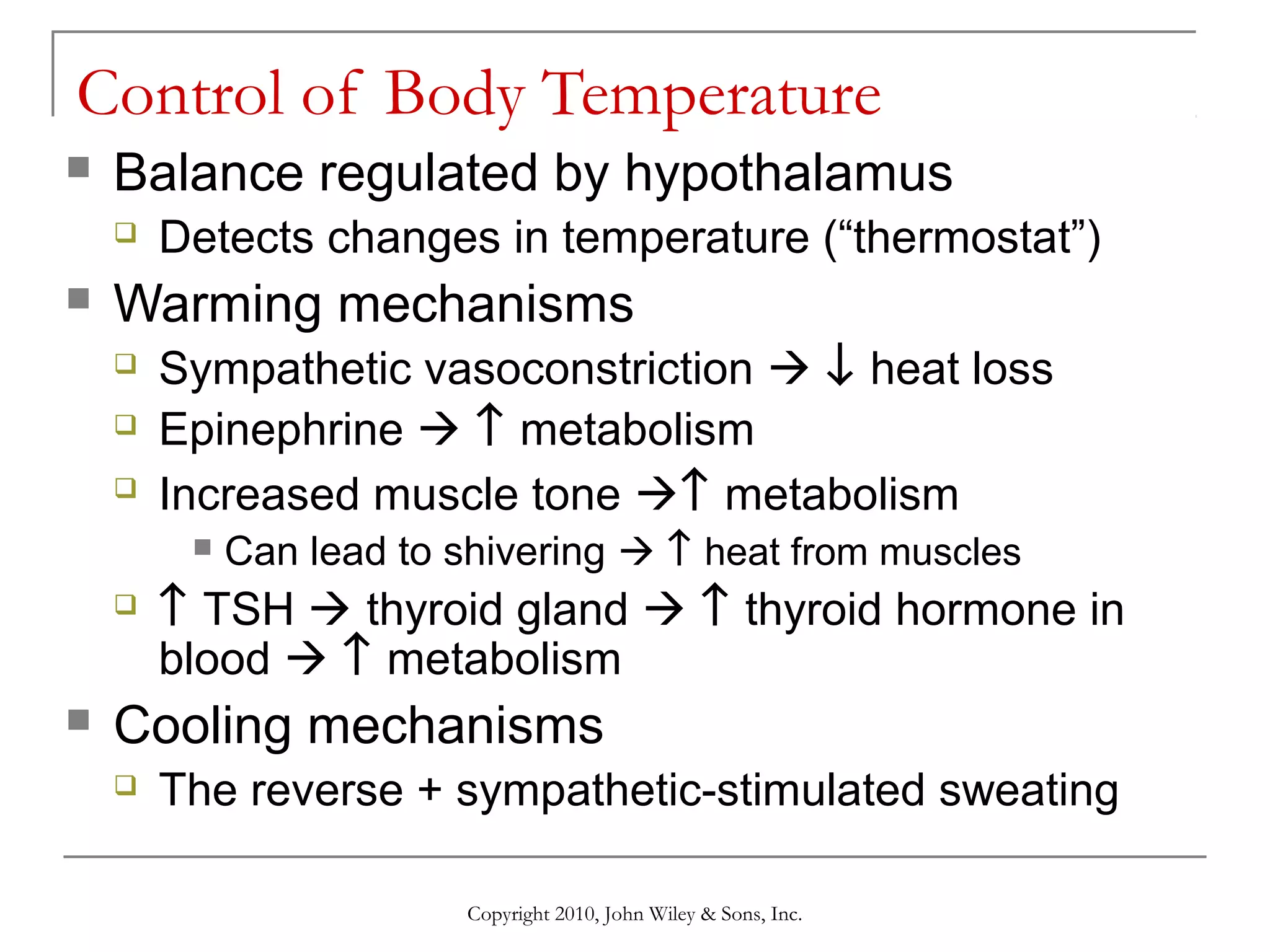
Control of Body Temperature
 Balance regulated by hypothalamus
 Detects changes in temperature (“thermostat”)
 Warming mechanisms
 Sympathetic vasoconstriction  ↓ heat loss
 Epinephrine  ↑ metabolism
 Increased muscle tone ↑ metabolism
 Can lead to shivering  ↑ heat from muscles
 ↑ TSH  thyroid gland  ↑ thyroid hormone in
blood  ↑ metabolism
 Cooling mechanisms
 The reverse + sympathetic-stimulated sweating
Copyright 2010, John Wiley & Sons, Inc.
End of Chapter 20
 Copyright 2010 John Wiley & Sons, Inc.
All rights reserved. Reproduction or translation of
this work beyond that permitted in section 117 of the
1976 United States Copyright Act without express
permission of the copyright owner is unlawful.
Request for further information should be addressed
to the Permission Department, John Wiley & Sons,
Inc. The purchaser may make back-up copies for
his/her own use only and not for distribution or
resale. The Publishers assumes no responsibility
for errors, omissions, or damages caused by the
use of theses programs or from the use of the
information herein.

Lecture 10 nutrition and metabolism

  • 1.
    Copyright 2010, JohnWiley & Sons, Inc. Chapter 20 Nutrition and Metabolism
  • 2.
    Copyright 2010, JohnWiley & Sons, Inc. Nutrients  Nutrients are chemicals the body uses for growth, maintenance, and repair  Essential nutrients: ones needed in the diet because the body cannot make sufficient amounts to meet body needs.  There are six major types of nutrients: carbohydrates, lipids, proteins, minerals, vitamins, and water.
  • 3.
    Copyright 2010, JohnWiley & Sons, Inc. Healthy Eating  4 Cal/ gram for protein or carbohydrate  9 Cal/gram for lipids  Experted-suggested dietary calories:  50-60% Calories from carbohydrate  Should be <15% monosaccharides  <30% from fats (mostly triglycerides)  Should be < 10% from saturated fats  12-15% from protein
  • 4.
    Copyright 2010, JohnWiley & Sons, Inc. Guidelines for Healthy Eating  Eat a variety of foods  Maintain a healthy weight  Choose foods low in fat, saturated fat, and cholesterol  Eat plenty of fruits, vegetables, and grains  Use sugars in moderation  Use sodium in moderation: < 2.3 grams/day  Use alcoholic beverages in moderation only:  1 drink/day for women; 2 drinks/day for men
  • 5.
    Copyright 2010, JohnWiley & Sons, Inc. My Pyramid  Introduced in 2005 by USDA  Web: http://www.mypyramid.gov/  Personalized approach to healthy food choices  Based on gender, age, and activity  Food from each of 6 bands needed each day  Example: healthy, moderately active 18-year-old  Female requires about 2000 Calories/day  Male requires about 2800 Calories/day  Steps a reminder of daily activity needed
  • 6.
    Copyright 2010, JohnWiley & Sons, Inc. My Pyramid
  • 7.
    Copyright 2010, JohnWiley & Sons, Inc. Categories of Nutrients  Carbohydrates, proteins, lipids  Calories for energy + building materials.  Water  Minerals  Ca, P, K, S, Na, Cl, Fl, Mg, Fe, Cr, I, Mn, Co, Cu, Zn, Se. Table 21.1  Vitamins: essential or dietary provitamins  Lipid-soluble: A, D, E, K  Water-soluble: B vitamins and C  Functions: Table 20.2
  • 8.
    Copyright 2010, JohnWiley & Sons, Inc. Categories of Nutrients: Six  Carbohydrates, proteins, lipids  Give calories for energy + building materials.  Minerals: inorganic (Table 20.1)  Ca, P, K, S, Na, Cl, Fl, Mg, Fe, I, Mn, Co, Cu, Zn, Se, Cr  Electrolytes, components of skeleton, enzymes  Vitamins: organic (Table 20.2)  Lipid soluble: A, D, E, K  Water soluble: B group, C  Many function as coenzymes
  • 9.
    Copyright 2010, JohnWiley & Sons, Inc. Metabolism  Facilitated by enzymes and coenzymes  NAD+ from B vitamin niacin  FAD from riboflavin (B2)  Sequence of enzymatic steps is a pathway  Two categories  Anabolism: synthesis of more complex chemicals  Catabolism: breakdown with energy release  40%  cellular functions (ATP)  60%  heat
  • 10.
    Copyright 2010, JohnWiley & Sons, Inc. Metabolism
  • 11.
    Copyright 2010, JohnWiley & Sons, Inc. Metabolism Interactions Animation  Introduction to Metabolism You must be connected to the internet to run this animation.
  • 12.
    Copyright 2010, JohnWiley & Sons, Inc. Metabolism
  • 13.
    Copyright 2010, JohnWiley & Sons, Inc. Carbohydrate Metabolism  Glucose: the body’s preferred source for ATP production  Possible uses of glucose  Used immediately for ATP production  Stored as glycogen in liver or skeletal muscle  Leftover: forms triglycerides in adipose tissue  Enters cells by facilitated diffusion  Insulin increases rate of transport
  • 14.
    Copyright 2010, JohnWiley & Sons, Inc. Glucose Catabolism Overall catabolism of glucose Glucose + 6 O2  36-38 ATP + 6 CO2 + 6 H2O 1. Glycolysis (in cytosol)  Glucose  pyruvate + ATP + NADH + H+  Anaerobic cellular respiration 2. Transition step (in mitochondria): Pyruvate  acetyl CoA + CO2 + NADH + H+ 3. Krebs cycle (in mitochondria): aerobic CO2 + ATP + NADH + H+ + FADH2 4. Electron transport chain (in mitochondria): aerobic  NADH + H+ + FADH2 + O2  ATP + H2O
  • 15.
    Copyright 2010, JohnWiley & Sons, Inc. Glucose Anabolism and Regulation of Blood Glucose Levels  When blood glucose is high  Glucose + ATP  glycogen (in liver, muscle)  Effect: blood glucose level is lowered  When blood glucose is low  Hormones glucagon and epinephrine stimulate  Glycogen breakdown to  glucose  Hormones: glucagon and cortisol stimulate  Gluconeogenesis in liver cells by  Glycerol (from fat)  glucose  Some amino acids  glucose
  • 16.
    Copyright 2010, JohnWiley & Sons, Inc. Glucose Anabolism and Regulation of Blood Glucose Levels
  • 17.
    Copyright 2010, JohnWiley & Sons, Inc. Lipid Metabolism  Lipolysis (catabolism): triglycerides  glycerol + fatty acids  Glycerol  glycolysis or gluconeogenesis  Fatty acids  acetyl-CoA (2-carbon)  Krebs cyle  ATP  Liver converts some acetyl-CoA  ketone bodies  Diabetics can form excessive ketone bodies  acetone (causes sweet breath) + acidosis (with possible coma and death)  Lipogenesis (anabolism)  Excess fats, carbohydrates, or proteins  fats
  • 18.
    Copyright 2010, JohnWiley & Sons, Inc. Lipid Metabolism
  • 19.
    Copyright 2010, JohnWiley & Sons, Inc. Lipid Transport in Blood  Lipids are not water soluble so need protein coating  lipoproteins  Types of lipoproteins  Chylomicrons: carry dietary fat to adipose  Very low-density lipoproteins (VLDL)  Made in liver; transport fat to adipose tissue  Converted to LDLs  Low-density lipoproteins (LDL): “bad”  Carry 75% of cholesterol to cells for use there  High-density lipoproteins (HDL): “good”  Remove excess cholesterol and transport to liver for disposal
  • 20.
    Copyright 2010, JohnWiley & Sons, Inc. Protein Metabolism  Catabolism: protein breakdown  Deamination in liver to remove NH2  NH3  Liver converts toxic NH3  urea  urine  Rest of amino acid  Krebs cycle  ATP  Anabolism: protein synthesis to form many different proteins in the body  Essential amino acids (10): must come in diet  Nonessential amino acids (10): can be made in the body by modifications of essential amino acids
  • 21.
    Copyright 2010, JohnWiley & Sons, Inc. Metabolism and Body Heat Gain  Heat is one form of energy  Measured in calories  1 calorie (cal) = energy needed to raise 1 g of water 1o C  For foods use kilocalories (1000 cal) = Calorie  Heat is produced (gained) from catabolism  Rate of production = metabolic rate  Basal metabolic rate (BMR) = heat produced from catabolism when resting and fasting  BMR for adult :1200-1800 Cal/day
  • 22.
    Copyright 2010, JohnWiley & Sons, Inc. Metabolism and Body Heat  Metabolic rate is affected by the following  Exercise: rate can increase 15-20 times  Hormones: thyroid is primary  Nervous System: ANS can increase  Body temperature: warming increases  Ingestion of food: gives 10-20% increase  Age: metabolic rate of child higher than adult’s  Gender, pregnancy, climate, sleep, malnutrition
  • 23.
    Copyright 2010, JohnWiley & Sons, Inc. Body Heat Loss  Must be continuous as catabolism constantly produces heat  Routes of heat loss  Radiation: loss of body heat to air  Conduction: loss of body heat to surface, such as cold metal seat  Convection  Loss of body heat to air moving from a fan or from breeze outside shower curtain  Evaporation  Conversion of water to vapor as in sweating; helps prevent overheating with exercise
  • 24.
    Copyright 2010, JohnWiley & Sons, Inc. Control of Body Temperature  Balance regulated by hypothalamus  Detects changes in temperature (“thermostat”)  Warming mechanisms  Sympathetic vasoconstriction  ↓ heat loss  Epinephrine  ↑ metabolism  Increased muscle tone ↑ metabolism  Can lead to shivering  ↑ heat from muscles  ↑ TSH  thyroid gland  ↑ thyroid hormone in blood  ↑ metabolism  Cooling mechanisms  The reverse + sympathetic-stimulated sweating
  • 25.
    Copyright 2010, JohnWiley & Sons, Inc. End of Chapter 20  Copyright 2010 John Wiley & Sons, Inc. All rights reserved. Reproduction or translation of this work beyond that permitted in section 117 of the 1976 United States Copyright Act without express permission of the copyright owner is unlawful. Request for further information should be addressed to the Permission Department, John Wiley & Sons, Inc. The purchaser may make back-up copies for his/her own use only and not for distribution or resale. The Publishers assumes no responsibility for errors, omissions, or damages caused by the use of theses programs or from the use of the information herein.