Chapter 30


             UTRITION
What is Nutrition?
   Nutrition: the study of food, including
         How food nourishes our bodies
         How food influences our health


  Nutrition is a relatively new discipline of science.
Why is Nutrition Important?

   Nutrition contributes to wellness.

   Wellness: the absence of disease
         Physical, emotional, and spiritual health

   Critical components of wellness:
         Nutrition
         Physical activity
Why is Nutrition Important?

   Nutrition can prevent disease.
      Nutrient deficiency diseases:
         scurvy, goiter, rickets
      Diseases influenced by nutrition:
         chronic diseases such as heart disease
      Diseases in which nutrition plays a role:
         osteoarthritis, osteoporosis
Nutrition is the science that studies food


                       ?
and how food nourishes our body and
influences health.

True
False
A
Nutrition is the science that studies food and
how food nourishes our body and influences
health.

True
False
What Are Nutrients?

  Nutrients: the chemicals in foods that are critical
  to human growth and function.

        carbohydrates            vitamins
        fats and oils            minerals
        proteins                 water
What Are Nutrients?

  Macronutrients: nutrients required in relatively
  large amounts.
        Provide energy to our bodies
        Carbohydrates, fats and oils, proteins
  Micronutrients: nutrients required in smaller
  amounts.
        Vitamins and minerals
Energy From Nutrients

  We measure energy in kilocalories (kcal).


    E N
  Kilocalorie: amount of energy required to raise
  the temperature of 1g of water by 1oC.

  On food labels, “calorie” actually refers to
  kilocalories.

                   from
Carbohydrates


C a rb
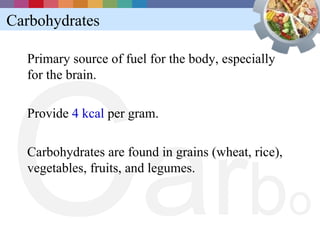
  Primary source of fuel for the body, especially
  for the brain.

  Provide 4 kcal per gram.

  Carbohydrates are found in grains (wheat, rice),
  vegetables, fruits, and legumes.


                                                     o
Carbohydrates


C a rb
  How does the body process dietary carbohydrates?

  Carbohydrates must be breakdown from di-,
  oligo-,and polysaccharides into monosaccharide.

  Only monosaccharide can pass into the blood
  stream.


                                                o
Carbohydrates


C a rb
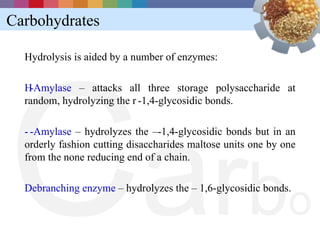
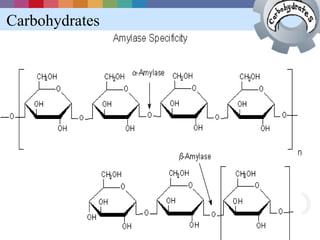
  Hydrolysis is aided by a number of enzymes:

  H-Amylase – attacks all three storage polysaccharide at
  random, hydrolyzing the r -1,4-glycosidic bonds.

  - -Amylase – hydrolyzes the –-1,4-glycosidic bonds but in an
  orderly fashion cutting disaccharides maltose units one by one
  from the none reducing end of a chain.


                                                              o
  Debranching enzyme – hydrolyzes the – 1,6-glycosidic bonds.
Carbohydrates


C a rb          o
Fats and Oils


 FO
   Fats and oils are composed of lipids, molecules
   that are insoluble in water.

   Provide 7 kcal per gram.

   An important energy source during rest or low
   intensity exercise.


                      &
   Found in butter, margarine, vegetable oils.
Fats and Oils


FO
   How does the body process dietary fats?

   Lipids in foods must be hydrolyze into smaller
   components before they can be absorb into the
   blood or lymph system.

   Lipase - enzymes that promote hydrolysis.


                   &
Proteins

   Proteins are chains of amino acids.


        P RO
   Proteins can supply 4 kcal of energy per gram,
   but are not a primary energy source.

   Proteins are an important source of nitrogen
Proteins

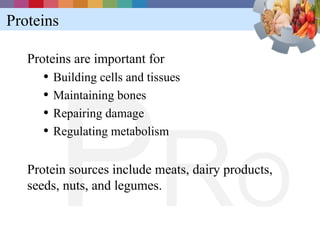
   Proteins are important for
      • Building cells and tissues


        P RO
      • Maintaining bones
      • Repairing damage
      • Regulating metabolism

   Protein sources include meats, dairy products,
   seeds, nuts, and legumes.
Proteins


   Digestion of dietary proteins begins with


           P RO
      cooking which denatures proteins.

      Denatured proteins are hydrolyze by
   hydrochloric acid and digestive enzymes
                in the stomach.
Proteins

   HCL denatures protein and hydrolyzes peptide bonds.

   Pepsin – hydrolyzes peptide bonds of amino side of the aromatic
   amino acids (tryptophan, phenylalanine, and tyrosine).

   Chymotrypsin – hydrolyzes internal peptide bonds at the same
   amino acids as does pepsin.

   Trypsin – hydrolyzes the carboxyl side of arginine and lysine.

   Carboxypeptidase – hydrolyzes amino acids one by one from the
   c-terminal end of the protein.
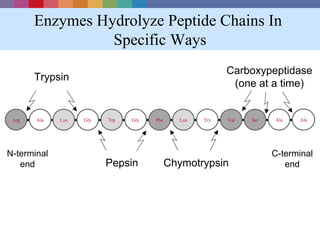
Enzymes Hydrolyze Peptide Chains In
                 Specific Ways
                                                         Carboxypeptidase
       Trypsin
                                                          (one at a time)


 Arg   Ala   Lys   Gly   Trp   Gly   Phe     Leu   Try   Val   Ser   Ala   Ala


N-terminal                                                           C-terminal
   end                   Pepsin            Chymotrypsin                 end
Proteins are a primary energy source for


                      ?
our bodies

True
False
A
Proteins are a primary energy source for
our bodies

True
False
Vitamins

  Vitamins: organic molecules that assist in
      regulating body processes.

  Vitamins are micronutrients that do not supply
      energy to our bodies.
        Fat-soluble vitamins
        Water-soluble vitamins
Vitamins

  Fat-soluble vitamins:
        Vitamins A, D, E and K
        Dissolve easily in fats and oils


  Fat-soluble vitamins can be stored in the body.
Vitamins

  Water-soluble vitamins:
       Vitamin C and the B vitamins
       Remain dissolved in water


  Excess water-soluble vitamins are eliminated by
  the kidneys and cannot be stored in our bodies.
All vitamins must be consumed daily to


                     ?
support optimal health.

True
False
A
All vitamins must be consumed daily to
support optimal health.

True
False
Minerals

  Minerals: inorganic substances required for body
  processes.

  Minerals include sodium, calcium, iron,
  potassium, and magnesium.

  Minerals have many different functions such as
  fluid regulation, bone structure, muscle
  movement, and nerve functioning.
Minerals

   Our bodies require at least 100 mg per day of the
   major minerals such as calcium, phosphorus,
   magnesium, sodium, potassium, and chloride.

   We require less than 100 mg per day of the trace
   minerals such as iron, zinc, copper, iodine, and
   fluoride.
Water

  Water is a critical nutrient for health and
  survival.

  Water is involved in many body processes:
  fluid balance               nutrient transport
  nerve impulses              removal of wastes
  muscle contractions         chemical reactions
  many, many more…
Determining Nutrient Needs

  Dietary Reference Intakes (DRIs): updated
  nutritional standards.

        Expand on the traditional RDA values


       Set standards for nutrients that do not have
     RDA values
Determining Nutrient Needs

    DRIs consist of 4 values:
    1. Estimated Average Requirement (EAR)
    2. Recommended Dietary Allowances (RDA)
    3. Adequate Intake (AI)
    4. Tolerable Upper-Intake Level (UL)
Food Guide Pyramid
Determining Nutrient Needs

  Estimated Average Requirement (EAR)
     • The average daily intake level of a nutrient that
       will meet the needs of half of the people in a
       particular category


     • Used to determine the Recommended Dietary
       Allowance (RDA) of a nutrient
Determining Nutrient Needs


   Recommended Dietary Allowances (RDA)

     The average daily intake level required to
     meet the needs of 97 – 98% of people in a
                particular category
Determining Nutrient Needs

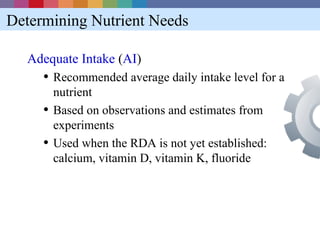
  Adequate Intake (AI)
     • Recommended average daily intake level for a
         nutrient
     •   Based on observations and estimates from
         experiments
     •   Used when the RDA is not yet established:
         calcium, vitamin D, vitamin K, fluoride
Determining Nutrient Needs

  Tolerable Upper Intake Level (UL)
     • Highest average daily intake level that is not
         likely to have adverse effects on the health of
         most people
     •   Consumption of a nutrient at levels above the
         UL is not considered safe
The Recommended Daily Allowance is the
maximum amount of nutrient that people should
consume to support normal body functions.


                              ?
True
False
A
The Recommended Daily Allowance is the
maximum amount of nutrient that people should
consume to support normal body functions.
True
False
Determining Nutrient Needs

  Estimated Energy Requirement (EER)
       Average dietary energy intake (kcal) to
     maintain energy balance

        Based on age, gender, weight, height, level of
        physical activity
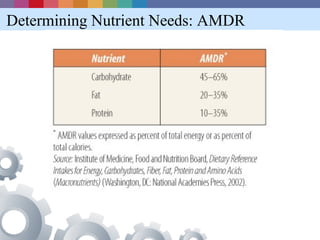
Determining Nutrient Needs

   Acceptable Macronutrient Distribution Ranges
                   (AMDR)

        Describes the portion of the energy intake that
        should come from each macronutrient
Determining Nutrient Needs: AMDR
PREPARED BY:

GEMIMA GALVEZ
    BSED 3C
ERRALYN RUBITE
    BSED 3C
VALERIE TOROY
    BSED 3C

Nutrition-biochemistry

  • 1.
    Chapter 30 UTRITION
  • 2.
    What is Nutrition? Nutrition: the study of food, including How food nourishes our bodies How food influences our health Nutrition is a relatively new discipline of science.
  • 3.
    Why is NutritionImportant? Nutrition contributes to wellness. Wellness: the absence of disease Physical, emotional, and spiritual health Critical components of wellness: Nutrition Physical activity
  • 4.
    Why is NutritionImportant? Nutrition can prevent disease. Nutrient deficiency diseases: scurvy, goiter, rickets Diseases influenced by nutrition: chronic diseases such as heart disease Diseases in which nutrition plays a role: osteoarthritis, osteoporosis
  • 5.
    Nutrition is thescience that studies food ? and how food nourishes our body and influences health. True False
  • 6.
    A Nutrition is thescience that studies food and how food nourishes our body and influences health. True False
  • 7.
    What Are Nutrients? Nutrients: the chemicals in foods that are critical to human growth and function. carbohydrates vitamins fats and oils minerals proteins water
  • 8.
    What Are Nutrients? Macronutrients: nutrients required in relatively large amounts. Provide energy to our bodies Carbohydrates, fats and oils, proteins Micronutrients: nutrients required in smaller amounts. Vitamins and minerals
  • 9.
    Energy From Nutrients We measure energy in kilocalories (kcal). E N Kilocalorie: amount of energy required to raise the temperature of 1g of water by 1oC. On food labels, “calorie” actually refers to kilocalories. from
  • 10.
    Carbohydrates C a rb Primary source of fuel for the body, especially for the brain. Provide 4 kcal per gram. Carbohydrates are found in grains (wheat, rice), vegetables, fruits, and legumes. o
  • 11.
    Carbohydrates C a rb How does the body process dietary carbohydrates? Carbohydrates must be breakdown from di-, oligo-,and polysaccharides into monosaccharide. Only monosaccharide can pass into the blood stream. o
  • 12.
    Carbohydrates C a rb Hydrolysis is aided by a number of enzymes: H-Amylase – attacks all three storage polysaccharide at random, hydrolyzing the r -1,4-glycosidic bonds. - -Amylase – hydrolyzes the –-1,4-glycosidic bonds but in an orderly fashion cutting disaccharides maltose units one by one from the none reducing end of a chain. o Debranching enzyme – hydrolyzes the – 1,6-glycosidic bonds.
  • 13.
  • 14.
    Fats and Oils FO Fats and oils are composed of lipids, molecules that are insoluble in water. Provide 7 kcal per gram. An important energy source during rest or low intensity exercise. & Found in butter, margarine, vegetable oils.
  • 15.
    Fats and Oils FO How does the body process dietary fats? Lipids in foods must be hydrolyze into smaller components before they can be absorb into the blood or lymph system. Lipase - enzymes that promote hydrolysis. &
  • 16.
    Proteins Proteins are chains of amino acids. P RO Proteins can supply 4 kcal of energy per gram, but are not a primary energy source. Proteins are an important source of nitrogen
  • 17.
    Proteins Proteins are important for • Building cells and tissues P RO • Maintaining bones • Repairing damage • Regulating metabolism Protein sources include meats, dairy products, seeds, nuts, and legumes.
  • 18.
    Proteins Digestion of dietary proteins begins with P RO cooking which denatures proteins. Denatured proteins are hydrolyze by hydrochloric acid and digestive enzymes in the stomach.
  • 19.
    Proteins HCL denatures protein and hydrolyzes peptide bonds. Pepsin – hydrolyzes peptide bonds of amino side of the aromatic amino acids (tryptophan, phenylalanine, and tyrosine). Chymotrypsin – hydrolyzes internal peptide bonds at the same amino acids as does pepsin. Trypsin – hydrolyzes the carboxyl side of arginine and lysine. Carboxypeptidase – hydrolyzes amino acids one by one from the c-terminal end of the protein.
  • 20.
    Enzymes Hydrolyze PeptideChains In Specific Ways Carboxypeptidase Trypsin (one at a time) Arg Ala Lys Gly Trp Gly Phe Leu Try Val Ser Ala Ala N-terminal C-terminal end Pepsin Chymotrypsin end
  • 21.
    Proteins are aprimary energy source for ? our bodies True False
  • 22.
    A Proteins are aprimary energy source for our bodies True False
  • 23.
    Vitamins Vitamins:organic molecules that assist in regulating body processes. Vitamins are micronutrients that do not supply energy to our bodies. Fat-soluble vitamins Water-soluble vitamins
  • 24.
    Vitamins Fat-solublevitamins: Vitamins A, D, E and K Dissolve easily in fats and oils Fat-soluble vitamins can be stored in the body.
  • 25.
    Vitamins Water-solublevitamins: Vitamin C and the B vitamins Remain dissolved in water Excess water-soluble vitamins are eliminated by the kidneys and cannot be stored in our bodies.
  • 26.
    All vitamins mustbe consumed daily to ? support optimal health. True False
  • 27.
    A All vitamins mustbe consumed daily to support optimal health. True False
  • 28.
    Minerals Minerals:inorganic substances required for body processes. Minerals include sodium, calcium, iron, potassium, and magnesium. Minerals have many different functions such as fluid regulation, bone structure, muscle movement, and nerve functioning.
  • 29.
    Minerals Our bodies require at least 100 mg per day of the major minerals such as calcium, phosphorus, magnesium, sodium, potassium, and chloride. We require less than 100 mg per day of the trace minerals such as iron, zinc, copper, iodine, and fluoride.
  • 30.
    Water Wateris a critical nutrient for health and survival. Water is involved in many body processes: fluid balance nutrient transport nerve impulses removal of wastes muscle contractions chemical reactions many, many more…
  • 31.
    Determining Nutrient Needs Dietary Reference Intakes (DRIs): updated nutritional standards. Expand on the traditional RDA values Set standards for nutrients that do not have RDA values
  • 32.
  • 33.
    Determining Nutrient Needs DRIs consist of 4 values: 1. Estimated Average Requirement (EAR) 2. Recommended Dietary Allowances (RDA) 3. Adequate Intake (AI) 4. Tolerable Upper-Intake Level (UL)
  • 34.
  • 35.
    Determining Nutrient Needs Estimated Average Requirement (EAR) • The average daily intake level of a nutrient that will meet the needs of half of the people in a particular category • Used to determine the Recommended Dietary Allowance (RDA) of a nutrient
  • 36.
    Determining Nutrient Needs Recommended Dietary Allowances (RDA) The average daily intake level required to meet the needs of 97 – 98% of people in a particular category
  • 37.
    Determining Nutrient Needs Adequate Intake (AI) • Recommended average daily intake level for a nutrient • Based on observations and estimates from experiments • Used when the RDA is not yet established: calcium, vitamin D, vitamin K, fluoride
  • 38.
    Determining Nutrient Needs Tolerable Upper Intake Level (UL) • Highest average daily intake level that is not likely to have adverse effects on the health of most people • Consumption of a nutrient at levels above the UL is not considered safe
  • 44.
    The Recommended DailyAllowance is the maximum amount of nutrient that people should consume to support normal body functions. ? True False
  • 45.
    A The Recommended DailyAllowance is the maximum amount of nutrient that people should consume to support normal body functions. True False
  • 46.
    Determining Nutrient Needs Estimated Energy Requirement (EER) Average dietary energy intake (kcal) to maintain energy balance Based on age, gender, weight, height, level of physical activity
  • 47.
    Determining Nutrient Needs Acceptable Macronutrient Distribution Ranges (AMDR) Describes the portion of the energy intake that should come from each macronutrient
  • 48.
  • 50.
    PREPARED BY: GEMIMA GALVEZ BSED 3C ERRALYN RUBITE BSED 3C VALERIE TOROY BSED 3C