Understand the fuel your body
needs and how it is used.
Preview
 Introduction
 Balanced Diet
 Vitamins, Minerals, Carbohydrates &
Proteins
 Diet chart & Important of natural
Diet
 Tips for Healthy Cooking
Introduction
Nutrition is the science that interprets
the interaction of nutrients and other
substances in food in relation to maintenance,
growth, reproduction, health and disease of an
organism.
Healthy Mind, Healthy Body
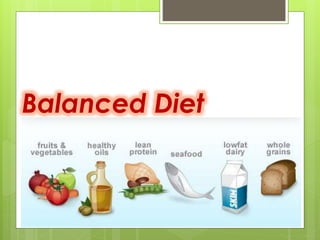
Balanced Diet
Why is it important to eat
healthy?
• Best way to live a healthy life is to eat a
balanced diet
• To provide nutrients that your body needs to
function
• To give you more energy and alertness throughout
the day
• To prevent future disease and sickness such as
Diabetes, obesity and cancer etc..
Your body needs nutrients
found in foods.
• Nutrients provide energy and materials
for cell development, growth, and
repair.
• You need energy for every activity and
to maintain a steady internal
temperature.
Vitamins, Minerals,
Carbohydrates &
Proteins
Types of Nutrients
 Macro-Nutrients – essential for human survival and
growth
• Carbohydrates
• Proteins
• Fats
• Water
 Micro-Nutrients – essential for growth and enhance
the function and usability of macro-nutrients
• Vitamins
• Minerals
The difference between macro and micro nutrients is the amount
your need each day. Macro-nutrients must exceed one gram per
day.
Carbohydrates
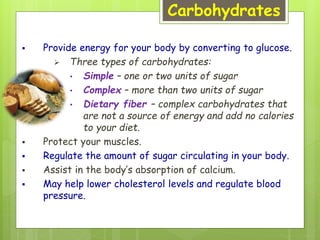
 Provide energy for your body by converting to glucose.
 Three types of carbohydrates:
• Simple – one or two units of sugar
• Complex – more than two units of sugar
• Dietary fiber – complex carbohydrates that
are not a source of energy and add no calories
to your diet.
 Protect your muscles.
 Regulate the amount of sugar circulating in your body.
 Assist in the body’s absorption of calcium.
 May help lower cholesterol levels and regulate blood
pressure.
Proteins
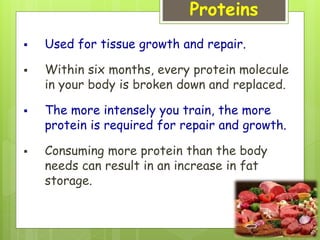
 Used for tissue growth and repair.
 Within six months, every protein molecule
in your body is broken down and replaced.
 The more intensely you train, the more
protein is required for repair and growth.
 Consuming more protein than the body
needs can result in an increase in fat
storage.
Fats
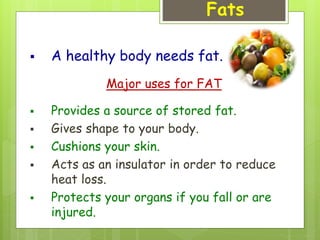
 A healthy body needs fat.
Major uses for FAT
 Provides a source of stored fat.
 Gives shape to your body.
 Cushions your skin.
 Acts as an insulator in order to reduce
heat loss.
 Protects your organs if you fall or are
injured.
Vitamins and Minerals
 Vitamins are essential for:
• Building body tissues such as bones, skin, glands,
nerves, and blood.
• Assisting in the metabolizing of proteins, fats, and
carbohydrates so you receive energy from food.
• Promoting healing
• Preventing nutritional deficiency diseases.
 Minerals are essential for:
• The formation of strong bones and teeth
• Helping to control the nervous system
• Fluid balance in tissues
• Muscle contractions
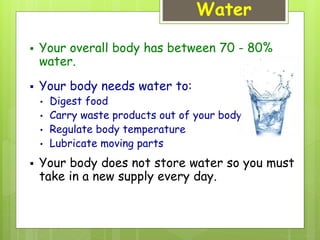
Water
 Your overall body has between 70 - 80%
water.
 Your body needs water to:
• Digest food
• Carry waste products out of your body
• Regulate body temperature
• Lubricate moving parts
 Your body does not store water so you must
take in a new supply every day.
Diet chart &
Importance of
natural Diet
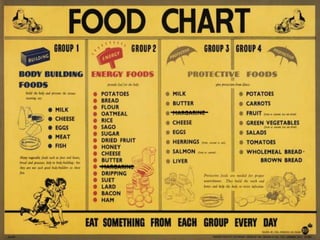
Diet Chart
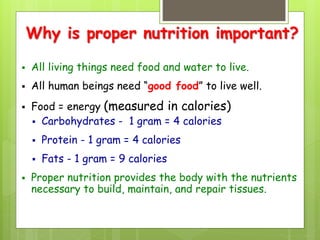
Why is proper nutrition important?
 All living things need food and water to live.
 All human beings need “good food” to live well.
 Food = energy (measured in calories)
 Carbohydrates - 1 gram = 4 calories
 Protein - 1 gram = 4 calories
 Fats - 1 gram = 9 calories
 Proper nutrition provides the body with the nutrients
necessary to build, maintain, and repair tissues.
Basic Nutrition
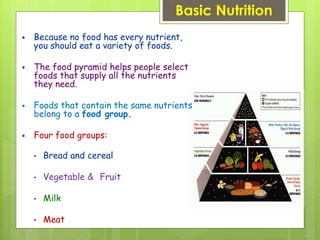
 Because no food has every nutrient,
you should eat a variety of foods.
 The food pyramid helps people select
foods that supply all the nutrients
they need.
 Foods that contain the same nutrients
belong to a food group.
 Four food groups:
• Bread and cereal
• Vegetable & Fruit
• Milk
• Meat
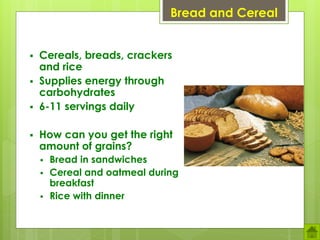
Bread and Cereal
 Cereals, breads, crackers
and rice
 Supplies energy through
carbohydrates
 6-11 servings daily
 How can you get the right
amount of grains?
 Bread in sandwiches
 Cereal and oatmeal during
breakfast
 Rice with dinner
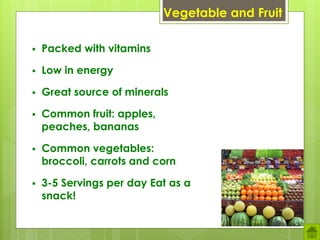
Vegetable and Fruit
 Packed with vitamins
 Low in energy
 Great source of minerals
 Common fruit: apples,
peaches, bananas
 Common vegetables:
broccoli, carrots and corn
 3-5 Servings per day Eat as a
snack!
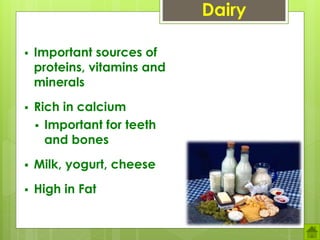
Dairy
 Important sources of
proteins, vitamins and
minerals
 Rich in calcium
 Important for teeth
and bones
 Milk, yogurt, cheese
 High in Fat
Meat
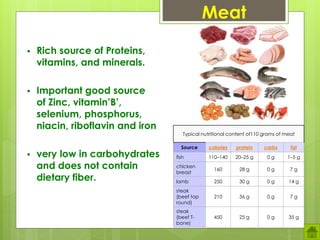
 Rich source of Proteins,
vitamins, and minerals.
 Important good source
of Zinc, vitamin’B’,
selenium, phosphorus,
niacin, riboflavin and iron
 very low in carbohydrates
and does not contain
dietary fiber.
Typical nutritional content of110 grams of meat
Source calories protein carbs fat
fish 110–140 20–25 g 0 g 1–5 g
chicken
breast
160 28 g 0 g 7 g
lamb 250 30 g 0 g 14 g
steak
(beef top
round)
210 36 g 0 g 7 g
steak
(beef T-
bone)
450 25 g 0 g 35 g
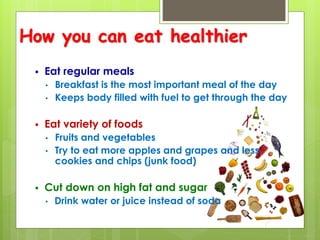
How you can eat healthier
 Eat regular meals
• Breakfast is the most important meal of the day
• Keeps body filled with fuel to get through the day
 Eat variety of foods
• Fruits and vegetables
• Try to eat more apples and grapes and less
cookies and chips (junk food)
 Cut down on high fat and sugar
• Drink water or juice instead of soda
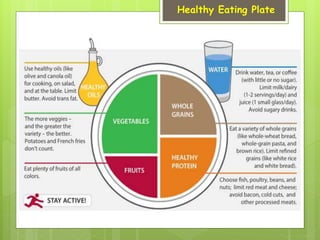
Healthy Eating Plate
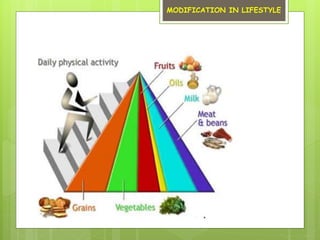
MODIFICATION IN LIFESTYLE
Key Concepts to an
Effective Nutritional Plan
 Breakfast is the most important meal of the day.
 Attempt to eat 4-6 meals per day.
 Minimum of 8 glasses of water per day.
 Attempt to consume carbohydrates, proteins, and
fats in every meal.
 Vegetables are the best source of vitamins and
minerals.
 Read labels and understand serving sizes.
 Supplements should be used as supplements.
 Make a lifestyle change – diets often fail.
Examples of Highly Nutritious Snacks
 Peanut butter and jelly on wheat bread
 Apples and peanut butter
 Low fat yogurt
 Cheese sticks
 Turkey Roll-ups
Results of Poor Nutrition
 Obesity
 Heart Disease
 Hypertension
 Diabetes
 Osteoporosis
 Bones may break due to a lack of calcium
 Gums may bleed due to low Vitamin C
 Low Iron count
Tips for Healthy
Cooking
Choosing Oils
 Use oils like sunflower, Canola, Safflower, Rice
Bran, Olive oil for cooking
 Avoid oils like coconut, palm or palm kernel oil as
they are high in saturated fats.
 Repeated heating of oils and fats during frying
may lead to formation of trans fatty acids
(TFA) not for good health.
 Try using oil sprays to minimize its use.
 Do not mix two oils together.
Methods for frying
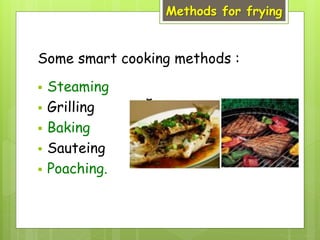
Some smart cooking methods :
 Steaming
 Grilling
 Baking
 Sauteing
 Poaching.
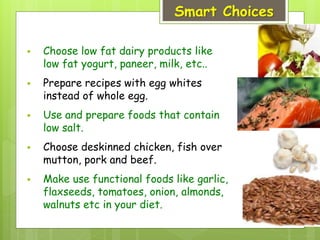
Smart Choices
 Choose low fat dairy products like
low fat yogurt, paneer, milk, etc..
 Prepare recipes with egg whites
instead of whole egg.
 Use and prepare foods that contain
low salt.
 Choose deskinned chicken, fish over
mutton, pork and beef.
 Make use functional foods like garlic,
flaxseeds, tomatoes, onion, almonds,
walnuts etc in your diet.
Thank You
Sree Kumar K

Nutrition Sree

  • 1.
    Understand the fuelyour body needs and how it is used.
  • 2.
    Preview  Introduction  BalancedDiet  Vitamins, Minerals, Carbohydrates & Proteins  Diet chart & Important of natural Diet  Tips for Healthy Cooking
  • 3.
    Introduction Nutrition is thescience that interprets the interaction of nutrients and other substances in food in relation to maintenance, growth, reproduction, health and disease of an organism. Healthy Mind, Healthy Body
  • 4.
  • 5.
    Why is itimportant to eat healthy? • Best way to live a healthy life is to eat a balanced diet • To provide nutrients that your body needs to function • To give you more energy and alertness throughout the day • To prevent future disease and sickness such as Diabetes, obesity and cancer etc..
  • 6.
    Your body needsnutrients found in foods. • Nutrients provide energy and materials for cell development, growth, and repair. • You need energy for every activity and to maintain a steady internal temperature.
  • 7.
  • 8.
    Types of Nutrients Macro-Nutrients – essential for human survival and growth • Carbohydrates • Proteins • Fats • Water  Micro-Nutrients – essential for growth and enhance the function and usability of macro-nutrients • Vitamins • Minerals The difference between macro and micro nutrients is the amount your need each day. Macro-nutrients must exceed one gram per day.
  • 9.
    Carbohydrates  Provide energyfor your body by converting to glucose.  Three types of carbohydrates: • Simple – one or two units of sugar • Complex – more than two units of sugar • Dietary fiber – complex carbohydrates that are not a source of energy and add no calories to your diet.  Protect your muscles.  Regulate the amount of sugar circulating in your body.  Assist in the body’s absorption of calcium.  May help lower cholesterol levels and regulate blood pressure.
  • 10.
    Proteins  Used fortissue growth and repair.  Within six months, every protein molecule in your body is broken down and replaced.  The more intensely you train, the more protein is required for repair and growth.  Consuming more protein than the body needs can result in an increase in fat storage.
  • 11.
    Fats  A healthybody needs fat. Major uses for FAT  Provides a source of stored fat.  Gives shape to your body.  Cushions your skin.  Acts as an insulator in order to reduce heat loss.  Protects your organs if you fall or are injured.
  • 12.
    Vitamins and Minerals Vitamins are essential for: • Building body tissues such as bones, skin, glands, nerves, and blood. • Assisting in the metabolizing of proteins, fats, and carbohydrates so you receive energy from food. • Promoting healing • Preventing nutritional deficiency diseases.  Minerals are essential for: • The formation of strong bones and teeth • Helping to control the nervous system • Fluid balance in tissues • Muscle contractions
  • 13.
    Water  Your overallbody has between 70 - 80% water.  Your body needs water to: • Digest food • Carry waste products out of your body • Regulate body temperature • Lubricate moving parts  Your body does not store water so you must take in a new supply every day.
  • 14.
    Diet chart & Importanceof natural Diet
  • 15.
  • 16.
    Why is propernutrition important?  All living things need food and water to live.  All human beings need “good food” to live well.  Food = energy (measured in calories)  Carbohydrates - 1 gram = 4 calories  Protein - 1 gram = 4 calories  Fats - 1 gram = 9 calories  Proper nutrition provides the body with the nutrients necessary to build, maintain, and repair tissues.
  • 17.
    Basic Nutrition  Becauseno food has every nutrient, you should eat a variety of foods.  The food pyramid helps people select foods that supply all the nutrients they need.  Foods that contain the same nutrients belong to a food group.  Four food groups: • Bread and cereal • Vegetable & Fruit • Milk • Meat
  • 18.
    Bread and Cereal Cereals, breads, crackers and rice  Supplies energy through carbohydrates  6-11 servings daily  How can you get the right amount of grains?  Bread in sandwiches  Cereal and oatmeal during breakfast  Rice with dinner
  • 19.
    Vegetable and Fruit Packed with vitamins  Low in energy  Great source of minerals  Common fruit: apples, peaches, bananas  Common vegetables: broccoli, carrots and corn  3-5 Servings per day Eat as a snack!
  • 20.
    Dairy  Important sourcesof proteins, vitamins and minerals  Rich in calcium  Important for teeth and bones  Milk, yogurt, cheese  High in Fat
  • 21.
    Meat  Rich sourceof Proteins, vitamins, and minerals.  Important good source of Zinc, vitamin’B’, selenium, phosphorus, niacin, riboflavin and iron  very low in carbohydrates and does not contain dietary fiber. Typical nutritional content of110 grams of meat Source calories protein carbs fat fish 110–140 20–25 g 0 g 1–5 g chicken breast 160 28 g 0 g 7 g lamb 250 30 g 0 g 14 g steak (beef top round) 210 36 g 0 g 7 g steak (beef T- bone) 450 25 g 0 g 35 g
  • 22.
    How you caneat healthier  Eat regular meals • Breakfast is the most important meal of the day • Keeps body filled with fuel to get through the day  Eat variety of foods • Fruits and vegetables • Try to eat more apples and grapes and less cookies and chips (junk food)  Cut down on high fat and sugar • Drink water or juice instead of soda
  • 23.
  • 24.
  • 25.
    Key Concepts toan Effective Nutritional Plan  Breakfast is the most important meal of the day.  Attempt to eat 4-6 meals per day.  Minimum of 8 glasses of water per day.  Attempt to consume carbohydrates, proteins, and fats in every meal.  Vegetables are the best source of vitamins and minerals.  Read labels and understand serving sizes.  Supplements should be used as supplements.  Make a lifestyle change – diets often fail.
  • 26.
    Examples of HighlyNutritious Snacks  Peanut butter and jelly on wheat bread  Apples and peanut butter  Low fat yogurt  Cheese sticks  Turkey Roll-ups
  • 27.
    Results of PoorNutrition  Obesity  Heart Disease  Hypertension  Diabetes  Osteoporosis  Bones may break due to a lack of calcium  Gums may bleed due to low Vitamin C  Low Iron count
  • 28.
  • 29.
    Choosing Oils  Useoils like sunflower, Canola, Safflower, Rice Bran, Olive oil for cooking  Avoid oils like coconut, palm or palm kernel oil as they are high in saturated fats.  Repeated heating of oils and fats during frying may lead to formation of trans fatty acids (TFA) not for good health.  Try using oil sprays to minimize its use.  Do not mix two oils together.
  • 30.
    Methods for frying Somesmart cooking methods :  Steaming  Grilling  Baking  Sauteing  Poaching.
  • 31.
    Smart Choices  Chooselow fat dairy products like low fat yogurt, paneer, milk, etc..  Prepare recipes with egg whites instead of whole egg.  Use and prepare foods that contain low salt.  Choose deskinned chicken, fish over mutton, pork and beef.  Make use functional foods like garlic, flaxseeds, tomatoes, onion, almonds, walnuts etc in your diet.
  • 32.