Chapter 18 Nutrition and Metabolism
Objectives Define and contrast catabolism and anabolism Describe the metabolic roles of carbohydrates, fats, proteins, vitamins, and minerals Define basic metabolic rate and list some factors that affect it
Objectives Describe three disorders associated with eating or metabolism Discuss the physiological mechanisms that regulate body temperature
Definitions Nutrition—food, vitamins, and minerals that are ingested and assimilated into the body Metabolism—process of using food molecules as energy sources and as building blocks for our own molecules
Definitions Catabolism—process that breaks food molecules down, releasing their stored energy; oxygen used in catabolism Anabolism—process that builds food molecules into complex chemical compounds
Metabolic Function of the Liver Processes blood immediately after it leaves the gastrointestinal tract Helps maintain normal blood glucose level Site of protein and fat metabolism Removes toxins from the blood Synthesizes several kinds of protein compounds
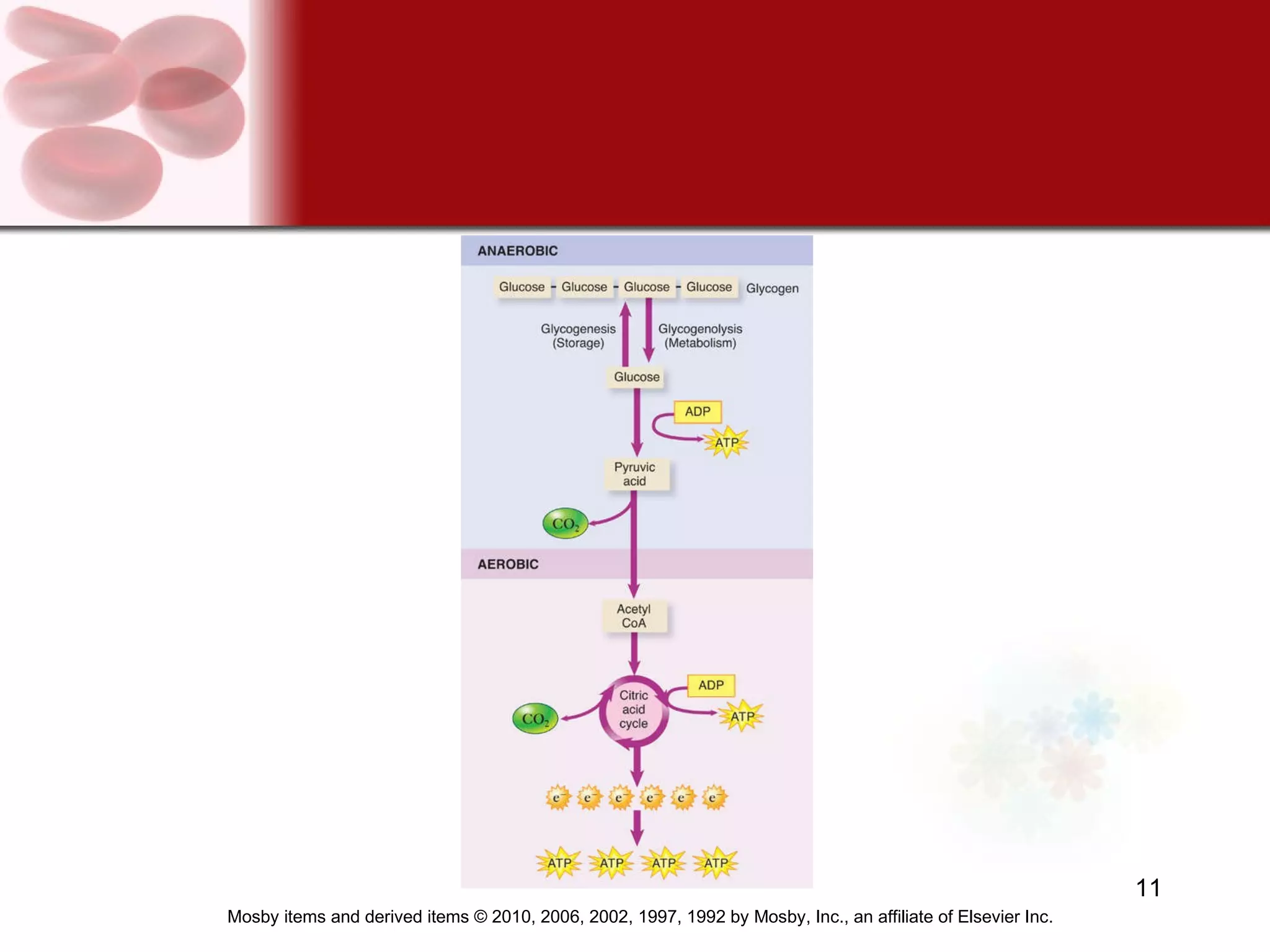
Nutrient Metabolism Carbohydrate metabolism   Carbohydrates are the preferred energy food of the body Three series of chemical reactions that occur in a precise sequence make up the process of glucose metabolism Glycolysis—occurs in cytoplasm of the cell Anaerobic process (uses no oxygen) Changes glucose to pyruvic acid, which is then converted into acetyl CoA Yields small amount of energy (transferred to ATP)
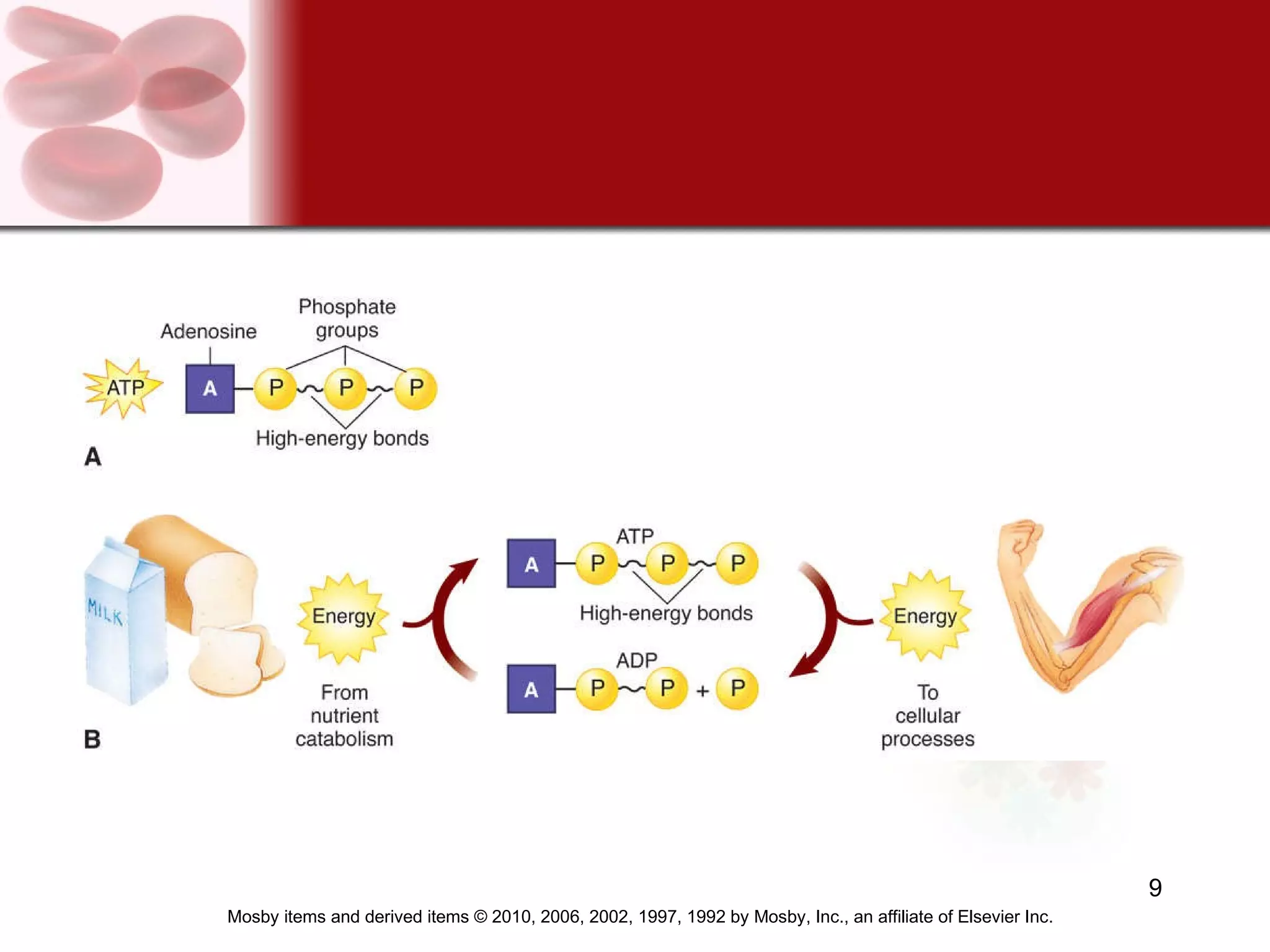
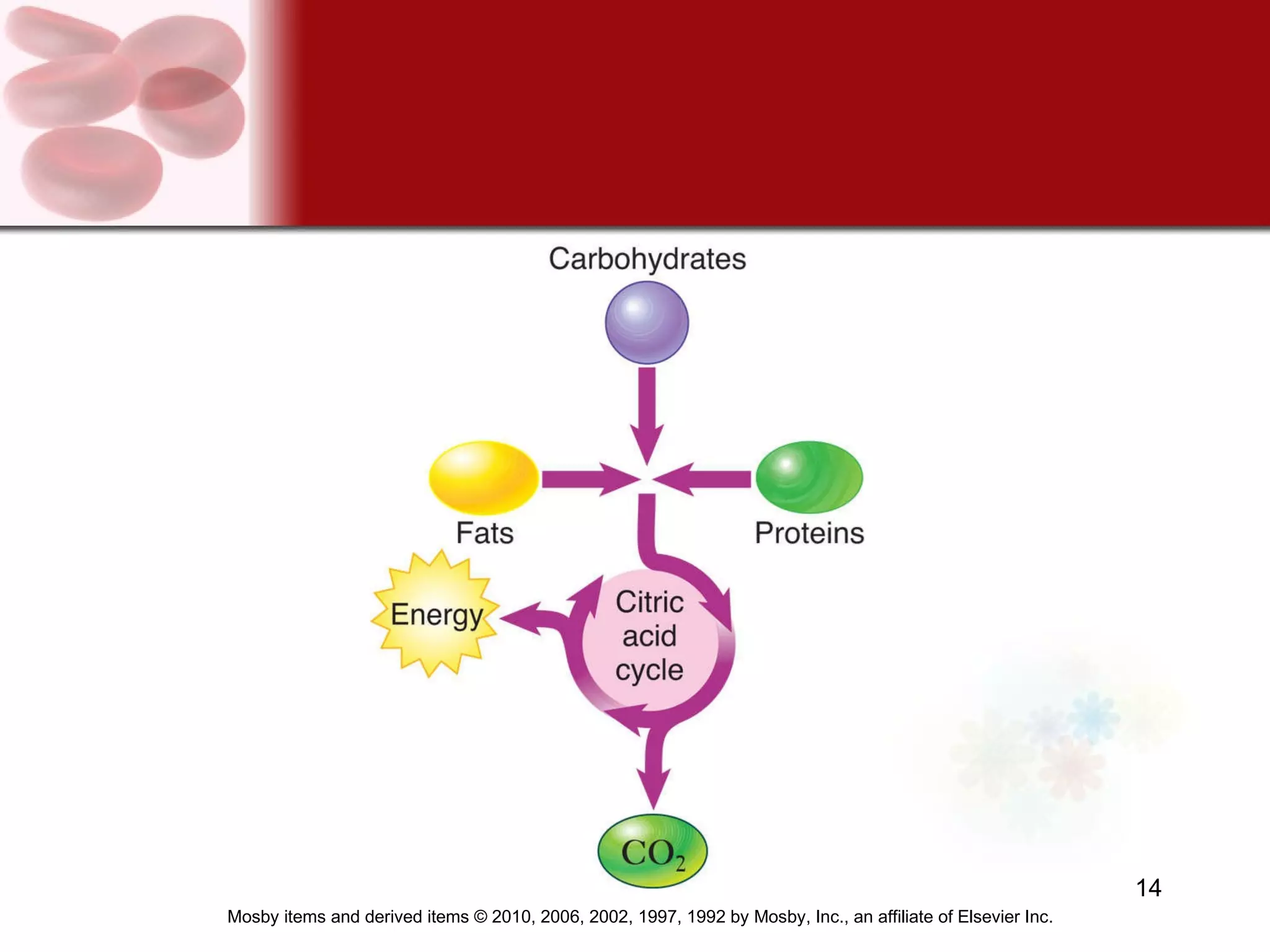
Nutrient Metabolism Citric acid (Krebs) cycle—occurs in the mitochondria Aerobic process (requires oxygen) Changes acetyl CoA to carbon dioxide Yields small amount of energy  Most energy leaving the citric acid cycle is in the form of  high-energy electrons) Electron transport system—occurs in the mitochondria Transfers energy from high-energy electrons (from citric acid cycle) to ATP molecules ATP serves as direct source of energy for cells
 
Nutrient Metabolism Carbohydrate metabolism (cont’d) Energy transferred to ATP differs from energy  in food molecules Not stored; released almost instantly Can be used directly to do cellular work Carbohydrates primarily catabolized for energy, but small amounts anabolized by glycogenesis (series of chemical reactions that changes glucose to glycogen—occurs mainly in liver cells where glycogen is stored)
 
Nutrient Metabolism Carbohydrate metabolism (cont’d) Blood glucose (imprecisely, blood sugar)—amount of glucose in blood Normally stays between about 80 and 110 mg per 100 mL of blood during fasting Insulin accelerates the movement of glucose out of the blood into cells, therefore decreases blood glucose and increases glucose catabolism
Nutrient Metabolism Fat metabolism Fats are primarily an energy food Converted to glucose by catabolism  Excess fat is anabolized to form adipose tissue  Protein metabolism Proteins are catabolized for energy only after carbohydrate and fat stores are depleted Gluconeogenesis breaks apart amino acids to convert them to glucose
 
Vitamins and Minerals Vitamins—organic molecules that are needed in small amounts for normal metabolism (Table 18-2) Avitaminosis—deficiency of a vitamin Can lead to severe metabolic problems Avitaminosis C can lead to scurvy Hypervitaminosis—excess of a vitamin Can be just as serious as avitaminosis May be chronic or acute
Vitamins and Minerals Minerals—inorganic molecules found naturally in the earth Required by the body for normal function, including nerve conduction (Table 18-3) Can attach to enzymes to facilitate their work
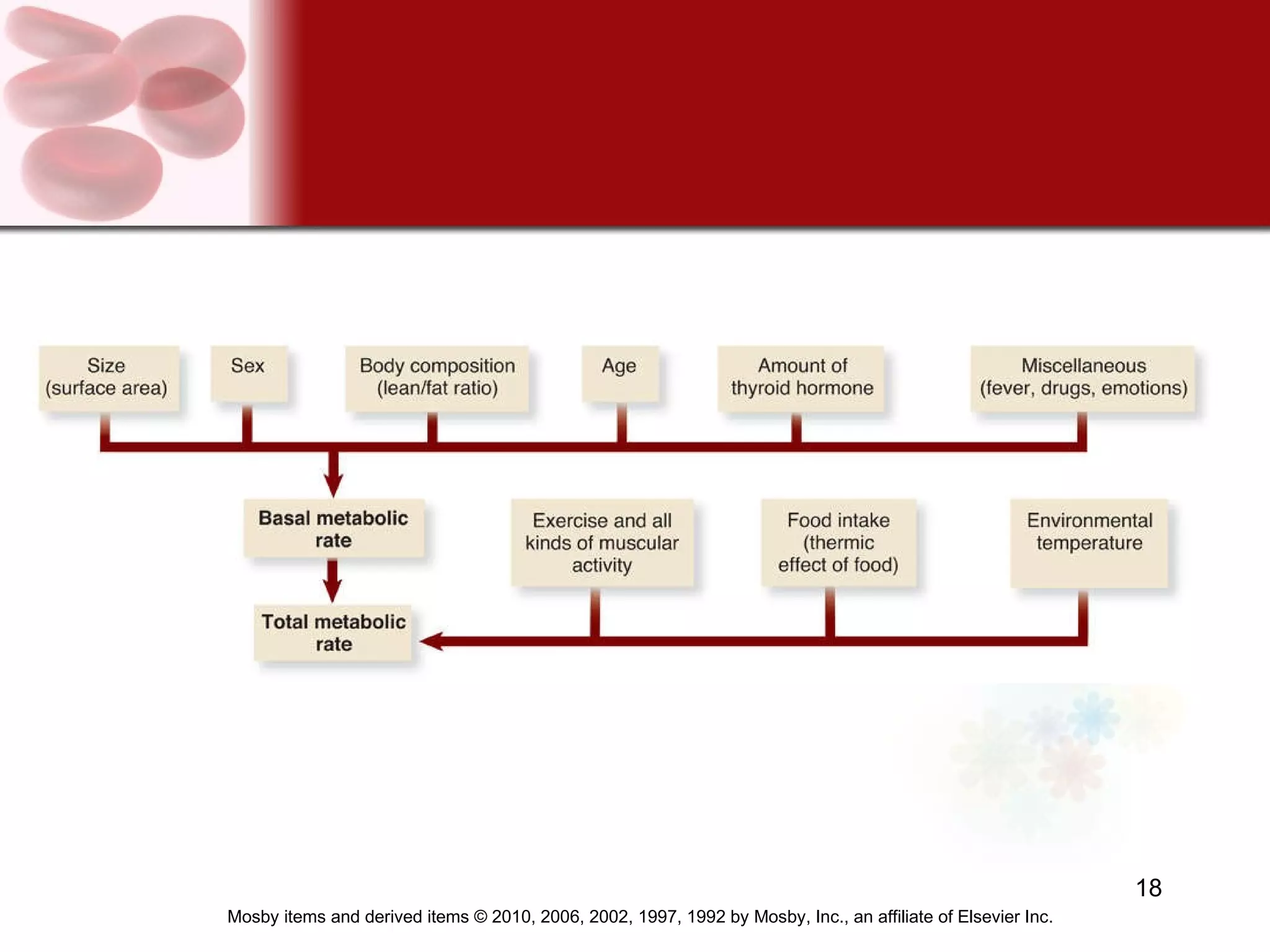
Metabolic Rates Basal metabolic rate (BMR)—rate of metabolism when a person is lying down, is awake, is not digesting food, and the environment is comfortably warm Total metabolic rate (TMR)—the total amounts of energy, expressed in calories, used by the body per day
 
Metabolic and Eating Disorders Disruption or imbalance of metabolism caused by several different factors Inborn errors of metabolism—genetic conditions involving deficient or abnormal metabolic enzymes Some metabolic disorders are complications of other conditions Hormonal imbalances
Metabolic and Eating Disorders Eating disorders  Anorexia nervosa—characterized by chronic refusal to eat Bulimia—an alternating pattern of craving of food followed by a period of self-denial; in bulimarexia, the self-denial triggers self-induced vomiting Obesity—abnormally high proportion of fat in the body; may be a symptom of an eating disorder Protein-calorie malnutrition (PCM)—results from a deficiency of calories in general and proteins in particular
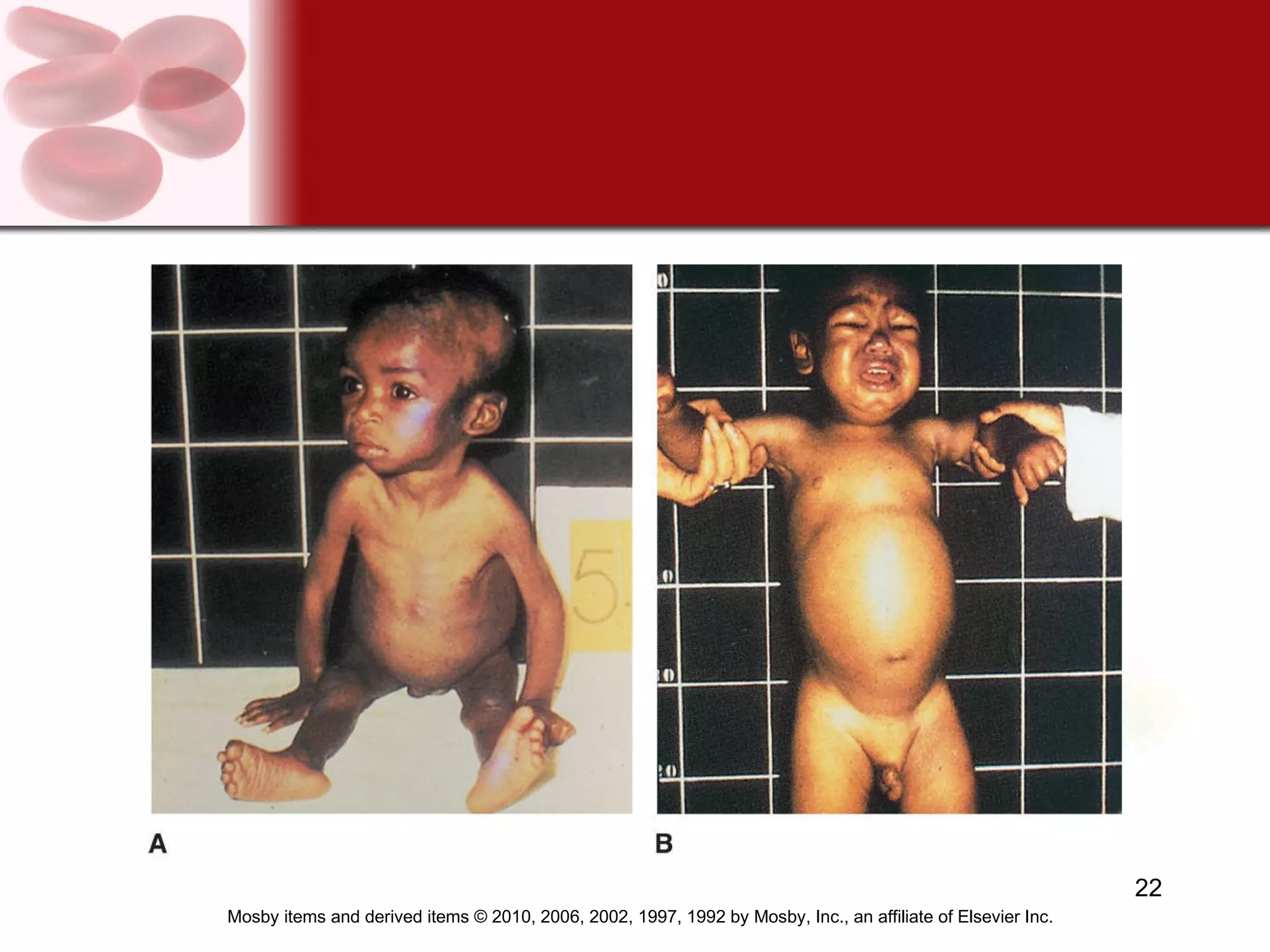
Metabolic and Eating Disorders Protein-calorie malnutrition (PCM)—results from a deficiency of calories in general and proteins in particular  May be a complication of a preexisting condition  Marasmus—type of advanced PCM caused by an overall lack of calories and protein, characterized by tissue wasting and fluid and electrolyte imbalances Kwashiorkor—type of advanced PCM caused by a lack of protein in the presence of sufficient calories; similar to marasmus but distinguished by ascites and flaking dermatitis
 
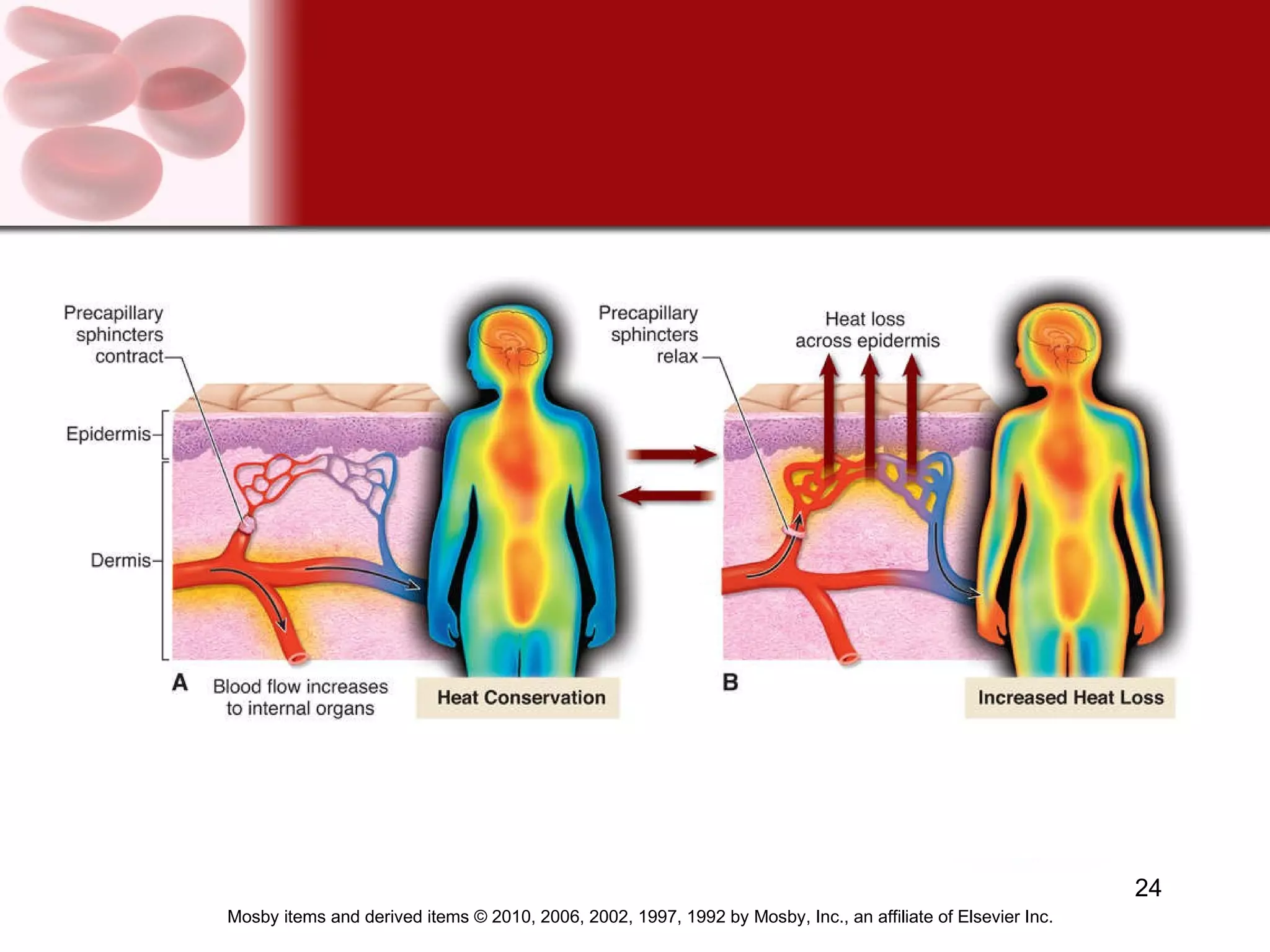
Body Temperature Hypothalamus—regulates the homeostasis of body temperature through a variety of processes Blood flow to the skin increases when body is overheated Heat is lost  through the skin by radiation, conduction, convection, evaporation
 
Body Temperature Abnormal body temperature can have serious physiological consequences Fever (febrile state)—unusually high body temperature associated with systemic inflammation response Malignant hyperthermia (MH)—inherited condition that causes increased body temperature (hyperthermia) and muscle rigidity when exposed to certain anesthetics
Body Temperature Heat exhaustion—results from loss of fluid as the body tries to cool itself; may be accompanied by heat cramps Heat stroke (sunstroke)—overheating of body resulting from failure of thermoregulatory mechanisms in a warm environment
Body Temperature Hypothermia—reduced body temperature resulting from failure of thermoregulatory mechanisms in a cold environment Frostbite—local tissue damage caused by extreme cold; may result in necrosis or gangrene

Nutrition and Metabolism

  • 1.
    Chapter 18 Nutritionand Metabolism
  • 2.
    Objectives Define andcontrast catabolism and anabolism Describe the metabolic roles of carbohydrates, fats, proteins, vitamins, and minerals Define basic metabolic rate and list some factors that affect it
  • 3.
    Objectives Describe threedisorders associated with eating or metabolism Discuss the physiological mechanisms that regulate body temperature
  • 4.
    Definitions Nutrition—food, vitamins,and minerals that are ingested and assimilated into the body Metabolism—process of using food molecules as energy sources and as building blocks for our own molecules
  • 5.
    Definitions Catabolism—process thatbreaks food molecules down, releasing their stored energy; oxygen used in catabolism Anabolism—process that builds food molecules into complex chemical compounds
  • 6.
    Metabolic Function ofthe Liver Processes blood immediately after it leaves the gastrointestinal tract Helps maintain normal blood glucose level Site of protein and fat metabolism Removes toxins from the blood Synthesizes several kinds of protein compounds
  • 7.
    Nutrient Metabolism Carbohydratemetabolism Carbohydrates are the preferred energy food of the body Three series of chemical reactions that occur in a precise sequence make up the process of glucose metabolism Glycolysis—occurs in cytoplasm of the cell Anaerobic process (uses no oxygen) Changes glucose to pyruvic acid, which is then converted into acetyl CoA Yields small amount of energy (transferred to ATP)
  • 8.
    Nutrient Metabolism Citricacid (Krebs) cycle—occurs in the mitochondria Aerobic process (requires oxygen) Changes acetyl CoA to carbon dioxide Yields small amount of energy Most energy leaving the citric acid cycle is in the form of high-energy electrons) Electron transport system—occurs in the mitochondria Transfers energy from high-energy electrons (from citric acid cycle) to ATP molecules ATP serves as direct source of energy for cells
  • 9.
  • 10.
    Nutrient Metabolism Carbohydratemetabolism (cont’d) Energy transferred to ATP differs from energy in food molecules Not stored; released almost instantly Can be used directly to do cellular work Carbohydrates primarily catabolized for energy, but small amounts anabolized by glycogenesis (series of chemical reactions that changes glucose to glycogen—occurs mainly in liver cells where glycogen is stored)
  • 11.
  • 12.
    Nutrient Metabolism Carbohydratemetabolism (cont’d) Blood glucose (imprecisely, blood sugar)—amount of glucose in blood Normally stays between about 80 and 110 mg per 100 mL of blood during fasting Insulin accelerates the movement of glucose out of the blood into cells, therefore decreases blood glucose and increases glucose catabolism
  • 13.
    Nutrient Metabolism Fatmetabolism Fats are primarily an energy food Converted to glucose by catabolism Excess fat is anabolized to form adipose tissue Protein metabolism Proteins are catabolized for energy only after carbohydrate and fat stores are depleted Gluconeogenesis breaks apart amino acids to convert them to glucose
  • 14.
  • 15.
    Vitamins and MineralsVitamins—organic molecules that are needed in small amounts for normal metabolism (Table 18-2) Avitaminosis—deficiency of a vitamin Can lead to severe metabolic problems Avitaminosis C can lead to scurvy Hypervitaminosis—excess of a vitamin Can be just as serious as avitaminosis May be chronic or acute
  • 16.
    Vitamins and MineralsMinerals—inorganic molecules found naturally in the earth Required by the body for normal function, including nerve conduction (Table 18-3) Can attach to enzymes to facilitate their work
  • 17.
    Metabolic Rates Basalmetabolic rate (BMR)—rate of metabolism when a person is lying down, is awake, is not digesting food, and the environment is comfortably warm Total metabolic rate (TMR)—the total amounts of energy, expressed in calories, used by the body per day
  • 18.
  • 19.
    Metabolic and EatingDisorders Disruption or imbalance of metabolism caused by several different factors Inborn errors of metabolism—genetic conditions involving deficient or abnormal metabolic enzymes Some metabolic disorders are complications of other conditions Hormonal imbalances
  • 20.
    Metabolic and EatingDisorders Eating disorders Anorexia nervosa—characterized by chronic refusal to eat Bulimia—an alternating pattern of craving of food followed by a period of self-denial; in bulimarexia, the self-denial triggers self-induced vomiting Obesity—abnormally high proportion of fat in the body; may be a symptom of an eating disorder Protein-calorie malnutrition (PCM)—results from a deficiency of calories in general and proteins in particular
  • 21.
    Metabolic and EatingDisorders Protein-calorie malnutrition (PCM)—results from a deficiency of calories in general and proteins in particular May be a complication of a preexisting condition Marasmus—type of advanced PCM caused by an overall lack of calories and protein, characterized by tissue wasting and fluid and electrolyte imbalances Kwashiorkor—type of advanced PCM caused by a lack of protein in the presence of sufficient calories; similar to marasmus but distinguished by ascites and flaking dermatitis
  • 22.
  • 23.
    Body Temperature Hypothalamus—regulatesthe homeostasis of body temperature through a variety of processes Blood flow to the skin increases when body is overheated Heat is lost through the skin by radiation, conduction, convection, evaporation
  • 24.
  • 25.
    Body Temperature Abnormalbody temperature can have serious physiological consequences Fever (febrile state)—unusually high body temperature associated with systemic inflammation response Malignant hyperthermia (MH)—inherited condition that causes increased body temperature (hyperthermia) and muscle rigidity when exposed to certain anesthetics
  • 26.
    Body Temperature Heatexhaustion—results from loss of fluid as the body tries to cool itself; may be accompanied by heat cramps Heat stroke (sunstroke)—overheating of body resulting from failure of thermoregulatory mechanisms in a warm environment
  • 27.
    Body Temperature Hypothermia—reducedbody temperature resulting from failure of thermoregulatory mechanisms in a cold environment Frostbite—local tissue damage caused by extreme cold; may result in necrosis or gangrene