Fat soluble
Vitamins
Biological function and Disease
manifestation of water and fat
soluble vitamins (no structures)
Attribution-NonCommercial-ShareAlike
4.0 International (CC BY-NC-SA 4.0)
Vitamins
The vitamins are mainly classified into two:
1. The fat soluble vitamins are A, D, E and K
2. Water soluble vitamins are named as B
complex and C
Fat Soluble Vitamins Water Soluble
Vitamins
Solubility in fat Soluble Not Soluble
Water
Solubility
Not soluble Soluble
Absorption Along with lipids
Requires Bile salts
Absorption simple
Carrier
proteins
Present No carrier proteins
Storage Stored in liver No storage
Excretion Not excreted Excreted
Deficiency Manifests only when
stores are depleted
Manifests rapidly as
there is no storage
Toxicity Hypervitaminosis may
result
Unlikely, since
excess is excreted
Treatment of
deficiency
Single large doses may
prevent deficiency
Regular dietary
supply is required
Major Vitamins A,D,E and K B and C
Vitamin deficiency
In general, deficiency of vitamins may occur due to:
a. reduced intake
b. impaired absorption
c. impaired metabolism
d. additional requirements
e. increased losses.
Vitamin A
Fat soluble vitamins
Vitamin A
• Vitamin A is fat soluble.
• The active form is present only in animal tissues.
• The pro-vitamin, beta-carotene is present in plant tissues. Beta carotene has two beta ionone rings
connected by a polyprenoid chain
• All the compounds with vitamin A activity are referred to as retinoids. They are polyisoprenoid
compounds having a beta-ionone ring system
• Three different compounds with vitamin A activity are retinol (vitamin A alcohol), retinal (vitamin A
aldehyde) and retinoic acid (vitamin A acid)
Vitamin A
• The retinal may be reduced to retinol by retinal reductase. This reaction is readily reversible. Retinal is
oxidized to retinoic acid, which cannot be converted back to the other forms
• The side chain contains alternate double bonds, and hence many isomers are possible. The all-trans
variety of retinal, also called vitamin A1 is most common
• Vitamin A2 is found in fish oils and has an extra double bond in the ring. Biologically important compound
is 11-cis-retinal.
Vitamin A
Absorption of Vitamin A
I. Beta carotene is cleaved by a di-oxygenase, to form retinal. The retinal is reduced to retinol by an
NADH or NADPH dependent retinal reductase present in the intestinal mucosa. Intestine is the major
site of absorption
II. The absorption is along with other fats and requires bile salts. In biliary tract obstruction and
steatorrhoea, vitamin A absorption is reduced.
III. Within the mucosal cell, the retinol is reesterified with fatty acids, incorporated into chylomicrons and
transported to liver. In the liver stellate cells, vitamin is stored as retinol palmitate.
Vitamin A
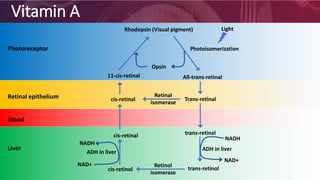
Rhodopsin (Visual pigment)
11-cis-retinal All-trans-retinal
cis-retinal Trans-retinal
cis-retinol
trans-retinalcis-retinal
trans-retinol
NADH
NAD+
NAD+
NADH
ADH in liver
ADH in liver
Retinal
isomerase
Retinol
isomerase
Photoisomerization
Light
Opsin
Photoreceptor
Retinal epithelium
Blood
Liver
Vitamin A
Other Biochemical Functions of Vitamin A
• Retinoic acid has a role in the regulation of gene expression and differentiation of tissues
• All-trans-retinoic acid and 9-cisretinoic acid act like steroid hormones
• They bind to nuclear receptors; retinoic acid along with the receptor binds to the response elements of
DNA. Retinoic acid receptors (RAR) bind all-trans-retinoic acid, while retinoic x receptors (RXR) bind to 9-
cisretinoic acid
• RXRs form dimers with vitamin D-receptor also. This explains why deficiency of vitamin A impairs vitamin
D function
Vitamin A
Reproductive system
• Retinol is necessary for the reproductive system
• Retinol acts like a steroid hormone in controlling the expression of certain genes
• This may account for the requirement of vitamin A for normal reproduction
• In vitamin deficiency, miscarriages are noticed in female rats
• They function as antioxidant property and functions as a anticancer agent
• Beta carotenes may be useful in preventing heart attacks
• Vitamin A is necessary for the maintenance of normal epithelium and skin.
Vitamin A
Deficiency manifestations of Vitamin A
Night Blindness or Nyctalopia
Visual acuity is diminished in dim light. The patient cannot read or drive a car in poor light. The dark
adaptation time is increased.
Xerophthalmia
• The conjunctiva becomes dry, thick and wrinkled. The conjunctiva gets keratinized and loses its normal
transparency. Dryness spreads to cornea. It becomes glazy and lusterless due to keratinization of corneal
epithelium. Infections may follow
Vitamin A
Deficiency manifestations of Vitamin A
Bitot's Spots
• These are seen as greyish-white triangular plaques firmly adherent to the conjunctiva. This is due to
increased thickness of conjunctiva in certain areas. All the ocular changes mentioned so far are
completely reversible when vitamin is supplemented
Keratomalacia
• When the xerophthalmia persists for a long time, it progresses to keratomalacia (softening of the
cornea). There is degeneration of corneal epithelium which may get vascularized. Later, corneal opacities
develop. Bacterial infection leads to corneal ulceration, perforation of cornea and total blindness.
Vitamin A
Deficiency manifestations of Vitamin A
Preventable Blindness
• The deficiency of vitamin A is the most common cause of blindness in Indian children below the age of 5.
One-third of the world's blind population are residing in India. About 40% of blindness is preventable.
Vitamin A deficiency is a major public health problem. A single dose of vitamin A is given, as a
prophylactic measure, to children below 1 year age.
Vitamin A
Deficiency manifestations of Vitamin A
Skin and Mucous Membrane Lesions
• The skin becomes rough. Keratinizing of the epithelium of the respiratory, gastrointestinal and
genitourinary tract have been observed. Epithelium is atrophied. Keratinization of urinary tract
epithelium may lead to kidney stone
• The alterations in skin may cause increased occurrence of generalized infections. Therefore in old
literature, vitamin A is referred to as anti-inflammatory vitamin
• Isoretinone, a synthetic variant of vitamin A is known to reduce the sebaceous secretions, hence it is used
to prevent acne formation during adolescence.
Vitamin A
Causes for Vitamin A Deficiency
1. Decreased intake
2. Obstructive jaundice causing defective absorption
3. Cirrhosis of liver leading to reduced synthesis of RBP
4. Severe malnutrition, where amino acids are not available for RBP synthesis
5. Chronic nephrosis, where RBP is excreted through urine.
Vitamin A
Dietary Sources of Vitamin A
• Animal sources include milk, butter, cream, cheese, egg
yolk and liver. Fish liver oils (cod liver oil and shark liver
oil) are very rich sources of the vitamin.
• Vegetable sources contain the yellow pigment beta
carotene.
• Carrot contains significant quantity of beta carotene .
Papaya, mango, pumpkins and green leafy vegetables
(spinach, amaranth) are other good sources for vitamin A
activity. During cooking the activity is not destroyed.
Vitamin D
Fat soluble vitamins
Vitamin D or cholecalciferol
Formation of Vitamin D
FormationofVitaminD
Vitamin D
Activation of Vitamin D
1. Vitamin D is a prohormone. The cholecalciferol is first transported to liver, where hydroxylation at 25th
position occurs, to form 25-hydroxy cholecalciferol (25-HCC). The hepatic 25-hydroxylase is a microsomal
monooxygenase. It requires cytochrome P-450 and NADPH. 25-HCC is the major storage form.
2. In plasma, 25-HCC is bound to "vitamin D binding protein" (VDBP), an alpha-2 globulin.
3. In the kidney, it is further hydroxylated at the 1st position. The 1-alpha hydroxylase is located in mitochondria
of proximal convoluted tubules. It requires cytochrome P-450, NADPH and ferrodoxin (an iron-sulfur protein).
Thus 1,25-dihydroxy cholecalciferol (DHCC) is generated. Since it contains three hydroxyl groups at 1, 3 and
25 positions, it is also called Calcitriol. The calcitriol thus formed is the active form of vitamin; it is a
hormone.
Vitamin D
Biochemical Effects of Vitamin D
The sites of action are:
1. intestinal villi cells
2. bone osteoblasts
3. kidney distal tubular cells
Vitamin D
Vitamin D and Absorption of Calcium
• Calcitriol promotes the absorption of calcium and phosphorus from the intestine
• In the brush-border surface, calcium is absorbed passively
• From the intestinal cell to blood, absorption of calcium needs energy. It is either by the sodium-calcium
exchange mechanism or by pumping out the calcium-calbindin complex
• Calcitriol helps in transcription of specific genes that code for Calbindin. Due to the increased availability
of calcium binding protein, the absorption of calcium is increased.
Vitamin D
Effect of Vitamin D in Bone
• Mineralization of the bone is increased by increasing the activity of osteoblasts
• Calcitriol coordinates the remodelling action of osteoclasts and osteoblasts. It produces the differentiation
of osteoclast precursors from multinucleated cells of osteoblast lineage
• Calcitriol stimulates osteoblasts which secrete alkaline phosphatase
• Due to this enzyme, the local concentration of phosphate is increased
• The ionic product of calcium and phosphorus increases, leading to mineralization
Vitamin D
Effect of Vitamin D in Renal Tubules
• Calcitriol increases the reabsorption of calcium and phosphorus by renal tubules,
therefore both minerals are conserved
Deficiency of Vitamin D
• The deficiency diseases are rickets in children and osteoporosis in adults. Hence
vitamin D is known as antirachitic vitamin
Vitamin D
Causes for Vitamin D Deficiency
• Deficiency of vitamin D can occur in people who are not exposed to sunlight properly, e.g. inhabitants of
northern latitudes, in winter months, in people who are bedridden for long periods, or those who cover
the whole body
• Nutritional deficiency of calcium or phosphate may also produce similar clinical picture
• Malabsorption of vitamin (obstructive jaundice and steatorrhea). High phytate content in diet may also
reduce the absorption of vitamin
• Abnormality of vitamin D activation. Liver and renal diseases may retard the hydroxylation reactions.
• Deficient renal absorption of phosphates
Vitamin D
Clinical Features of Rickets
• Rickets is seen in children. There is insufficient mineralization of bone. Bones become soft. The bone
growth is markedly affected
• Plasma calcium and phosphorus are low normal with alkaline phosphatase (bone isoenzyme) being
markedly elevated
• The classical features of rickets are bone deformities. Weight bearing bones are bent
• beading of ribs or rickety rosary, bossing of frontal bones, and pigeon chest
Vitamin D
Requirement of Vitamin D
1. Children = 10 microgram (400 IU)/day
2. Adults = 5 microgram (200 IU)/day
3. Pregnancy, lactation = 10 microgram/day
4. Above the age of 60 = 600 IU per day
Vitamin D
Sources of Vitamin D
• Exposure to sunlight produces cholecalciferol
• Moreover fish liver oil, fish and egg yolk are good sources of the vitamin
• Milk contains moderate quantity of the vitamin
Vitamin D
Hypervitaminosis D
• Doses above 1500 units per day for very long periods may cause toxicity
• Symptoms include weakness, polyuria, intense thirst, difficulty in speaking, hypertension and weight loss
• Hypercalcemia leads to calcification of soft tissues, (metastatic calcification, otherwise called calcinosis),
especially in vascular and renal tissues
• Although vitamin D is toxic in higher doses, excessive exposure to sunlight does not result in vitamin D
toxicity, because excess D3 is destroyed by sunlight itself
Vitamin E
Fat soluble vitamins
Vitamin E
Biochemical Role of Vitamin E
• Vitamin E is the most powerful natural antioxidant. Free radicals are continuously being generated in
living systems. Their prompt inactivation is of great importance
• Vitamin E is a known biological antioxidant able to quench the lipid peroxidation chain and to protect
the plasma membranes from the attack of free radicals
Vitamin E
Biochemical Role of Vitamin E
• The free radicals would attack bio-membranes. Vitamin E protects RBC from hemolysis. By preventing the
peroxidation, it keeps the structural and functional integrity of all cells
• Gradual deterioration of ageing process is due to the cumulative effects of free radicals. Vitamin E also
boosts immune response
• It reduces the risk of atherosclerosis by reducing oxidation of LDL. Vitamin E can depress leukocyte
oxidative bactericidal activity
Vitamin E
Inter-relationship with Selenium
• Selenium is present in glutathione peroxidase; an important enzyme that oxidizes and destroys the free
radicals
• Selenium has been found to decrease the requirement of vitamin E and vice versa. They act
synergistically to minimize lipid peroxidation.
Vitamin E
Deficiency Manifestations of Vitamin E
• In rats, inability to produce healthy ovum and loss of motility of spermatozoa, hemolysis of red cells,
acute hepatic necrosis and muscular dystrophy are observed
• In a normal adult, the body vitamin E stores can meet the requirement for several months.
• Human deficiency has not been reported. But in volunteers, vitamin E deficiency has been shown to
produce increased fragility of RBCs, muscular weakness and creatinuria.
Vitamin E
Recommended Daily Allowance
• Males 10 mg per day
• Females 8 mg/day
• Pregnancy 10 mg/day
• Lactation 12 mg/day
• 15 mg of vitamin E is equivalent to 33 international units. The requirement increases with higher intake of
PUFA. Pharmacological dose is 200-400 IU per day
Vitamin K
Fat soluble vitamins
Vitamin K
Absorption and Storage
• Absorption of vitamin K occurs in the intestine along with chylomicrons
• Bile salts are required for the normal absorption
• The vitamin K may be derived from the diet or intestinal bacterial synthesis
• It is stored in the liver and transported in plasma along with beta lipoproteins
Vitamin K
Biochemical Role of Vitamin K
• Vitamin K is necessary for coagulation. Factors dependent on vitamin K are Factor II (prothrombin); Factor
VII (SPCA); Factor IX (Christmas factor); Factor X (Stuart Prower factor)
• All these factors are synthesized by the liver as inactive zymogens. They undergo post-translational
modification; gamma carboxylation of glutamic acid residues. These are the binding sites for calcium ions.
The gamma carboxy glutamic acid (GCG) synthesis requires vitamin K as a co-factor
Vitamin K
Biochemical Role of Vitamin K
• Vitamin K dependent gamma carboxylation is also necessary for the functional activity of osteocalcin as
well as structural proteins of kidney, lung and spleen
• Osteocalcin is synthesized by osteoblasts and seen only in bone. It is a small protein (40-50 amino acids
length) that binds tightly to hydroxy apatite crystals of bone
• This binding is dependent on the degree of gamma carboxylation. Osteocalcin also contains
hydroxyproline, so it is dependent on both vitamins K and C
Vitamin K Dependent Carboxylase
• It is microsomal enzyme. It requires oxygen, CO2, NADPH and reduced vitamin K. In this process, the
vitamin passes through a cycle
Vitamin K
Causes for Deficiency of Vitamin K
• In normal adults dietary deficiency seldom occurs since the intestinal bacterial synthesis is sufficient to
meet the needs of the body
• However deficiency can occur in conditions of malabsorption of lipids
• This can result from obstructive jaundice, chronic pancreatitis, sprue, etc. Prolonged antibiotic therapy
and gastrointestinal infections with diarrhea will destroy the bacterial flora and can also lead to vitamin K
deficiency.
Vitamin K
Clinical Manifestations of Deficiency
• Hemorrhagic disease of the newborn is attributed to vitamin K deficiency
• The newborns, especially the premature infants have relative vitamin K deficiency
• This is due to lack of hepatic stores, limited oral intake (breast milk has very low levels, 15 mg/liter) and
absence of intestinal bacterial flora
• It is often advised that pre-term infants be given prophylactic doses of vitamin K
• In children and adults, Vitamin K deficiency may be manifested as bruising tendency, ecchymotic patches,
mucous membrane hemorrhage, post-traumatic bleeding and internal bleeding
• Prolongation of prothrombin time and delayed clotting time are characteristic of vitamin K deficiency
Vitamin K
Clinical Manifestations of Deficiency
• Measurement of prothrombin time (PT) is taken as an index of liver function
• When liver function is considerably lowered, prolongation of PT occurs due to deficient synthesis of the
coagulation factors
• In such cases, administration of vitamin fails to restore PT to normal levels. Hence before undertaking any
surgery on jaundiced patients, PT before and after administration of vitamin K should be done
• Warfarin and dicoumarol will competitively inhibit the gamma carboxylation system due to structural
similarity with vitamin K. Hence they are widely used as anticoagulants for therapeutic purposes.
Vitamin K
Daily Requirement of Vitamin K
• Recommended daily allowance is 50-100 mg/day. This is usually available in a normal diet
Sources of Vitamin K
• Green leafy vegetables are good dietary sources
• Even if the diet does not contain the vitamin, intestinal bacterial synthesis will meet the daily
requirements, as long as absorption is normal

Fat soluble vitamins

  • 1.
    Fat soluble Vitamins Biological functionand Disease manifestation of water and fat soluble vitamins (no structures) Attribution-NonCommercial-ShareAlike 4.0 International (CC BY-NC-SA 4.0)
  • 2.
    Vitamins The vitamins aremainly classified into two: 1. The fat soluble vitamins are A, D, E and K 2. Water soluble vitamins are named as B complex and C Fat Soluble Vitamins Water Soluble Vitamins Solubility in fat Soluble Not Soluble Water Solubility Not soluble Soluble Absorption Along with lipids Requires Bile salts Absorption simple Carrier proteins Present No carrier proteins Storage Stored in liver No storage Excretion Not excreted Excreted Deficiency Manifests only when stores are depleted Manifests rapidly as there is no storage Toxicity Hypervitaminosis may result Unlikely, since excess is excreted Treatment of deficiency Single large doses may prevent deficiency Regular dietary supply is required Major Vitamins A,D,E and K B and C
  • 3.
    Vitamin deficiency In general,deficiency of vitamins may occur due to: a. reduced intake b. impaired absorption c. impaired metabolism d. additional requirements e. increased losses.
  • 4.
  • 5.
    Vitamin A • VitaminA is fat soluble. • The active form is present only in animal tissues. • The pro-vitamin, beta-carotene is present in plant tissues. Beta carotene has two beta ionone rings connected by a polyprenoid chain • All the compounds with vitamin A activity are referred to as retinoids. They are polyisoprenoid compounds having a beta-ionone ring system • Three different compounds with vitamin A activity are retinol (vitamin A alcohol), retinal (vitamin A aldehyde) and retinoic acid (vitamin A acid)
  • 6.
    Vitamin A • Theretinal may be reduced to retinol by retinal reductase. This reaction is readily reversible. Retinal is oxidized to retinoic acid, which cannot be converted back to the other forms • The side chain contains alternate double bonds, and hence many isomers are possible. The all-trans variety of retinal, also called vitamin A1 is most common • Vitamin A2 is found in fish oils and has an extra double bond in the ring. Biologically important compound is 11-cis-retinal.
  • 7.
    Vitamin A Absorption ofVitamin A I. Beta carotene is cleaved by a di-oxygenase, to form retinal. The retinal is reduced to retinol by an NADH or NADPH dependent retinal reductase present in the intestinal mucosa. Intestine is the major site of absorption II. The absorption is along with other fats and requires bile salts. In biliary tract obstruction and steatorrhoea, vitamin A absorption is reduced. III. Within the mucosal cell, the retinol is reesterified with fatty acids, incorporated into chylomicrons and transported to liver. In the liver stellate cells, vitamin is stored as retinol palmitate.
  • 8.
    Vitamin A Rhodopsin (Visualpigment) 11-cis-retinal All-trans-retinal cis-retinal Trans-retinal cis-retinol trans-retinalcis-retinal trans-retinol NADH NAD+ NAD+ NADH ADH in liver ADH in liver Retinal isomerase Retinol isomerase Photoisomerization Light Opsin Photoreceptor Retinal epithelium Blood Liver
  • 9.
    Vitamin A Other BiochemicalFunctions of Vitamin A • Retinoic acid has a role in the regulation of gene expression and differentiation of tissues • All-trans-retinoic acid and 9-cisretinoic acid act like steroid hormones • They bind to nuclear receptors; retinoic acid along with the receptor binds to the response elements of DNA. Retinoic acid receptors (RAR) bind all-trans-retinoic acid, while retinoic x receptors (RXR) bind to 9- cisretinoic acid • RXRs form dimers with vitamin D-receptor also. This explains why deficiency of vitamin A impairs vitamin D function
  • 10.
    Vitamin A Reproductive system •Retinol is necessary for the reproductive system • Retinol acts like a steroid hormone in controlling the expression of certain genes • This may account for the requirement of vitamin A for normal reproduction • In vitamin deficiency, miscarriages are noticed in female rats • They function as antioxidant property and functions as a anticancer agent • Beta carotenes may be useful in preventing heart attacks • Vitamin A is necessary for the maintenance of normal epithelium and skin.
  • 11.
    Vitamin A Deficiency manifestationsof Vitamin A Night Blindness or Nyctalopia Visual acuity is diminished in dim light. The patient cannot read or drive a car in poor light. The dark adaptation time is increased. Xerophthalmia • The conjunctiva becomes dry, thick and wrinkled. The conjunctiva gets keratinized and loses its normal transparency. Dryness spreads to cornea. It becomes glazy and lusterless due to keratinization of corneal epithelium. Infections may follow
  • 12.
    Vitamin A Deficiency manifestationsof Vitamin A Bitot's Spots • These are seen as greyish-white triangular plaques firmly adherent to the conjunctiva. This is due to increased thickness of conjunctiva in certain areas. All the ocular changes mentioned so far are completely reversible when vitamin is supplemented Keratomalacia • When the xerophthalmia persists for a long time, it progresses to keratomalacia (softening of the cornea). There is degeneration of corneal epithelium which may get vascularized. Later, corneal opacities develop. Bacterial infection leads to corneal ulceration, perforation of cornea and total blindness.
  • 13.
    Vitamin A Deficiency manifestationsof Vitamin A Preventable Blindness • The deficiency of vitamin A is the most common cause of blindness in Indian children below the age of 5. One-third of the world's blind population are residing in India. About 40% of blindness is preventable. Vitamin A deficiency is a major public health problem. A single dose of vitamin A is given, as a prophylactic measure, to children below 1 year age.
  • 14.
    Vitamin A Deficiency manifestationsof Vitamin A Skin and Mucous Membrane Lesions • The skin becomes rough. Keratinizing of the epithelium of the respiratory, gastrointestinal and genitourinary tract have been observed. Epithelium is atrophied. Keratinization of urinary tract epithelium may lead to kidney stone • The alterations in skin may cause increased occurrence of generalized infections. Therefore in old literature, vitamin A is referred to as anti-inflammatory vitamin • Isoretinone, a synthetic variant of vitamin A is known to reduce the sebaceous secretions, hence it is used to prevent acne formation during adolescence.
  • 15.
    Vitamin A Causes forVitamin A Deficiency 1. Decreased intake 2. Obstructive jaundice causing defective absorption 3. Cirrhosis of liver leading to reduced synthesis of RBP 4. Severe malnutrition, where amino acids are not available for RBP synthesis 5. Chronic nephrosis, where RBP is excreted through urine.
  • 16.
    Vitamin A Dietary Sourcesof Vitamin A • Animal sources include milk, butter, cream, cheese, egg yolk and liver. Fish liver oils (cod liver oil and shark liver oil) are very rich sources of the vitamin. • Vegetable sources contain the yellow pigment beta carotene. • Carrot contains significant quantity of beta carotene . Papaya, mango, pumpkins and green leafy vegetables (spinach, amaranth) are other good sources for vitamin A activity. During cooking the activity is not destroyed.
  • 17.
  • 18.
    Vitamin D orcholecalciferol Formation of Vitamin D
  • 19.
  • 20.
    Vitamin D Activation ofVitamin D 1. Vitamin D is a prohormone. The cholecalciferol is first transported to liver, where hydroxylation at 25th position occurs, to form 25-hydroxy cholecalciferol (25-HCC). The hepatic 25-hydroxylase is a microsomal monooxygenase. It requires cytochrome P-450 and NADPH. 25-HCC is the major storage form. 2. In plasma, 25-HCC is bound to "vitamin D binding protein" (VDBP), an alpha-2 globulin. 3. In the kidney, it is further hydroxylated at the 1st position. The 1-alpha hydroxylase is located in mitochondria of proximal convoluted tubules. It requires cytochrome P-450, NADPH and ferrodoxin (an iron-sulfur protein). Thus 1,25-dihydroxy cholecalciferol (DHCC) is generated. Since it contains three hydroxyl groups at 1, 3 and 25 positions, it is also called Calcitriol. The calcitriol thus formed is the active form of vitamin; it is a hormone.
  • 21.
    Vitamin D Biochemical Effectsof Vitamin D The sites of action are: 1. intestinal villi cells 2. bone osteoblasts 3. kidney distal tubular cells
  • 22.
    Vitamin D Vitamin Dand Absorption of Calcium • Calcitriol promotes the absorption of calcium and phosphorus from the intestine • In the brush-border surface, calcium is absorbed passively • From the intestinal cell to blood, absorption of calcium needs energy. It is either by the sodium-calcium exchange mechanism or by pumping out the calcium-calbindin complex • Calcitriol helps in transcription of specific genes that code for Calbindin. Due to the increased availability of calcium binding protein, the absorption of calcium is increased.
  • 23.
    Vitamin D Effect ofVitamin D in Bone • Mineralization of the bone is increased by increasing the activity of osteoblasts • Calcitriol coordinates the remodelling action of osteoclasts and osteoblasts. It produces the differentiation of osteoclast precursors from multinucleated cells of osteoblast lineage • Calcitriol stimulates osteoblasts which secrete alkaline phosphatase • Due to this enzyme, the local concentration of phosphate is increased • The ionic product of calcium and phosphorus increases, leading to mineralization
  • 24.
    Vitamin D Effect ofVitamin D in Renal Tubules • Calcitriol increases the reabsorption of calcium and phosphorus by renal tubules, therefore both minerals are conserved Deficiency of Vitamin D • The deficiency diseases are rickets in children and osteoporosis in adults. Hence vitamin D is known as antirachitic vitamin
  • 25.
    Vitamin D Causes forVitamin D Deficiency • Deficiency of vitamin D can occur in people who are not exposed to sunlight properly, e.g. inhabitants of northern latitudes, in winter months, in people who are bedridden for long periods, or those who cover the whole body • Nutritional deficiency of calcium or phosphate may also produce similar clinical picture • Malabsorption of vitamin (obstructive jaundice and steatorrhea). High phytate content in diet may also reduce the absorption of vitamin • Abnormality of vitamin D activation. Liver and renal diseases may retard the hydroxylation reactions. • Deficient renal absorption of phosphates
  • 26.
    Vitamin D Clinical Featuresof Rickets • Rickets is seen in children. There is insufficient mineralization of bone. Bones become soft. The bone growth is markedly affected • Plasma calcium and phosphorus are low normal with alkaline phosphatase (bone isoenzyme) being markedly elevated • The classical features of rickets are bone deformities. Weight bearing bones are bent • beading of ribs or rickety rosary, bossing of frontal bones, and pigeon chest
  • 27.
    Vitamin D Requirement ofVitamin D 1. Children = 10 microgram (400 IU)/day 2. Adults = 5 microgram (200 IU)/day 3. Pregnancy, lactation = 10 microgram/day 4. Above the age of 60 = 600 IU per day
  • 28.
    Vitamin D Sources ofVitamin D • Exposure to sunlight produces cholecalciferol • Moreover fish liver oil, fish and egg yolk are good sources of the vitamin • Milk contains moderate quantity of the vitamin
  • 29.
    Vitamin D Hypervitaminosis D •Doses above 1500 units per day for very long periods may cause toxicity • Symptoms include weakness, polyuria, intense thirst, difficulty in speaking, hypertension and weight loss • Hypercalcemia leads to calcification of soft tissues, (metastatic calcification, otherwise called calcinosis), especially in vascular and renal tissues • Although vitamin D is toxic in higher doses, excessive exposure to sunlight does not result in vitamin D toxicity, because excess D3 is destroyed by sunlight itself
  • 30.
  • 31.
    Vitamin E Biochemical Roleof Vitamin E • Vitamin E is the most powerful natural antioxidant. Free radicals are continuously being generated in living systems. Their prompt inactivation is of great importance • Vitamin E is a known biological antioxidant able to quench the lipid peroxidation chain and to protect the plasma membranes from the attack of free radicals
  • 32.
    Vitamin E Biochemical Roleof Vitamin E • The free radicals would attack bio-membranes. Vitamin E protects RBC from hemolysis. By preventing the peroxidation, it keeps the structural and functional integrity of all cells • Gradual deterioration of ageing process is due to the cumulative effects of free radicals. Vitamin E also boosts immune response • It reduces the risk of atherosclerosis by reducing oxidation of LDL. Vitamin E can depress leukocyte oxidative bactericidal activity
  • 33.
    Vitamin E Inter-relationship withSelenium • Selenium is present in glutathione peroxidase; an important enzyme that oxidizes and destroys the free radicals • Selenium has been found to decrease the requirement of vitamin E and vice versa. They act synergistically to minimize lipid peroxidation.
  • 34.
    Vitamin E Deficiency Manifestationsof Vitamin E • In rats, inability to produce healthy ovum and loss of motility of spermatozoa, hemolysis of red cells, acute hepatic necrosis and muscular dystrophy are observed • In a normal adult, the body vitamin E stores can meet the requirement for several months. • Human deficiency has not been reported. But in volunteers, vitamin E deficiency has been shown to produce increased fragility of RBCs, muscular weakness and creatinuria.
  • 35.
    Vitamin E Recommended DailyAllowance • Males 10 mg per day • Females 8 mg/day • Pregnancy 10 mg/day • Lactation 12 mg/day • 15 mg of vitamin E is equivalent to 33 international units. The requirement increases with higher intake of PUFA. Pharmacological dose is 200-400 IU per day
  • 36.
  • 37.
    Vitamin K Absorption andStorage • Absorption of vitamin K occurs in the intestine along with chylomicrons • Bile salts are required for the normal absorption • The vitamin K may be derived from the diet or intestinal bacterial synthesis • It is stored in the liver and transported in plasma along with beta lipoproteins
  • 38.
    Vitamin K Biochemical Roleof Vitamin K • Vitamin K is necessary for coagulation. Factors dependent on vitamin K are Factor II (prothrombin); Factor VII (SPCA); Factor IX (Christmas factor); Factor X (Stuart Prower factor) • All these factors are synthesized by the liver as inactive zymogens. They undergo post-translational modification; gamma carboxylation of glutamic acid residues. These are the binding sites for calcium ions. The gamma carboxy glutamic acid (GCG) synthesis requires vitamin K as a co-factor
  • 39.
    Vitamin K Biochemical Roleof Vitamin K • Vitamin K dependent gamma carboxylation is also necessary for the functional activity of osteocalcin as well as structural proteins of kidney, lung and spleen • Osteocalcin is synthesized by osteoblasts and seen only in bone. It is a small protein (40-50 amino acids length) that binds tightly to hydroxy apatite crystals of bone • This binding is dependent on the degree of gamma carboxylation. Osteocalcin also contains hydroxyproline, so it is dependent on both vitamins K and C Vitamin K Dependent Carboxylase • It is microsomal enzyme. It requires oxygen, CO2, NADPH and reduced vitamin K. In this process, the vitamin passes through a cycle
  • 40.
    Vitamin K Causes forDeficiency of Vitamin K • In normal adults dietary deficiency seldom occurs since the intestinal bacterial synthesis is sufficient to meet the needs of the body • However deficiency can occur in conditions of malabsorption of lipids • This can result from obstructive jaundice, chronic pancreatitis, sprue, etc. Prolonged antibiotic therapy and gastrointestinal infections with diarrhea will destroy the bacterial flora and can also lead to vitamin K deficiency.
  • 41.
    Vitamin K Clinical Manifestationsof Deficiency • Hemorrhagic disease of the newborn is attributed to vitamin K deficiency • The newborns, especially the premature infants have relative vitamin K deficiency • This is due to lack of hepatic stores, limited oral intake (breast milk has very low levels, 15 mg/liter) and absence of intestinal bacterial flora • It is often advised that pre-term infants be given prophylactic doses of vitamin K • In children and adults, Vitamin K deficiency may be manifested as bruising tendency, ecchymotic patches, mucous membrane hemorrhage, post-traumatic bleeding and internal bleeding • Prolongation of prothrombin time and delayed clotting time are characteristic of vitamin K deficiency
  • 42.
    Vitamin K Clinical Manifestationsof Deficiency • Measurement of prothrombin time (PT) is taken as an index of liver function • When liver function is considerably lowered, prolongation of PT occurs due to deficient synthesis of the coagulation factors • In such cases, administration of vitamin fails to restore PT to normal levels. Hence before undertaking any surgery on jaundiced patients, PT before and after administration of vitamin K should be done • Warfarin and dicoumarol will competitively inhibit the gamma carboxylation system due to structural similarity with vitamin K. Hence they are widely used as anticoagulants for therapeutic purposes.
  • 43.
    Vitamin K Daily Requirementof Vitamin K • Recommended daily allowance is 50-100 mg/day. This is usually available in a normal diet Sources of Vitamin K • Green leafy vegetables are good dietary sources • Even if the diet does not contain the vitamin, intestinal bacterial synthesis will meet the daily requirements, as long as absorption is normal