WILL EVANS
Design Thinker-in-Residence
NYU Stern School of Management
Will.Evans@PraxisFlow.com
@semanticwill
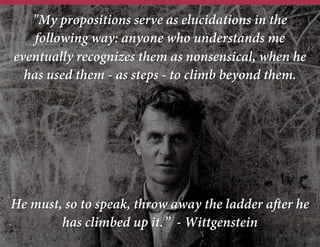
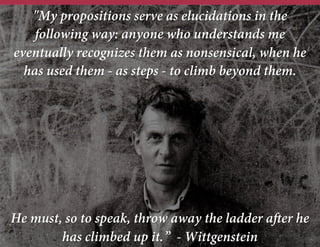
"My propositions serve as elucidations in the
following way: anyone who understands me
eventually recognizes them as nonsensical, when he
has used them - as steps - to climb beyond them.
He must, so to speak, throw away the ladder after he
has climbed up it.”
- Wittgenstein
“All models are lies,
but some models are skillful.”
TRADITIONAL PRODUCT DEVELOPMENT
WHAT IS LEAN STARTUP?
A post-positivist apologetics of a “movement”
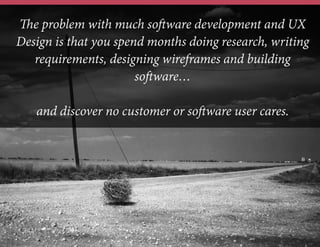
The problem with many startups is that you spend months or
years doing research, writing requirements, designing and
building software…
and discover no customer or user cares.
It Started With a Question
If startups fail from a lack of customers not
product development failure…
Then why do we have:
•  A process for product development?
•  No process for customer development?
“A Startup is a human institution
designed to deliver a product or service
under conditions of
extreme uncertainty”
– Eric Ries
“Waste is any human activity
which absorbs resources, but
creates no value.”
- James P Womak and Daniel T. Jones, Lean Thinking
Over the past 35 years, design &
development, much like Waterfall*,
accumulated a lot of wasteful, time-
consuming, CYA practices that

delivered no discernable value to the
business or to customers.

Zach Nies
LEAN STARTUP LIFECYCLE
LEAN STARTUP BUSINESS MODEL CANVAS
GOOB (GET OUT OF THE BUILDING)
Hypotheses, Not Requirements
Focus on Learning (innovation accounting)
Use Iterative Design & Testing
Validating before Scale
Small Batches = Less Risk
CORE LEAN STARTUP CONCEPTS
Your team should maximize for:
LEARNING
FOCUS
While Minimizing:
CYCLE TIME
1.  Most teams don't start with a customer hypothesis; they work
backwards from a solution hypothesis.
2.  Because teams start with a solution hypothesis, it's almost
impossible for them to generate multiple hypotheses for testing.
3.  GOOB, when done poorly, is particularly prone to confirmation
bias
4.  Formulating hypotheses & stating assumptions is hard.
5.  Designing reliable experiments is a skill that takes time to learn
6.  There is little focus on the organization / value stream
7.  It is “ahistorical” meaning little knowledge of it’s own past
DECONSTRUCTING LEAN STARTUP
Lean*UX
#WTF?
By Lean*UX
most people really mean
“UX in the context of
the Lean Startup Method”
Term coined by Janice Fraser, Founder of LUXR
WHAT is LEANUX?
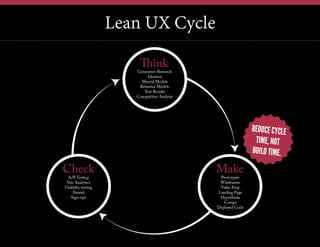
LEAN UX CYCLE
FUNDAMENTALS OF LEAN UX
•  Balanced, Cross-functional team
•  Externalize (visualize) process
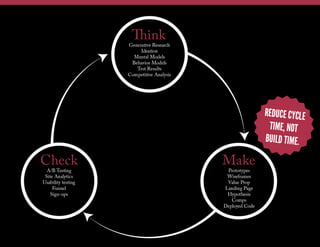
•  Flow: Think > Make > Check
•  Research to understand Customer/Problem Space
•  No proxies between customers and team
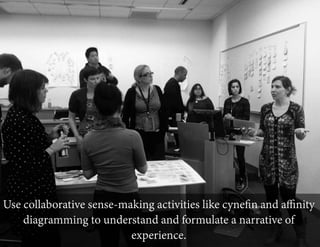
•  Collaborative Sense-making
•  Generative Ideation: It’s about optionality
•  Formulate many small experiments and measure
outcome
Your team should maximize for:
LEARNING
FOCUS
While Minimizing:
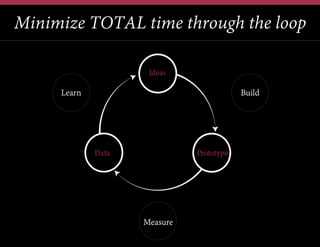
CYCLE TIME
•  Customer Exploration
•  Problem Exploration
•  Solution Exploration
•  Iteration & Scaling
LEANUX PROCESS
Let’s unpack what this looks like…
BASICS OF CUSTOMER EXPLORATION
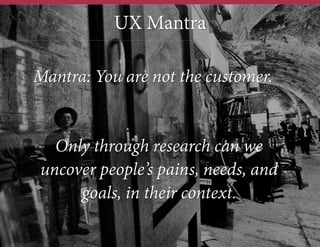
UX MANTRA
Mantra: You are not the customer.
Only through research can we
uncover people’s pains, needs, and
goals, in their context.
Background
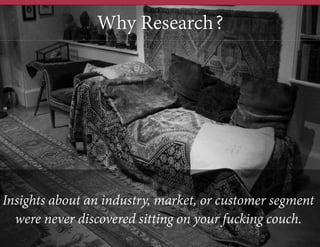
WHY RESEARCH?
Insights about an industry, market, or customer segment
were never discovered sitting on your fucking couch.
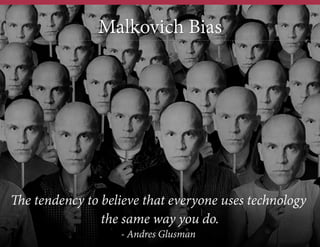
MALKOVICH BIAS
The tendency to believe that everyone uses technology
the same way you do.
- Andres Glusman
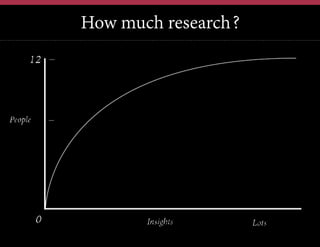
Customer ResearchHOW MUCH RESEARCH?
Lot
s	
  
People	
  
Insights	
  
12	
  
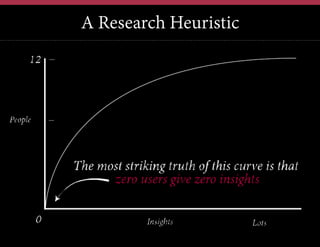
Lot
s	
  
People	
  
Insights	
  
A RESEARCH HEURISTIC
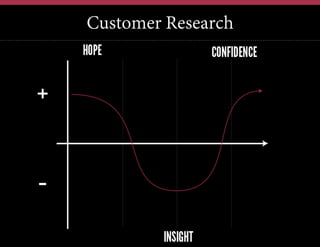
THE RESEARCH INSIGHT DESPAIR CURVE
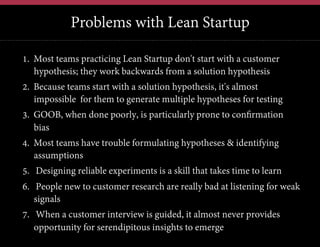
•  Most teams practicing Lean Startup don't start with a customer
hypothesis; they work backwards from a solution hypothesis
•  Because teams start with a solution hypothesis, it's almost
impossible for them to generate multiple hypotheses for testing
•  GOOB, when done poorly, is particularly prone to confirmation
bias
•  Most teams have trouble formulating hypotheses & identifying
assumptions
•  Designing reliable experiments is a skill that takes time to learn
•  People new to customer research are really bad at listening for
weak signals
•  When a customer interview is guided, it almost never provides
opportunity for serendipitous insights to emerge
Problems with Lean Startup
•  Customer Exploration
•  Problem Exploration
•  Solution Exploration
•  Iteration & Scaling
LEANUX PROCESS
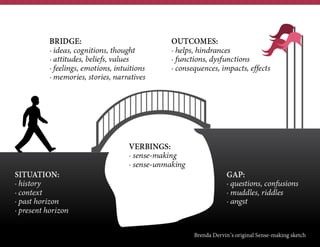
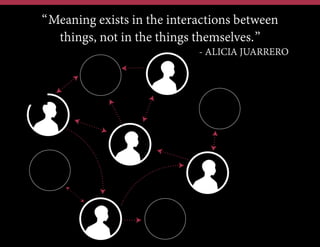
How do we make sense of the world so that we can
make decisions and act?
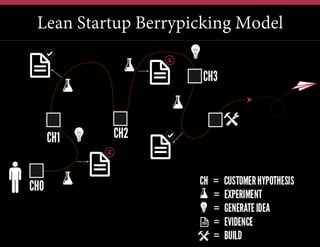
A BERRYPICKING MODEL OF LEAN STARTUP
PROBLEM FRAMING
4 W PROBLEM EXPLORATION
§  Who
§  What
§  Why
§  Where
4W Exploration
Who
Who has this problem? Is it your
customer? Have you validated that the
problem is real? Can you prove it?
What
What is the nature of the problem? Can
you explain it simply? How do you know
it’s a problem? What is the evidence to
support the problem?
Why do you believe it is a problem worth
solving? Is it an acute problem for the
customer? How acute?
Why
Where does this problem arise? In which
context does the customer experience the
problem? Have you observed the problem
in context? Can you describe that
context?
Where
By yourself - write out on
post-its at least 2
•  Who
•  What
•  Why
•  Where
4W Exploration – 10 min
As a team, present all post-its onto a blank
sheet of large paper, discuss all 4 Ws people
presented, take note of duplicates.
•  Which 2 are most revealing
•  Which 2 are most relevant to your
customer on your empathy map?
Use dot-voting
4W Exploration –
Synthesis– 20 minutes
Now, after reviewing the 4W Canvas, please
write out at least a paragraph describing the
problem as a problem statement. Make sure
to be explicit about the Who, What, Why,
Where.
Problem Statement – 10 minutes
Each team member present their problem
statement. Dot vote on the 1 strongest
problem (or combine them).
Team must present a single problem
statement to the entire group
Synthesis – 10 minutes
Every team select one person.
Stand Up and read problem statement.
Place on flip chart at front of the room.
PRESENT
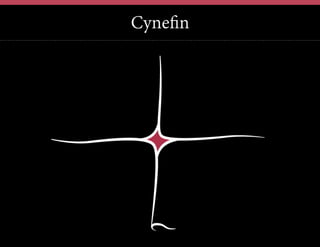
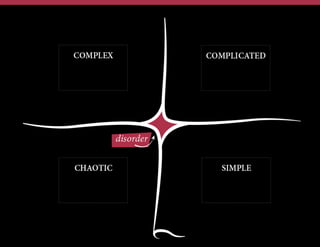
CYNEFIN
The place of your
multiple belongings
CYNEFIN
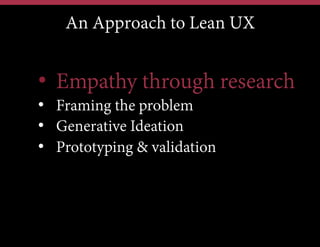
•  Customer Exploration
•  Problem Exploration
•  Solution Exploration
•  Iteration & Scaling
LEANUX PROCESS
SOLUTION IDEATION
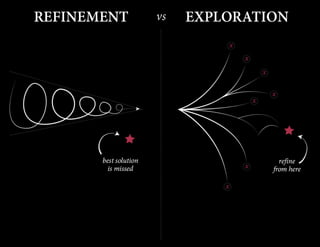
EXPLOITATION vs EXPLORATION
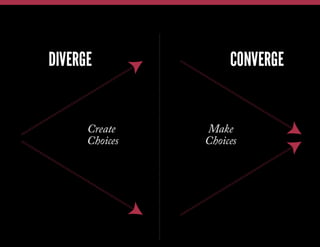
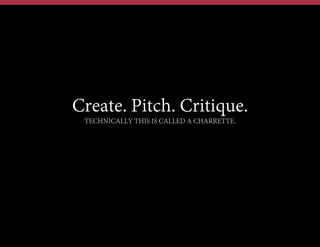
CREATE
PITCH
CRITIQUE
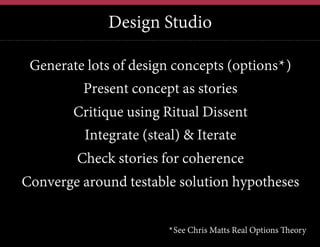
Generate lots of design concepts (options*)
Present concept as stories
Critique using Ritual Dissent
Integrate (steal) & Iterate
Check stories for coherence
Converge around testable solution hypotheses
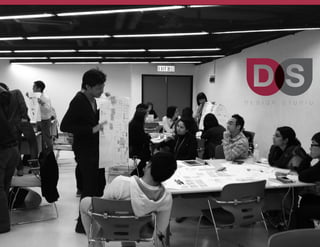
Design Studio
*See Chris Matts Real Options Theory
•  Customer Exploration
•  Problem Exploration
•  Solution Exploration
•  Iteration & Scaling
LEANUX PROCESS
ITERATE & SCALE
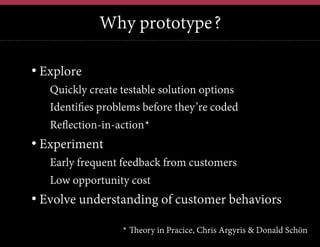
WHY PROTOTYPE?
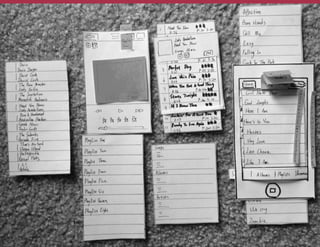
• Explore
• Quickly create testable solution options
• Identifies problems before they’re coded
• Reflection-in-action*
• Experiment
• Early frequent feedback from customers
• Low opportunity cost
• Evolve understanding of customer behaviors
* Theory in Pracice, Chris Argyris & Donald Schön
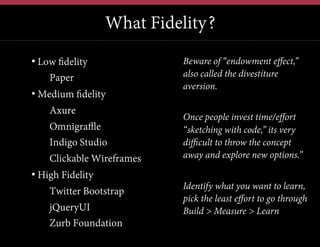
WHAT FIDELITY?
• Low fidelity
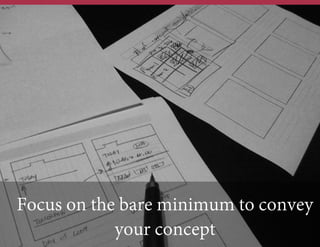
• Paper
• Medium fidelity
• Axure
• Omnigraffle
• Indigo Studio
• Clickable Wireframes
• High Fidelity
• Twitter Bootstrap
• jQueryUI
• Zurb Foundation
Beware of “endowment effect,”
also called the divestiture
aversion.
Once people invest time/effort
“sketching with code,” its very
difficult to throw the concept
away and explore new options.”
Identify what you want to learn,
pick the least effort to go through
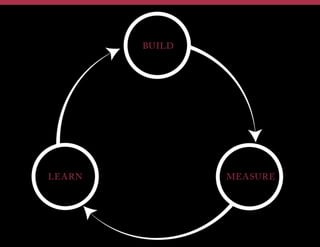
Build > Measure > Learn
LEANUX PRINCIPLES
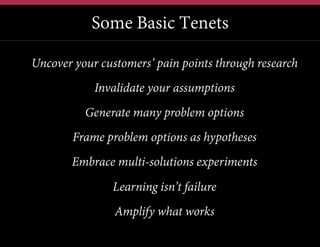
•  Discover customer problems through research
•  Cross-functional collaboration
•  Visualize the work
•  Invalidate assumptions
•  Generate many problem options
•  Collaborative solutioning
•  Validation before scaling
THE LEANUX KATA
•  Who is the customer?
•  What is their problem?
•  What do you know and how do you know it?
•  What are your assumptions? How will you test them?
•  What have you learned and what should you learn next?
•  What is your very next experiment? How will you measure
it?
LEAN THINKING
LEAN PRINCIPLES
•  Identify Customers & Value
•  Map the Value Stream
•  Create Flow by Eliminating Waste
•  Respond to Customer Pull
•  Continuously Improve
PURPOSE, PROCESS, PEOPLE
•  Purpose: What is our organizations purpose? Who is our
customer? What is the value? Where is the target?
•  Process: How will the organization assess each major value stream
to make sure we’re maximizing optionality while decreasing waste?
•  People: How do we empower people to own the process, own the
work, and be constantly learning? How can everyone touching the
value stream be actively engaged in operating it correctly and
continually improving it?
LEANUX MANAGEMENT
“Lean UX management is not about experts
providing answers, or aligning “resources” to a
strategic vision. It’s about providing a system of
constraints for people to ask the right questions, find
purpose in their work, and be empowered to make
decisions and constantly learn & improve through
experimentation and failure.”
WILL EVANS
Design Thinker-in-Residence
NYU Stern School of Management
Will.Evans@PraxisFlow.com
@semanticwill

LeanUX is a Useful F*&king Lie

  • 2.
    WILL EVANS Design Thinker-in-Residence NYUStern School of Management Will.Evans@PraxisFlow.com @semanticwill
  • 3.
    "My propositions serveas elucidations in the following way: anyone who understands me eventually recognizes them as nonsensical, when he has used them - as steps - to climb beyond them. He must, so to speak, throw away the ladder after he has climbed up it.” - Wittgenstein
  • 4.
    “All models arelies, but some models are skillful.”
  • 5.
  • 6.
  • 7.
    WHAT IS LEANSTARTUP? A post-positivist apologetics of a “movement”
  • 10.
    The problem withmany startups is that you spend months or years doing research, writing requirements, designing and building software… and discover no customer or user cares.
  • 12.
    It Started Witha Question If startups fail from a lack of customers not product development failure… Then why do we have: •  A process for product development? •  No process for customer development?
  • 13.
    “A Startup isa human institution designed to deliver a product or service under conditions of extreme uncertainty” – Eric Ries
  • 15.
    “Waste is anyhuman activity which absorbs resources, but creates no value.” - James P Womak and Daniel T. Jones, Lean Thinking
  • 16.
    Over the past35 years, design & development, much like Waterfall*, accumulated a lot of wasteful, time- consuming, CYA practices that delivered no discernable value to the business or to customers.
  • 18.
  • 21.
  • 23.
  • 24.
    GOOB (GET OUTOF THE BUILDING) Hypotheses, Not Requirements Focus on Learning (innovation accounting) Use Iterative Design & Testing Validating before Scale Small Batches = Less Risk CORE LEAN STARTUP CONCEPTS
  • 25.
    Your team shouldmaximize for: LEARNING FOCUS While Minimizing: CYCLE TIME
  • 26.
    1.  Most teamsdon't start with a customer hypothesis; they work backwards from a solution hypothesis. 2.  Because teams start with a solution hypothesis, it's almost impossible for them to generate multiple hypotheses for testing. 3.  GOOB, when done poorly, is particularly prone to confirmation bias 4.  Formulating hypotheses & stating assumptions is hard. 5.  Designing reliable experiments is a skill that takes time to learn 6.  There is little focus on the organization / value stream 7.  It is “ahistorical” meaning little knowledge of it’s own past DECONSTRUCTING LEAN STARTUP
  • 27.
  • 28.
    By Lean*UX most peoplereally mean “UX in the context of the Lean Startup Method” Term coined by Janice Fraser, Founder of LUXR
  • 29.
  • 30.
  • 31.
    FUNDAMENTALS OF LEANUX •  Balanced, Cross-functional team •  Externalize (visualize) process •  Flow: Think > Make > Check •  Research to understand Customer/Problem Space •  No proxies between customers and team •  Collaborative Sense-making •  Generative Ideation: It’s about optionality •  Formulate many small experiments and measure outcome
  • 32.
    Your team shouldmaximize for: LEARNING FOCUS While Minimizing: CYCLE TIME
  • 34.
    •  Customer Exploration • Problem Exploration •  Solution Exploration •  Iteration & Scaling LEANUX PROCESS Let’s unpack what this looks like…
  • 35.
    BASICS OF CUSTOMEREXPLORATION
  • 37.
    UX MANTRA Mantra: Youare not the customer. Only through research can we uncover people’s pains, needs, and goals, in their context.
  • 39.
  • 40.
    WHY RESEARCH? Insights aboutan industry, market, or customer segment were never discovered sitting on your fucking couch.
  • 41.
    MALKOVICH BIAS The tendencyto believe that everyone uses technology the same way you do. - Andres Glusman
  • 42.
    Customer ResearchHOW MUCHRESEARCH? Lot s   People   Insights  
  • 43.
    12   Lot s   People   Insights   A RESEARCH HEURISTIC
  • 44.
    THE RESEARCH INSIGHTDESPAIR CURVE
  • 46.
    •  Most teamspracticing Lean Startup don't start with a customer hypothesis; they work backwards from a solution hypothesis •  Because teams start with a solution hypothesis, it's almost impossible for them to generate multiple hypotheses for testing •  GOOB, when done poorly, is particularly prone to confirmation bias •  Most teams have trouble formulating hypotheses & identifying assumptions •  Designing reliable experiments is a skill that takes time to learn •  People new to customer research are really bad at listening for weak signals •  When a customer interview is guided, it almost never provides opportunity for serendipitous insights to emerge Problems with Lean Startup
  • 47.
    •  Customer Exploration • Problem Exploration •  Solution Exploration •  Iteration & Scaling LEANUX PROCESS
  • 48.
    How do wemake sense of the world so that we can make decisions and act?
  • 49.
    A BERRYPICKING MODELOF LEAN STARTUP
  • 50.
  • 51.
    4 W PROBLEMEXPLORATION
  • 52.
    §  Who §  What § Why §  Where 4W Exploration
  • 53.
    Who Who has thisproblem? Is it your customer? Have you validated that the problem is real? Can you prove it?
  • 54.
    What What is thenature of the problem? Can you explain it simply? How do you know it’s a problem? What is the evidence to support the problem?
  • 55.
    Why do youbelieve it is a problem worth solving? Is it an acute problem for the customer? How acute? Why
  • 56.
    Where does thisproblem arise? In which context does the customer experience the problem? Have you observed the problem in context? Can you describe that context? Where
  • 57.
    By yourself -write out on post-its at least 2 •  Who •  What •  Why •  Where 4W Exploration – 10 min
  • 58.
    As a team,present all post-its onto a blank sheet of large paper, discuss all 4 Ws people presented, take note of duplicates. •  Which 2 are most revealing •  Which 2 are most relevant to your customer on your empathy map? Use dot-voting 4W Exploration – Synthesis– 20 minutes
  • 59.
    Now, after reviewingthe 4W Canvas, please write out at least a paragraph describing the problem as a problem statement. Make sure to be explicit about the Who, What, Why, Where. Problem Statement – 10 minutes
  • 61.
    Each team memberpresent their problem statement. Dot vote on the 1 strongest problem (or combine them). Team must present a single problem statement to the entire group Synthesis – 10 minutes
  • 62.
    Every team selectone person. Stand Up and read problem statement. Place on flip chart at front of the room. PRESENT
  • 63.
  • 64.
    The place ofyour multiple belongings
  • 65.
  • 66.
    •  Customer Exploration • Problem Exploration •  Solution Exploration •  Iteration & Scaling LEANUX PROCESS
  • 67.
  • 68.
  • 70.
  • 71.
    Generate lots ofdesign concepts (options*) Present concept as stories Critique using Ritual Dissent Integrate (steal) & Iterate Check stories for coherence Converge around testable solution hypotheses Design Studio *See Chris Matts Real Options Theory
  • 72.
    •  Customer Exploration • Problem Exploration •  Solution Exploration •  Iteration & Scaling LEANUX PROCESS
  • 73.
  • 76.
    WHY PROTOTYPE? • Explore • Quickly createtestable solution options • Identifies problems before they’re coded • Reflection-in-action* • Experiment • Early frequent feedback from customers • Low opportunity cost • Evolve understanding of customer behaviors * Theory in Pracice, Chris Argyris & Donald Schön
  • 77.
    WHAT FIDELITY? • Low fidelity • Paper • Mediumfidelity • Axure • Omnigraffle • Indigo Studio • Clickable Wireframes • High Fidelity • Twitter Bootstrap • jQueryUI • Zurb Foundation Beware of “endowment effect,” also called the divestiture aversion. Once people invest time/effort “sketching with code,” its very difficult to throw the concept away and explore new options.” Identify what you want to learn, pick the least effort to go through Build > Measure > Learn
  • 78.
    LEANUX PRINCIPLES •  Discovercustomer problems through research •  Cross-functional collaboration •  Visualize the work •  Invalidate assumptions •  Generate many problem options •  Collaborative solutioning •  Validation before scaling
  • 79.
    THE LEANUX KATA • Who is the customer? •  What is their problem? •  What do you know and how do you know it? •  What are your assumptions? How will you test them? •  What have you learned and what should you learn next? •  What is your very next experiment? How will you measure it?
  • 80.
  • 81.
    LEAN PRINCIPLES •  IdentifyCustomers & Value •  Map the Value Stream •  Create Flow by Eliminating Waste •  Respond to Customer Pull •  Continuously Improve
  • 82.
    PURPOSE, PROCESS, PEOPLE • Purpose: What is our organizations purpose? Who is our customer? What is the value? Where is the target? •  Process: How will the organization assess each major value stream to make sure we’re maximizing optionality while decreasing waste? •  People: How do we empower people to own the process, own the work, and be constantly learning? How can everyone touching the value stream be actively engaged in operating it correctly and continually improving it?
  • 83.
    LEANUX MANAGEMENT “Lean UXmanagement is not about experts providing answers, or aligning “resources” to a strategic vision. It’s about providing a system of constraints for people to ask the right questions, find purpose in their work, and be empowered to make decisions and constantly learn & improve through experimentation and failure.”
  • 84.
    WILL EVANS Design Thinker-in-Residence NYUStern School of Management Will.Evans@PraxisFlow.com @semanticwill