"All men dream: but not equally. Those that dream
by night in the dusty recesses of their minds wake
in the day to find that it was in vanity: but the
dreamers of the day are dangerous men, for they
may act their dreams with open eyes, to make it
possible."
- T.E. Lawrence, "Lawrence of Arabia"
WHO ARE WE?
WILL EVANS

THOMAS WENDT

Managing Director

UX Strategist
The Library Corporation

Surrounding Signifiers

will@tlclabs.co
@semanticwill

thomas@srsg.co
@thomas_wendt

#NYInnovates
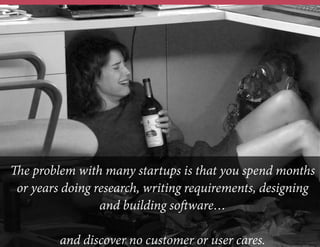
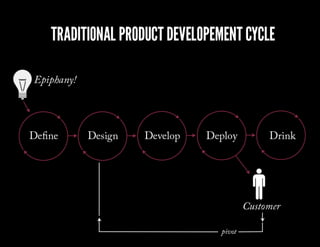
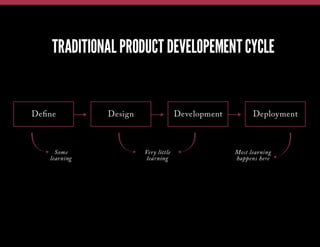
The problem with many startups is that you spend months
or years doing research, writing requirements, designing
and building software…
and discover no customer or user cares.
It Started With a Question
If startups fail from a lack of customers not
product development failure…

Then why do we have:
•  A process for product development?
•  No process for customer development?
Lean* UX
#WTF?
*By Lean UX
most people really mean
“UX in the context of
the Lean Startup Method”
Term coined by Janice Fraser, Founder of LUXR
“Waste is any human activity
which absorbs resources, but
creates no value.”
- James P Womak and Daniel T. Jones, Lean Thinking
Over the past 35 years, design &
development, much like Waterfall*,
accumulated a lot of wasteful, timeconsuming, CYA practices that delivered
no discernable value to the business or to
customers.
Waterfall is a pejorative term used by Agilistas to describe traditional SDLC
A post-positivist apologetics of a “movement”.

WHAT IS LEAN STARTUP?
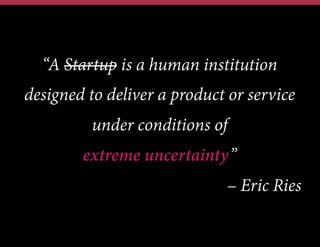
“A Startup is a human institution
designed to deliver a product or service
under conditions of
extreme uncertainty”
– Eric Ries
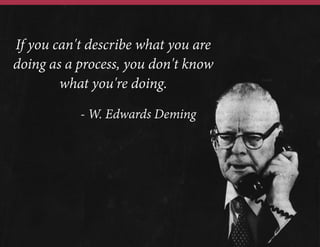
If you can't describe what you are
doing as a process, you don't know
what you're doing.
- W. Edwards Deming
Zach Nies
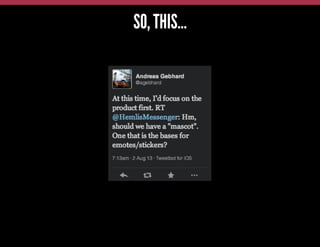
SO, THIS…
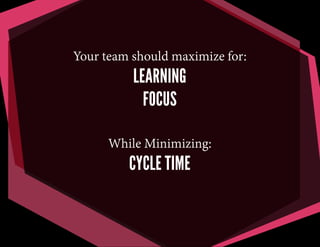
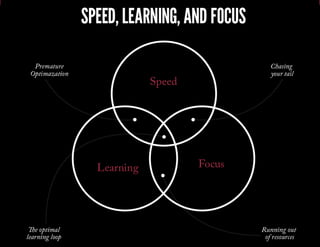
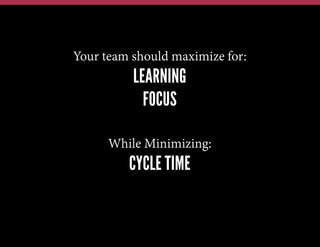
Your team should maximize for:

LEARNING
FOCUS
While Minimizing:

CYCLE TIME
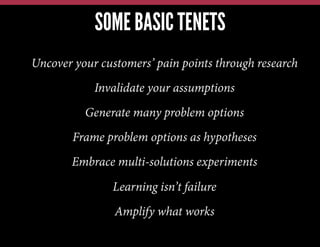
SOME BASIC TENETS
Uncover your customers’ pain points through research
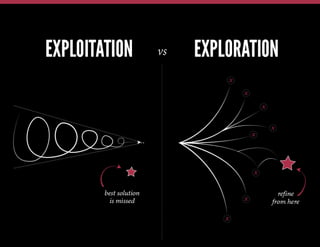
Invalidate your assumptions
Generate many problem options
Frame problem options as hypotheses
Embrace multi-solutions experiments
Learning isn’t failure
Amplify what works
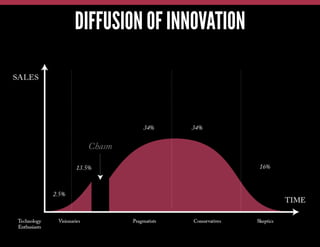
DIFFUSION OF INNOVATION
Core Lean Startup Concepts
GOOB (GET OUT OF THE BUILDING)
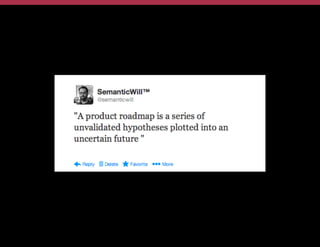
Hypotheses, Not Requirements
Focus on Learning
Use Iterative Design & Testing
Small Batches = Less Risk
Practice “Respect for People”
Perform Root Cause Analysis – 5 Whys
Deconstructing Lean Startup
1.  Most teams don't start with a customer hypothesis; they work
backwards from a solution hypothesis.
2.  Because teams start with a solution hypothesis, it's almost
impossible for them to generate multiple hypotheses for testing.

3.  GOOB, when done poorly, is particularly prone to confirmation bias
4.  Formulating hypotheses & stating assumptions is hard.
5.  Designing reliable experiments is a skill that takes time to learn
6.  People new to customer research are really bad!
7.  When a customer interview is guided, it almost never provides
opportunity for serendipitous insights to emerge.
WHAT LEANUX?
is
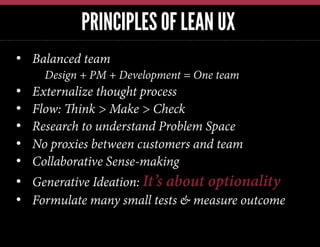
PRINCIPLES OF LEAN UX
•  Balanced team
Design + PM + Development = One team

• 
• 
• 
• 
• 
• 
• 

Externalize thought process
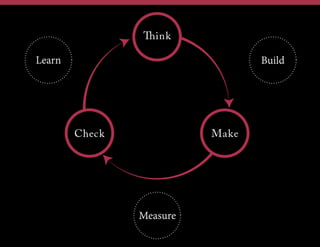
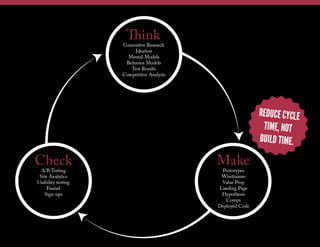
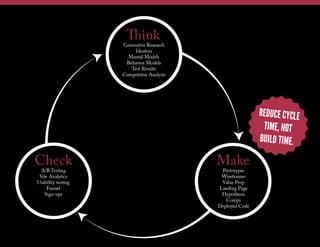
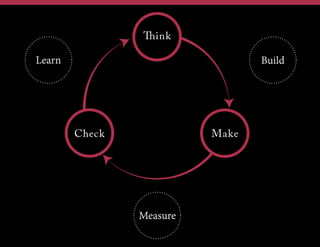
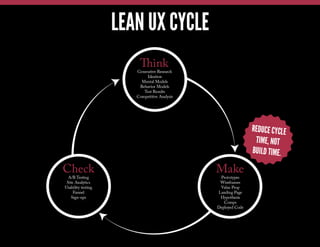
Flow: Think > Make > Check
Research to understand Problem Space
No proxies between customers and team
Collaborative Sense-making
Generative Ideation: It’s about optionality
Formulate many small tests & measure outcome
HOW DO WE MAKE SENSE OF THE WORLD SO THAT WE CAN ACT?

SENSEMAKING
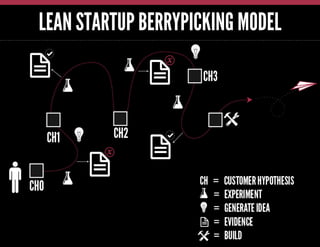
LEAN STARTUP BERRYPICKING MODEL
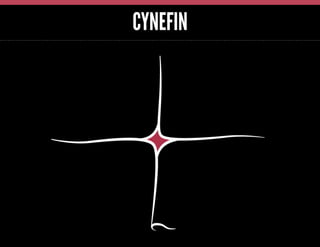
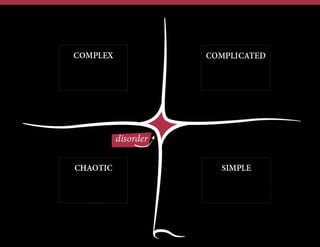
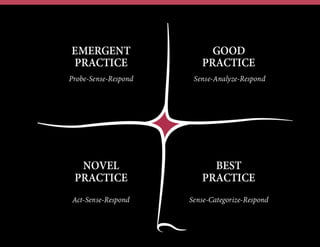
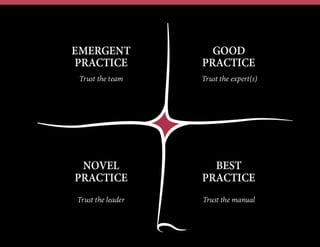
CYNEFIN
The place of your multiple
affiliations or belongings.
COLLABORATIVE DESIGN

CREATING OPTIONS
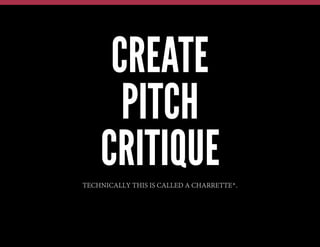
CREATE
PITCH
CRITIQUE
TECHNICALLY THIS IS CALLED A CHARRETTE*.
A MOST MISUNDERSTOOD TERM

MINIMUM VIABLE PRODUCT
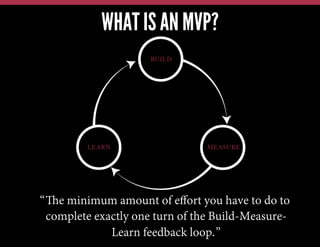
WHAT IS AN MVP?

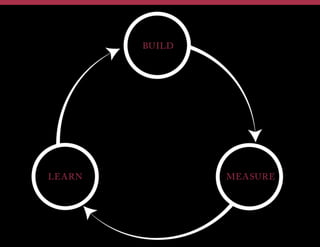
“The minimum amount of effort you have to do to
complete exactly one turn of the Build-MeasureLearn feedback loop.”
Your team should maximize for:

LEARNING
FOCUS
While Minimizing:

CYCLE TIME
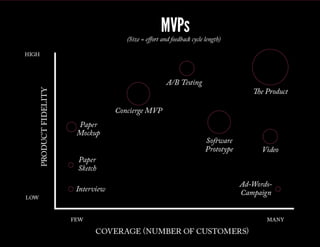
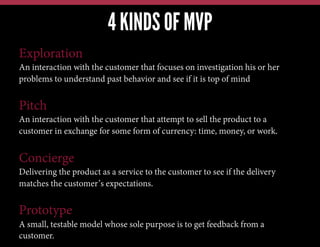
4 KINDS OF MVP
Exploration
An interaction with the customer that focuses on investigation his or her
problems to understand past behavior and see if it is top of mind

Pitch
An interaction with the customer that attempt to sell the product to a
customer in exchange for some form of currency: time, money, or work.

Concierge
Delivering the product as a service to the customer to see if the delivery
matches the customer’s expectations.

Prototype
A small, testable model whose sole purpose is to get feedback from a
customer.
A danger with iterating through
prototypes during the solution interview
stage is that it is quite easy to get carried
away and end up with more than you
need for you MVP.
In order to reduce waste and speed up
learning, you need to pare down your
prototypes so that all you have left is the
essence of your product:
The MVP.
Reducing the scope of your MVP not only
shortens your development cycle, but also
removes unnecessary distractions that
dilute your products messaging.
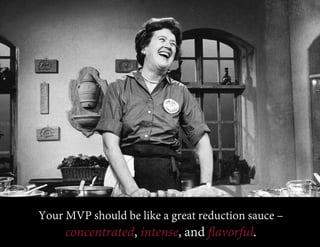
Your MVP should be like a great reduction sauce –

concentrated, intense, and flavorful.
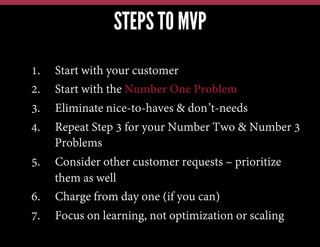
STEPS TO MVP
1. 
2. 
3. 
4. 

Start with your customer
Start with the Number One Problem
Eliminate nice-to-haves & don’t-needs
Repeat Step 3 for your Number Two & Number 3
Problems
5.  Consider other customer requests – prioritize
them as well
6.  Charge from day one (if you can)
7.  Focus on learning, not optimization or scaling
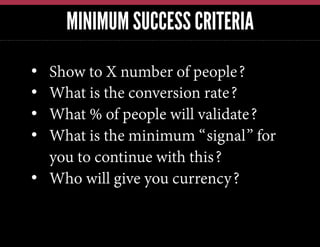
MINIMUM SUCCESS CRITERIA
• 
• 
• 
• 

Show to X number of people?
What is the conversion rate?
What % of people will validate?
What is the minimum “signal” for
you to continue with this?
•  Who will give you currency?
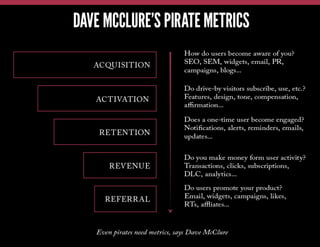
METRICS & MEASUREMENT
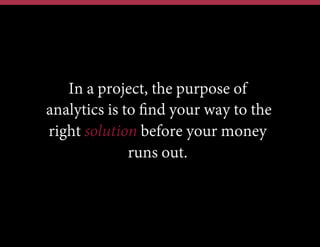
In a project, the purpose of
analytics is to find your way to the
right solution before your money
runs out.
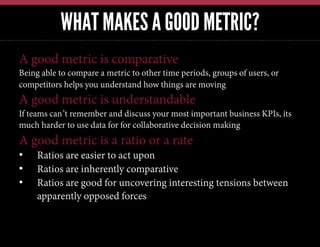
WHAT MAKES A GOOD METRIC?
A good metric is comparative
Being able to compare a metric to other time periods, groups of users, or
competitors helps you understand how things are moving

A good metric is understandable
If teams can’t remember and discuss your most important business KPIs, its
much harder to use data for for collaborative decision making

A good metric is a ratio or a rate
• 
• 
• 

Ratios are easier to act upon
Ratios are inherently comparative
Ratios are good for uncovering interesting tensions between
apparently opposed forces
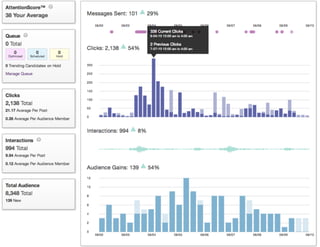
VANITY VS ACTIONABLE METRICS
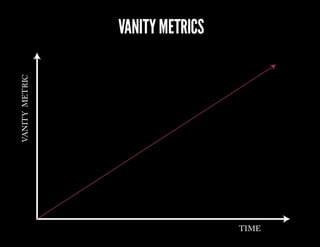
Vanity metrics might make you feel
all awesome and shit, but they don’t
change how you act.
Actionable metrics change your
behavior by helping you choose a
course of action.
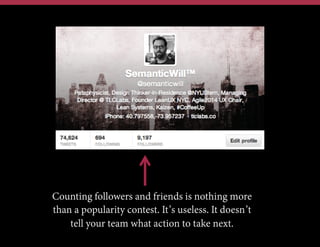
Counting followers and friends is nothing more
than a popularity contest. It’s useless. It doesn’t
tell your team what action to take next.
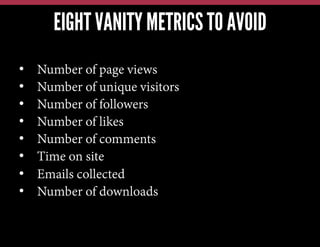
EIGHT VANITY METRICS TO AVOID
• 
• 
• 
• 
• 
• 
• 
• 

Number of page views
Number of unique visitors
Number of followers
Number of likes
Number of comments
Time on site
Emails collected
Number of downloads
A QUICK REVIEW
LEAN UX CYCLE
PRINCIPLES OF LEAN UX
•  Balanced team
Design + PM + Development = One team

• 
• 
• 
• 
• 
• 
• 

Externalize thought process
Flow: Think > Make > Check
Research to understand Problem Space
No proxies between customers and team
Collaborative Sense-making
Generative Ideation: It’s about optionality
Formulate many small tests & measure outcome
Your startup should maximize for:

LEARNING
FOCUS
while minimizing:

CYCLE TIME
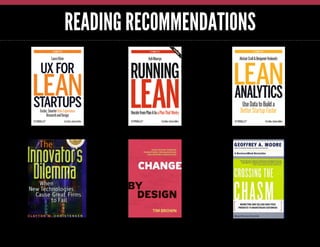
READING RECOMMENDATIONS
 	
  
WILL EVANS

THOMAS WENDT

@semanticwill
will@tlclabs.co

@thomas_wendt
thomas@srsg.co

Thanks!

Introduction to Lean Startup & Lean User Experience Design

  • 2.
    "All men dream:but not equally. Those that dream by night in the dusty recesses of their minds wake in the day to find that it was in vanity: but the dreamers of the day are dangerous men, for they may act their dreams with open eyes, to make it possible." - T.E. Lawrence, "Lawrence of Arabia"
  • 3.
    WHO ARE WE? WILLEVANS THOMAS WENDT Managing Director UX Strategist The Library Corporation Surrounding Signifiers will@tlclabs.co @semanticwill thomas@srsg.co @thomas_wendt #NYInnovates
  • 6.
    The problem withmany startups is that you spend months or years doing research, writing requirements, designing and building software… and discover no customer or user cares.
  • 8.
    It Started Witha Question If startups fail from a lack of customers not product development failure… Then why do we have: •  A process for product development? •  No process for customer development?
  • 9.
  • 10.
    *By Lean UX mostpeople really mean “UX in the context of the Lean Startup Method” Term coined by Janice Fraser, Founder of LUXR
  • 11.
    “Waste is anyhuman activity which absorbs resources, but creates no value.” - James P Womak and Daniel T. Jones, Lean Thinking
  • 12.
    Over the past35 years, design & development, much like Waterfall*, accumulated a lot of wasteful, timeconsuming, CYA practices that delivered no discernable value to the business or to customers. Waterfall is a pejorative term used by Agilistas to describe traditional SDLC
  • 16.
    A post-positivist apologeticsof a “movement”. WHAT IS LEAN STARTUP?
  • 18.
    “A Startup isa human institution designed to deliver a product or service under conditions of extreme uncertainty” – Eric Ries
  • 19.
    If you can'tdescribe what you are doing as a process, you don't know what you're doing. - W. Edwards Deming
  • 21.
  • 24.
  • 25.
    Your team shouldmaximize for: LEARNING FOCUS While Minimizing: CYCLE TIME
  • 27.
    SOME BASIC TENETS Uncoveryour customers’ pain points through research Invalidate your assumptions Generate many problem options Frame problem options as hypotheses Embrace multi-solutions experiments Learning isn’t failure Amplify what works
  • 31.
  • 32.
    Core Lean StartupConcepts GOOB (GET OUT OF THE BUILDING) Hypotheses, Not Requirements Focus on Learning Use Iterative Design & Testing Small Batches = Less Risk Practice “Respect for People” Perform Root Cause Analysis – 5 Whys
  • 33.
    Deconstructing Lean Startup 1. Most teams don't start with a customer hypothesis; they work backwards from a solution hypothesis. 2.  Because teams start with a solution hypothesis, it's almost impossible for them to generate multiple hypotheses for testing. 3.  GOOB, when done poorly, is particularly prone to confirmation bias 4.  Formulating hypotheses & stating assumptions is hard. 5.  Designing reliable experiments is a skill that takes time to learn 6.  People new to customer research are really bad! 7.  When a customer interview is guided, it almost never provides opportunity for serendipitous insights to emerge.
  • 34.
  • 35.
    PRINCIPLES OF LEANUX •  Balanced team Design + PM + Development = One team •  •  •  •  •  •  •  Externalize thought process Flow: Think > Make > Check Research to understand Problem Space No proxies between customers and team Collaborative Sense-making Generative Ideation: It’s about optionality Formulate many small tests & measure outcome
  • 41.
    HOW DO WEMAKE SENSE OF THE WORLD SO THAT WE CAN ACT? SENSEMAKING
  • 42.
  • 43.
  • 44.
    The place ofyour multiple affiliations or belongings.
  • 48.
  • 51.
  • 52.
    A MOST MISUNDERSTOODTERM MINIMUM VIABLE PRODUCT
  • 53.
    WHAT IS ANMVP? “The minimum amount of effort you have to do to complete exactly one turn of the Build-MeasureLearn feedback loop.”
  • 55.
    Your team shouldmaximize for: LEARNING FOCUS While Minimizing: CYCLE TIME
  • 58.
    4 KINDS OFMVP Exploration An interaction with the customer that focuses on investigation his or her problems to understand past behavior and see if it is top of mind Pitch An interaction with the customer that attempt to sell the product to a customer in exchange for some form of currency: time, money, or work. Concierge Delivering the product as a service to the customer to see if the delivery matches the customer’s expectations. Prototype A small, testable model whose sole purpose is to get feedback from a customer.
  • 59.
    A danger withiterating through prototypes during the solution interview stage is that it is quite easy to get carried away and end up with more than you need for you MVP. In order to reduce waste and speed up learning, you need to pare down your prototypes so that all you have left is the essence of your product: The MVP.
  • 60.
    Reducing the scopeof your MVP not only shortens your development cycle, but also removes unnecessary distractions that dilute your products messaging.
  • 61.
    Your MVP shouldbe like a great reduction sauce – concentrated, intense, and flavorful.
  • 62.
    STEPS TO MVP 1.  2.  3.  4.  Startwith your customer Start with the Number One Problem Eliminate nice-to-haves & don’t-needs Repeat Step 3 for your Number Two & Number 3 Problems 5.  Consider other customer requests – prioritize them as well 6.  Charge from day one (if you can) 7.  Focus on learning, not optimization or scaling
  • 64.
    MINIMUM SUCCESS CRITERIA •  •  •  •  Showto X number of people? What is the conversion rate? What % of people will validate? What is the minimum “signal” for you to continue with this? •  Who will give you currency?
  • 67.
  • 70.
    In a project,the purpose of analytics is to find your way to the right solution before your money runs out.
  • 72.
    WHAT MAKES AGOOD METRIC? A good metric is comparative Being able to compare a metric to other time periods, groups of users, or competitors helps you understand how things are moving A good metric is understandable If teams can’t remember and discuss your most important business KPIs, its much harder to use data for for collaborative decision making A good metric is a ratio or a rate •  •  •  Ratios are easier to act upon Ratios are inherently comparative Ratios are good for uncovering interesting tensions between apparently opposed forces
  • 74.
    VANITY VS ACTIONABLEMETRICS Vanity metrics might make you feel all awesome and shit, but they don’t change how you act. Actionable metrics change your behavior by helping you choose a course of action.
  • 76.
    Counting followers andfriends is nothing more than a popularity contest. It’s useless. It doesn’t tell your team what action to take next.
  • 78.
    EIGHT VANITY METRICSTO AVOID •  •  •  •  •  •  •  •  Number of page views Number of unique visitors Number of followers Number of likes Number of comments Time on site Emails collected Number of downloads
  • 79.
  • 81.
  • 82.
    PRINCIPLES OF LEANUX •  Balanced team Design + PM + Development = One team •  •  •  •  •  •  •  Externalize thought process Flow: Think > Make > Check Research to understand Problem Space No proxies between customers and team Collaborative Sense-making Generative Ideation: It’s about optionality Formulate many small tests & measure outcome
  • 83.
    Your startup shouldmaximize for: LEARNING FOCUS while minimizing: CYCLE TIME
  • 84.
  • 85.
  • 86.