Modeling Leadership
    @SemanticWill
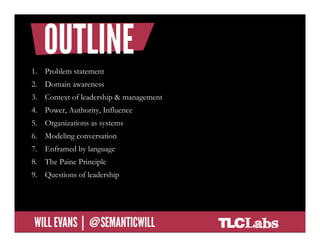
1.  Problem statement
2.  Domain awareness
3.  Context of leadership & management
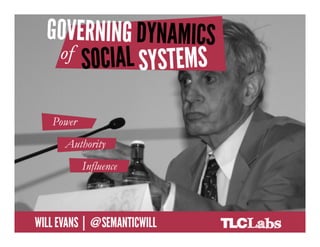
4.  Power, Authority, Influence
5.  Organizations as systems
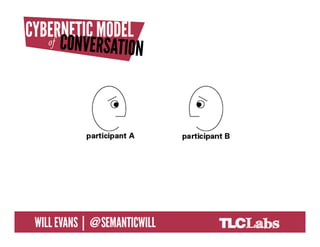
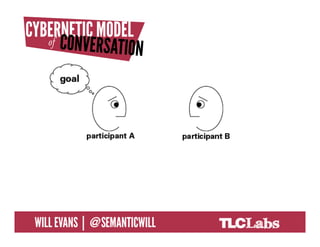
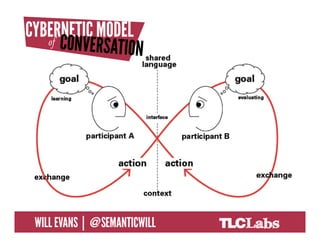
6.  Modeling conversation
7.  Enframed by language
8.  The Paine Principle
9.  Questions of leadership
@SemanticWill | Will Evans
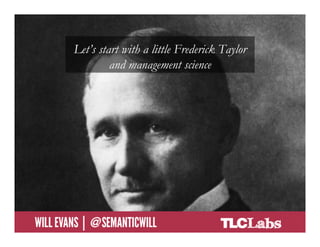
Let’s start with a little Frederick Taylor
                          and management science


@SemanticWill | Will Evans
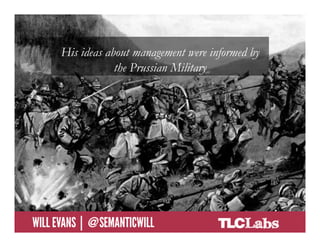
His ideas about management were informed by
                        the Prussian Military


@SemanticWill | Will Evans
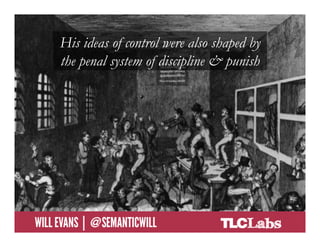
His ideas of control were also shaped by
            the penal system of discipline & punish


@SemanticWill | Will Evans
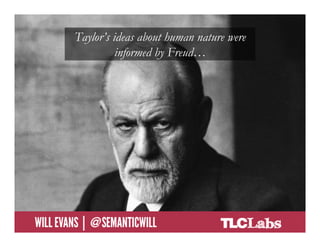
Taylor’s ideas about human nature were
                           informed by Freud…


@SemanticWill | Will Evans
Who did an epic amount of coke.


@SemanticWill | Will Evans
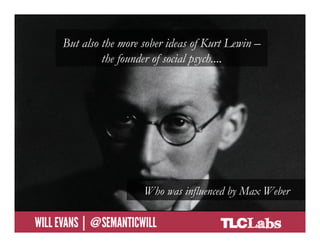
But also the more sober ideas of Kurt Lewin –
                      the founder of social psych....


                               Who was influenced by Max Weber

@SemanticWill | Will Evans
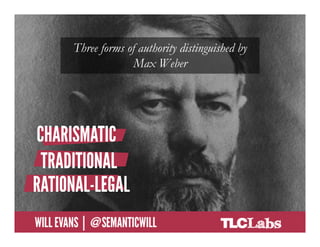
Three forms of authority distinguished by
                              Max Weber


@SemanticWill | Will Evans
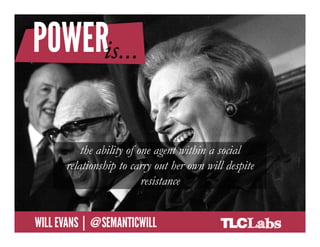
the ability of one agent within a social
              relationship to carry out her own will despite
                                  resistance

@SemanticWill | Will Evans
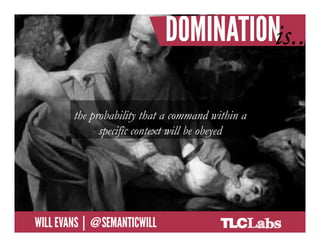
the probability that a command within a
                       specific context will be obeyed


@SemanticWill | Will Evans
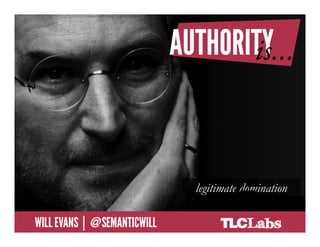
legitimate domination

@SemanticWill | Will Evans
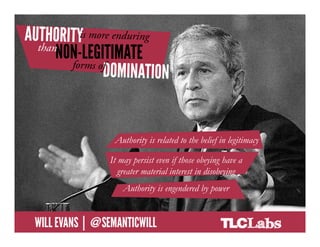
Authority is more enduring than non-
       legitimate forms of domination


                               Authority is related to the belief in legitimacy
                     •  Authority is related to the belief in legitimacy
                             It may persist even if those obeying have a
                     •  It may persist even if those obeying have a
                                greater material interest in disobeying
                        greater material interest in disobeying
                     •  Authority is engendered by powerby power
                                  Authority is engendered


@SemanticWill | Will Evans
Foucault and Power

@SemanticWill | Will Evans
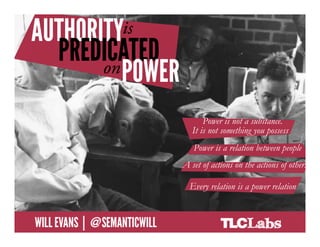
Authority is predicated on power


                                                            Power is not a substance.
                                                        It is not something you possess
                                                        Power is a relation between people
                   Power is not a substance. It is not something you possess
                                                    A set of actions on the actions of others
                   Power is a relation between people
                   A set of actions on the actions of others relation is a power relation
                                                       Every
                   Every relation is a power relation

@SemanticWill | Will Evans
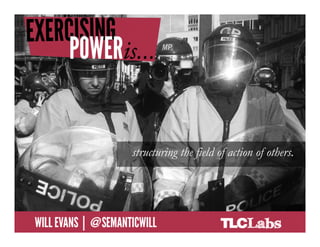
structuring the field of action of others.


@SemanticWill | Will Evans
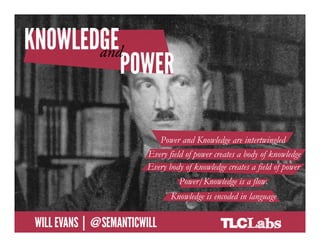
Power and Knowledge


                                Power and Knowledge are intertwingled
                             Every field of power creates a body of knowledge
                             Every body of knowledge creates a field of power
                                       Power/Knowledge is a flow.
                                    Knowledge is encoded in language

@SemanticWill | Will Evans
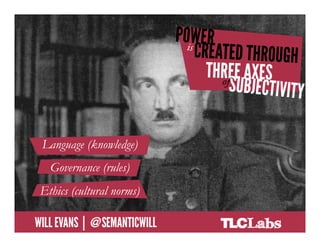
Power is created through 3 axes of
               subjectivity


      Language (knowledge)
       Governance (rules)
     Governance (rules)

    Ethics (cultural norms)
  Ethics (cultural norms)

@SemanticWill | Will Evans
Language enframes process;
     Process becomes the Panopticon

@SemanticWill | Will Evans
SO WHAT OF INFLUENCE?


@SemanticWill | Will Evans
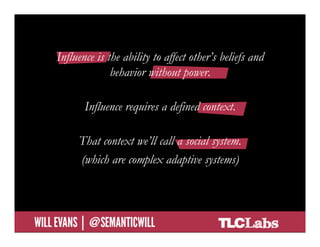
Influence is the ability to affect other’s beliefs and
                         behavior without power.

                     Influence requires a defined context.

                   That context we’ll call a social system.
                   (which are complex adaptive systems)


@SemanticWill | Will Evans
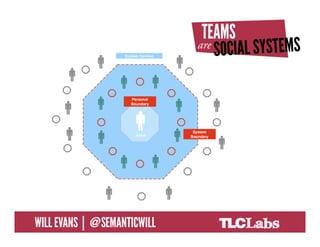
SOCIAL SYSTEMS ARE SYSTEMS OF
     CONVERSATION

@SemanticWill | Will Evans
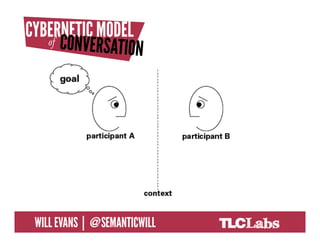
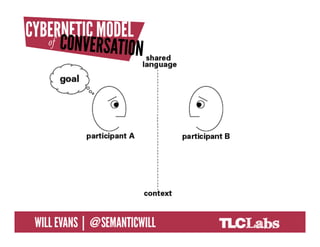
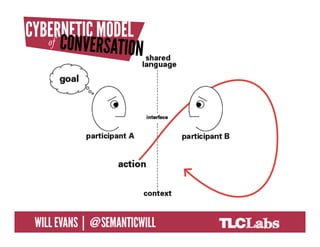
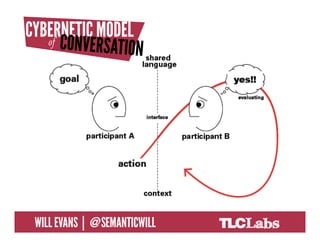
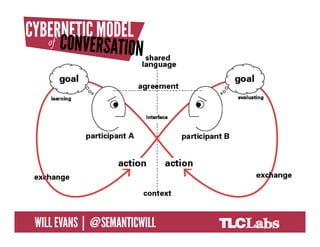
We need a model of conversation to understand power
     IF ORGANIZATIONS ARE SYSTEMS
          dynamics, decision making, and influence
     OF CONVERSATION

@SemanticWill | Will Evans
Yeah, but…


@SemanticWill | Will Evans
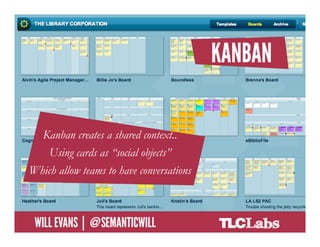
Kanban creates a shared context..
    Using cards as “social objects”
 Which allow teams to have conversations


@SemanticWill | Will Evans
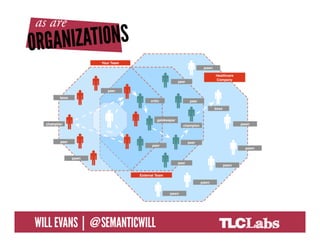
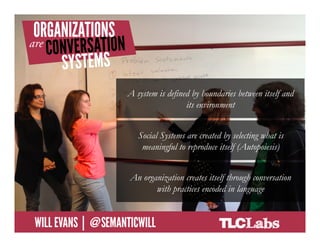
ORGANIZATIONS ARE CONVERSATION SYSTEMS


                             A system is defined by boundaries between itself and
                                               its environment


                                Social Systems are created by selecting what is
                                 meaningful to reproduce itself (Autopoiesis)


                             An organization creates itself through conversation
                                    with practices encoded in language


@SemanticWill | Will Evans
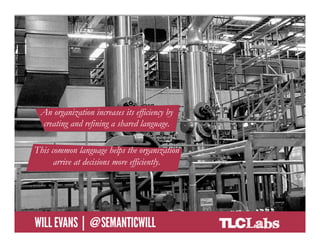
An organization increases its efficiency by creating
    An and refining aincreaseslanguage. by
         organization shared its efficiency
     creating and refining a shared language.
This common language helps the organization arrive
    This common language helps the organization
            at decisions more efficiently.
          arrive at decisions more efficiently.


 @SemanticWill | Will Evans
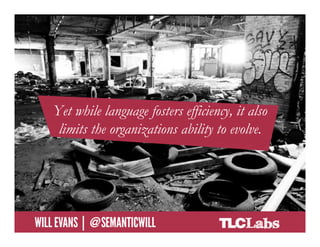
Yet while language fosters efficiency, it also
           limits thelanguage fostersability to evolve.
          Yet while   organizations efficiency, it also
            limits the organizations ability to evolve.


@SemanticWill | Will Evans
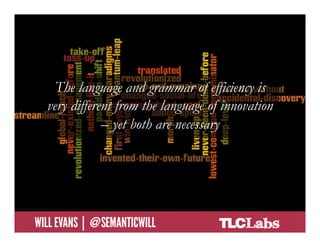
The language and grammar of efficiency is
        very different from the language of innovation
                    – yet both are necessary


@SemanticWill | Will Evans
Constrained by a one vocabulary, the organization becomes
     unable to adapt to exogenous shocks to the system.


@SemanticWill | Will Evans
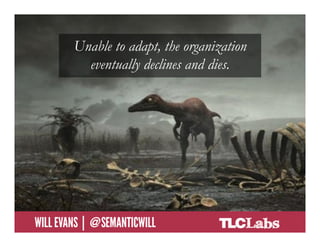
Unable to adapt, the organization
                   eventually declines and dies.


@SemanticWill | Will Evans
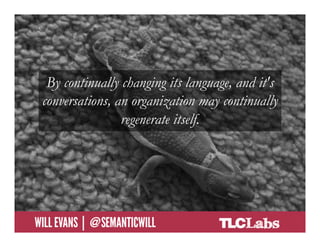
By continually changing its language, and it's
      conversations, an organization may continually
                      regenerate itself.


@SemanticWill | Will Evans
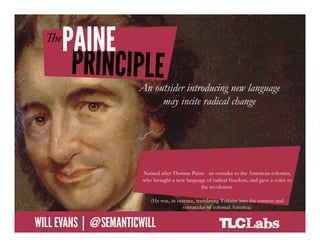
The Paine Principle

                             An outsider introducing new language
                                  may incite radical change


                             Named after Thomas Paine - an outsider to the American colonies,
                             who brought a new language of radical freedom, and gave a voice to
                                                     the revolution.

                                (He was, in essence, translating Voltaire into the context and
                                               vernacular of colonial America)

@SemanticWill | Will Evans
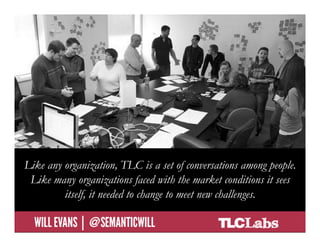
Like any organization, TLC is a set of conversations among people.
 Like many organizations faced with the market conditions it sees
         itself, it needed to change to meet new challenges.

@SemanticWill | Will Evans
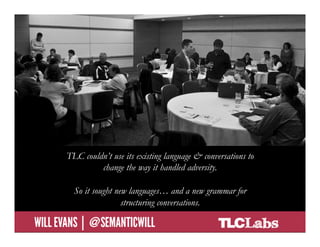
TLC couldn’t use its existing language & conversations to
                       change the way it handled adversity.

                 So it sought new languages… and a new grammar for
                                structuring conversations.
@SemanticWill | Will Evans
To support an organization's future viability, effective
     decision makers actively introduce change into the system.

    They may do so by generating new language that teams in
        the organization come to understand or embrace.


@SemanticWill | Will Evans
Before IBM can reap the benefits of teams using design
   thinking to increase collaborative ideation, they first have to
      introduce the grammar & language of design thinking


@SemanticWill | Will Evans
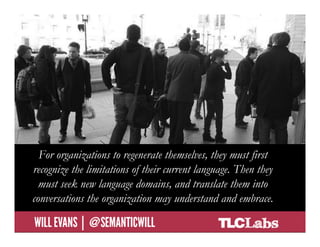
For organizations to regenerate themselves, they must first
  recognize the limitations of their current language. Then they
    must seek new language domains, and translate them into
  conversations the organization may understand and embrace.
@SemanticWill | Will Evans
QUESTIONS OF LEADERSHIP


@SemanticWill | Will Evans
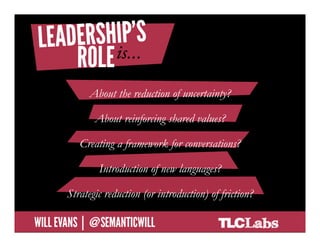
Leaderships role is…

                       About the reduction of uncertainty?

                         About reinforcing shared values?

                   Creating a framework for conversations?

                             Introduction of new languages?

               Strategic reduction (or introduction) of friction?

@SemanticWill | Will Evans
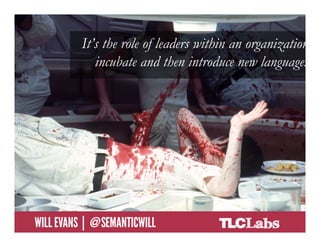
It’s the role of leaders within an organization to
                       incubate and then introduce new languages


@SemanticWill | Will Evans
A thought…

                You cannot use the language of the past to
                    articulate a vision for the future.

               Current language can only write a narrative
                            of futures past.


@SemanticWill | Will Evans
The task of discovering the requisite variety of tools
                     and disciplines is iterative.

        The source of new languages is questions – questions
                   that spark new conversations


@SemanticWill | Will Evans
As a leader, ask yourself…

                   What questions should you be asking?


@SemanticWill | Will Evans
As a leader, ask yourself…

               What questions should you be asking?
             What questions are you not supposed to ask?


@SemanticWill | Will Evans
As a leader, ask yourself…

               What questions should you be asking?
             What questions are you not supposed to ask?


@SemanticWill | Will Evans
As a leader, ask yourself…

               What questions should you be asking?
             What questions are you not supposed to ask?


                    Ask questions that don't come easy.


@SemanticWill | Will Evans
As a leader, ask yourself…
  •  What questions should you be asking?
           What questions should you be asking?
  •  What questions are you not supposed to
        What questions are you not supposed to ask?
     ask?
  •  > Ask those.
  •  Ask questions thatthat don't come easy.
            Ask questions don’t come easy.
  •  Ask thequestion that are tough, awkward, taboo.
        Ask questions that are tough,
     awkward, taboo.

@SemanticWill | Will Evans
Thanks!
Will Evans | @SemanticWill
      tlclabs.co
Modeling Leadership for #LeanUXNYC

Modeling Leadership for #LeanUXNYC

  • 1.
    Modeling Leadership @SemanticWill
  • 2.
    1.  Problem statement 2. Domain awareness 3.  Context of leadership & management 4.  Power, Authority, Influence 5.  Organizations as systems 6.  Modeling conversation 7.  Enframed by language 8.  The Paine Principle 9.  Questions of leadership
  • 5.
  • 6.
    Let’s start witha little Frederick Taylor and management science @SemanticWill | Will Evans
  • 7.
    His ideas aboutmanagement were informed by the Prussian Military @SemanticWill | Will Evans
  • 8.
    His ideas ofcontrol were also shaped by the penal system of discipline & punish @SemanticWill | Will Evans
  • 9.
    Taylor’s ideas abouthuman nature were informed by Freud… @SemanticWill | Will Evans
  • 10.
    Who did anepic amount of coke. @SemanticWill | Will Evans
  • 11.
    But also themore sober ideas of Kurt Lewin – the founder of social psych.... Who was influenced by Max Weber @SemanticWill | Will Evans
  • 12.
    Three forms ofauthority distinguished by Max Weber @SemanticWill | Will Evans
  • 13.
    the ability ofone agent within a social relationship to carry out her own will despite resistance @SemanticWill | Will Evans
  • 14.
    the probability thata command within a specific context will be obeyed @SemanticWill | Will Evans
  • 15.
  • 16.
    Authority is moreenduring than non- legitimate forms of domination Authority is related to the belief in legitimacy •  Authority is related to the belief in legitimacy It may persist even if those obeying have a •  It may persist even if those obeying have a greater material interest in disobeying greater material interest in disobeying •  Authority is engendered by powerby power Authority is engendered @SemanticWill | Will Evans
  • 17.
  • 18.
    Authority is predicatedon power Power is not a substance. It is not something you possess Power is a relation between people Power is not a substance. It is not something you possess A set of actions on the actions of others Power is a relation between people A set of actions on the actions of others relation is a power relation Every Every relation is a power relation @SemanticWill | Will Evans
  • 19.
    structuring the fieldof action of others. @SemanticWill | Will Evans
  • 20.
    Power and Knowledge Power and Knowledge are intertwingled Every field of power creates a body of knowledge Every body of knowledge creates a field of power Power/Knowledge is a flow. Knowledge is encoded in language @SemanticWill | Will Evans
  • 21.
    Power is createdthrough 3 axes of subjectivity Language (knowledge) Governance (rules) Governance (rules) Ethics (cultural norms) Ethics (cultural norms) @SemanticWill | Will Evans
  • 22.
    Language enframes process; Process becomes the Panopticon @SemanticWill | Will Evans
  • 23.
    SO WHAT OFINFLUENCE? @SemanticWill | Will Evans
  • 24.
    Influence is theability to affect other’s beliefs and behavior without power. Influence requires a defined context. That context we’ll call a social system. (which are complex adaptive systems) @SemanticWill | Will Evans
  • 25.
  • 26.
  • 27.
    SOCIAL SYSTEMS ARESYSTEMS OF CONVERSATION @SemanticWill | Will Evans
  • 28.
    We need amodel of conversation to understand power IF ORGANIZATIONS ARE SYSTEMS dynamics, decision making, and influence OF CONVERSATION @SemanticWill | Will Evans
  • 29.
  • 30.
  • 31.
  • 32.
  • 33.
  • 34.
  • 35.
  • 36.
  • 37.
  • 38.
    Kanban creates ashared context.. Using cards as “social objects” Which allow teams to have conversations @SemanticWill | Will Evans
  • 39.
    ORGANIZATIONS ARE CONVERSATIONSYSTEMS A system is defined by boundaries between itself and its environment Social Systems are created by selecting what is meaningful to reproduce itself (Autopoiesis) An organization creates itself through conversation with practices encoded in language @SemanticWill | Will Evans
  • 40.
    An organization increasesits efficiency by creating An and refining aincreaseslanguage. by organization shared its efficiency creating and refining a shared language. This common language helps the organization arrive This common language helps the organization at decisions more efficiently. arrive at decisions more efficiently. @SemanticWill | Will Evans
  • 41.
    Yet while languagefosters efficiency, it also limits thelanguage fostersability to evolve. Yet while organizations efficiency, it also limits the organizations ability to evolve. @SemanticWill | Will Evans
  • 42.
    The language andgrammar of efficiency is very different from the language of innovation – yet both are necessary @SemanticWill | Will Evans
  • 43.
    Constrained by aone vocabulary, the organization becomes unable to adapt to exogenous shocks to the system. @SemanticWill | Will Evans
  • 44.
    Unable to adapt,the organization eventually declines and dies. @SemanticWill | Will Evans
  • 45.
    By continually changingits language, and it's conversations, an organization may continually regenerate itself. @SemanticWill | Will Evans
  • 46.
    The Paine Principle An outsider introducing new language may incite radical change Named after Thomas Paine - an outsider to the American colonies, who brought a new language of radical freedom, and gave a voice to the revolution. (He was, in essence, translating Voltaire into the context and vernacular of colonial America) @SemanticWill | Will Evans
  • 47.
    Like any organization,TLC is a set of conversations among people. Like many organizations faced with the market conditions it sees itself, it needed to change to meet new challenges. @SemanticWill | Will Evans
  • 48.
    TLC couldn’t useits existing language & conversations to change the way it handled adversity. So it sought new languages… and a new grammar for structuring conversations. @SemanticWill | Will Evans
  • 49.
    To support anorganization's future viability, effective decision makers actively introduce change into the system. They may do so by generating new language that teams in the organization come to understand or embrace. @SemanticWill | Will Evans
  • 50.
    Before IBM canreap the benefits of teams using design thinking to increase collaborative ideation, they first have to introduce the grammar & language of design thinking @SemanticWill | Will Evans
  • 51.
    For organizations toregenerate themselves, they must first recognize the limitations of their current language. Then they must seek new language domains, and translate them into conversations the organization may understand and embrace. @SemanticWill | Will Evans
  • 52.
  • 53.
    Leaderships role is… About the reduction of uncertainty? About reinforcing shared values? Creating a framework for conversations? Introduction of new languages? Strategic reduction (or introduction) of friction? @SemanticWill | Will Evans
  • 54.
    It’s the roleof leaders within an organization to incubate and then introduce new languages @SemanticWill | Will Evans
  • 55.
    A thought… You cannot use the language of the past to articulate a vision for the future. Current language can only write a narrative of futures past. @SemanticWill | Will Evans
  • 56.
    The task ofdiscovering the requisite variety of tools and disciplines is iterative. The source of new languages is questions – questions that spark new conversations @SemanticWill | Will Evans
  • 57.
    As a leader,ask yourself… What questions should you be asking? @SemanticWill | Will Evans
  • 58.
    As a leader,ask yourself… What questions should you be asking? What questions are you not supposed to ask? @SemanticWill | Will Evans
  • 59.
    As a leader,ask yourself… What questions should you be asking? What questions are you not supposed to ask? @SemanticWill | Will Evans
  • 60.
    As a leader,ask yourself… What questions should you be asking? What questions are you not supposed to ask? Ask questions that don't come easy. @SemanticWill | Will Evans
  • 61.
    As a leader,ask yourself… •  What questions should you be asking? What questions should you be asking? •  What questions are you not supposed to What questions are you not supposed to ask? ask? •  > Ask those. •  Ask questions thatthat don't come easy. Ask questions don’t come easy. •  Ask thequestion that are tough, awkward, taboo. Ask questions that are tough, awkward, taboo. @SemanticWill | Will Evans
  • 62.
    Thanks! Will Evans |@SemanticWill tlclabs.co