Agile: Myths and
Legends
FEATURING: TFS AND VISUAL STUDIO 2012
Angela Dugan

Application
Lifecycle
Management

Project
Leadership

.NET Solutions

Mobile
Solutions
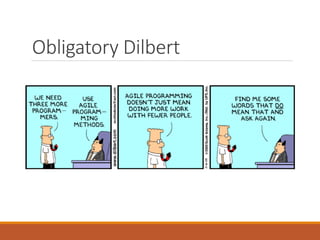
Obligatory Dilbert
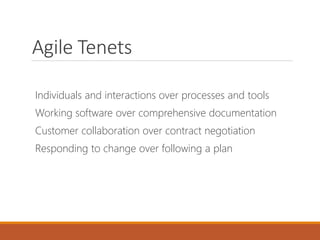
Agile Tenets
Individuals and interactions over processes and tools
Working software over comprehensive documentation
Customer collaboration over contract negotiation
Responding to change over following a plan
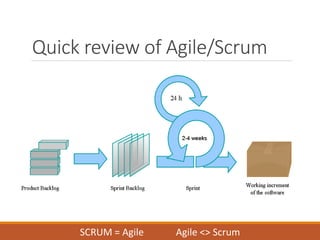
Quick review of Agile/Scrum

SCRUM = Agile

Agile <> Scrum
My Top Agile Myths & Legends
1.

Organizations are not succeeding with agile

2.

Agile works better than traditional approaches (e.g. Waterfall)

3.

Traditional (Waterfall) works better for distributed/offshore
teams

4.

Agile teams waste a lot of time testing that traditional teams
don’t

5.

Agile teams don’t produce documentation

6.

Daily stand-ups are just glorified status meetings

7.

Without detailed records, I don’t know that my people are really
working all the time!

8.

If we convert to Agile, that means we can “do more with less”
right?
Myth #1
Organizations are not succeeding
with agile
(a.k.a. “Agile is just a fad”)
Regarding that fad nonsense…
Agile has been around as a general methodology since as
early as the 70s
Agile was introduced as an “official” flavor of software
development processes in the early 90’s
The Agile Manifesto came into being in 2001
Myth #1
Organizations are not succeeding
with agile
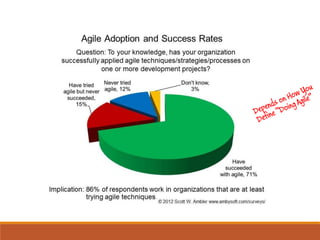
False: At least 86% are trying, and most are succeeding!
Myth #2
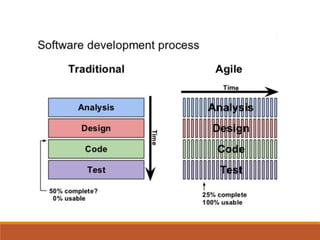
Agile generally works better than
traditional approaches (e.g. Waterfall)
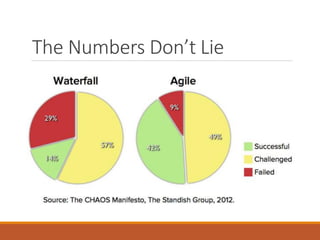
The Numbers Don’t Lie
But Agile Projects Still Fail!
Agile is more than 3 time LESS likely to fail than Waterfall.

Agile is 3 times MORE likely to succeed than Waterfall.
But…
Agile is not a guarantee of Success (“no silver bullet”)
Agile will never be perfect so long as imperfect people
are executing it
Myth #2
Agile generally works better than
traditional approaches (e.g. Waterfall)
True: Anybody can fail with Agile, but when done right I’ve yet to see a
situation where adopting agile practices didn’t improve things
Myth #3
Traditional (Waterfall) works better for
distributed/offshore teams
Challenges of Distributed Teams
Communication and coordination can be hampered by timezone differences
Self-management and communicating impediments is
difficult for some cultures
Daily stand-ups may require additional technology to
facilitate

Peer review and code quality/standards enforcement may
require extra effort and diligence
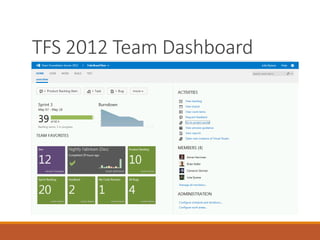
TFS 2012 Team Dashboard
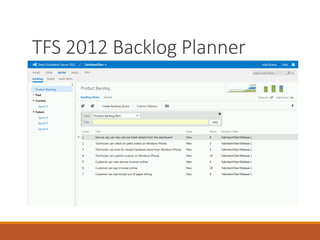
TFS 2012 Backlog Planner
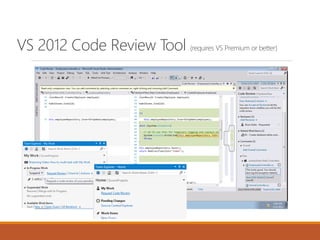
VS 2012 Code Review Tool (requires VS Premium or better)
Distributed Agile Strategies
Coordinate schedules to ensure overlap in the work-day
Meet face to face to establish trust
Install web cameras, Skype, and/or on-line task boards to
enable real-time communication
Establish continuous integration CI and target high test
coverage across all teams

Keep iterations short
Myth #3
Traditional (Waterfall) works better for
distributed/offshore teams
Sometimes: Agile can work for distributed teams, but takes work and it IS succeeding.
Myth #4
Agile teams waste a lot of time up front
testing that traditional teams don’t
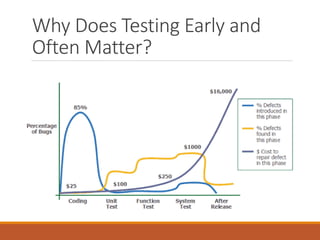
Why Does Testing Early and
Often Matter?
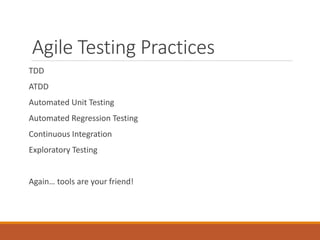
Agile Testing Practices
TDD
ATDD
Automated Unit Testing

Automated Regression Testing
Continuous Integration
Exploratory Testing

Again… tools are your friend!
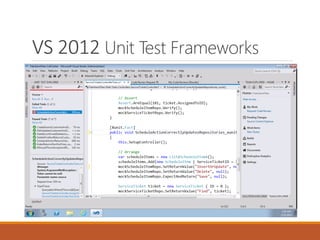
VS 2012 Unit Test Frameworks
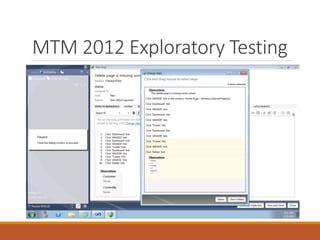
MTM 2012 Exploratory Testing
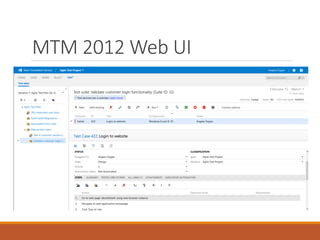
MTM 2012 Web UI
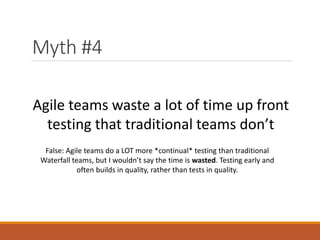
Myth #4
Agile teams waste a lot of time up front
testing that traditional teams don’t
False: Agile teams do a LOT more *continual* testing than traditional
Waterfall teams, but I wouldn’t say the time is wasted. Testing early and
often builds in quality, rather than tests in quality.
Myth #5
Agile teams don’t produce
documentation
Agile Tenets
Individuals and interactions over processes and tools

Working software over comprehensive
documentation
Customer collaboration over contract negotiation
Responding to change over following a plan
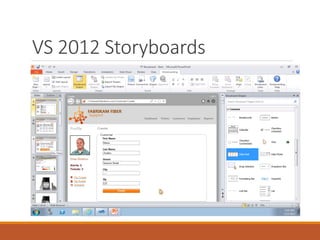
VS 2012 Storyboards
Myth #5
Agile teams don’t produce
documentation
False: Agile teams only produce as much documentation as necessary
Myth #6
Daily stand-ups are just glorified status
meetings
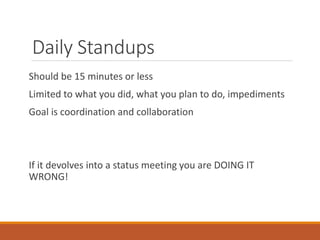
Daily Standups
Should be 15 minutes or less
Limited to what you did, what you plan to do, impediments
Goal is coordination and collaboration

If it devolves into a status meeting you are DOING IT
WRONG!
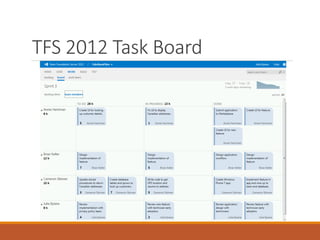
TFS 2012 Task Board
Myth #6
Daily stand-ups are just glorified status
meetings
False: Standups are only about the entire software team
collaborating on the next 24 hours of work.
Myth #7
Without detailed records, I don’t know that
my people are really working all the time!
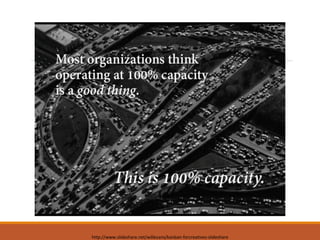
http://www.slideshare.net/willevans/kanban-forcreatives-slideshare
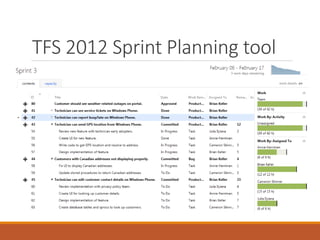
TFS 2012 Sprint Planning tool
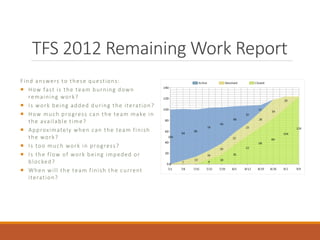
TFS 2012 Remaining Work Report
F i n d a n s w e rs t o t h e s e q u e st i o n s :
 H o w fa s t i s t h e t e a m b u r n i n g d o w n
re m a i n i n g w o r k ?
 I s w o r k b e i n g a d d e d d u r i n g t h e i t e ra t i o n ?
 H o w m u c h p ro g re s s c a n t h e t e a m m a ke i n
t h e ava i l a b l e t i m e ?
 A p p rox i m ate l y w h e n c a n t h e t e a m f i n i s h
the work?
 I s t o o m u c h w o r k i n p ro g re s s ?
 I s t h e f l o w o f w o r k b e i n g i m p e d ed o r
b l o c ke d ?
 W h e n w i l l t h e t e a m f i n i s h t h e c u r re nt
i t e rat i o n ?
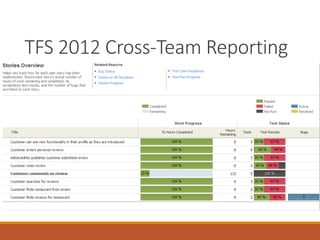
TFS 2012 Cross-Team Reporting
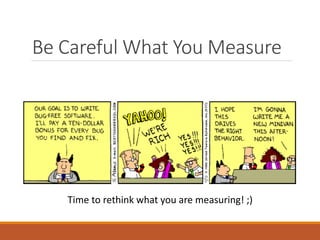
Be Careful What You Measure

Time to rethink what you are measuring! ;)
Myth #7
Without detailed records, I don’t know that
my people are really working all the time
With agile you are MORE likely to know EXACTLY what
people are working on every day.
The better question might be, why are you focusing on
the number of hours worked?
Myth #8
If we convert to Agile, that means we
can “do more with less” right?
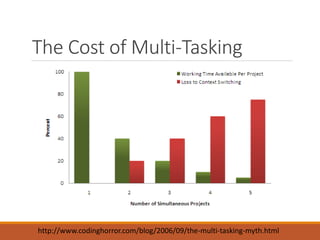
The Cost of Multi-Tasking

http://www.codinghorror.com/blog/2006/09/the-multi-tasking-myth.html
Do More With Less
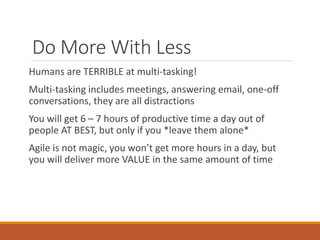
Humans are TERRIBLE at multi-tasking!
Multi-tasking includes meetings, answering email, one-off
conversations, they are all distractions

You will get 6 – 7 hours of productive time a day out of
people AT BEST, but only if you *leave them alone*
Agile is not magic, you won’t get more hours in a day, but
you will deliver more VALUE in the same amount of time
Myth #8
If we convert to Agile, that means we
can “do more with less” right?
Sort of: People will be allowed to focus, and you
will see more value delivered with less bugs in
the same amount of time
Good reads
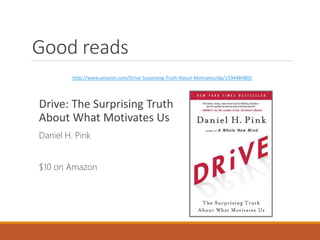
http://www.amazon.com/Drive-Surprising-Truth-About-Motivates/dp/1594484805

Drive: The Surprising Truth
About What Motivates Us
Daniel H. Pink
$10 on Amazon
Good reads
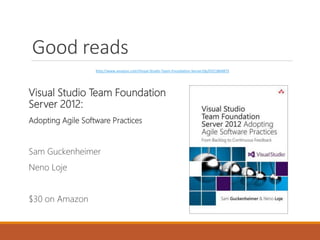
http://www.amazon.com/Visual-Studio-Team-Foundation-Server/dp/0321864875

Visual Studio Team Foundation
Server 2012:
Adopting Agile Software Practices

Sam Guckenheimer
Neno Loje
$30 on Amazon
Questions?

Agile Myths and Legends

  • 1.
    Agile: Myths and Legends FEATURING:TFS AND VISUAL STUDIO 2012
  • 2.
  • 3.
  • 4.
    Agile Tenets Individuals andinteractions over processes and tools Working software over comprehensive documentation Customer collaboration over contract negotiation Responding to change over following a plan
  • 5.
    Quick review ofAgile/Scrum SCRUM = Agile Agile <> Scrum
  • 6.
    My Top AgileMyths & Legends 1. Organizations are not succeeding with agile 2. Agile works better than traditional approaches (e.g. Waterfall) 3. Traditional (Waterfall) works better for distributed/offshore teams 4. Agile teams waste a lot of time testing that traditional teams don’t 5. Agile teams don’t produce documentation 6. Daily stand-ups are just glorified status meetings 7. Without detailed records, I don’t know that my people are really working all the time! 8. If we convert to Agile, that means we can “do more with less” right?
  • 7.
    Myth #1 Organizations arenot succeeding with agile (a.k.a. “Agile is just a fad”)
  • 9.
    Regarding that fadnonsense… Agile has been around as a general methodology since as early as the 70s Agile was introduced as an “official” flavor of software development processes in the early 90’s The Agile Manifesto came into being in 2001
  • 10.
    Myth #1 Organizations arenot succeeding with agile False: At least 86% are trying, and most are succeeding!
  • 11.
    Myth #2 Agile generallyworks better than traditional approaches (e.g. Waterfall)
  • 12.
  • 13.
    But Agile ProjectsStill Fail! Agile is more than 3 time LESS likely to fail than Waterfall. Agile is 3 times MORE likely to succeed than Waterfall. But… Agile is not a guarantee of Success (“no silver bullet”) Agile will never be perfect so long as imperfect people are executing it
  • 14.
    Myth #2 Agile generallyworks better than traditional approaches (e.g. Waterfall) True: Anybody can fail with Agile, but when done right I’ve yet to see a situation where adopting agile practices didn’t improve things
  • 15.
    Myth #3 Traditional (Waterfall)works better for distributed/offshore teams
  • 16.
    Challenges of DistributedTeams Communication and coordination can be hampered by timezone differences Self-management and communicating impediments is difficult for some cultures Daily stand-ups may require additional technology to facilitate Peer review and code quality/standards enforcement may require extra effort and diligence
  • 17.
    TFS 2012 TeamDashboard
  • 18.
  • 19.
    VS 2012 CodeReview Tool (requires VS Premium or better)
  • 20.
    Distributed Agile Strategies Coordinateschedules to ensure overlap in the work-day Meet face to face to establish trust Install web cameras, Skype, and/or on-line task boards to enable real-time communication Establish continuous integration CI and target high test coverage across all teams Keep iterations short
  • 21.
    Myth #3 Traditional (Waterfall)works better for distributed/offshore teams Sometimes: Agile can work for distributed teams, but takes work and it IS succeeding.
  • 22.
    Myth #4 Agile teamswaste a lot of time up front testing that traditional teams don’t
  • 23.
    Why Does TestingEarly and Often Matter?
  • 24.
    Agile Testing Practices TDD ATDD AutomatedUnit Testing Automated Regression Testing Continuous Integration Exploratory Testing Again… tools are your friend!
  • 25.
    VS 2012 UnitTest Frameworks
  • 26.
  • 27.
  • 28.
    Myth #4 Agile teamswaste a lot of time up front testing that traditional teams don’t False: Agile teams do a LOT more *continual* testing than traditional Waterfall teams, but I wouldn’t say the time is wasted. Testing early and often builds in quality, rather than tests in quality.
  • 29.
    Myth #5 Agile teamsdon’t produce documentation
  • 30.
    Agile Tenets Individuals andinteractions over processes and tools Working software over comprehensive documentation Customer collaboration over contract negotiation Responding to change over following a plan
  • 31.
  • 32.
    Myth #5 Agile teamsdon’t produce documentation False: Agile teams only produce as much documentation as necessary
  • 33.
    Myth #6 Daily stand-upsare just glorified status meetings
  • 34.
    Daily Standups Should be15 minutes or less Limited to what you did, what you plan to do, impediments Goal is coordination and collaboration If it devolves into a status meeting you are DOING IT WRONG!
  • 35.
  • 36.
    Myth #6 Daily stand-upsare just glorified status meetings False: Standups are only about the entire software team collaborating on the next 24 hours of work.
  • 37.
    Myth #7 Without detailedrecords, I don’t know that my people are really working all the time!
  • 38.
  • 39.
    TFS 2012 SprintPlanning tool
  • 40.
    TFS 2012 RemainingWork Report F i n d a n s w e rs t o t h e s e q u e st i o n s :  H o w fa s t i s t h e t e a m b u r n i n g d o w n re m a i n i n g w o r k ?  I s w o r k b e i n g a d d e d d u r i n g t h e i t e ra t i o n ?  H o w m u c h p ro g re s s c a n t h e t e a m m a ke i n t h e ava i l a b l e t i m e ?  A p p rox i m ate l y w h e n c a n t h e t e a m f i n i s h the work?  I s t o o m u c h w o r k i n p ro g re s s ?  I s t h e f l o w o f w o r k b e i n g i m p e d ed o r b l o c ke d ?  W h e n w i l l t h e t e a m f i n i s h t h e c u r re nt i t e rat i o n ?
  • 41.
  • 42.
    Be Careful WhatYou Measure Time to rethink what you are measuring! ;)
  • 43.
    Myth #7 Without detailedrecords, I don’t know that my people are really working all the time With agile you are MORE likely to know EXACTLY what people are working on every day. The better question might be, why are you focusing on the number of hours worked?
  • 44.
    Myth #8 If weconvert to Agile, that means we can “do more with less” right?
  • 45.
    The Cost ofMulti-Tasking http://www.codinghorror.com/blog/2006/09/the-multi-tasking-myth.html
  • 46.
    Do More WithLess Humans are TERRIBLE at multi-tasking! Multi-tasking includes meetings, answering email, one-off conversations, they are all distractions You will get 6 – 7 hours of productive time a day out of people AT BEST, but only if you *leave them alone* Agile is not magic, you won’t get more hours in a day, but you will deliver more VALUE in the same amount of time
  • 48.
    Myth #8 If weconvert to Agile, that means we can “do more with less” right? Sort of: People will be allowed to focus, and you will see more value delivered with less bugs in the same amount of time
  • 49.
    Good reads http://www.amazon.com/Drive-Surprising-Truth-About-Motivates/dp/1594484805 Drive: TheSurprising Truth About What Motivates Us Daniel H. Pink $10 on Amazon
  • 50.
    Good reads http://www.amazon.com/Visual-Studio-Team-Foundation-Server/dp/0321864875 Visual StudioTeam Foundation Server 2012: Adopting Agile Software Practices Sam Guckenheimer Neno Loje $30 on Amazon
  • 51.