

W I L L E VA N S   @ S E M A N T I C W I L L   E D I N B U R G H S C O T L A N D
T W I T T E R : #LASCOT16
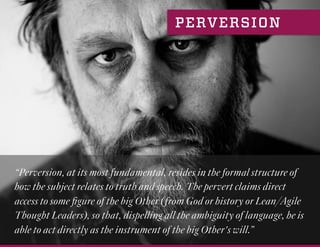
“Perversion, at its most fundamental, resides in the formal structure of
how the subject relates to truth and speech. The pervert claims direct
access to some figure of the big Other (from God or history or Lean/Agile
Thought Leaders), so that, dispelling all the ambiguity of language, he is
able to act directly as the instrument of the big Other's will.”
PERVERSION
OUTLINE
•  Assumptions
•  Systems
•  Strategy, WTF?
•  What *is* Strategy?
•  The OODA Loop(s)
•  Structuring Structures, Bourdieu Remixed
•  Propensities, Efficacy, and Capability
•  Dispositionality
•  Final Thoughts
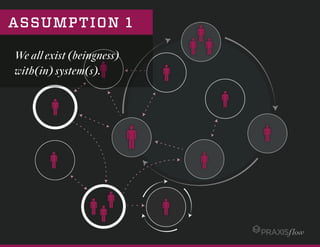
ASSUMPTION 1
We all exist (beingness)
with(in) system(s).
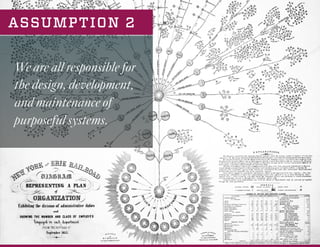
ASSUMPTION 2
We are all responsible for
the design, development,
and maintenance of
purposeful systems.
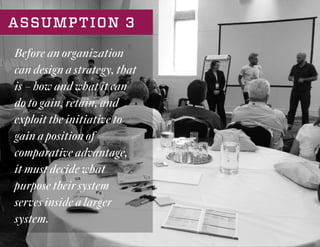
ASSUMPTION 3
Before an organization
can design a strategy, that
is – how and what it can
do to gain, retain, and
exploit the initiative to
gain a position of
comparative advantage,
it must decide what
purpose their system
serves inside a larger
system.
From “Strategic Navigation,” William Dettmer
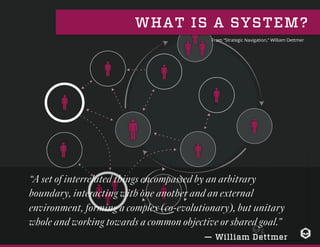
WHAT IS A SYSTEM?
“A set of interrelated things encompassed by an arbitrary
boundary, interacting with one another and an external
environment, forming a complex (co-evolutionary), but unitary
whole and working towards a common objective or shared goal.”
— William Dettmer
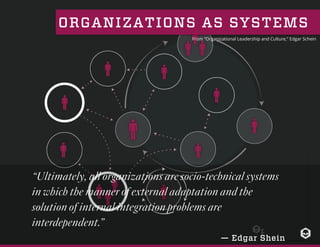
From “Organizational Leadership and Culture,” Edgar Schein
ORGANIZATIONS AS SYSTEMS
“Ultimately, all organizations are socio-technical systems
in which the manner of external adaptation and the
solution of internal integration problems are
interdependent.”
— Edgar Shein
STRATEGY
Not everything is strategy, and not everyone is a strategist.
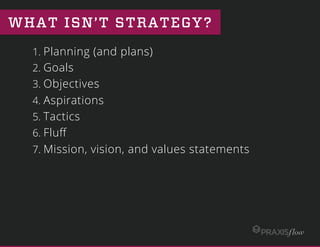
WHAT ISN’T STRATEGY?
1. Planning (and plans)
2. Goals
3. Objectives
4. Aspirations
5. Tactics
6. Fluff
7. Mission, vision, and values statements
(The 9th waste in Lean)
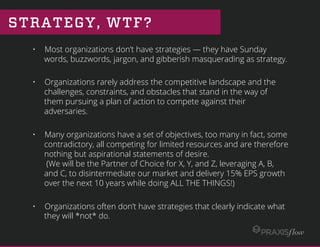
STRATEGY, WTF?
•  Most organizations don’t have strategies — they have Sunday
words, buzzwords, jargon, and gibberish masquerading as strategy.
•  Organizations rarely address the competitive landscape and the
challenges, constraints, and obstacles that stand in the way of
them pursuing a plan of action to compete against their
adversaries.
•  Many organizations have a set of objectives, too many in fact, some
contradictory, all competing for limited resources and are therefore
nothing but aspirational statements of desire.
(We will be the Partner of Choice for X, Y, and Z, leveraging A, B,
and C, to disintermediate our market and delivery 15% EPS growth
over the next 10 years while doing ALL THE THINGS!)
•  Organizations often don’t have strategies that clearly indicate what
they will *not* do.
Strategyformseemstofolloworganizationalfunction.
Companiesdeveloptheirstrategicplansintermsoftheir
existingsubsystemsandsilos–betheyfunctions,divisions,
ordepartments.Thismayonlybeacceptablegivenhighly
stable,slowmovingenvironments.
#ConwayFTW
CONWAY’S STRATEGY
In highlydynamiccontexts,it’simportantnot
justtorespondtochangebuttoalsoshapeit
throughthemanagementofpropensitiesthat
changethedispositionalityoftheorganization
relativetothesystem.
Successfulstrategiestendtoemergefrom
environmentalsituationsorfromwithinthe
darkestbowelsofanorganizationasoftenas
theyaredeliberatelyplannedfromthetop
downHoshinStyle.
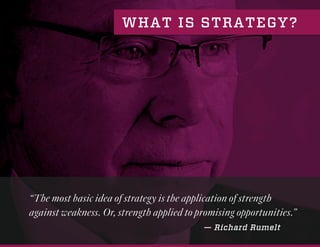
WHAT IS STRATEGY?
“The most basic idea of strategy is the application of strength
against weakness. Or, strength applied to promising opportunities.”
— Richard Rumelt
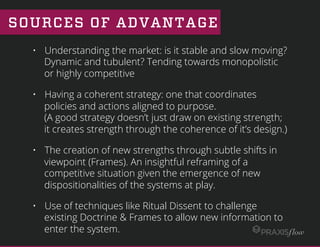
SOURCES OF ADVANTAGE
•  Understanding the market: is it stable and slow moving?
Dynamic and tubulent? Tending towards monopolistic
or highly competitive
•  Having a coherent strategy: one that coordinates
policies and actions aligned to purpose.
(A good strategy doesn’t just draw on existing strength;
it creates strength through the coherence of it’s design.)
•  The creation of new strengths through subtle shifts in
viewpoint (Frames). An insightful reframing of a
competitive situation given the emergence of new
dispositionalities of the systems at play.
•  Use of techniques like Ritual Dissent to challenge
existing Doctrine & Frames to allow new information to
enter the system.
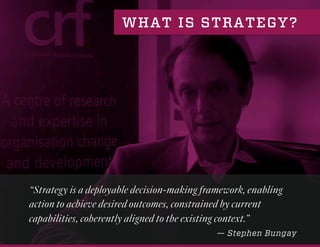
WHAT IS STRATEGY?
“Strategy is a deployable decision-making framework, enabling
action to achieve desired outcomes, constrained by current
capabilities, coherently aligned to the existing context.”
— Stephen Bungay
“Decisions without actions are pointless.
Actions without decisions are reckless.”
— John Boyd
Theprobleminmostorganizationsisthe
learnedhelplessnessof*not*beingableto
makedecisions.Thequestionweat
PraxisFlowseemtobeconstantlyaskingof
seniorleadersinlargeenterprisesisthis...
Whatdoestheflowofdecisionswithinyour
organizationlooklike?
Isyoursystemoptimizedformakingthose
decisions?
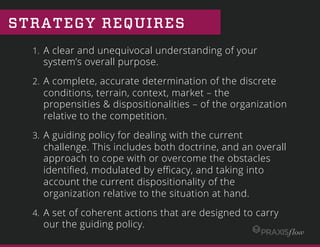
STRATEGY REQUIRES
1.  A clear and unequivocal understanding of your
system’s overall purpose.
2.  A complete, accurate determination of the discrete
conditions, terrain, context, market – the
propensities & dispositionalities – of the organization
relative to the competition.
3.  A guiding policy for dealing with the current
challenge. This includes both doctrine, and an overall
approach to cope with or overcome the obstacles
identified, modulated by efficacy, and taking into
account the current dispositionality of the
organization relative to the situation at hand.
4.  A set of coherent actions that are designed to carry
our the guiding policy.
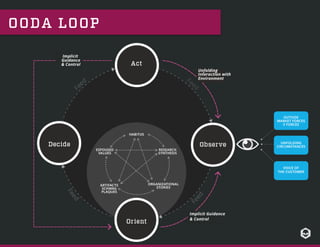
OODA LOOPING
Situationally modulating dispositionalities
OODA LOOP
Boyddiscoveredthatthekeytowinningwas
twofold:aneffectivepassthroughtheOODA
stepsinitially,followedbyfast,successive
adjustmentstothechangedenvironment
throughmorerepetitiveOODAcycles.
OODA
Totheextentthatastrategist(militaryor
civilian)cannavigatethroughtheOODA
cyclefasterthantheopponent,controlofthe
initiatives(openingsofoptions)accruesto
theOODAuser,whileconfusion,
disorientation,andambiguityaccruetothe
opponent.Init’sidealstate,Boydsuggested
it’slikecommandingbothsidesoftheconflict.
OODA
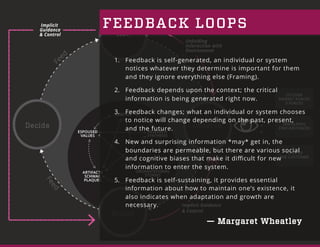
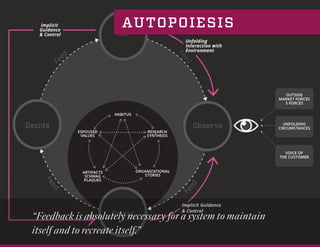
FEEDBACK LOOPS
1.  Feedback is self-generated, an individual or system
notices whatever they determine is important for them
and they ignore everything else (Framing).
2.  Feedback depends upon the context; the critical
information is being generated right now.
3.  Feedback changes; what an individual or system chooses
to notice will change depending on the past, present,
and the future.
4.  New and surprising information *may* get in, the
boundaries are permeable, but there are various social
and cognitive biases that make it difficult for new
information to enter the system.
5.  Feedback is self-sustaining, it provides essential
information about how to maintain one’s existence, it
also indicates when adaptation and growth are
necessary.
— Margaret Wheatley
AUTOPOIESIS
“Feedback is absolutely necessary for a system to maintain
itself and to recreate itself.”
FRAMING
“A frame is, simplistically, a point of view; often, and
particularly in technical situations, this point of view is
deemed ‘irrelevant’ or ‘biasing’ because it implicitly references
a non-objective way of considering a situation or idea.
But a frame – while certainly subjective and often biasing – is
of critical use to the designer, as it is something that is shaped
over the long-term aggregation of thoughts and experiences.”
— Jon Kolko
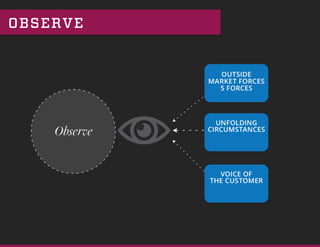
OBSERVE
You can’t outsource competitive research
OBSERVE
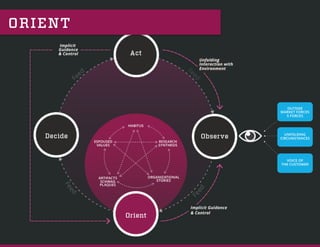
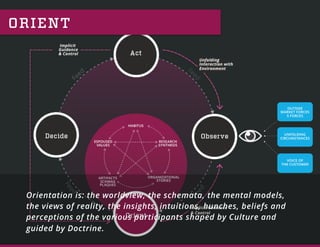
ORIENT
Sensemaking in Competitive Environments
ORIENT
ORIENT
Orientation is: the worldview, the schemata, the mental models,
the views of reality, the insights, intuitions, hunches, beliefs and
perceptions of the various participants shaped by Culture and
guided by Doctrine.
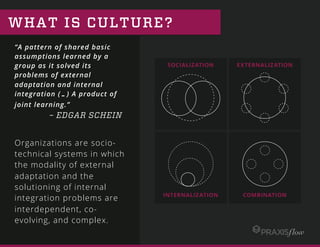
WHAT IS CULTURE?
“A pattern of shared basic
assumptions learned by a
group as it solved its
problems of external
adaptation and internal
integration (…) A product of
joint learning.”
– EDGAR SCHEIN
Organizations are socio-
technical systems in which
the modality of external
adaptation and the
solutioning of internal
integration problems are
interdependent, co-
evolving, and complex.
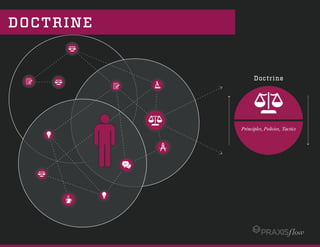
DOCTRINE
“ Doctrineisdefinedasthefundamentalprinciplesby
whichsocialsystemsorelements(organizationsand
teams)guidetheiractionsinsupportofobjectives.”
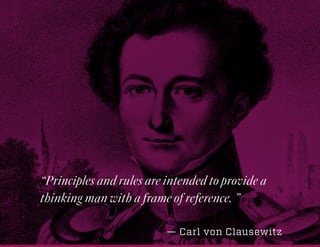
“Principles and rules are intended to provide a
thinking man with a frame of reference. ”
— Carl von Clausewitz
DOCTRINE
Principlesarenotsupposedtobechecklistsor
constrainingsetsofrules.Theyaremeantto
fostertheinitiativeneededforknowledge
workerstobeadaptive,creativeproblem
solvers.Theyprovideabasisforincorporating
newideas,technologies,andorganizational
designs.
Doctrineactsasanenablingconstraint
allowingknowledgeworkerstomake
decisionsunderconditionsofextreme
uncertainty.Establishingandusingjargon,
commandlanguageandsymbolswith
commonmeaningsenhancecommunication
totakeaction.
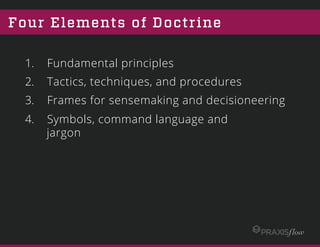
Four Elements of Doctrine
1.  Fundamental principles
2.  Tactics, techniques, and procedures
3.  Frames for sensemaking and decisioneering
4.  Symbols, command language and
jargon
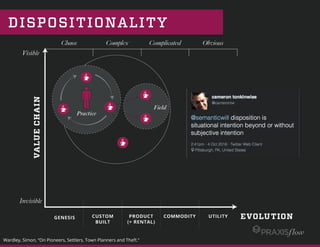
DISPOSITIONALITY
What it isn’t, and what it might be
Anyactiontoexecuteastrategy,however
minimal,changesthestrategicenvironment.
Andinachangedenvironment,theoriginally
conceivedstrategymaynolongerbe
optimum,whichgeneratestheneedtoadjust
theoriginalstrategyandre-execute.
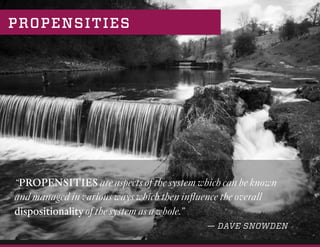
PROPENSITIES
“PROPENSITIES are aspects of the system which can be known
and managed in various ways which then influence the overall
dispositionality of the system as a whole.”
— DAVE SNOWDEN
DISPOSITIONALITY
Potential(asitrelatestopowerrelationsbetween
adversaries)isbornofdispositionality.
 
Disposition includes the particular shape of the object
(round or square), as well as the situation at hand (on level
or sloping ground), the relations to other things and their
position. Maximum potential is conveyed by the differing
nature of the gradient so it’s both static (the things,
materials, places at hand, 6 forces, 5 constants), as well as
dynamic (the opportunity, directionality which may be
influenced by intendings).
 
Wardley, Simon, “On Pioneers, Settlers, Town Planners and Theft.”
DISPOSITIONALITY
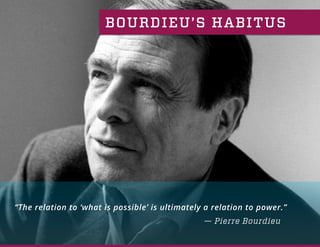
BOURDIEU’S HABITUS
“The relation to ‘what is possible’ is ultimately a relation to power.”
— Pierre Bourdieu
Ingeneral,then,strategyaims,throughaseriesof
repertoiresandroutines,todeterminethe
principleswithinthestructuringstructuresof
habitus,throughwhichoneevaluatestheprevailing
dispositionalities,powerrelations,andplansof
operationsinadvancetogenerateadvantagesand
realizethestrategicobjectives.
FINAL THOUGHTS
•  Start with the current situation, context, and
dispositionality of the systems at play;
•  In highly stable, slow moving environments, Hoshin
Kanri/strategic planning is fine (and so is waterfall and
Six Sigma);
•  In turbulent, quickly evolving, dynamic contexts, you
need to cycle through your OODA loop at an
accelerating pace;
•  While getting inside the OODA Loop of your opponent
(disrupting their Observe/Orient);
•  To create a greater set of potential options of
dispositional advantage relative to your competition.
REFERENCES
Bourdieu,P.(1980).TheLogicofPractice.Stanford,Stanford
UniversityPress.
Bourdieu,P.(1984).Distinction:ASocialCritiqueoftheJudgemen
ofTaste.London,Routledge.
Bourdieu,P.(1986).‘TheFormsofCapital’.HandbookofTheory
andResearchfortheSociologyofCapital.J.G.Richardson.New
York,GreenwoodPress:241-58.
Dettmer,William(2003)“StrategicNavigation:ASystems
ApproachtoBusinessStrategy,” AmericanSocietyofQuality
Foucault,Michel."TheSubjectandPower."InMichelFoucault:
BeyondStructuralismandHermeneutics,editedbyH.Dreyfusand
P.Rabinow,pp.208-226.2nded.Chicago:TheUniversityof
ChicagoPress,1983.
Gaventa,J.(2003).PowerafterLukes:Areviewoftheliterature,
Brighton:InstituteofDevelopmentStudies.Jullian,Francois
(1977),ThePropensityofThings:TowardaHistoryofEfficacyin
China,MITPress
Juarrero,Alicia(2002).DynamicsinAction,MITPress,
Cambridge,Massachusettes
Snowden, Dave,“Propensities,”CognitiveEdgeBlog
Moncrieffe,J.(2006).“ThePowerofStigma:Encounterswith
‘StreetChildren’and‘Restavecs’inHaiti.”IDSBulletin37(6):
31-46.
Rumelt,Richard,(2012)“GoodStrategyBadStrategy:The
DifferenceandWhyitMatters,”ProfileBooksLtd
VeneKlasen,L.andV.Miller(2002). ANewWeaveofPower,
PeopleandPolitics:TheActionGuideforAdvocacyandCitizen
Participation.OklahomaCity,WorldNeighbors.
Wardley,Simon,“OnPioneers,Settlers,TownPlannersand
Theft.”
Wardley,Simon,“AnintroductiontoWardley(ValueChain)
Mapping”
COLOPHON
This talk was conceived and designed based on
conversations and work done with Jabe Bloom
from 2011 – 2016.
All typefaces are from Heoffler & Jones.
•  Header Text is in Vitesse Black
•  Body Text is in Quarto Light
•  Quotes are in Quarto Light Italic
•  Labels and Body Text are in Open Sans
W I L L E VA N S   @ S E M A N T I C W I L L   E D I N B U R G H

Dispositioning Advantage: A Pervert's Guide to Strategy Design