WILL EVANS
Design Thinker-in-Residence
NYU Stern School of Management
Will.Evans@PraxisFlow.com
@semanticwill
LEARNING ORGANIZATIONS
Learning organizations [are] organizations
where people continually expand their capacity
to create the results they truly desire, where new
and expansive patterns of thinking are nurtured,
where collective aspiration is set free, and where
people are continually learning to see the whole
together.
(Senge 1990)
CONTINUOUS IMPROVEMENTS
•  To become a true learning organization you
need to continuously improve.
•  No Problem is a Problem
•  Kaizen (continuous improvement) is hard
work
•  A3 & PDSA
•  Sometimes A3 to too heavy
OBSTRACLES TO LEARNING ORGANIZATION
•  Silo thinking (and silos in general)
•  No time for reflection (the S in PDSA)
•  Problem denial (Mystery and Mastery)
•  Leadership doesn’t value learning
•  No systematic framework for learning
•  No ability to frame problems well
A problem well stated is mostly
solved.
The problem is stating a problem well is
really hard.
PROBLEM FRAMING
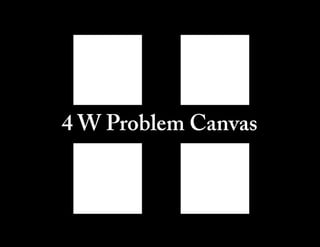
4 W Problem Canvas
§  Who
§  What
§  Why
§  Where
4W EXPLORATION
WHO
•  Who has this problem?
•  Is it your customer*?
•  Have you validated that the problem
is real?
•  Can you prove it?
* Customer is only & always defined as the people that
give you money for your product services.
WHAT
•  What is the nature of the problem?
•  Can you explain it simply?
•  How do you know it’s a problem?
•  What is the evidence to support the
problem?
•  Where does this problem arise?
•  In which context does the customer
experience the problem?
•  Have you observed the problem in
context?
•  Can you describe that context?
WHERE
•  Why do you believe it is a problem
worth solving?
•  Is it an acute problem for the
customer?
•  How acute?
WHY
WHICH IS TIMEBOXED
By yourself - write out on post-its at least
2;Try to keep it to under 8 words; don’t
discuss with anyone.
•  Who
•  What
•  Why
•  Where
* This exercise assumes at least 3 teams of 3 people.
4W Exploration* – 10 min
As a team, present all post-its onto a blank
sheet of large paper divided into 4
quadrants. Discuss all 4 Ws people
presented; take note of duplicates.
•  Which 2 are most revealing
•  Which 2 are most relevant to your
customer on your empathy map?
Use dot-voting
Synthesis– 20 minutes
Now, after reviewing the 4W Canvas with
your team, please write a one paragraph
problem statement by yourself. Make sure to
be explicit about the Who, What, Why,
Where.
Again, don’t talk with your team; write in
your own voice.
Problem Statement Writing – 10 minutes
Each team member present their
problem statement. Dot vote on the 1
strongest problem statement (or combine
them, but don’t exceed 1 paragraph).
Team must present a single problem
statement to the entire group.
Synthesis – 10 minutes
Every team select one person.
Stand Up and read problem statement.
Place on flip chart at front of the room.
PRESENT
In your head, but not out loud,
Is the solution to this problem clear to
you?* (Don’t share your solution idea
with anyone)
*If not, then return to the problem and refine
until the solution emerges in the negative
space. – Jabe Bloom
Now….
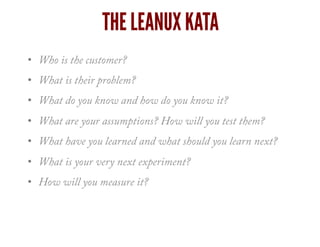
THE LEANUX KATA
•  Who is the customer?
•  What is their problem?
•  What do you know and how do you know it?
•  What are your assumptions? How will you test them?
•  What have you learned and what should you learn next?
•  What is your very next experiment?
•  How will you measure it?
WILL EVANS
Design Thinker-in-Residence
NYU Stern School of Management
Will.Evans@PraxisFlow.com
@semanticwill

LeanUX: Problem Framing Using the 4 Ws

  • 2.
    WILL EVANS Design Thinker-in-Residence NYUStern School of Management Will.Evans@PraxisFlow.com @semanticwill
  • 3.
  • 4.
    Learning organizations [are]organizations where people continually expand their capacity to create the results they truly desire, where new and expansive patterns of thinking are nurtured, where collective aspiration is set free, and where people are continually learning to see the whole together. (Senge 1990)
  • 5.
    CONTINUOUS IMPROVEMENTS •  Tobecome a true learning organization you need to continuously improve. •  No Problem is a Problem •  Kaizen (continuous improvement) is hard work •  A3 & PDSA •  Sometimes A3 to too heavy
  • 6.
    OBSTRACLES TO LEARNINGORGANIZATION •  Silo thinking (and silos in general) •  No time for reflection (the S in PDSA) •  Problem denial (Mystery and Mastery) •  Leadership doesn’t value learning •  No systematic framework for learning •  No ability to frame problems well
  • 7.
    A problem wellstated is mostly solved. The problem is stating a problem well is really hard.
  • 8.
  • 9.
  • 10.
    §  Who §  What § Why §  Where 4W EXPLORATION
  • 11.
    WHO •  Who hasthis problem? •  Is it your customer*? •  Have you validated that the problem is real? •  Can you prove it? * Customer is only & always defined as the people that give you money for your product services.
  • 12.
    WHAT •  What isthe nature of the problem? •  Can you explain it simply? •  How do you know it’s a problem? •  What is the evidence to support the problem?
  • 13.
    •  Where doesthis problem arise? •  In which context does the customer experience the problem? •  Have you observed the problem in context? •  Can you describe that context? WHERE
  • 14.
    •  Why doyou believe it is a problem worth solving? •  Is it an acute problem for the customer? •  How acute? WHY
  • 15.
  • 16.
    By yourself -write out on post-its at least 2;Try to keep it to under 8 words; don’t discuss with anyone. •  Who •  What •  Why •  Where * This exercise assumes at least 3 teams of 3 people. 4W Exploration* – 10 min
  • 17.
    As a team,present all post-its onto a blank sheet of large paper divided into 4 quadrants. Discuss all 4 Ws people presented; take note of duplicates. •  Which 2 are most revealing •  Which 2 are most relevant to your customer on your empathy map? Use dot-voting Synthesis– 20 minutes
  • 18.
    Now, after reviewingthe 4W Canvas with your team, please write a one paragraph problem statement by yourself. Make sure to be explicit about the Who, What, Why, Where. Again, don’t talk with your team; write in your own voice. Problem Statement Writing – 10 minutes
  • 20.
    Each team memberpresent their problem statement. Dot vote on the 1 strongest problem statement (or combine them, but don’t exceed 1 paragraph). Team must present a single problem statement to the entire group. Synthesis – 10 minutes
  • 21.
    Every team selectone person. Stand Up and read problem statement. Place on flip chart at front of the room. PRESENT
  • 22.
    In your head,but not out loud, Is the solution to this problem clear to you?* (Don’t share your solution idea with anyone) *If not, then return to the problem and refine until the solution emerges in the negative space. – Jabe Bloom Now….
  • 23.
    THE LEANUX KATA • Who is the customer? •  What is their problem? •  What do you know and how do you know it? •  What are your assumptions? How will you test them? •  What have you learned and what should you learn next? •  What is your very next experiment? •  How will you measure it?
  • 24.
    WILL EVANS Design Thinker-in-Residence NYUStern School of Management Will.Evans@PraxisFlow.com @semanticwill