
Business Process Playbook
An Introduction
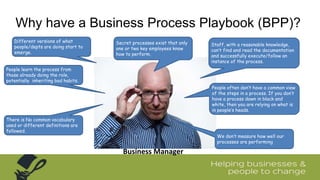
Why have a Business Process Playbook (BPP)?
Staff, with a reasonable knowledge,
can’t find and read the documentation
and successfully execute/follow an
instance of the process.
People often don’t have a common view
of the steps in a process. If you don’t
have a process down in black and
white, then you are relying on what is
in people’s heads.
Different versions of what
people/depts are doing start to
emerge.
People learn the process from
those already doing the role,
potentially inheriting bad habits.
Secret processes exist that only
one or two key employees know
how to perform.
There is No common vocabulary
used or different definitions are
followed.
We don’t measure how well our
processes are performing
Business Manager
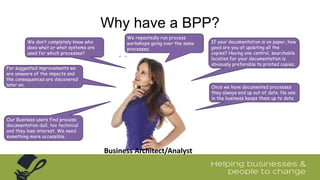
Why have a BPP?
If your documentation is on paper, how
good are you at updating all the
copies? Having one central, searchable
location for your documentation is
obviously preferable to printed copies.
Once we have documented processes
they always end up out of date. No one
in the business keeps them up to date.
For suggested improvements we
are unaware of the impacts and
the consequences are discovered
later on.
We repeatedly run process
workshops going over the same
processes.
Our Business users find process
documentation dull, too technical
and they lose interest. We need
something more accessible.
We don’t completely know who
does what or what systems are
used for which processes?
Business Architect/Analyst
Why have a BPP?
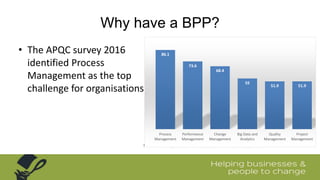
‱ The APQC survey 2016
identified Process
Management as the top
challenge for organisations
86.1
73.6
68.4
55
51.9 51.9
Process
Management
Performance
Management
Change
Management
Big Data and
Analytics
Quality
Management
Project
Management
Poor Process Management Leads to
‱ Increasing complexity in the organisation
‱ Inefficiencies & inconsistencies
‱ Lower productivity
‱ Longer upskilling for new employees
‱ Miscommunication
‱ Higher error rates/exception handling
‱ Reduced capability for change
Purpose
‱ A Business Process Playbook (BPP) can be a valuable part of
your Business Process Management approach.
‱ The aims of the process playbook are:
– To provide a means to communicate what the process is.
– To provide a structure to record, maintain and share processes across the
organisation
– To improve the governance and stewardship of processes within your
business
– To cultivate a focus on process management
– To support process performance management
– To be highly visual and acceptable to non-technical business users
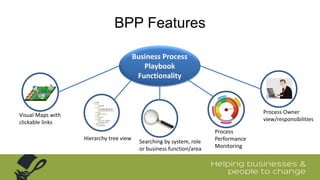
BPP Features
Business Process
Playbook
Functionality
Visual Maps with
clickable links
Process Owner
view/responsibilities
Hierarchy tree view
Searching by system, role
or business function/area
Process
Performance
Monitoring
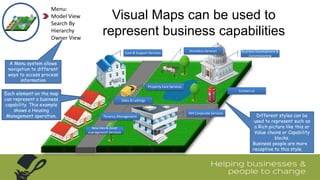
Visual Maps can be used to
represent business capabilities
Menu:
Model View
Search By
Hierarchy
Owner View
Care & Support Services Business Development &
Commissioning
Homeless Services
Property Care Services
MH Corporate Services
Sales & Lettings
Tenancy Management
New Dev & Asset
management Services
Contact us
Different styles can be
used to represent such as
a Rich picture like this or
Value chains or Capability
blocks.
Business people are more
receptive to this style.
A Menu system allows
navigation to different
ways to access process
information
Each element on the map
can represent a business
capability. This example
shows a Housing
Management operation.
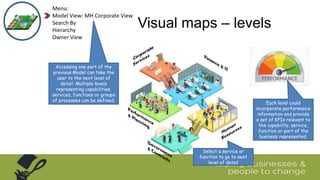
Visual maps – levels
Menu:
Model View: MH Corporate View
Search By
Hierarchy
Owner View
Accessing one part of the
previous Model can take the
user to the next level of
detail. Multiple levels
representing capabilities,
services, functions or groups
of processes can be defined.
Each level could
incorporate performance
information and provide
a set of KPIs relevant to
the capability, service,
function or part of the
business represented.
Select a service or
function to go to next
level of detail
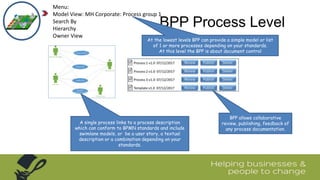
BPP Process Level
Menu:
Model View: MH Corporate: Process group 1
Search By
Hierarchy
Owner View
At the lowest levels BPP can provide a simple model or list
of 1 or more processes depending on your standards.
At this level the BPP is about document control
BPP allows collaborative
review, publishing, feedback of
any process documentation.
A single process links to a process description
which can conform to BPMN standards and include
swimlane models, or be a user story, a textual
description or a combination depending on your
standards.
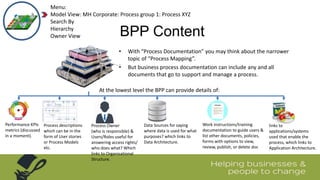
BPP Content
Menu:
Model View: MH Corporate: Process group 1: Process XYZ
Search By
Hierarchy
Owner View
‱ With “Process Documentation” you may think about the narrower
topic of “Process Mapping”.
‱ But business process documentation can include any and all
documents that go to support and manage a process.
Performance KPIs
metrics (discussed
in a moment).
Process descriptions
which can be in the
form of User stories
or Process Models
etc.
Process Owner
(who is responsible) &
Users/Roles useful for
answering access rights/
who does what? Which
links to Organisational
Structure.
Data Sources for saying
where data is used for what
purposes? which links to
Data Architecture.
links to
applications/systems
used that enable the
process, which links to
Application Architecture.
Work instructions/training
documentation to guide users &
list other documents, policies,
forms with options to view,
review, publish, or delete doc
At the lowest level the BPP can provide details of:
Process Performance Monitoring
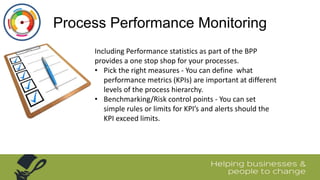
Including Performance statistics as part of the BPP
provides a one stop shop for your processes.
‱ Pick the right measures - You can define what
performance metrics (KPIs) are important at different
levels of the process hierarchy.
‱ Benchmarking/Risk control points - You can set
simple rules or limits for KPI’s and alerts should the
KPI exceed limits.
Process Performance Monitoring
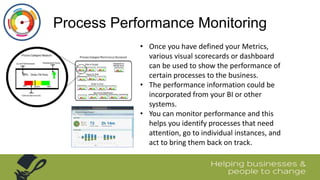
‱ Once you have defined your Metrics,
various visual scorecards or dashboard
can be used to show the performance of
certain processes to the business.
‱ The performance information could be
incorporated from your BI or other
systems.
‱ You can monitor performance and this
helps you identify processes that need
attention, go to individual instances, and
act to bring them back on track.
Hierarchy Tree
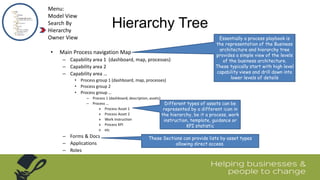
‱ Main Process navigation Map
– Capability area 1 (dashboard, map, processes)
– Capability area 2
– Capability area 

‱ Process group 1 (dashboard, map, processes)
‱ Process group 2
‱ Process group 

– Process 1 (dashboard, description, assets)
– Process 

» Process Asset 1
» Process Asset 2
» Work instruction
» Process KPI
» etc
– Forms & Docs
– Applications
– Roles
Menu:
Model View
Search By
Hierarchy
Owner View Essentially a process playbook is
the representation of the Business
architecture and hierarchy tree
provides a simple view of the levels
of the business architecture.
These typically start with high level
capability views and drill down into
lower levels of details
Different types of assets can be
represented by a different icon in
the hierarchy, be it a process, work
instruction, template, guidance or
KPI statistic
These Sections can provide lists by asset types
allowing direct access.
Process Owner View
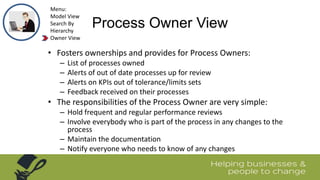
‱ Fosters ownerships and provides for Process Owners:
– List of processes owned
– Alerts of out of date processes up for review
– Alerts on KPIs out of tolerance/limits sets
– Feedback received on their processes
‱ The responsibilities of the Process Owner are very simple:
– Hold frequent and regular performance reviews
– Involve everybody who is part of the process in any changes to the
process
– Maintain the documentation
– Notify everyone who needs to know of any changes
Menu:
Model View
Search By
Hierarchy
Owner View
Alternate Search by routes
‱ Sometimes you want to find something via different access
point.
‱ BPP supports searching processes that are

– supported by a system/application?
– involve a user/role?
– for a business unit/dept?
– uses a data source?
‱ This can be useful for impact analysis for changes.
Menu:
Model View
Search By
Hierarchy
Owner View
Delivery Steps
‱ Build or procure a process repository.
– BPMS packages offer process repository but tend to be for more specialist use
rather than for business use.
‱ An exercise of process discovery.
– Define all capabilities of the organisation at a high level. Do this in visual form
because it’s really a very effective way to engage and convey what happens.
– Start with documenting the core processes.
– Slowly build up when addressing change in a Business area.
‱ Establish process owners.
‱ Integrate with BI Dashboards for performance statistics.
Challenges
‱ BPP success depends on its acceptance by the business and a
commitment to use and maintain.
– Culture of the organisation and management buy in
– Level of process maturity within the organisation
– Investment required and proving value add
‱ Processes can quickly become out of date which erodes the value of
the BPP.
– Don’t expect compliance through documentation. Often senior managers assume that once you
document the process all will be well. Sadly, knowing what the process is and sticking to it are two
different things. Brings into play other aspects of process management:
– Auditing and Compliance
– Performance management
‱ The best way to combat this is to:
– Have a plan in place to maintain your process documentation.
– Appoint a Process Owner.
Benefits of a Business Process Playbook
One source of Process Identification/definition
Collaboration, sharing, common understanding, standardisation
Foster business ownership of processes
Improve Training
Reduce Knowledge vulnerability
Supports Lean and other process improvement initiatives
Tracks process changes
Faster business change impact analysis
A basis for process performance management
https://toppersconsulting.wordpress.com/

Business Process Playbook - An introduction

  • 1.
  • 2.
    Why have aBusiness Process Playbook (BPP)? Staff, with a reasonable knowledge, can’t find and read the documentation and successfully execute/follow an instance of the process. People often don’t have a common view of the steps in a process. If you don’t have a process down in black and white, then you are relying on what is in people’s heads. Different versions of what people/depts are doing start to emerge. People learn the process from those already doing the role, potentially inheriting bad habits. Secret processes exist that only one or two key employees know how to perform. There is No common vocabulary used or different definitions are followed. We don’t measure how well our processes are performing Business Manager
  • 3.
    Why have aBPP? If your documentation is on paper, how good are you at updating all the copies? Having one central, searchable location for your documentation is obviously preferable to printed copies. Once we have documented processes they always end up out of date. No one in the business keeps them up to date. For suggested improvements we are unaware of the impacts and the consequences are discovered later on. We repeatedly run process workshops going over the same processes. Our Business users find process documentation dull, too technical and they lose interest. We need something more accessible. We don’t completely know who does what or what systems are used for which processes? Business Architect/Analyst
  • 4.
    Why have aBPP? ‱ The APQC survey 2016 identified Process Management as the top challenge for organisations 86.1 73.6 68.4 55 51.9 51.9 Process Management Performance Management Change Management Big Data and Analytics Quality Management Project Management
  • 5.
    Poor Process ManagementLeads to ‱ Increasing complexity in the organisation ‱ Inefficiencies & inconsistencies ‱ Lower productivity ‱ Longer upskilling for new employees ‱ Miscommunication ‱ Higher error rates/exception handling ‱ Reduced capability for change
  • 6.
    Purpose ‱ A BusinessProcess Playbook (BPP) can be a valuable part of your Business Process Management approach. ‱ The aims of the process playbook are: – To provide a means to communicate what the process is. – To provide a structure to record, maintain and share processes across the organisation – To improve the governance and stewardship of processes within your business – To cultivate a focus on process management – To support process performance management – To be highly visual and acceptable to non-technical business users
  • 7.
    BPP Features Business Process Playbook Functionality VisualMaps with clickable links Process Owner view/responsibilities Hierarchy tree view Searching by system, role or business function/area Process Performance Monitoring
  • 8.
    Visual Maps canbe used to represent business capabilities Menu: Model View Search By Hierarchy Owner View Care & Support Services Business Development & Commissioning Homeless Services Property Care Services MH Corporate Services Sales & Lettings Tenancy Management New Dev & Asset management Services Contact us Different styles can be used to represent such as a Rich picture like this or Value chains or Capability blocks. Business people are more receptive to this style. A Menu system allows navigation to different ways to access process information Each element on the map can represent a business capability. This example shows a Housing Management operation.
  • 9.
    Visual maps –levels Menu: Model View: MH Corporate View Search By Hierarchy Owner View Accessing one part of the previous Model can take the user to the next level of detail. Multiple levels representing capabilities, services, functions or groups of processes can be defined. Each level could incorporate performance information and provide a set of KPIs relevant to the capability, service, function or part of the business represented. Select a service or function to go to next level of detail
  • 10.
    BPP Process Level Menu: ModelView: MH Corporate: Process group 1 Search By Hierarchy Owner View At the lowest levels BPP can provide a simple model or list of 1 or more processes depending on your standards. At this level the BPP is about document control BPP allows collaborative review, publishing, feedback of any process documentation. A single process links to a process description which can conform to BPMN standards and include swimlane models, or be a user story, a textual description or a combination depending on your standards.
  • 11.
    BPP Content Menu: Model View:MH Corporate: Process group 1: Process XYZ Search By Hierarchy Owner View ‱ With “Process Documentation” you may think about the narrower topic of “Process Mapping”. ‱ But business process documentation can include any and all documents that go to support and manage a process. Performance KPIs metrics (discussed in a moment). Process descriptions which can be in the form of User stories or Process Models etc. Process Owner (who is responsible) & Users/Roles useful for answering access rights/ who does what? Which links to Organisational Structure. Data Sources for saying where data is used for what purposes? which links to Data Architecture. links to applications/systems used that enable the process, which links to Application Architecture. Work instructions/training documentation to guide users & list other documents, policies, forms with options to view, review, publish, or delete doc At the lowest level the BPP can provide details of:
  • 12.
    Process Performance Monitoring IncludingPerformance statistics as part of the BPP provides a one stop shop for your processes. ‱ Pick the right measures - You can define what performance metrics (KPIs) are important at different levels of the process hierarchy. ‱ Benchmarking/Risk control points - You can set simple rules or limits for KPI’s and alerts should the KPI exceed limits.
  • 13.
    Process Performance Monitoring ‱Once you have defined your Metrics, various visual scorecards or dashboard can be used to show the performance of certain processes to the business. ‱ The performance information could be incorporated from your BI or other systems. ‱ You can monitor performance and this helps you identify processes that need attention, go to individual instances, and act to bring them back on track.
  • 14.
    Hierarchy Tree ‱ MainProcess navigation Map – Capability area 1 (dashboard, map, processes) – Capability area 2 – Capability area 
 ‱ Process group 1 (dashboard, map, processes) ‱ Process group 2 ‱ Process group 
 – Process 1 (dashboard, description, assets) – Process 
 » Process Asset 1 » Process Asset 2 » Work instruction » Process KPI » etc – Forms & Docs – Applications – Roles Menu: Model View Search By Hierarchy Owner View Essentially a process playbook is the representation of the Business architecture and hierarchy tree provides a simple view of the levels of the business architecture. These typically start with high level capability views and drill down into lower levels of details Different types of assets can be represented by a different icon in the hierarchy, be it a process, work instruction, template, guidance or KPI statistic These Sections can provide lists by asset types allowing direct access.
  • 15.
    Process Owner View ‱Fosters ownerships and provides for Process Owners: – List of processes owned – Alerts of out of date processes up for review – Alerts on KPIs out of tolerance/limits sets – Feedback received on their processes ‱ The responsibilities of the Process Owner are very simple: – Hold frequent and regular performance reviews – Involve everybody who is part of the process in any changes to the process – Maintain the documentation – Notify everyone who needs to know of any changes Menu: Model View Search By Hierarchy Owner View
  • 16.
    Alternate Search byroutes ‱ Sometimes you want to find something via different access point. ‱ BPP supports searching processes that are
 – supported by a system/application? – involve a user/role? – for a business unit/dept? – uses a data source? ‱ This can be useful for impact analysis for changes. Menu: Model View Search By Hierarchy Owner View
  • 17.
    Delivery Steps ‱ Buildor procure a process repository. – BPMS packages offer process repository but tend to be for more specialist use rather than for business use. ‱ An exercise of process discovery. – Define all capabilities of the organisation at a high level. Do this in visual form because it’s really a very effective way to engage and convey what happens. – Start with documenting the core processes. – Slowly build up when addressing change in a Business area. ‱ Establish process owners. ‱ Integrate with BI Dashboards for performance statistics.
  • 18.
    Challenges ‱ BPP successdepends on its acceptance by the business and a commitment to use and maintain. – Culture of the organisation and management buy in – Level of process maturity within the organisation – Investment required and proving value add ‱ Processes can quickly become out of date which erodes the value of the BPP. – Don’t expect compliance through documentation. Often senior managers assume that once you document the process all will be well. Sadly, knowing what the process is and sticking to it are two different things. Brings into play other aspects of process management: – Auditing and Compliance – Performance management ‱ The best way to combat this is to: – Have a plan in place to maintain your process documentation. – Appoint a Process Owner.
  • 19.
    Benefits of aBusiness Process Playbook One source of Process Identification/definition Collaboration, sharing, common understanding, standardisation Foster business ownership of processes Improve Training Reduce Knowledge vulnerability Supports Lean and other process improvement initiatives Tracks process changes Faster business change impact analysis A basis for process performance management
  • 20.

Editor's Notes

  • #7 It can also be called a Process Library, repository, tool etc. It is not Process case tool for development or analysis of processes.
  • #9 Top level is more a Business Capability Model capability define as “a particular ability or capacity that a business may possess or exchange to achieve a specific purpose or outcome or service”
  • #11 Actually performance information can be provided at any level
  • #12 Actually performance information can be provided at any level
  • #13 Examples: Capability Area or Process performance KPI’s Frequency/volume Ave Duration At risk/overdue No of processes No of improvements Doc changes New/Out of date processes Feedback received
  • #14 Examples: Capability Area or Process performance KPI’s Frequency/volume Ave Duration At risk/overdue No of processes No of improvements Doc changes New/Out of date processes Feedback received