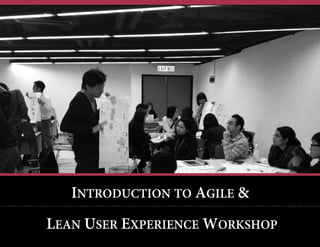
INTRODUCTION TO AGILE &
LEAN USER EXPERIENCE WORKSHOP
WILL EVANS

JACKLYN BURGAN

Managing Director

Interaction Designer

TLC Labs

Turner Broadcasting

Design Thinker-in-Residence

Chief Awesomeologist

NYU Stern Graduate School of Management

Glitter Queen

@semanticwill
@playfulpixel
True Fact
The vast majority of projects fail
NOT because they couldn’t build
a great product using the latest
new technology.
They failed because they built
something no one wanted.
Let’s start with an exercise!
Which is timeboxed 2min
Why Are We Here?
•  All too often, leaders, managers, teams, designers rely
on common approaches that may work well in one
context, and fail in another.
•  Teams want to create better customer experiences (user
experiences), but aren’t sure what that really means.
•  Teams often find it difficult moving from insights to
action (based on this research, what should we do
now?).


Might as well give you the take-aways…
•  Context matters – effective teams are adept at
knowing which context (domain) they are in
•  Different contexts (ontologies) require different
ways of knowing (epistemologies).
•  Sense-Making as a collaborative meaningmaking activity for framing problems &
generating options.
•  The Customer Experience is “owned” by
everyone, not just a single role.
8
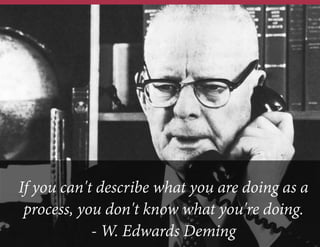
If you can't describe what you are doing as a
process, you don't know what you're doing.
- W. Edwards Deming
Lean* UX?
By Lean*UX
most people really mean
“UX Design in the context of
the Lean Startup Method”
Term coined by Janice Fraser, Founder of LUXR
We’ve heard the “UX Design” is
important, and the customer
experience is important, but…
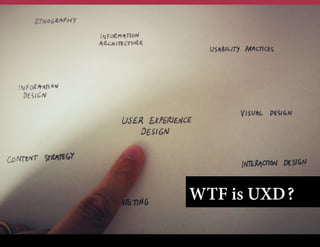
WTF is UXD?
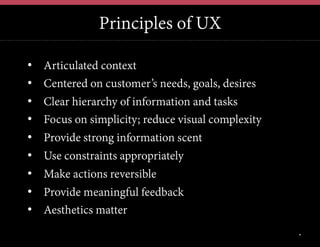
Principles of UX
• 
• 
• 
• 
• 
• 
• 
• 
• 

Articulated context
Centered on customer’s needs, goals, desires
Clear hierarchy of information and tasks
Focus on simplicity; reduce visual complexity
Provide strong information scent
Use constraints appropriately
Make actions reversible
Provide meaningful feedback
Aesthetics matter


*
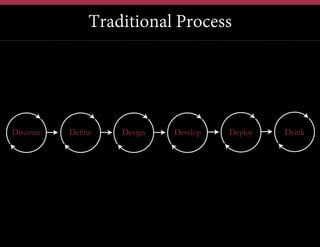
Traditional Process
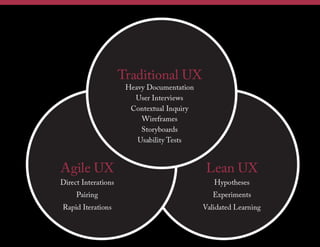
“Traditional” UX Practices
•  Emphasize deliverables
•  See the work as a solution that gets sold to
stakeholders
•  See the (UX) designer as the hero in charge of

finding solutions to design challenges and
getting approval before development starts
Over the past 35 years, UX* (CX,
IxD/IA/UCD), much like Waterfall,
accumulated a lot of wasteful, timeconsuming, CYA practices that
delivered no discernable value to the
business or to customers.
*CX is a new term popularized by Forrester Research
Over the past 12 years, so has Agile.
“Waste is any human activity which
absorbs resources, but creates no value.”
- James P Womak and Daniel T. Jones, Lean Thinking
Why Agile or Lean?
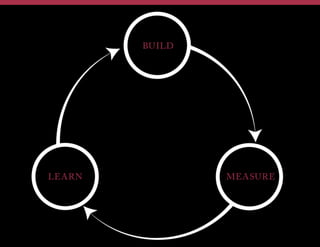
•  Companies innovates in a context of uncertainty.
There’s insufficient evidence to confidently answer
questions like will people want this kind of
product? Will people buy it? What should it look
like? What features should it have?
•  Because of the uncertainty, progress is measured
by what we learn through experiments. Product
success is found through repeated cycles of “buildmeasure-learn”
•  Work is organized into the smallest possible batch
size and launched quickly -> Agile
(Lean UX) Process
•  Figure out who it’s for?
•  Interviews, personas, design target

•  What can the user do that wasn’t possible
before?
•  Activity map, concept drawings, storyboards

•  What features does the user need for that?
•  Stickys, sketches, whiteboarding

•  Sketch it, (prototype it), then build it
•  “Fake it, then make it”
Shared Goals

Agile development and Lean UX share a few goals:
•  Shorten the time to market
•  Working software over comprehensive
documentation
•  Collaboration over negotiation
•  Responding to change over following a plan
How Can We Improve Our Process?
•  The design work we do is often limited to onthe-go type of decisions
•  We struggle with approvals
•  We don’t have an established process that
involves UXD, thus our scenario is not “going
from traditional UX to Lean”, but rather,
“establishing our approach to UXD”
Problem vs. Solution
“Focus on the problem. If you’re only excited about
the solution, you’ll lose interest when your solution
doesn’t fix the problem.”
- Adil Wali, CTO of ModCloth
Business, UXD, and Development should all focus
on the Customer, Problem, and Solution.
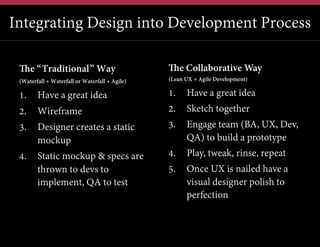
Integrating Design into Development Process
The “Traditional” Way

The Collaborative Way

(Waterfall + Waterfall or Waterfall + Agile)

(Lean UX + Agile Development)

1.  Have a great idea
2.  Wireframe
3.  Designer creates a static
mockup
4.  Static mockup & specs are
thrown to devs to
implement, QA to test

1.  Have a great idea
2.  Sketch together
3.  Engage team (BA, UX, Dev,
QA) to build a prototype
4.  Play, tweak, rinse, repeat
5.  Once UX is nailed have a
visual designer polish to
perfection
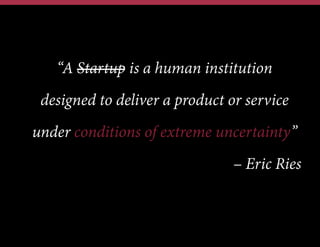
“A Startup is a human institution
designed to deliver a product or service
under conditions of extreme uncertainty”
– Eric Ries
WHAT IS LEAN STARTUP?
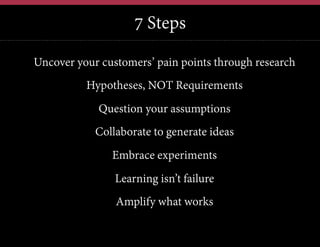
7 Steps
Uncover your customers’ pain points through research
Hypotheses, NOT Requirements
Question your assumptions
Collaborate to generate ideas
Embrace experiments
Learning isn’t failure
Amplify what works
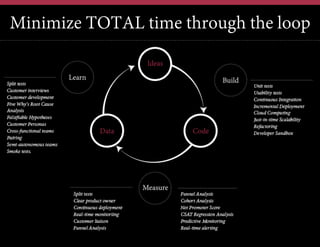
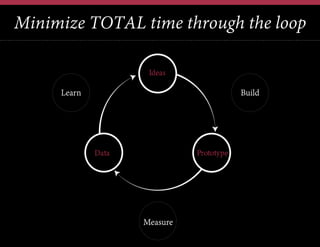
Minimize TOTAL time through the loop
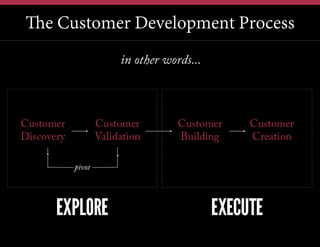
The Customer Development Process
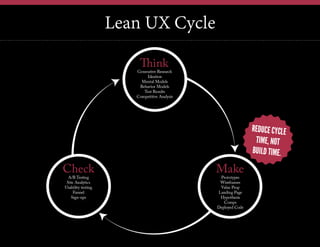
Lean UX Cycle
4 Key Elements to Lean UX
We have this problem, lets jump in and brainstorm a solution
We have a new technology, what can we possibly use it for?
Our competitors just launched X; how quickly can we also do X?

• 
• 
• 
• 

Empathy through research
Framing the problem
Generative Ideation
Prototyping & validation
BASICS OF CUSTOMER RESEARCH
Background
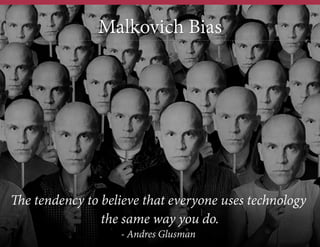
Malkovich Bias

The tendency to believe that everyone uses technology
the same way you do.
- Andres Glusman
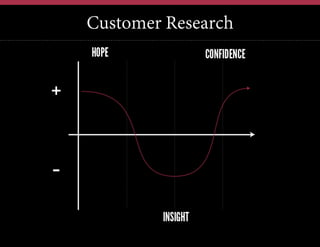
Customer Research
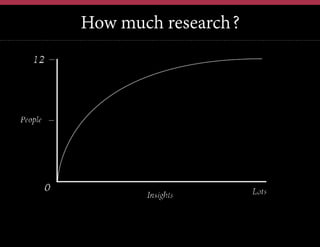
How much Research
Customer research?
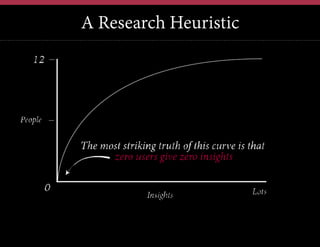
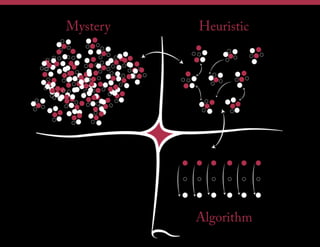
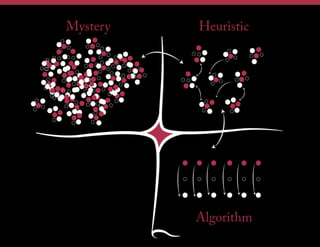
A Research Heuristic
12	
  

People	
  

0

Insights	
  

Lot
s	
  
UX Mantra
12	
  

Mantra: You are not the customer.

Only through research can we
uncover people’s pains, needs, and
goals, in their context.
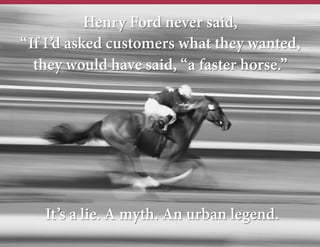
Henry Ford never said,
“If I’d asked customers what they wanted,
they would have said, “a faster horse.”

It’s a lie. A myth. An urban legend.
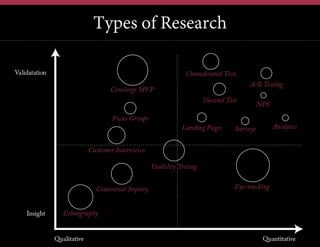
Types of Research
INTERVIEWING EXERCISE
Stand Up!

A–B-C
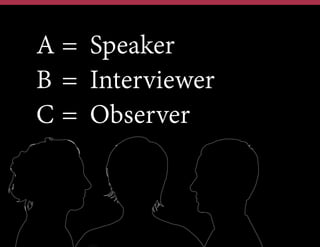
A = Speaker
B = Interviewer
C = Observer
Speakers

Close your eyes
Interviewers

Chat with speaker about
their commute to work
Observers

Watch what happens.
Write observations on
post-it notes.
Interviewers

Don’t take notes.
2 minutes
Reflection
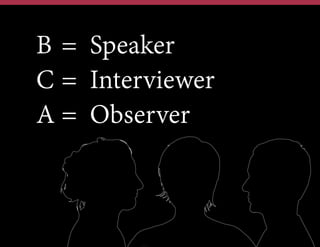
B = Speaker
C = Interviewer
A = Observer
Speakers

Close your eyes
Interviewers

Chat with the speaker about
their car maintenance costs
Interviewers

One more thing.
Interviewers

After the first question –
you cannot speak again.
Shhh…
Observers

Watch what happens.
Write observations on
post-it notes.
Interviewers

Don’t take notes.
2 minutes
Reflection
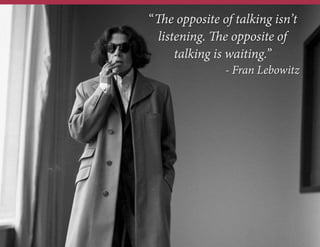
“The opposite of talking isn’t
listening. The opposite of
talking is waiting.”
- Fran Lebowitz
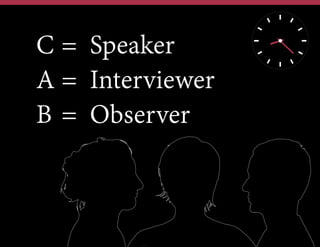
C = Speaker
A = Interviewer
B = Observer
Speakers

Close your eyes
Interviewers

Chat with the speaker about
parking in midtown Atlanta
Interviewers

After the first question, you
can only ask:
“Can you tell me more
about X?”
Observers

Watch what happens. Write
observations on post-it
notes.
Interviewers

Do note take notes.
4 minutes
Reflection
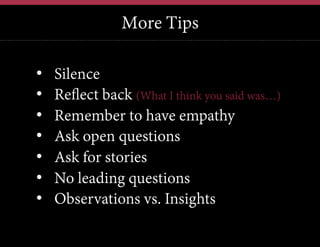
More Tips
• 
• 
• 
• 
• 
• 
• 

Silence
Reflect back (What I think you said was…)
Remember to have empathy
Ask open questions
Ask for stories
No leading questions
Observations vs. Insights
Break
CUSTOMER EMPATHY MAP
Timeboxed 10 minutes
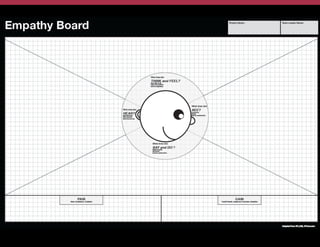
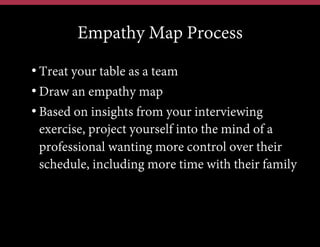
Empathy Map Process
• Treat your table as a team
• Draw an empathy map
• Based on insights from your interviewing
exercise, project yourself into the mind of a
professional wanting more control over their
schedule, including more time with their family
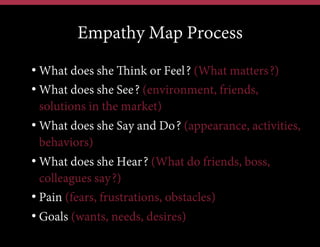
Empathy Map Process
• What does she Think or Feel? (What matters?)
• What does she See? (environment, friends,
solutions in the market)
• What does she Say and Do? (appearance, activities,
behaviors)
• What does she Hear? (What do friends, boss,
colleagues say?)
• Pain (fears, frustrations, obstacles)
• Goals (wants, needs, desires)
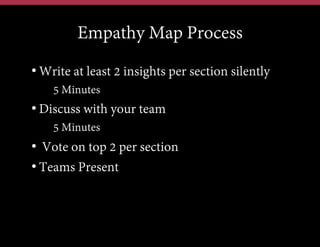
Empathy Map Process
• Write at least 2 insights per section silently
•  5 Minutes

• Discuss with your team
•  5 Minutes

•  Vote on top 2 per section
• Teams Present
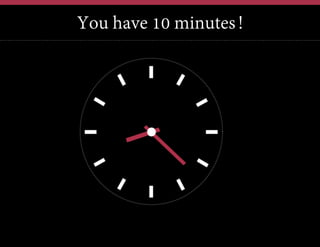
You have 10 minutes!
Those were all assumptions…
ETHNOGRAGHY
Ethnography
Allows Us To
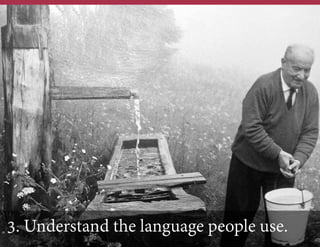
1. Discover the semantics of living
2. Decode signifiers of cultural practice
3. Understand the language people use.
The Power of Pairing
Keys
To Good
Ethnography
Delve deeply into the context, lives, cultures, and rituals of a few
people rather than study a large number of people superficially.
This isn’t about booty calls, this is about relationships.
Holistically study people’s behaviors and experiences in daily life.
You won’t find this in a lab, focus group, or 5 minute interview on
the street.
Learn to ask probing, open questions, gathering as much data as
possible to inform your understanding.
Practice “active seeing,” and “active listening.” Record every
minutiae of daily existence, and encode on post-its.
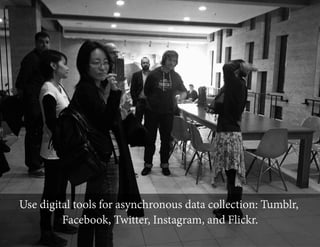
Use digital tools for asynchronous data collection: Tumblr,
Facebook, Twitter, Instagram, and Flickr.
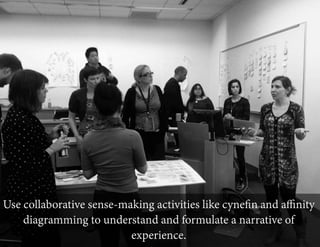
Use collaborative sense-making activities like cynefin and affinity
diagramming to understand and formulate a narrative of
experience.
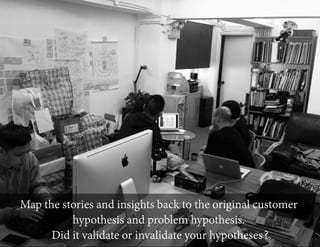
Map the stories and insights back to the original customer
hypothesis and problem hypothesis.
Did it validate or invalidate your hypotheses?
Before Interviews
12	
  

• 
• 
• 
• 

Identify who you are interviewing
Articulate customer hypotheses
Craft a topic map for your interviews
Write down your prompts
9 Keys to Customer Research
12	
  

1. 
2. 
3. 
4. 
5. 
6. 
7. 
8. 
9. 

One interview at a time
Always pair interview (if you can)
Introduce yourself
Record the conversation
Ask general, open-ended questions to get
people talking
As questions around the problem “Do you
ever experience a problem like X”
Then ask, “Tell me about the last time…”
Listen more than you talk
Separate behavior from narrative
Guidelines
12	
  

1.  It’s about empathizing
2.  Listen, even when people go off topic
3.  Context is king – document it, and make
sure the context of research maps to the
problem being explored
4.  Start from the assumption that everything
you know is wrong
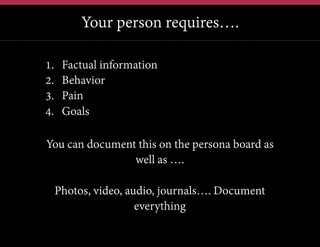
You need to gather:
12	
  

1. 
2. 
3. 
4. 

Factual information
Behavior
Pain
Goals

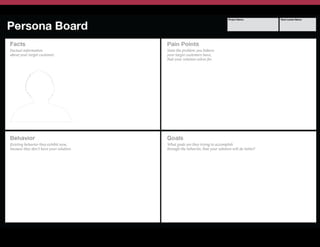
You can document this on the persona board as
well as ….
Photos, video, audio, journals…. Document
everything
A simple 3-Point Interview
•  Has [insert specific problem] been a problem
for you? (context)
• Tell me about the last time you dealt with this
problem? (story)
•  What’s your ideal solution for this problem?
(solution)
Open Ended Questions Start With…
12	
  

• 
• 
• 
• 
• 
• 

Tell me about…
How so…
What are your thoughts on…
Could you elaborate on…
Give some examples of
Tell me about the last time you…
During the interview
12	
  

DO
•  Take notes
•  Smile
•  Ask open-ended questions
•  Get their story
•  Shut up and listen

DON’T
•  Talk about your product
•  Ask about future behavior
•  Sell
•  Ask leading questions
•  Talk much
PERSONAS
Lean Personas
12	
  

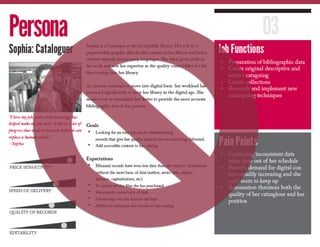
•  Personas are an archetype of your
actual, validated customers based on
research.
•  Personas are not a sheet of paper, they
are a living document.
•  (Just) making up personas is useless.
•  BUT – creating persona hypotheses
gets the ball moving… to do research.
Lean Personas
12	
  

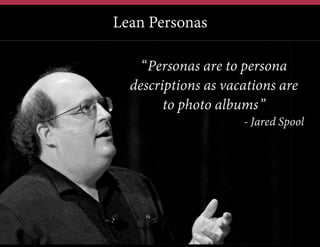
“Personas are to persona
descriptions as vacations are
to photo albums”
- Jared Spool
Your person requires….
12	
  

1. 
2. 
3. 
4. 

Factual information
Behavior
Pain
Goals

You can document this on the persona board as
well as ….
Photos, video, audio, journals…. Document
everything
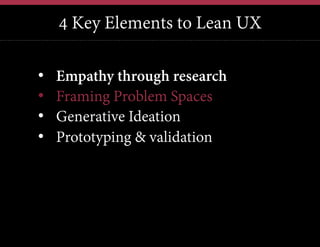
4 Key Elements to Lean UX
We have this problem, lets jump in and brainstorm a solution
We have a new technology, what can we possibly use it for?
Our competitors just launched X; how quickly can we also do X?

• 
• 
• 
• 

Empathy through research
Framing Problem Spaces
Generative Ideation
Prototyping & validation
How do we make sense of the world so that we can act in it?

FRAMING AND SENSE MAKING
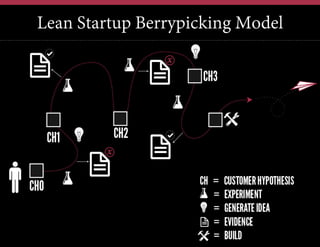
Lean Startup Berrypicking Model
Problem Statement
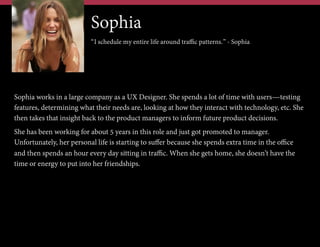
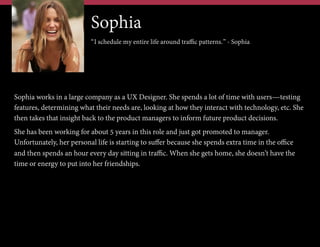
Sophia
“I schedule my entire life around traffic patterns.” - Sophia

Sophia works in a large company as a UX Designer. She spends a lot of time with users—testing
features, determining what their needs are, looking at how they interact with technology, etc. She
then takes that insight back to the product managers to inform future product decisions.
She has been working for about 5 years in this role and just got promoted to manager.
Unfortunately, her personal life is starting to suffer because she spends extra time in the office
and then spends an hour every day sitting in traffic. When she gets home, she doesn’t have the
time or energy to put into her friendships.
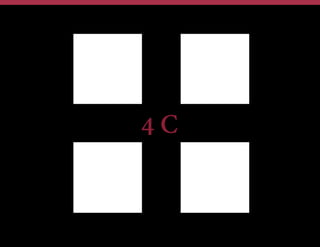
4C
4C Exploration
§ 
§ 
§ 
§ 

Components
Characteristics
Challenges
Characters
Components
Components are parts of the problem or
topic. For example, a component for
Sophia may be her smart phone bill.
Characteristics
Characteristics are features or attributes of
the topic. For e x a m p l e , a characteristic
of Sophia’s financial goals may be “risk
tolerant”.
Challenges
Challenges are obstacles associated with
the topic. For example, Thursday evening
girls night out might be a challenge.
Characters
Characters are people associated with the
topic. Friends, boss, colleagues, parents –
anyone who may influence her financial
habits.
Which is timeboxed
4C Exploration
§ 
§ 
§ 
§ 

Components
Characteristics
Challenges
Characters
From Sense-Making to Abduction
We have this problem, lets jump in and brainstorm a solution
We have a new technology, what can we possibly use it for?
Our competitors just launched X; how quickly can we also do X?

•  Empathy through research
•  Framing the problem

•  Generative Ideation

•  Prototyping & validation
GENERATIVE IDEATION
An Exercise!
Which is timeboxed 2min
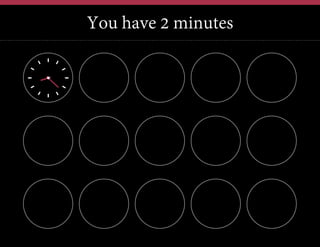
You have 2 minutes
Ideation Process
Create. Pitch. Critique.
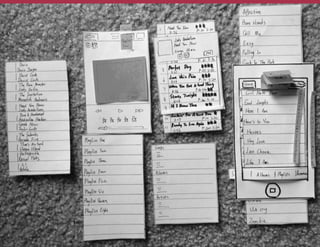
TECHNICALLY THIS IS CALLED A CHARRETTE*.
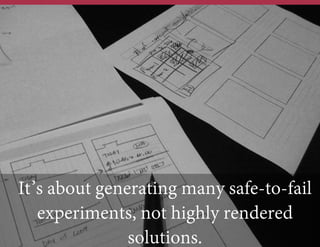
It’s about generating many safe-to-fail
experiments, not highly rendered
solutions.
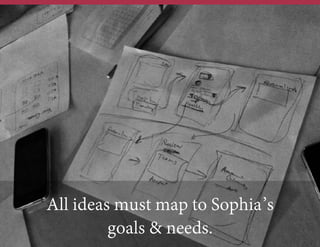
All ideas must map to Sophia’s
goals & needs.
Design Studio
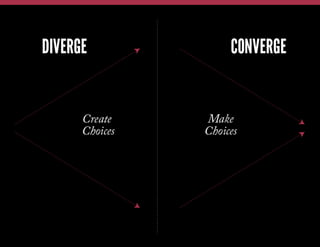
Generate lots of design concepts (options*)
Present concepts as stories
Critique using Ritual Dissent
Integrate (steal) & Iterate
Check stories for coherence
Converge around testable solution hypotheses
*See Chris Matts Real Options Theory
Create. Pitch. Critique.
TECHNICALLY THIS IS CALLED A CHARRETTE*.
Level playing field.
Idea generation.
Team buy-in.
Ownership/investment.
Vet design concepts.
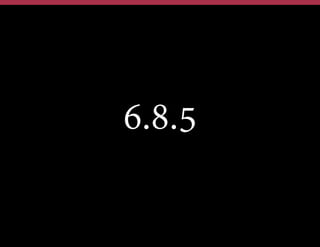
6.8.5
Create. Pitch. Critique.
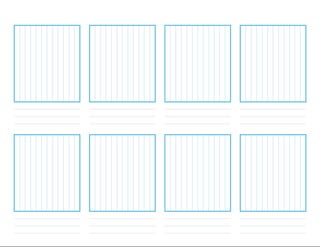
Create six to eight concept sketches
individually.
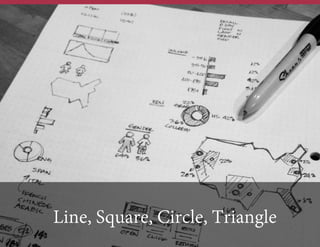
Line, Square, Circle, Triangle
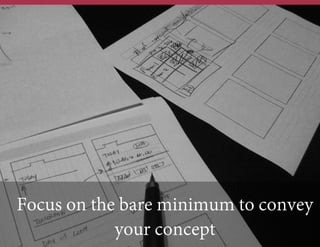
Focus on the bare minimum to convey
your concept
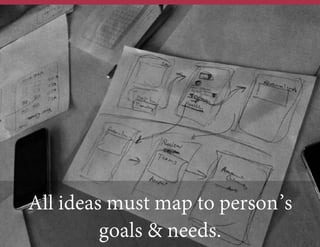
All ideas must map to person’s
goals & needs.
Create. Pitch. Critique.
Three minutes to pitch how your
concept solves the problem.
Create. Pitch. Critique.
Two minutes for critique.
Two to three ways it solves the
problem and one to two
opportunities for improvement.
Sophia
“I schedule my entire life around traffic patterns.” - Sophia

Sophia works in a large company as a UX Designer. She spends a lot of time with users—testing
features, determining what their needs are, looking at how they interact with technology, etc. She
then takes that insight back to the product managers to inform future product decisions.
She has been working for about 5 years in this role and just got promoted to manager.
Unfortunately, her personal life is starting to suffer because she spends extra time in the office
and then spends an hour every day sitting in traffic. When she gets home, she doesn’t have the
time or energy to put into her friendships.
Sketching
5 minutes
Pitching
(pick a timer)
3 minutes
Critique
2x2
2 minutes
nd
2

Iteration
5 minutes
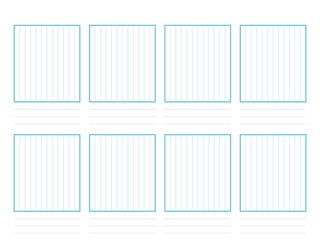
Storyboarding!
5 minutes
Pitching
2 minutes
Critique
2x2
2 minutes
nd
3

Iteration
10 minutes
Sketching – 1 Interface/Solution
10 minutes
“Many ideas grow better when
transplanted into another mind than
the one where they sprang up.”
- Oliver Wendell Holmes
Pitching
3 minutes
Critique
2x2
2 minutes
Team Sketch

1 Concept
25 minutes
Ritual Dissent
“Whenever we propose a
solution to a problem, we ought
to try as hard as we can to
overthrow our solution, rather
than defend it.”
- Karl Popper
Present
Pick a spokesperson
5 minutes to prepare
Ritual Dissent
•  The basic approach involves a spokesperson presenting a series
of ideas to a group of investors who listens to them in silence.
•  You’re spokesperson will only have 5 minutes to present
•  Team must imagine they are a group of investors hearing a
pitch from a startup.
•  No questions can be asked of the spokesperson.
•  Investor team must find all the things wrong with the concept,
why it solves no problem, and all the other solutions in the
marketplace that do things better.
Ritual Dissent
•  The spokesperson turns to face the wall, so that
their back is to the investor team and listens in
silence while the group attacks the idea.
•  The spokesperson cannot respond to questions
or defend the ideas.
•  Investor team must be as harsh as possible.
•  Spokesperson can only take notes on everything
he/she hears.
“The opposite of talking isn’t
listening. The opposite of
talking is waiting.”
- Fran Lebowitz
For all critique decide:
•  Ignore (backburner)
•  Remove (de-solve)
•  Research Solution (best practice)
•  Research Problem (innovate)
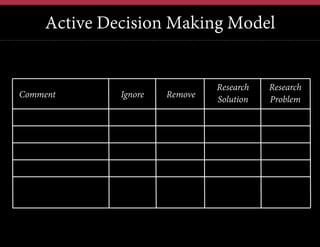
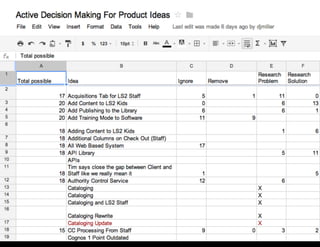
Active Decision Making Model

Comment

Ignore

Remove

Research
Solution

Research
Problem
Iterate as a team based on
the critique.

15Min
Then pitch to the whole
workshop.
But first…
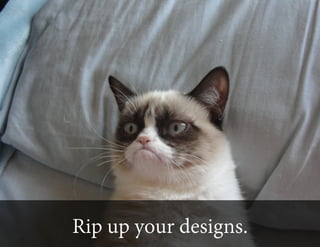
Rip up your designs.
Team Sketch

Use ADM & Sketch
15 minutes
Team Present

3 Minutes
Ritual Assent

2 Minutes
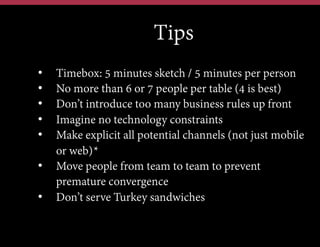
•  Tips
• 
• 
• 
• 
• 

Timebox: 5 minutes sketch / 5 minutes per person
No more than 6 or 7 people per table (4 is best)
Don’t introduce too many business rules up front
Imagine no technology constraints
Make explicit all potential channels (not just mobile
or web)*
•  Move people from team to team to prevent
premature convergence
•  Don’t serve Turkey sandwiches
Potential Pitfalls
•  Having a solution before Design Studio starts – “we
already have a solution – we just want buy-in”
•  Not adequately scoping design studio to match the
problem – “we can only spend 2 hours on design
studio because of people’s schedules”
•  Introducing blockers or business constraints too early
•  The invisible hand of the absent stakeholder

Process & Pitfalls: http://bit.ly/vpeuJn
Articles to learn more on UXMag
Introduction to Design Studio
The Design of Design Studio
Design Studio in AgileUX: Process and Pitfalls
PROTOTYPE & VALIDATE
Minimize TOTAL time through the loop
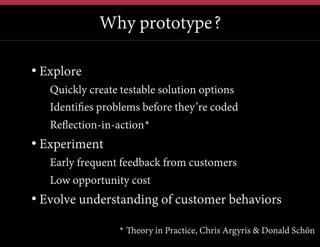
Why prototype?
•  Explore
• Quickly create testable solution options
• Identifies problems before they’re coded
• Reflection-in-action*

•  Experiment
• Early frequent feedback from customers
• Low opportunity cost

•  Evolve understanding of customer behaviors
* Theory in Practice, Chris Argyris & Donald Schön
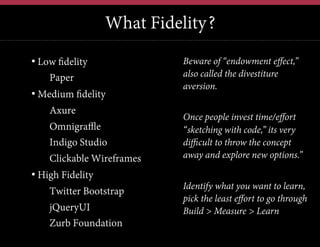
What Fidelity?
•  Low fidelity
• Paper
•  Medium fidelity
• Axure
• Omnigraffle
• Indigo Studio
• Clickable Wireframes
•  High Fidelity
• Twitter Bootstrap
• jQueryUI
• Zurb Foundation

Beware of “endowment effect,”
also called the divestiture
aversion.
Once people invest time/effort
“sketching with code,” its very
difficult to throw the concept
away and explore new options.”
Identify what you want to learn,
pick the least effort to go through
Build > Measure > Learn
Maximize Optionality
From insights, you can create multiple problem & solution
hypotheses sets.
It's not about designing the one right solution and refining.
It's about testing many solutions to multiple problem
hypotheses.

It's about many small bets.
Some Ideas for Good Product Design
•  Balanced team
Design + PM + Development = One team

• 
• 
• 
• 
• 
• 
• 

Externalize thought process
Flow: Think > Make > Check
Research to understand Problem Space
No proxies between customers and team
Collaborative Sense-making
Generative Ideation: It’s about optionality
Formulate many small tests & measure outcome
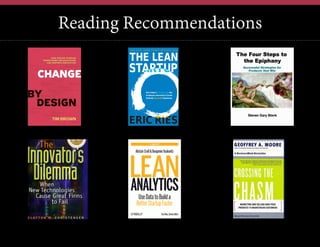
Reading Recommendations
THANKS!
WILL EVANS

JACKLYN BURGAN

Director of Design & Research

Interaction Designer

TLC Labs

Turner Broadcasting

Design Thinker-in-Residence

Chief Awesomeologist

NYU Stern Graduate School of

Dancing Queen

Management
@semanticwill

@playfulpixel

Intro to Agile and Lean UX

  • 1.
    INTRODUCTION TO AGILE& LEAN USER EXPERIENCE WORKSHOP
  • 2.
    WILL EVANS JACKLYN BURGAN ManagingDirector Interaction Designer TLC Labs Turner Broadcasting Design Thinker-in-Residence Chief Awesomeologist NYU Stern Graduate School of Management Glitter Queen @semanticwill @playfulpixel
  • 3.
    True Fact The vastmajority of projects fail NOT because they couldn’t build a great product using the latest new technology. They failed because they built something no one wanted.
  • 4.
    Let’s start withan exercise!
  • 5.
  • 7.
    Why Are WeHere? •  All too often, leaders, managers, teams, designers rely on common approaches that may work well in one context, and fail in another. •  Teams want to create better customer experiences (user experiences), but aren’t sure what that really means. •  Teams often find it difficult moving from insights to action (based on this research, what should we do now?).    
  • 8.
    Might as wellgive you the take-aways… •  Context matters – effective teams are adept at knowing which context (domain) they are in •  Different contexts (ontologies) require different ways of knowing (epistemologies). •  Sense-Making as a collaborative meaningmaking activity for framing problems & generating options. •  The Customer Experience is “owned” by everyone, not just a single role. 8
  • 9.
    If you can'tdescribe what you are doing as a process, you don't know what you're doing. - W. Edwards Deming
  • 10.
  • 11.
    By Lean*UX most peoplereally mean “UX Design in the context of the Lean Startup Method” Term coined by Janice Fraser, Founder of LUXR
  • 12.
    We’ve heard the“UX Design” is important, and the customer experience is important, but…
  • 13.
  • 14.
    Principles of UX •  •  •  •  •  •  •  •  •  Articulatedcontext Centered on customer’s needs, goals, desires Clear hierarchy of information and tasks Focus on simplicity; reduce visual complexity Provide strong information scent Use constraints appropriately Make actions reversible Provide meaningful feedback Aesthetics matter     *
  • 15.
  • 16.
    “Traditional” UX Practices • Emphasize deliverables •  See the work as a solution that gets sold to stakeholders •  See the (UX) designer as the hero in charge of finding solutions to design challenges and getting approval before development starts
  • 17.
    Over the past35 years, UX* (CX, IxD/IA/UCD), much like Waterfall, accumulated a lot of wasteful, timeconsuming, CYA practices that delivered no discernable value to the business or to customers. *CX is a new term popularized by Forrester Research
  • 18.
    Over the past12 years, so has Agile.
  • 19.
    “Waste is anyhuman activity which absorbs resources, but creates no value.” - James P Womak and Daniel T. Jones, Lean Thinking
  • 21.
    Why Agile orLean? •  Companies innovates in a context of uncertainty. There’s insufficient evidence to confidently answer questions like will people want this kind of product? Will people buy it? What should it look like? What features should it have? •  Because of the uncertainty, progress is measured by what we learn through experiments. Product success is found through repeated cycles of “buildmeasure-learn” •  Work is organized into the smallest possible batch size and launched quickly -> Agile
  • 22.
    (Lean UX) Process • Figure out who it’s for? •  Interviews, personas, design target •  What can the user do that wasn’t possible before? •  Activity map, concept drawings, storyboards •  What features does the user need for that? •  Stickys, sketches, whiteboarding •  Sketch it, (prototype it), then build it •  “Fake it, then make it”
  • 23.
    Shared Goals Agile developmentand Lean UX share a few goals: •  Shorten the time to market •  Working software over comprehensive documentation •  Collaboration over negotiation •  Responding to change over following a plan
  • 24.
    How Can WeImprove Our Process? •  The design work we do is often limited to onthe-go type of decisions •  We struggle with approvals •  We don’t have an established process that involves UXD, thus our scenario is not “going from traditional UX to Lean”, but rather, “establishing our approach to UXD”
  • 25.
    Problem vs. Solution “Focuson the problem. If you’re only excited about the solution, you’ll lose interest when your solution doesn’t fix the problem.” - Adil Wali, CTO of ModCloth Business, UXD, and Development should all focus on the Customer, Problem, and Solution.
  • 26.
    Integrating Design intoDevelopment Process The “Traditional” Way The Collaborative Way (Waterfall + Waterfall or Waterfall + Agile) (Lean UX + Agile Development) 1.  Have a great idea 2.  Wireframe 3.  Designer creates a static mockup 4.  Static mockup & specs are thrown to devs to implement, QA to test 1.  Have a great idea 2.  Sketch together 3.  Engage team (BA, UX, Dev, QA) to build a prototype 4.  Play, tweak, rinse, repeat 5.  Once UX is nailed have a visual designer polish to perfection
  • 27.
    “A Startup isa human institution designed to deliver a product or service under conditions of extreme uncertainty” – Eric Ries
  • 28.
    WHAT IS LEANSTARTUP?
  • 29.
    7 Steps Uncover yourcustomers’ pain points through research Hypotheses, NOT Requirements Question your assumptions Collaborate to generate ideas Embrace experiments Learning isn’t failure Amplify what works
  • 31.
    Minimize TOTAL timethrough the loop
  • 32.
  • 33.
  • 34.
    4 Key Elementsto Lean UX We have this problem, lets jump in and brainstorm a solution We have a new technology, what can we possibly use it for? Our competitors just launched X; how quickly can we also do X? •  •  •  •  Empathy through research Framing the problem Generative Ideation Prototyping & validation
  • 35.
  • 36.
  • 37.
    Malkovich Bias The tendencyto believe that everyone uses technology the same way you do. - Andres Glusman
  • 39.
  • 40.
  • 41.
    A Research Heuristic 12   People   0 Insights   Lot s  
  • 42.
    UX Mantra 12   Mantra:You are not the customer. Only through research can we uncover people’s pains, needs, and goals, in their context.
  • 43.
    Henry Ford neversaid, “If I’d asked customers what they wanted, they would have said, “a faster horse.” It’s a lie. A myth. An urban legend.
  • 44.
  • 45.
  • 46.
  • 47.
    A = Speaker B= Interviewer C = Observer
  • 48.
  • 49.
    Interviewers Chat with speakerabout their commute to work
  • 50.
    Observers Watch what happens. Writeobservations on post-it notes.
  • 51.
  • 52.
  • 53.
  • 54.
    B = Speaker C= Interviewer A = Observer
  • 55.
  • 56.
    Interviewers Chat with thespeaker about their car maintenance costs
  • 57.
  • 58.
    Interviewers After the firstquestion – you cannot speak again. Shhh…
  • 59.
    Observers Watch what happens. Writeobservations on post-it notes.
  • 60.
  • 61.
  • 62.
  • 63.
    “The opposite oftalking isn’t listening. The opposite of talking is waiting.” - Fran Lebowitz
  • 64.
    C = Speaker A= Interviewer B = Observer
  • 65.
  • 66.
    Interviewers Chat with thespeaker about parking in midtown Atlanta
  • 67.
    Interviewers After the firstquestion, you can only ask: “Can you tell me more about X?”
  • 68.
    Observers Watch what happens.Write observations on post-it notes.
  • 69.
  • 70.
  • 71.
  • 72.
    More Tips •  •  •  •  •  •  •  Silence Reflect back(What I think you said was…) Remember to have empathy Ask open questions Ask for stories No leading questions Observations vs. Insights
  • 73.
  • 74.
  • 76.
  • 77.
    Empathy Map Process • Treatyour table as a team • Draw an empathy map • Based on insights from your interviewing exercise, project yourself into the mind of a professional wanting more control over their schedule, including more time with their family
  • 78.
    Empathy Map Process • Whatdoes she Think or Feel? (What matters?) • What does she See? (environment, friends, solutions in the market) • What does she Say and Do? (appearance, activities, behaviors) • What does she Hear? (What do friends, boss, colleagues say?) • Pain (fears, frustrations, obstacles) • Goals (wants, needs, desires)
  • 79.
    Empathy Map Process • Writeat least 2 insights per section silently •  5 Minutes • Discuss with your team •  5 Minutes •  Vote on top 2 per section • Teams Present
  • 80.
    You have 10minutes!
  • 81.
    Those were allassumptions…
  • 82.
  • 83.
  • 84.
    1. Discover thesemantics of living
  • 85.
    2. Decode signifiersof cultural practice
  • 86.
    3. Understand thelanguage people use.
  • 87.
    The Power ofPairing
  • 88.
  • 89.
    Delve deeply intothe context, lives, cultures, and rituals of a few people rather than study a large number of people superficially. This isn’t about booty calls, this is about relationships.
  • 90.
    Holistically study people’sbehaviors and experiences in daily life. You won’t find this in a lab, focus group, or 5 minute interview on the street.
  • 91.
    Learn to askprobing, open questions, gathering as much data as possible to inform your understanding.
  • 92.
    Practice “active seeing,”and “active listening.” Record every minutiae of daily existence, and encode on post-its.
  • 93.
    Use digital toolsfor asynchronous data collection: Tumblr, Facebook, Twitter, Instagram, and Flickr.
  • 94.
    Use collaborative sense-makingactivities like cynefin and affinity diagramming to understand and formulate a narrative of experience.
  • 95.
    Map the storiesand insights back to the original customer hypothesis and problem hypothesis. Did it validate or invalidate your hypotheses?
  • 96.
    Before Interviews 12   •  •  •  •  Identifywho you are interviewing Articulate customer hypotheses Craft a topic map for your interviews Write down your prompts
  • 97.
    9 Keys toCustomer Research 12   1.  2.  3.  4.  5.  6.  7.  8.  9.  One interview at a time Always pair interview (if you can) Introduce yourself Record the conversation Ask general, open-ended questions to get people talking As questions around the problem “Do you ever experience a problem like X” Then ask, “Tell me about the last time…” Listen more than you talk Separate behavior from narrative
  • 98.
    Guidelines 12   1.  It’sabout empathizing 2.  Listen, even when people go off topic 3.  Context is king – document it, and make sure the context of research maps to the problem being explored 4.  Start from the assumption that everything you know is wrong
  • 99.
    You need togather: 12   1.  2.  3.  4.  Factual information Behavior Pain Goals You can document this on the persona board as well as …. Photos, video, audio, journals…. Document everything
  • 100.
    A simple 3-PointInterview •  Has [insert specific problem] been a problem for you? (context) • Tell me about the last time you dealt with this problem? (story) •  What’s your ideal solution for this problem? (solution)
  • 101.
    Open Ended QuestionsStart With… 12   •  •  •  •  •  •  Tell me about… How so… What are your thoughts on… Could you elaborate on… Give some examples of Tell me about the last time you…
  • 102.
    During the interview 12   DO •  Take notes •  Smile •  Ask open-ended questions •  Get their story •  Shut up and listen DON’T •  Talk about your product •  Ask about future behavior •  Sell •  Ask leading questions •  Talk much
  • 103.
  • 105.
    Lean Personas 12   • Personas are an archetype of your actual, validated customers based on research. •  Personas are not a sheet of paper, they are a living document. •  (Just) making up personas is useless. •  BUT – creating persona hypotheses gets the ball moving… to do research.
  • 106.
    Lean Personas 12   “Personasare to persona descriptions as vacations are to photo albums” - Jared Spool
  • 107.
    Your person requires…. 12   1.  2.  3.  4.  Factual information Behavior Pain Goals You can document this on the persona board as well as …. Photos, video, audio, journals…. Document everything
  • 109.
    4 Key Elementsto Lean UX We have this problem, lets jump in and brainstorm a solution We have a new technology, what can we possibly use it for? Our competitors just launched X; how quickly can we also do X? •  •  •  •  Empathy through research Framing Problem Spaces Generative Ideation Prototyping & validation
  • 110.
    How do wemake sense of the world so that we can act in it? FRAMING AND SENSE MAKING
  • 111.
  • 112.
  • 113.
    Sophia “I schedule myentire life around traffic patterns.” - Sophia Sophia works in a large company as a UX Designer. She spends a lot of time with users—testing features, determining what their needs are, looking at how they interact with technology, etc. She then takes that insight back to the product managers to inform future product decisions. She has been working for about 5 years in this role and just got promoted to manager. Unfortunately, her personal life is starting to suffer because she spends extra time in the office and then spends an hour every day sitting in traffic. When she gets home, she doesn’t have the time or energy to put into her friendships.
  • 114.
  • 115.
  • 116.
    Components Components are partsof the problem or topic. For example, a component for Sophia may be her smart phone bill.
  • 117.
    Characteristics Characteristics are featuresor attributes of the topic. For e x a m p l e , a characteristic of Sophia’s financial goals may be “risk tolerant”.
  • 118.
    Challenges Challenges are obstaclesassociated with the topic. For example, Thursday evening girls night out might be a challenge.
  • 119.
    Characters Characters are peopleassociated with the topic. Friends, boss, colleagues, parents – anyone who may influence her financial habits.
  • 120.
  • 121.
  • 122.
    From Sense-Making toAbduction We have this problem, lets jump in and brainstorm a solution We have a new technology, what can we possibly use it for? Our competitors just launched X; how quickly can we also do X? •  Empathy through research •  Framing the problem •  Generative Ideation •  Prototyping & validation
  • 123.
  • 124.
  • 125.
  • 126.
    You have 2minutes
  • 127.
  • 129.
    Create. Pitch. Critique. TECHNICALLYTHIS IS CALLED A CHARRETTE*.
  • 132.
    It’s about generatingmany safe-to-fail experiments, not highly rendered solutions.
  • 133.
    All ideas mustmap to Sophia’s goals & needs.
  • 134.
    Design Studio Generate lotsof design concepts (options*) Present concepts as stories Critique using Ritual Dissent Integrate (steal) & Iterate Check stories for coherence Converge around testable solution hypotheses *See Chris Matts Real Options Theory
  • 136.
    Create. Pitch. Critique. TECHNICALLYTHIS IS CALLED A CHARRETTE*.
  • 137.
    Level playing field. Ideageneration. Team buy-in. Ownership/investment. Vet design concepts.
  • 138.
  • 140.
  • 141.
    Create six toeight concept sketches individually.
  • 143.
  • 144.
    Focus on thebare minimum to convey your concept
  • 145.
    All ideas mustmap to person’s goals & needs.
  • 146.
  • 147.
    Three minutes topitch how your concept solves the problem.
  • 148.
  • 149.
    Two minutes forcritique.
  • 150.
    Two to threeways it solves the problem and one to two opportunities for improvement.
  • 151.
    Sophia “I schedule myentire life around traffic patterns.” - Sophia Sophia works in a large company as a UX Designer. She spends a lot of time with users—testing features, determining what their needs are, looking at how they interact with technology, etc. She then takes that insight back to the product managers to inform future product decisions. She has been working for about 5 years in this role and just got promoted to manager. Unfortunately, her personal life is starting to suffer because she spends extra time in the office and then spends an hour every day sitting in traffic. When she gets home, she doesn’t have the time or energy to put into her friendships.
  • 152.
  • 153.
  • 154.
  • 155.
  • 157.
  • 158.
  • 159.
  • 160.
  • 161.
  • 163.
  • 164.
    Sketching – 1Interface/Solution 10 minutes
  • 165.
    “Many ideas growbetter when transplanted into another mind than the one where they sprang up.” - Oliver Wendell Holmes
  • 166.
  • 167.
  • 168.
  • 169.
  • 170.
    “Whenever we proposea solution to a problem, we ought to try as hard as we can to overthrow our solution, rather than defend it.” - Karl Popper
  • 171.
  • 172.
    Ritual Dissent •  Thebasic approach involves a spokesperson presenting a series of ideas to a group of investors who listens to them in silence. •  You’re spokesperson will only have 5 minutes to present •  Team must imagine they are a group of investors hearing a pitch from a startup. •  No questions can be asked of the spokesperson. •  Investor team must find all the things wrong with the concept, why it solves no problem, and all the other solutions in the marketplace that do things better.
  • 173.
    Ritual Dissent •  Thespokesperson turns to face the wall, so that their back is to the investor team and listens in silence while the group attacks the idea. •  The spokesperson cannot respond to questions or defend the ideas. •  Investor team must be as harsh as possible. •  Spokesperson can only take notes on everything he/she hears.
  • 174.
    “The opposite oftalking isn’t listening. The opposite of talking is waiting.” - Fran Lebowitz
  • 175.
    For all critiquedecide: •  Ignore (backburner) •  Remove (de-solve) •  Research Solution (best practice) •  Research Problem (innovate)
  • 176.
    Active Decision MakingModel Comment Ignore Remove Research Solution Research Problem
  • 178.
    Iterate as ateam based on the critique. 15Min Then pitch to the whole workshop.
  • 179.
  • 180.
    Rip up yourdesigns.
  • 181.
    Team Sketch Use ADM& Sketch 15 minutes
  • 182.
  • 183.
  • 184.
    •  Tips •  •  •  •  •  Timebox: 5minutes sketch / 5 minutes per person No more than 6 or 7 people per table (4 is best) Don’t introduce too many business rules up front Imagine no technology constraints Make explicit all potential channels (not just mobile or web)* •  Move people from team to team to prevent premature convergence •  Don’t serve Turkey sandwiches
  • 185.
    Potential Pitfalls •  Havinga solution before Design Studio starts – “we already have a solution – we just want buy-in” •  Not adequately scoping design studio to match the problem – “we can only spend 2 hours on design studio because of people’s schedules” •  Introducing blockers or business constraints too early •  The invisible hand of the absent stakeholder Process & Pitfalls: http://bit.ly/vpeuJn
  • 186.
    Articles to learnmore on UXMag Introduction to Design Studio The Design of Design Studio Design Studio in AgileUX: Process and Pitfalls
  • 187.
  • 188.
    Minimize TOTAL timethrough the loop
  • 190.
    Why prototype? •  Explore • Quicklycreate testable solution options • Identifies problems before they’re coded • Reflection-in-action* •  Experiment • Early frequent feedback from customers • Low opportunity cost •  Evolve understanding of customer behaviors * Theory in Practice, Chris Argyris & Donald Schön
  • 191.
    What Fidelity? •  Lowfidelity • Paper •  Medium fidelity • Axure • Omnigraffle • Indigo Studio • Clickable Wireframes •  High Fidelity • Twitter Bootstrap • jQueryUI • Zurb Foundation Beware of “endowment effect,” also called the divestiture aversion. Once people invest time/effort “sketching with code,” its very difficult to throw the concept away and explore new options.” Identify what you want to learn, pick the least effort to go through Build > Measure > Learn
  • 192.
    Maximize Optionality From insights,you can create multiple problem & solution hypotheses sets. It's not about designing the one right solution and refining. It's about testing many solutions to multiple problem hypotheses. It's about many small bets.
  • 193.
    Some Ideas forGood Product Design •  Balanced team Design + PM + Development = One team •  •  •  •  •  •  •  Externalize thought process Flow: Think > Make > Check Research to understand Problem Space No proxies between customers and team Collaborative Sense-making Generative Ideation: It’s about optionality Formulate many small tests & measure outcome
  • 194.
  • 195.
    THANKS! WILL EVANS JACKLYN BURGAN Directorof Design & Research Interaction Designer TLC Labs Turner Broadcasting Design Thinker-in-Residence Chief Awesomeologist NYU Stern Graduate School of Dancing Queen Management @semanticwill @playfulpixel