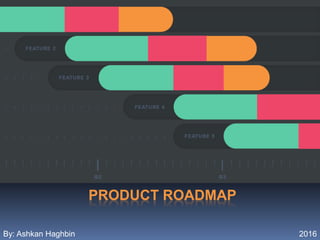



PRODUCT ROADMAP
By: Ashkan Haghbin 2016
Your product roadmap should define your product’s journeyover time
and highlight important milestonesthroughout that journey
 Where Are You Going?
 How Are You Getting There?
 Why Are You Going?
Before You Begin
Where Are You Going?
Your Product Visionis the guiding force behind every decision you make
in your product’s lifecycle
 Product Vision Should Align with BusinessStrategy
How Are You Getting There?
 Minding Your Metrics
Certain actions have a greater impact on your progress than others, some
initiatives will drive your product toward where you want it to be at a faster pace
than others
Why Are You Going?
Customers Are Your #1 Priority
There shouldn’t be anything that goes on your roadmap that doesn’t help
soothe customer pain and solve their problems.
Get Your Priorities Straight!
Your product shouldn’t try to do everything and neither should you.
The Doctor is In
Start by Diagnosing & Curing Customer Pain
 Feedback and Complaints are excellent sources of information about customer pain
 First gauge the severity of the problem, then determine the frequency of the pain
The Matrix Approach
Prioritizing by Impact & Effort
Impact & Effort Matrix
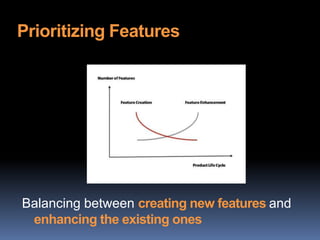
Prioritizing Features
Balancing between creating new features and
enhancing the existing ones
Dealing with Uncertainty
What about when you can’t measure or estimate the expected impact of an initiative?
Taking the Lean Startup principle: MinimumViable Feature (MVF) Approach
Build-Measure-Learn tactic
 Start by implementing one or two options that preliminary research shows will be popular
 Then, use your predefined KPIs to prove (or disprove) your hypothesis
 Validate whether you should continue building the feature out fully or leave it alone
Cleaning up your Backlog
What to do with the features and initiatives that are always picked last?
1. They require too many resources to implement.
2. They aren’t expected to have enough impact to justify building.
 Is this an item your organization HAS to do or simply WANTS to do?
 When it’s resource intensive “want to do,” you need to build out the business case
Cleaning up your Backlog
It’s best to take care of these “have to do” items at your convenience and on your own
terms, rather than leave them looming in the background of your product backlog
because it allows you to have a bit more control.
Maintaining a Healthy Roadmap
Feeding Your Roadmap a Balanced Diet
Don’t let shiny new toys and short term goals blur your productvision.
“Bucket” approach: categorizing initiatives into several “buckets” and making sure every
release has a balance of items from each category
Validate Feedback Before Building
Just Like Fine Wine, a Customer Request Improves With Age
When you allow customer requests to simmer for a bit, you give yourself the opportunity to collect
feedback from more customers and validate whether the request is worth acting on and whether
the customer who first requested the feature still wants it the next time you talk to them.
Avoid Feature Bloat
Don’t Overpack your Product with Extra Bells and Whistles
Features don’t come without a price, and investing in adding a new feature means
budgeting for more than just development and implementation.
New functions and features come with complexitycosts for customers
A Word on Healthy Competition
Instead of trying to keep up with your competitors’ new releases and functionalities,
use them as a source for inspiration - they chose to solve a customer problem with
Feature X, but are there other (and better) ways to solve it?
Don’t Let Competition Distract from Vision (or Dictate Roadmap Decisions)
Reference
 Get Your Priorities Straight!, A Practical Guide to Smart Roadmap
Prioritization for Product Managers, www.uservoice.com

Product Roadmap

  • 1.
  • 2.
    Your product roadmapshould define your product’s journeyover time and highlight important milestonesthroughout that journey  Where Are You Going?  How Are You Getting There?  Why Are You Going? Before You Begin
  • 3.
    Where Are YouGoing? Your Product Visionis the guiding force behind every decision you make in your product’s lifecycle  Product Vision Should Align with BusinessStrategy
  • 5.
    How Are YouGetting There?  Minding Your Metrics Certain actions have a greater impact on your progress than others, some initiatives will drive your product toward where you want it to be at a faster pace than others
  • 6.
    Why Are YouGoing? Customers Are Your #1 Priority There shouldn’t be anything that goes on your roadmap that doesn’t help soothe customer pain and solve their problems.
  • 7.
    Get Your PrioritiesStraight! Your product shouldn’t try to do everything and neither should you.
  • 8.
    The Doctor isIn Start by Diagnosing & Curing Customer Pain  Feedback and Complaints are excellent sources of information about customer pain  First gauge the severity of the problem, then determine the frequency of the pain
  • 9.
  • 10.
  • 11.
    Prioritizing Features Balancing betweencreating new features and enhancing the existing ones
  • 12.
    Dealing with Uncertainty Whatabout when you can’t measure or estimate the expected impact of an initiative? Taking the Lean Startup principle: MinimumViable Feature (MVF) Approach Build-Measure-Learn tactic  Start by implementing one or two options that preliminary research shows will be popular  Then, use your predefined KPIs to prove (or disprove) your hypothesis  Validate whether you should continue building the feature out fully or leave it alone
  • 13.
    Cleaning up yourBacklog What to do with the features and initiatives that are always picked last? 1. They require too many resources to implement. 2. They aren’t expected to have enough impact to justify building.  Is this an item your organization HAS to do or simply WANTS to do?  When it’s resource intensive “want to do,” you need to build out the business case
  • 14.
    Cleaning up yourBacklog It’s best to take care of these “have to do” items at your convenience and on your own terms, rather than leave them looming in the background of your product backlog because it allows you to have a bit more control.
  • 15.
    Maintaining a HealthyRoadmap Feeding Your Roadmap a Balanced Diet Don’t let shiny new toys and short term goals blur your productvision. “Bucket” approach: categorizing initiatives into several “buckets” and making sure every release has a balance of items from each category
  • 16.
    Validate Feedback BeforeBuilding Just Like Fine Wine, a Customer Request Improves With Age When you allow customer requests to simmer for a bit, you give yourself the opportunity to collect feedback from more customers and validate whether the request is worth acting on and whether the customer who first requested the feature still wants it the next time you talk to them.
  • 17.
    Avoid Feature Bloat Don’tOverpack your Product with Extra Bells and Whistles Features don’t come without a price, and investing in adding a new feature means budgeting for more than just development and implementation. New functions and features come with complexitycosts for customers
  • 18.
    A Word onHealthy Competition Instead of trying to keep up with your competitors’ new releases and functionalities, use them as a source for inspiration - they chose to solve a customer problem with Feature X, but are there other (and better) ways to solve it? Don’t Let Competition Distract from Vision (or Dictate Roadmap Decisions)
  • 20.
    Reference  Get YourPriorities Straight!, A Practical Guide to Smart Roadmap Prioritization for Product Managers, www.uservoice.com