


LEAN
STARTUP
WORKSHOP
AGENDA
1. Intro
2. Overview of the bases of Lean Startup
   1. Lean Manufacturing
   2. Customer Development
   3. Agile Development
3. Entrepreneurship is Management
4. Validated Learning
5. Build - Measure – Learn
6. Innovation Accounting
INTRO
WHAT IS A STARTUP?
• A startup is a human institution designed to deliver a new
  product or service under conditions of extreme
  uncertainty.
• Nothing to do with size of company, sector of the
  economy or industry
WHY DO STARTUPS
FAIL
• Rarely fail because the product doesn’t work
• Usually fail because there are no customers
• Quality of the initial idea is not correlated with success
• Startups that succeed are those that manage to iterate
  enough times before they run out of resources
• Time between these iterations is fundamental
THE LEAN STARTUP
• Anything we can do to shrink the time between major
  iterations will increase the likelihood of success.
• Speed is the Startup competitive advantage.
LEAN STARTUPS GO
FASTER
• Commodity technology stack, highly leveraged (free/open
Source, user‐generated content, SEM).
• Customer development – find out what customers want
  before you build it.
• Agile software development – but tuned to the startup
  condition.
CUSTOMER
DEVELOPME
NT
BASES OF LEAN STARTUP
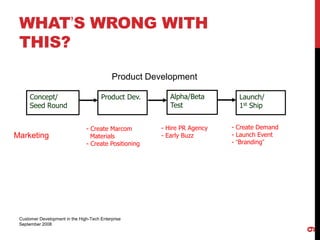
WHAT’S WRONG WITH
 THIS?

                                            Product Development

      Concept/                         Product Dev.       Alpha/Beta        Launch/
      Seed Round                                          Test              1st Ship


                                - Create Marcom        - Hire PR Agency   - Create Demand
Marketing                         Materials            - Early Buzz       - Launch Event
                                - Create Positioning                      - “Branding”


 Customer Development in the High-Tech Enterprise
 September 2008


                                                                                            9
BUILD IT AND THEY
WILL COME
Only true for life and death products
  • i.e. Biotech Cancer Cure
  • Issues are development risks and distribution,
    not customer acceptance
Not true for most other products
  • Software, Consumer, Web
  • Issues are customer acceptance and market adoption
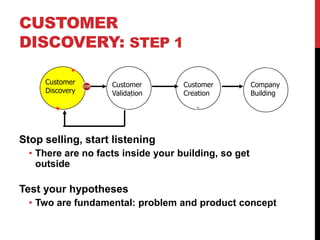
CUSTOMER
DISCOVERY: STEP 1

     Customer       Customer        Customer          Company
     Discovery      Validation      Creation          Building


Stop selling, start listening
  • There are no facts inside your building, so get
    outside

Test your hypotheses
  • Two are fundamental: problem and product concept
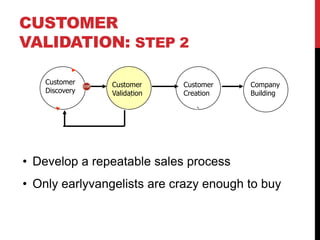
CUSTOMER
VALIDATION: STEP 2

    Customer    Customer     Customer   Company
    Discovery   Validation   Creation   Building


• Develop a repeatable sales process
• Only earlyvangelists are crazy enough to buy
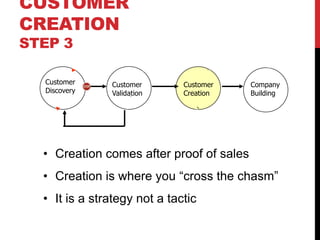
CUSTOMER
CREATION
STEP 3

  Customer     Customer       Customer    Company
  Discovery    Validation     Creation    Building


  • Creation comes after proof of sales
  • Creation is where you “cross the chasm”
  • It is a strategy not a tactic
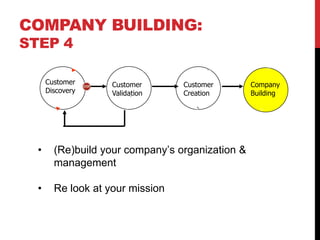
COMPANY BUILDING:
STEP 4

      Customer      Customer      Customer        Company
      Discovery     Validation    Creation        Building


  •     (Re)build your company’s organization &
        management

  •     Re look at your mission
GENCHI
GEMBUTSU
GO AND SEE FOR YOURSELF
“GET OUT OF THE BUILDING” STEVE BLANK
LEAN
MANUFACT
URING
BASES OF LEAN STARTUP
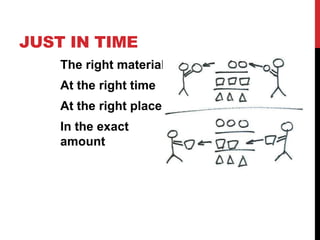
JUST IN TIME
    The right material
    At the right time
    At the right place
    In the exact
    amount
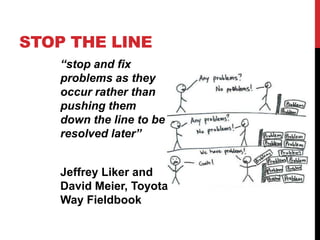
STOP THE LINE
    “stop and fix
    problems as they
    occur rather than
    pushing them
    down the line to be
    resolved later”


    Jeffrey Liker and
    David Meier, Toyota
    Way Fieldbook
THE ESSENCE OF LEAN IS ENGAGING
EVERYONE IN IDENTIFYING AND
SOLVING PROBLEMS
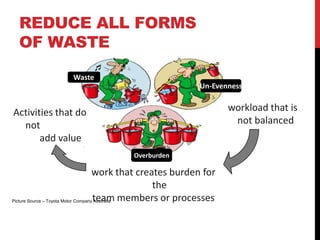
REDUCE ALL FORMS
  OF WASTE

                   Waste
                                                            Un-Evenness


Activities that do                                                  workload that is
  not                                                                not balanced
       add value
                                      Overburden

                                     work that creates burden for
                                                   the
Picture Source – Toyota Motor Company team members or processes
                                      Australia
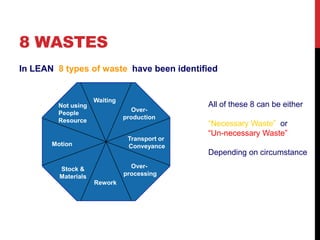
8 WASTES
In LEAN 8 types of waste have been identified


                     Waiting
        Not using                              All of these 8 can be either
                                 Over-
        People
                               production
        Resource
                                               “Necessary Waste” or
                                               “Un-necessary Waste”
                                Transport or
       Motion                   Conveyance
                                               Depending on circumstance

         Stock &                 Over-
         Materials             processing
                     Rework
AGILE
DEVELOPMENT

BASES OF LEAN STARTUP
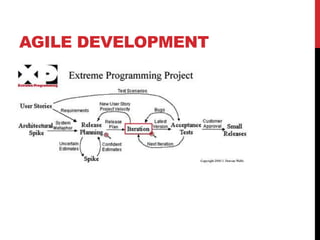
AGILE DEVELOPMENT


   Solution: Unknown
COMMODITY
TECHNOLOGY STACK
• Leverage = for each ounce of effort you invest in your
  product, you take advantage of the efforts of thousands or
  millions of others.
• It’s easy to see how high‐leverage technology is driving
  costs down.
• More important is its impact on speed.
• Time to bring a new product to market is falling rapidly.


• 

ENTREPRENEUR
SHIP IS
MANAGEMENT
THAT SOUNDS BORING
BUSINESS PLAN VS JUST
DO IT SCHOOL OF
ENTREPRENEURSHIP
• Business Plan
   • A business plan never survives a client first contact
   • A bad plan greatly executed = dead company
• Just do it
    • Have you ever cut a chicken’s head? (you got the picture)
STARTUP = EXPERIMENT
VALUE OF A STARTUP =
VALIDATED LEARNING
• What products do customers really want?
• How will the product grow?
• Who is our customer?
• Which customer should we listen to and which should we
  ignore?
VALIDATED
LEARNING
VALIDATED LEARNING
Focus energies on validated learning, learning where and
when to invest energy results in saving time and money


To apply scientific method, we need to identify which
hypotheses to test.
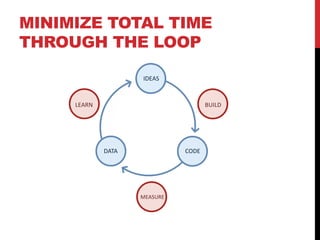
MINIMIZE TOTAL TIME
THROUGH TOTAL J me through the loop
     Minimize
              THE LOOP

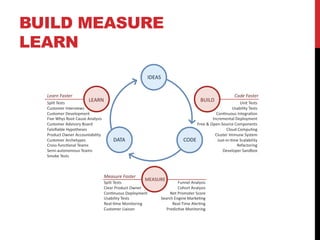
                        IDEAS


         LEARN                           BUILD


                 DATA             CODE


                        MEASURE
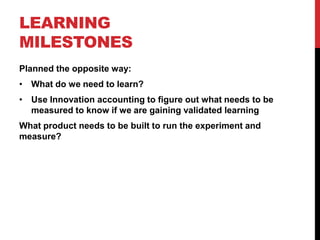
LEARNING
MILESTONES
Planned the opposite way:
• What do we need to learn?
• Use Innovation accounting to figure out what needs to be
  measured to know if we are gaining validated learning
What product needs to be built to run the experiment and
measure?
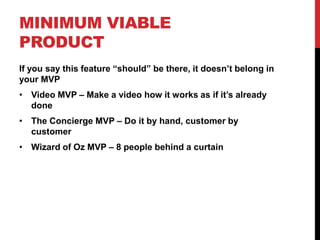
MINIMUM VIABLE
PRODUCT
If you say this feature “should” be there, it doesn’t belong in
your MVP
• Video MVP – Make a video how it works as if it’s already
  done
• The Concierge MVP – Do it by hand, customer by
  customer
• Wizard of Oz MVP – 8 people behind a curtain
QUALITY IN
AN MVP
IF WE DON’T KNOW WHO THE CUSTOMER
IS, WE DON’T KNOW WHAT QUALITY IS
STARTUP’S JOB
• Measure where it right and wrong
• Confronting hard truths
• Devise Experiments to learn how to move the real
  numbers closer to the ideal reflected in the business plan
BUILD
MEASURE
LEARN
BUILD MEASURE
LEARN
EXPERIMENTS
• Do them with early adopters, not average customers


• GOAL: Measure what customers did (unlike focus groups)


• An experiment is a PRODUCT
YOUR TWO MOST
IMPORTANT
ASSUMPTIONS
• Value Hypothesis
• Growth Hypothesis
INNOVATION
ACCOUNTING
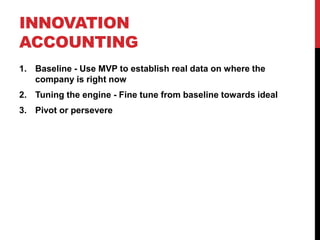
INNOVATION
ACCOUNTING
1. Baseline - Use MVP to establish real data on where the
   company is right now
2. Tuning the engine - Fine tune from baseline towards ideal
3. Pivot or persevere
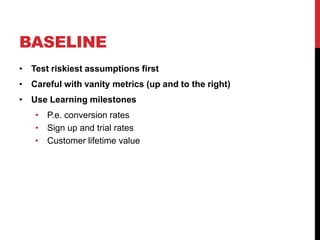
BASELINE
• Test riskiest assumptions first
• Careful with vanity metrics (up and to the right)
• Use Learning milestones
   • P.e. conversion rates
   • Sign up and trial rates
   • Customer lifetime value
TUNING THE ENGINE
• Work towards second learning milestones
• Every prod. Dev, marketing should be targeted at
  improving one of the drivers of it’s growth model
PIVOT OR PERSEVERE
Schedule a regular meeting (every 6 weeks, for instance)


Startups that fails to converge to something like the ideal:
time to pivot
FUNNEL METRICS
Behaviors critical to engine of Growth (specific to each
business)


• Customer registration
• Downloads
• Trials
• Repeat Usage
• Purchase
COHORT ANALYSIS
• One of the most important tools of Startup Analysis
• Don’t look at cumulative totals or gross numbers like total
  revenue and total number of customers
• Look at performance of each group of customers
• Each group is called a Cohort
VANITY METRICS
• Gross Metrics
• Total Registered User
• Total Paying customers,
• etc
INSTEAD OF
VANITY
METRICS
USE COHORT ANALYSIS AND SPLIT TESTS
THE 3 AAA OF
METRICS
• Actionable – Must demonstrate clear cause and effect
• Accessible – Make reports as simple as possible so that
  everyone understands them
• Auditable – Ensure data is credible
PIVOT
Structured Course Correction designed to test a new
fundamental hypothesis about a product, strategy and
engine of growth.


A pivot requires that we keep one foot rooted in what we’ve
learned so far, while making a fundamental change in
strategy
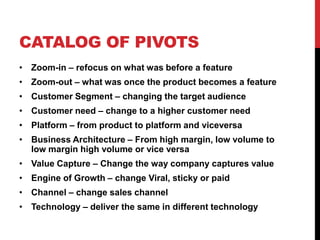
CATALOG OF PIVOTS
• Zoom-in – refocus on what was before a feature
• Zoom-out – what was once the product becomes a feature
• Customer Segment – changing the target audience
• Customer need – change to a higher customer need
• Platform – from product to platform and viceversa
• Business Architecture – From high margin, low volume to
  low margin high volume or vice versa
• Value Capture – Change the way company captures value
• Engine of Growth – change Viral, sticky or paid
• Channel – change sales channel
• Technology – deliver the same in different technology
BATCH
A CAUTIONARY TALE ABOUT LETTERS
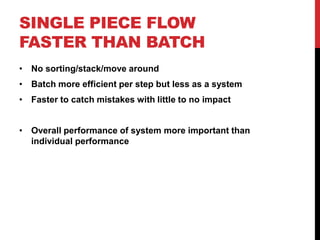
SINGLE PIECE FLOW
FASTER THAN BATCH
• No sorting/stack/move around
• Batch more efficient per step but less as a system
• Faster to catch mistakes with little to no impact


• Overall performance of system more important than
  individual performance
ENGINE OF
GROWTH
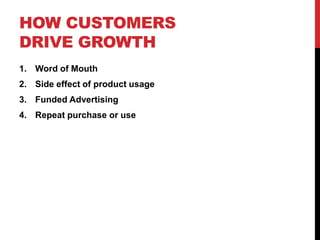
HOW CUSTOMERS
DRIVE GROWTH
1. Word of Mouth
2. Side effect of product usage
3. Funded Advertising
4. Repeat purchase or use
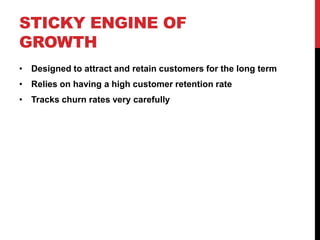
STICKY ENGINE OF
GROWTH
• Designed to attract and retain customers for the long term
• Relies on having a high customer retention rate
• Tracks churn rates very carefully
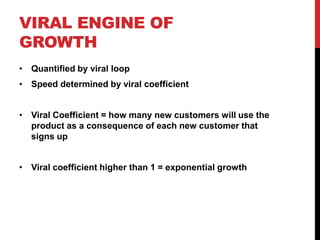
VIRAL ENGINE OF
GROWTH
• Quantified by viral loop
• Speed determined by viral coefficient


• Viral Coefficient = how many new customers will use the
  product as a consequence of each new customer that
  signs up


• Viral coefficient higher than 1 = exponential growth
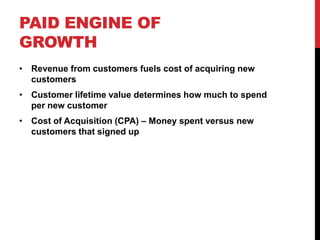
PAID ENGINE OF
GROWTH
• Revenue from customers fuels cost of acquiring new
  customers
• Customer lifetime value determines how much to spend
  per new customer
• Cost of Acquisition (CPA) – Money spent versus new
  customers that signed up
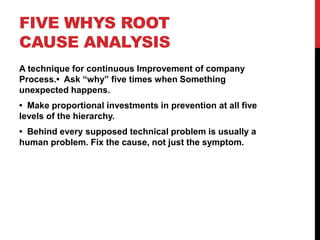
FIVE WHYS ROOT
CAUSE ANALYSIS
A technique for continuous Improvement of company
Process.• Ask “why” five times when Something
unexpected happens.
• Make proportional investments in prevention at all five
levels of the hierarchy.
• Behind every supposed technical problem is usually a
human problem. Fix the cause, not just the symptom.
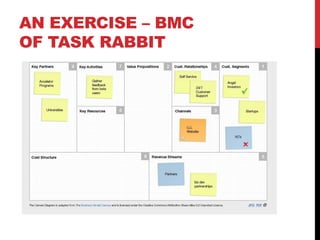
AN EXERCISE – BMC
OF TASK RABBIT

Lean startupworkshop

  • 1.
  • 2.
    AGENDA 1. Intro 2. Overviewof the bases of Lean Startup 1. Lean Manufacturing 2. Customer Development 3. Agile Development 3. Entrepreneurship is Management 4. Validated Learning 5. Build - Measure – Learn 6. Innovation Accounting
  • 3.
  • 4.
    WHAT IS ASTARTUP? • A startup is a human institution designed to deliver a new product or service under conditions of extreme uncertainty. • Nothing to do with size of company, sector of the economy or industry
  • 5.
    WHY DO STARTUPS FAIL •Rarely fail because the product doesn’t work • Usually fail because there are no customers • Quality of the initial idea is not correlated with success • Startups that succeed are those that manage to iterate enough times before they run out of resources • Time between these iterations is fundamental
  • 6.
    THE LEAN STARTUP •Anything we can do to shrink the time between major iterations will increase the likelihood of success. • Speed is the Startup competitive advantage.
  • 7.
    LEAN STARTUPS GO FASTER •Commodity technology stack, highly leveraged (free/open Source, user‐generated content, SEM). • Customer development – find out what customers want before you build it. • Agile software development – but tuned to the startup condition.
  • 8.
  • 9.
    WHAT’S WRONG WITH THIS? Product Development Concept/ Product Dev. Alpha/Beta Launch/ Seed Round Test 1st Ship - Create Marcom - Hire PR Agency - Create Demand Marketing Materials - Early Buzz - Launch Event - Create Positioning - “Branding” Customer Development in the High-Tech Enterprise September 2008 9
  • 10.
    BUILD IT ANDTHEY WILL COME Only true for life and death products • i.e. Biotech Cancer Cure • Issues are development risks and distribution, not customer acceptance Not true for most other products • Software, Consumer, Web • Issues are customer acceptance and market adoption
  • 11.
    CUSTOMER DISCOVERY: STEP 1 Customer Customer Customer Company Discovery Validation Creation Building Stop selling, start listening • There are no facts inside your building, so get outside Test your hypotheses • Two are fundamental: problem and product concept
  • 12.
    CUSTOMER VALIDATION: STEP 2 Customer Customer Customer Company Discovery Validation Creation Building • Develop a repeatable sales process • Only earlyvangelists are crazy enough to buy
  • 13.
    CUSTOMER CREATION STEP 3 Customer Customer Customer Company Discovery Validation Creation Building • Creation comes after proof of sales • Creation is where you “cross the chasm” • It is a strategy not a tactic
  • 14.
    COMPANY BUILDING: STEP 4 Customer Customer Customer Company Discovery Validation Creation Building • (Re)build your company’s organization & management • Re look at your mission
  • 15.
    GENCHI GEMBUTSU GO AND SEEFOR YOURSELF “GET OUT OF THE BUILDING” STEVE BLANK
  • 16.
  • 17.
    JUST IN TIME The right material At the right time At the right place In the exact amount
  • 18.
    STOP THE LINE “stop and fix problems as they occur rather than pushing them down the line to be resolved later” Jeffrey Liker and David Meier, Toyota Way Fieldbook
  • 19.
    THE ESSENCE OFLEAN IS ENGAGING EVERYONE IN IDENTIFYING AND SOLVING PROBLEMS
  • 20.
    REDUCE ALL FORMS OF WASTE Waste Un-Evenness Activities that do workload that is not not balanced add value Overburden work that creates burden for the Picture Source – Toyota Motor Company team members or processes Australia
  • 21.
    8 WASTES In LEAN8 types of waste have been identified Waiting Not using All of these 8 can be either Over- People production Resource “Necessary Waste” or “Un-necessary Waste” Transport or Motion Conveyance Depending on circumstance Stock & Over- Materials processing Rework
  • 22.
  • 23.
    AGILE DEVELOPMENT Solution: Unknown
  • 24.
    COMMODITY TECHNOLOGY STACK • Leverage= for each ounce of effort you invest in your product, you take advantage of the efforts of thousands or millions of others. • It’s easy to see how high‐leverage technology is driving costs down. • More important is its impact on speed. • Time to bring a new product to market is falling rapidly.

 • 

  • 25.
  • 26.
    BUSINESS PLAN VSJUST DO IT SCHOOL OF ENTREPRENEURSHIP • Business Plan • A business plan never survives a client first contact • A bad plan greatly executed = dead company • Just do it • Have you ever cut a chicken’s head? (you got the picture)
  • 27.
  • 28.
    VALUE OF ASTARTUP = VALIDATED LEARNING • What products do customers really want? • How will the product grow? • Who is our customer? • Which customer should we listen to and which should we ignore?
  • 29.
  • 30.
    VALIDATED LEARNING Focus energieson validated learning, learning where and when to invest energy results in saving time and money To apply scientific method, we need to identify which hypotheses to test.
  • 31.
    MINIMIZE TOTAL TIME THROUGHTOTAL J me through the loop Minimize THE LOOP IDEAS LEARN BUILD DATA CODE MEASURE
  • 32.
    LEARNING MILESTONES Planned the oppositeway: • What do we need to learn? • Use Innovation accounting to figure out what needs to be measured to know if we are gaining validated learning What product needs to be built to run the experiment and measure?
  • 33.
    MINIMUM VIABLE PRODUCT If yousay this feature “should” be there, it doesn’t belong in your MVP • Video MVP – Make a video how it works as if it’s already done • The Concierge MVP – Do it by hand, customer by customer • Wizard of Oz MVP – 8 people behind a curtain
  • 34.
    QUALITY IN AN MVP IFWE DON’T KNOW WHO THE CUSTOMER IS, WE DON’T KNOW WHAT QUALITY IS
  • 35.
    STARTUP’S JOB • Measurewhere it right and wrong • Confronting hard truths • Devise Experiments to learn how to move the real numbers closer to the ideal reflected in the business plan
  • 36.
  • 37.
  • 38.
    EXPERIMENTS • Do themwith early adopters, not average customers • GOAL: Measure what customers did (unlike focus groups) • An experiment is a PRODUCT
  • 39.
    YOUR TWO MOST IMPORTANT ASSUMPTIONS •Value Hypothesis • Growth Hypothesis
  • 40.
  • 41.
    INNOVATION ACCOUNTING 1. Baseline -Use MVP to establish real data on where the company is right now 2. Tuning the engine - Fine tune from baseline towards ideal 3. Pivot or persevere
  • 42.
    BASELINE • Test riskiestassumptions first • Careful with vanity metrics (up and to the right) • Use Learning milestones • P.e. conversion rates • Sign up and trial rates • Customer lifetime value
  • 43.
    TUNING THE ENGINE •Work towards second learning milestones • Every prod. Dev, marketing should be targeted at improving one of the drivers of it’s growth model
  • 44.
    PIVOT OR PERSEVERE Schedulea regular meeting (every 6 weeks, for instance) Startups that fails to converge to something like the ideal: time to pivot
  • 45.
    FUNNEL METRICS Behaviors criticalto engine of Growth (specific to each business) • Customer registration • Downloads • Trials • Repeat Usage • Purchase
  • 46.
    COHORT ANALYSIS • Oneof the most important tools of Startup Analysis • Don’t look at cumulative totals or gross numbers like total revenue and total number of customers • Look at performance of each group of customers • Each group is called a Cohort
  • 47.
    VANITY METRICS • GrossMetrics • Total Registered User • Total Paying customers, • etc
  • 48.
    INSTEAD OF VANITY METRICS USE COHORTANALYSIS AND SPLIT TESTS
  • 49.
    THE 3 AAAOF METRICS • Actionable – Must demonstrate clear cause and effect • Accessible – Make reports as simple as possible so that everyone understands them • Auditable – Ensure data is credible
  • 50.
    PIVOT Structured Course Correctiondesigned to test a new fundamental hypothesis about a product, strategy and engine of growth. A pivot requires that we keep one foot rooted in what we’ve learned so far, while making a fundamental change in strategy
  • 51.
    CATALOG OF PIVOTS •Zoom-in – refocus on what was before a feature • Zoom-out – what was once the product becomes a feature • Customer Segment – changing the target audience • Customer need – change to a higher customer need • Platform – from product to platform and viceversa • Business Architecture – From high margin, low volume to low margin high volume or vice versa • Value Capture – Change the way company captures value • Engine of Growth – change Viral, sticky or paid • Channel – change sales channel • Technology – deliver the same in different technology
  • 52.
  • 53.
    SINGLE PIECE FLOW FASTERTHAN BATCH • No sorting/stack/move around • Batch more efficient per step but less as a system • Faster to catch mistakes with little to no impact • Overall performance of system more important than individual performance
  • 54.
  • 55.
    HOW CUSTOMERS DRIVE GROWTH 1.Word of Mouth 2. Side effect of product usage 3. Funded Advertising 4. Repeat purchase or use
  • 56.
    STICKY ENGINE OF GROWTH •Designed to attract and retain customers for the long term • Relies on having a high customer retention rate • Tracks churn rates very carefully
  • 57.
    VIRAL ENGINE OF GROWTH •Quantified by viral loop • Speed determined by viral coefficient • Viral Coefficient = how many new customers will use the product as a consequence of each new customer that signs up • Viral coefficient higher than 1 = exponential growth
  • 58.
    PAID ENGINE OF GROWTH •Revenue from customers fuels cost of acquiring new customers • Customer lifetime value determines how much to spend per new customer • Cost of Acquisition (CPA) – Money spent versus new customers that signed up
  • 59.
    FIVE WHYS ROOT CAUSEANALYSIS A technique for continuous Improvement of company Process.• Ask “why” five times when Something unexpected happens. • Make proportional investments in prevention at all five levels of the hierarchy. • Behind every supposed technical problem is usually a human problem. Fix the cause, not just the symptom.
  • 60.
    AN EXERCISE –BMC OF TASK RABBIT