OR:
HOW
I
LEARNED
TO
STOP
BEING
WASTEFUL
AND
LOVE
LEAN
UX
*	
  

NOT ACTUALLY A DOCTOR
LEAN UX IS NOT

Mysterious, complex, or even fundamentally new.
LEAN UX IS NOT

Cut back, slimmed down, or half-assed
UX involvement.
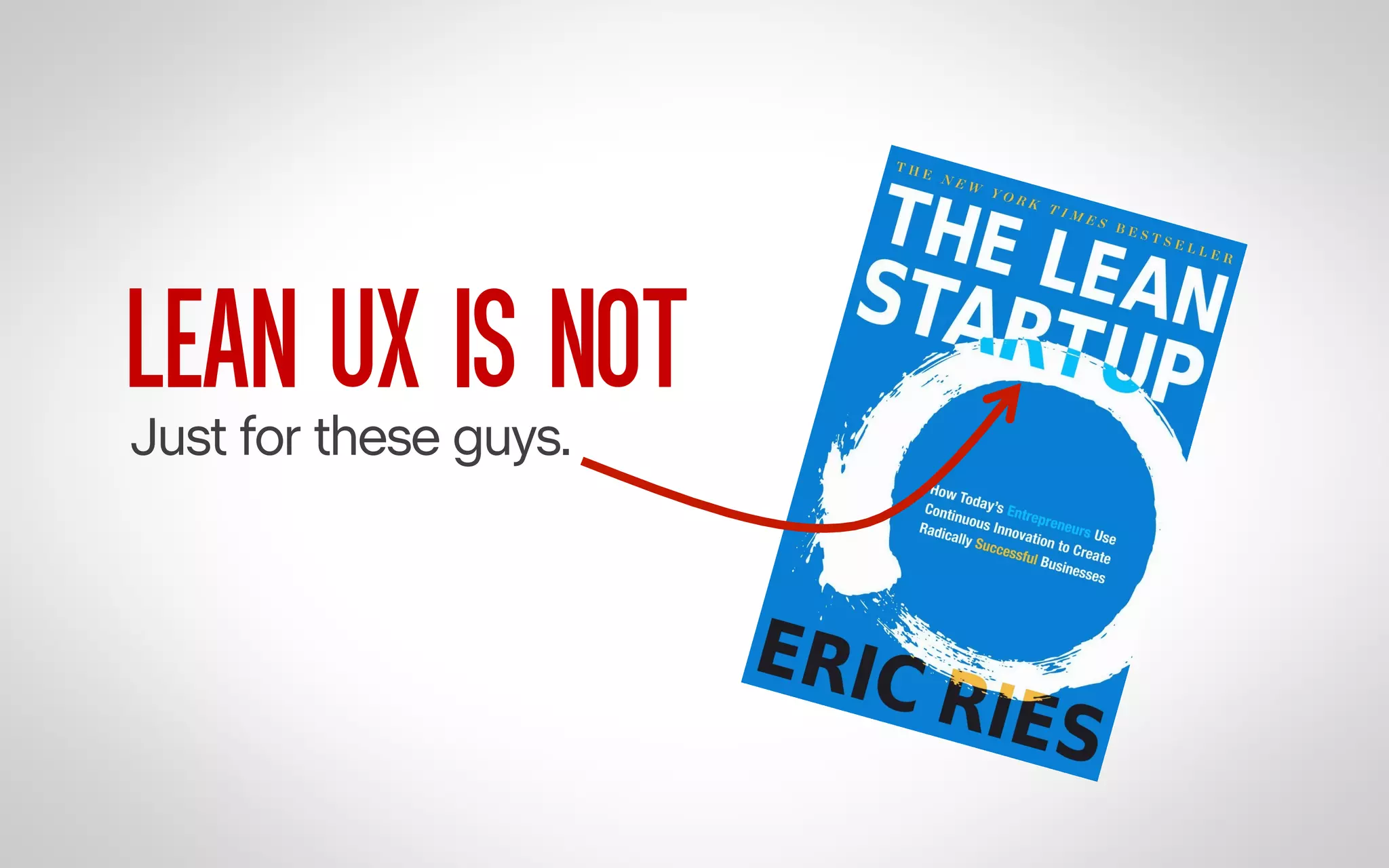
LEAN UX IS NOT

Just for these guys.
LEAN UX IS

User Experience Design combined with the
principles of Lean Startup…
“Lean UX is an important new way to think about what we do, and
I think there is real meat on it.” –Jared Spool
LEAN UX IS

…which were inspired by Lean manufacturing
principles…
“Lean UX is an important new way to think about what we do, and
I think there is real meat on it.” –Jared Spool
LEAN UX IS

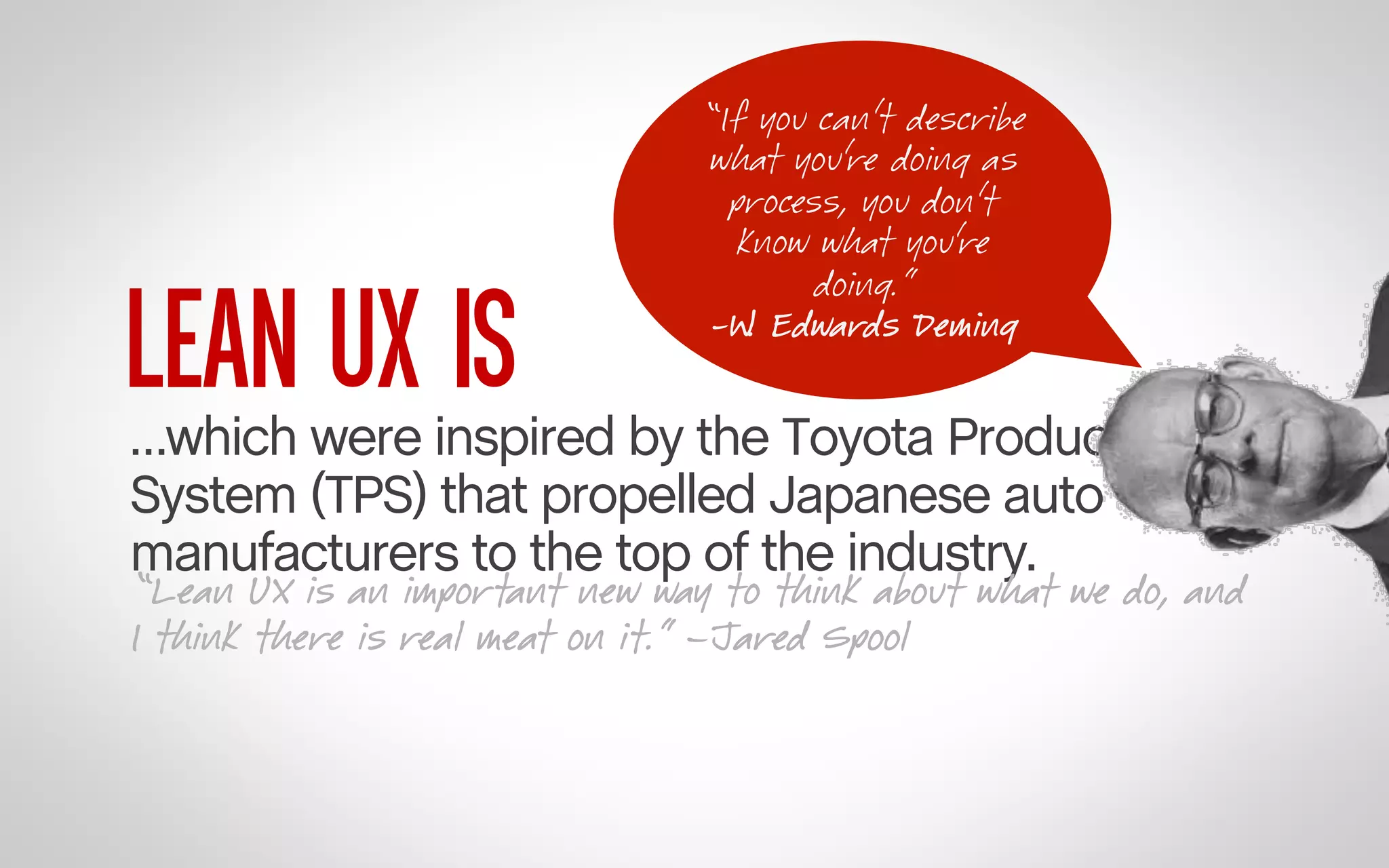
“If you can’t describe
what you’re doing as
process, you don’t
know what you’re
doing.”
-W. Edwards Deming 	
  

…which were inspired by the Toyota Production
System (TPS) that propelled Japanese auto
manufacturers to the top of the industry.

“Lean UX is an important new way to think about what we do, and
I think there is real meat on it.” –Jared Spool
LEAN UX IS

A tactic to remove waste from the design process.
“We move away from heavily documented handoffs to a process that
creates only the design artifacts we need to move the team’s
learning forward.” –Gothelf & Seidon
WASTE :

[weyst] noun	
  
A bad use of something valuable that you have only
a limited amount of.
E.G. A waste of time or money
WASTE :
“Any human activity which absorbs resources, but
creates no value.”
-James P Womak and Daniel T. Jones, Lean Thinking
LEAN UX IS

Influenced not only by Lean Startup, but Design
Thinking and Agile development.
LEAN UX IS

At it’s core, a mindset.
“Lean UX is the practice of bringing the true nature of a product
to light faster, in a collaborative, cross-functional way that
reduces the emphasis on thorough documentation while increasing
the focus on building a shared understanding of the actual product
experience being designed.” –Gothelf & Seidon
PROBLEM :

People are inherently poor at visualizing outcomes.
“The problem with much software development and UX Design is
that you spend months doing research, writing requirements,
designing wireframes and building software… and discover no
customer or software user cares.” –Will Evans
WHY LEAN UX?

Waterfall approaches are slow to
unearth design problems.
“In [our] new reality, traditional ‘get it all figured out first’
approaches are not workable.” –Gothelf & Seidon
WHY LEAN UX?

Right or wrong, stakeholders want to be heard.
Lean UX provides avenues to hear and test
stakeholder requests.
WHY LEAN UX?

In a competitive marketplace, results matter.
Product quality is paramount.
“At this point in experience design’s evolution, satisfaction ought to
be the norm, and delight ought to be the goal.” –Parrish Hanna
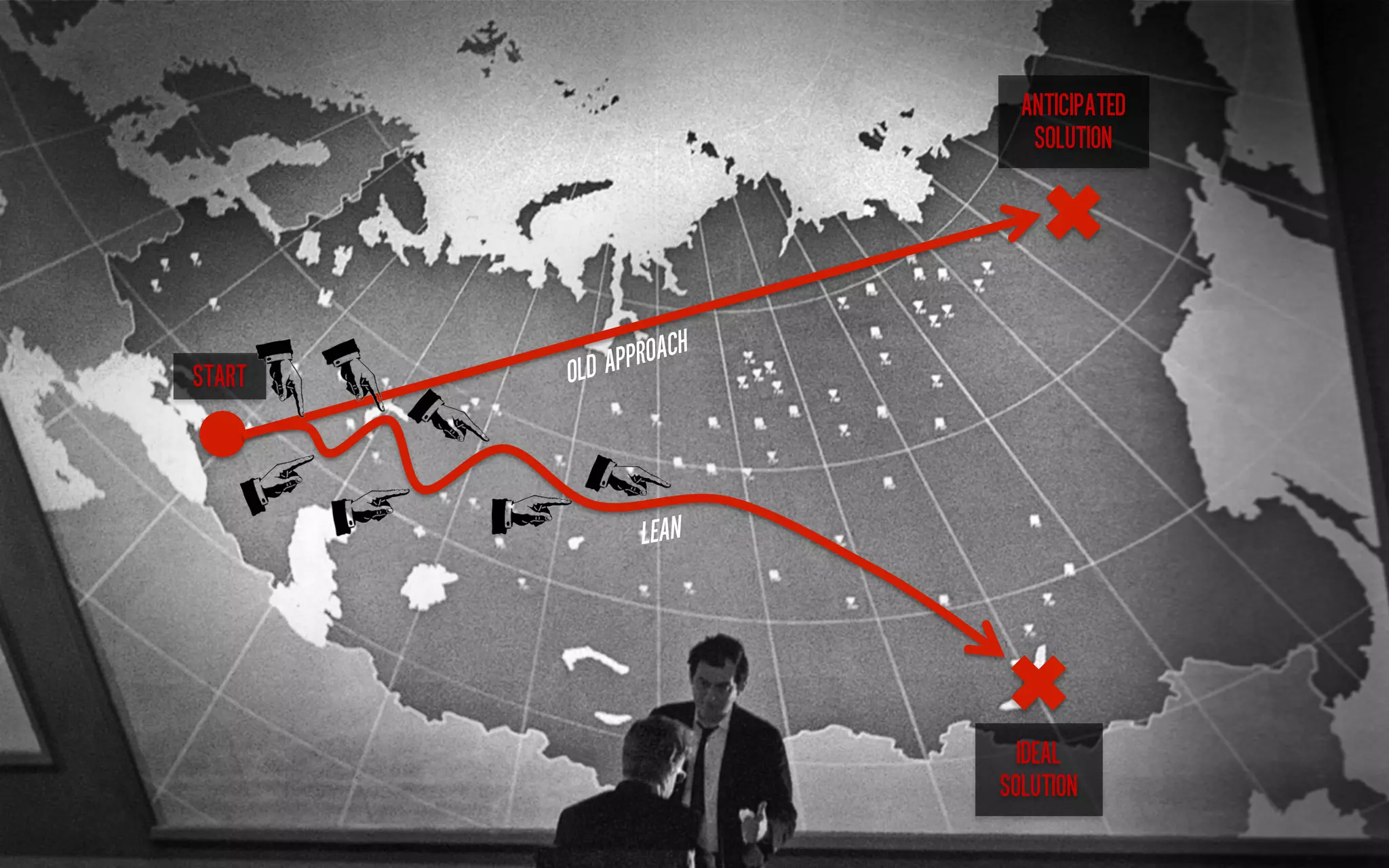
ANTICIPATED
SOLUTION	
  

START	
  

H	
  
APPROAC
OLD

LEAN	
  

IDEAL
SOLUTION	
  
COLLABORATE

Place an emphasis on individuals and interactions
over processes and tools…
“The needs of the many outweigh… the needs of the few… or the
one.” –Spock & Kirk
COLLABORATE

…Teams should be cross-functional and
collaborative, creating a “shared understanding”…
“[Lean methods] drive us to harmonize our ‘system’ of designers,
developers, product managers, quality assurance engineers,
marketers, and others in a transparent, cross-functional
collaboration that brings nondesigners into our design process.”
–Gothelf & Seidon
COLLABORATE

…an emphasis should be placed on stakeholder
collaboration over contract negotiation.
“Collaboration… creates consensus behind decisions… It also lessens
dependency on heavy documentation.” –Gothelf & Seidon
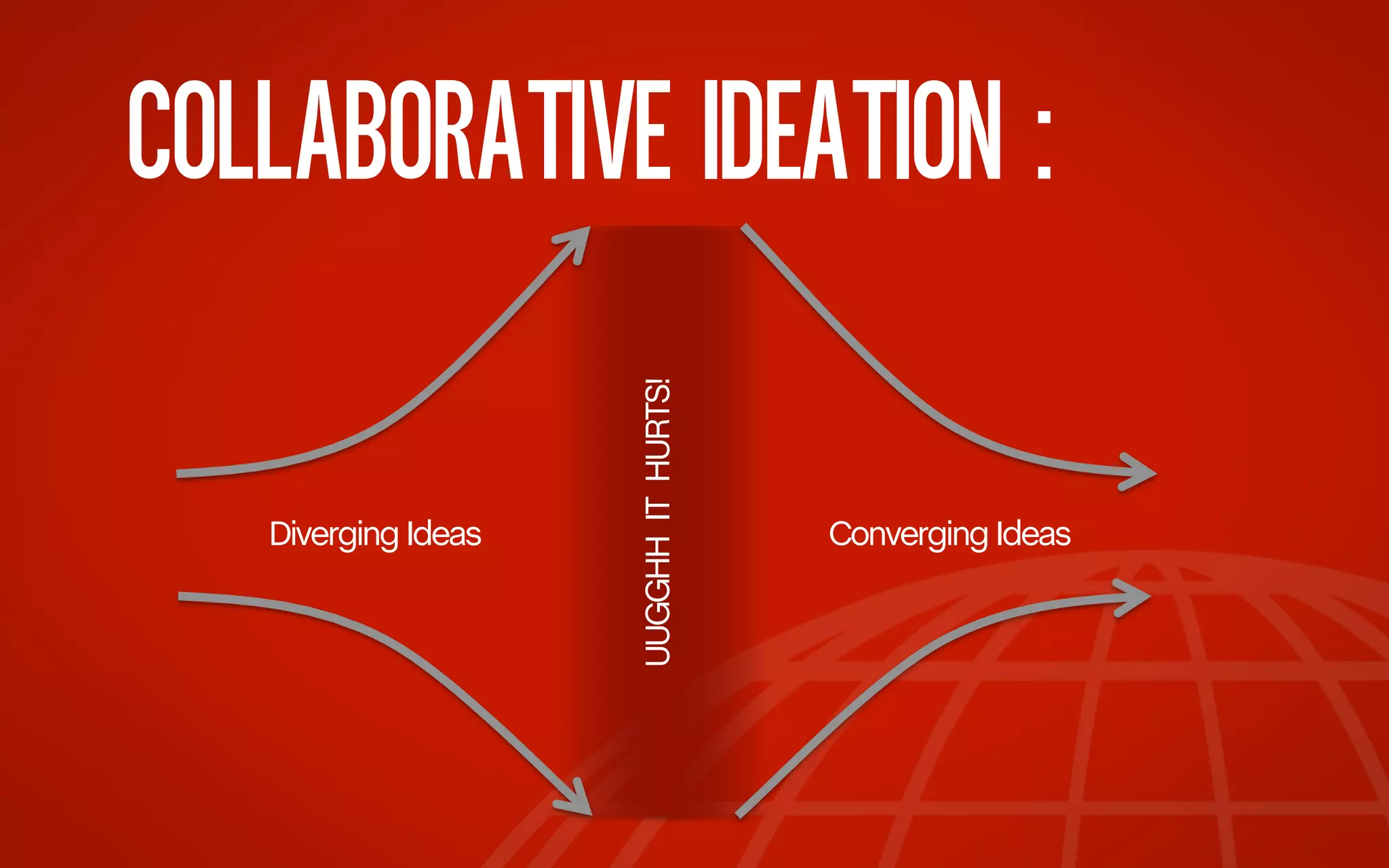
Diverging Ideas	
  

UUGGHH IT HURTS!	
  

COLLABORATIVE IDEATION :
Converging Ideas	
  
DESIGN SMALL

Design in small batches…
“This concept means creating only the design that is necessary to
move the team forward and avoid a big ‘inventory’ of untested and
unimplemented design ideas.” –Gothelf & Seidon
DESIGN SMALL

By using a Minimum Viable Product (MVP) you
uncover insights with minimal effort.
“Each design is a proposed business solution—a hypothesis… The
smallest thing you can build to test each hypothesis is your MVP.”
–Gothelf & Seidon
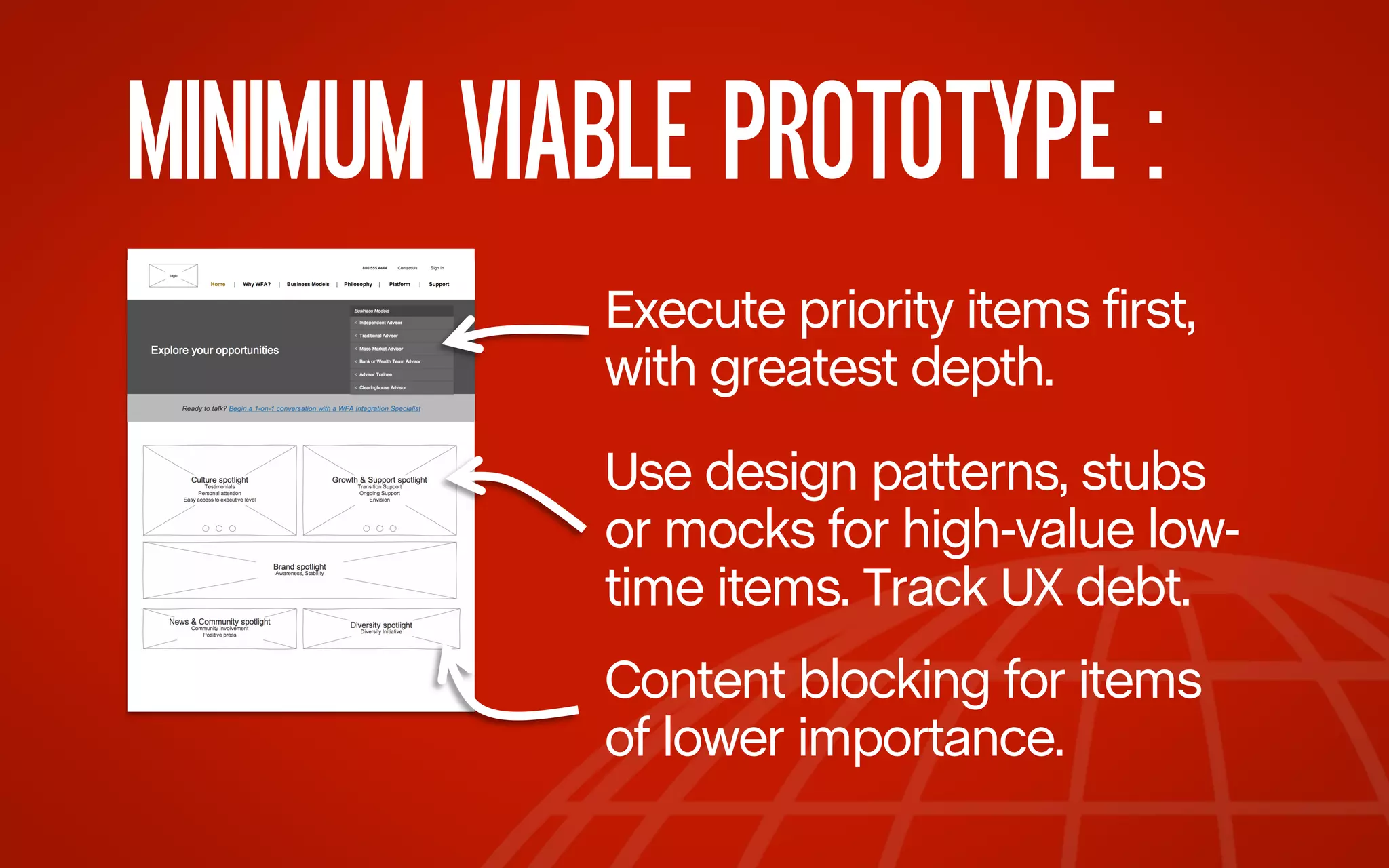
MINIMUM VIABLE PROTOTYPE :
Execute priority items first,
with greatest depth.
Use design patterns, stubs
or mocks for high-value lowtime items. Track UX debt.
Content blocking for items
of lower importance.
SHARE

Externalize your work. Be willing to share
unfinished and unpolished drafts.
“Externalizing means getting your work out of your head and out
of your computer and into public view.” –Gothelf & Seidon
SHARE

Making over debating. As quickly as possible put
your team’s design ideas into action.
“There is more value in creating the first version of an idea than
spending half a day debating its merits in a conference room… you
need to make something for people to respond to.”
–Gothelf & Seidon
REDUCE DELIVERABLES

Anything that doesn’t contribute to an outcome
is waste…
“In Lean UX the ultimate goal is improved outcomes… anything that
doesn’t contribute to that outcome is considered waste… the more
waste the team can eliminate, the faster they can move.”
–Gothelf & Seidon
REDUCE DELIVERABLES

…focus on outcomes, not outputs.
“A problem-focused team is one that has been assigned a business
problem to solve, as opposed to a set of features to implement.
This is the logical extension of the focus on outcomes.”
–Gothelf & Seidon
REMEMBER, WASTE IS :
“Any human activity which absorbs resources, but
creates no value.”
“With increased cross-functional collaboration, stakeholder
conversation becomes less about what artifact is being created and
more about which outcome is being achieved.” –Gothelf & Seidon
TEST ITERATIVELY

Continuous discovery—based on experimentation…
“Instead of relying on a hero designer to divine the best solution
from a single point of view, we use rapid experimentation and
measurement to learn… [by continuously] engaging the customer
during the design and development process.” –Gothelf & Seidon
TEST ITERATIVELY

…Get out of the building.

“The realization that meeting-room debates about user needs won’t
be settled conclusively within your office… research involves the
entire team.” –Gothelf & Seidon
FAIL

Permission to fail—as soon as possible.
“Permission to fail means that the team has a safe environment in
which to experiment.” –Gothelf & Seidon
LEARN

Learning as you move forward is more important
than scaling. Broad feature deployment creates
intense risk and inhibits learning.
“Ensuring that an idea is right before scaling it out mitigates the
risk inherent in broad feature deployment.” –Gothelf & Seidon
ANTI-PATTERN

Rockstars, Gurus, and Ninjas.
“Rockstars don’t share—neither their ideas nor the spotlight.
Team cohesion breaks down when you add individuals with
large egos.” –Gothelf & Seidon
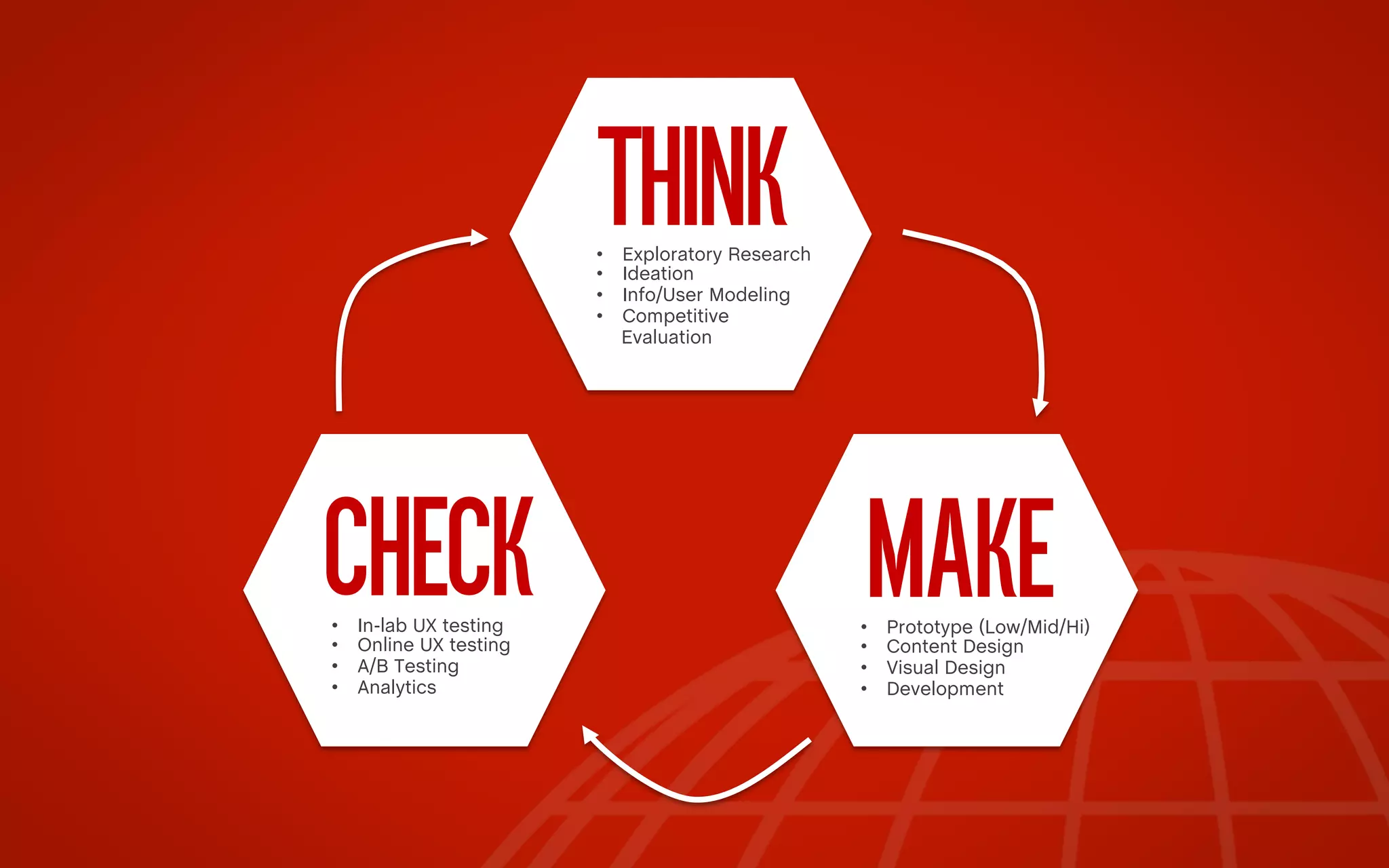
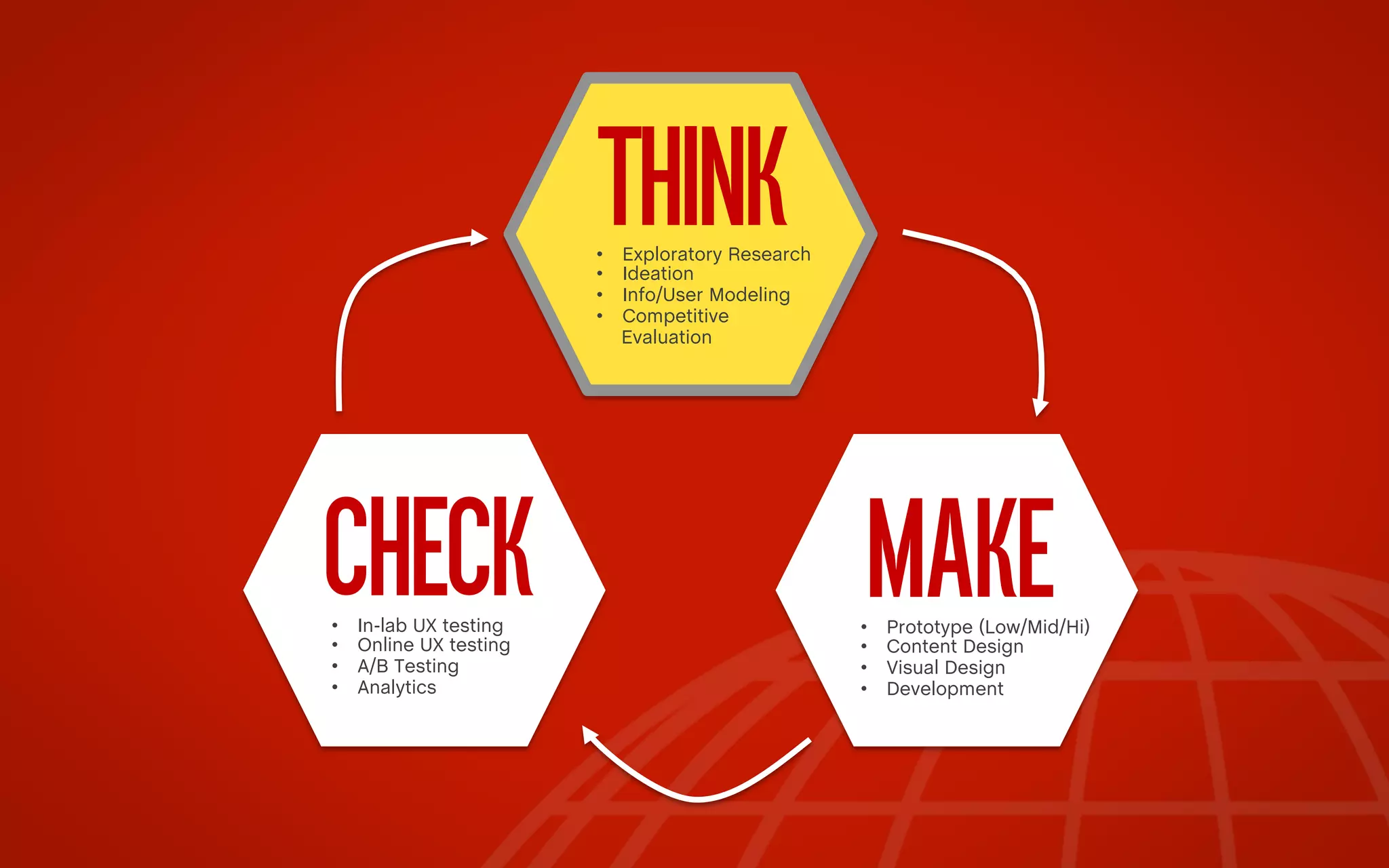
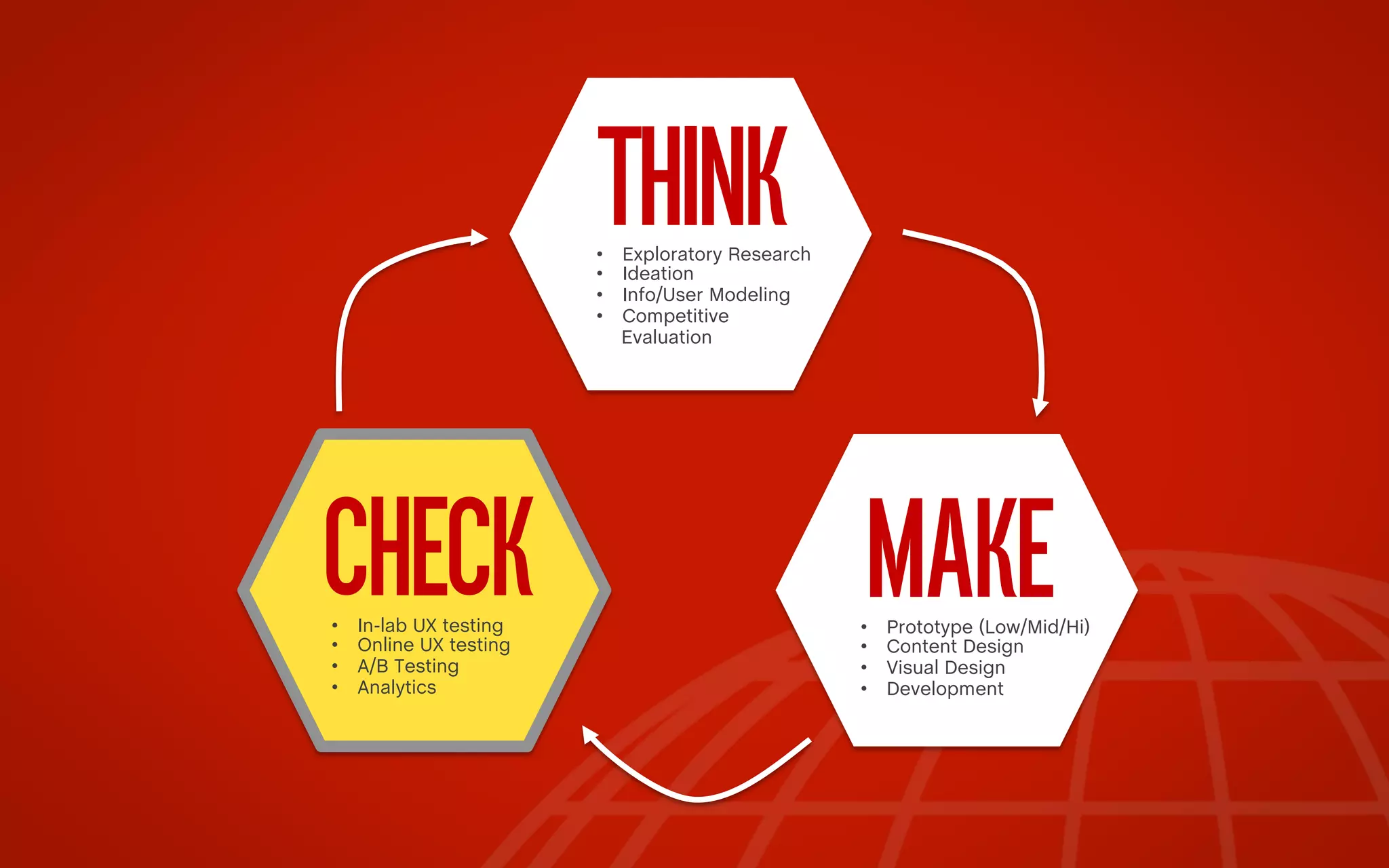
THINK

• 
• 
• 
• 

CHECK
• 
• 
• 
• 

In-lab UX testing
Online UX testing
A/B Testing
Analytics

Exploratory Research
Ideation
Info/User Modeling
Competitive
Evaluation

• 
• 
• 
• 

MAKE

Prototype (Low/Mid/Hi)
Content Design
Visual Design
Development
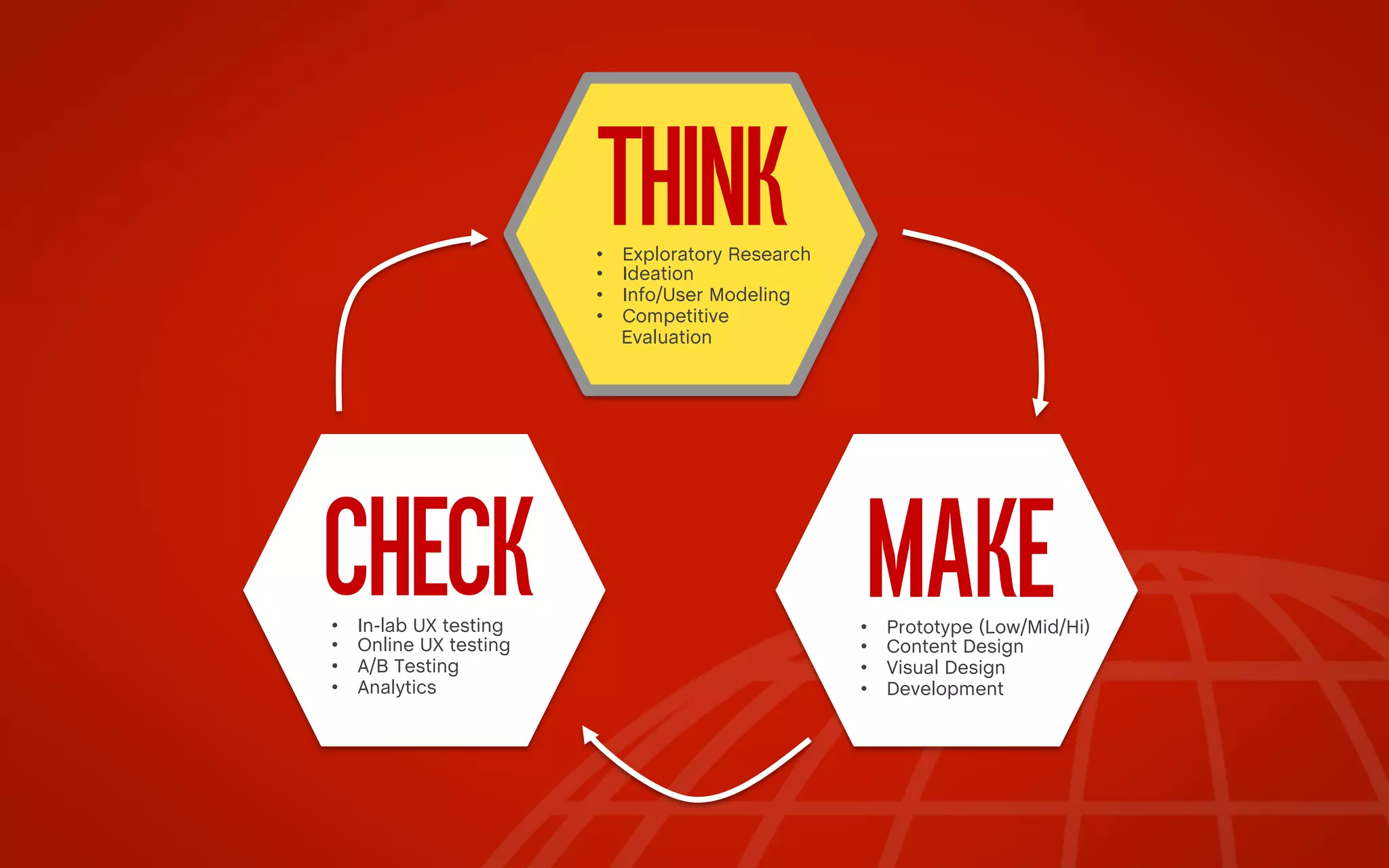
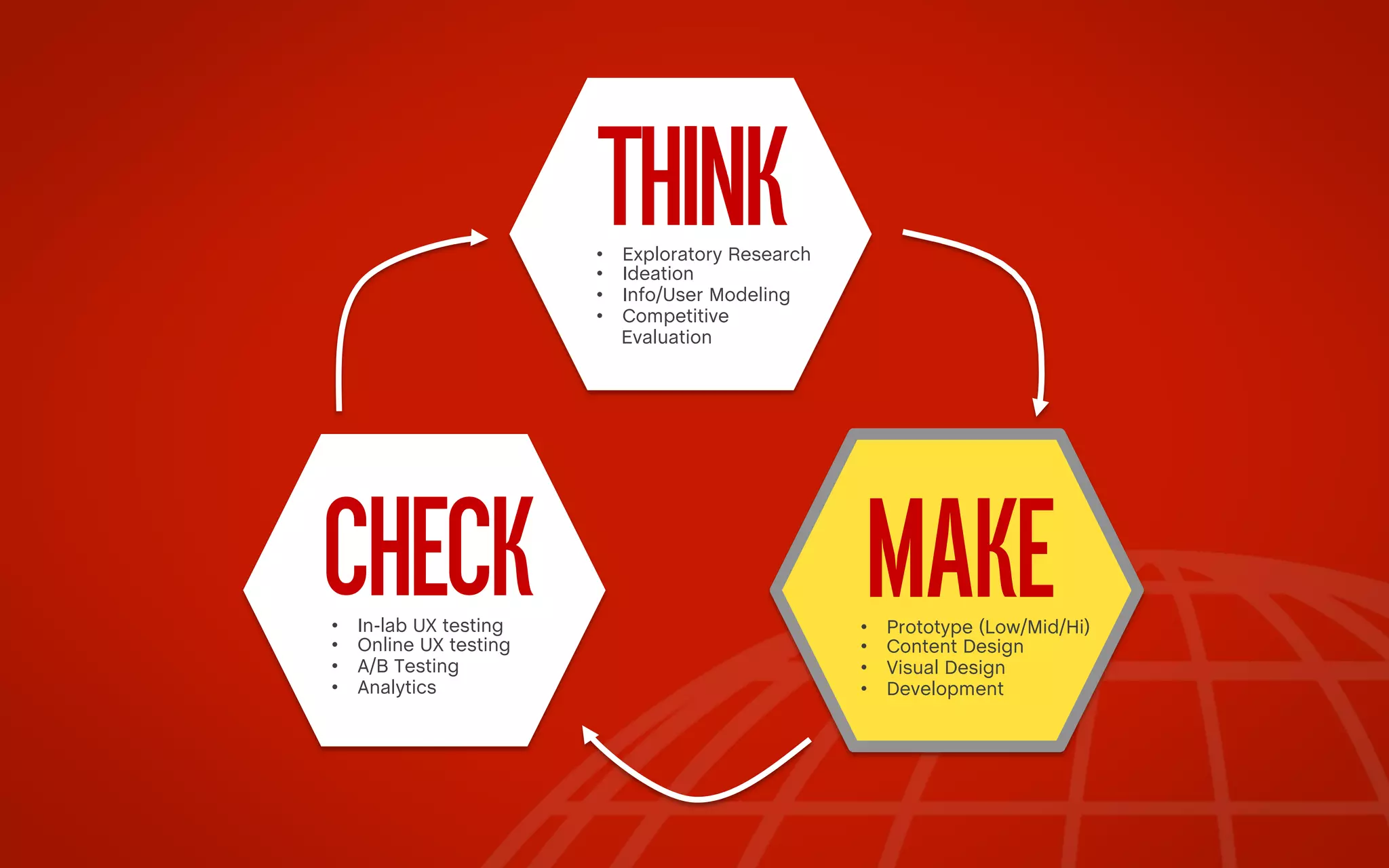
THINK

• 
• 
• 
• 

CHECK
• 
• 
• 
• 

In-lab UX testing
Online UX testing
A/B Testing
Analytics

Exploratory Research
Ideation
Info/User Modeling
Competitive
Evaluation

• 
• 
• 
• 

MAKE

Prototype (Low/Mid/Hi)
Content Design
Visual Design
Development
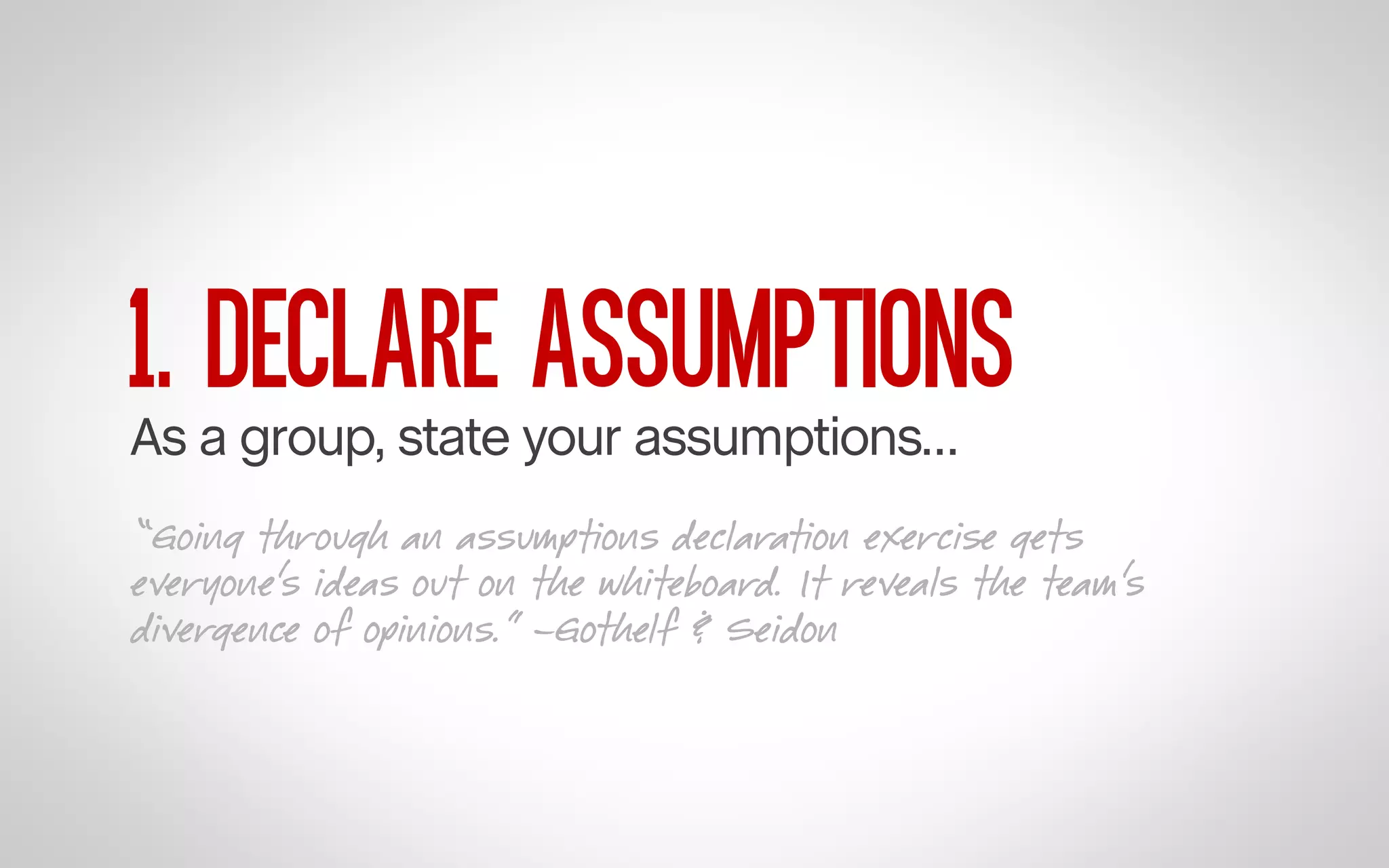
1. DECLARE ASSUMPTIONS

As a group, state your assumptions…

“Going through an assumptions declaration exercise gets
everyone’s ideas out on the whiteboard. It reveals the team’s
divergence of opinions.” –Gothelf & Seidon
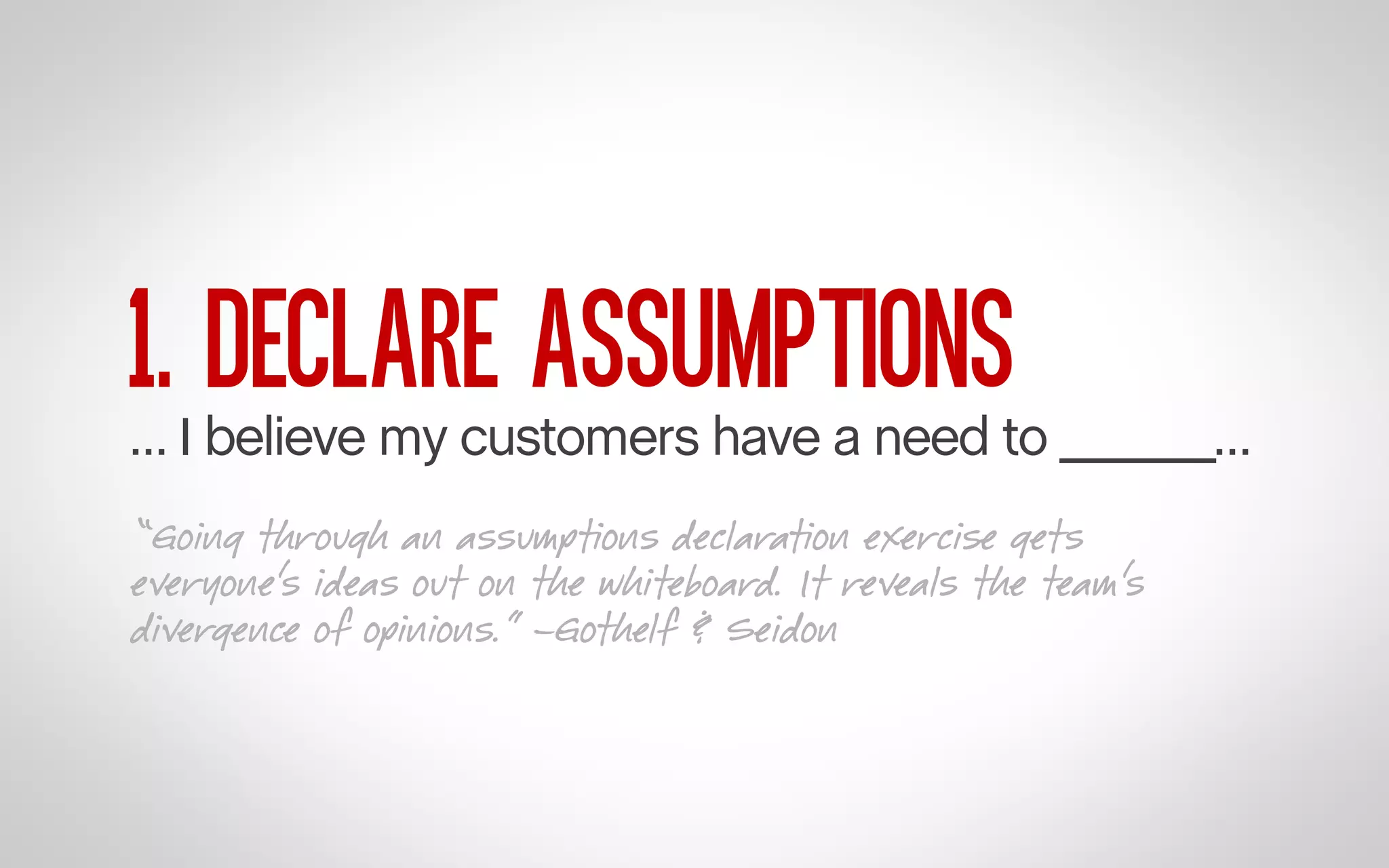
1. DECLARE ASSUMPTIONS

… I believe my customers have a need to ______…
“Going through an assumptions declaration exercise gets
everyone’s ideas out on the whiteboard. It reveals the team’s
divergence of opinions.” –Gothelf & Seidon
1. DECLARE ASSUMPTIONS

… The #1 value a customer wants is _______…
“Going through an assumptions declaration exercise gets
everyone’s ideas out on the whiteboard. It reveals the team’s
divergence of opinions.” –Gothelf & Seidon
1. DECLARE ASSUMPTIONS

… These needs can be solved with _______.
“Going through an assumptions declaration exercise gets
everyone’s ideas out on the whiteboard. It reveals the team’s
divergence of opinions.” –Gothelf & Seidon
2. START HIGH-LEVEL PERSONAS

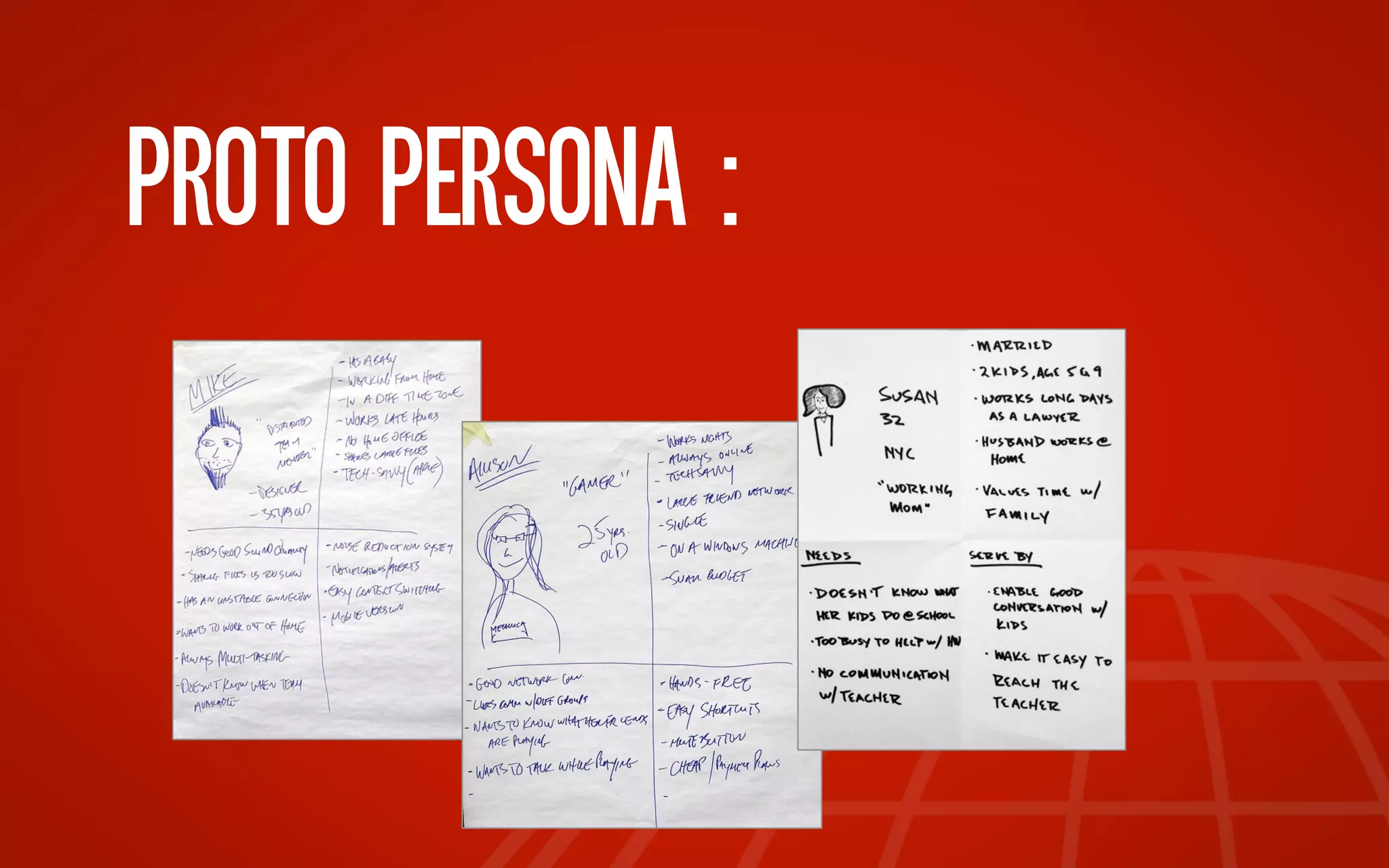
Create proto-personas that will evolve over time.

“Proto-personas are our best guess as to who is using (or will
use) our product and why… Then, as we learn from our ongoing
research, we quickly find out how accurate our initial guesses are.”
–Gothelf & Seidon
PROTO PERSONA :
3. PRIORITIZE ASSUMPTIONS

Prioritize assumptions by risk. The higher the risk,
the greater the need for early learning.
“Lean UX is an exercise in ruthless prioritization. Understanding
that you can’t test every assumption, how do you decides which one
to test first?... How bad would it be if we were wrong about this?”
–Gothelf & Seidon
4. DERIVE TESTABLE HYPOTHESES

Transform each assumption into a format that is
easier to test: a hypothesis statement.

“Put together a list of outcomes you are trying to create, a
definition of the personas you are trying to service, and a set of
the features you believe might work in this situation.”
–Gothelf & Seidon
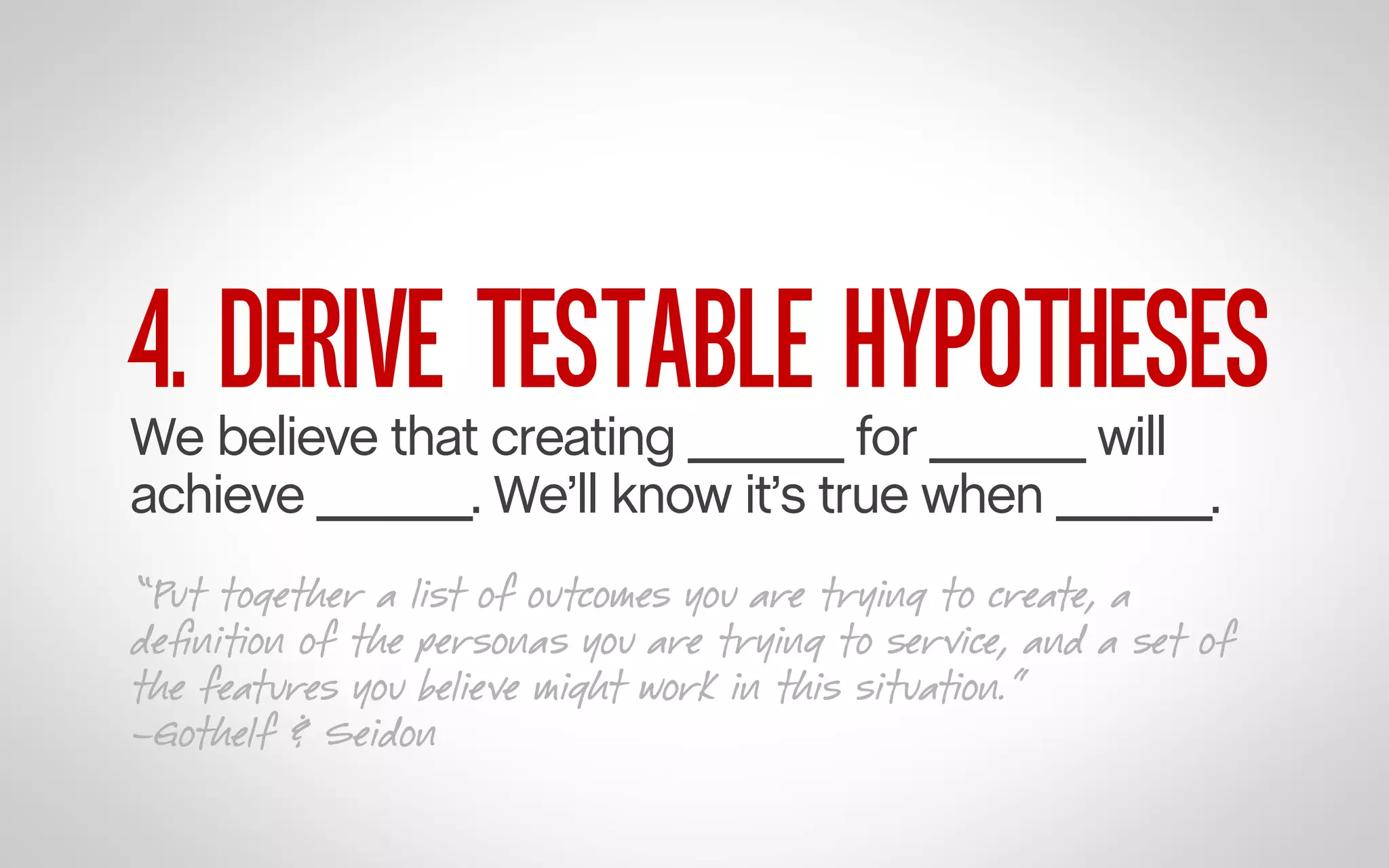
4. DERIVE TESTABLE HYPOTHESES

We believe that creating ______ for ______ will
achieve ______. We’ll know it’s true when ______.

“Put together a list of outcomes you are trying to create, a
definition of the personas you are trying to service, and a set of
the features you believe might work in this situation.”
–Gothelf & Seidon
5. BRAINSTORM FEATURES

Come up with a list of potential solutions to
address hypotheses.
“Too often, though, our design process starts when someone has a
feature idea, and we end up working backward to try to justify
the feature.” –Gothelf & Seidon
THINK

• 
• 
• 
• 

CHECK
• 
• 
• 
• 

In-lab UX testing
Online UX testing
A/B Testing
Analytics

Exploratory Research
Ideation
Info/User Modeling
Competitive
Evaluation

• 
• 
• 
• 

MAKE

Prototype (Low/Mid/Hi)
Content Design
Visual Design
Development
THINK

• 
• 
• 
• 

CHECK
• 
• 
• 
• 

In-lab UX testing
Online UX testing
A/B Testing
Analytics

Exploratory Research
Ideation
Info/User Modeling
Competitive
Evaluation

• 
• 
• 
• 

MAKE

Prototype (Low/Mid/Hi)
Content Design
Visual Design
Development
6. COLLABORATIVE DESIGN

Create a shared understanding by working
together in collaborative design.
“[Collaborative design] brings designers and non-designers
together in co-creation.” –Gothelf & Seidon
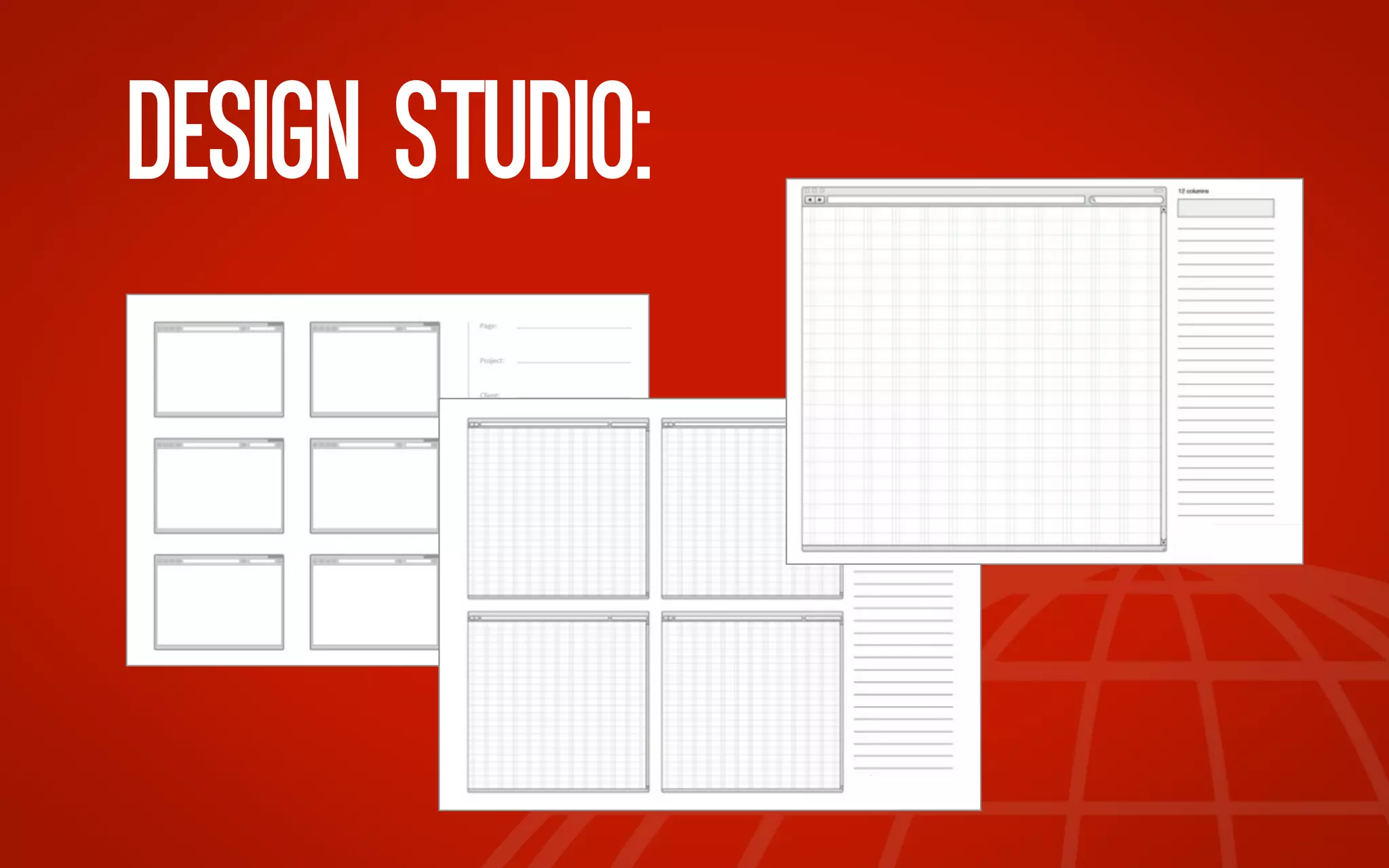
6. COLLABORATIVE DESIGN

…Including Design Studios…

“Collaboration yields better results than hero design…. The key is
to collaborate with a diverse group of team members. Designing
together increases the design IQ… [and] builds team-wide shared
understanding.” –Gothelf & Seidon
6. COLLABORATIVE DESIGN

… style guides and pattern libraries.

“Designing together increases the design IQ… [and] builds teamwide shared understanding… [Pattern libraries] create efficiency.”
–Gothelf & Seidon
DESIGN STUDIO:
THINK

• 
• 
• 
• 

CHECK
• 
• 
• 
• 

In-lab UX testing
Online UX testing
A/B Testing
Analytics

Exploratory Research
Ideation
Info/User Modeling
Competitive
Evaluation

• 
• 
• 
• 

MAKE

Prototype (Low/Mid/Hi)
Content Design
Visual Design
Development
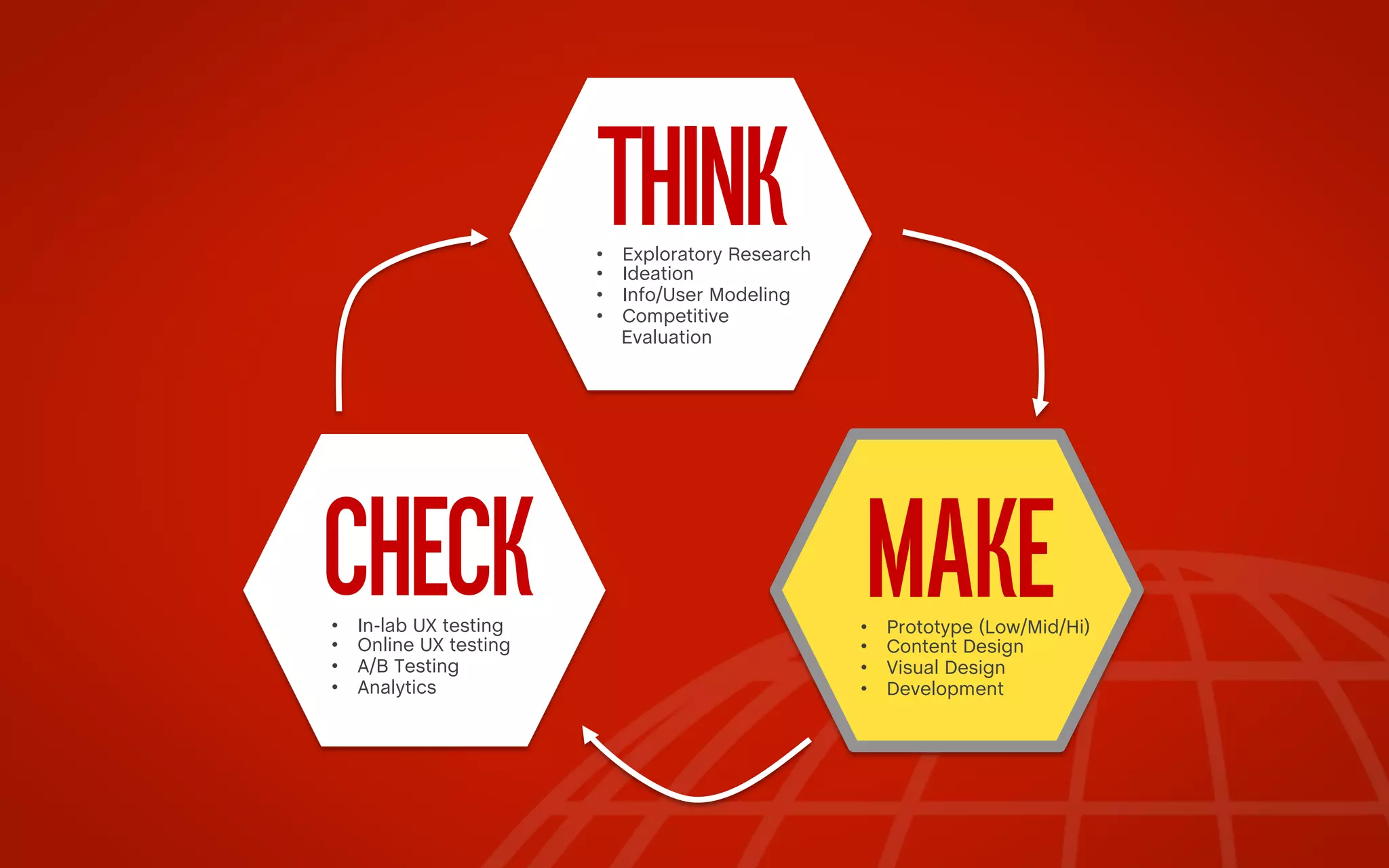
THINK

• 
• 
• 
• 

CHECK
• 
• 
• 
• 

In-lab UX testing
Online UX testing
A/B Testing
Analytics

Exploratory Research
Ideation
Info/User Modeling
Competitive
Evaluation

• 
• 
• 
• 

MAKE

Prototype (Low/Mid/Hi)
Content Design
Visual Design
Development
7. LEARN ITERATIVELY

Conduct iterative user research…

“Too often, research activities take place only on rare occasions—
either at the beginning of a project or at the end.”
–Gothelf & Seidon
7. LEARN ITERATIVELY

…in a rapid and light-weight manner
(e.g. three users every Thursday)…
“Knowing you’re never more than a few days away from customer
feedback has a powerful effect on teams. It takes the pressure
away from your decision making.” –Gothelf & Seidon
7. LEARN ITERATIVELY

…as a team, not relying solely on a researcher…
“Lean UX research is collaborative: you don’t rely on the work of
specialized researchers to deliver learning to your team… use the
researcher as a coach to help your team plan and execute your
activities.” –Gothelf & Seidon
7. LEARN ITERATIVELY

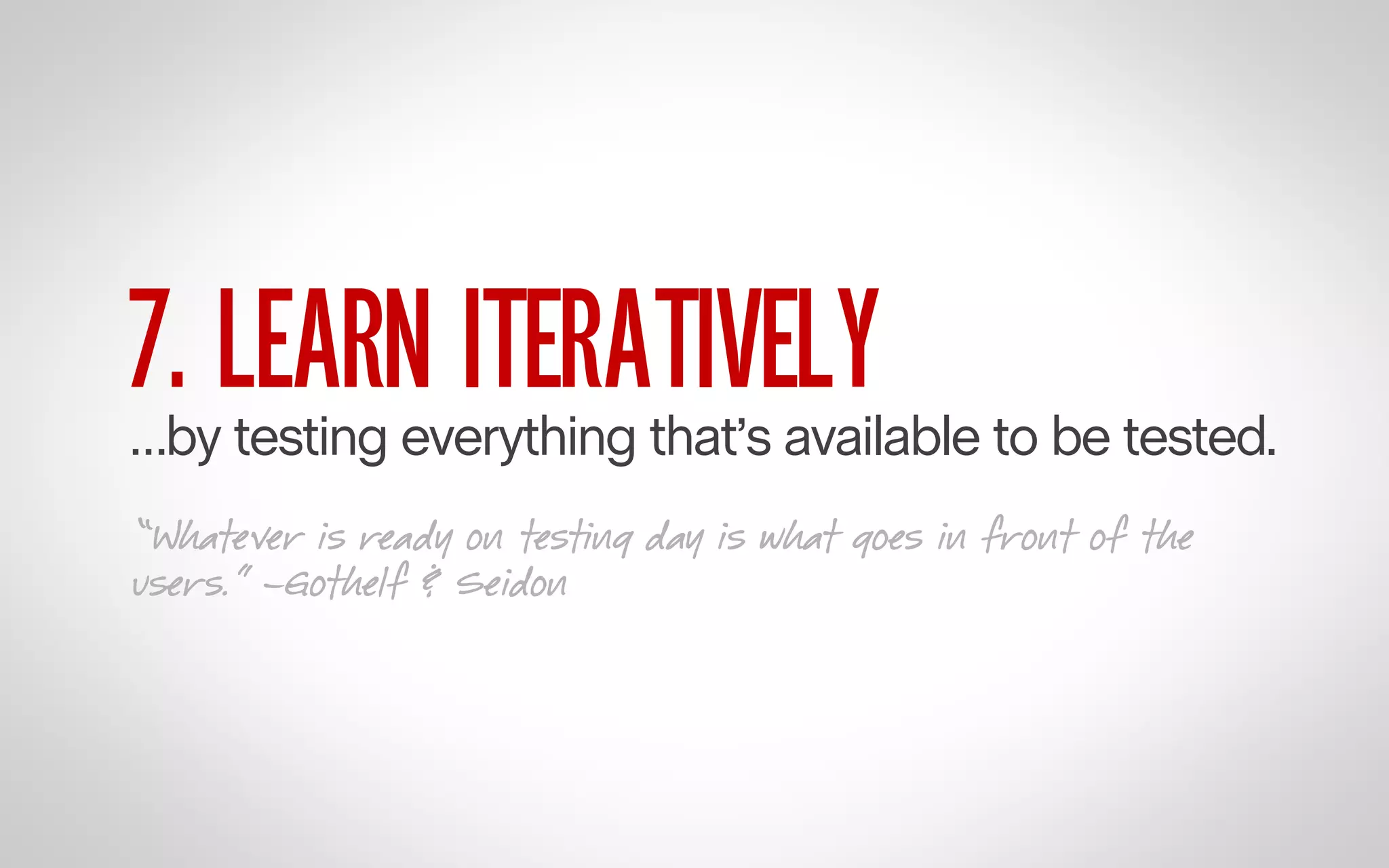
…by testing everything that’s available to be tested.
“Whatever is ready on testing day is what goes in front of the
users.” –Gothelf & Seidon
8. SHARE LEARNINGS FREELY

Proactively reach out to stakeholders with
learnings and next steps.
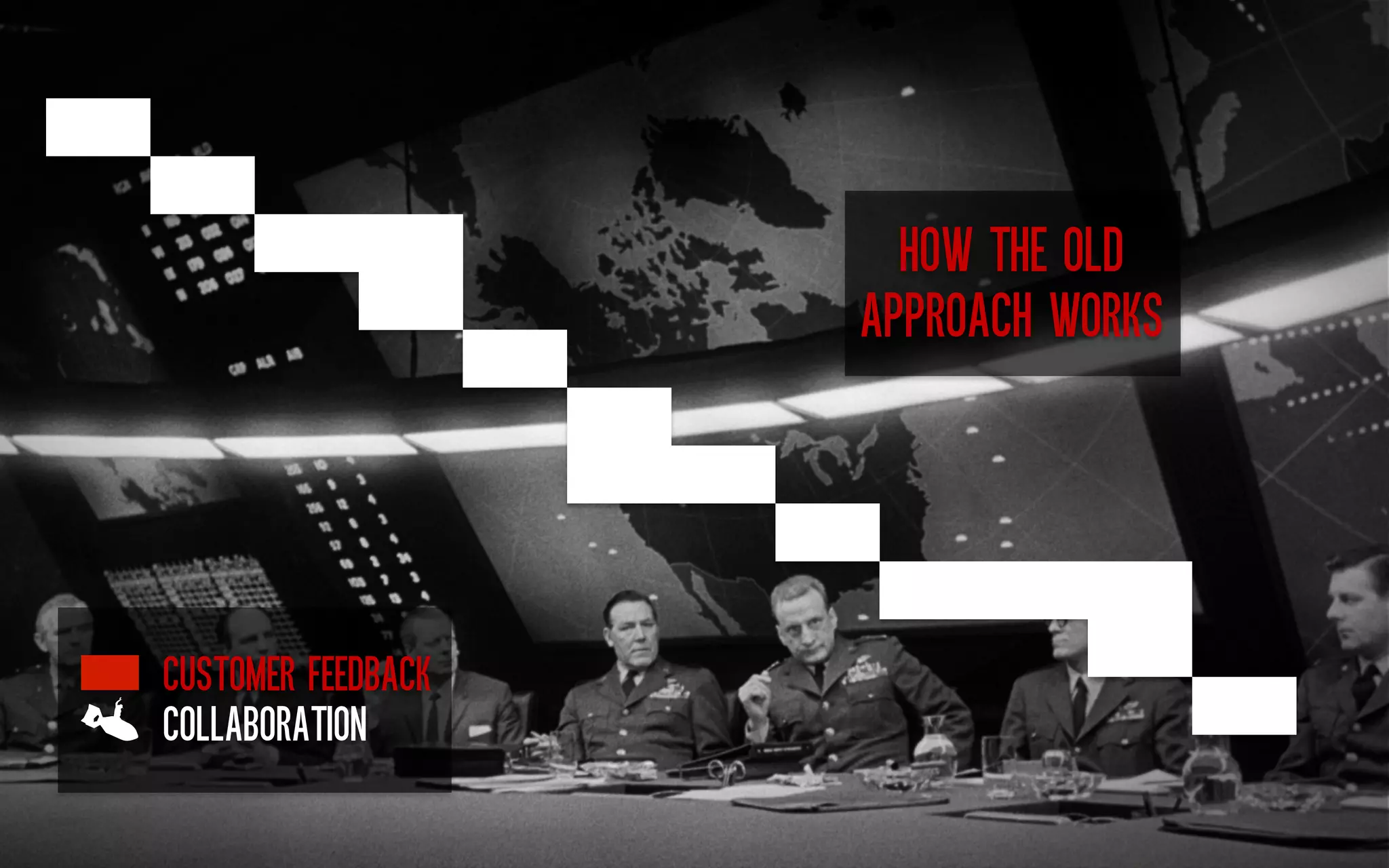
HOW THE OLD
APPROACH WORKS	
  

CUSTOMER FEEDBACK
COLLABORATION	
  
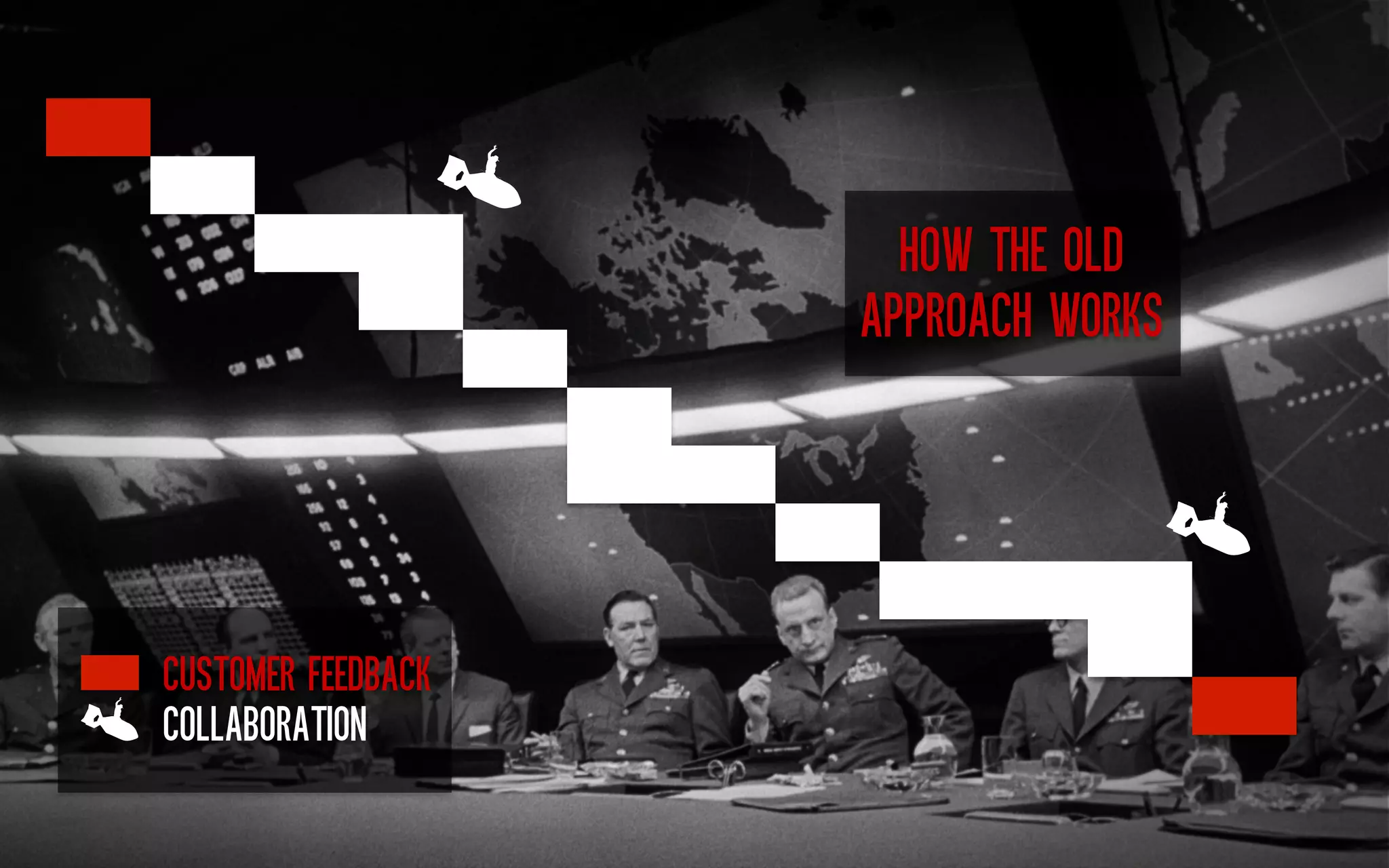
HOW THE OLD
APPROACH WORKS	
  

CUSTOMER FEEDBACK
COLLABORATION	
  
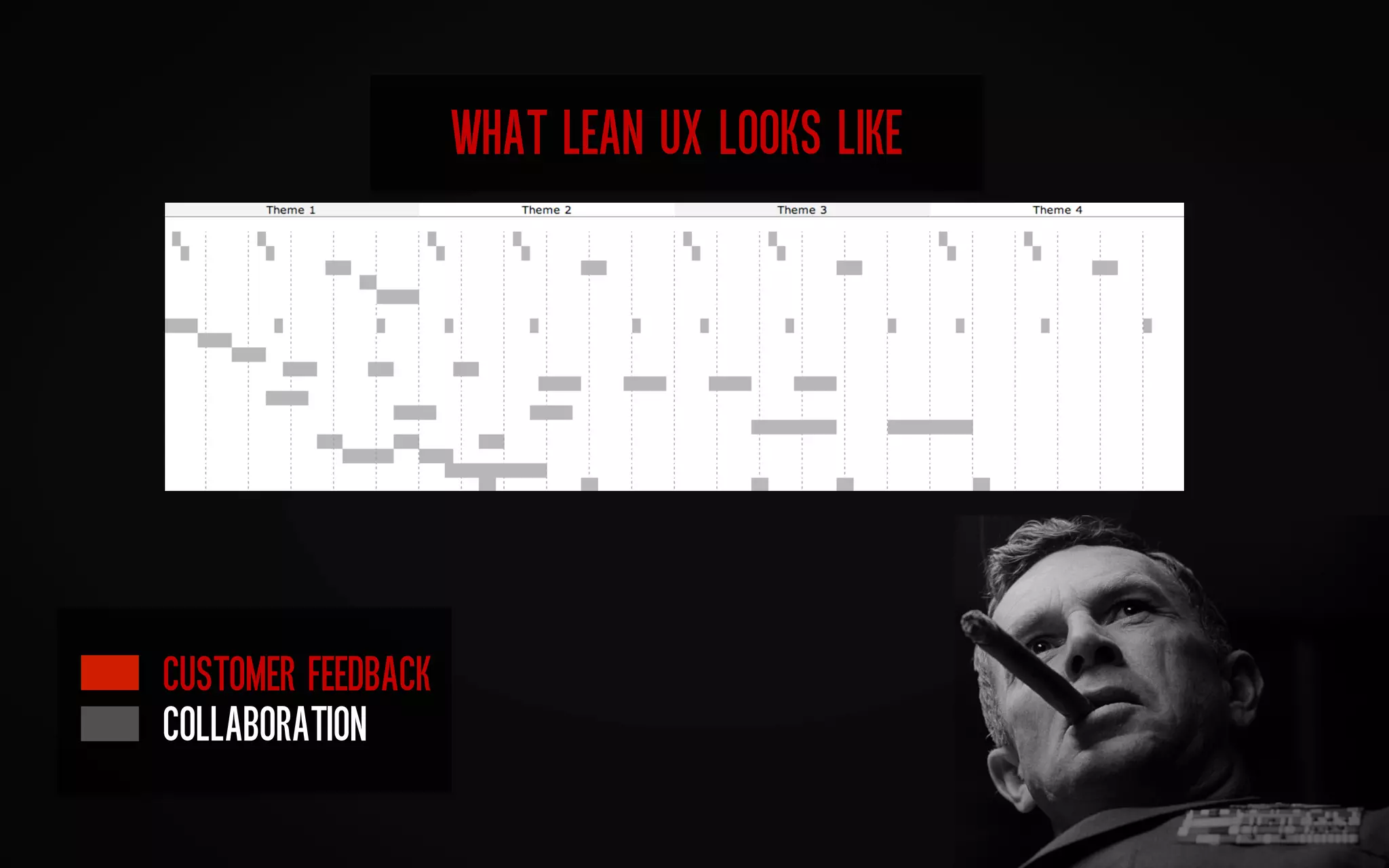
WHAT LEAN UX LOOKS LIKE	
  

CUSTOMER FEEDBACK
COLLABORATION	
  
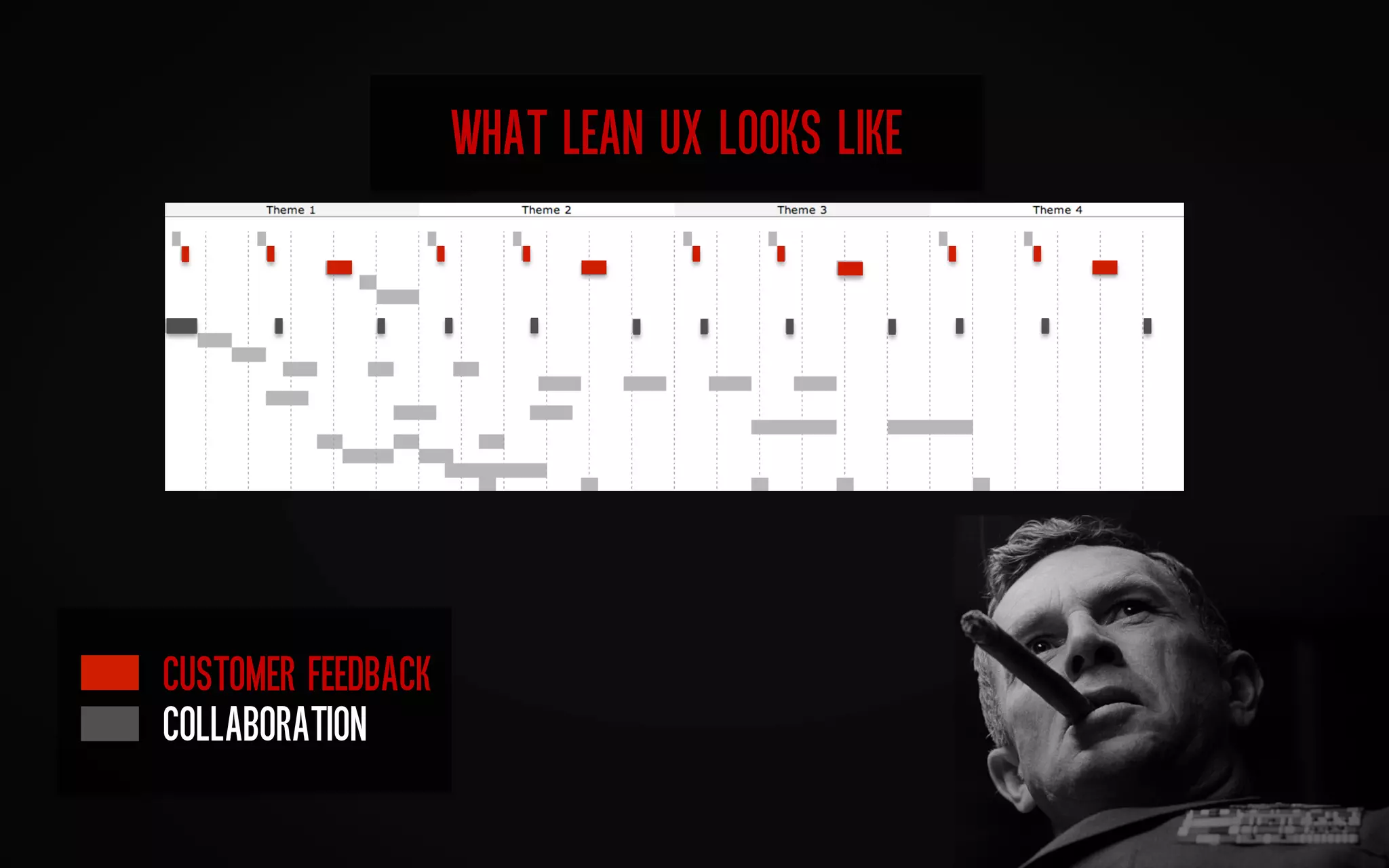
WHAT LEAN UX LOOKS LIKE	
  

CUSTOMER FEEDBACK
COLLABORATION	
  
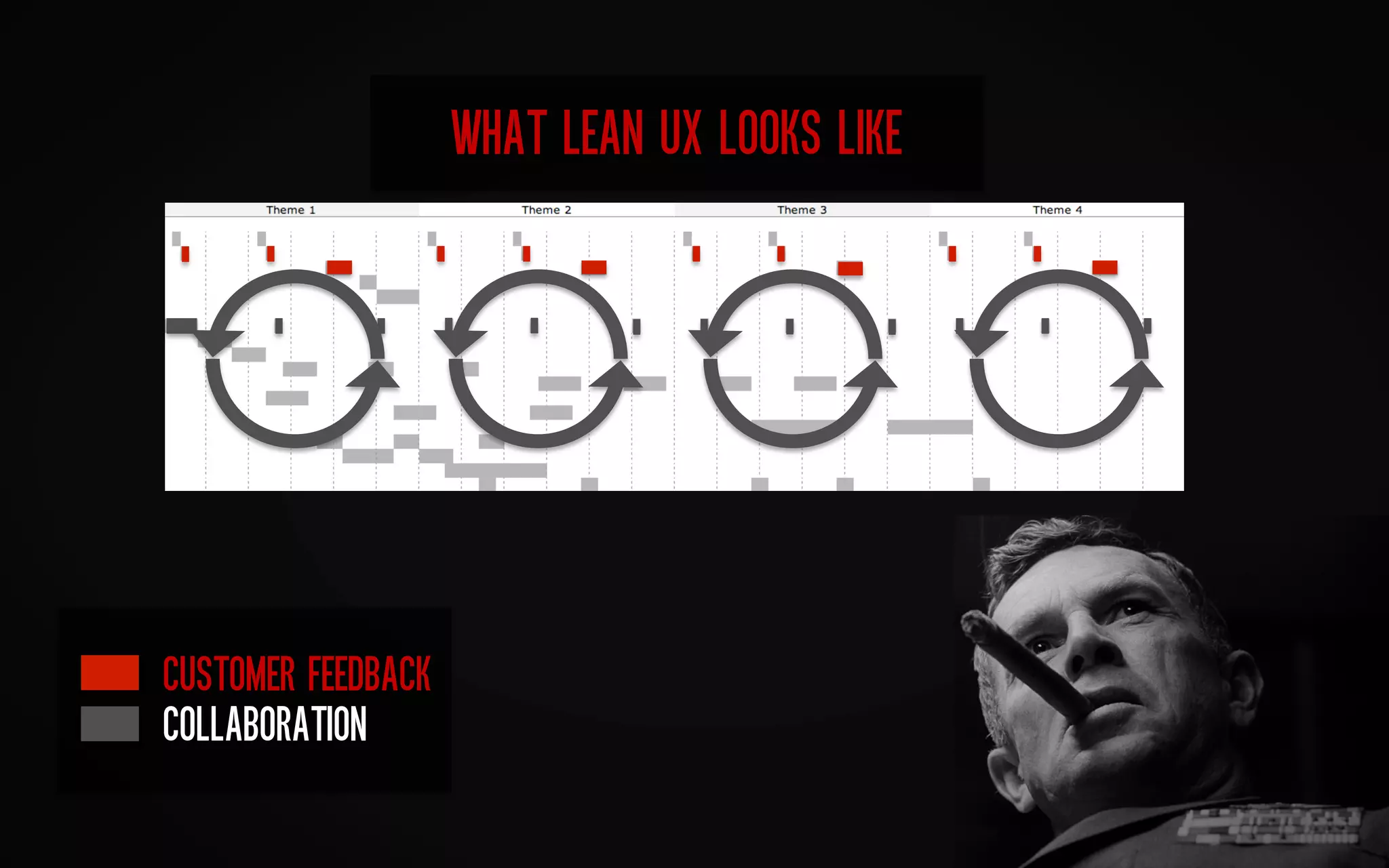
WHAT LEAN UX LOOKS LIKE	
  

CUSTOMER FEEDBACK
COLLABORATION	
  
SET EXPECTATIONS

Set client or stakeholder expectations early, even
before the pitch.
“Making Lean UX work requires the proper expectation setting up
front. From the beginning of the engagement, even before the
pitch, start setting the expectation with your client that this
engagement will be different.” –Gothelf & Seidon
ELIMINATE ROADMAPS

Roadmaps and lists of requirements dictate
approach and solutions from the get-go,
guaranteeing executions of false assumptions.
“Success criteria must be redefined and roadmaps must be done
away with. In their place teams build backlogs of hypotheses.”
–Gothelf & Seidon
FOCUS ON COMPETENCIES

Adopt a mantra of “competencies over roles”
including core competencies and secondary
competencies.
“Too often, people in organizations discourage others from working
outside the confines of their job description. This approach is
deeply anticollaborative.” –Gothelf & Seidon
CO-LOCATE

Create shared environments for project teams.
“Open workspaces allow team members to see each other and to
easily reach out when questions arise... Augment these open spaces
with breakout rooms where the teams can brainstorm.”
–Gothelf & Seidon
NO HEROES

Don’t hire heros. Discourage siloed solutioning.
“Glossy deliverables can drive bad corporate decisions. They can
bias judgment specifically because their beauty is so persuasive.”
–Gothelf & Seidon
NO MORE BDUF

End the practice of big design up front, especially
when big design happens as a part of a pitch.
“The needs of the many outweigh… the needs of the few… or the
one.” –Spock & Kirk
HYPOTHESIZE EVERYWHERE

Create hypotheses in every discipline. Eliminate
the guesswork and emotion from decision making.
“Knowing you’re never more than a few days away from customer
feedback has a powerful effect on teams. It takes the pressure
away from your decision making.” –Gothelf & Seidon
Questions?
@trump29


TRUEMPER

h#p://linkedin.com/in/jaketruemper
truemper@gmail.com	
  

Dr.* Truemper, Or: How I learned to Stop Being Wasteful and Love Lean UX

  • 1.
  • 3.
    LEAN UX ISNOT Mysterious, complex, or even fundamentally new.
  • 4.
    LEAN UX ISNOT Cut back, slimmed down, or half-assed UX involvement.
  • 5.
    LEAN UX ISNOT Just for these guys.
  • 7.
    LEAN UX IS UserExperience Design combined with the principles of Lean Startup… “Lean UX is an important new way to think about what we do, and I think there is real meat on it.” –Jared Spool
  • 8.
    LEAN UX IS …whichwere inspired by Lean manufacturing principles… “Lean UX is an important new way to think about what we do, and I think there is real meat on it.” –Jared Spool
  • 9.
    LEAN UX IS “Ifyou can’t describe what you’re doing as process, you don’t know what you’re doing.” -W. Edwards Deming   …which were inspired by the Toyota Production System (TPS) that propelled Japanese auto manufacturers to the top of the industry. “Lean UX is an important new way to think about what we do, and I think there is real meat on it.” –Jared Spool
  • 10.
    LEAN UX IS Atactic to remove waste from the design process. “We move away from heavily documented handoffs to a process that creates only the design artifacts we need to move the team’s learning forward.” –Gothelf & Seidon
  • 11.
    WASTE : [weyst] noun   A bad use of something valuable that you have only a limited amount of. E.G. A waste of time or money
  • 12.
    WASTE : “Any humanactivity which absorbs resources, but creates no value.” -James P Womak and Daniel T. Jones, Lean Thinking
  • 13.
    LEAN UX IS Influencednot only by Lean Startup, but Design Thinking and Agile development.
  • 14.
    LEAN UX IS Atit’s core, a mindset. “Lean UX is the practice of bringing the true nature of a product to light faster, in a collaborative, cross-functional way that reduces the emphasis on thorough documentation while increasing the focus on building a shared understanding of the actual product experience being designed.” –Gothelf & Seidon
  • 16.
    PROBLEM : People areinherently poor at visualizing outcomes. “The problem with much software development and UX Design is that you spend months doing research, writing requirements, designing wireframes and building software… and discover no customer or software user cares.” –Will Evans
  • 17.
    WHY LEAN UX? Waterfallapproaches are slow to unearth design problems. “In [our] new reality, traditional ‘get it all figured out first’ approaches are not workable.” –Gothelf & Seidon
  • 18.
    WHY LEAN UX? Rightor wrong, stakeholders want to be heard. Lean UX provides avenues to hear and test stakeholder requests.
  • 19.
    WHY LEAN UX? Ina competitive marketplace, results matter. Product quality is paramount. “At this point in experience design’s evolution, satisfaction ought to be the norm, and delight ought to be the goal.” –Parrish Hanna
  • 20.
    ANTICIPATED SOLUTION   START   H   APPROAC OLD LEAN   IDEAL SOLUTION  
  • 22.
    COLLABORATE Place an emphasison individuals and interactions over processes and tools… “The needs of the many outweigh… the needs of the few… or the one.” –Spock & Kirk
  • 23.
    COLLABORATE …Teams should becross-functional and collaborative, creating a “shared understanding”… “[Lean methods] drive us to harmonize our ‘system’ of designers, developers, product managers, quality assurance engineers, marketers, and others in a transparent, cross-functional collaboration that brings nondesigners into our design process.” –Gothelf & Seidon
  • 24.
    COLLABORATE …an emphasis shouldbe placed on stakeholder collaboration over contract negotiation. “Collaboration… creates consensus behind decisions… It also lessens dependency on heavy documentation.” –Gothelf & Seidon
  • 25.
    Diverging Ideas   UUGGHHIT HURTS!   COLLABORATIVE IDEATION : Converging Ideas  
  • 26.
    DESIGN SMALL Design insmall batches… “This concept means creating only the design that is necessary to move the team forward and avoid a big ‘inventory’ of untested and unimplemented design ideas.” –Gothelf & Seidon
  • 27.
    DESIGN SMALL By usinga Minimum Viable Product (MVP) you uncover insights with minimal effort. “Each design is a proposed business solution—a hypothesis… The smallest thing you can build to test each hypothesis is your MVP.” –Gothelf & Seidon
  • 28.
    MINIMUM VIABLE PROTOTYPE: Execute priority items first, with greatest depth. Use design patterns, stubs or mocks for high-value lowtime items. Track UX debt. Content blocking for items of lower importance.
  • 29.
    SHARE Externalize your work.Be willing to share unfinished and unpolished drafts. “Externalizing means getting your work out of your head and out of your computer and into public view.” –Gothelf & Seidon
  • 30.
    SHARE Making over debating.As quickly as possible put your team’s design ideas into action. “There is more value in creating the first version of an idea than spending half a day debating its merits in a conference room… you need to make something for people to respond to.” –Gothelf & Seidon
  • 31.
    REDUCE DELIVERABLES Anything thatdoesn’t contribute to an outcome is waste… “In Lean UX the ultimate goal is improved outcomes… anything that doesn’t contribute to that outcome is considered waste… the more waste the team can eliminate, the faster they can move.” –Gothelf & Seidon
  • 32.
    REDUCE DELIVERABLES …focus onoutcomes, not outputs. “A problem-focused team is one that has been assigned a business problem to solve, as opposed to a set of features to implement. This is the logical extension of the focus on outcomes.” –Gothelf & Seidon
  • 33.
    REMEMBER, WASTE IS: “Any human activity which absorbs resources, but creates no value.” “With increased cross-functional collaboration, stakeholder conversation becomes less about what artifact is being created and more about which outcome is being achieved.” –Gothelf & Seidon
  • 34.
    TEST ITERATIVELY Continuous discovery—basedon experimentation… “Instead of relying on a hero designer to divine the best solution from a single point of view, we use rapid experimentation and measurement to learn… [by continuously] engaging the customer during the design and development process.” –Gothelf & Seidon
  • 35.
    TEST ITERATIVELY …Get outof the building. “The realization that meeting-room debates about user needs won’t be settled conclusively within your office… research involves the entire team.” –Gothelf & Seidon
  • 36.
    FAIL Permission to fail—assoon as possible. “Permission to fail means that the team has a safe environment in which to experiment.” –Gothelf & Seidon
  • 37.
    LEARN Learning as youmove forward is more important than scaling. Broad feature deployment creates intense risk and inhibits learning. “Ensuring that an idea is right before scaling it out mitigates the risk inherent in broad feature deployment.” –Gothelf & Seidon
  • 39.
    ANTI-PATTERN Rockstars, Gurus, andNinjas. “Rockstars don’t share—neither their ideas nor the spotlight. Team cohesion breaks down when you add individuals with large egos.” –Gothelf & Seidon
  • 41.
    THINK •  •  •  •  CHECK •  •  •  •  In-lab UX testing OnlineUX testing A/B Testing Analytics Exploratory Research Ideation Info/User Modeling Competitive Evaluation •  •  •  •  MAKE Prototype (Low/Mid/Hi) Content Design Visual Design Development
  • 42.
    THINK •  •  •  •  CHECK •  •  •  •  In-lab UX testing OnlineUX testing A/B Testing Analytics Exploratory Research Ideation Info/User Modeling Competitive Evaluation •  •  •  •  MAKE Prototype (Low/Mid/Hi) Content Design Visual Design Development
  • 43.
    1. DECLARE ASSUMPTIONS Asa group, state your assumptions… “Going through an assumptions declaration exercise gets everyone’s ideas out on the whiteboard. It reveals the team’s divergence of opinions.” –Gothelf & Seidon
  • 44.
    1. DECLARE ASSUMPTIONS …I believe my customers have a need to ______… “Going through an assumptions declaration exercise gets everyone’s ideas out on the whiteboard. It reveals the team’s divergence of opinions.” –Gothelf & Seidon
  • 45.
    1. DECLARE ASSUMPTIONS …The #1 value a customer wants is _______… “Going through an assumptions declaration exercise gets everyone’s ideas out on the whiteboard. It reveals the team’s divergence of opinions.” –Gothelf & Seidon
  • 46.
    1. DECLARE ASSUMPTIONS …These needs can be solved with _______. “Going through an assumptions declaration exercise gets everyone’s ideas out on the whiteboard. It reveals the team’s divergence of opinions.” –Gothelf & Seidon
  • 47.
    2. START HIGH-LEVELPERSONAS Create proto-personas that will evolve over time. “Proto-personas are our best guess as to who is using (or will use) our product and why… Then, as we learn from our ongoing research, we quickly find out how accurate our initial guesses are.” –Gothelf & Seidon
  • 48.
  • 49.
    3. PRIORITIZE ASSUMPTIONS Prioritizeassumptions by risk. The higher the risk, the greater the need for early learning. “Lean UX is an exercise in ruthless prioritization. Understanding that you can’t test every assumption, how do you decides which one to test first?... How bad would it be if we were wrong about this?” –Gothelf & Seidon
  • 50.
    4. DERIVE TESTABLEHYPOTHESES Transform each assumption into a format that is easier to test: a hypothesis statement. “Put together a list of outcomes you are trying to create, a definition of the personas you are trying to service, and a set of the features you believe might work in this situation.” –Gothelf & Seidon
  • 51.
    4. DERIVE TESTABLEHYPOTHESES We believe that creating ______ for ______ will achieve ______. We’ll know it’s true when ______. “Put together a list of outcomes you are trying to create, a definition of the personas you are trying to service, and a set of the features you believe might work in this situation.” –Gothelf & Seidon
  • 52.
    5. BRAINSTORM FEATURES Comeup with a list of potential solutions to address hypotheses. “Too often, though, our design process starts when someone has a feature idea, and we end up working backward to try to justify the feature.” –Gothelf & Seidon
  • 53.
    THINK •  •  •  •  CHECK •  •  •  •  In-lab UX testing OnlineUX testing A/B Testing Analytics Exploratory Research Ideation Info/User Modeling Competitive Evaluation •  •  •  •  MAKE Prototype (Low/Mid/Hi) Content Design Visual Design Development
  • 54.
    THINK •  •  •  •  CHECK •  •  •  •  In-lab UX testing OnlineUX testing A/B Testing Analytics Exploratory Research Ideation Info/User Modeling Competitive Evaluation •  •  •  •  MAKE Prototype (Low/Mid/Hi) Content Design Visual Design Development
  • 55.
    6. COLLABORATIVE DESIGN Createa shared understanding by working together in collaborative design. “[Collaborative design] brings designers and non-designers together in co-creation.” –Gothelf & Seidon
  • 56.
    6. COLLABORATIVE DESIGN …IncludingDesign Studios… “Collaboration yields better results than hero design…. The key is to collaborate with a diverse group of team members. Designing together increases the design IQ… [and] builds team-wide shared understanding.” –Gothelf & Seidon
  • 57.
    6. COLLABORATIVE DESIGN …style guides and pattern libraries. “Designing together increases the design IQ… [and] builds teamwide shared understanding… [Pattern libraries] create efficiency.” –Gothelf & Seidon
  • 58.
  • 59.
    THINK •  •  •  •  CHECK •  •  •  •  In-lab UX testing OnlineUX testing A/B Testing Analytics Exploratory Research Ideation Info/User Modeling Competitive Evaluation •  •  •  •  MAKE Prototype (Low/Mid/Hi) Content Design Visual Design Development
  • 60.
    THINK •  •  •  •  CHECK •  •  •  •  In-lab UX testing OnlineUX testing A/B Testing Analytics Exploratory Research Ideation Info/User Modeling Competitive Evaluation •  •  •  •  MAKE Prototype (Low/Mid/Hi) Content Design Visual Design Development
  • 61.
    7. LEARN ITERATIVELY Conductiterative user research… “Too often, research activities take place only on rare occasions— either at the beginning of a project or at the end.” –Gothelf & Seidon
  • 62.
    7. LEARN ITERATIVELY …ina rapid and light-weight manner (e.g. three users every Thursday)… “Knowing you’re never more than a few days away from customer feedback has a powerful effect on teams. It takes the pressure away from your decision making.” –Gothelf & Seidon
  • 63.
    7. LEARN ITERATIVELY …asa team, not relying solely on a researcher… “Lean UX research is collaborative: you don’t rely on the work of specialized researchers to deliver learning to your team… use the researcher as a coach to help your team plan and execute your activities.” –Gothelf & Seidon
  • 64.
    7. LEARN ITERATIVELY …bytesting everything that’s available to be tested. “Whatever is ready on testing day is what goes in front of the users.” –Gothelf & Seidon
  • 65.
    8. SHARE LEARNINGSFREELY Proactively reach out to stakeholders with learnings and next steps.
  • 67.
    HOW THE OLD APPROACHWORKS   CUSTOMER FEEDBACK COLLABORATION  
  • 68.
    HOW THE OLD APPROACHWORKS   CUSTOMER FEEDBACK COLLABORATION  
  • 69.
    WHAT LEAN UXLOOKS LIKE   CUSTOMER FEEDBACK COLLABORATION  
  • 70.
    WHAT LEAN UXLOOKS LIKE   CUSTOMER FEEDBACK COLLABORATION  
  • 71.
    WHAT LEAN UXLOOKS LIKE   CUSTOMER FEEDBACK COLLABORATION  
  • 73.
    SET EXPECTATIONS Set clientor stakeholder expectations early, even before the pitch. “Making Lean UX work requires the proper expectation setting up front. From the beginning of the engagement, even before the pitch, start setting the expectation with your client that this engagement will be different.” –Gothelf & Seidon
  • 74.
    ELIMINATE ROADMAPS Roadmaps andlists of requirements dictate approach and solutions from the get-go, guaranteeing executions of false assumptions. “Success criteria must be redefined and roadmaps must be done away with. In their place teams build backlogs of hypotheses.” –Gothelf & Seidon
  • 75.
    FOCUS ON COMPETENCIES Adopta mantra of “competencies over roles” including core competencies and secondary competencies. “Too often, people in organizations discourage others from working outside the confines of their job description. This approach is deeply anticollaborative.” –Gothelf & Seidon
  • 76.
    CO-LOCATE Create shared environmentsfor project teams. “Open workspaces allow team members to see each other and to easily reach out when questions arise... Augment these open spaces with breakout rooms where the teams can brainstorm.” –Gothelf & Seidon
  • 77.
    NO HEROES Don’t hireheros. Discourage siloed solutioning. “Glossy deliverables can drive bad corporate decisions. They can bias judgment specifically because their beauty is so persuasive.” –Gothelf & Seidon
  • 78.
    NO MORE BDUF Endthe practice of big design up front, especially when big design happens as a part of a pitch. “The needs of the many outweigh… the needs of the few… or the one.” –Spock & Kirk
  • 79.
    HYPOTHESIZE EVERYWHERE Create hypothesesin every discipline. Eliminate the guesswork and emotion from decision making. “Knowing you’re never more than a few days away from customer feedback has a powerful effect on teams. It takes the pressure away from your decision making.” –Gothelf & Seidon
  • 80.