Lean Startup
Introduction
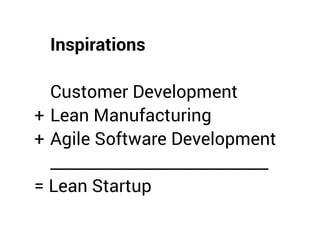
Inspirations
Customer Development
+ Lean Manufacturing
+ Agile Software Development
___________________________
= Lean Startup
90% of startups fail
Only 4% make it to $1 million turnover
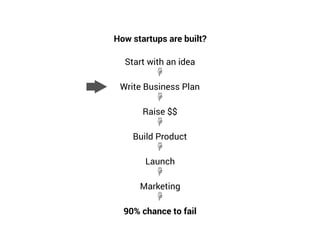
How startups are built?
Start with an idea
☟
Write Business Plan
☟
Raise $$
☟
Build Product
☟
Launch
☟
Marketing
☟
90% chance to fail
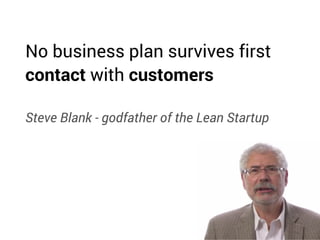
No business plan survives first
contact with customers
Steve Blank - godfather of the Lean Startup
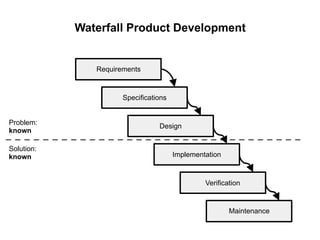
Waterfall Product Development
Requirements
Specifications
Design
Implementation
Verification
Maintenance
Problem:
known
Solution:
known
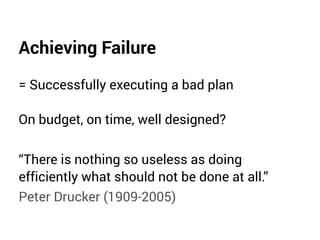
Achieving Failure
= Successfully executing a bad plan
On budget, on time, well designed?
“There is nothing so useless as doing
efficiently what should not be done at all.”
Peter Drucker (1909-2005)
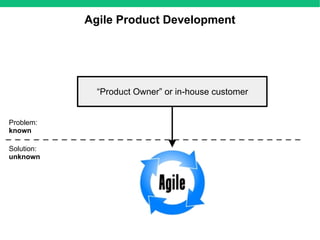
Agile Product Development
“Product Owner” or in-house customer
Problem:
known
Solution:
unknown
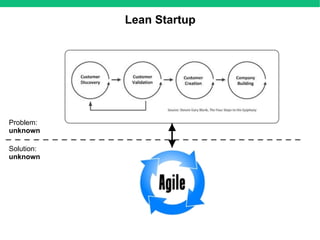
Lean Startup
Problem:
unknown
Solution:
unknown
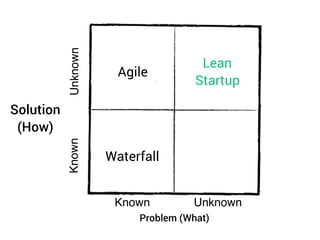
Problem (What)
Unknown
Solution
(How)
Waterfall
Agile
Lean
Startup
Known
Known Unknown
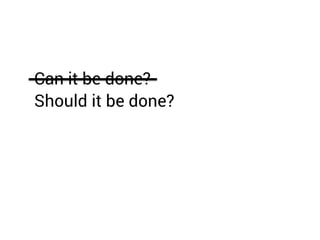
Can it be done?
Should it be done?
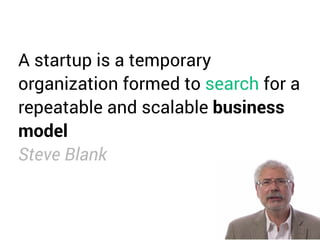
A startup is a temporary
organization formed to search for a
repeatable and scalable business
model
Steve Blank
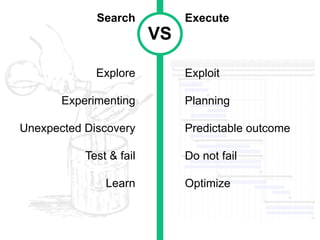
Execute
Exploit
Planning
Predictable outcome
Do not fail
Optimize
VS
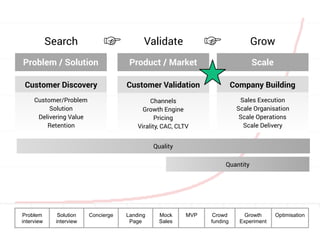
Search
Explore
Experimenting
Unexpected Discovery
Test & fail
Learn
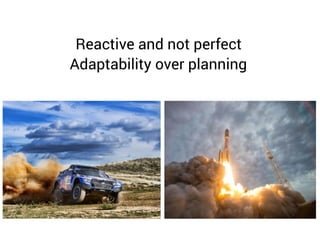
Reactive and not perfect
Adaptability over planning
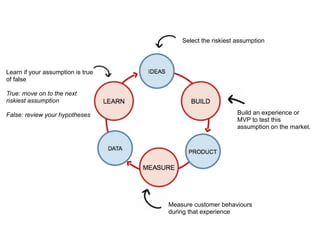
Learn if your assumption is true
of false
True: move on to the next
riskiest assumption
False: review your hypotheses
Select the riskiest assumption
Build an experience or
MVP to test this
assumption on the market.
Measure customer behaviours
during that experience
You are wasting if you are not learning
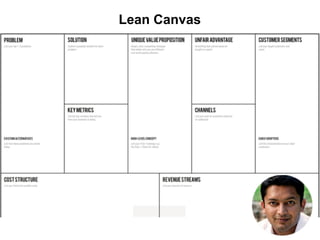
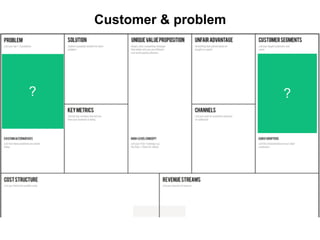
Lean Canvas
Search Validate Grow
Problem / Solution Product / Market Scale
Customer Discovery Customer Validation Company Building
Customer/Problem
Solution
Delivering Value
Retention
Channels
Growth Engine
Pricing
Virality, CAC, CLTV
Sales Execution
Scale Organisation
Scale Operations
Scale Delivery
Quality
Quantity
Growth
Experiment
Problem
interview
Solution
interview
Concierge Landing
Page
Mock
Sales
Crowd
funding
MVP Optimisation
☞☞
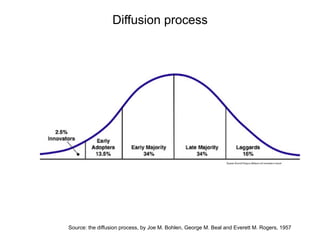
Diffusion process
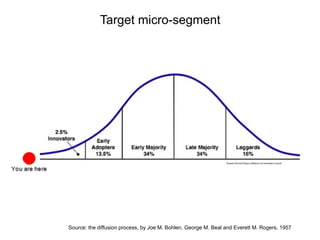
Source: the diffusion process, by Joe M. Bohlen, George M. Beal and Everett M. Rogers, 1957
Target micro-segment
Customer & problem
? ?
A startup is a temporary
organization formed to search for a
repeatable and scalable business
model
Steve Blank
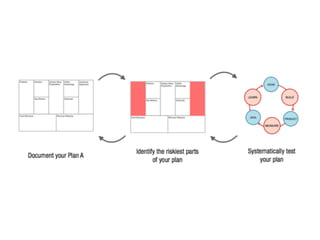
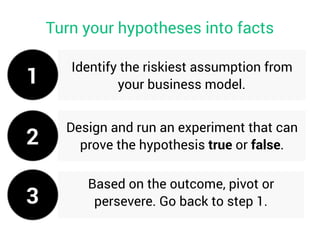
Turn your hypotheses into facts
Based on the outcome, pivot or
persevere. Go back to step 1.
Identify the riskiest assumption from
your business model.
Design and run an experiment that can
prove the hypothesis true or false.
1
2
3
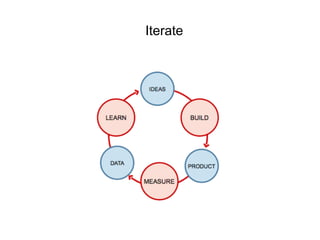
Iterate
The better you know your customers
the better you can help them
Iain Wallace - 2015
Problem? Need? Pain? Desire?
Think job-to-be-done...
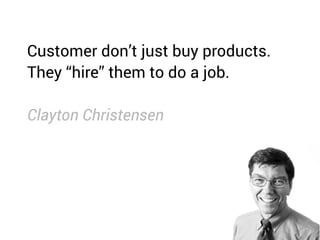
Customer don’t just buy products.
They “hire” them to do a job.
Clayton Christensen
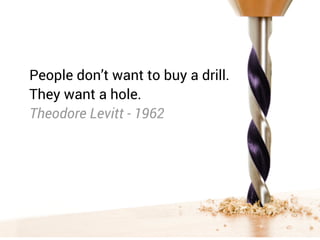
People don’t want to buy a drill.
They want a hole.
Theodore Levitt - 1962
Customer Discovery:
Find a problem worth solving
for your customers
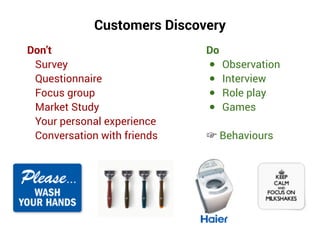
Don’t
Survey
Questionnaire
Focus group
Market Study
Your personal experience
Conversation with friends
Customers Discovery
Do
● Observation
● Interview
● Role play
● Games
☞ Behaviours
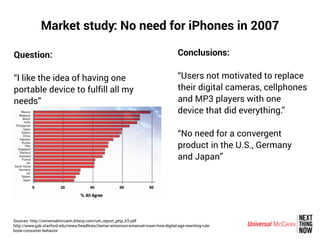
Question:
“I like the idea of having one
portable device to fulfill all my
needs”
Sources: http://universalmccann.bitecp.com/um_report_pttp_lr3.pdf
http://www.gsb.stanford.edu/news/headlines/itamar-simonson-emanuel-rosen-how-digital-age-rewriting-rule-
book-consumer-behavior
Market study: No need for iPhones in 2007
Conclusions:
“Users not motivated to replace
their digital cameras, cellphones
and MP3 players with one
device that did everything.”
“No need for a convergent
product in the U.S., Germany
and Japan”
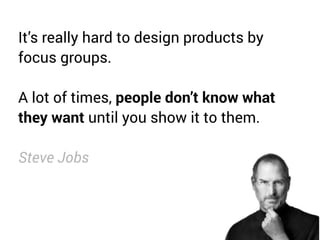
It’s really hard to design products by
focus groups.
A lot of times, people don’t know what
they want until you show it to them.
Steve Jobs
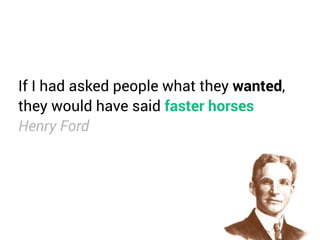
If I had asked people what they wanted,
they would have said faster horses
Henry Ford
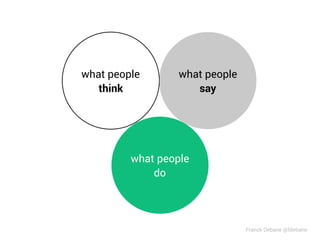
what people
do
what people
think
what people
say
Franck Debane @fdebane
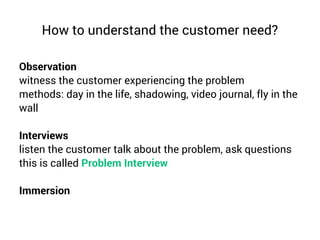
How to understand the customer need?
Observation
witness the customer experiencing the problem
methods: day in the life, shadowing, video journal, fly in the
wall
Interviews
listen the customer talk about the problem, ask questions
this is called Problem Interview
Immersion
https://www.youtube.com/watch?v=CKsSvR5u-qk
GET OUT OF THE
BUILDING
How to do
Customer Interviews?
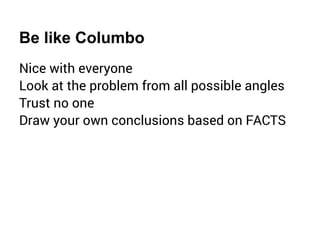
Be like Columbo
Nice with everyone
Look at the problem from all possible angles
Trust no one
Draw your own conclusions based on FACTS
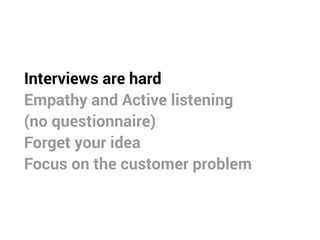
Interviews are hard
Empathy and Active listening
(no questionnaire)
Forget your idea
Focus on the customer problem
Guide and Drill
Learn, be curious
Ask why. Why why. Be nosy.
Find facts and avoid opinions
Watch for bias
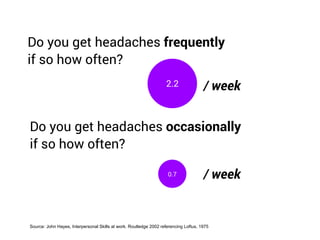
Ask about past events
Do you get headaches frequently
if so how often?
Do you get headaches occasionally
if so how often?
Source: John Hayes, Interpersonal Skills at work. Routledge 2002 referencing Loftus, 1975
2.2 / week
0.7 / week
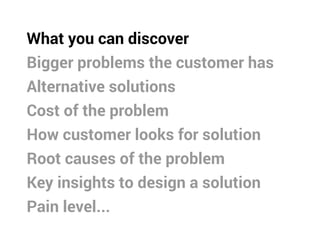
What you can discover
Bigger problems the customer has
Alternative solutions
Cost of the problem
How customer looks for solution
Root causes of the problem
Key insights to design a solution
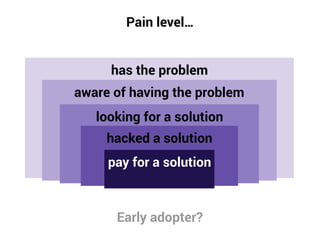
Pain level...
has the problem
aware of having the problem
looking for a solution
hacked a solution
pay for a solution
Pain level…
Early adopter?
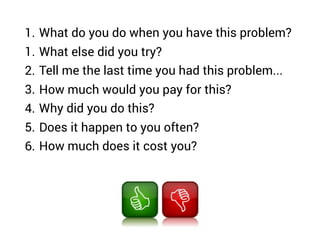
1. What do you do when you have this problem?
1. What else did you try?
2. Tell me the last time you had this problem...
3. How much would you pay for this?
4. Why did you do this?
5. Does it happen to you often?
6. How much does it cost you?
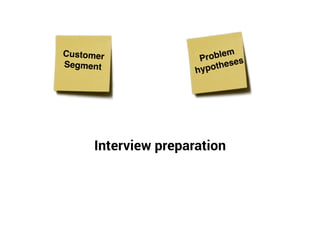
Customer
Segment
Problem
hypotheses
Interview preparation
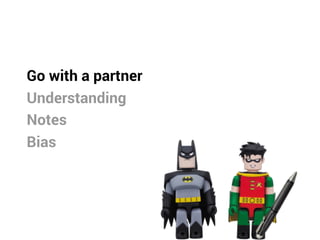
Go with a partner
Understanding
Notes
Bias
Finding customers
Persona
Behaviours
Alternative solutions
IRL. Online.
Starting the conversation
Just one person
“I am doing a research on ...”
Smile. Make them comfortable
Trust and complicity
About them
After the interview
Thank you
Answer questions
Ask for introductions and referrals
Debrief with partner
Solution Interview
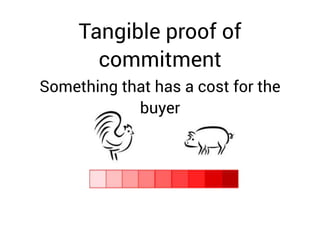
Tangible proof of
commitment
Something that has a cost for the
buyer
Tangible proof of commitment
Money - pre-order
Check - to cash later
A signed agreement - with blood?
Invitation to another meeting - location?
An email, phone number, access to friends list
Access to their sensitive data
Something that is valuable...your ideas...
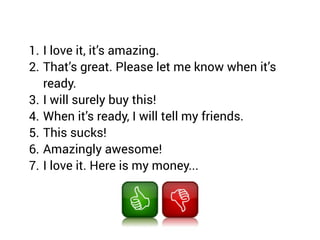
1. I love it, it’s amazing.
2. That’s great. Please let me know when it’s
ready.
3. I will surely buy this!
4. When it’s ready, I will tell my friends.
5. This sucks!
6. Amazingly awesome!
7. I love it. Here is my money...
Unless commitment is
made, there are only
promises and hopes; but
no plans
Peter Drucker
Lean Startup Customer Development Interview

Lean Startup Customer Development Interview