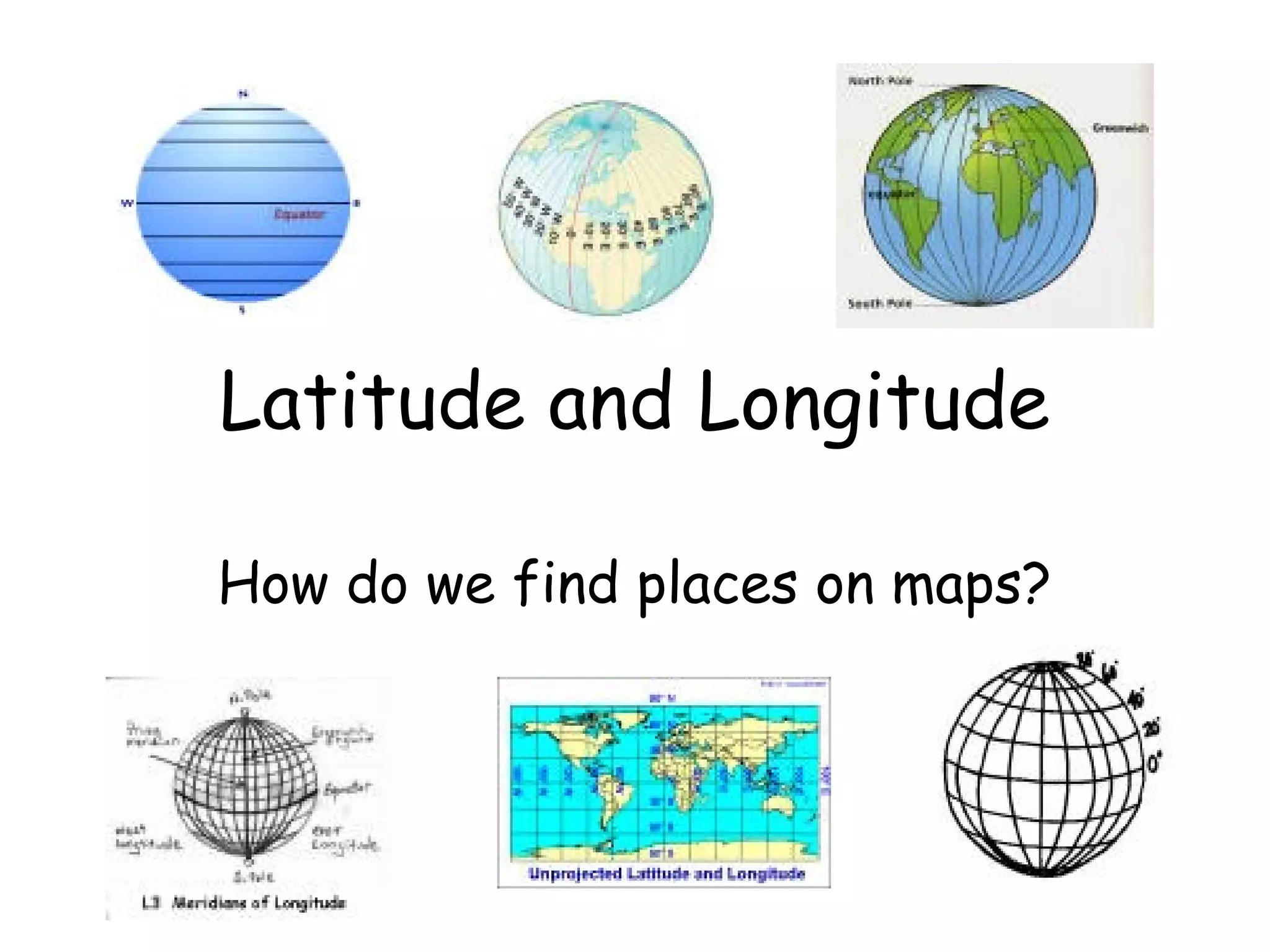
Latitude and Longitude
How do we find places on maps?
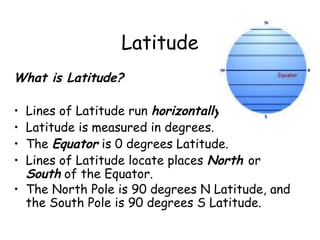
Latitude
What is Latitude?
• Lines of Latitude run horizontally
• Latitude is measured in degrees.
• The Equator is 0 degrees Latitude.
• Lines of Latitude locate places North or
South of the Equator.
• The North Pole is 90 degrees N Latitude, and
the South Pole is 90 degrees S Latitude.
Five Divisions
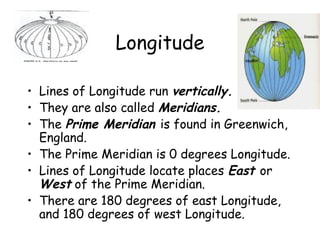
Longitude
• Lines of Longitude run vertically.
• They are also called Meridians.
• The Prime Meridian is found in Greenwich,
England.
• The Prime Meridian is 0 degrees Longitude.
• Lines of Longitude locate places East or
West of the Prime Meridian.
• There are 180 degrees of east Longitude,
and 180 degrees of west Longitude.
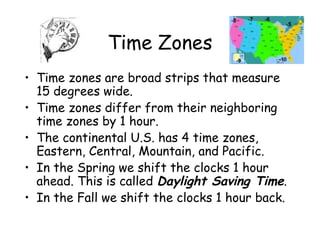
Time Zones
• Time zones are broad strips that measure
15 degrees wide.
• Time zones differ from their neighboring
time zones by 1 hour.
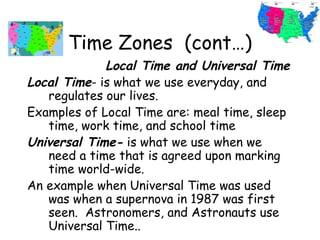
• The continental U.S. has 4 time zones,
Eastern, Central, Mountain, and Pacific.
• In the Spring we shift the clocks 1 hour
ahead. This is called Daylight Saving Time.
• In the Fall we shift the clocks 1 hour back.
Time Zones (cont…)
Local Time and Universal Time
Local Time- is what we use everyday, and
regulates our lives.
Examples of Local Time are: meal time, sleep
time, work time, and school time
Universal Time- is what we use when we
need a time that is agreed upon marking
time world-wide.
An example when Universal Time was used
was when a supernova in 1987 was first
seen. Astronomers, and Astronauts use
Universal Time..
Time Zones (cont….)
• Greenwich Mean Time- is the time
that is registered at Greenwich,
England.
**Greenwich Mean Time is another
name for Universal Time.
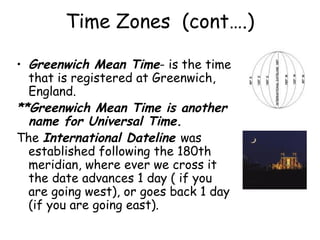
The International Dateline was
established following the 180th
meridian, where ever we cross it
the date advances 1 day ( if you
are going west), or goes back 1 day
(if you are going east).
Summary
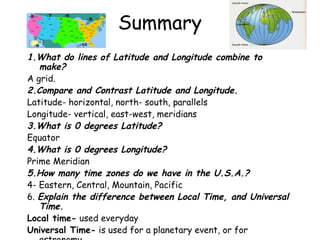
1.What do lines of Latitude and Longitude combine to
make?
A grid.
2.Compare and Contrast Latitude and Longitude.
Latitude- horizontal, north- south, parallels
Longitude- vertical, east-west, meridians
3.What is 0 degrees Latitude?
Equator
4.What is 0 degrees Longitude?
Prime Meridian
5.How many time zones do we have in the U.S.A.?
4- Eastern, Central, Mountain, Pacific
6. Explain the difference between Local Time, and Universal
Time.
Local time- used everyday
Universal Time- is used for a planetary event, or for

Lat and long time zones 2

  • 1.
    Latitude and Longitude Howdo we find places on maps?
  • 2.
    Latitude What is Latitude? •Lines of Latitude run horizontally • Latitude is measured in degrees. • The Equator is 0 degrees Latitude. • Lines of Latitude locate places North or South of the Equator. • The North Pole is 90 degrees N Latitude, and the South Pole is 90 degrees S Latitude.
  • 3.
  • 4.
    Longitude • Lines ofLongitude run vertically. • They are also called Meridians. • The Prime Meridian is found in Greenwich, England. • The Prime Meridian is 0 degrees Longitude. • Lines of Longitude locate places East or West of the Prime Meridian. • There are 180 degrees of east Longitude, and 180 degrees of west Longitude.
  • 5.
    Time Zones • Timezones are broad strips that measure 15 degrees wide. • Time zones differ from their neighboring time zones by 1 hour. • The continental U.S. has 4 time zones, Eastern, Central, Mountain, and Pacific. • In the Spring we shift the clocks 1 hour ahead. This is called Daylight Saving Time. • In the Fall we shift the clocks 1 hour back.
  • 6.
    Time Zones (cont…) LocalTime and Universal Time Local Time- is what we use everyday, and regulates our lives. Examples of Local Time are: meal time, sleep time, work time, and school time Universal Time- is what we use when we need a time that is agreed upon marking time world-wide. An example when Universal Time was used was when a supernova in 1987 was first seen. Astronomers, and Astronauts use Universal Time..
  • 7.
    Time Zones (cont….) •Greenwich Mean Time- is the time that is registered at Greenwich, England. **Greenwich Mean Time is another name for Universal Time. The International Dateline was established following the 180th meridian, where ever we cross it the date advances 1 day ( if you are going west), or goes back 1 day (if you are going east).
  • 8.
    Summary 1.What do linesof Latitude and Longitude combine to make? A grid. 2.Compare and Contrast Latitude and Longitude. Latitude- horizontal, north- south, parallels Longitude- vertical, east-west, meridians 3.What is 0 degrees Latitude? Equator 4.What is 0 degrees Longitude? Prime Meridian 5.How many time zones do we have in the U.S.A.? 4- Eastern, Central, Mountain, Pacific 6. Explain the difference between Local Time, and Universal Time. Local time- used everyday Universal Time- is used for a planetary event, or for