These slides will assist you in determining if your
problem or question is inferential or descriptive in
nature.
Descriptive
Inferential
These slides will assist you in determining if your
problem or question is inferential or descriptive in
nature.
Statistics tell a story about what is going on in
the world.
In general there are two types of stories that are
told using statistics:
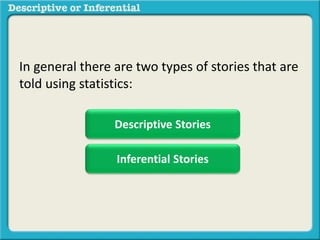
In general there are two types of stories that are
told using statistics:
Descriptive Stories
Inferential Stories
A descriptive story describes what is going on in
a population.
What is a population?
A population is every member of a defined
group.
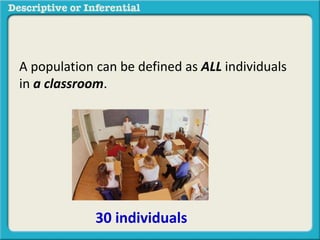
A population can be defined as ALL individuals
in a classroom.
A population can be defined as ALL individuals
in a classroom.
A population can be defined as ALL individuals
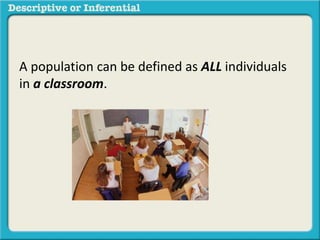
in a classroom.
30 individuals
A population can be defined as ALL individuals
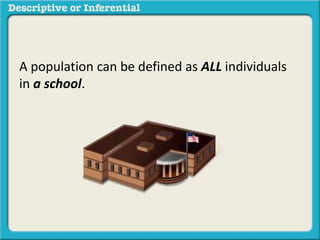
in a school.
A population can be defined as ALL individuals
in a school.
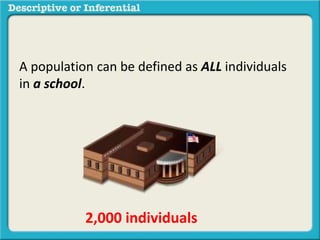
A population can be defined as ALL individuals
in a school.
2,000 individuals
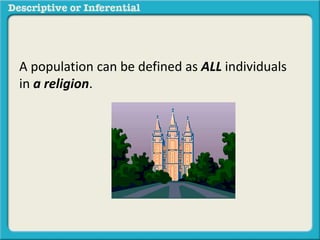
A population can be defined as ALL individuals
in a religion.
A population can be defined as ALL individuals
in a religion.
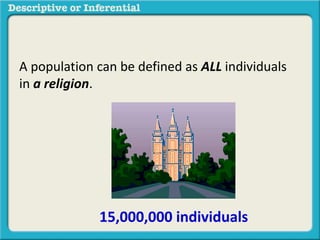
A population can be defined as ALL individuals
in a religion.
15,000,000 individuals
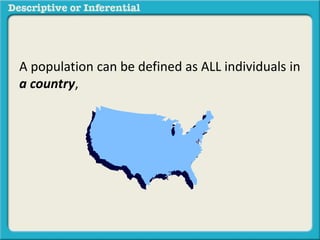
A population can be defined as ALL individuals in
a country.
A population can be defined as ALL individuals in
a country,
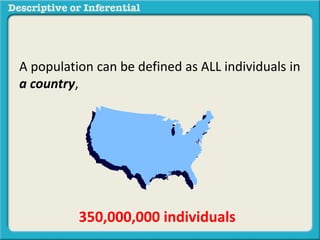
A population can be defined as ALL individuals in
a country,
350,000,000 individuals
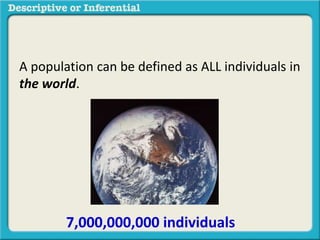
A population can be defined as ALL individuals in
the world.
A population can be defined as ALL individuals in
the world.
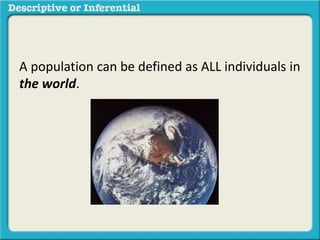
A population can be defined as ALL individuals in
the world.
7,000,000,000 individuals
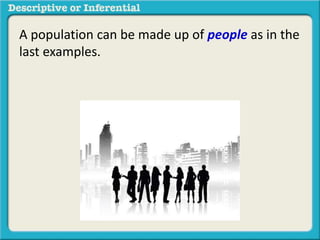
A population can be made up of people as in the
last examples.
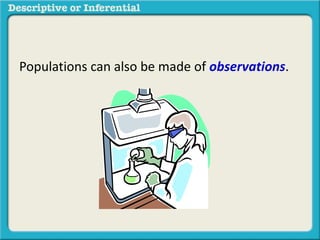
Populations can also be made of observations.
An observation can be the observing of EVERY
TIME a car makes a complete stop at an
intersection.
An observation can be the observing of EVERY
TIME a car makes a complete stop at an
intersection.
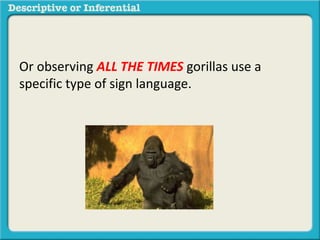
Or observing ALL THE TIMES gorillas use a
specific type of sign language.
If the numbers you are using tell the story about
EVERYONE in a group or ALL the possible
observations in a study,
If the numbers you are using tell the story about
EVERYONE in a group or ALL the possible
observations in a study, then you use
descriptive statistics to tell the story about that
population.
Examples of Word Problems that Use
Descriptive Statistics
Example #1
Example #1
Mrs. Jones has asked you to determine the
average test score for all of the students in her
five geography classes.
Example #1
Mrs. Jones has asked you to determine the
average test score for all of the students in her
five geography classes.
Example #1
Mrs. Jones has asked you to determine the
average test score for all of the students in her
five geography classes.
This is a descriptive question because we are
describing what is happening with the entire
population (all students in Mrs. Jones
geography classes)
Example #2
Example #2
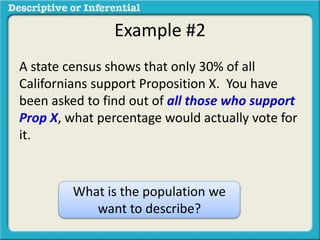
A state census shows that only 30% of all
Californians support Proposition X. You have
been asked to find out of all those who support
Prop X, what percentage would actually vote for
it.
Example #2
A state census shows that only 30% of all
Californians support Proposition X. You have
been asked to find out of all those who support
Prop X, what percentage would actually vote for
it.
What is the population we
want to describe?
Example #2
A state census shows that only 30% of all
Californians support Proposition X. You have
been asked to find out of all those who support
Prop X, what percentage would actually vote for
it.
What is the population we
want to describe?
Example #2
A state census shows that only 30% of all
Californians support Proposition X. You have
been asked to find out of all those who support
Prop X, what percentage would actually vote for
it.
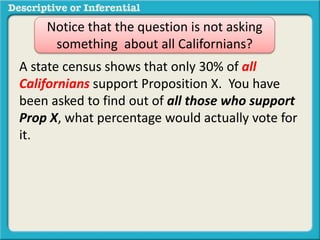
Notice that the question is not asking
something about all Californians?
Example #2
A state census shows that only 30% of all
Californians support Proposition 2. You have
been asked to find out of all those who support
Prop X, what percentage would actually vote for
it.
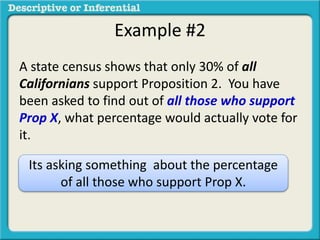
Its asking something about the percentage
of all those who support Prop X.
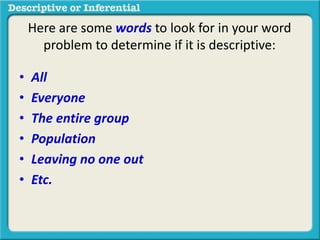
Here are some words to look for in your word
problem to determine if it is descriptive:
• All
• Everyone
• The entire group
• Population
• Leaving no one out
• Etc.
Here are some words to look for in your word
problem to determine if it is descriptive:
• All
• Everyone
• The entire group
• Population
• Leaving no one out
• Etc.
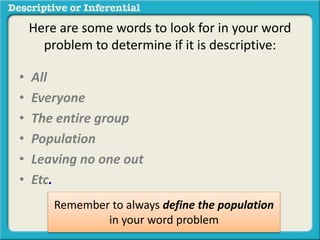
Remember to always define the population
in your word problem
Here are some words to look for in your word
problem to determine if it is descriptive:
• All
• Everyone
• The entire group
• Population
• Leaving no one out
• Etc.
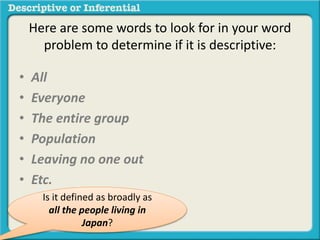
Is it defined as broadly as
all the people living in
Japan?
Here are some words to look for in your word
problem to determine if it is descriptive:
• All
• Everyone
• The entire group
• Population
• Leaving no one out
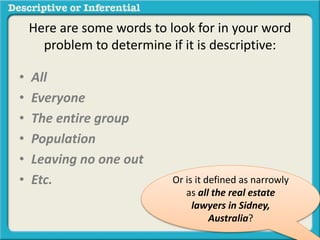
• Etc. Or is it defined as narrowly
as all the real estate
lawyers in Sidney,
Australia?
Here are some words to look for in your word
problem to determine if it is descriptive:
Are you ready to make your decision?
Is your word problem descriptive?
Descriptive
Inferential
Now let’s determine how to tell if your
word problem tells an inferential story.
Because it is not feasible to collect information
about everyone in a country, state, or school,
nor would it be possible to look at all
observations, we can take a smaller sample and
then generalize it to a larger population.
The methods used to do this are called
inferential statistics
Because it is not feasible to collect information
about everyone in a country, state, or school,
nor would it be feasible to look at all
observations, we can take a smaller sample and
then generalize it to a larger population.
The methods used to do this are called
inferential statistics
Because it is not feasible to collect information
about everyone in a country, state, or school,
nor would it be feasible to look at all
observations, we can take a smaller sample and
then generalize it to a larger population.
The methods used to do this are called
inferential statistics
Because it is not feasible to collect information
about everyone in a country, state, or school,
nor would it be feasible to look at all
observations, we can take a smaller sample and
then generalize it to a larger population.
The methods used to do this are called
inferential statistics.
Inferential statistics use information about a
sample (a group within a population) to tell a
story about a population.
Inferential statistics use information about a
sample (a group within a population) to tell a
story about a population.
The word inferential means we are inferring
something about a population based on information
from a smaller but representative sample
Consider the following inferential problem:
Using a sample of 5th grade student verbal acuity
scores, determine the average scores of 5th
graders in the state of Montana.
Consider the following inferential problem:
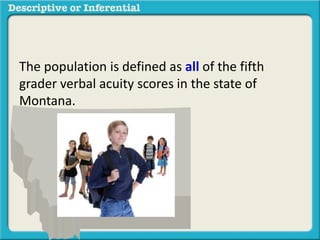
The population is defined as all of the fifth
grader verbal acuity scores in the state of
Montana.
The population is defined as all of the fifth
grader verbal acuity scores in the state of
Montana.
Let’s take a random
sample of a 100 fifth
grade students scores
from across the entire
state.
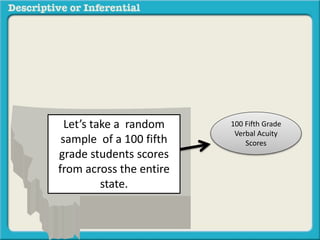
100 Fifth Grade
Verbal Acuity
Scores
Let’s take a random
sample of a 100 fifth
grade students scores
from across the entire
state.
100 Fifth Grade
Verbal Acuity
Scores
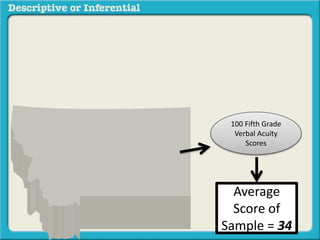
Average
Score of
Sample = 34
100 Fifth Grade
Verbal Acuity
Scores
Average
Score of
Sample = 34
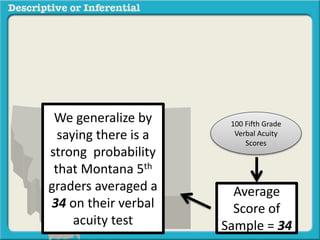
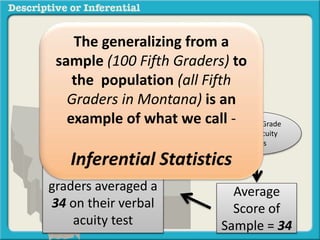
We generalize by
saying there is a
strong probability
that Montana 5th
graders averaged a
34 on their verbal
acuity test
100 Fifth Grade
Verbal Acuity
Scores
Average
Score of
Sample = 34
We generalize by
saying there is a
strong probability
that Montana 5th
graders averaged a
34 on their verbal
acuity test
The generalizing from a
sample (100 Fifth Graders) to
the population (all Fifth
Graders in Montana) is an
example of what we call -
Inferential Statistics
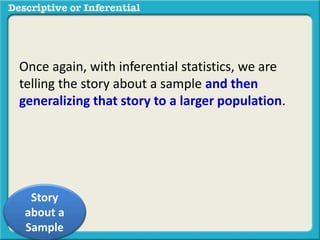
Once again, with inferential statistics, we are
telling the story about a sample
Once again, with inferential statistics, we are
telling the story about a sample
Story
about a
Sample
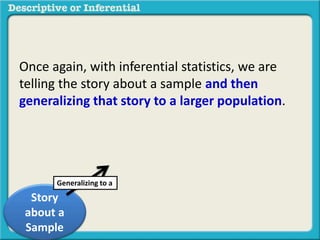
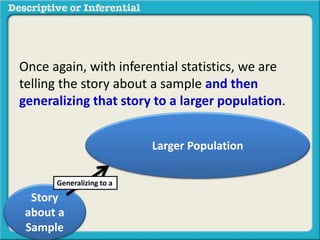
Once again, with inferential statistics, we are
telling the story about a sample and then
generalizing that story to a larger population.
Once again, with inferential statistics, we are
telling the story about a sample and then
generalizing that story to a larger population.
Story
about a
Sample
Once again, with inferential statistics, we are
telling the story about a sample and then
generalizing that story to a larger population.
Story
about a
Sample
Generalizing to a
Once again, with inferential statistics, we are
telling the story about a sample and then
generalizing that story to a larger population.
Story
about a
Sample
Larger Population
Generalizing to a
Let’s look at an example of an
inferential statistic word problem
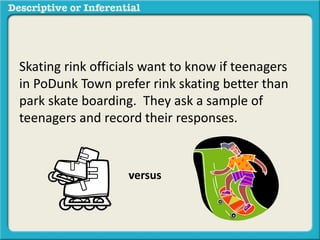
Skating rink officials want to know if teenagers
in PoDunk Town prefer rink skating better than
park skate boarding. They ask a sample of
teenagers and record their responses.
versus
Skating rink officials want to know if teenagers
in PoDunk Town prefer rink skating better than
park skate boarding. They ask a sample of
teenagers and record their responses.
It will most likely be
an inferential
question if you see
the word sample
Skating rink officials want to know if teenagers
in PoDunk Town prefer rink skating better than
park skate boarding. They ask a sample of
teenagers and record their responses.
that generalizes to a
population
Here are some words to look for in your word
problem to determine if it is inferential:
• sample
• some
• several
• random
• generalize
• Etc.
Here are some words to look for in your word
problem to determine if it is inferential:
Would you classify the problem you are working
on as inferential?
Would you classify the problem you are working
on as inferential?
Descriptive
Inferential

Descriptive inferential-discuss 1

  • 1.
    These slides willassist you in determining if your problem or question is inferential or descriptive in nature.
  • 2.
    Descriptive Inferential These slides willassist you in determining if your problem or question is inferential or descriptive in nature.
  • 3.
    Statistics tell astory about what is going on in the world.
  • 4.
    In general thereare two types of stories that are told using statistics:
  • 5.
    In general thereare two types of stories that are told using statistics: Descriptive Stories Inferential Stories
  • 6.
    A descriptive storydescribes what is going on in a population.
  • 7.
    What is apopulation?
  • 8.
    A population isevery member of a defined group.
  • 9.
    A population canbe defined as ALL individuals
  • 10.
    A population canbe defined as ALL individuals in a classroom.
  • 11.
    A population canbe defined as ALL individuals in a classroom.
  • 12.
    A population canbe defined as ALL individuals in a classroom. 30 individuals
  • 13.
    A population canbe defined as ALL individuals in a school.
  • 14.
    A population canbe defined as ALL individuals in a school.
  • 15.
    A population canbe defined as ALL individuals in a school. 2,000 individuals
  • 16.
    A population canbe defined as ALL individuals in a religion.
  • 17.
    A population canbe defined as ALL individuals in a religion.
  • 18.
    A population canbe defined as ALL individuals in a religion. 15,000,000 individuals
  • 19.
    A population canbe defined as ALL individuals in a country.
  • 20.
    A population canbe defined as ALL individuals in a country,
  • 21.
    A population canbe defined as ALL individuals in a country, 350,000,000 individuals
  • 22.
    A population canbe defined as ALL individuals in the world.
  • 23.
    A population canbe defined as ALL individuals in the world.
  • 24.
    A population canbe defined as ALL individuals in the world. 7,000,000,000 individuals
  • 25.
    A population canbe made up of people as in the last examples.
  • 26.
    Populations can alsobe made of observations.
  • 27.
    An observation canbe the observing of EVERY TIME a car makes a complete stop at an intersection.
  • 28.
    An observation canbe the observing of EVERY TIME a car makes a complete stop at an intersection.
  • 29.
    Or observing ALLTHE TIMES gorillas use a specific type of sign language.
  • 30.
    If the numbersyou are using tell the story about EVERYONE in a group or ALL the possible observations in a study,
  • 31.
    If the numbersyou are using tell the story about EVERYONE in a group or ALL the possible observations in a study, then you use descriptive statistics to tell the story about that population.
  • 32.
    Examples of WordProblems that Use Descriptive Statistics
  • 33.
  • 34.
    Example #1 Mrs. Joneshas asked you to determine the average test score for all of the students in her five geography classes.
  • 35.
    Example #1 Mrs. Joneshas asked you to determine the average test score for all of the students in her five geography classes.
  • 36.
    Example #1 Mrs. Joneshas asked you to determine the average test score for all of the students in her five geography classes. This is a descriptive question because we are describing what is happening with the entire population (all students in Mrs. Jones geography classes)
  • 37.
  • 38.
    Example #2 A statecensus shows that only 30% of all Californians support Proposition X. You have been asked to find out of all those who support Prop X, what percentage would actually vote for it.
  • 39.
    Example #2 A statecensus shows that only 30% of all Californians support Proposition X. You have been asked to find out of all those who support Prop X, what percentage would actually vote for it. What is the population we want to describe?
  • 40.
    Example #2 A statecensus shows that only 30% of all Californians support Proposition X. You have been asked to find out of all those who support Prop X, what percentage would actually vote for it. What is the population we want to describe?
  • 41.
    Example #2 A statecensus shows that only 30% of all Californians support Proposition X. You have been asked to find out of all those who support Prop X, what percentage would actually vote for it. Notice that the question is not asking something about all Californians?
  • 42.
    Example #2 A statecensus shows that only 30% of all Californians support Proposition 2. You have been asked to find out of all those who support Prop X, what percentage would actually vote for it. Its asking something about the percentage of all those who support Prop X.
  • 43.
    Here are somewords to look for in your word problem to determine if it is descriptive:
  • 44.
    • All • Everyone •The entire group • Population • Leaving no one out • Etc. Here are some words to look for in your word problem to determine if it is descriptive:
  • 45.
    • All • Everyone •The entire group • Population • Leaving no one out • Etc. Remember to always define the population in your word problem Here are some words to look for in your word problem to determine if it is descriptive:
  • 46.
    • All • Everyone •The entire group • Population • Leaving no one out • Etc. Is it defined as broadly as all the people living in Japan? Here are some words to look for in your word problem to determine if it is descriptive:
  • 47.
    • All • Everyone •The entire group • Population • Leaving no one out • Etc. Or is it defined as narrowly as all the real estate lawyers in Sidney, Australia? Here are some words to look for in your word problem to determine if it is descriptive:
  • 48.
    Are you readyto make your decision?
  • 49.
    Is your wordproblem descriptive?
  • 50.
    Is your wordproblem descriptive? Descriptive Inferential
  • 51.
    Now let’s determinehow to tell if your word problem tells an inferential story.
  • 52.
    Because it isnot feasible to collect information about everyone in a country, state, or school, nor would it be possible to look at all observations, we can take a smaller sample and then generalize it to a larger population. The methods used to do this are called inferential statistics
  • 53.
    Because it isnot feasible to collect information about everyone in a country, state, or school, nor would it be feasible to look at all observations, we can take a smaller sample and then generalize it to a larger population. The methods used to do this are called inferential statistics
  • 54.
    Because it isnot feasible to collect information about everyone in a country, state, or school, nor would it be feasible to look at all observations, we can take a smaller sample and then generalize it to a larger population. The methods used to do this are called inferential statistics
  • 55.
    Because it isnot feasible to collect information about everyone in a country, state, or school, nor would it be feasible to look at all observations, we can take a smaller sample and then generalize it to a larger population. The methods used to do this are called inferential statistics.
  • 56.
    Inferential statistics useinformation about a sample (a group within a population) to tell a story about a population.
  • 57.
    Inferential statistics useinformation about a sample (a group within a population) to tell a story about a population. The word inferential means we are inferring something about a population based on information from a smaller but representative sample
  • 58.
    Consider the followinginferential problem:
  • 59.
    Using a sampleof 5th grade student verbal acuity scores, determine the average scores of 5th graders in the state of Montana. Consider the following inferential problem:
  • 60.
    The population isdefined as all of the fifth grader verbal acuity scores in the state of Montana.
  • 61.
    The population isdefined as all of the fifth grader verbal acuity scores in the state of Montana.
  • 62.
    Let’s take arandom sample of a 100 fifth grade students scores from across the entire state.
  • 63.
    100 Fifth Grade VerbalAcuity Scores Let’s take a random sample of a 100 fifth grade students scores from across the entire state.
  • 64.
    100 Fifth Grade VerbalAcuity Scores Average Score of Sample = 34
  • 65.
    100 Fifth Grade VerbalAcuity Scores Average Score of Sample = 34 We generalize by saying there is a strong probability that Montana 5th graders averaged a 34 on their verbal acuity test
  • 66.
    100 Fifth Grade VerbalAcuity Scores Average Score of Sample = 34 We generalize by saying there is a strong probability that Montana 5th graders averaged a 34 on their verbal acuity test The generalizing from a sample (100 Fifth Graders) to the population (all Fifth Graders in Montana) is an example of what we call - Inferential Statistics
  • 67.
    Once again, withinferential statistics, we are telling the story about a sample
  • 68.
    Once again, withinferential statistics, we are telling the story about a sample Story about a Sample
  • 69.
    Once again, withinferential statistics, we are telling the story about a sample and then generalizing that story to a larger population.
  • 70.
    Once again, withinferential statistics, we are telling the story about a sample and then generalizing that story to a larger population. Story about a Sample
  • 71.
    Once again, withinferential statistics, we are telling the story about a sample and then generalizing that story to a larger population. Story about a Sample Generalizing to a
  • 72.
    Once again, withinferential statistics, we are telling the story about a sample and then generalizing that story to a larger population. Story about a Sample Larger Population Generalizing to a
  • 73.
    Let’s look atan example of an inferential statistic word problem
  • 74.
    Skating rink officialswant to know if teenagers in PoDunk Town prefer rink skating better than park skate boarding. They ask a sample of teenagers and record their responses. versus
  • 75.
    Skating rink officialswant to know if teenagers in PoDunk Town prefer rink skating better than park skate boarding. They ask a sample of teenagers and record their responses. It will most likely be an inferential question if you see the word sample
  • 76.
    Skating rink officialswant to know if teenagers in PoDunk Town prefer rink skating better than park skate boarding. They ask a sample of teenagers and record their responses. that generalizes to a population
  • 77.
    Here are somewords to look for in your word problem to determine if it is inferential:
  • 78.
    • sample • some •several • random • generalize • Etc. Here are some words to look for in your word problem to determine if it is inferential:
  • 79.
    Would you classifythe problem you are working on as inferential?
  • 80.
    Would you classifythe problem you are working on as inferential? Descriptive Inferential