AGBS | Bangalore
Measures of Dispersion
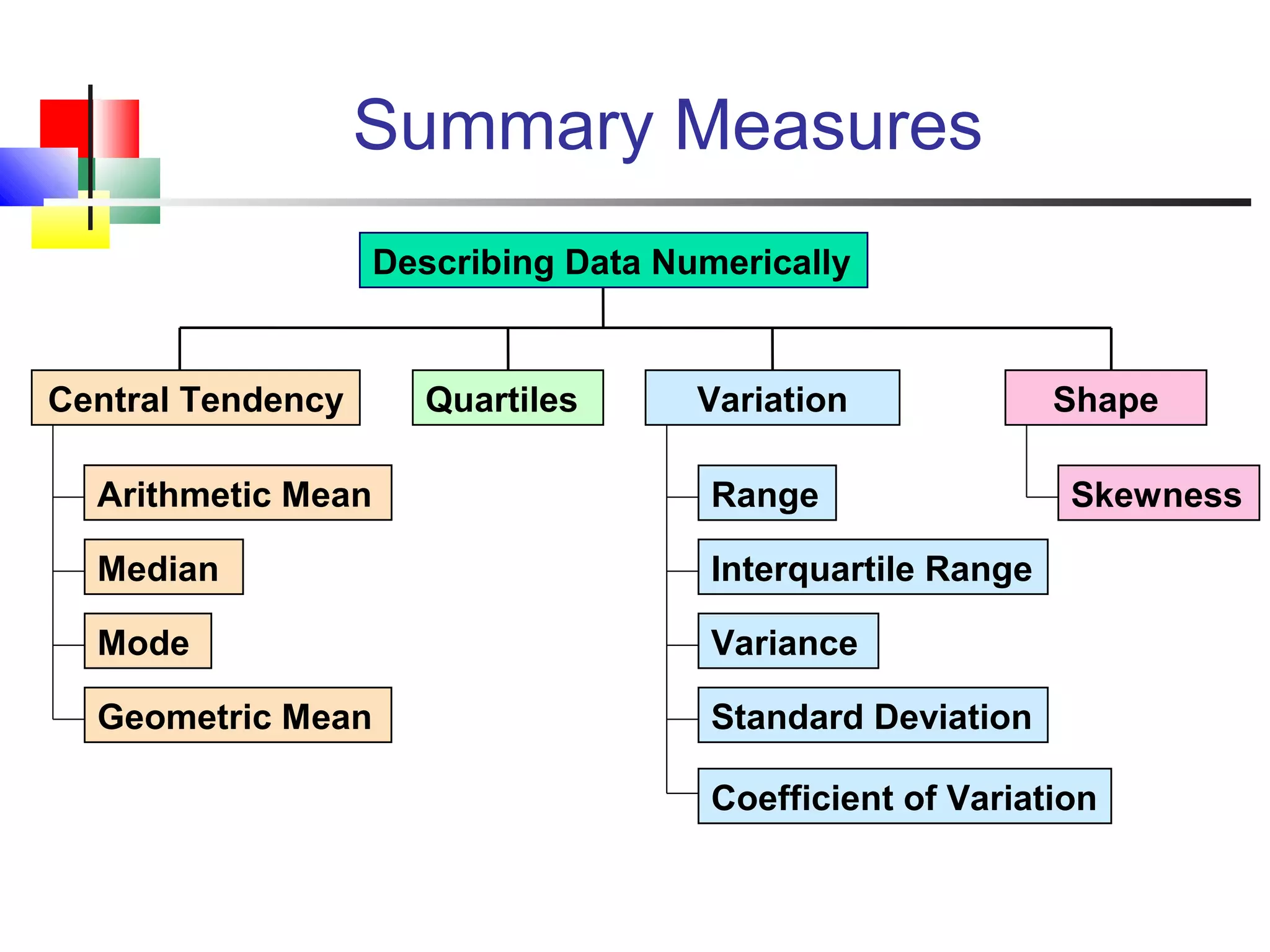
Summary Measures
Arithmetic Mean
Median
Mode
Describing Data Numerically
Variance
Standard Deviation
Coefficient of Variation
Range
Interquartile Range
Geometric Mean
Skewness
Central Tendency Variation ShapeQuartiles
Quartiles
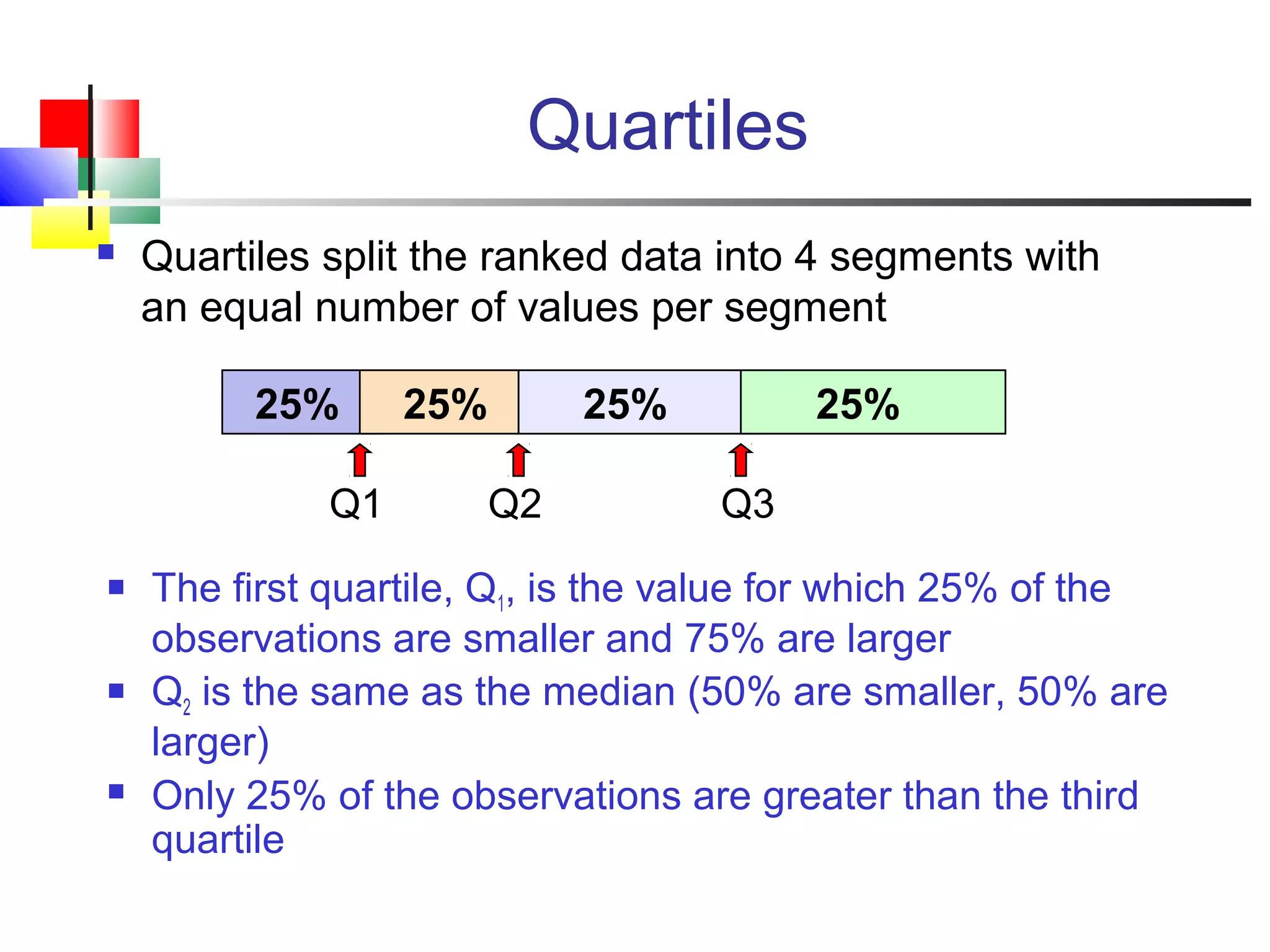
 Quartiles split the ranked data into 4 segments with
an equal number of values per segment
25% 25% 25% 25%
 The first quartile, Q1, is the value for which 25% of the
observations are smaller and 75% are larger
 Q2 is the same as the median (50% are smaller, 50% are
larger)
 Only 25% of the observations are greater than the third
quartile
Q1 Q2 Q3
Quartile Formulas
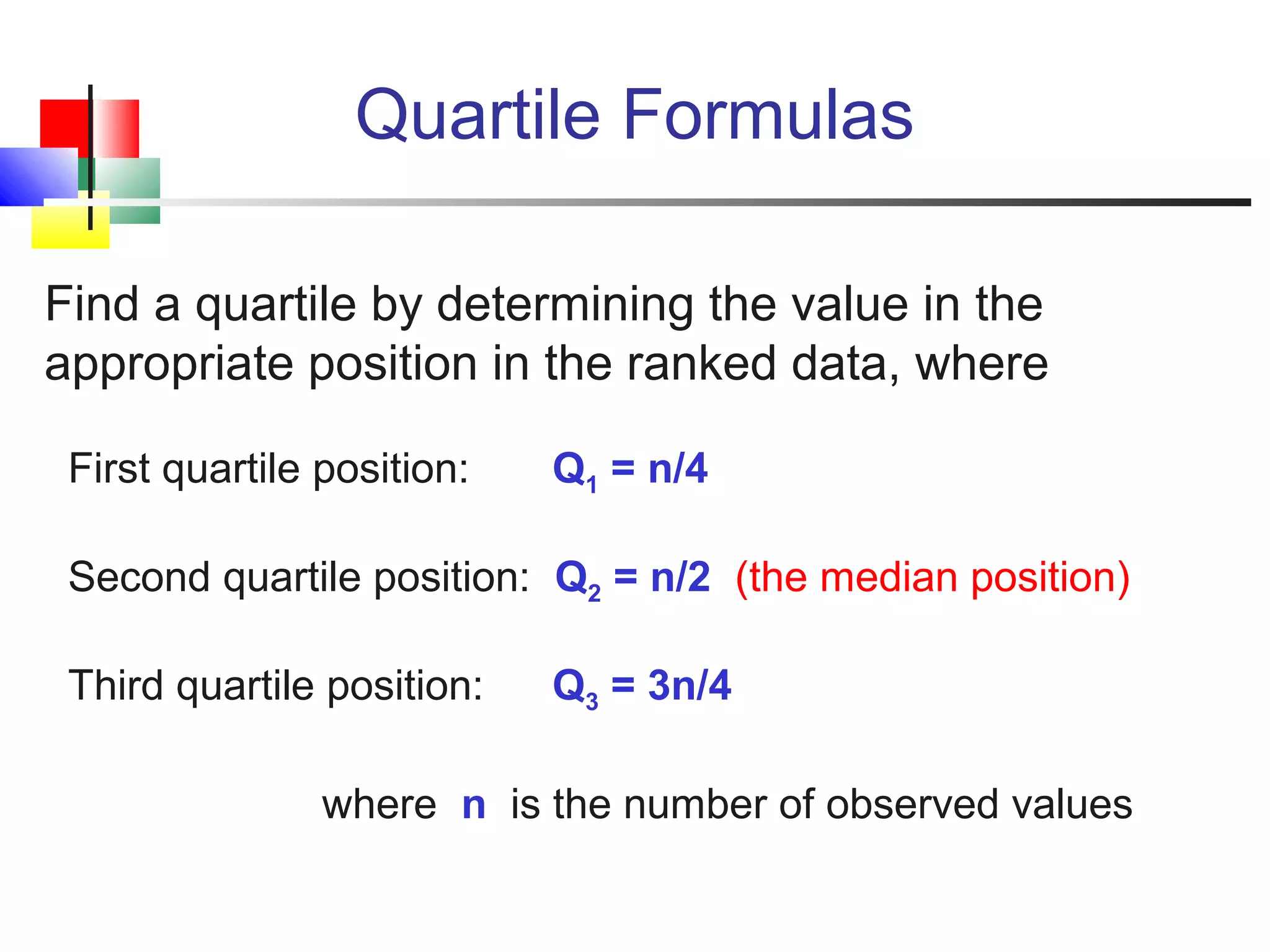
Find a quartile by determining the value in the
appropriate position in the ranked data, where
First quartile position: Q1 = n/4
Second quartile position: Q2 = n/2 (the median position)
Third quartile position: Q3 = 3n/4
where n is the number of observed values
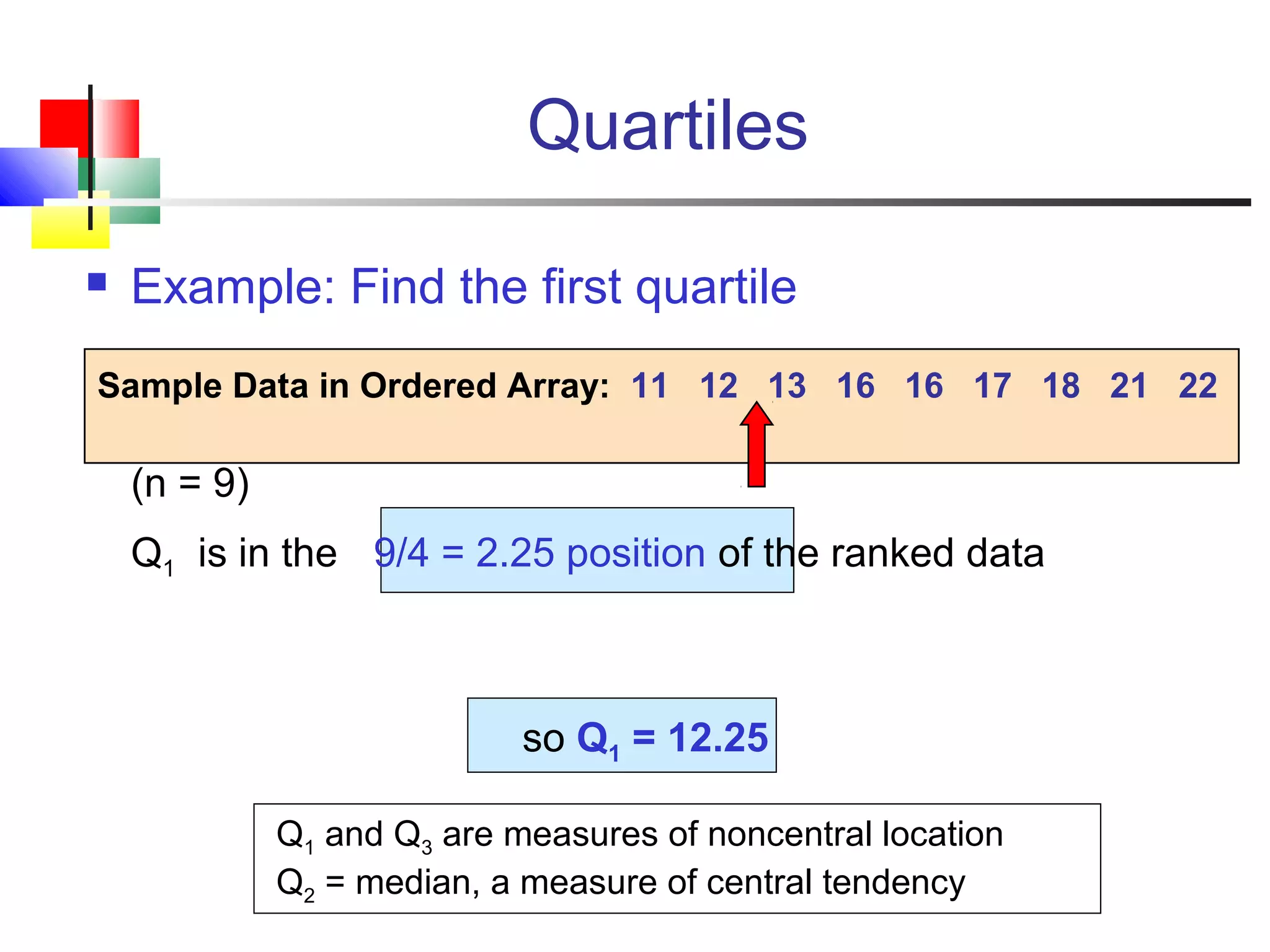
(n = 9)
Q1 is in the 9/4 = 2.25 position of the ranked data
so Q1 = 12.25
Quartiles
Sample Data in Ordered Array: 11 12 13 16 16 17 18 21 22
 Example: Find the first quartile
Q1 and Q3 are measures of noncentral location
Q2 = median, a measure of central tendency
Quartiles
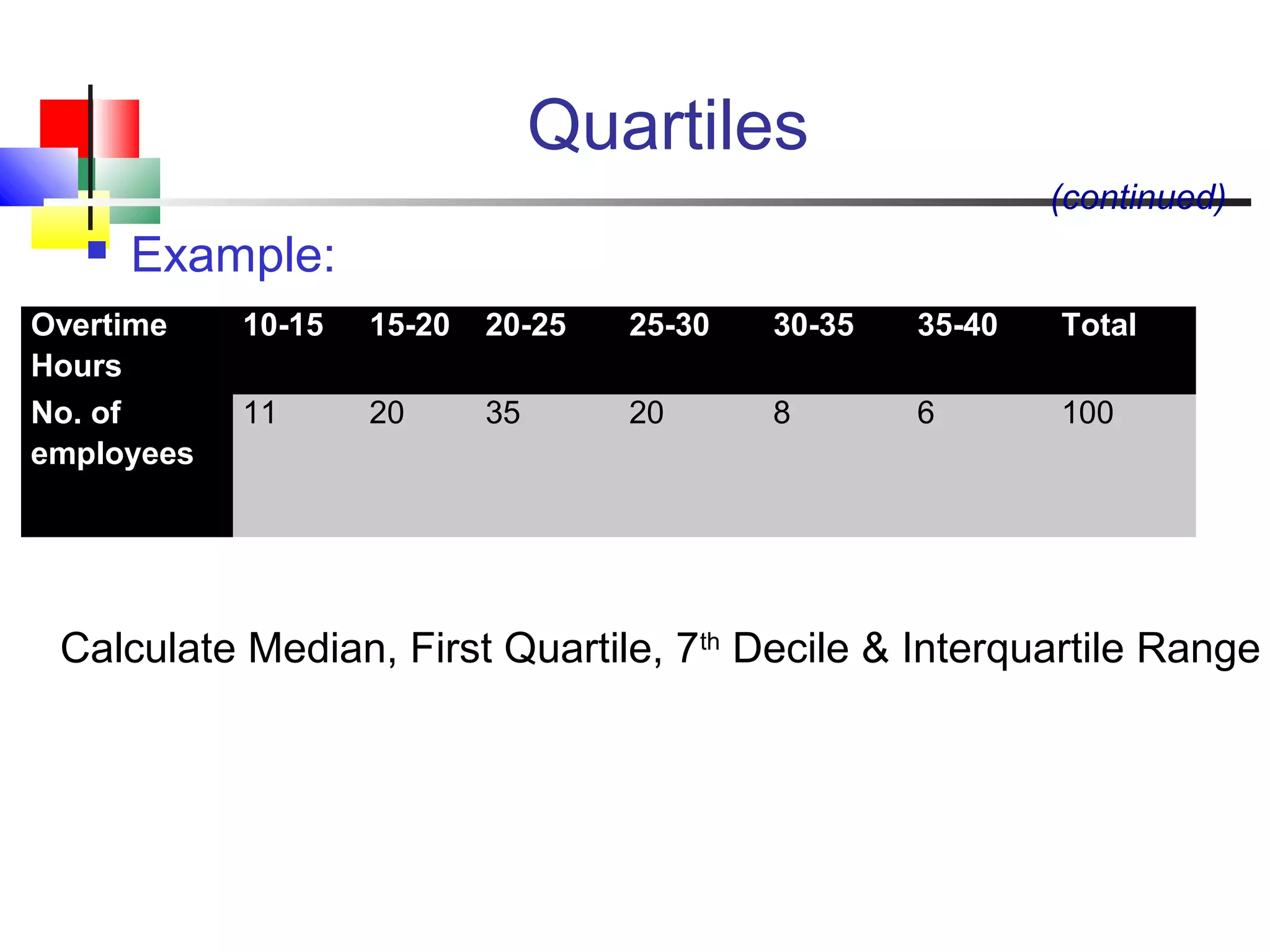
 Example:
(continued)
Overtime
Hours
10-15 15-20 20-25 25-30 30-35 35-40 Total
No. of
employees
11 20 35 20 8 6 100
Calculate Median, First Quartile, 7th
Decile & Interquartile Range
Same center,
different variation
Measures of Variation
Variation
Variance Standard
Deviation
Coefficient
of Variation
Range Interquartile
Range
 Measures of variation give
information on the spread or
variability of the data
values.
Range
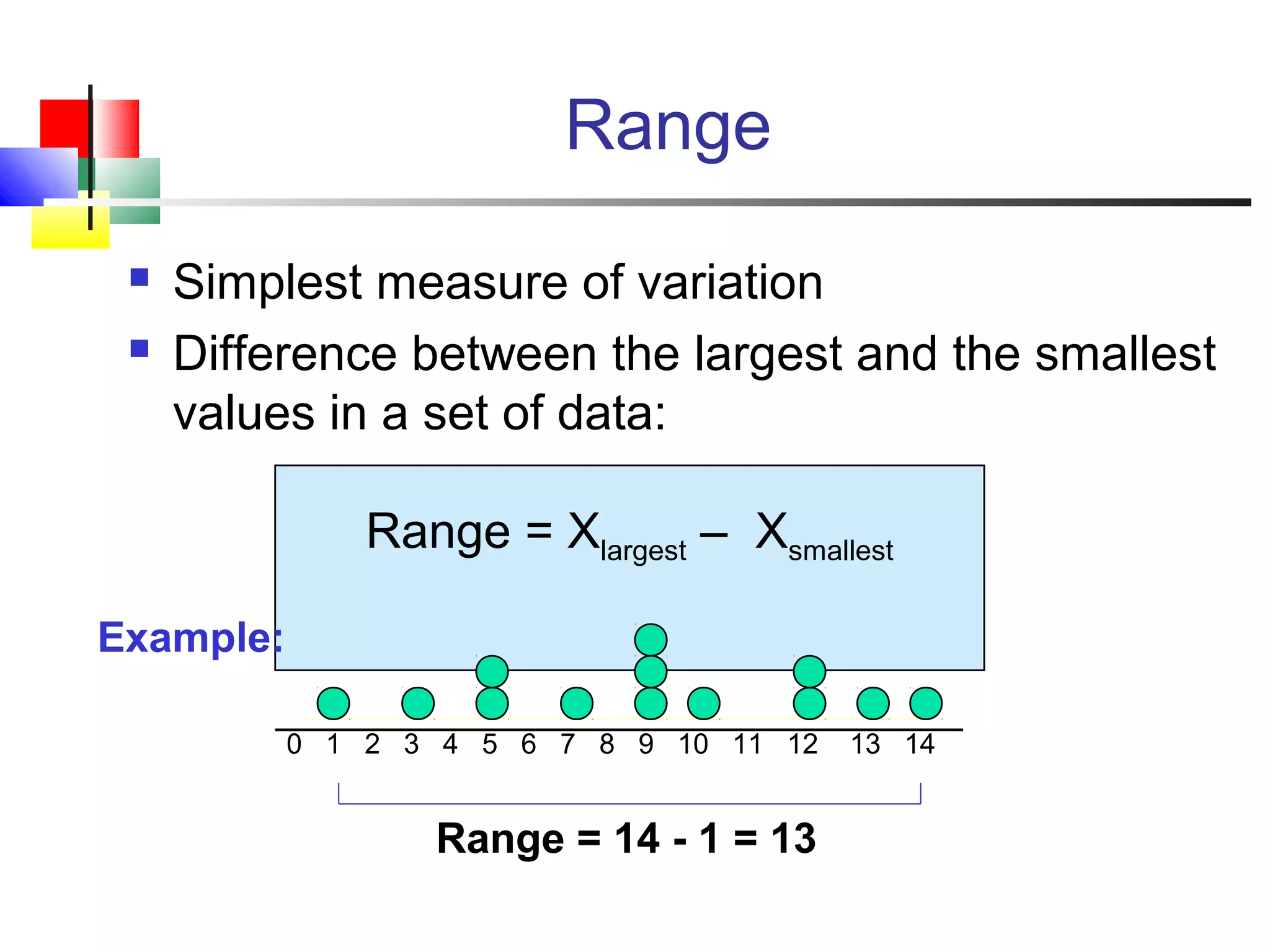
 Simplest measure of variation
 Difference between the largest and the smallest
values in a set of data:
Range = Xlargest – Xsmallest
0 1 2 3 4 5 6 7 8 9 10 11 12 13 14
Range = 14 - 1 = 13
Example:
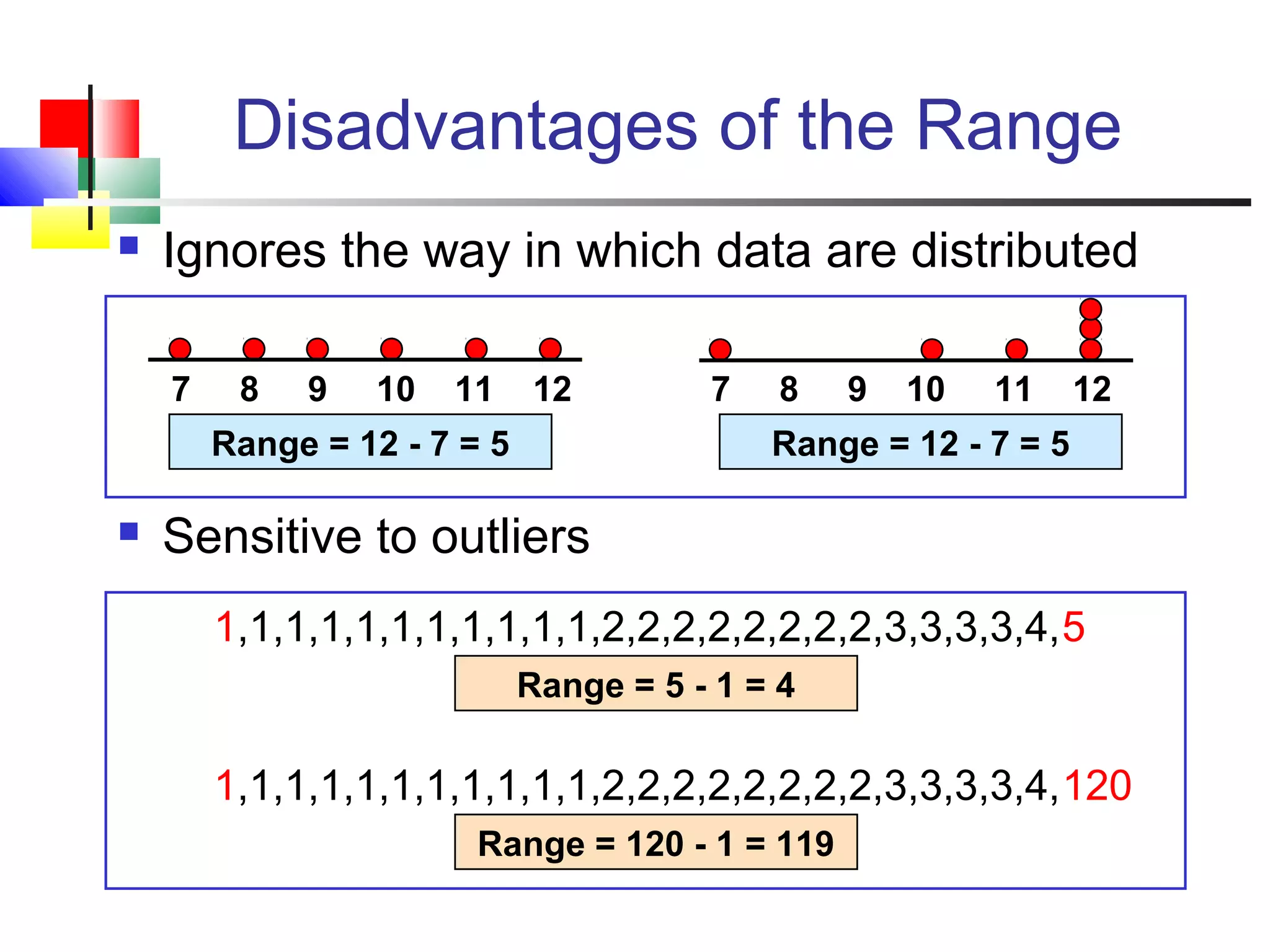
 Ignores the way in which data are distributed
 Sensitive to outliers
7 8 9 10 11 12
Range = 12 - 7 = 5
7 8 9 10 11 12
Range = 12 - 7 = 5
Disadvantages of the Range
1,1,1,1,1,1,1,1,1,1,1,2,2,2,2,2,2,2,2,3,3,3,3,4,5
1,1,1,1,1,1,1,1,1,1,1,2,2,2,2,2,2,2,2,3,3,3,3,4,120
Range = 5 - 1 = 4
Range = 120 - 1 = 119
Coefficient of Range
Coefficient of Range = [L-S]/[L+S]
Where,
L = Largest value in the data set
S = Smallest value in the data set
Interquartile Range
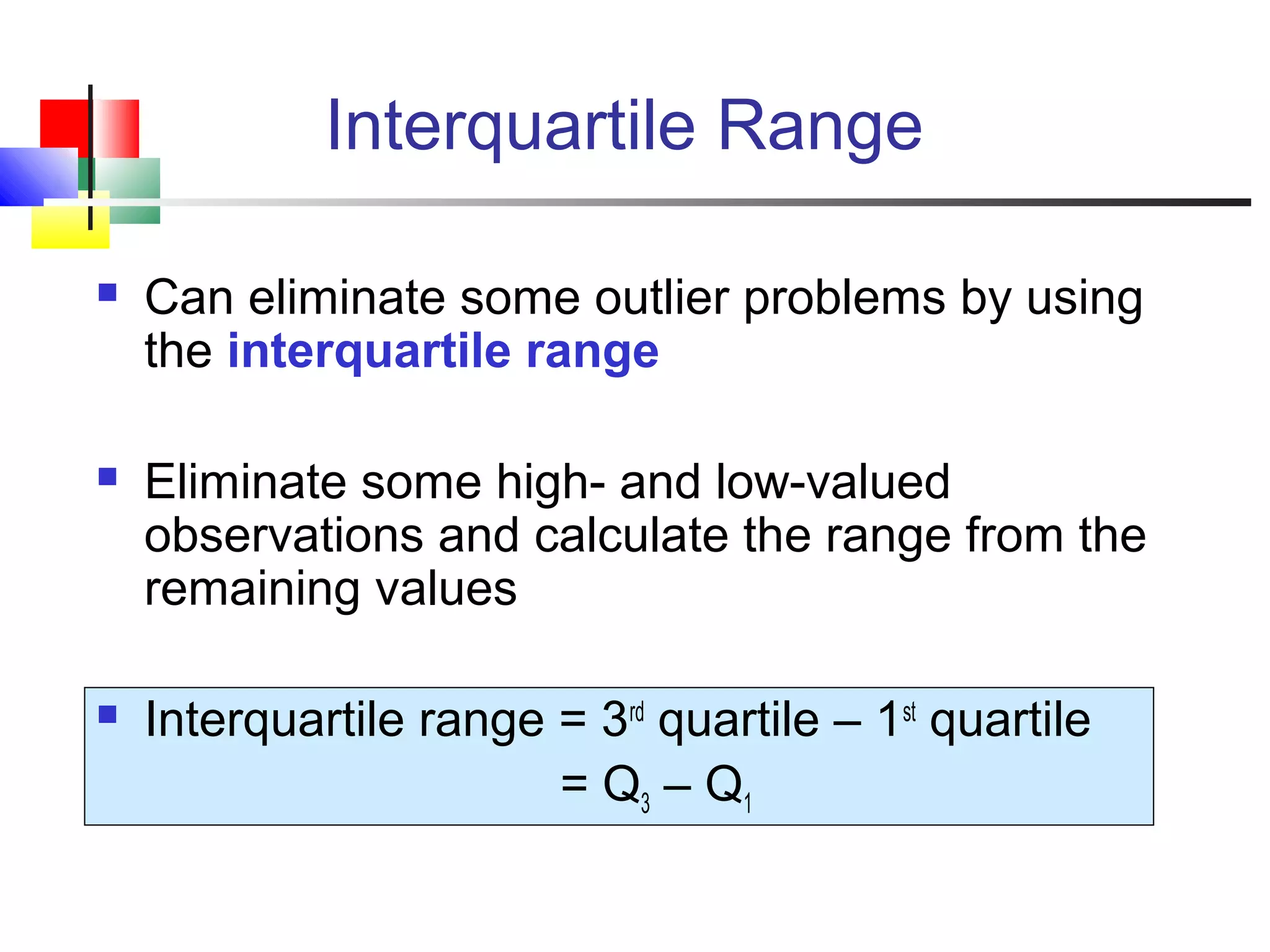
 Can eliminate some outlier problems by using
the interquartile range
 Eliminate some high- and low-valued
observations and calculate the range from the
remaining values
 Interquartile range = 3rd
quartile – 1st
quartile
= Q3 – Q1
Interquartile Range
Median
(Q2)
X
maximumX
minimum Q1 Q3
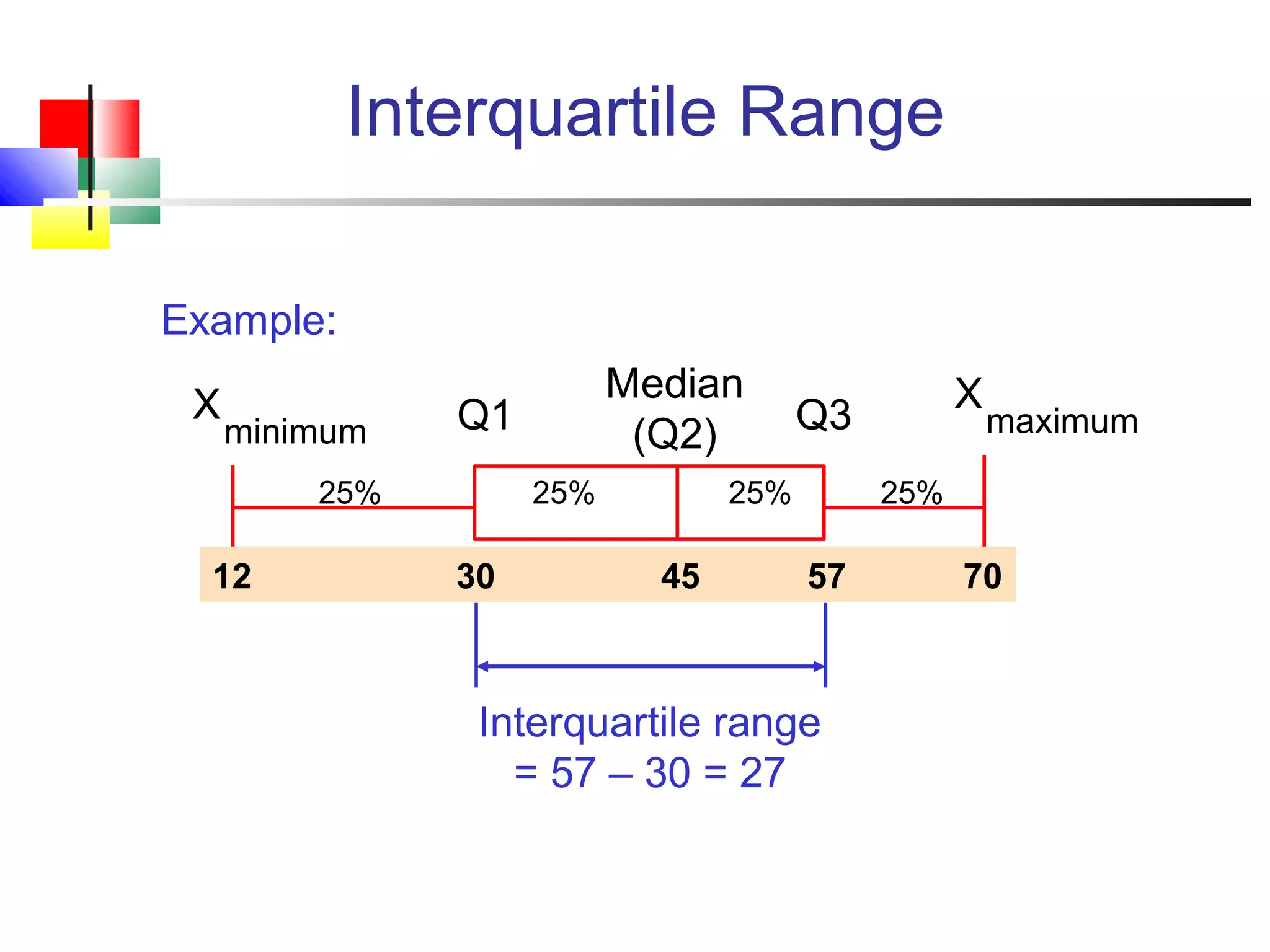
Example:
25% 25% 25% 25%
12 30 45 57 70
Interquartile range
= 57 – 30 = 27
Coefficient of QD
Coefficient of QD= [Q3-Q1]/[Q3+Q1]
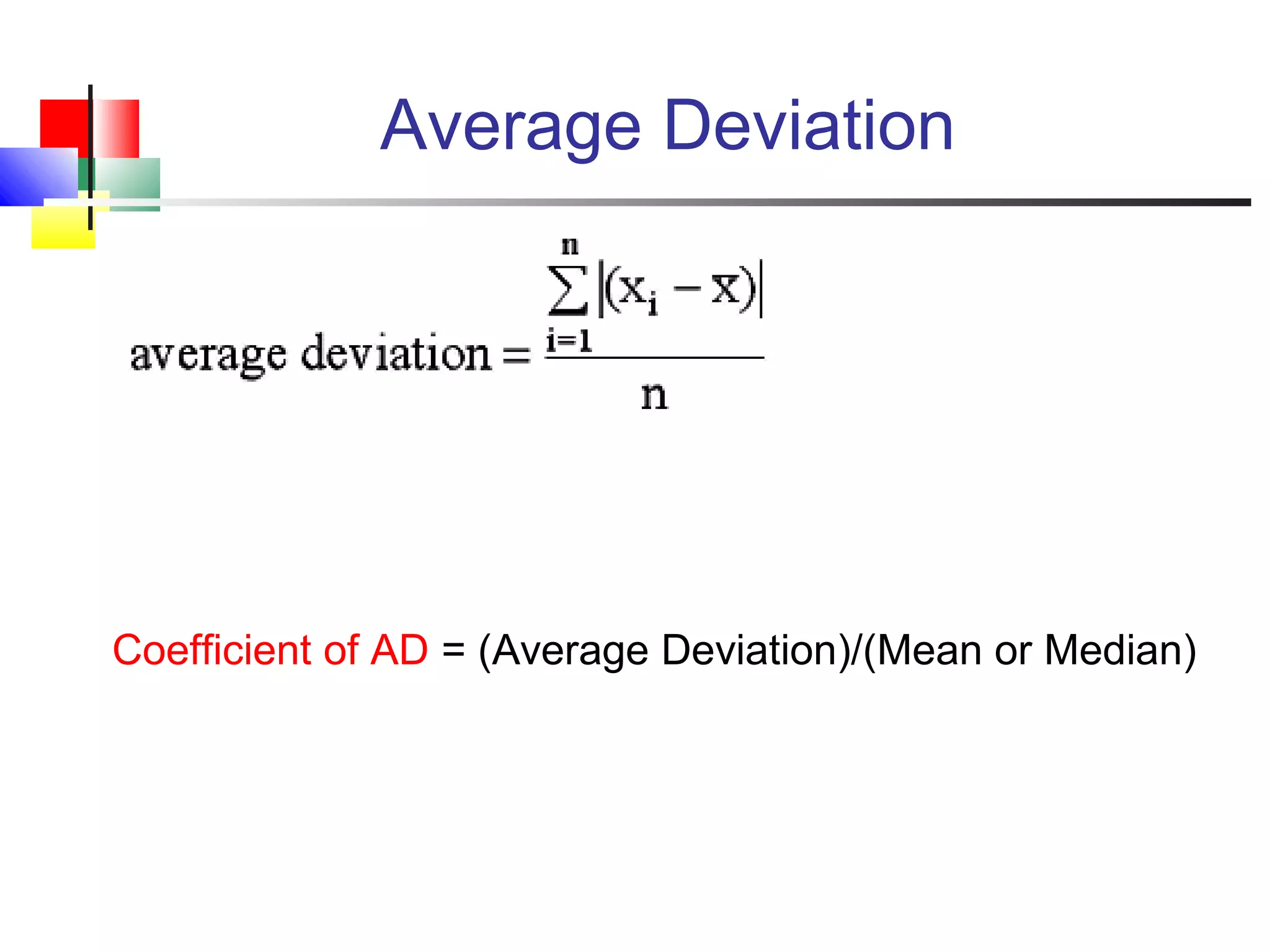
Average Deviation
Coefficient of AD = (Average Deviation)/(Mean or Median)
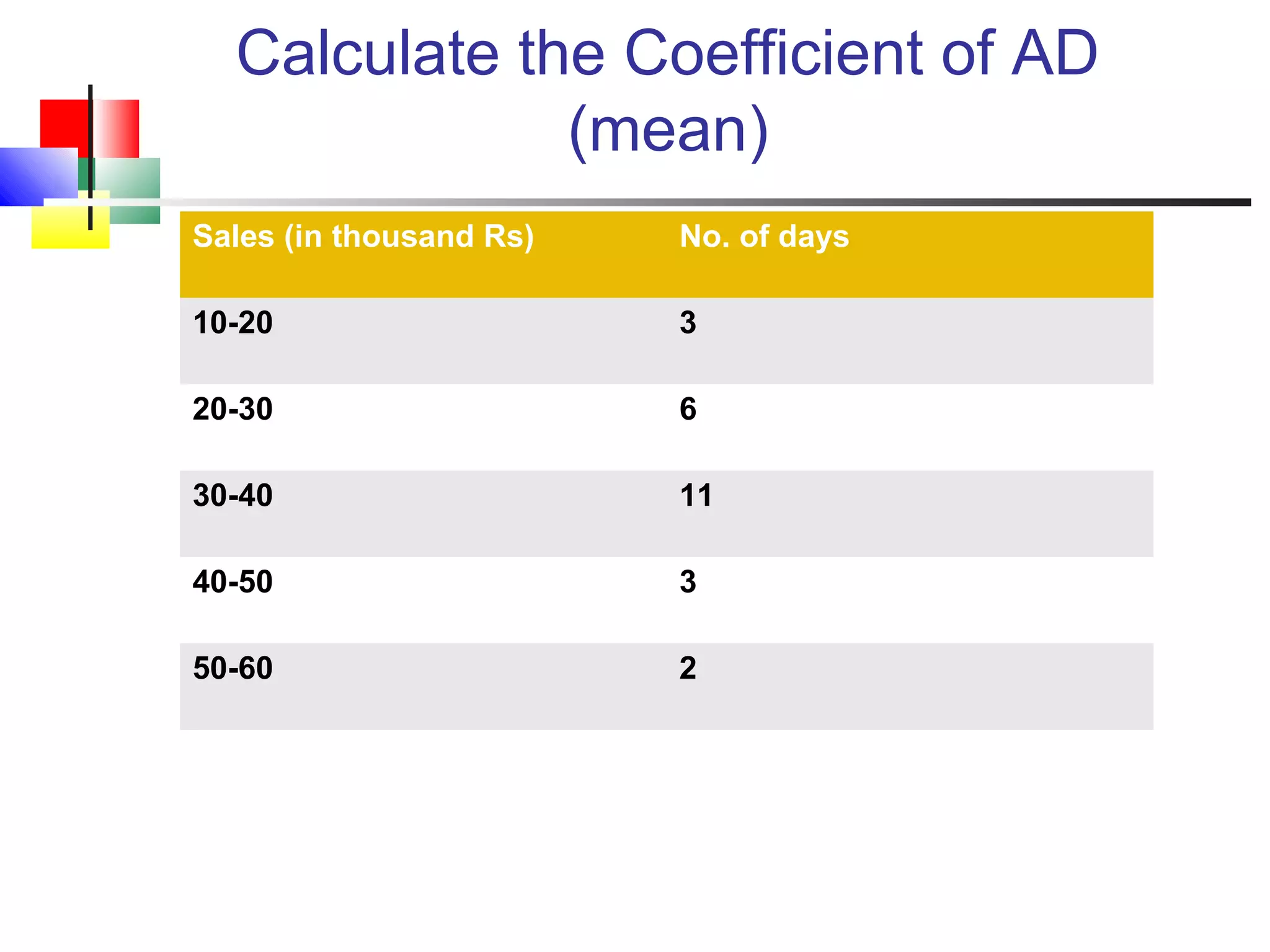
Calculate the Coefficient of AD
(mean)
Sales (in thousand Rs) No. of days
10-20 3
20-30 6
30-40 11
40-50 3
50-60 2
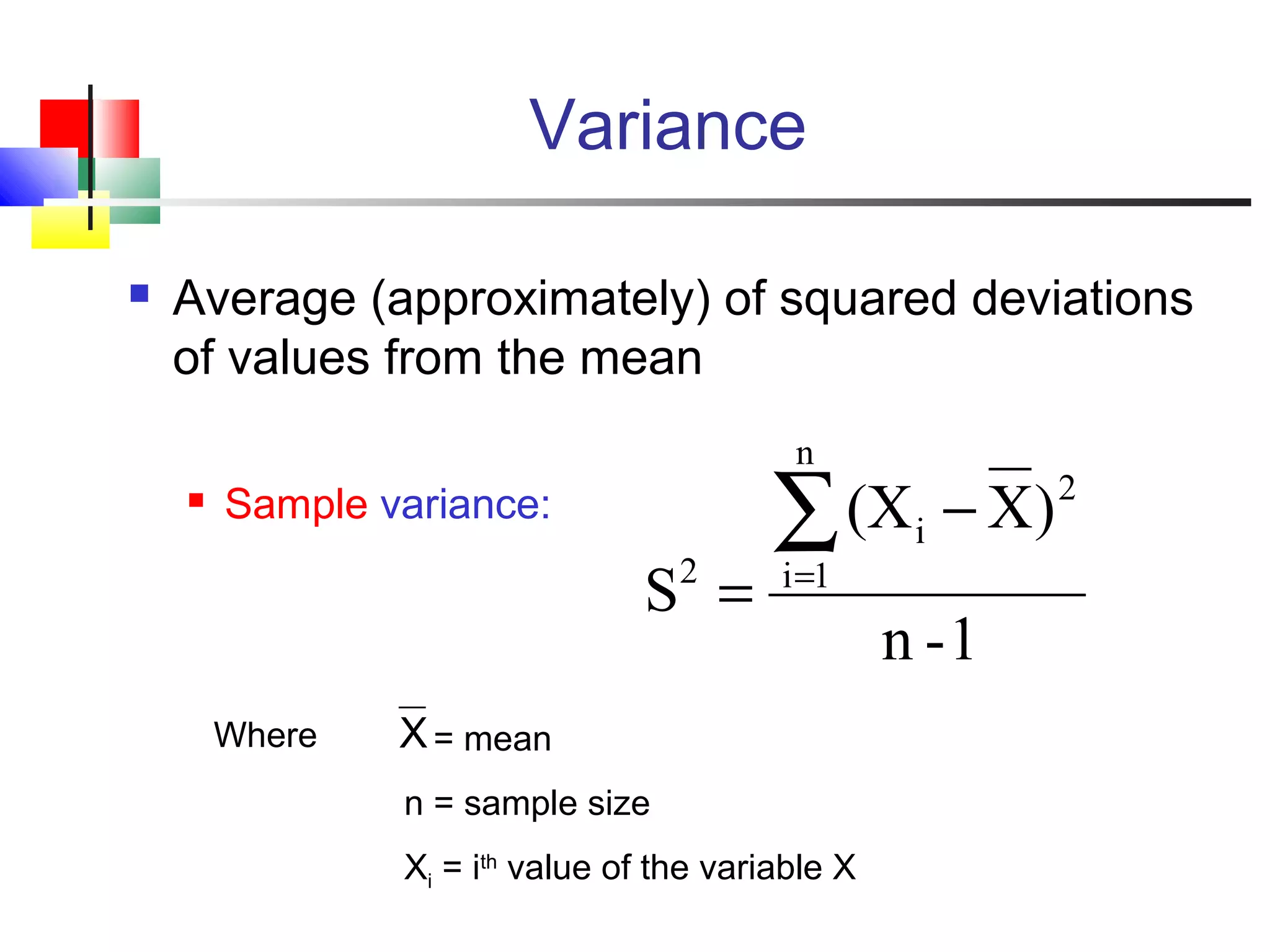
 Average (approximately) of squared deviations
of values from the mean
 Sample variance:
Variance
1-n
)X(X
S
n
1i
2
i
2
∑=
−
=
Where = mean
n = sample size
Xi = ith
value of the variable X
X
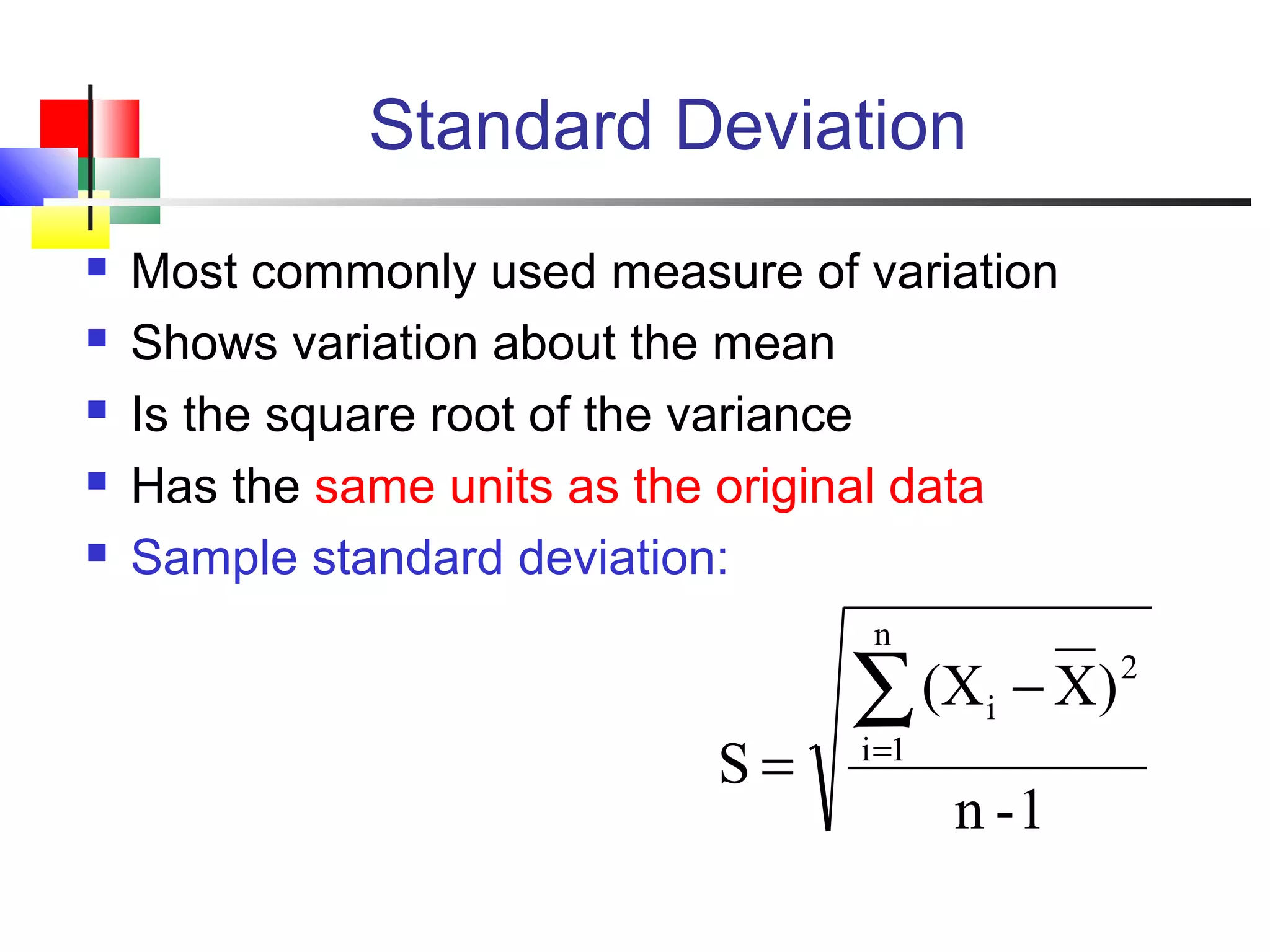
Standard Deviation
 Most commonly used measure of variation
 Shows variation about the mean
 Is the square root of the variance
 Has the same units as the original data
 Sample standard deviation:
1-n
)X(X
S
n
1i
2
i∑=
−
=
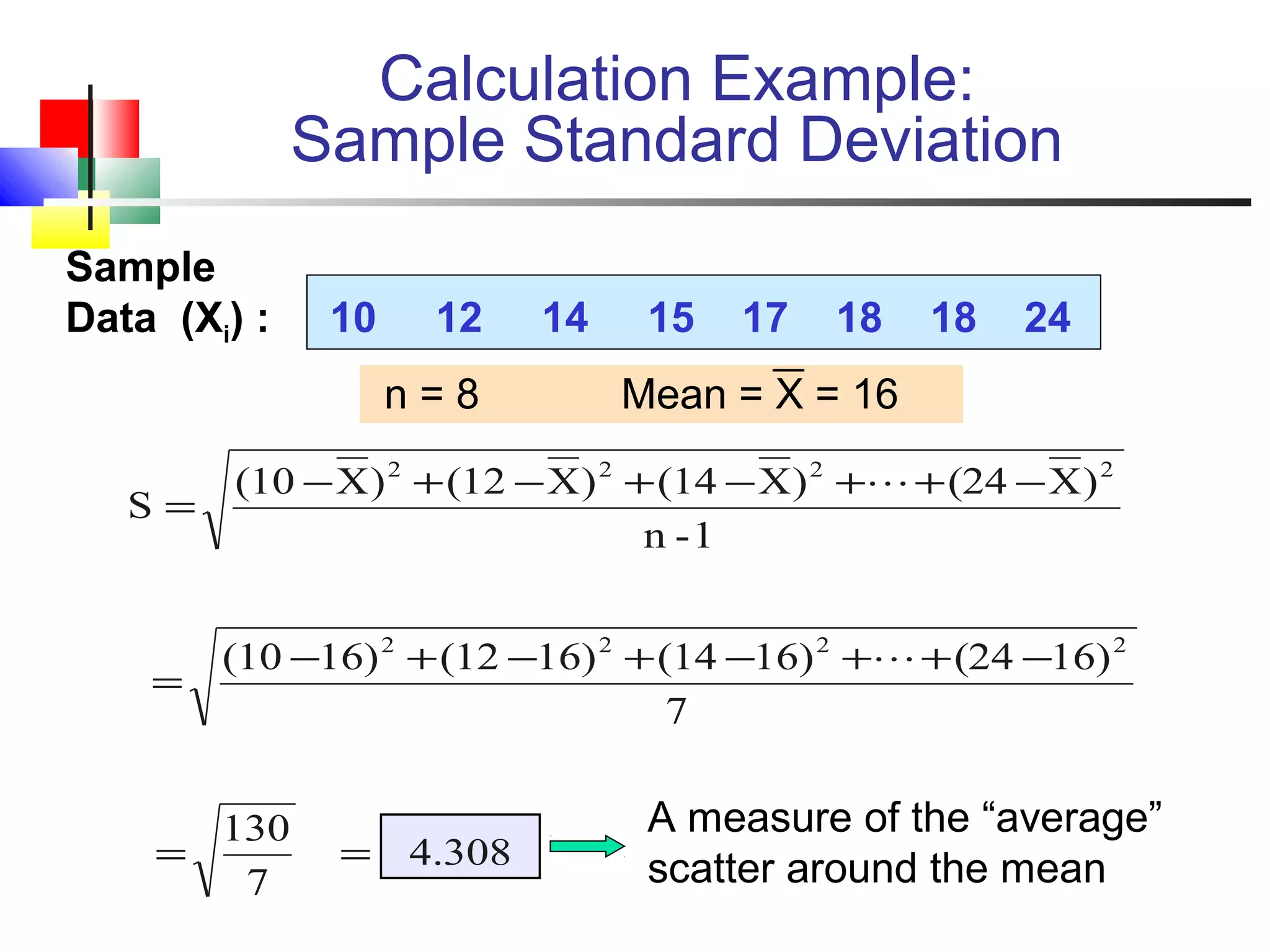
Calculation Example:
Sample Standard Deviation
Sample
Data (Xi) : 10 12 14 15 17 18 18 24
n = 8 Mean = X = 16
4.308
7
130
7
16)(2416)(1416)(1216)(10
1-n
)X(24)X(14)X(12)X(10
S
2222
2222
==
−++−+−+−
=
−++−+−+−
=


A measure of the “average”
scatter around the mean
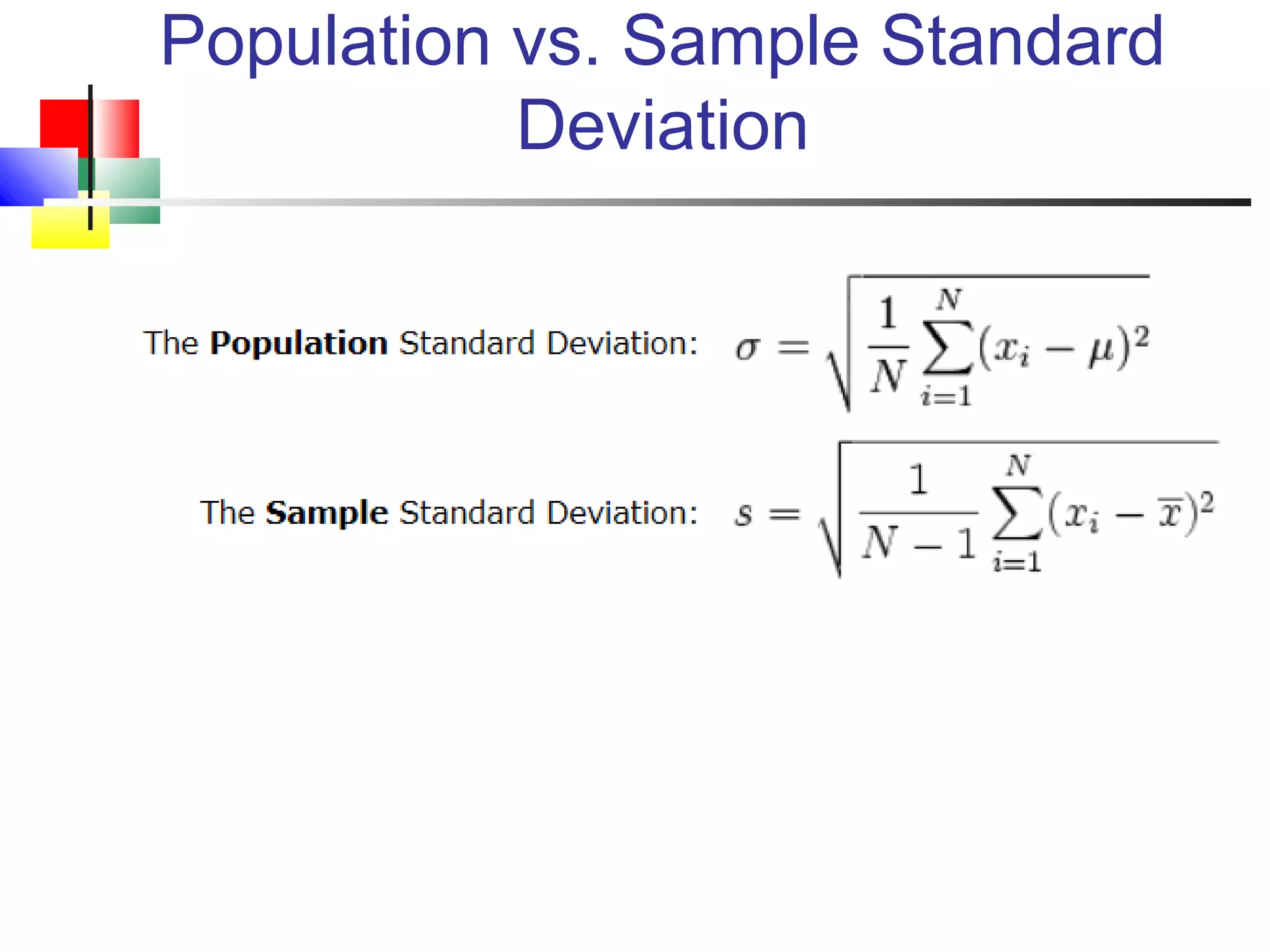
Population vs. Sample Standard
Deviation
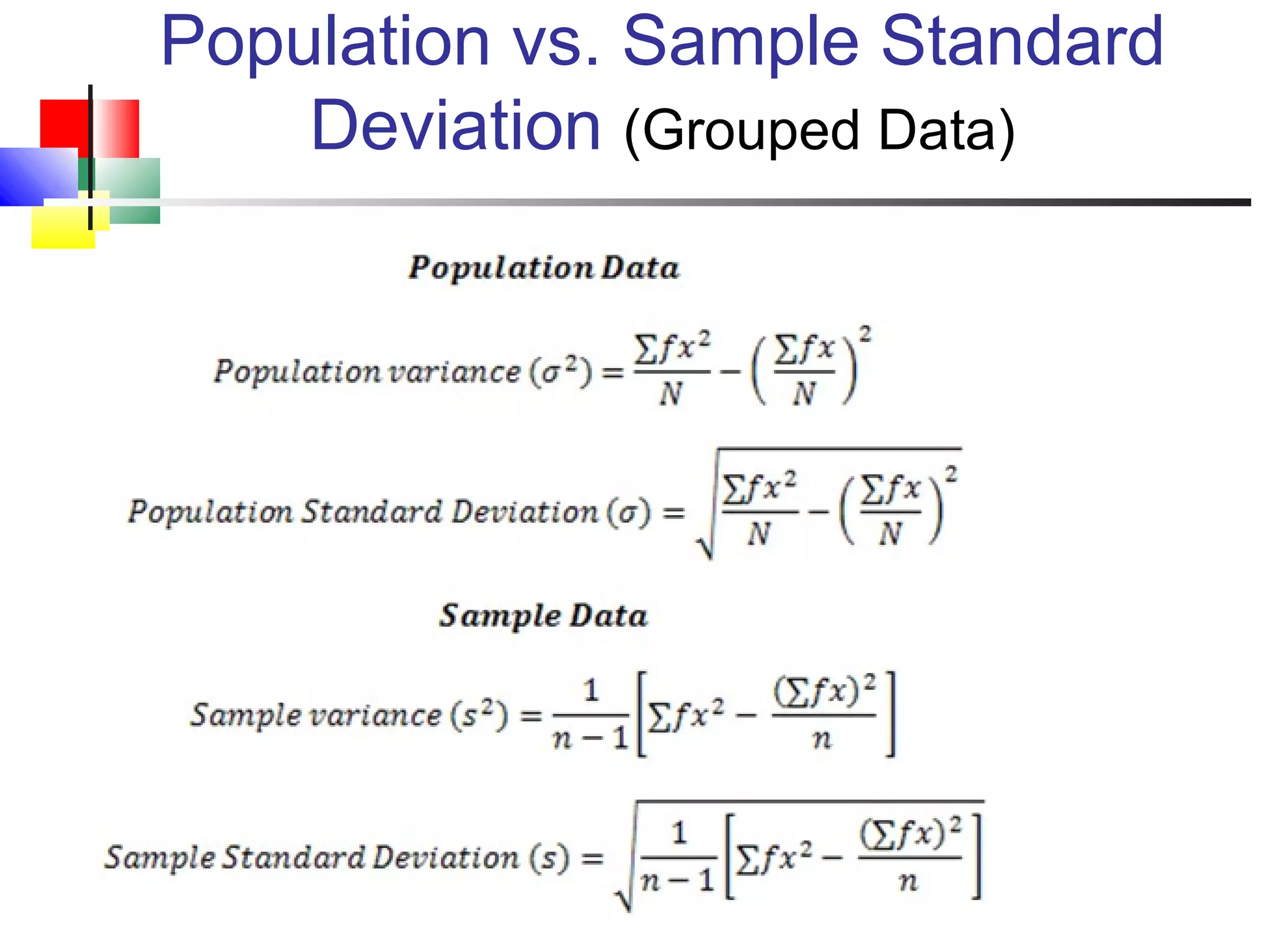
Population vs. Sample Standard
Deviation (Grouped Data)
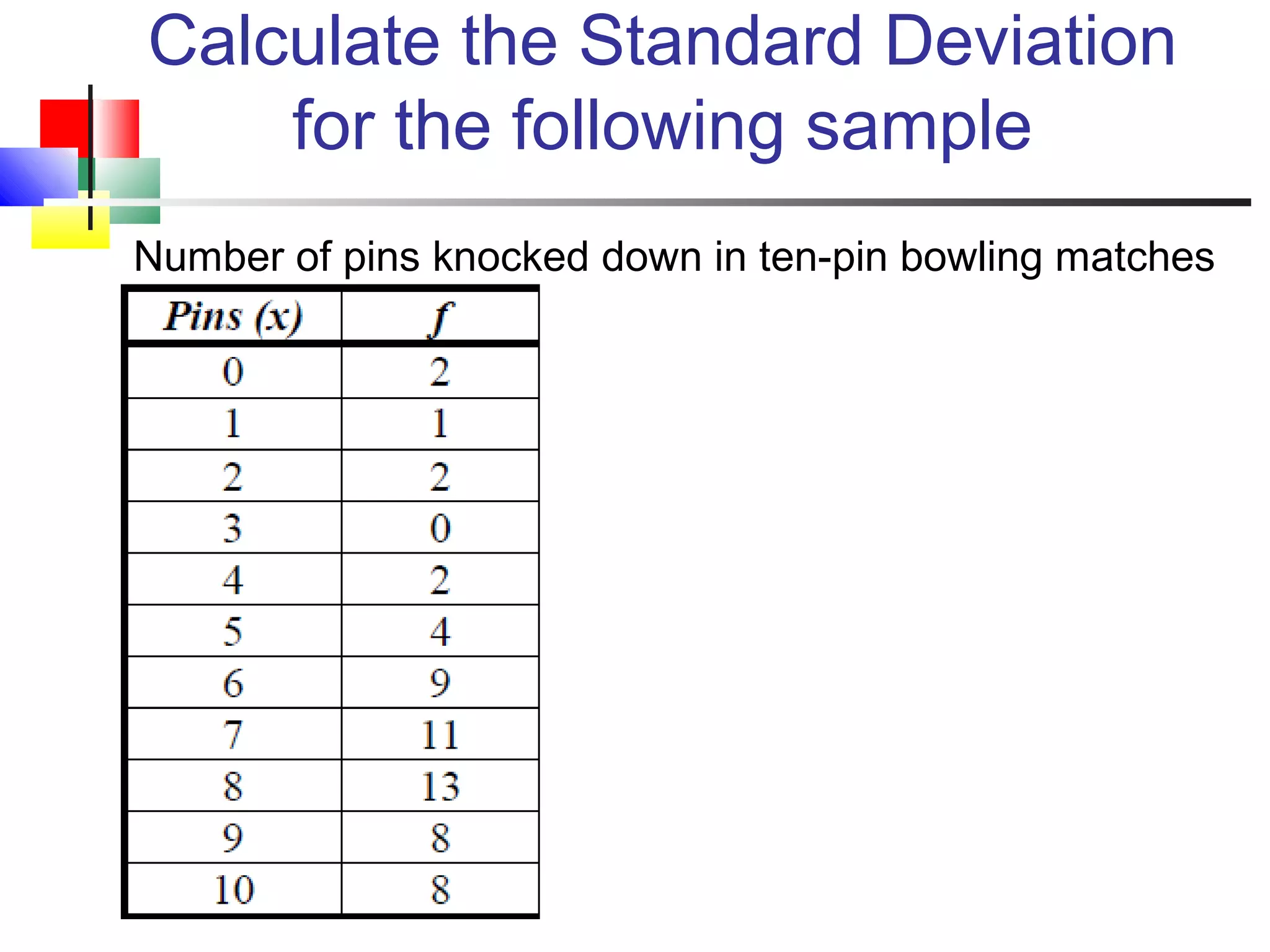
Calculate the Standard Deviation
for the following sample
Number of pins knocked down in ten-pin bowling matches
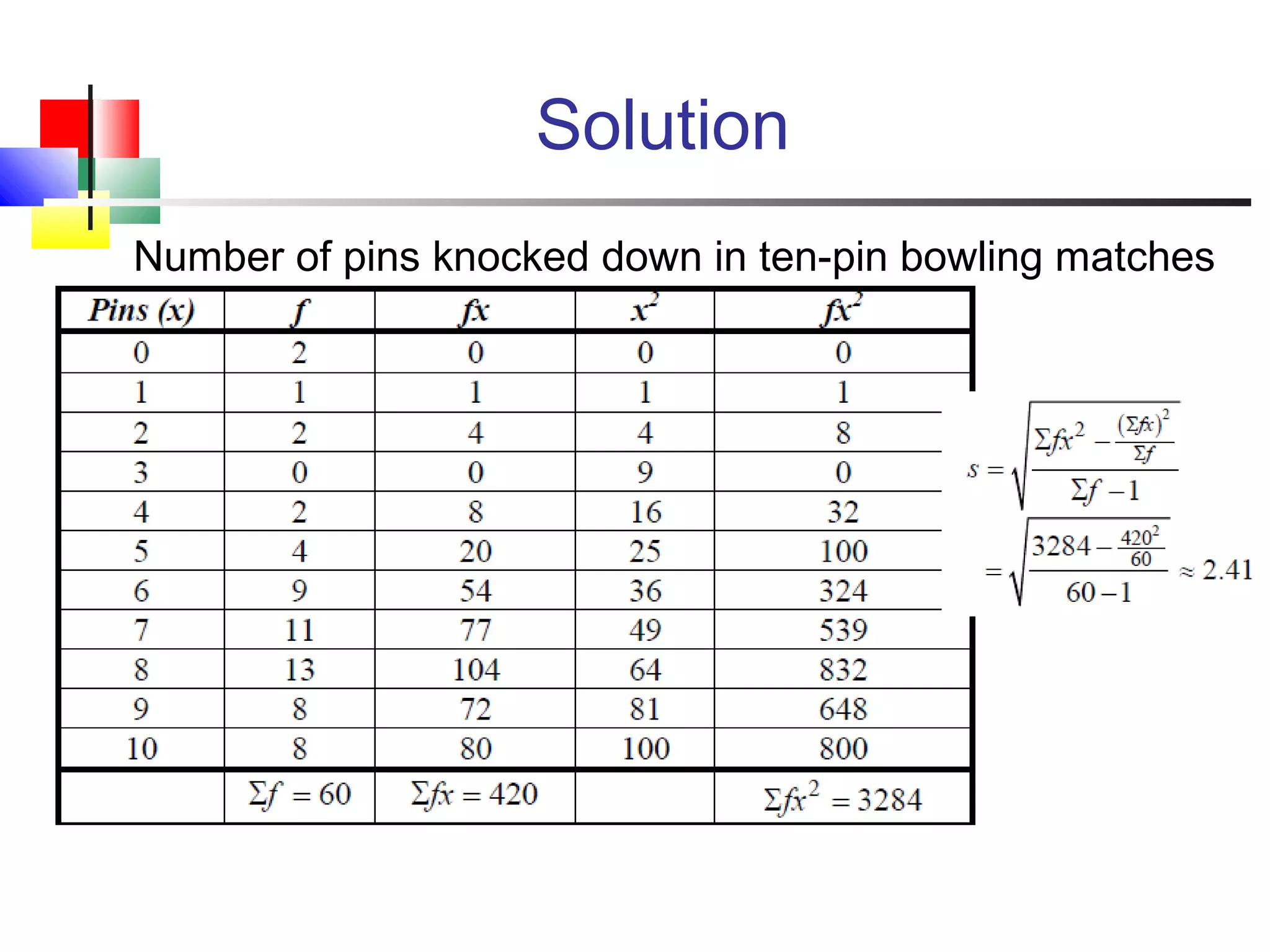
Solution
Number of pins knocked down in ten-pin bowling matches
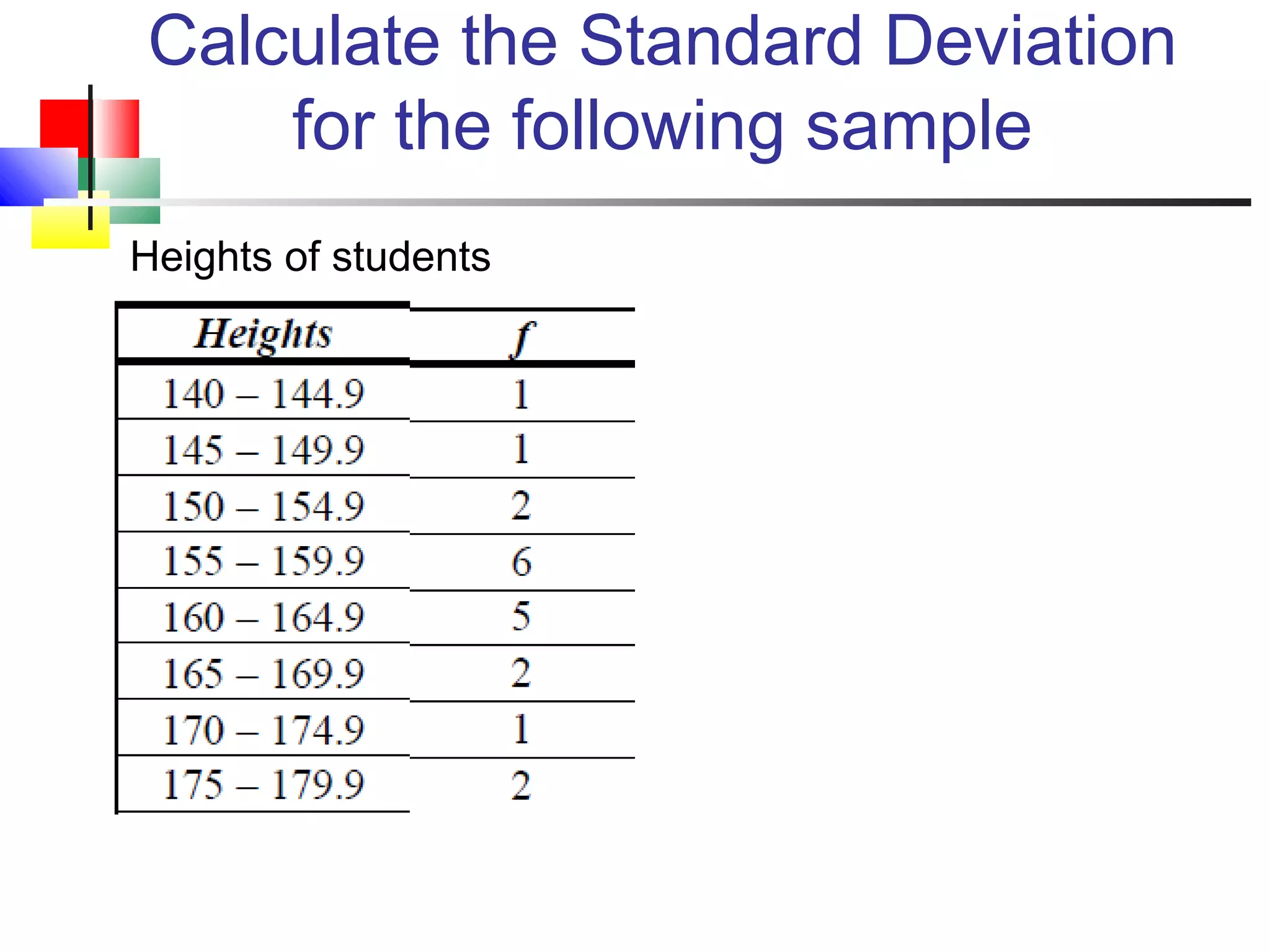
Calculate the Standard Deviation
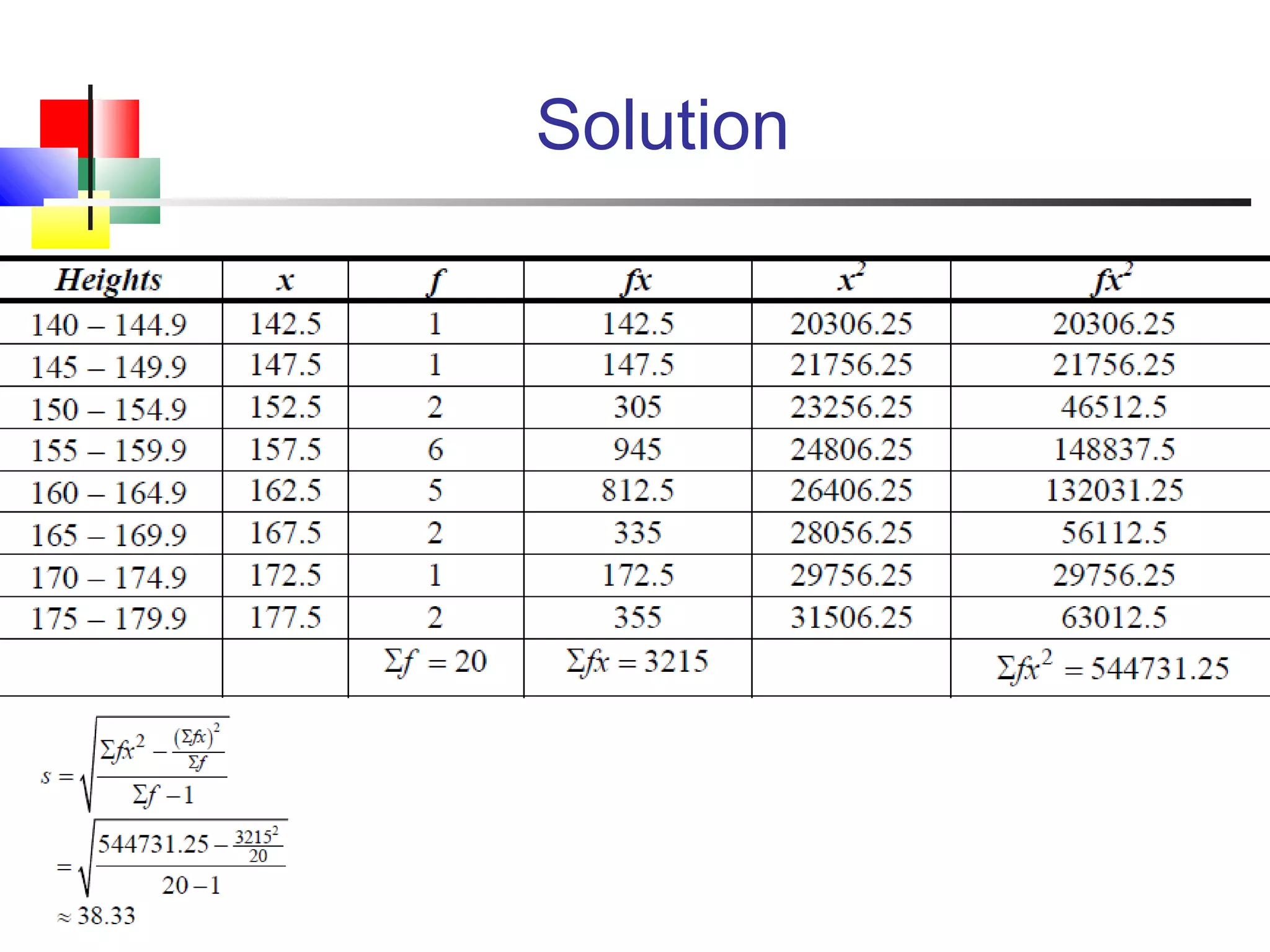
for the following sample
Heights of students
Solution
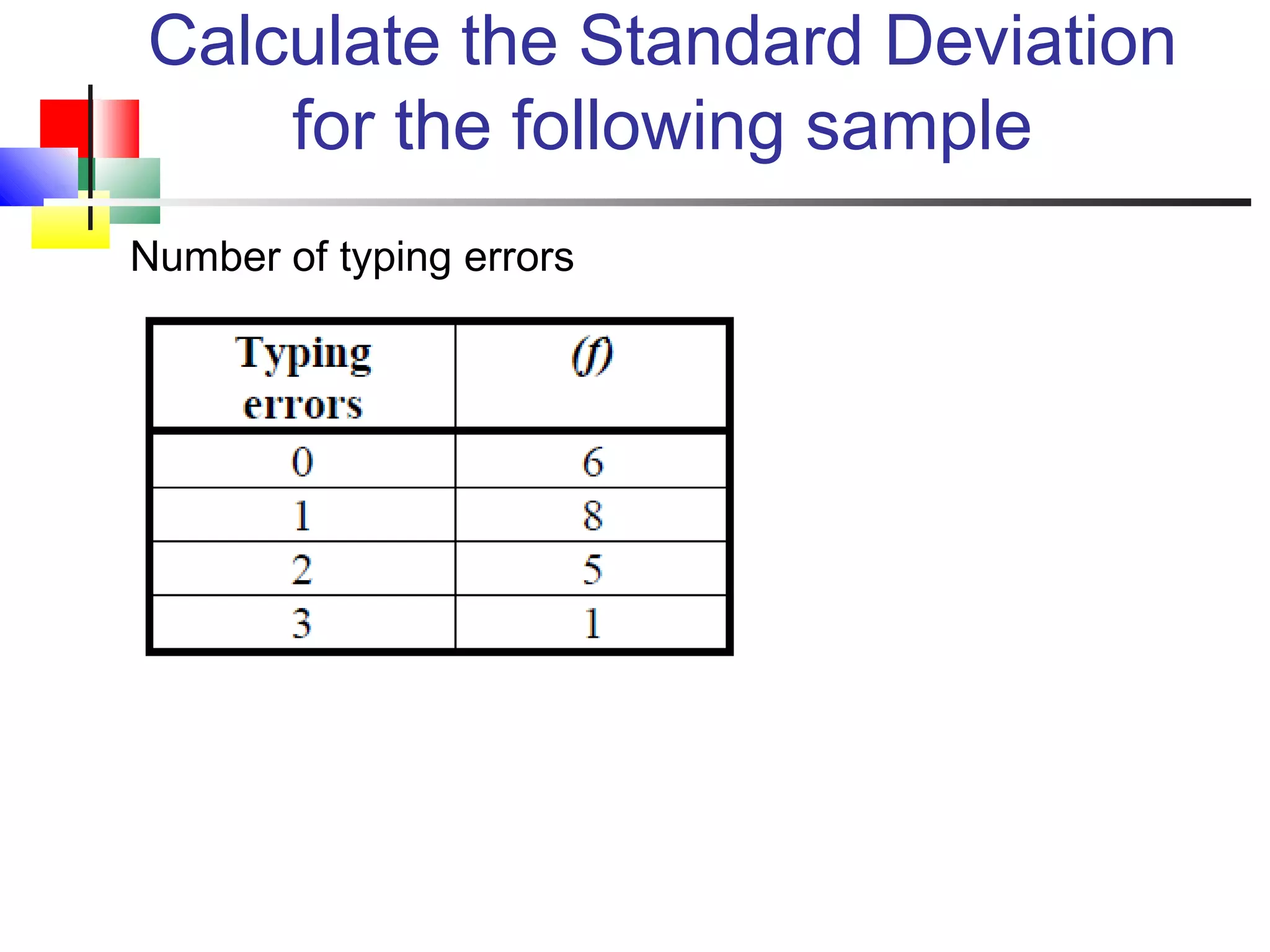
Calculate the Standard Deviation
for the following sample
Number of typing errors
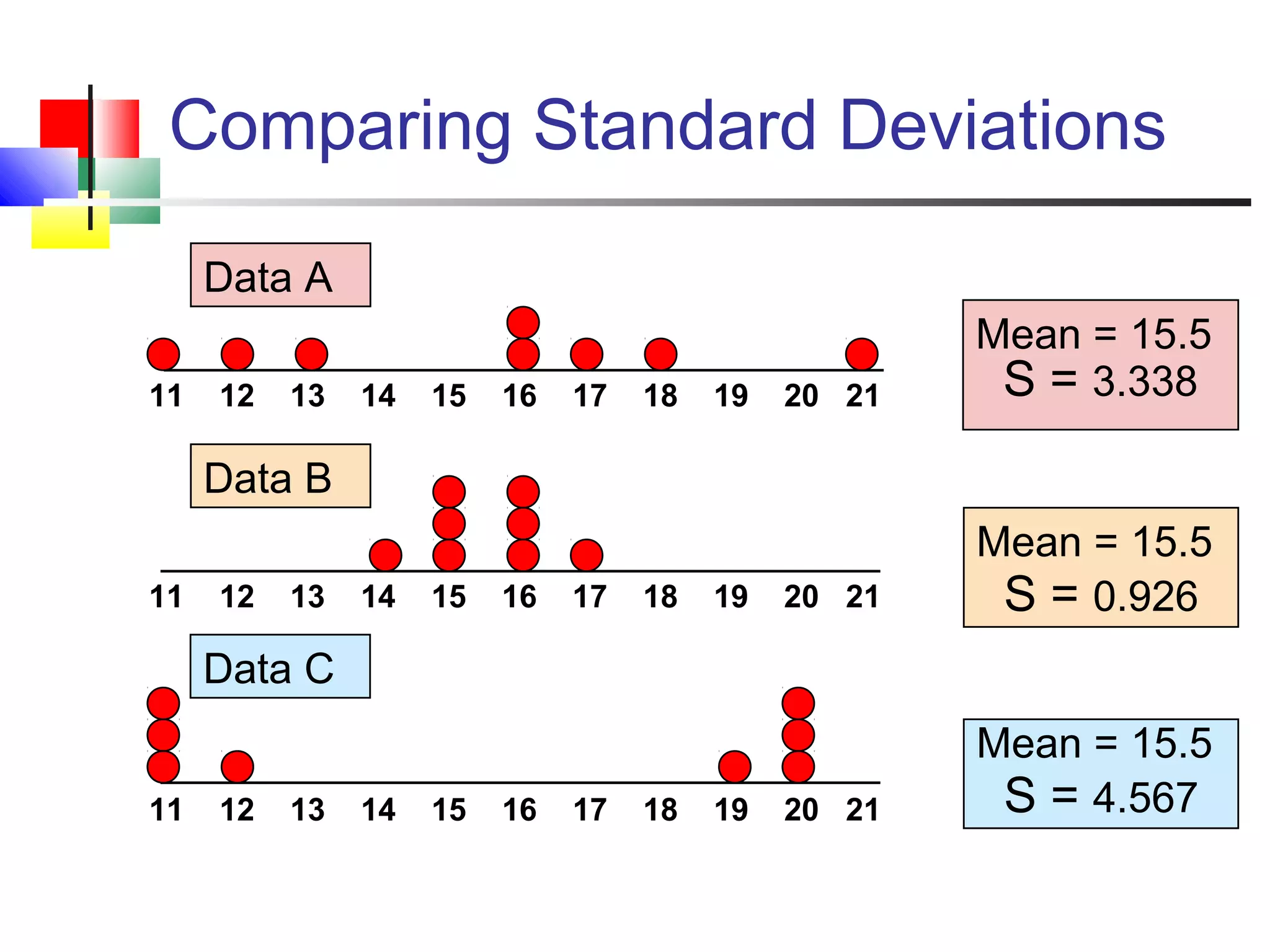
Comparing Standard Deviations
Mean = 15.5
S = 3.33811 12 13 14 15 16 17 18 19 20 21
11 12 13 14 15 16 17 18 19 20 21
Data B
Data A
Mean = 15.5
S = 0.926
11 12 13 14 15 16 17 18 19 20 21
Mean = 15.5
S = 4.567
Data C
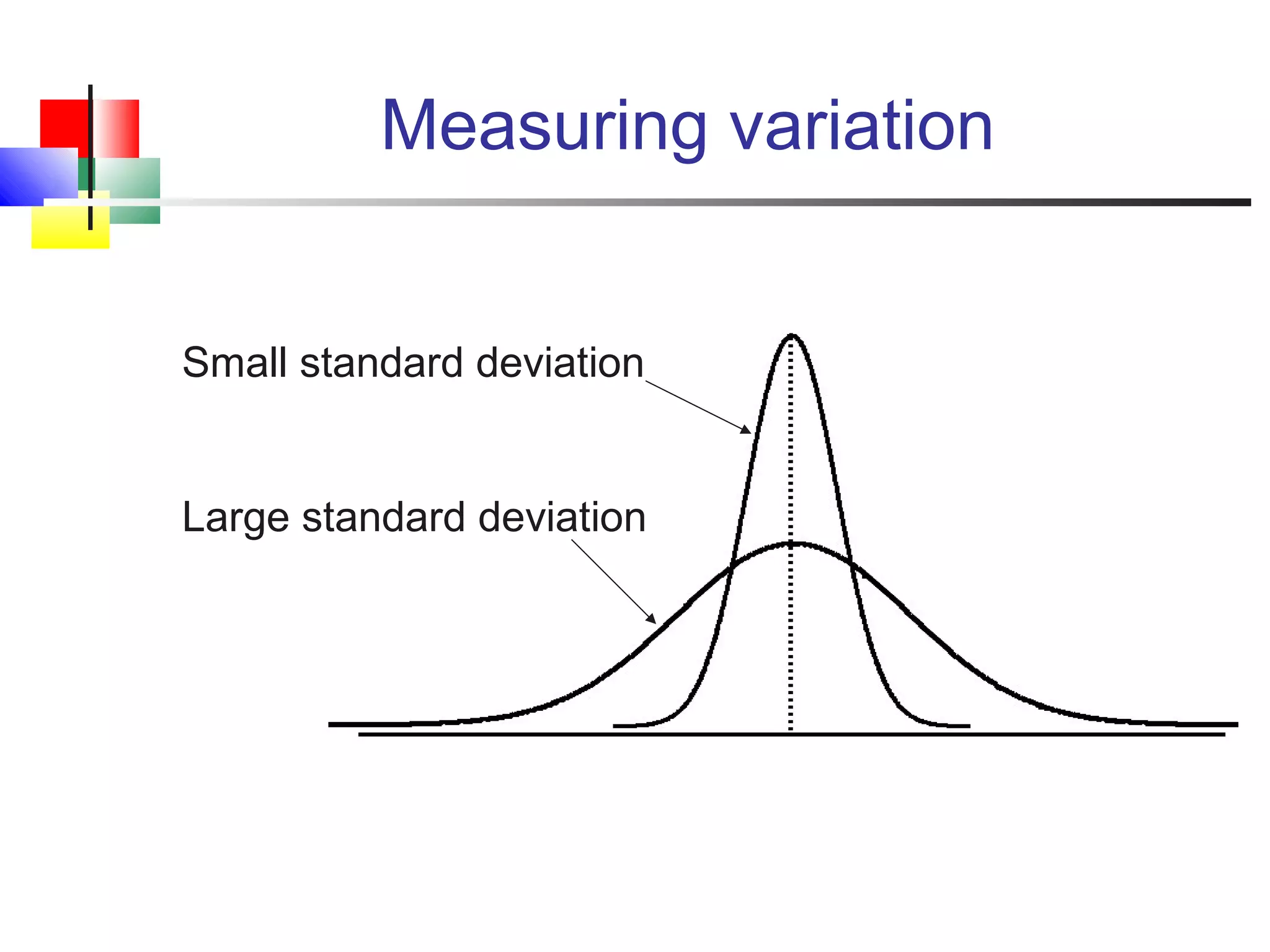
Measuring variation
Small standard deviation
Large standard deviation
Advantages of Variance and
Standard Deviation
 Each value in the data set is used in the
calculation
 Values far from the mean are given extra
weight
(because deviations from the mean are squared)
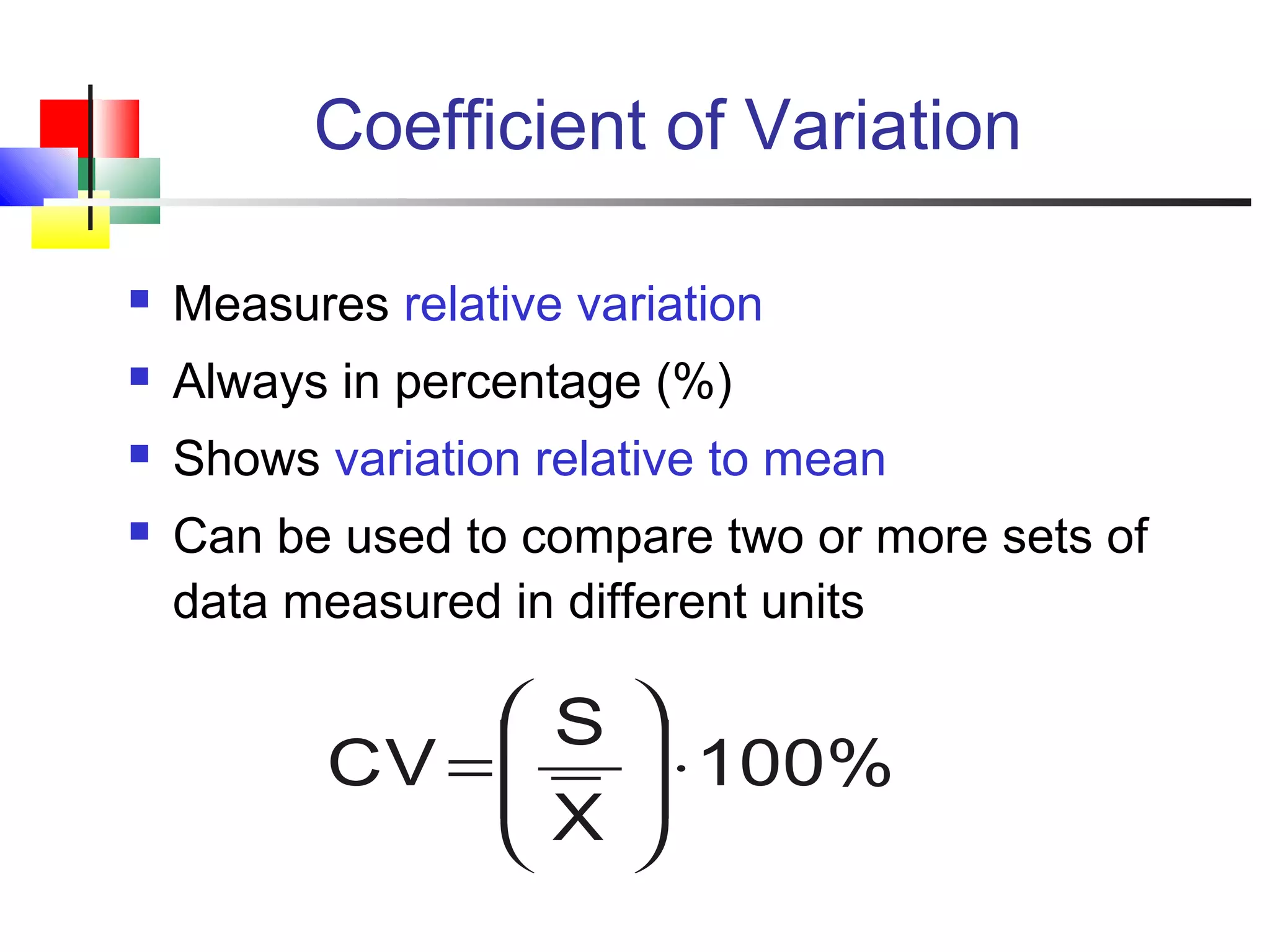
Coefficient of Variation
 Measures relative variation
 Always in percentage (%)
 Shows variation relative to mean
 Can be used to compare two or more sets of
data measured in different units
100%
X
S
CV ⋅







=
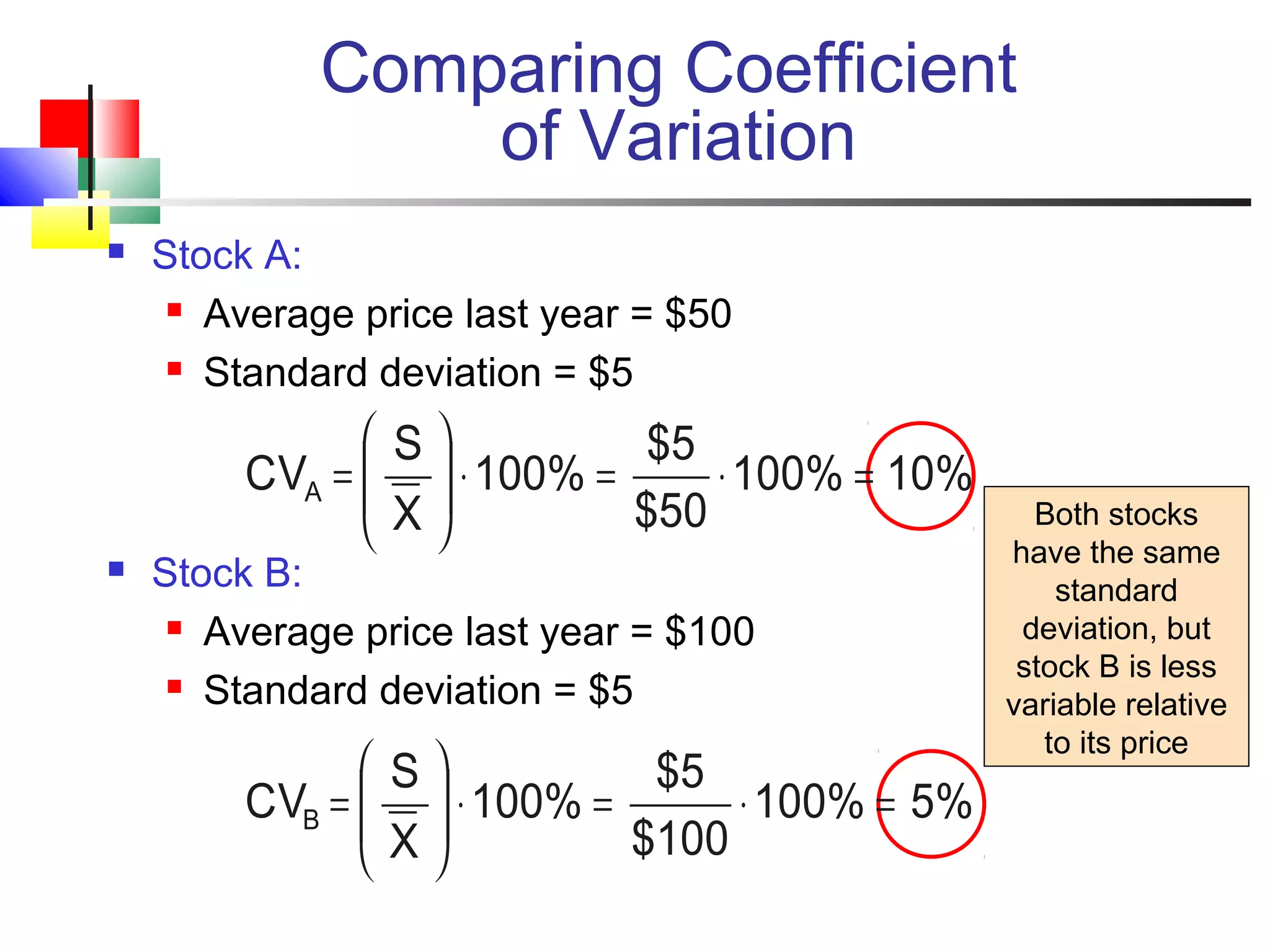
Comparing Coefficient
of Variation
 Stock A:
 Average price last year = $50
 Standard deviation = $5
 Stock B:
 Average price last year = $100
 Standard deviation = $5
Both stocks
have the same
standard
deviation, but
stock B is less
variable relative
to its price
10%100%
$50
$5
100%
X
S
CVA =⋅=⋅







=
5%100%
$100
$5
100%
X
S
CVB =⋅=⋅







=
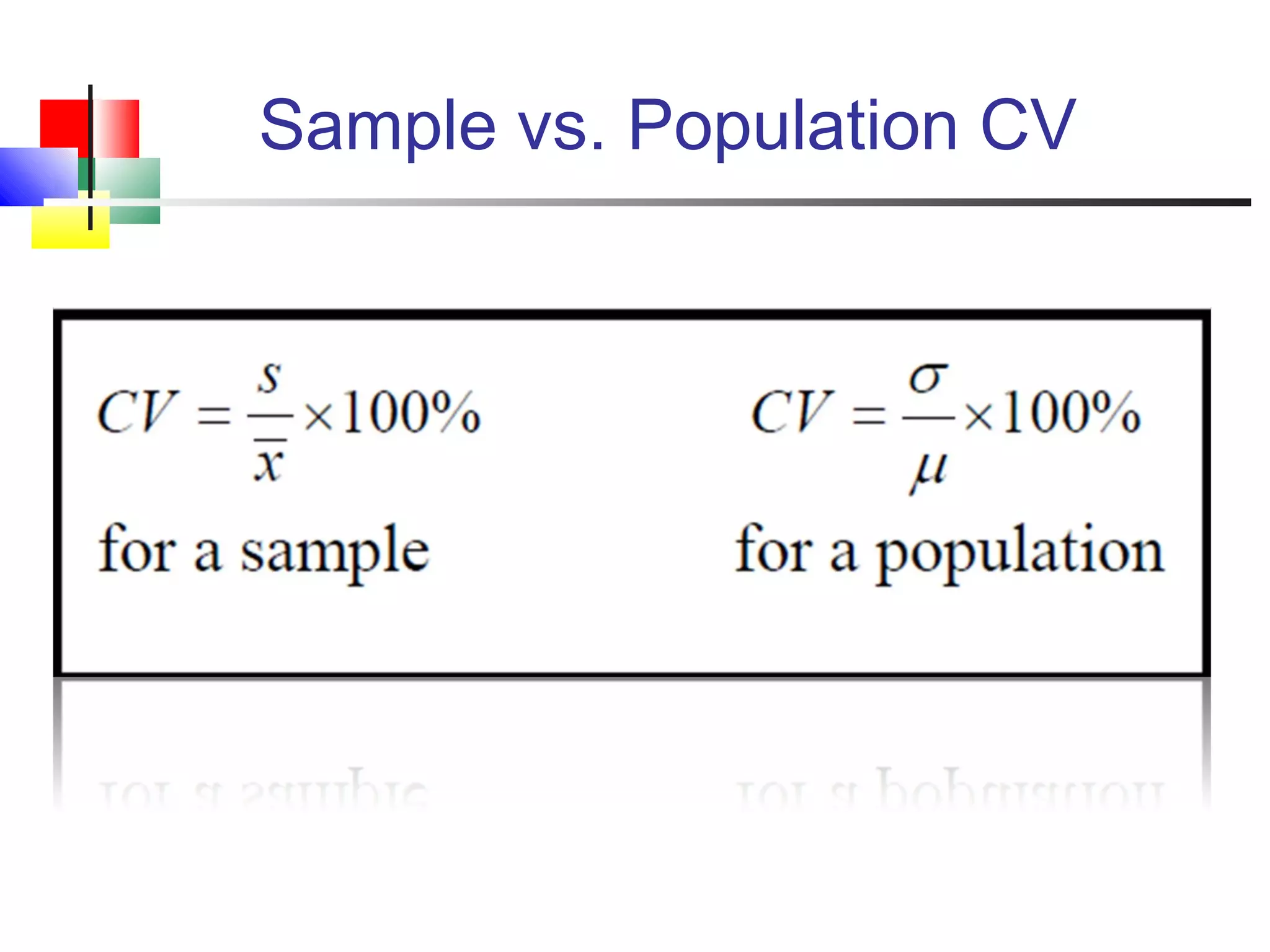
Sample vs. Population CV
Calculate!
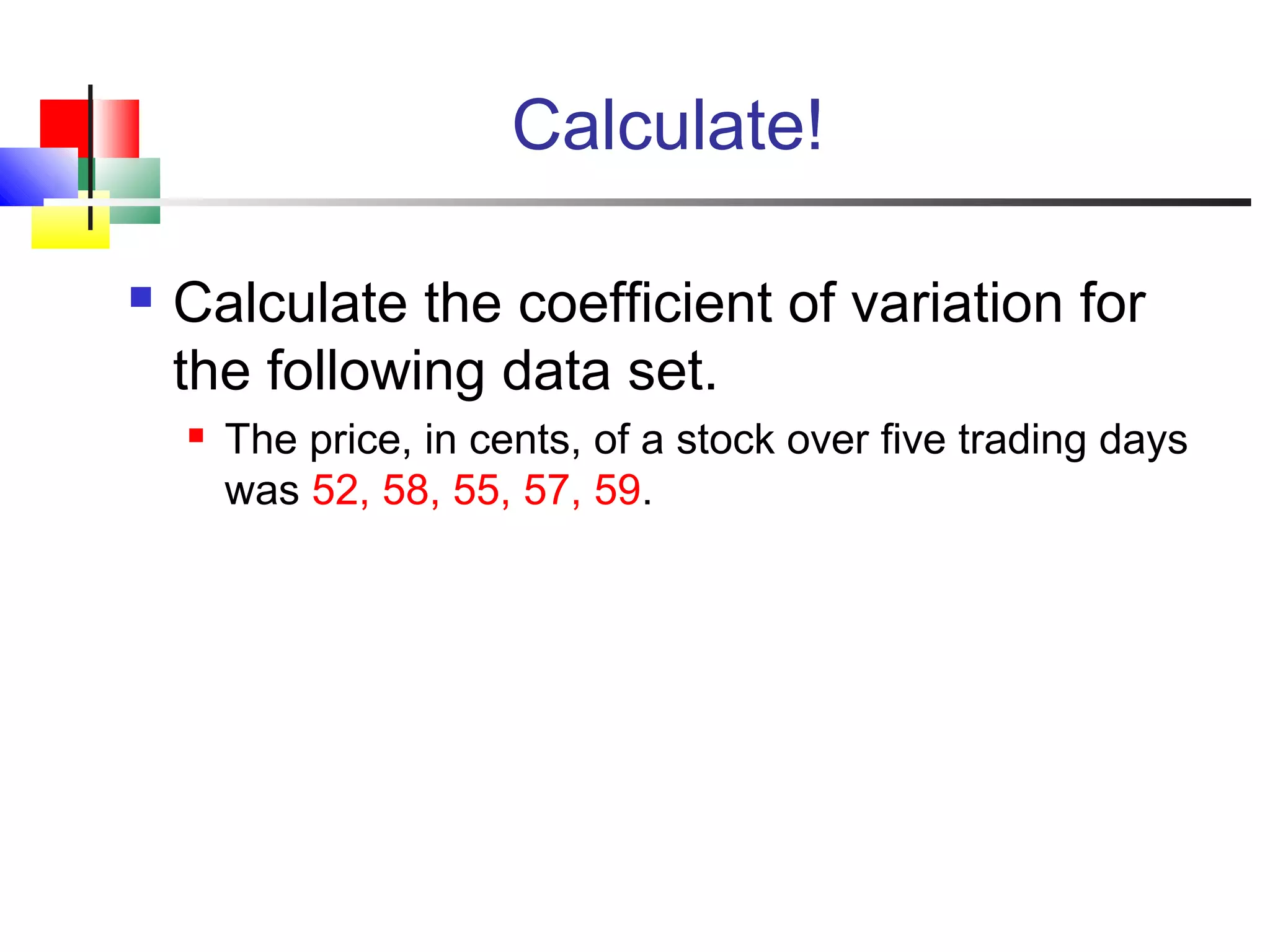
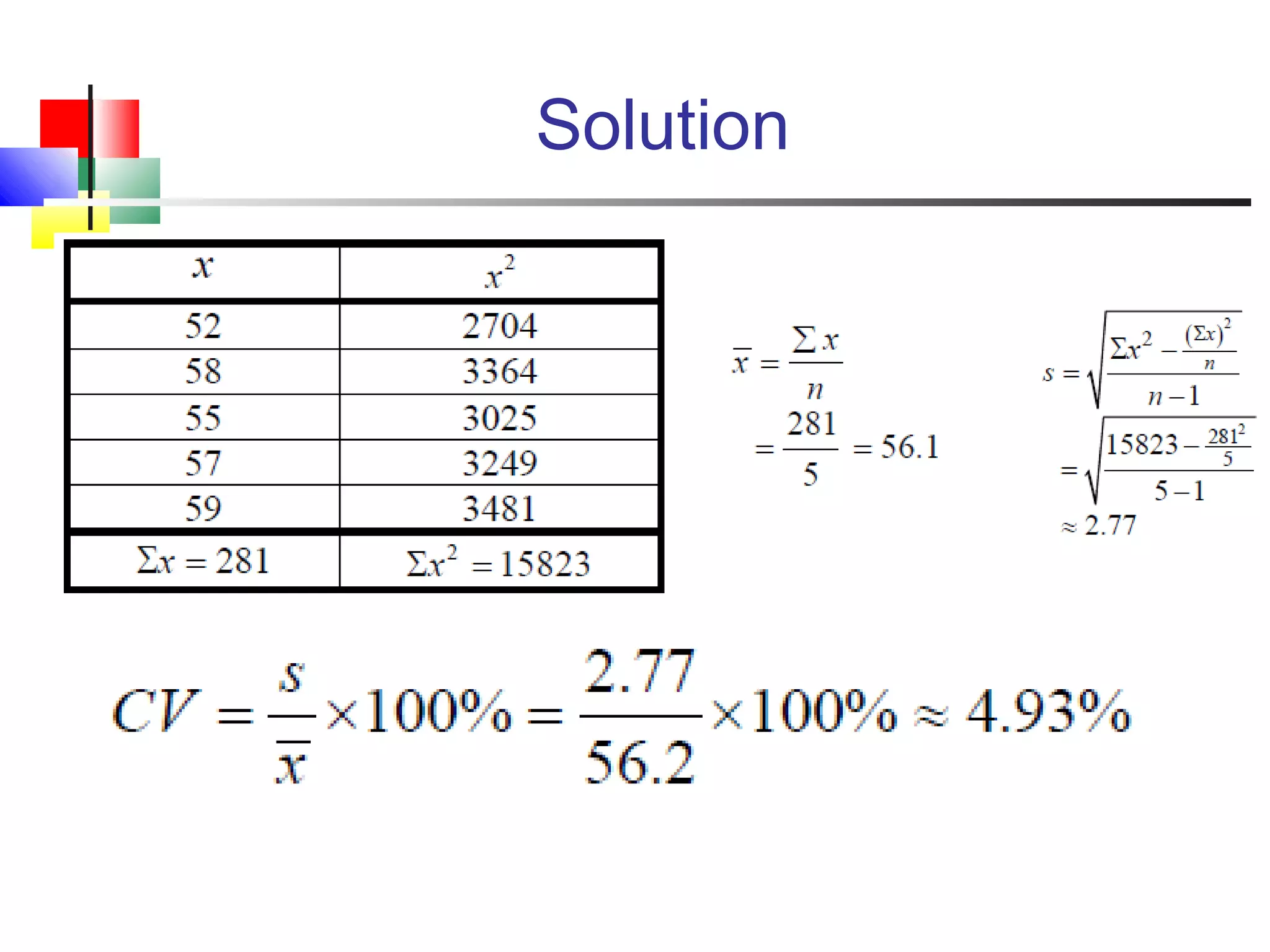
 Calculate the coefficient of variation for
the following data set.
 The price, in cents, of a stock over five trading days
was 52, 58, 55, 57, 59.
Solution
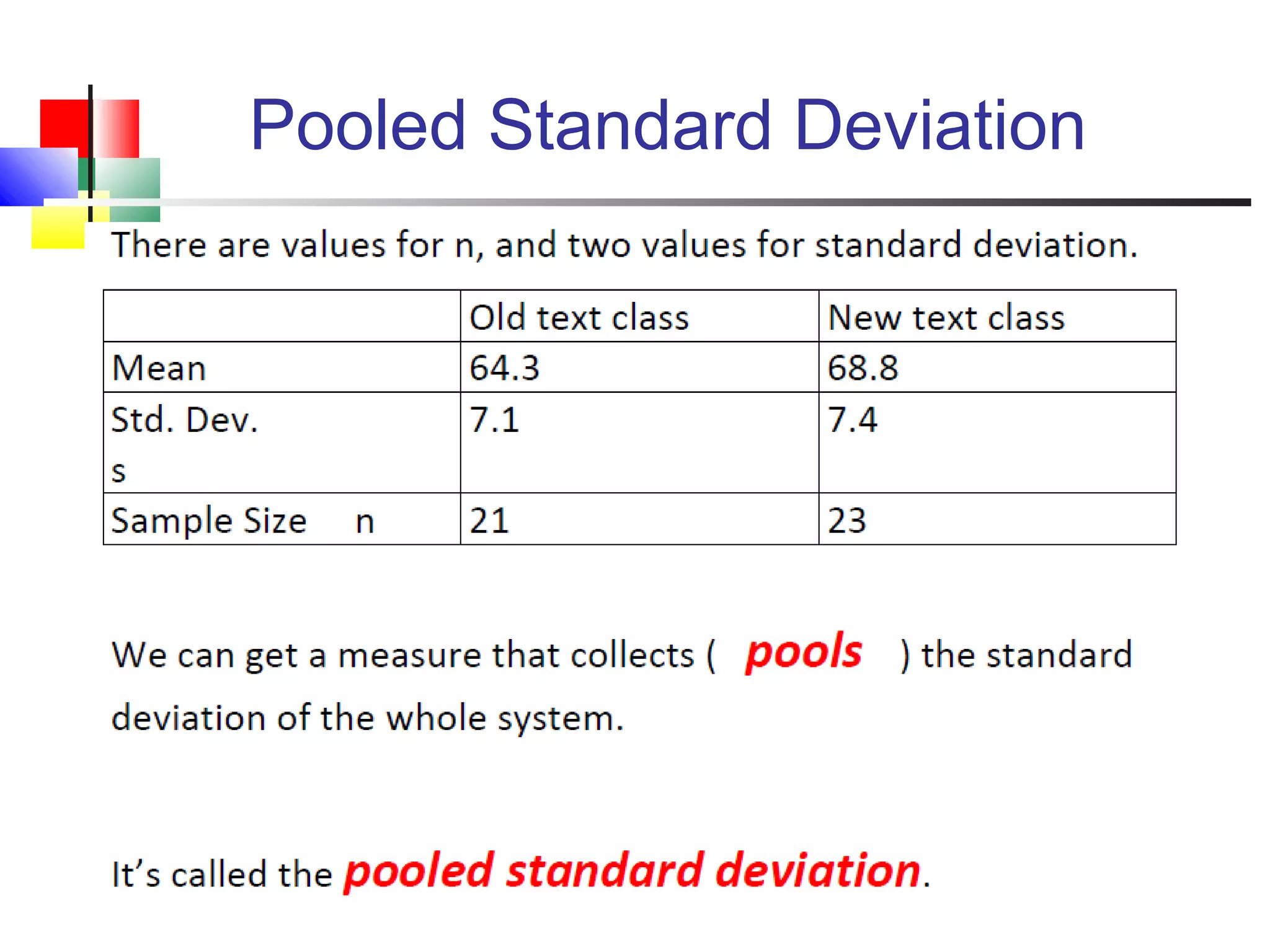
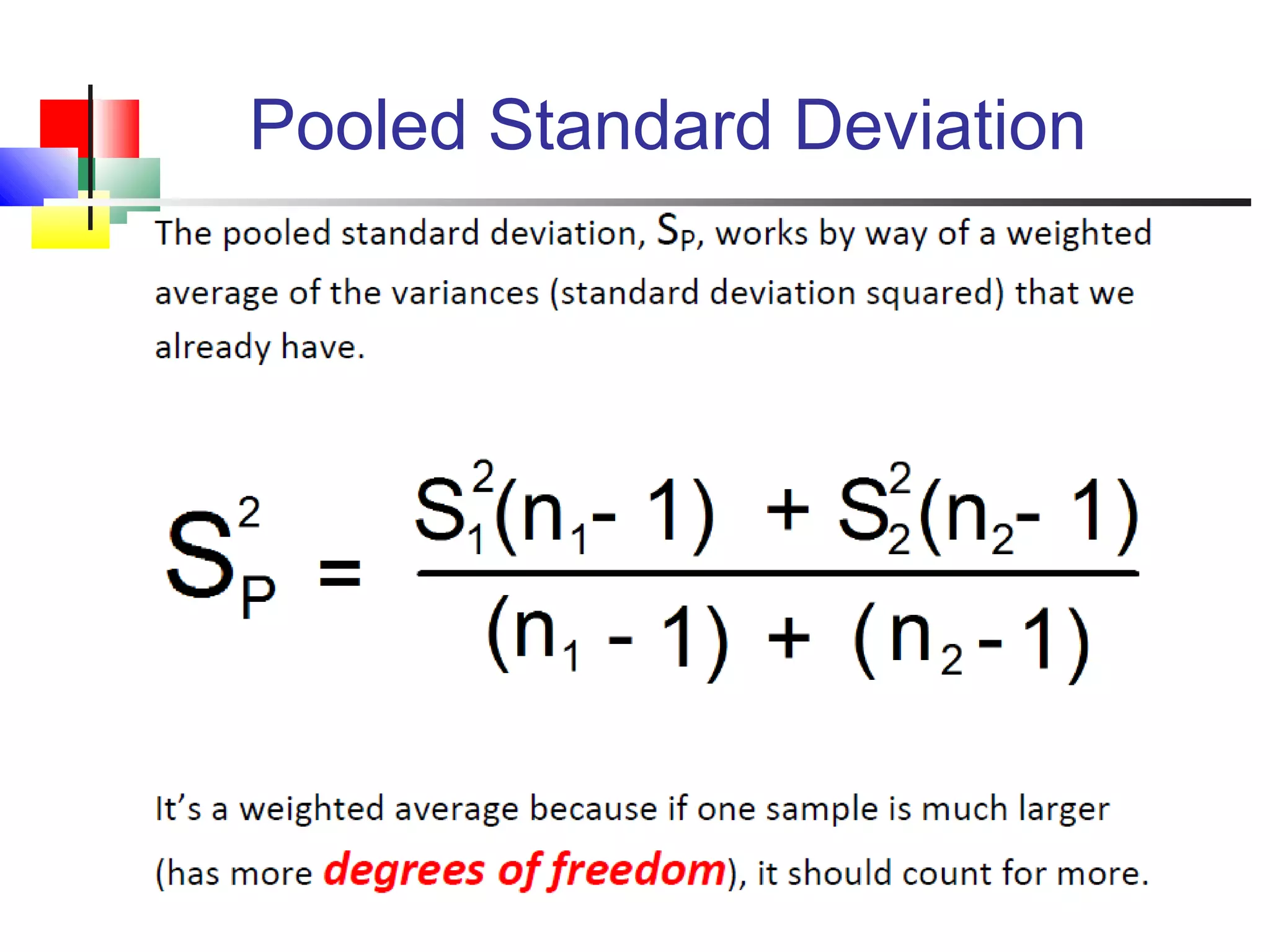
Pooled Standard Deviation
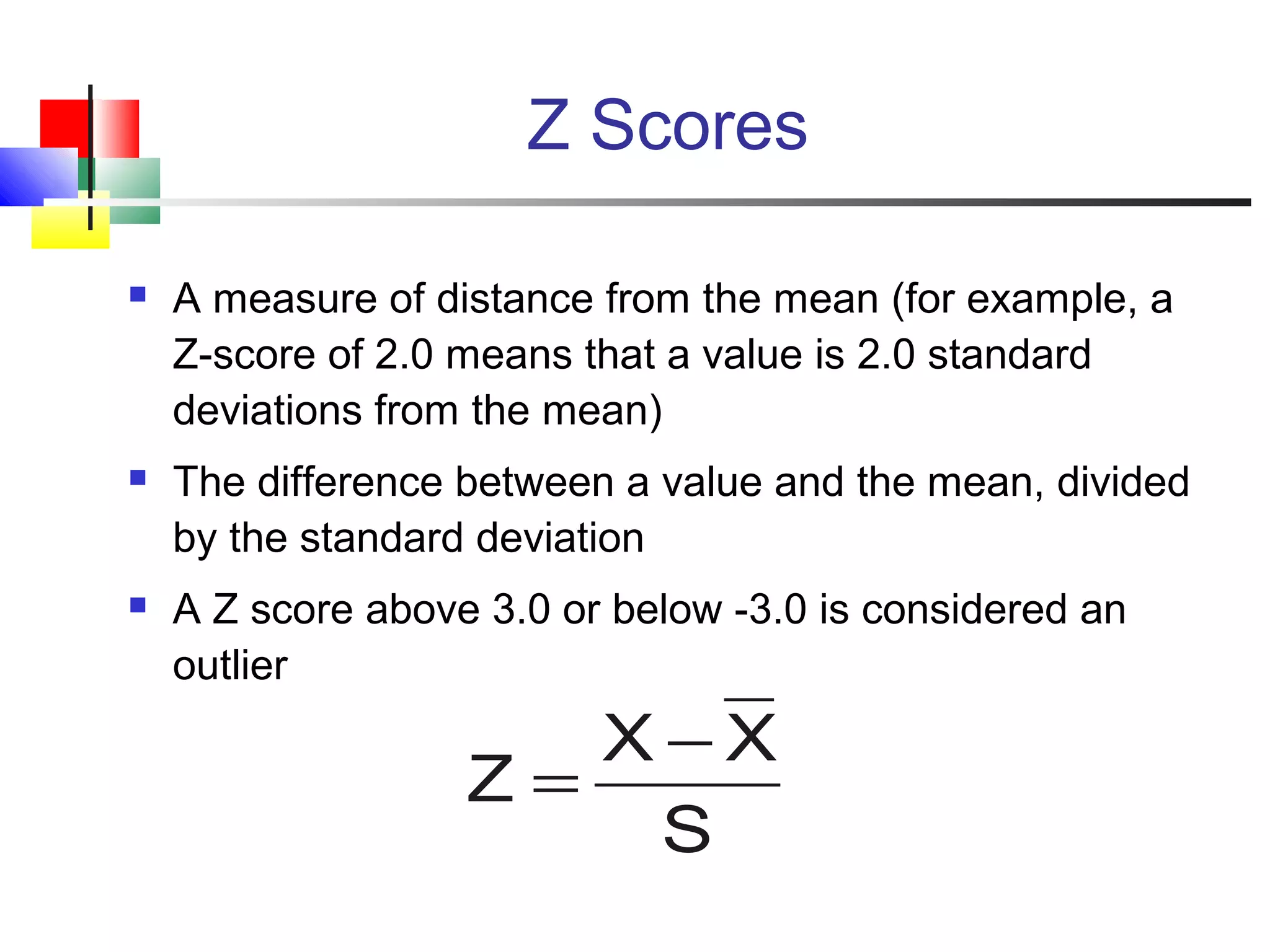
Z Scores
 A measure of distance from the mean (for example, a
Z-score of 2.0 means that a value is 2.0 standard
deviations from the mean)
 The difference between a value and the mean, divided
by the standard deviation
 A Z score above 3.0 or below -3.0 is considered an
outlier
S
XX
Z
−
=
Z Scores
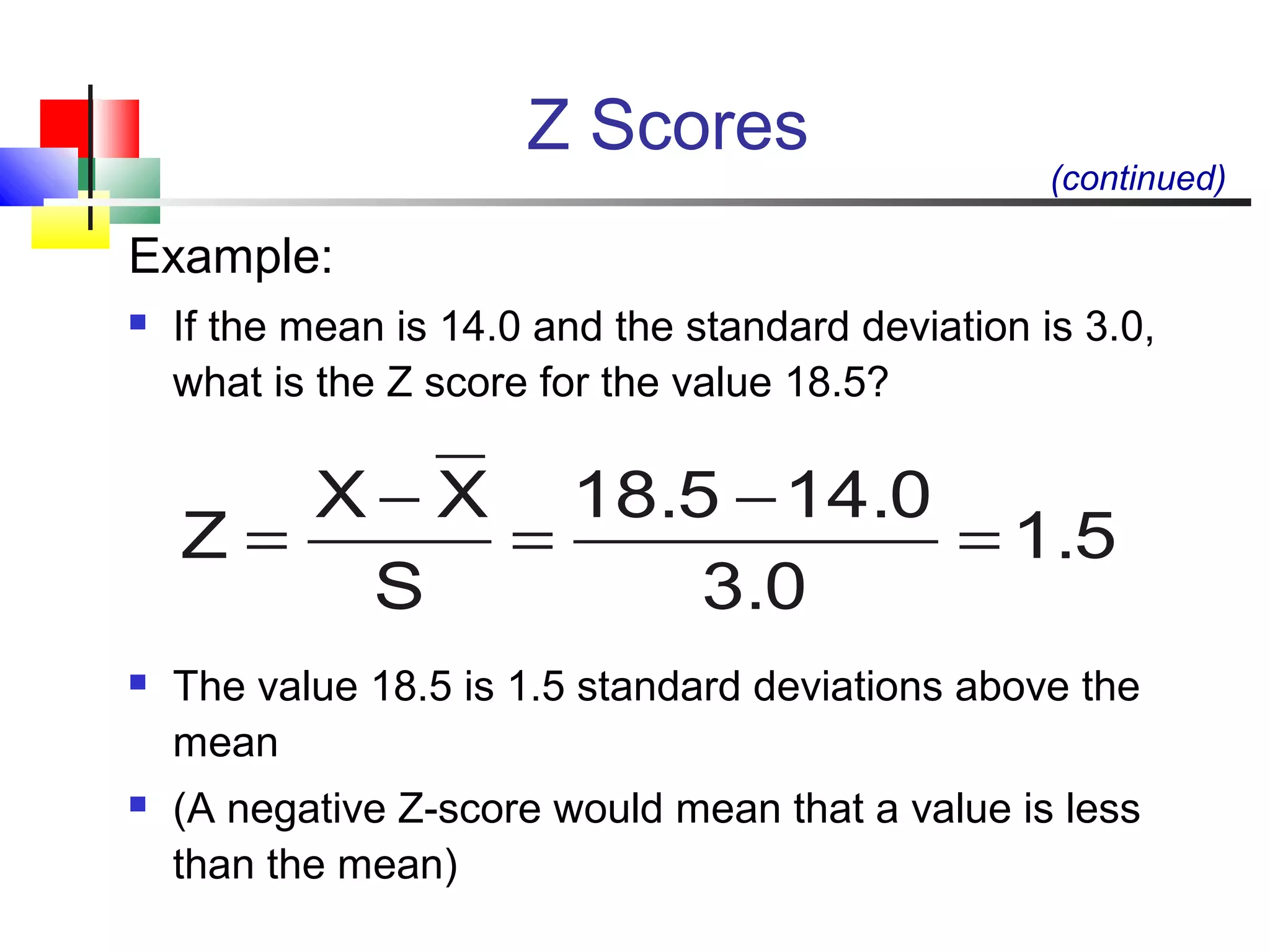
Example:
 If the mean is 14.0 and the standard deviation is 3.0,
what is the Z score for the value 18.5?
 The value 18.5 is 1.5 standard deviations above the
mean
 (A negative Z-score would mean that a value is less
than the mean)
1.5
3.0
14.018.5
S
XX
Z =
−
=
−
=
(continued)
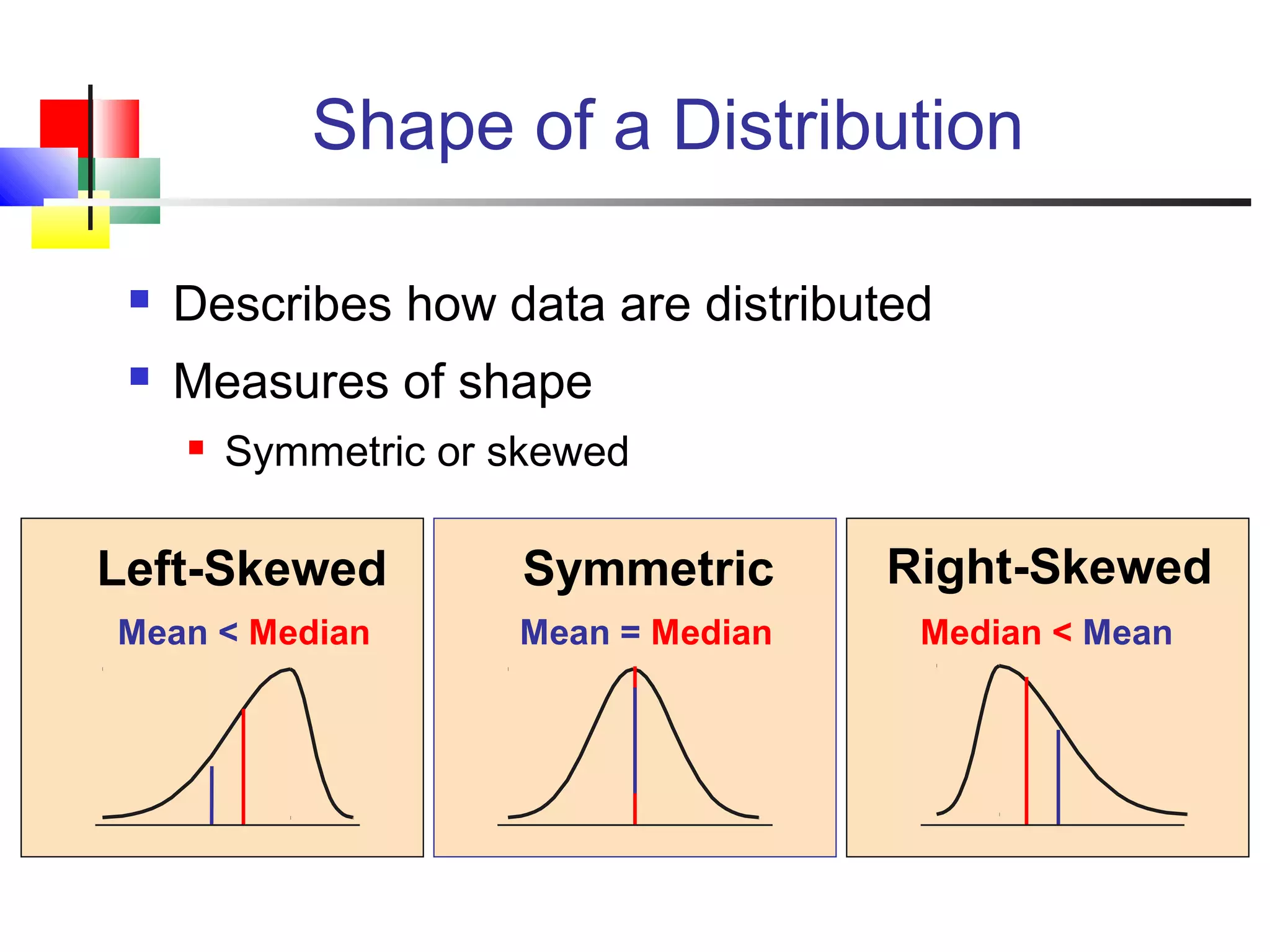
Shape of a Distribution
 Describes how data are distributed
 Measures of shape
 Symmetric or skewed
Mean = MedianMean < Median Median < Mean
Right-SkewedLeft-Skewed Symmetric
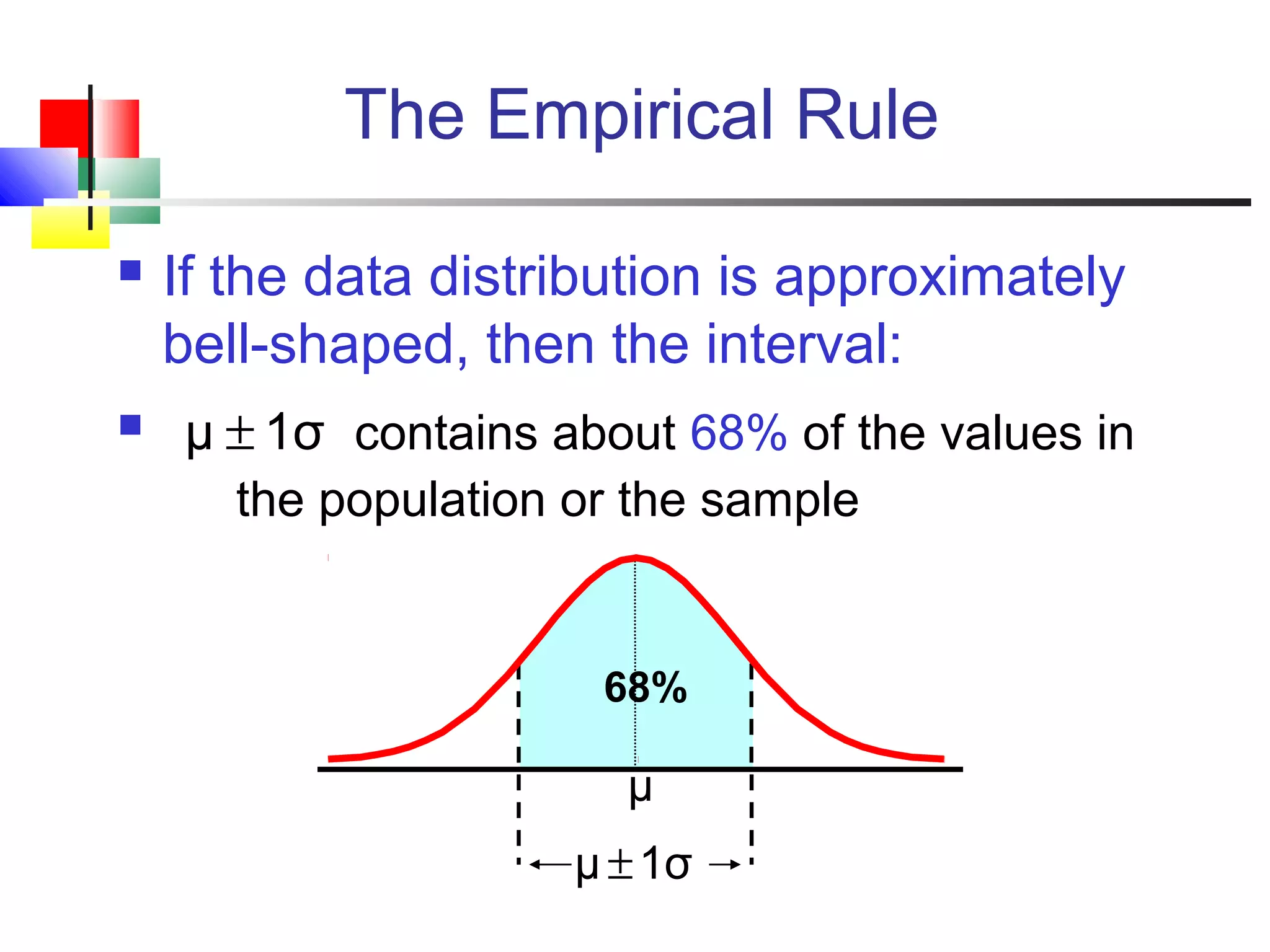
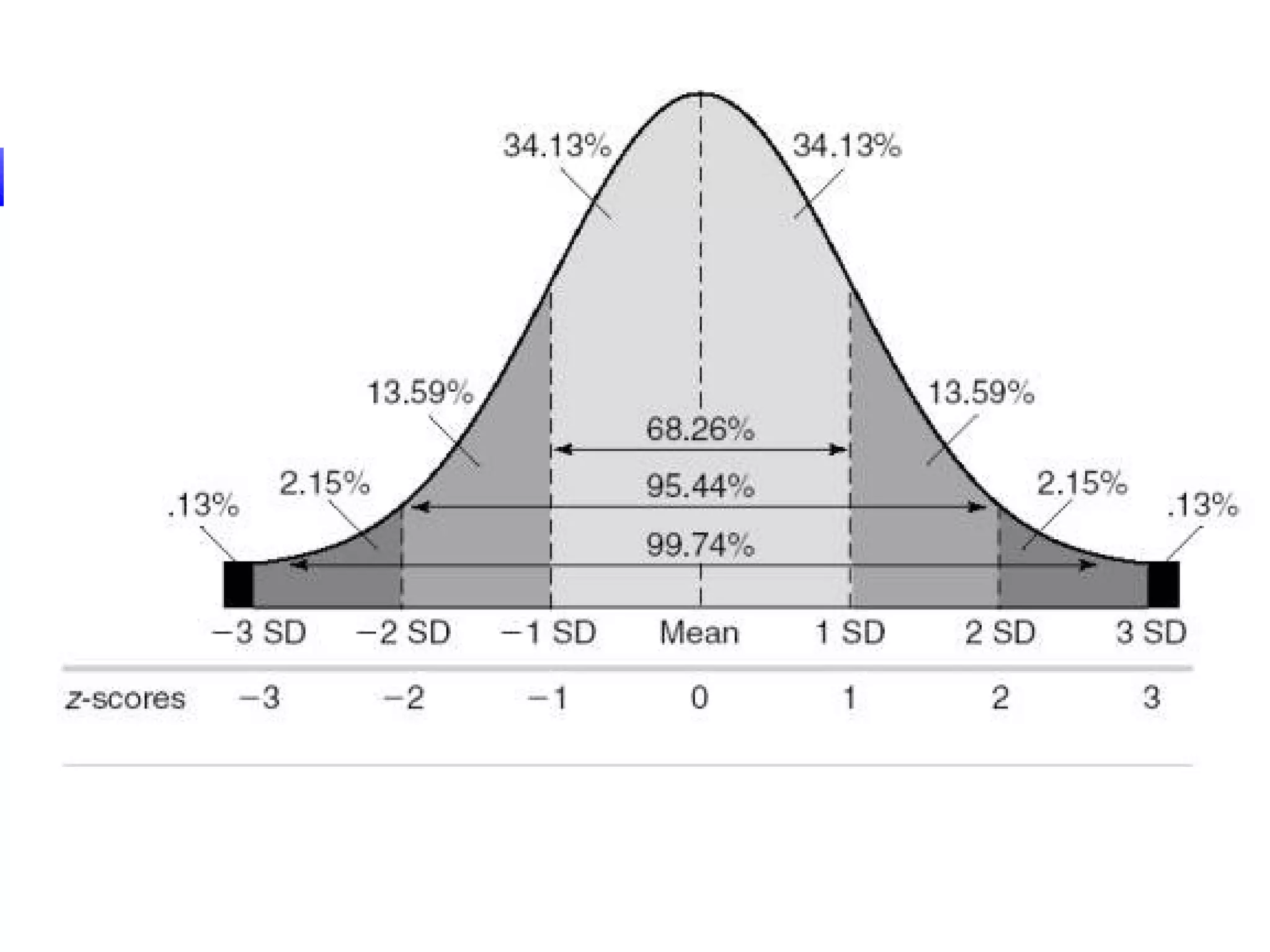
 If the data distribution is approximately
bell-shaped, then the interval:
 contains about 68% of the values in
the population or the sample
The Empirical Rule
1σμ ±
μ
68%
1σμ ±
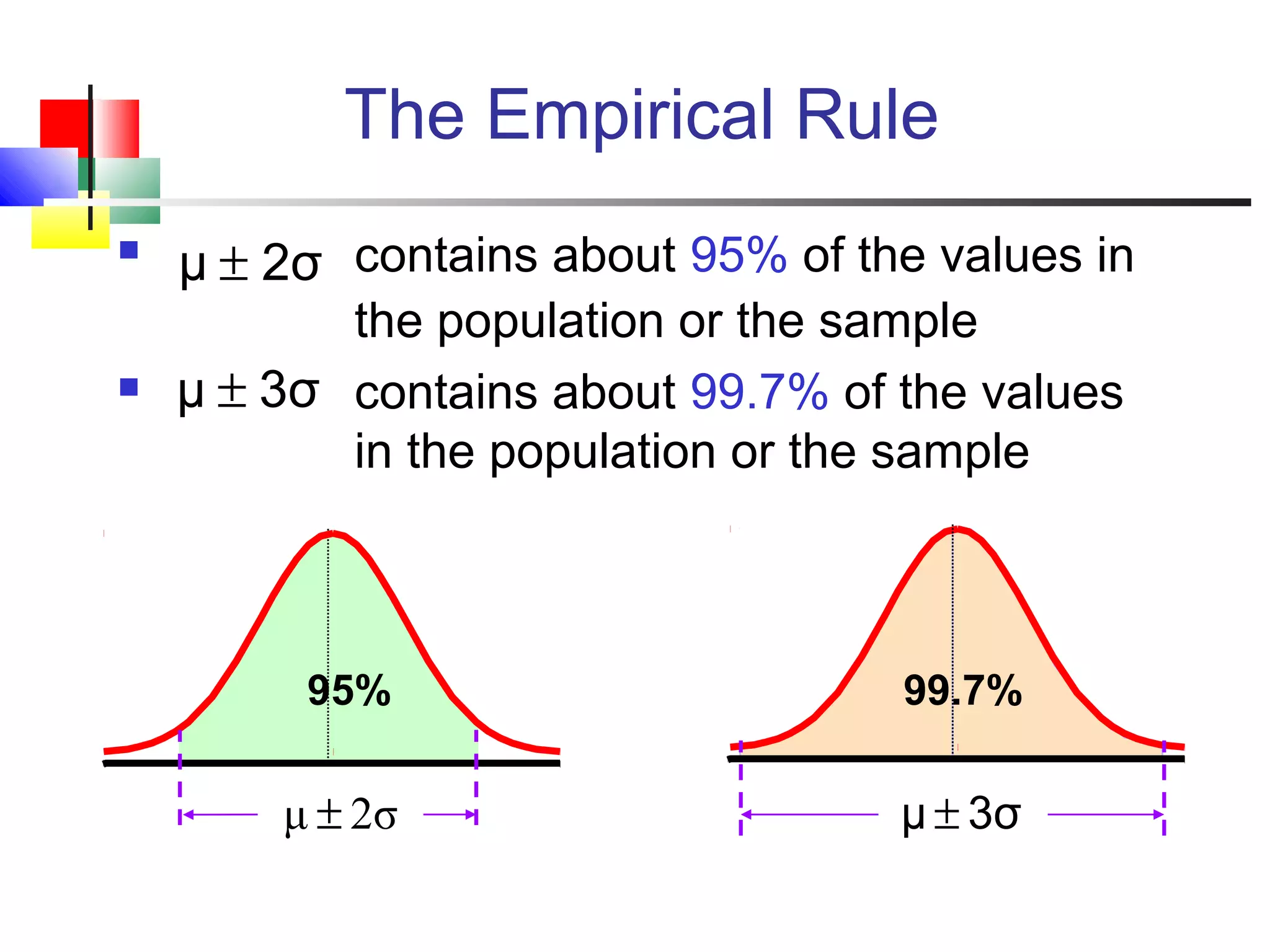
 contains about 95% of the values in
the population or the sample
 contains about 99.7% of the values
in the population or the sample
The Empirical Rule
2σμ ±
3σμ ±
3σμ ±
99.7%95%
2σμ ±
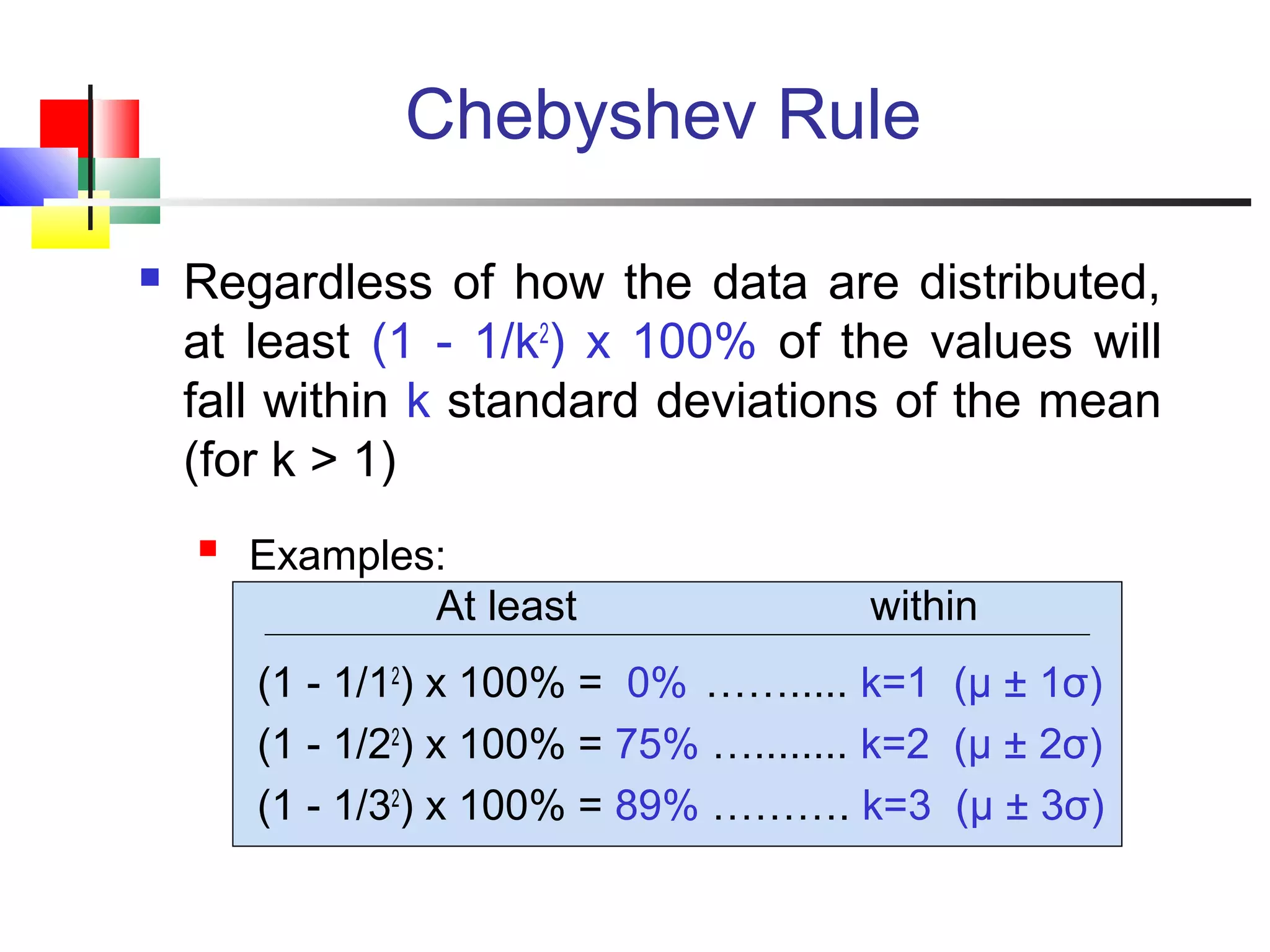
 Regardless of how the data are distributed,
at least (1 - 1/k2
) x 100% of the values will
fall within k standard deviations of the mean
(for k > 1)
 Examples:
(1 - 1/12
) x 100% = 0% ……..... k=1 (μ ± 1σ)
(1 - 1/22
) x 100% = 75% …........ k=2 (μ ± 2σ)
(1 - 1/32
) x 100% = 89% ………. k=3 (μ ± 3σ)
Chebyshev Rule
withinAt least
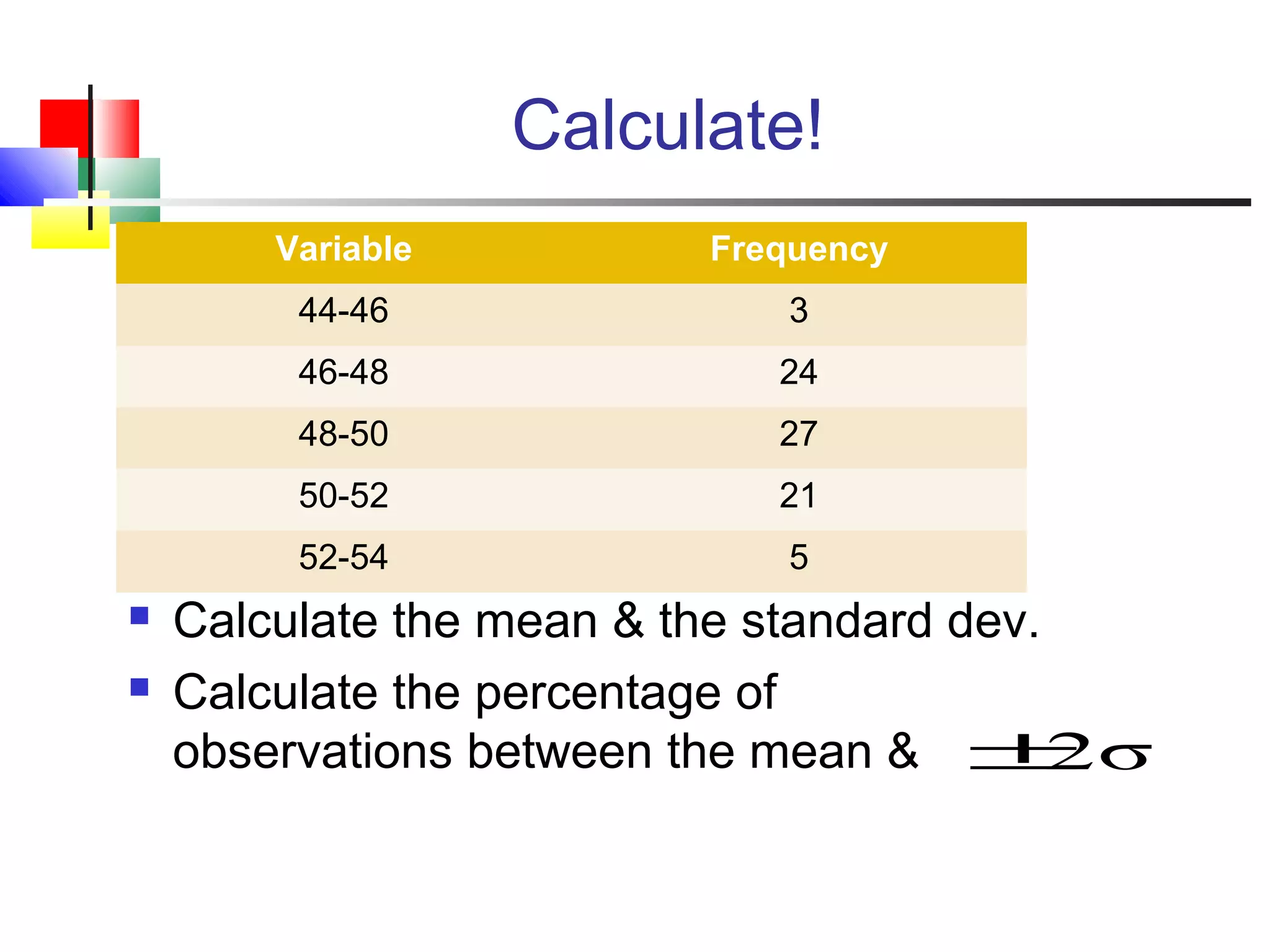
Calculate!
 Calculate the mean & the standard dev.
 Calculate the percentage of
observations between the mean & 2σ±
Variable Frequency
44-46 3
46-48 24
48-50 27
50-52 21
52-54 5
Find the correct Mean & Std. dev.
The Mean & Standard Deviation of a set of 100
observations were worked out as 40 & 5
respectively. It was later learnt that a mistake had
been made in data entry – in place of 40 (the
correct value), 50 was entered.
Skewness
 A fundamental task in many statistical analyses is to
characterize the location and variability of a data set
(Measures of central tendency vs. measures of
dispersion)
 Both measures tell us nothing about the shape of the
distribution
 It is possible to have frequency distributions which differ
widely in their nature and composition and yet may
have same central tendency and dispersion.
 Therefore, a further characterization of the data
includes skewness
Positive & Negative Skew
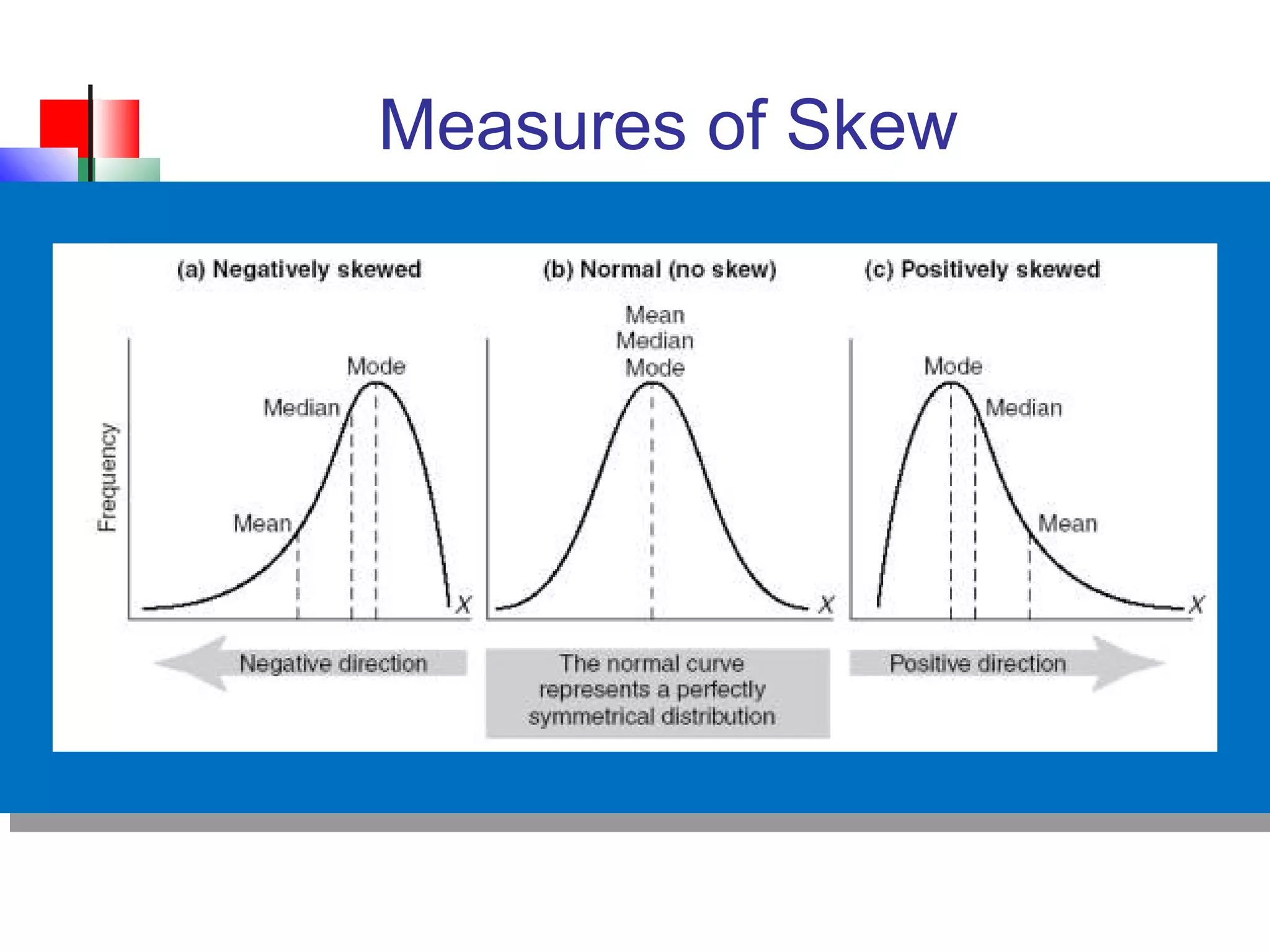
 Positive skewness
 There are more observations below the mean than
above it
 When the mean is greater than the median
 Negative skewness
 There are a small number of low observations and a
large number of high ones
 When the median is greater than the mean
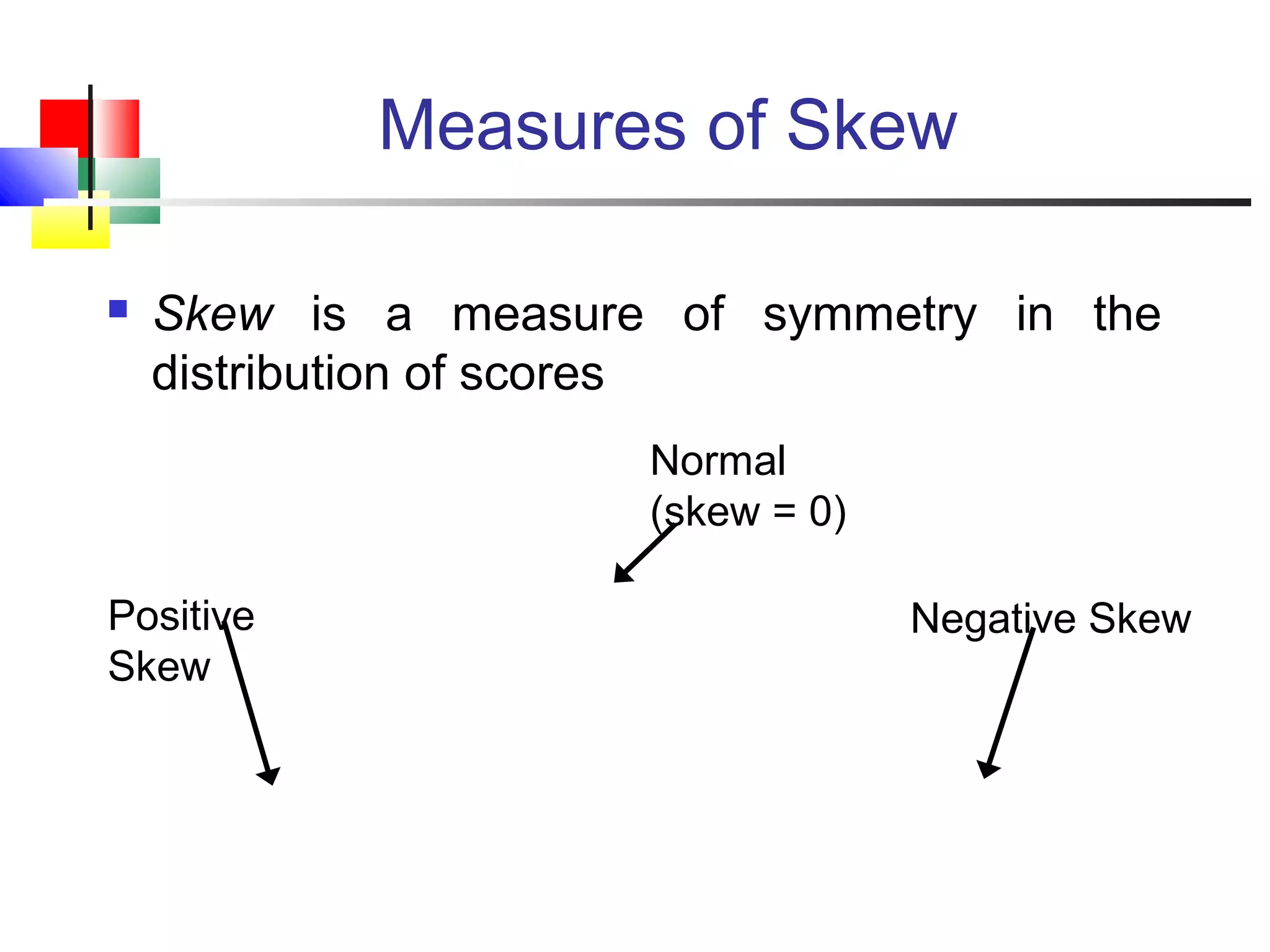
Measures of Skew
 Skew is a measure of symmetry in the
distribution of scores
Positive
Skew
Negative Skew
Normal
(skew = 0)
Measures of Skew
The Rules
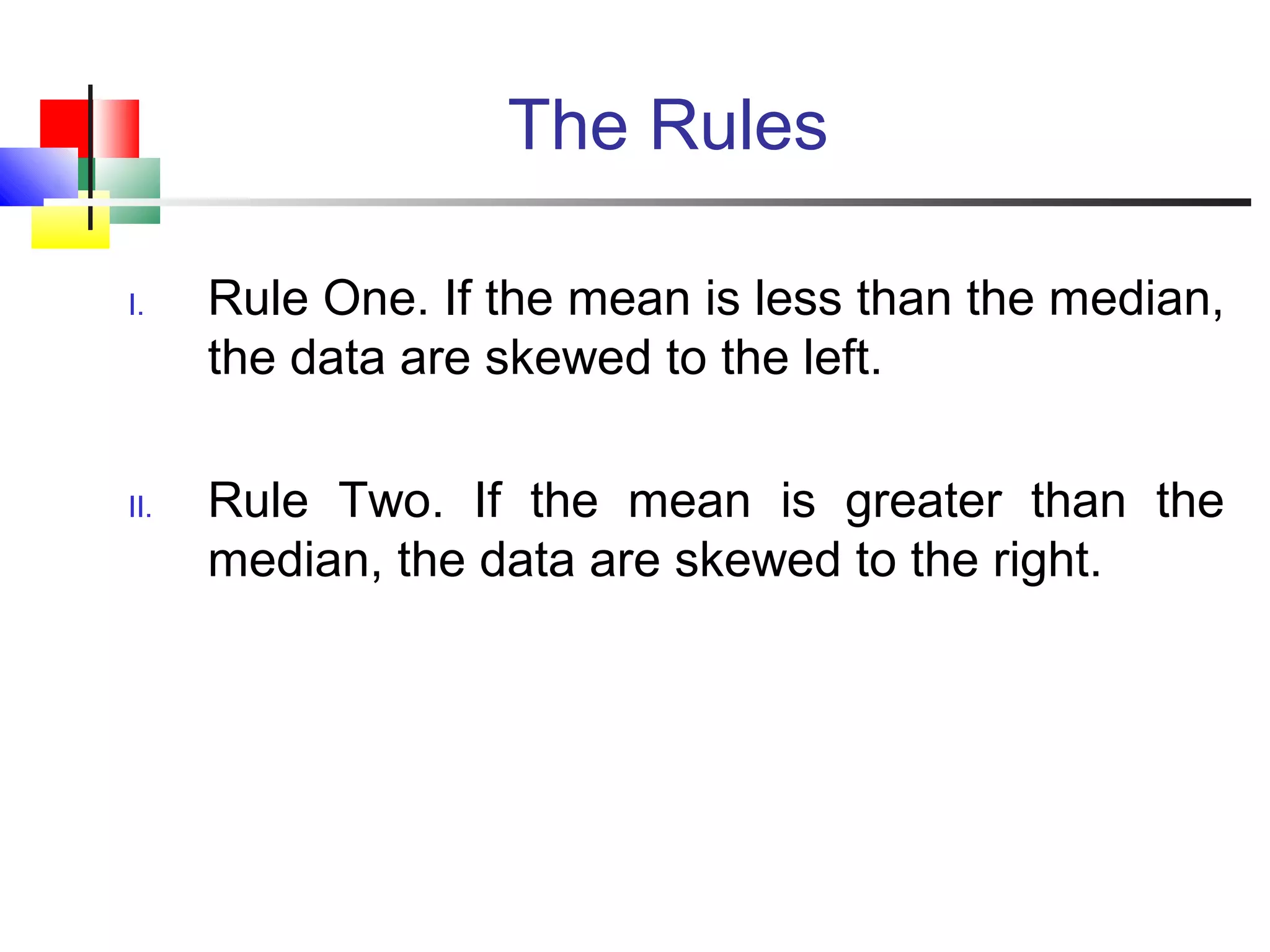
I. Rule One. If the mean is less than the median,
the data are skewed to the left.
II. Rule Two. If the mean is greater than the
median, the data are skewed to the right.
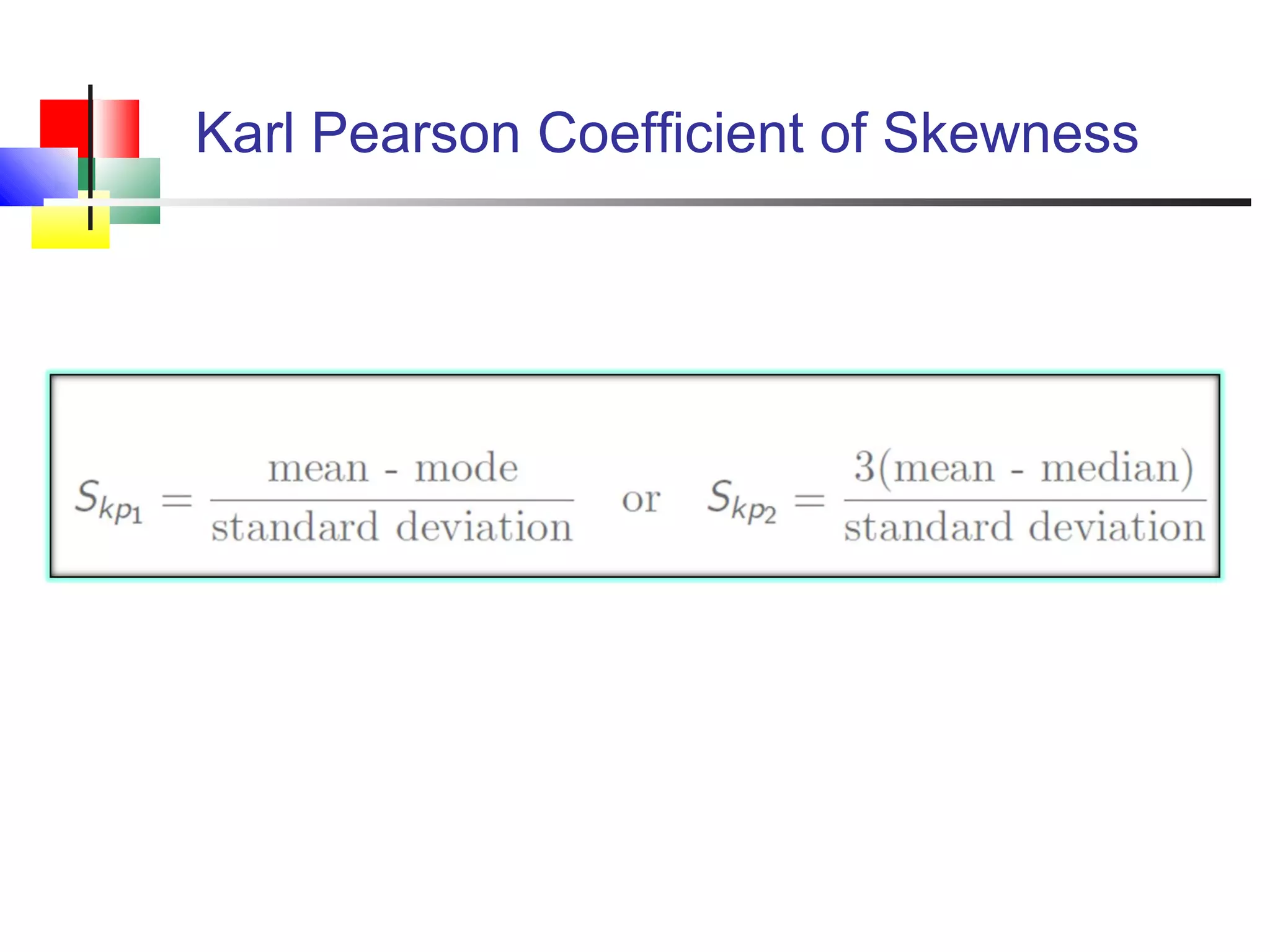
Karl Pearson Coefficient of Skewness
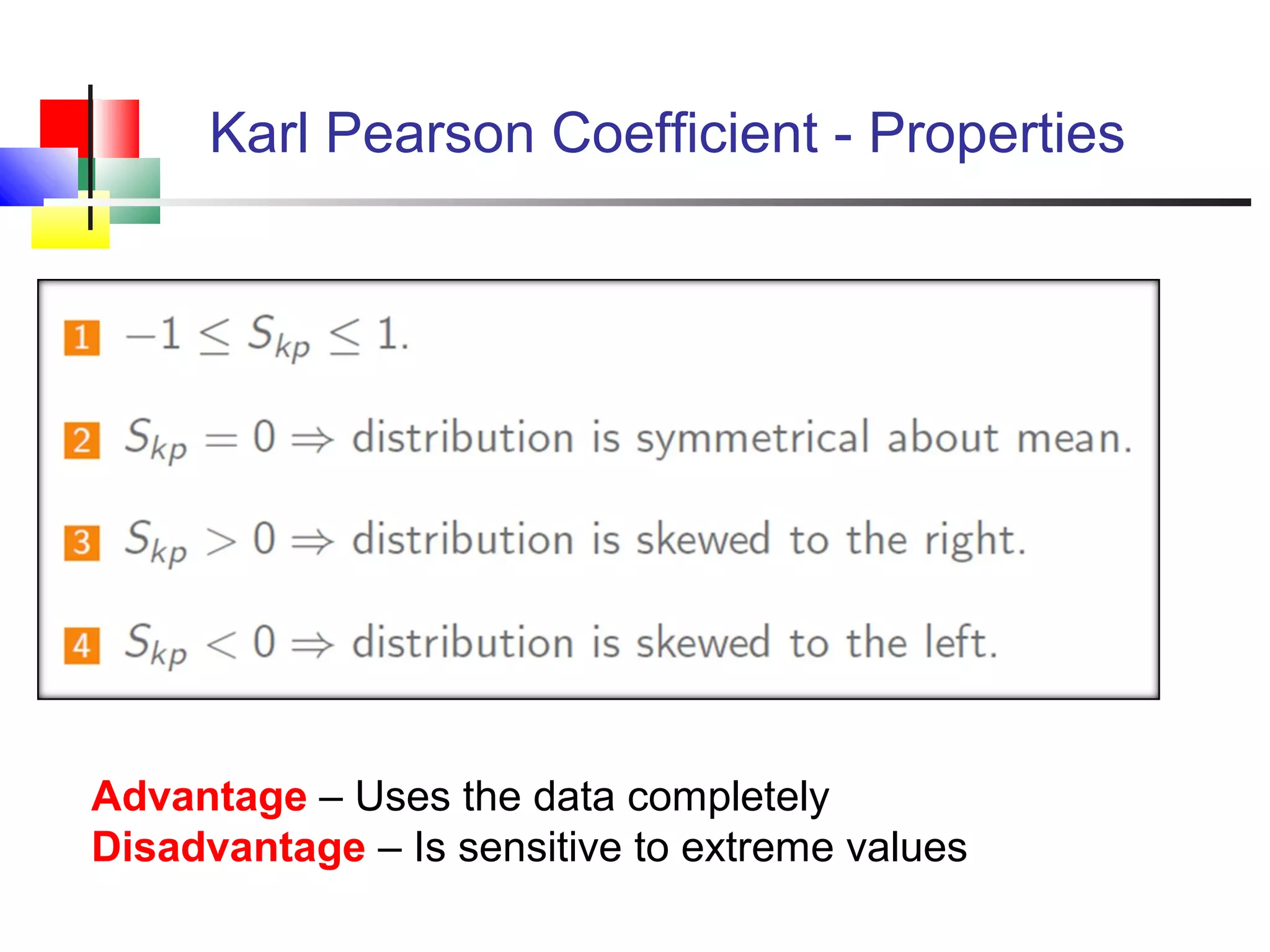
Karl Pearson Coefficient - Properties
Advantage – Uses the data completely
Disadvantage – Is sensitive to extreme values
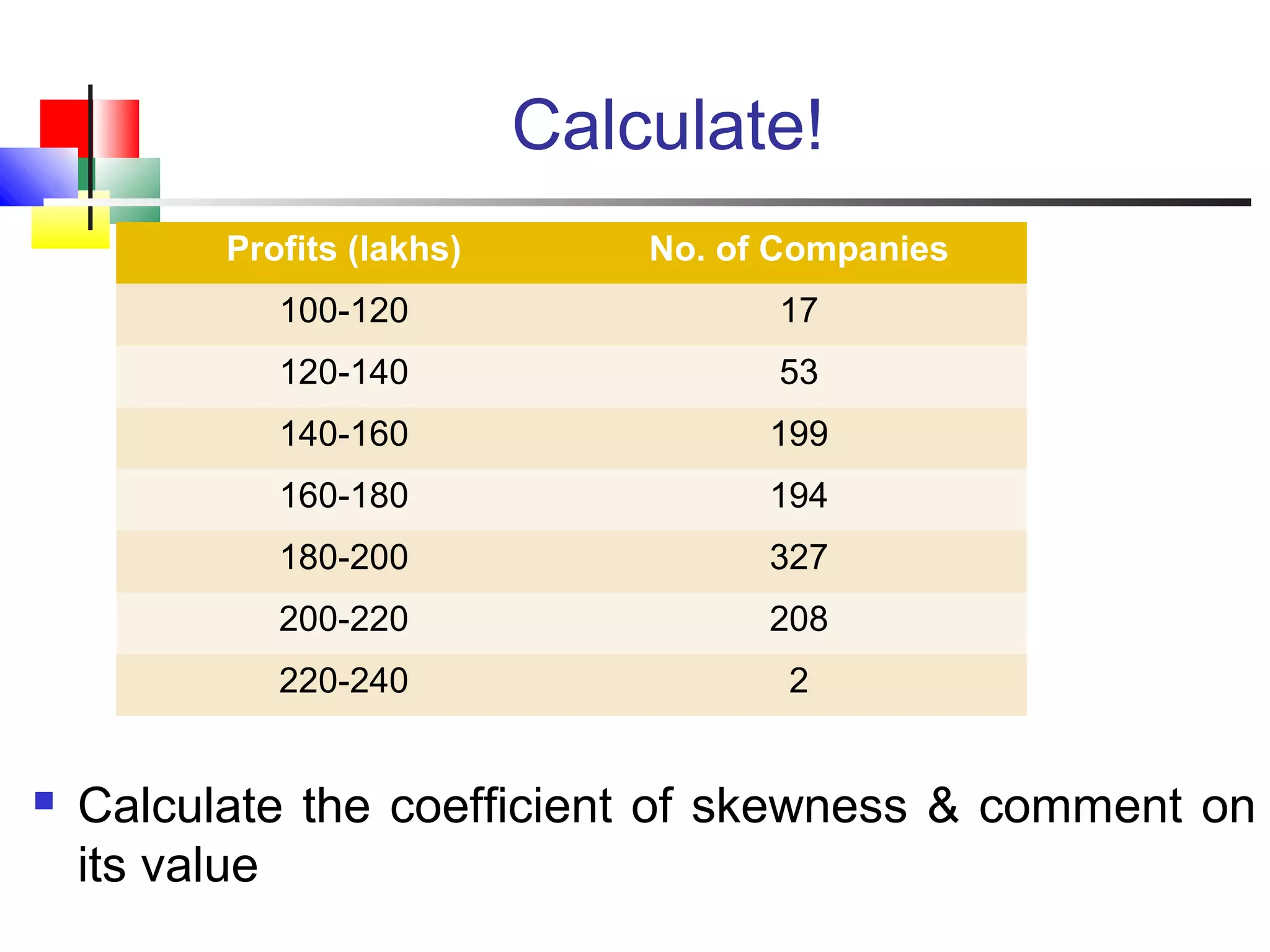
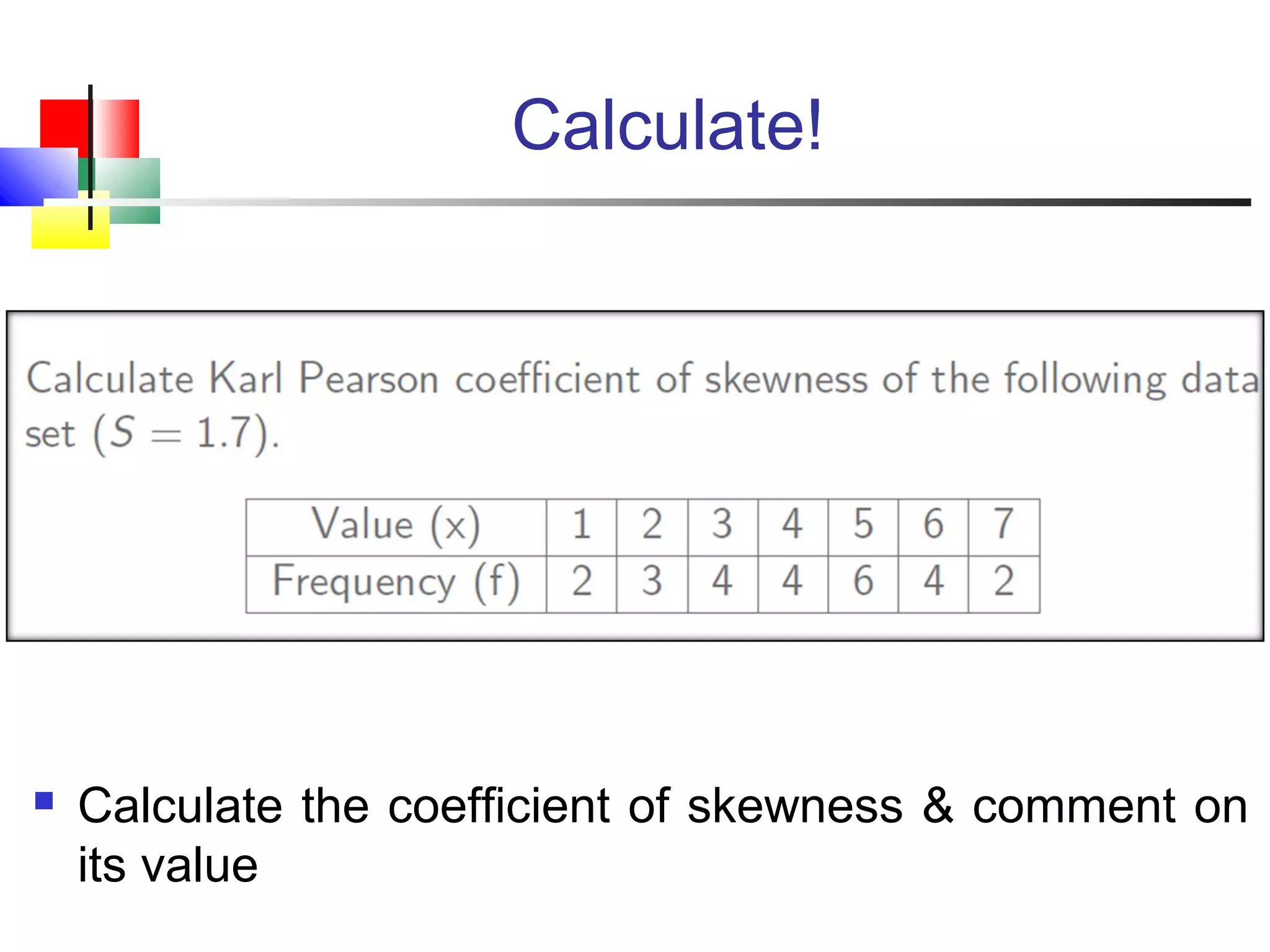
Calculate!
 Calculate the coefficient of skewness & comment on
its value
Calculate!
 Calculate the coefficient of skewness & comment on
its value
Profits (lakhs) No. of Companies
100-120 17
120-140 53
140-160 199
160-180 194
180-200 327
200-220 208
220-240 2
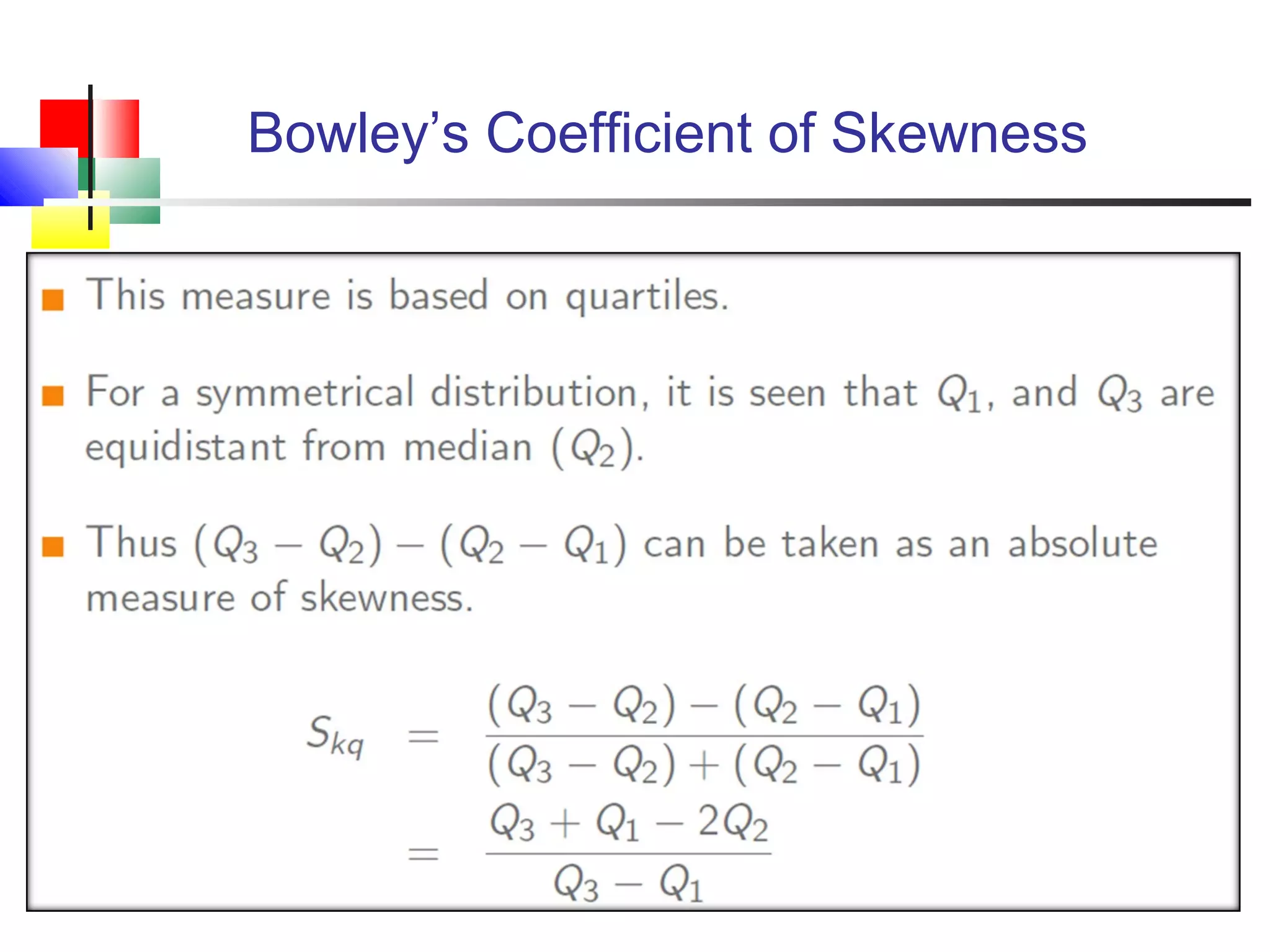
Bowley’s Coefficient of Skewness
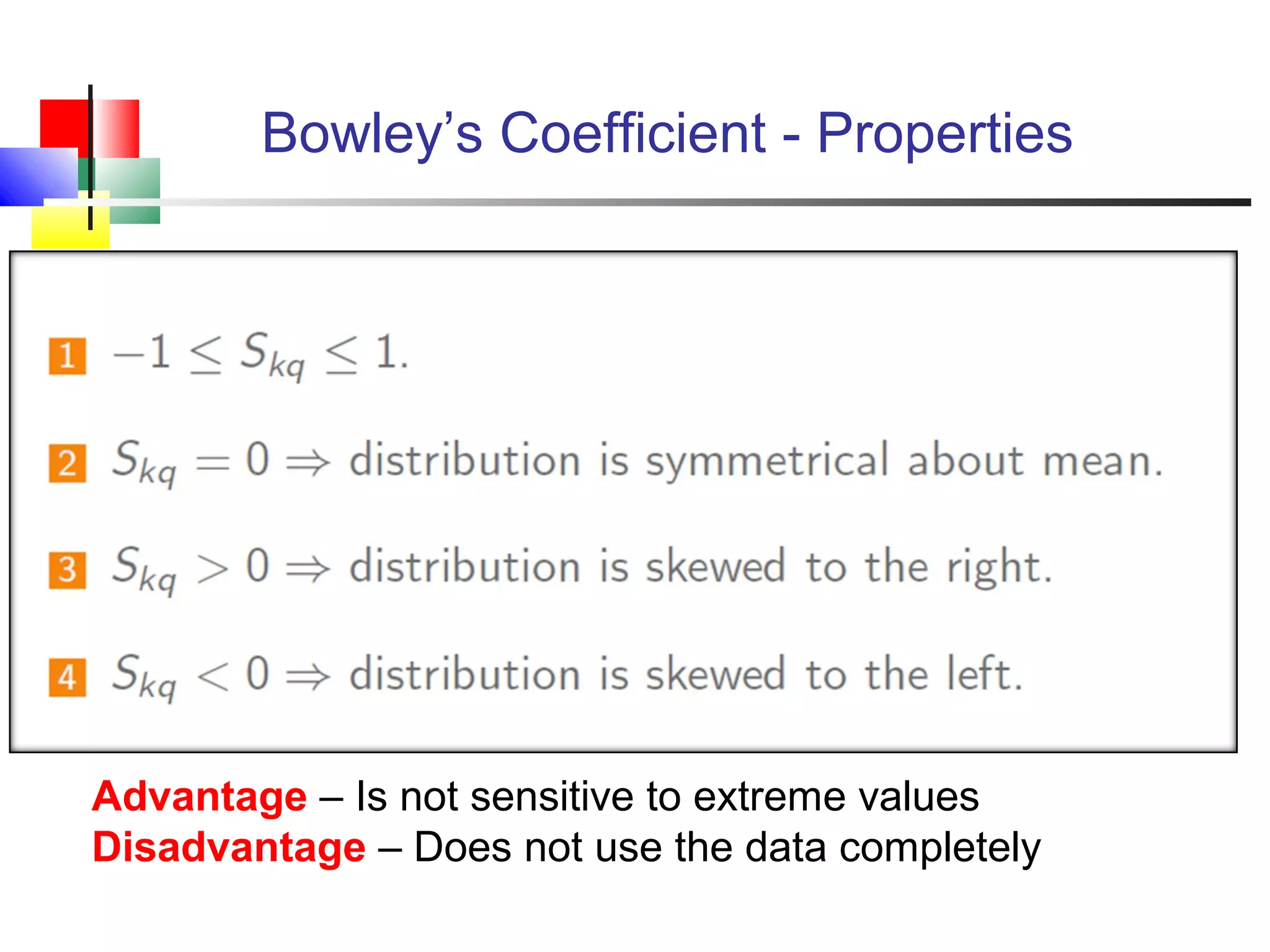
Bowley’s Coefficient - Properties
Advantage – Is not sensitive to extreme values
Disadvantage – Does not use the data completely
Calculate!
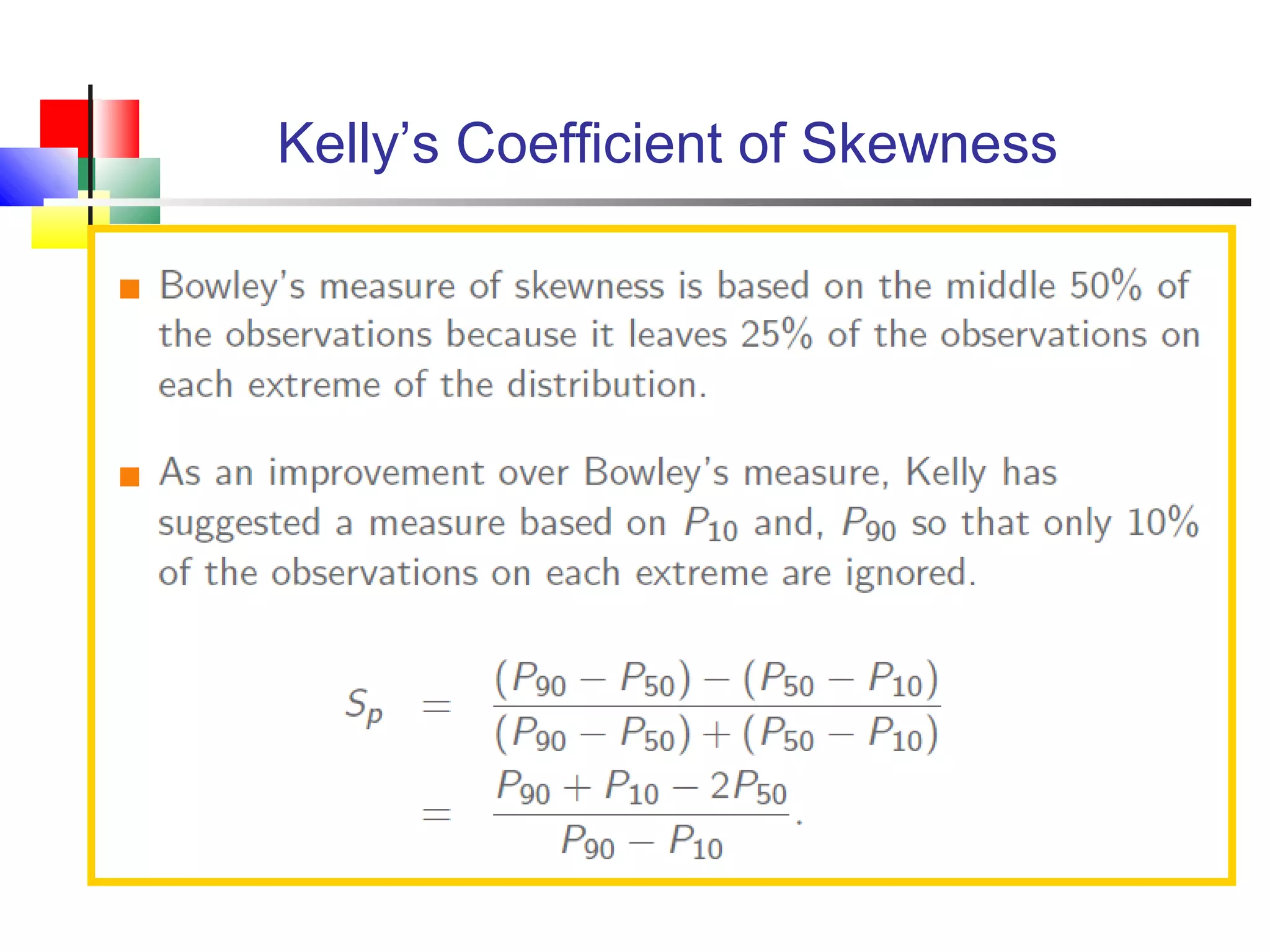
Kelly’s Coefficient of Skewness
Calculate!
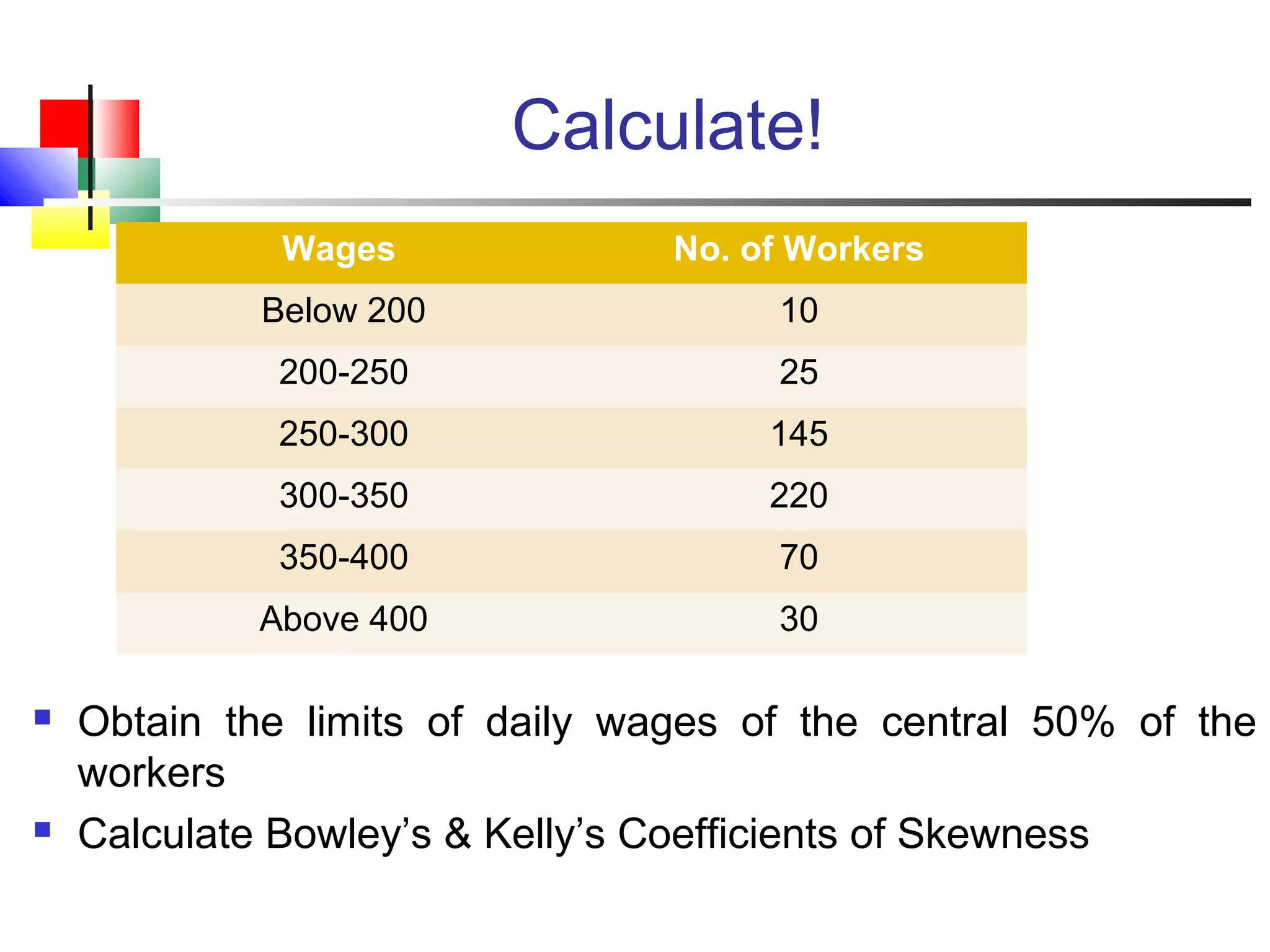
 Obtain the limits of daily wages of the central 50% of the
workers
 Calculate Bowley’s & Kelly’s Coefficients of Skewness
Wages No. of Workers
Below 200 10
200-250 25
250-300 145
300-350 220
350-400 70
Above 400 30
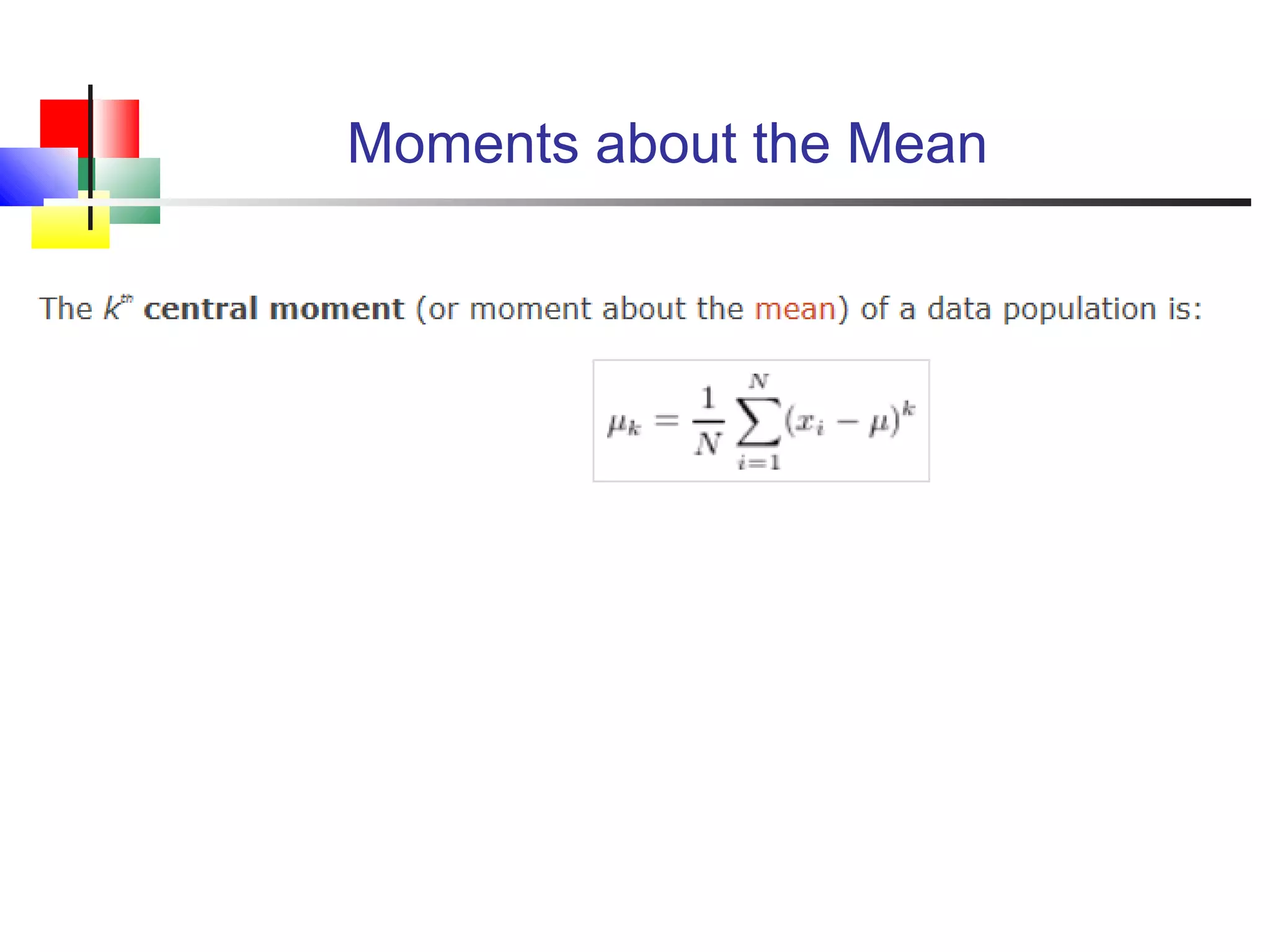
Moments about the Mean

Measures of dispersion discuss 2.2

  • 1.
  • 2.
    Summary Measures Arithmetic Mean Median Mode DescribingData Numerically Variance Standard Deviation Coefficient of Variation Range Interquartile Range Geometric Mean Skewness Central Tendency Variation ShapeQuartiles
  • 3.
    Quartiles  Quartiles splitthe ranked data into 4 segments with an equal number of values per segment 25% 25% 25% 25%  The first quartile, Q1, is the value for which 25% of the observations are smaller and 75% are larger  Q2 is the same as the median (50% are smaller, 50% are larger)  Only 25% of the observations are greater than the third quartile Q1 Q2 Q3
  • 4.
    Quartile Formulas Find aquartile by determining the value in the appropriate position in the ranked data, where First quartile position: Q1 = n/4 Second quartile position: Q2 = n/2 (the median position) Third quartile position: Q3 = 3n/4 where n is the number of observed values
  • 5.
    (n = 9) Q1is in the 9/4 = 2.25 position of the ranked data so Q1 = 12.25 Quartiles Sample Data in Ordered Array: 11 12 13 16 16 17 18 21 22  Example: Find the first quartile Q1 and Q3 are measures of noncentral location Q2 = median, a measure of central tendency
  • 6.
    Quartiles  Example: (continued) Overtime Hours 10-15 15-2020-25 25-30 30-35 35-40 Total No. of employees 11 20 35 20 8 6 100 Calculate Median, First Quartile, 7th Decile & Interquartile Range
  • 7.
    Same center, different variation Measuresof Variation Variation Variance Standard Deviation Coefficient of Variation Range Interquartile Range  Measures of variation give information on the spread or variability of the data values.
  • 8.
    Range  Simplest measureof variation  Difference between the largest and the smallest values in a set of data: Range = Xlargest – Xsmallest 0 1 2 3 4 5 6 7 8 9 10 11 12 13 14 Range = 14 - 1 = 13 Example:
  • 9.
     Ignores theway in which data are distributed  Sensitive to outliers 7 8 9 10 11 12 Range = 12 - 7 = 5 7 8 9 10 11 12 Range = 12 - 7 = 5 Disadvantages of the Range 1,1,1,1,1,1,1,1,1,1,1,2,2,2,2,2,2,2,2,3,3,3,3,4,5 1,1,1,1,1,1,1,1,1,1,1,2,2,2,2,2,2,2,2,3,3,3,3,4,120 Range = 5 - 1 = 4 Range = 120 - 1 = 119
  • 10.
    Coefficient of Range Coefficientof Range = [L-S]/[L+S] Where, L = Largest value in the data set S = Smallest value in the data set
  • 11.
    Interquartile Range  Caneliminate some outlier problems by using the interquartile range  Eliminate some high- and low-valued observations and calculate the range from the remaining values  Interquartile range = 3rd quartile – 1st quartile = Q3 – Q1
  • 12.
    Interquartile Range Median (Q2) X maximumX minimum Q1Q3 Example: 25% 25% 25% 25% 12 30 45 57 70 Interquartile range = 57 – 30 = 27
  • 13.
    Coefficient of QD Coefficientof QD= [Q3-Q1]/[Q3+Q1]
  • 14.
    Average Deviation Coefficient ofAD = (Average Deviation)/(Mean or Median)
  • 15.
    Calculate the Coefficientof AD (mean) Sales (in thousand Rs) No. of days 10-20 3 20-30 6 30-40 11 40-50 3 50-60 2
  • 16.
     Average (approximately)of squared deviations of values from the mean  Sample variance: Variance 1-n )X(X S n 1i 2 i 2 ∑= − = Where = mean n = sample size Xi = ith value of the variable X X
  • 17.
    Standard Deviation  Mostcommonly used measure of variation  Shows variation about the mean  Is the square root of the variance  Has the same units as the original data  Sample standard deviation: 1-n )X(X S n 1i 2 i∑= − =
  • 18.
    Calculation Example: Sample StandardDeviation Sample Data (Xi) : 10 12 14 15 17 18 18 24 n = 8 Mean = X = 16 4.308 7 130 7 16)(2416)(1416)(1216)(10 1-n )X(24)X(14)X(12)X(10 S 2222 2222 == −++−+−+− = −++−+−+− =   A measure of the “average” scatter around the mean
  • 19.
    Population vs. SampleStandard Deviation
  • 20.
    Population vs. SampleStandard Deviation (Grouped Data)
  • 21.
    Calculate the StandardDeviation for the following sample Number of pins knocked down in ten-pin bowling matches
  • 22.
    Solution Number of pinsknocked down in ten-pin bowling matches
  • 23.
    Calculate the StandardDeviation for the following sample Heights of students
  • 24.
  • 25.
    Calculate the StandardDeviation for the following sample Number of typing errors
  • 26.
    Comparing Standard Deviations Mean= 15.5 S = 3.33811 12 13 14 15 16 17 18 19 20 21 11 12 13 14 15 16 17 18 19 20 21 Data B Data A Mean = 15.5 S = 0.926 11 12 13 14 15 16 17 18 19 20 21 Mean = 15.5 S = 4.567 Data C
  • 27.
    Measuring variation Small standarddeviation Large standard deviation
  • 28.
    Advantages of Varianceand Standard Deviation  Each value in the data set is used in the calculation  Values far from the mean are given extra weight (because deviations from the mean are squared)
  • 29.
    Coefficient of Variation Measures relative variation  Always in percentage (%)  Shows variation relative to mean  Can be used to compare two or more sets of data measured in different units 100% X S CV ⋅        =
  • 30.
    Comparing Coefficient of Variation Stock A:  Average price last year = $50  Standard deviation = $5  Stock B:  Average price last year = $100  Standard deviation = $5 Both stocks have the same standard deviation, but stock B is less variable relative to its price 10%100% $50 $5 100% X S CVA =⋅=⋅        = 5%100% $100 $5 100% X S CVB =⋅=⋅        =
  • 31.
  • 32.
    Calculate!  Calculate thecoefficient of variation for the following data set.  The price, in cents, of a stock over five trading days was 52, 58, 55, 57, 59.
  • 33.
  • 34.
  • 35.
  • 36.
    Z Scores  Ameasure of distance from the mean (for example, a Z-score of 2.0 means that a value is 2.0 standard deviations from the mean)  The difference between a value and the mean, divided by the standard deviation  A Z score above 3.0 or below -3.0 is considered an outlier S XX Z − =
  • 37.
    Z Scores Example:  Ifthe mean is 14.0 and the standard deviation is 3.0, what is the Z score for the value 18.5?  The value 18.5 is 1.5 standard deviations above the mean  (A negative Z-score would mean that a value is less than the mean) 1.5 3.0 14.018.5 S XX Z = − = − = (continued)
  • 38.
    Shape of aDistribution  Describes how data are distributed  Measures of shape  Symmetric or skewed Mean = MedianMean < Median Median < Mean Right-SkewedLeft-Skewed Symmetric
  • 39.
     If thedata distribution is approximately bell-shaped, then the interval:  contains about 68% of the values in the population or the sample The Empirical Rule 1σμ ± μ 68% 1σμ ±
  • 40.
     contains about95% of the values in the population or the sample  contains about 99.7% of the values in the population or the sample The Empirical Rule 2σμ ± 3σμ ± 3σμ ± 99.7%95% 2σμ ±
  • 42.
     Regardless ofhow the data are distributed, at least (1 - 1/k2 ) x 100% of the values will fall within k standard deviations of the mean (for k > 1)  Examples: (1 - 1/12 ) x 100% = 0% ……..... k=1 (μ ± 1σ) (1 - 1/22 ) x 100% = 75% …........ k=2 (μ ± 2σ) (1 - 1/32 ) x 100% = 89% ………. k=3 (μ ± 3σ) Chebyshev Rule withinAt least
  • 43.
    Calculate!  Calculate themean & the standard dev.  Calculate the percentage of observations between the mean & 2σ± Variable Frequency 44-46 3 46-48 24 48-50 27 50-52 21 52-54 5
  • 44.
    Find the correctMean & Std. dev. The Mean & Standard Deviation of a set of 100 observations were worked out as 40 & 5 respectively. It was later learnt that a mistake had been made in data entry – in place of 40 (the correct value), 50 was entered.
  • 45.
    Skewness  A fundamentaltask in many statistical analyses is to characterize the location and variability of a data set (Measures of central tendency vs. measures of dispersion)  Both measures tell us nothing about the shape of the distribution  It is possible to have frequency distributions which differ widely in their nature and composition and yet may have same central tendency and dispersion.  Therefore, a further characterization of the data includes skewness
  • 46.
    Positive & NegativeSkew  Positive skewness  There are more observations below the mean than above it  When the mean is greater than the median  Negative skewness  There are a small number of low observations and a large number of high ones  When the median is greater than the mean
  • 47.
    Measures of Skew Skew is a measure of symmetry in the distribution of scores Positive Skew Negative Skew Normal (skew = 0)
  • 48.
  • 49.
    The Rules I. RuleOne. If the mean is less than the median, the data are skewed to the left. II. Rule Two. If the mean is greater than the median, the data are skewed to the right.
  • 50.
  • 51.
    Karl Pearson Coefficient- Properties Advantage – Uses the data completely Disadvantage – Is sensitive to extreme values
  • 52.
    Calculate!  Calculate thecoefficient of skewness & comment on its value
  • 53.
    Calculate!  Calculate thecoefficient of skewness & comment on its value Profits (lakhs) No. of Companies 100-120 17 120-140 53 140-160 199 160-180 194 180-200 327 200-220 208 220-240 2
  • 54.
  • 55.
    Bowley’s Coefficient -Properties Advantage – Is not sensitive to extreme values Disadvantage – Does not use the data completely
  • 56.
  • 57.
  • 58.
    Calculate!  Obtain thelimits of daily wages of the central 50% of the workers  Calculate Bowley’s & Kelly’s Coefficients of Skewness Wages No. of Workers Below 200 10 200-250 25 250-300 145 300-350 220 350-400 70 Above 400 30
  • 59.