Earth ScienceEarth Science
Chapter 4 Our Dynamic EarthChapter 4 Our Dynamic Earth
Mrs. AutryMrs. Autry
55thth
Grade ScienceGrade Science
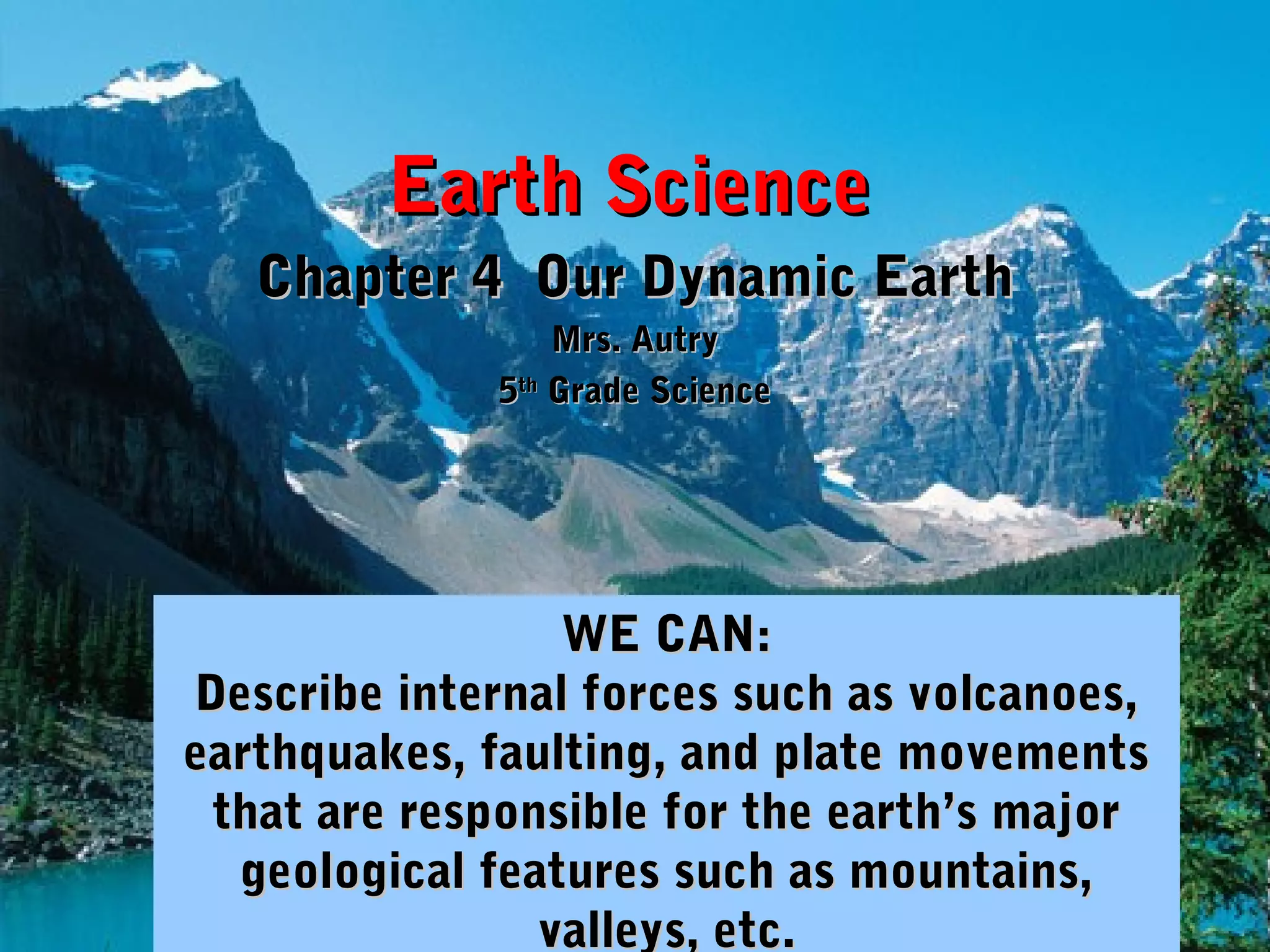
WE CAN:WE CAN:
Describe internal forces such as volcanoes,Describe internal forces such as volcanoes,
earthquakes, faulting, and plate movementsearthquakes, faulting, and plate movements
that are responsible for the earth’s majorthat are responsible for the earth’s major
geological features such as mountains,geological features such as mountains,
valleys, etc.valleys, etc.
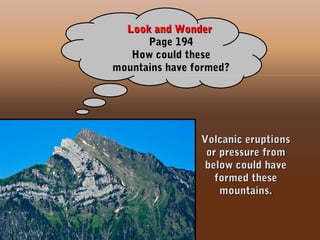
Look and WonderLook and Wonder
Page 194Page 194
How could theseHow could these
mountains have formed?mountains have formed?
Volcanic eruptionsVolcanic eruptions
or pressure fromor pressure from
below could havebelow could have
formed theseformed these
mountains.mountains.
What makes up Earth?
Scientists have gathered evidence
from earthquakes and volcanoes to
form a model of Earth’s interior.
Earth is made of layers that differ in
composition, thickness, and
temperature.
• hydrospherehydrosphere
• magmamagma
• faultfault
• corecore
• mantlemantle
• crustcrust
• geological featuregeological feature
New VocabularyNew Vocabulary
Chapter 4 Lesson 1-Chapter 4 Lesson 1-
CoreCore
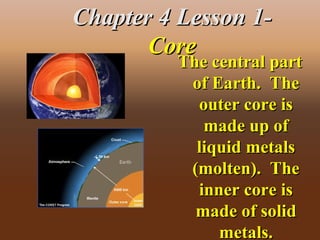
The central partThe central part
of Earth. Theof Earth. The
outer core isouter core is
made up ofmade up of
liquid metalsliquid metals
(molten). The(molten). The
inner core isinner core is
made of solidmade of solid
metals.metals.
MantleMantle
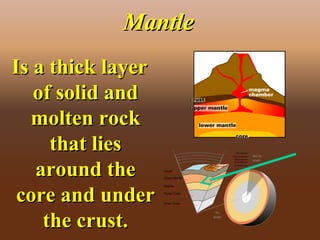
Is a thick layerIs a thick layer
of solid andof solid and
molten rockmolten rock
that liesthat lies
around thearound the
core and undercore and under
the crust.the crust.
CrustCrust
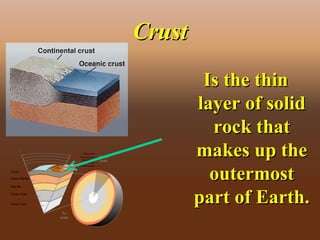
Is the thinIs the thin
layer of solidlayer of solid
rock thatrock that
makes up themakes up the
outermostoutermost
part of Earth.part of Earth.
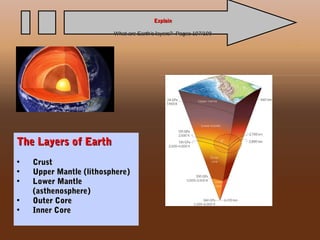
The Layers of EarthThe Layers of Earth
• CrustCrust
• Upper Mantle (lithosphere)Upper Mantle (lithosphere)
• Lower MantleLower Mantle
(asthenosphere)(asthenosphere)
• Outer CoreOuter Core
• Inner CoreInner Core
ExplainExplain
What are Earth’s layers? Pages 197/198What are Earth’s layers? Pages 197/198
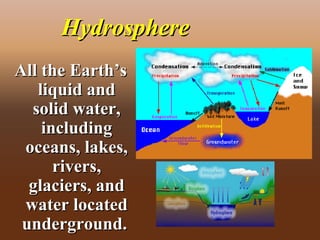
HydrosphereHydrosphere
All the Earth’sAll the Earth’s
liquid andliquid and
solid water,solid water,
includingincluding
oceans, lakes,oceans, lakes,
rivers,rivers,
glaciers, andglaciers, and
water locatedwater located
underground.underground.
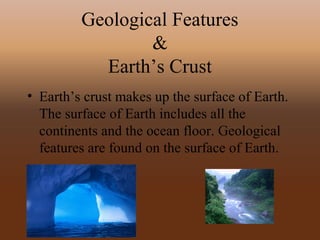
Geological Features
&
Earth’s Crust
• Earth’s crust makes up the surface of Earth.
The surface of Earth includes all the
continents and the ocean floor. Geological
features are found on the surface of Earth.
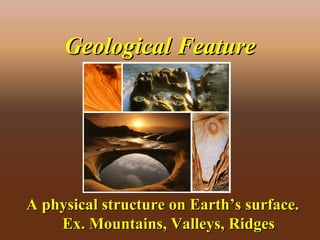
Geological FeatureGeological Feature
A physical structure on Earth’s surface.A physical structure on Earth’s surface.
Ex. Mountains, Valleys, RidgesEx. Mountains, Valleys, Ridges
Let’s Review
• True or False. The layers of Earth differ in thickness, composition, and
temperature.
• True
• The _______ is the thin layer of solid rock that makes up the
outermost part of Earth.
• Crust
• True or False. The outer core is made of solid metals and the inner
core is made of liquid metals.
• False
• A __________ is a physical structure on Earth’s surface.
• Geological Feature
• What is an example of a geological feature?
• Mountains, Valleys, Rivers, Lakes, Caves, Etc.
A look ahead…
• Are the continents moving?
• What causes the ocean floor to move?
• How did the earth’s major geological
features (mountains/valleys) form?
Earth ScienceEarth Science
Chapter 4 Our Dynamic EarthChapter 4 Our Dynamic Earth
Mrs. AutryMrs. Autry
55thth
Grade ScienceGrade Science
WE CAN:WE CAN:
Describe internal forces such as volcanoes,Describe internal forces such as volcanoes,
earthquakes, faulting, and plate movementsearthquakes, faulting, and plate movements
that are responsible for the earth’s majorthat are responsible for the earth’s major
geological features such as mountains,geological features such as mountains,
valleys, etc.valleys, etc.
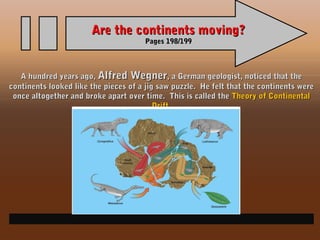
Are the continents moving?Are the continents moving?
Pages 198/199Pages 198/199
A hundred years ago,A hundred years ago, Alfred WegnerAlfred Wegner, a German geologist, noticed that the, a German geologist, noticed that the
continents looked like the pieces of a jig saw puzzle. He felt that the continents werecontinents looked like the pieces of a jig saw puzzle. He felt that the continents were
once altogether and broke apart over time. This is called theonce altogether and broke apart over time. This is called the Theory of ContinentalTheory of Continental
DriftDrift..
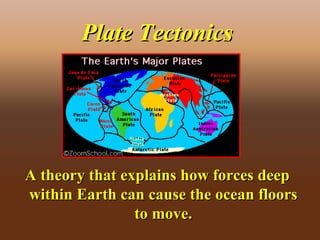
Plate TectonicsPlate Tectonics
A theory that explains how forces deepA theory that explains how forces deep
within Earth can cause the ocean floorswithin Earth can cause the ocean floors
to move.to move.
What causes tectonic plate
movement?
• Earth can cause ocean floors to spread and
continents to move. The lithosphere is made
of huge plates of solid rock. Earth’s
continents rest on these plates.
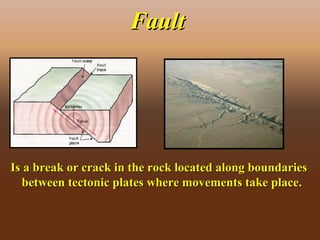
FaultFault
Is a break or crack in the rock located along boundariesIs a break or crack in the rock located along boundaries
between tectonic plates where movements take place.between tectonic plates where movements take place.
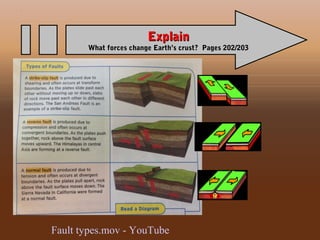
ExplainExplain
What forces change Earth’s crust? Pages 202/203What forces change Earth’s crust? Pages 202/203
Fault types.mov - YouTube
https://www.youtube.com/watch?v=tc
ExplainExplain
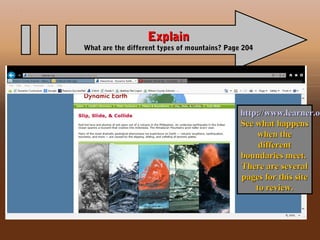
What are the different types of mountains? Page 204What are the different types of mountains? Page 204
http://www.learner.ohttp://www.learner.or
See what happensSee what happens
when thewhen the
differentdifferent
boundaries meet.boundaries meet.
There are severalThere are several
pages for this sitepages for this site
to review.to review.
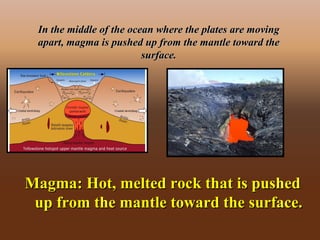
In the middle of the ocean where the plates are movingIn the middle of the ocean where the plates are moving
apart, magma is pushed up from the mantle toward theapart, magma is pushed up from the mantle toward the
surface.surface.
Magma: Hot, melted rock that is pushedMagma: Hot, melted rock that is pushed
up from the mantle toward the surface.up from the mantle toward the surface.
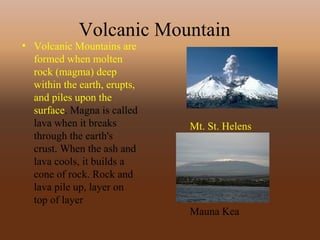
Volcanic Mountain
• Volcanic Mountains are
formed when molten
rock (magma) deep
within the earth, erupts,
and piles upon the
surface. Magna is called
lava when it breaks
through the earth's
crust. When the ash and
lava cools, it builds a
cone of rock. Rock and
lava pile up, layer on
top of layer
Mt. St. Helens
Mauna Kea
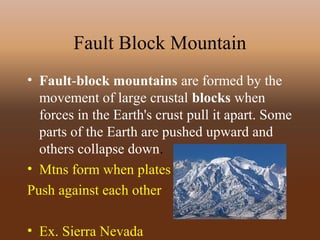
Fault Block Mountain
• Fault-block mountains are formed by the
movement of large crustal blocks when
forces in the Earth's crust pull it apart. Some
parts of the Earth are pushed upward and
others collapse down.
• Mtns form when plates
Push against each other
• Ex. Sierra Nevada
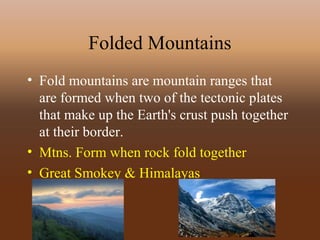
Folded Mountains
• Fold mountains are mountain ranges that
are formed when two of the tectonic plates
that make up the Earth's crust push together
at their border.
• Mtns. Form when rock fold together
• Great Smokey & Himalayas
https://www.youtube.com/watch?v=JrB
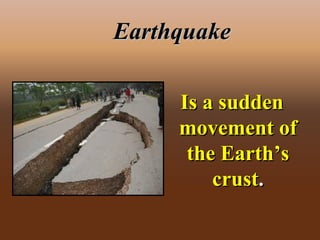
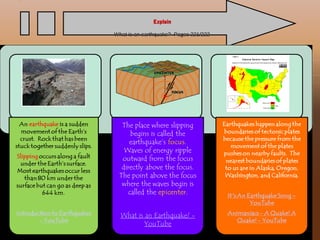
EarthquakeEarthquake
Is a suddenIs a sudden
movement ofmovement of
the Earth’sthe Earth’s
crustcrust..
Earthquakes- Cause
• The rock on both sides of a fault is pushed
and pulled by forces in the crust.
• Usually rocks on both sides of a fault are
stuck together. When layers of rock that are
stuck together suddenly slip, an earthquake
occurs.
Earthquakes- Continued
• Earthquakes happen along the boundaries of
tectonic plates because the pressure from
the movement of the plates pushes on faults.
ExplainExplain
What is an earthquake? Pages 221/222What is an earthquake? Pages 221/222
TsunamiTsunami
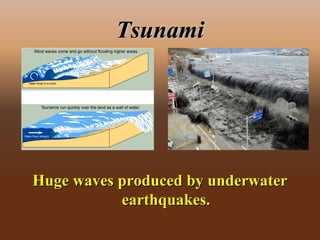
Huge waves produced by underwaterHuge waves produced by underwater
earthquakes.earthquakes.
Review
1) Which causes a rapid change to occur on Earth’s surface?
a. Earthquake b. acid rain c. wind d. snow storm
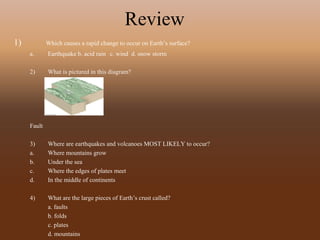
2) What is pictured in this diagram?
Fault
3) Where are earthquakes and volcanoes MOST LIKELY to occur?
a. Where mountains grow
b. Under the sea
c. Where the edges of plates meet
d. In the middle of continents
4) What are the large pieces of Earth’s crust called?
a. faults
b. folds
c. plates
d. mountains

5th Gr Science Chapter 4: Our Dynamic Earth

  • 1.
    Earth ScienceEarth Science Chapter4 Our Dynamic EarthChapter 4 Our Dynamic Earth Mrs. AutryMrs. Autry 55thth Grade ScienceGrade Science WE CAN:WE CAN: Describe internal forces such as volcanoes,Describe internal forces such as volcanoes, earthquakes, faulting, and plate movementsearthquakes, faulting, and plate movements that are responsible for the earth’s majorthat are responsible for the earth’s major geological features such as mountains,geological features such as mountains, valleys, etc.valleys, etc.
  • 2.
    Look and WonderLookand Wonder Page 194Page 194 How could theseHow could these mountains have formed?mountains have formed? Volcanic eruptionsVolcanic eruptions or pressure fromor pressure from below could havebelow could have formed theseformed these mountains.mountains.
  • 3.
    What makes upEarth? Scientists have gathered evidence from earthquakes and volcanoes to form a model of Earth’s interior. Earth is made of layers that differ in composition, thickness, and temperature.
  • 4.
    • hydrospherehydrosphere • magmamagma •faultfault • corecore • mantlemantle • crustcrust • geological featuregeological feature New VocabularyNew Vocabulary
  • 5.
    Chapter 4 Lesson1-Chapter 4 Lesson 1- CoreCore The central partThe central part of Earth. Theof Earth. The outer core isouter core is made up ofmade up of liquid metalsliquid metals (molten). The(molten). The inner core isinner core is made of solidmade of solid metals.metals.
  • 6.
    MantleMantle Is a thicklayerIs a thick layer of solid andof solid and molten rockmolten rock that liesthat lies around thearound the core and undercore and under the crust.the crust.
  • 7.
    CrustCrust Is the thinIsthe thin layer of solidlayer of solid rock thatrock that makes up themakes up the outermostoutermost part of Earth.part of Earth.
  • 8.
    The Layers ofEarthThe Layers of Earth • CrustCrust • Upper Mantle (lithosphere)Upper Mantle (lithosphere) • Lower MantleLower Mantle (asthenosphere)(asthenosphere) • Outer CoreOuter Core • Inner CoreInner Core ExplainExplain What are Earth’s layers? Pages 197/198What are Earth’s layers? Pages 197/198
  • 9.
    HydrosphereHydrosphere All the Earth’sAllthe Earth’s liquid andliquid and solid water,solid water, includingincluding oceans, lakes,oceans, lakes, rivers,rivers, glaciers, andglaciers, and water locatedwater located underground.underground.
  • 10.
    Geological Features & Earth’s Crust •Earth’s crust makes up the surface of Earth. The surface of Earth includes all the continents and the ocean floor. Geological features are found on the surface of Earth.
  • 11.
    Geological FeatureGeological Feature Aphysical structure on Earth’s surface.A physical structure on Earth’s surface. Ex. Mountains, Valleys, RidgesEx. Mountains, Valleys, Ridges
  • 12.
    Let’s Review • Trueor False. The layers of Earth differ in thickness, composition, and temperature. • True • The _______ is the thin layer of solid rock that makes up the outermost part of Earth. • Crust • True or False. The outer core is made of solid metals and the inner core is made of liquid metals. • False • A __________ is a physical structure on Earth’s surface. • Geological Feature • What is an example of a geological feature? • Mountains, Valleys, Rivers, Lakes, Caves, Etc.
  • 13.
    A look ahead… •Are the continents moving? • What causes the ocean floor to move? • How did the earth’s major geological features (mountains/valleys) form?
  • 14.
    Earth ScienceEarth Science Chapter4 Our Dynamic EarthChapter 4 Our Dynamic Earth Mrs. AutryMrs. Autry 55thth Grade ScienceGrade Science WE CAN:WE CAN: Describe internal forces such as volcanoes,Describe internal forces such as volcanoes, earthquakes, faulting, and plate movementsearthquakes, faulting, and plate movements that are responsible for the earth’s majorthat are responsible for the earth’s major geological features such as mountains,geological features such as mountains, valleys, etc.valleys, etc.
  • 15.
    Are the continentsmoving?Are the continents moving? Pages 198/199Pages 198/199 A hundred years ago,A hundred years ago, Alfred WegnerAlfred Wegner, a German geologist, noticed that the, a German geologist, noticed that the continents looked like the pieces of a jig saw puzzle. He felt that the continents werecontinents looked like the pieces of a jig saw puzzle. He felt that the continents were once altogether and broke apart over time. This is called theonce altogether and broke apart over time. This is called the Theory of ContinentalTheory of Continental DriftDrift..
  • 16.
    Plate TectonicsPlate Tectonics Atheory that explains how forces deepA theory that explains how forces deep within Earth can cause the ocean floorswithin Earth can cause the ocean floors to move.to move.
  • 17.
    What causes tectonicplate movement? • Earth can cause ocean floors to spread and continents to move. The lithosphere is made of huge plates of solid rock. Earth’s continents rest on these plates.
  • 18.
    FaultFault Is a breakor crack in the rock located along boundariesIs a break or crack in the rock located along boundaries between tectonic plates where movements take place.between tectonic plates where movements take place.
  • 19.
    ExplainExplain What forces changeEarth’s crust? Pages 202/203What forces change Earth’s crust? Pages 202/203 Fault types.mov - YouTube
  • 20.
  • 21.
    ExplainExplain What are thedifferent types of mountains? Page 204What are the different types of mountains? Page 204 http://www.learner.ohttp://www.learner.or See what happensSee what happens when thewhen the differentdifferent boundaries meet.boundaries meet. There are severalThere are several pages for this sitepages for this site to review.to review.
  • 22.
    In the middleof the ocean where the plates are movingIn the middle of the ocean where the plates are moving apart, magma is pushed up from the mantle toward theapart, magma is pushed up from the mantle toward the surface.surface. Magma: Hot, melted rock that is pushedMagma: Hot, melted rock that is pushed up from the mantle toward the surface.up from the mantle toward the surface.
  • 23.
    Volcanic Mountain • VolcanicMountains are formed when molten rock (magma) deep within the earth, erupts, and piles upon the surface. Magna is called lava when it breaks through the earth's crust. When the ash and lava cools, it builds a cone of rock. Rock and lava pile up, layer on top of layer Mt. St. Helens Mauna Kea
  • 24.
    Fault Block Mountain •Fault-block mountains are formed by the movement of large crustal blocks when forces in the Earth's crust pull it apart. Some parts of the Earth are pushed upward and others collapse down. • Mtns form when plates Push against each other • Ex. Sierra Nevada
  • 25.
    Folded Mountains • Foldmountains are mountain ranges that are formed when two of the tectonic plates that make up the Earth's crust push together at their border. • Mtns. Form when rock fold together • Great Smokey & Himalayas
  • 26.
  • 27.
    EarthquakeEarthquake Is a suddenIsa sudden movement ofmovement of the Earth’sthe Earth’s crustcrust..
  • 28.
    Earthquakes- Cause • Therock on both sides of a fault is pushed and pulled by forces in the crust. • Usually rocks on both sides of a fault are stuck together. When layers of rock that are stuck together suddenly slip, an earthquake occurs.
  • 29.
    Earthquakes- Continued • Earthquakeshappen along the boundaries of tectonic plates because the pressure from the movement of the plates pushes on faults.
  • 30.
    ExplainExplain What is anearthquake? Pages 221/222What is an earthquake? Pages 221/222
  • 31.
    TsunamiTsunami Huge waves producedby underwaterHuge waves produced by underwater earthquakes.earthquakes.
  • 32.
    Review 1) Which causesa rapid change to occur on Earth’s surface? a. Earthquake b. acid rain c. wind d. snow storm 2) What is pictured in this diagram? Fault 3) Where are earthquakes and volcanoes MOST LIKELY to occur? a. Where mountains grow b. Under the sea c. Where the edges of plates meet d. In the middle of continents 4) What are the large pieces of Earth’s crust called? a. faults b. folds c. plates d. mountains