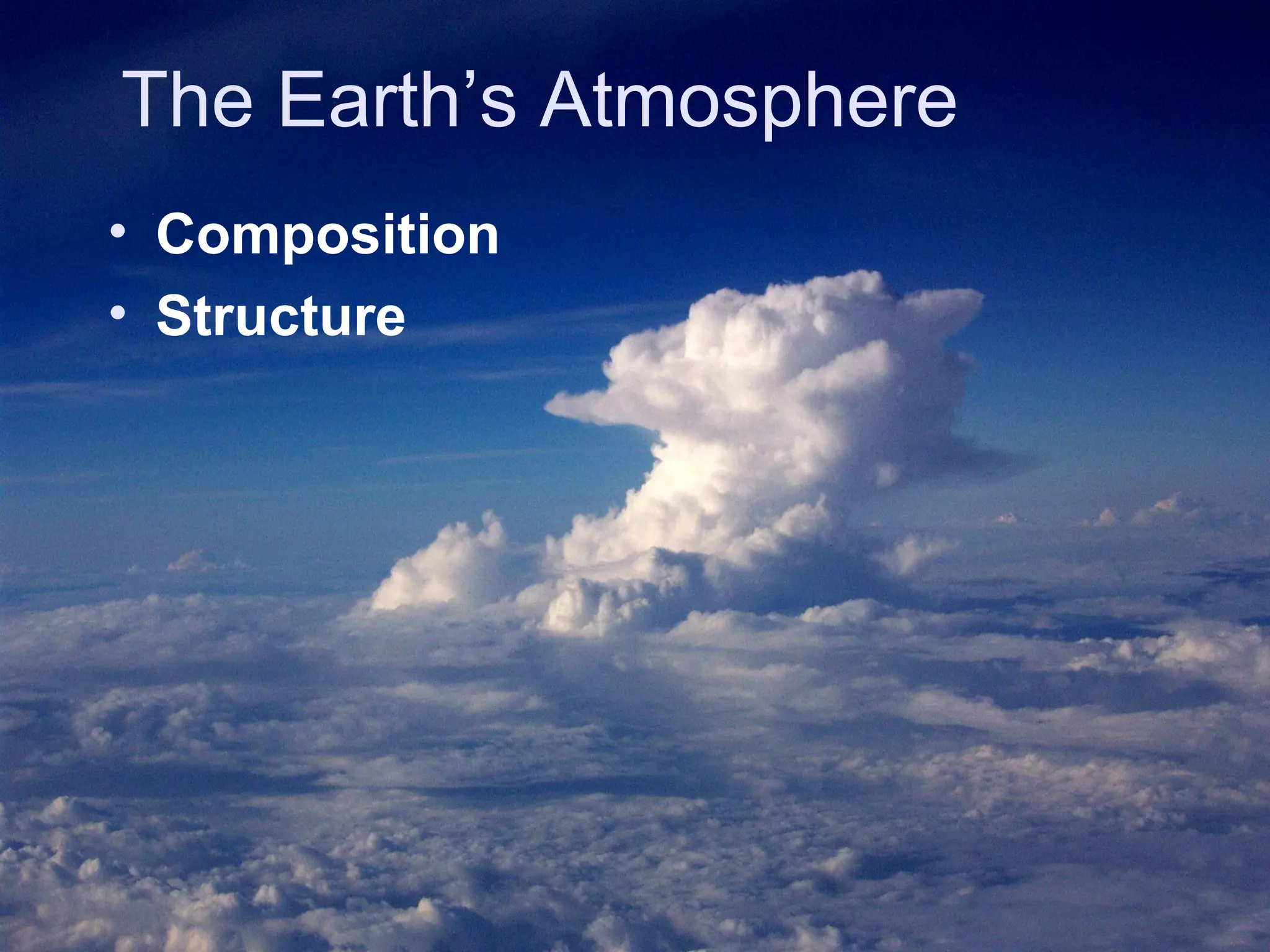
The Earth’s Atmosphere Composition  Structure  
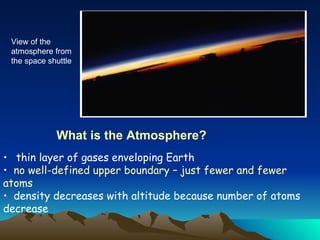
thin layer of gases enveloping Earth  no well-defined upper boundary – just fewer and fewer atoms density decreases with altitude because number of atoms decrease What is the Atmosphere? View of the atmosphere from the space shuttle
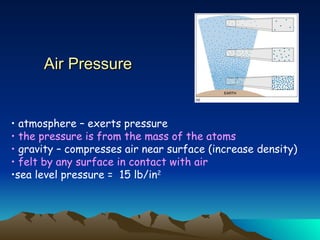
Air Pressure atmosphere – exerts pressure the pressure is from the mass of the atoms gravity – compresses air near surface (increase density) felt by any surface in contact with air   sea level pressure =  15 lb/in 2
Composition of Atmosphere atmosphere is a mixture of gases, solid particles, water droplets Small  changes are always happening  physical processes (volcanoes),  biological (plants and animals – transpiration and respiration),
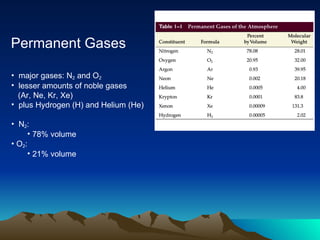
major gases: N 2  and O 2   lesser amounts of noble gases  (Ar, Ne, Kr, Xe)  plus Hydrogen (H) and Helium (He) N 2 : 78% volume  O 2 :  21% volume Permanent Gases
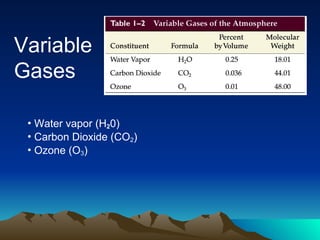
Water vapor (H 2 0) Carbon Dioxide (CO 2 ) Ozone (O 3 ) Variable  Gases
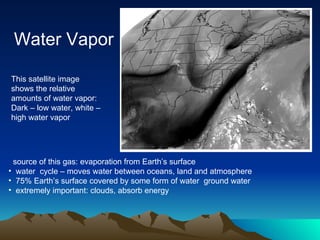
source of this gas: evaporation from Earth’s surface water  cycle – moves water between oceans, land and atmosphere  75% Earth’s surface covered by some form of water  ground water extremely important: clouds, absorb energy Water Vapor This satellite image shows the relative amounts of water vapor:  Dark – low water, white – high water vapor
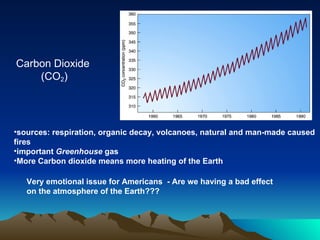
sources: respiration, organic decay, volcanoes, natural and man-made caused fires important  Greenhouse  gas More Carbon dioxide means more heating of the Earth Carbon Dioxide  (CO 2 ) Very emotional issue for Americans  - Are we having a bad effect on the atmosphere of the Earth???
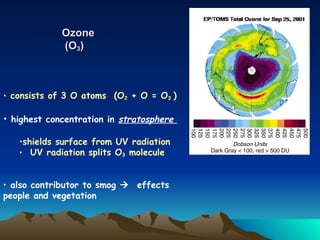
Ozone (O 3 ) consists of 3 O atoms  (O 2  + O = O 3  ) highest concentration in  stratosphere  shields surface from UV radiation  UV radiation splits O 3  molecule also contributor to smog     effects people and vegetation
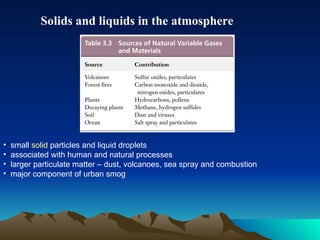
Solids and liquids in the atmosphere small  solid  particles and liquid droplets  associated with human and natural processes larger particulate matter – dust, volcanoes, sea spray and combustion  major component of urban smog
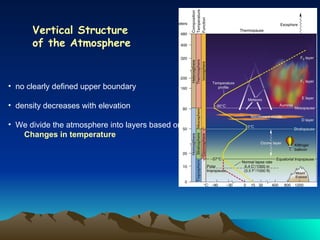
Vertical Structure  of the Atmosphere no clearly defined upper boundary  density decreases with elevation  We divide the atmosphere into layers based on: Changes in temperature
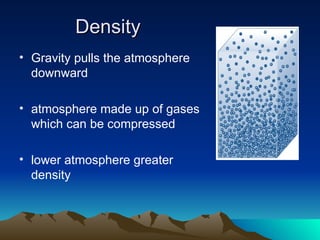
Density  Gravity pulls the atmosphere downward atmosphere made up of gases which can be compressed lower atmosphere greater density
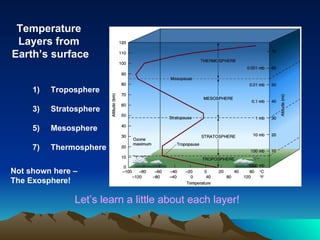
Temperature  Layers from  Earth’s surface Troposphere  Stratosphere Mesosphere Thermosphere Not shown here – The Exosphere! Let’s learn a little about each layer!
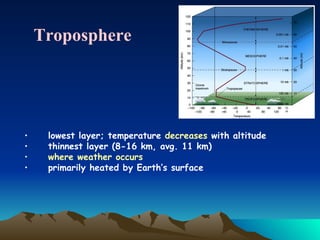
lowest layer; temperature  decreases  with altitude  thinnest layer (8-16 km, avg. 11 km) where weather occurs primarily heated by Earth’s surface  Troposphere
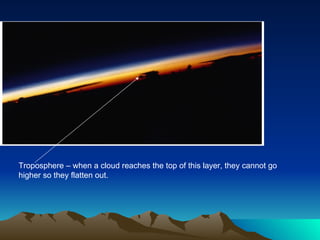
Troposphere – when a cloud reaches the top of this layer, they cannot go higher so they flatten out.
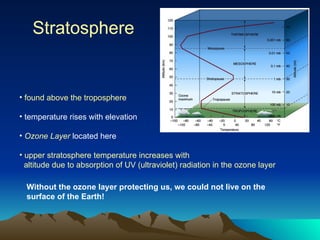
Stratosphere found above the troposphere temperature rises with elevation Ozone Layer   located here upper stratosphere temperature increases with altitude due to absorption of UV (ultraviolet) radiation in the ozone layer Without the ozone layer protecting us, we could not live on the surface of the Earth!
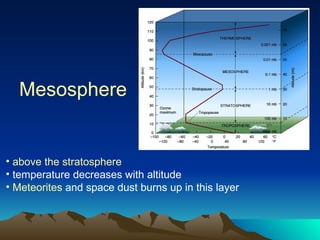
Mesosphere above the stratosphere temperature decreases with altitude Meteorites  and space dust burns up in this layer
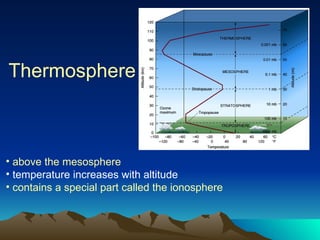
Thermosphere above the mesosphere temperature increases with altitude contains a special part called the ionosphere
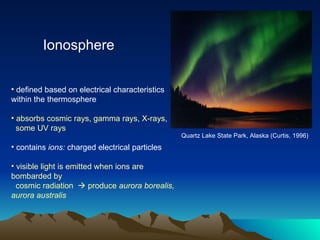
Ionosphere Quartz Lake State Park, Alaska (Curtis, 1996)   defined based on electrical characteristics within the thermosphere absorbs cosmic rays, gamma rays, X-rays, some UV rays contains  ions:  charged electrical particles visible light is emitted when ions are bombarded by cosmic radiation    produce  aurora borealis, aurora australis

Atmosphere

  • 1.
    The Earth’s AtmosphereComposition  Structure  
  • 2.
    thin layer ofgases enveloping Earth no well-defined upper boundary – just fewer and fewer atoms density decreases with altitude because number of atoms decrease What is the Atmosphere? View of the atmosphere from the space shuttle
  • 3.
    Air Pressure atmosphere– exerts pressure the pressure is from the mass of the atoms gravity – compresses air near surface (increase density) felt by any surface in contact with air sea level pressure = 15 lb/in 2
  • 4.
    Composition of Atmosphereatmosphere is a mixture of gases, solid particles, water droplets Small changes are always happening physical processes (volcanoes), biological (plants and animals – transpiration and respiration),
  • 5.
    major gases: N2 and O 2 lesser amounts of noble gases (Ar, Ne, Kr, Xe) plus Hydrogen (H) and Helium (He) N 2 : 78% volume O 2 : 21% volume Permanent Gases
  • 6.
    Water vapor (H2 0) Carbon Dioxide (CO 2 ) Ozone (O 3 ) Variable Gases
  • 7.
    source of thisgas: evaporation from Earth’s surface water cycle – moves water between oceans, land and atmosphere 75% Earth’s surface covered by some form of water ground water extremely important: clouds, absorb energy Water Vapor This satellite image shows the relative amounts of water vapor: Dark – low water, white – high water vapor
  • 8.
    sources: respiration, organicdecay, volcanoes, natural and man-made caused fires important Greenhouse gas More Carbon dioxide means more heating of the Earth Carbon Dioxide (CO 2 ) Very emotional issue for Americans - Are we having a bad effect on the atmosphere of the Earth???
  • 9.
    Ozone (O 3) consists of 3 O atoms (O 2 + O = O 3 ) highest concentration in stratosphere shields surface from UV radiation UV radiation splits O 3 molecule also contributor to smog  effects people and vegetation
  • 10.
    Solids and liquidsin the atmosphere small solid particles and liquid droplets associated with human and natural processes larger particulate matter – dust, volcanoes, sea spray and combustion major component of urban smog
  • 11.
    Vertical Structure of the Atmosphere no clearly defined upper boundary density decreases with elevation We divide the atmosphere into layers based on: Changes in temperature
  • 12.
    Density Gravitypulls the atmosphere downward atmosphere made up of gases which can be compressed lower atmosphere greater density
  • 13.
    Temperature Layersfrom Earth’s surface Troposphere Stratosphere Mesosphere Thermosphere Not shown here – The Exosphere! Let’s learn a little about each layer!
  • 14.
    lowest layer; temperature decreases with altitude thinnest layer (8-16 km, avg. 11 km) where weather occurs primarily heated by Earth’s surface Troposphere
  • 15.
    Troposphere – whena cloud reaches the top of this layer, they cannot go higher so they flatten out.
  • 16.
    Stratosphere found abovethe troposphere temperature rises with elevation Ozone Layer located here upper stratosphere temperature increases with altitude due to absorption of UV (ultraviolet) radiation in the ozone layer Without the ozone layer protecting us, we could not live on the surface of the Earth!
  • 17.
    Mesosphere above thestratosphere temperature decreases with altitude Meteorites and space dust burns up in this layer
  • 18.
    Thermosphere above themesosphere temperature increases with altitude contains a special part called the ionosphere
  • 19.
    Ionosphere Quartz LakeState Park, Alaska (Curtis, 1996) defined based on electrical characteristics within the thermosphere absorbs cosmic rays, gamma rays, X-rays, some UV rays contains ions: charged electrical particles visible light is emitted when ions are bombarded by cosmic radiation  produce aurora borealis, aurora australis