MATERIALS: ALL THE THINGS NEEDED IN
TESTING THE HYPOTHESIS
• List down all the materials
• Live organisms (seeds/ animals)
• Reagents
• Chemicals
• Other experimental units
MATERIALS
•Experimental Unit: Chief Material used in an
experiment
•Ex: Organism, Device, Plot in a garden, a structure
May be subjected to different treatments according to the
objectives
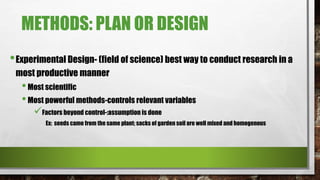
METHODS: PLAN OR DESIGN
•Experimental Design- (field of science) best way to conduct research in a
most productive manner
•Most scientific
•Most powerful methods-controls relevant variables
Factors beyond control-:assumption is done
Ex: seeds came from the same plant; sacks of garden soil are well mixed and homogenous
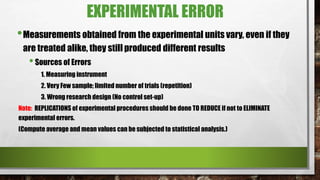
EXPERIMENTAL ERROR
•Measurements obtained from the experimental units vary, even if they
are treated alike, they still produced different results
•Sources of Errors
1. Measuring instrument
2. Very Few sample; limited number of trials (repetition)
3. Wrong research design (No control set-up)
Note: REPLICATIONS of experimental procedures should be done TO REDUCE if not to ELIMINATE
experimental errors.
(Compute average and mean values can be subjected to statistical analysis.)
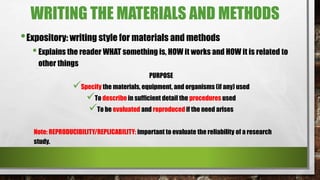
WRITING THE MATERIALS AND METHODS
•Expository: writing style for materials and methods
•Explains the reader WHAT something is, HOW it works and HOW it is related to
other things
PURPOSE
Specify the materials, equipment, and organisms (if any) used
To describe in sufficient detail the procedures used
To be evaluated and reproduced if the need arises
Note: REPRODUCIBILITY/REPLICABILITY: important to evaluate the reliability of a research
study.
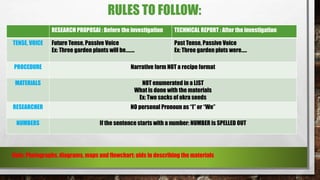
RULES TO FOLLOW:
RESEARCH PROPOSAl : Before the investigation TECHNICAL REPORT : After the investigation
TENSE, VOICE Future Tense, Passive Voice
Ex: Three garden plants will be……..
Past Tense, Passive Voice
Ex: Three garden plots were…..
PROCEDURE Narrative form NOT a recipe format
MATERIALS NOT enumerated in a LIST
What is done with the materials
Ex: Two sacks of okra seeds
RESEARCHER NO personal Pronoun as “I” or “We”
NUMBERS If the sentence starts with a number: NUMBER is SPELLED OUT
Note: Photographs, diagrams, maps and flowchart: aids in describing the materials

Materials and methods discuss

  • 2.
    MATERIALS: ALL THETHINGS NEEDED IN TESTING THE HYPOTHESIS • List down all the materials • Live organisms (seeds/ animals) • Reagents • Chemicals • Other experimental units
  • 3.
    MATERIALS •Experimental Unit: ChiefMaterial used in an experiment •Ex: Organism, Device, Plot in a garden, a structure May be subjected to different treatments according to the objectives
  • 4.
    METHODS: PLAN ORDESIGN •Experimental Design- (field of science) best way to conduct research in a most productive manner •Most scientific •Most powerful methods-controls relevant variables Factors beyond control-:assumption is done Ex: seeds came from the same plant; sacks of garden soil are well mixed and homogenous
  • 5.
    EXPERIMENTAL ERROR •Measurements obtainedfrom the experimental units vary, even if they are treated alike, they still produced different results •Sources of Errors 1. Measuring instrument 2. Very Few sample; limited number of trials (repetition) 3. Wrong research design (No control set-up) Note: REPLICATIONS of experimental procedures should be done TO REDUCE if not to ELIMINATE experimental errors. (Compute average and mean values can be subjected to statistical analysis.)
  • 6.
    WRITING THE MATERIALSAND METHODS •Expository: writing style for materials and methods •Explains the reader WHAT something is, HOW it works and HOW it is related to other things PURPOSE Specify the materials, equipment, and organisms (if any) used To describe in sufficient detail the procedures used To be evaluated and reproduced if the need arises Note: REPRODUCIBILITY/REPLICABILITY: important to evaluate the reliability of a research study.
  • 7.
    RULES TO FOLLOW: RESEARCHPROPOSAl : Before the investigation TECHNICAL REPORT : After the investigation TENSE, VOICE Future Tense, Passive Voice Ex: Three garden plants will be…….. Past Tense, Passive Voice Ex: Three garden plots were….. PROCEDURE Narrative form NOT a recipe format MATERIALS NOT enumerated in a LIST What is done with the materials Ex: Two sacks of okra seeds RESEARCHER NO personal Pronoun as “I” or “We” NUMBERS If the sentence starts with a number: NUMBER is SPELLED OUT Note: Photographs, diagrams, maps and flowchart: aids in describing the materials