Presented to : Sir Engr
LATIF JAN
Presented by : NIK JAMAL
ID : 5370
Meridian Equator, Latitude and longitude
Contains
What is the Prime Meridian?
What is the Equator ?
What is the Latitude?
What is the longitude?
 What are the North and South Latitudes?
What are the East and West Longitudes?
The International Date Line.
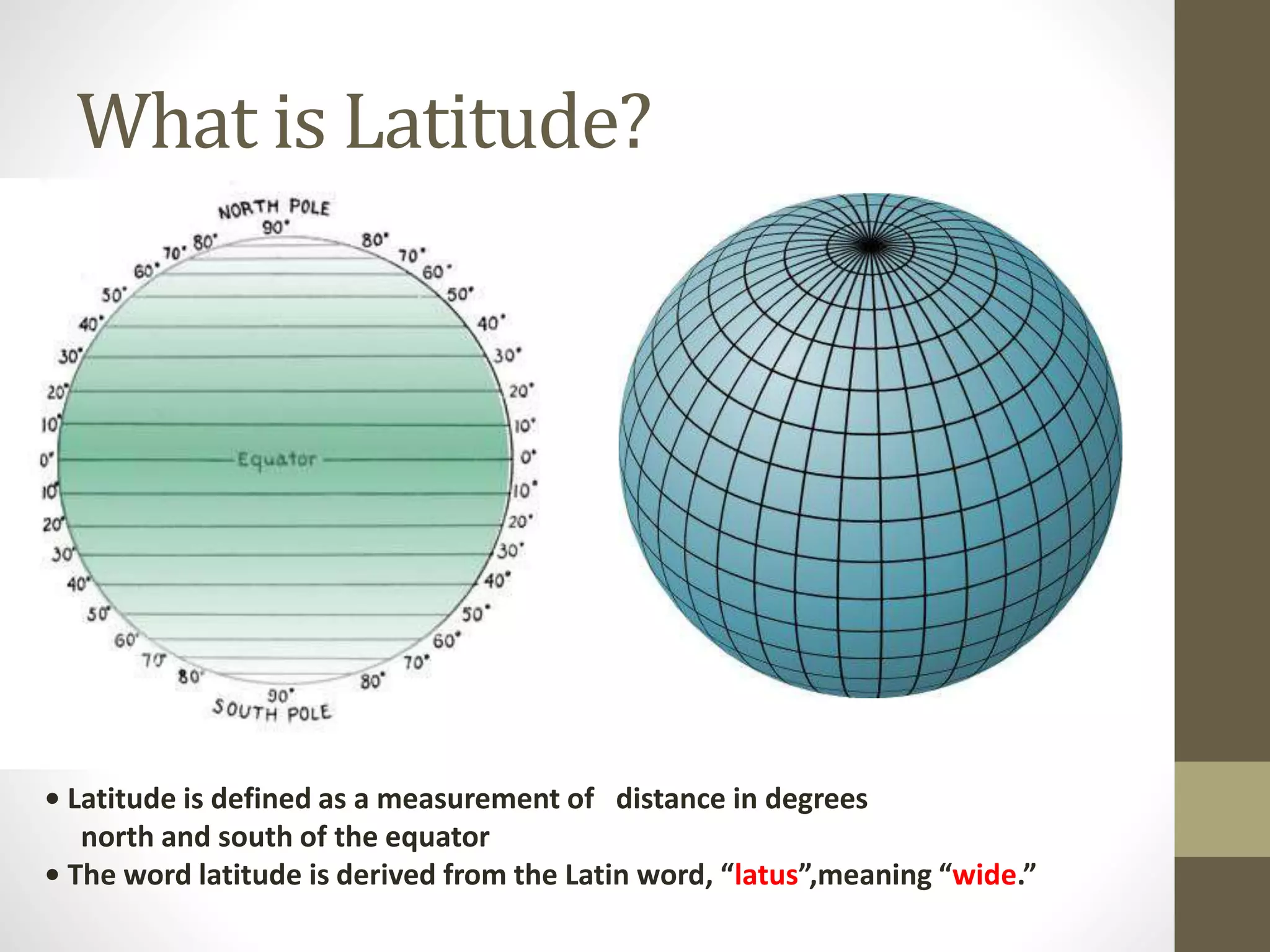
What is Latitude?
• Latitude is defined as a measurement of distance in degrees
north and south of the equator
• The word latitude is derived from the Latin word, “latus”,meaning “wide.”
What is Latitude?
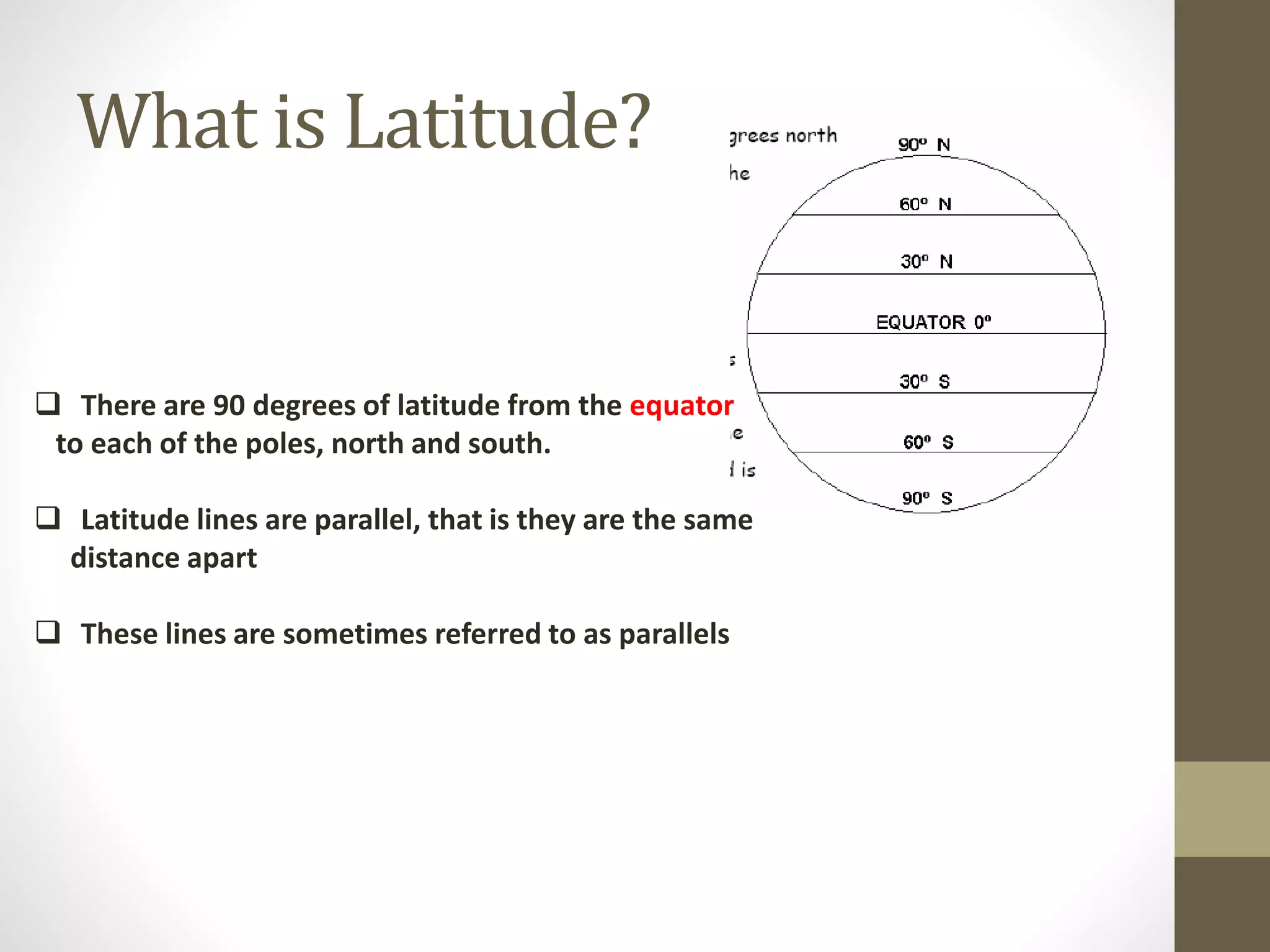
 There are 90 degrees of latitude from the equator
to each of the poles, north and south.
 Latitude lines are parallel, that is they are the same
distance apart
 These lines are sometimes referred to as parallels
The Equator
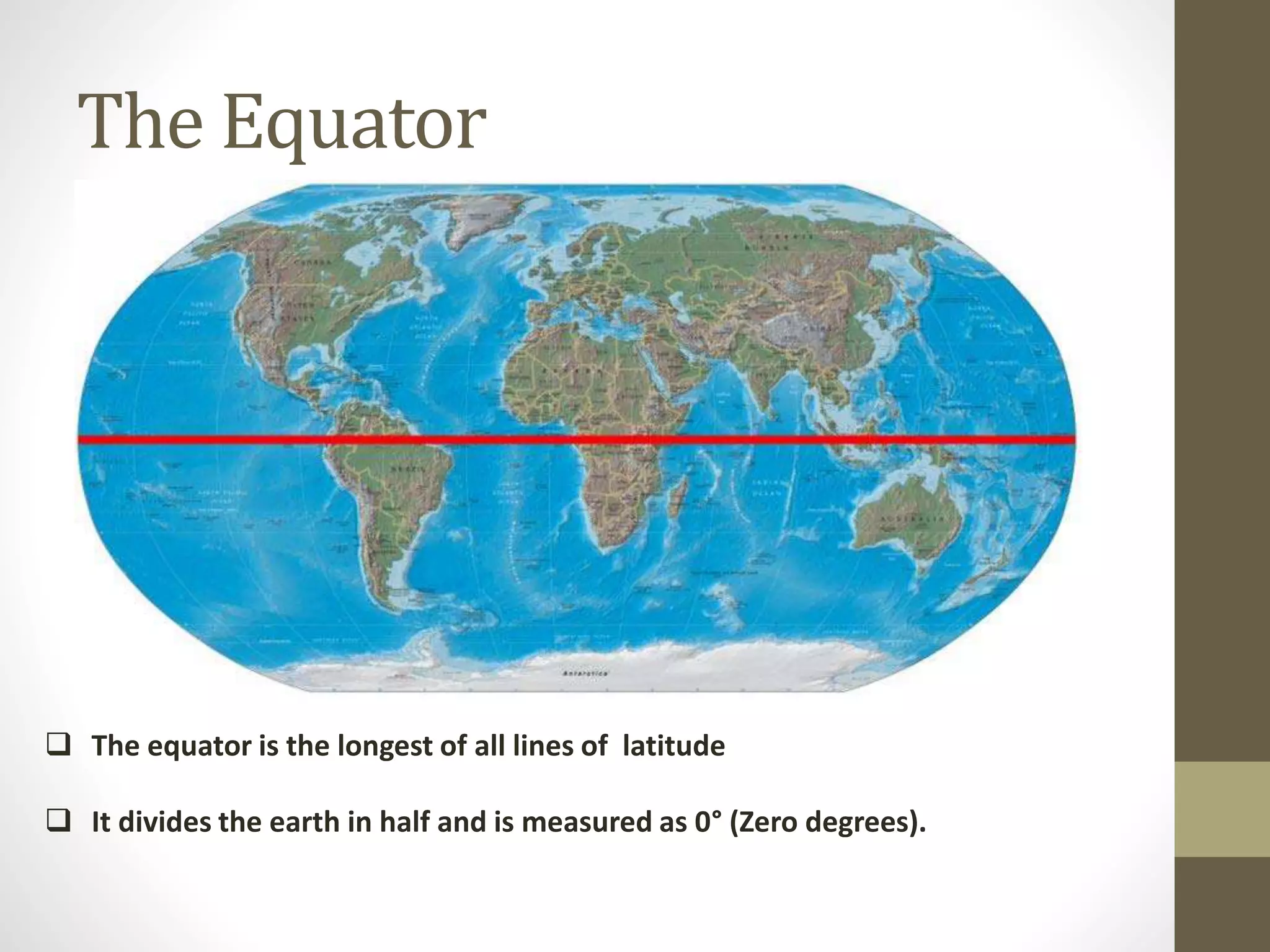
 The equator is the longest of all lines of latitude
 It divides the earth in half and is measured as 0° (Zero degrees).
North and South Latitudes
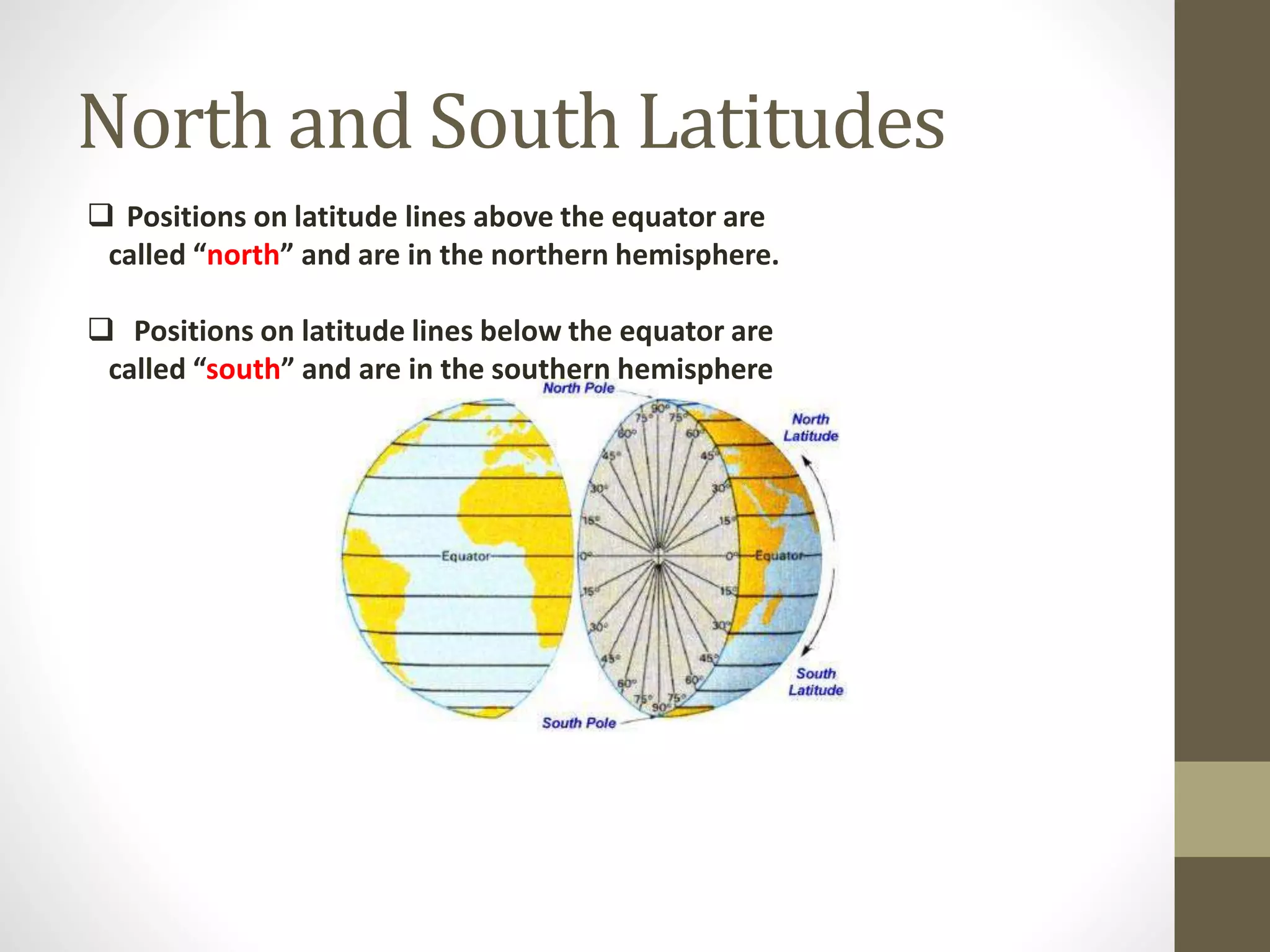
 Positions on latitude lines above the equator are
called “north” and are in the northern hemisphere.
 Positions on latitude lines below the equator are
called “south” and are in the southern hemisphere
What is Longitude?
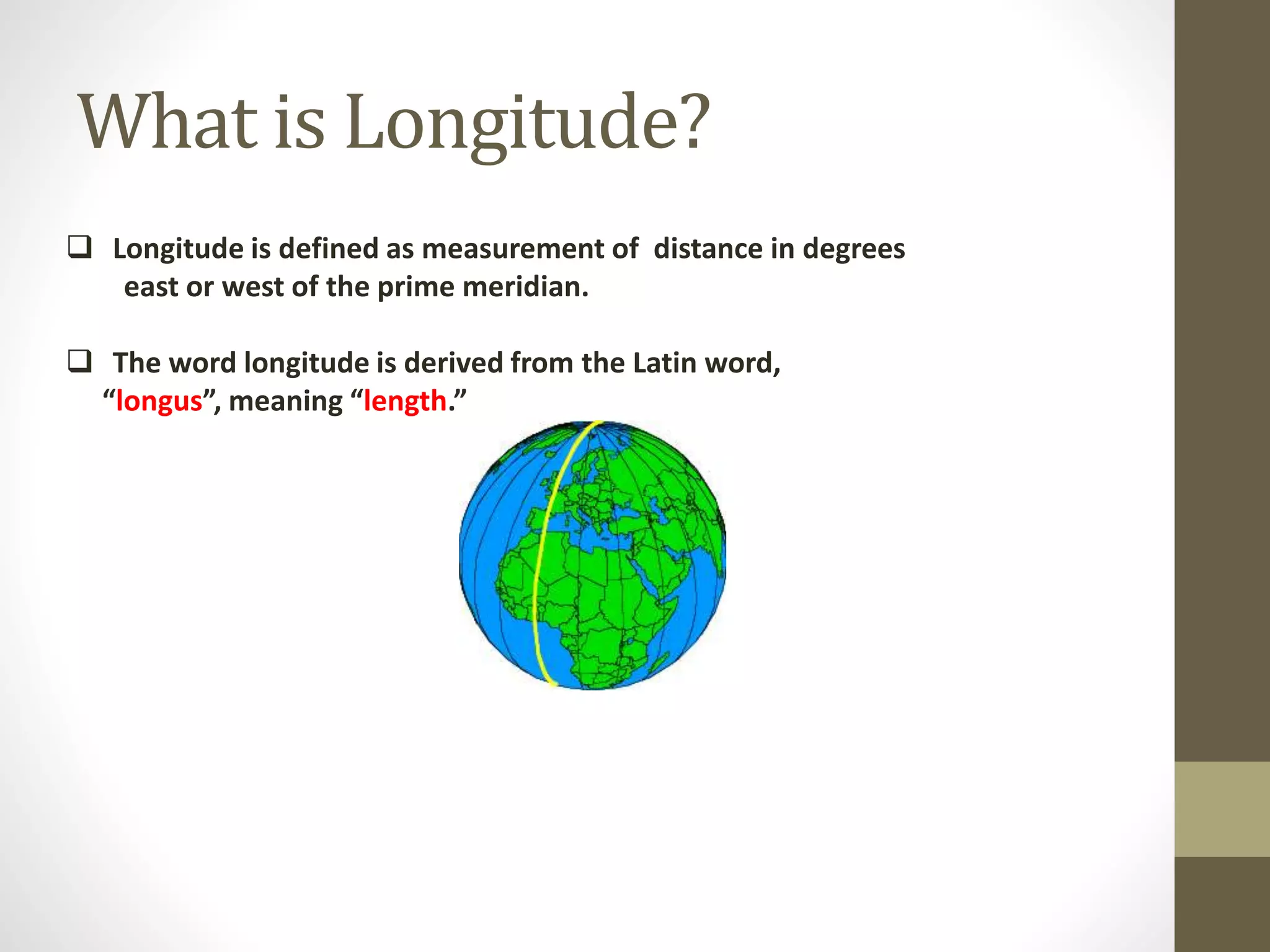
 Longitude is defined as measurement of distance in degrees
east or west of the prime meridian.
 The word longitude is derived from the Latin word,
“longus”, meaning “length.”
What is Longitude?
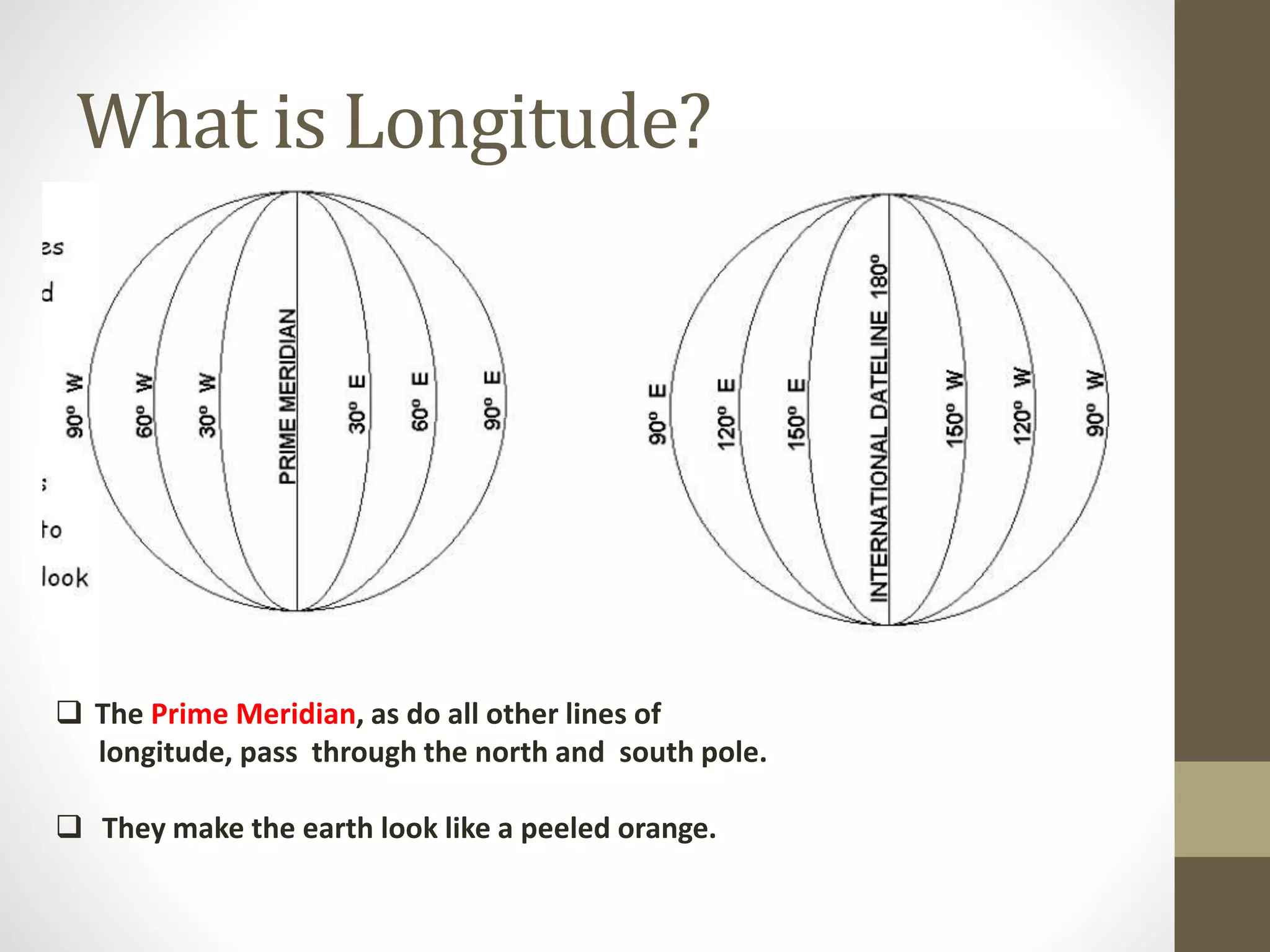
 The Prime Meridian, as do all other lines of
longitude, pass through the north and south pole.
 They make the earth look like a peeled orange.
East and West Longitudes
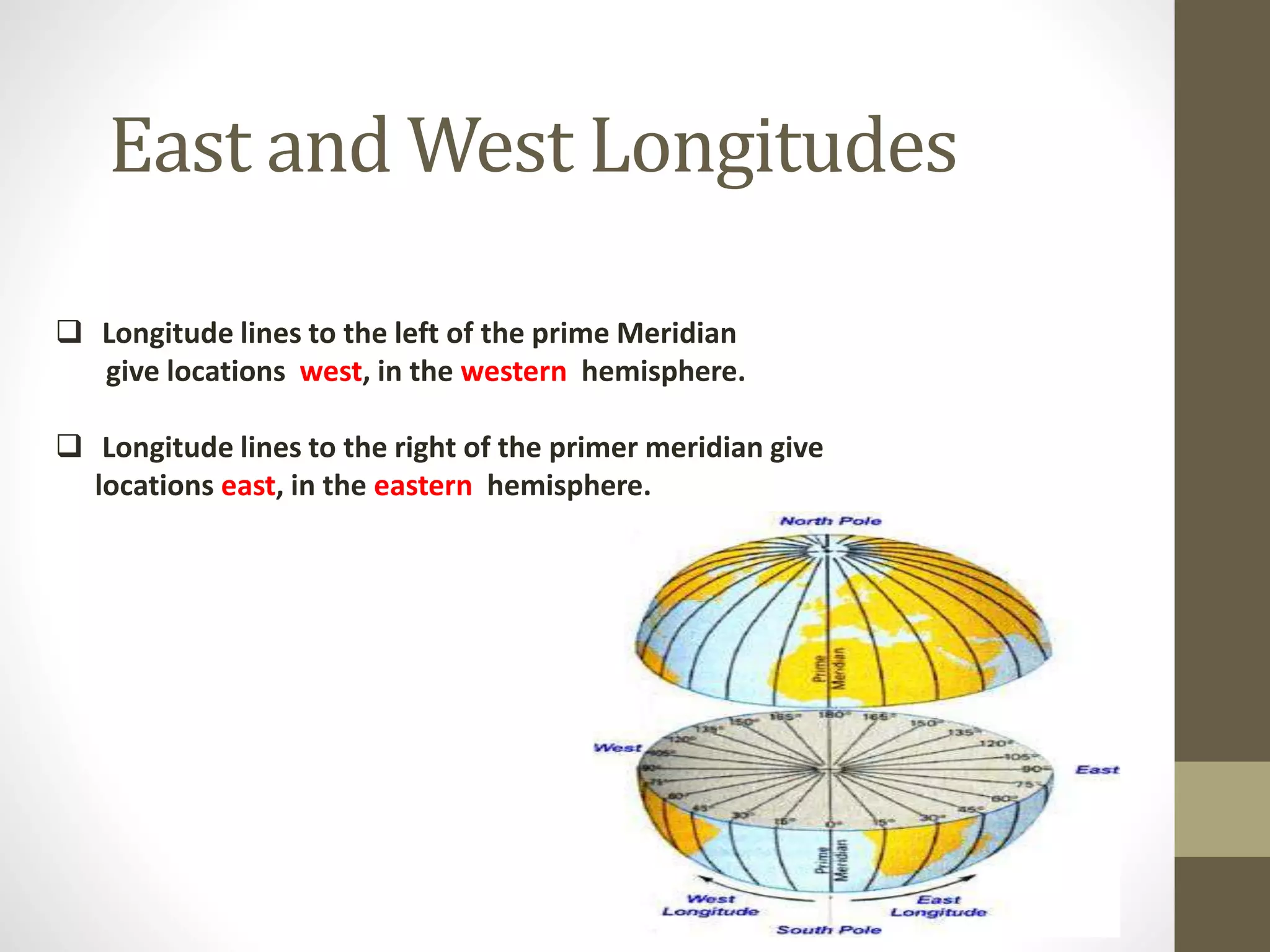
 Longitude lines to the left of the prime Meridian
give locations west, in the western hemisphere.
 Longitude lines to the right of the primer meridian give
locations east, in the eastern hemisphere.
Latitude -Longitude
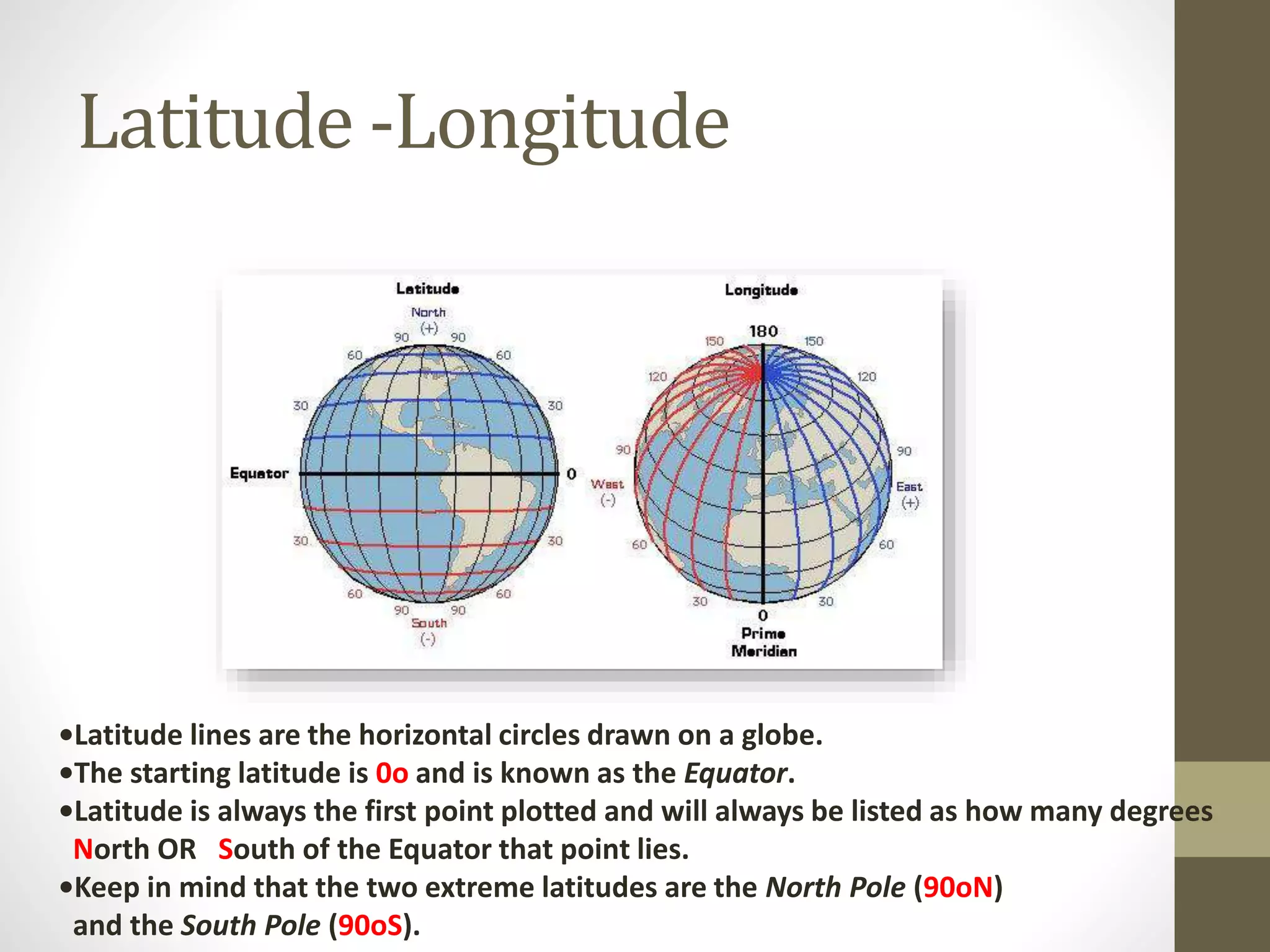
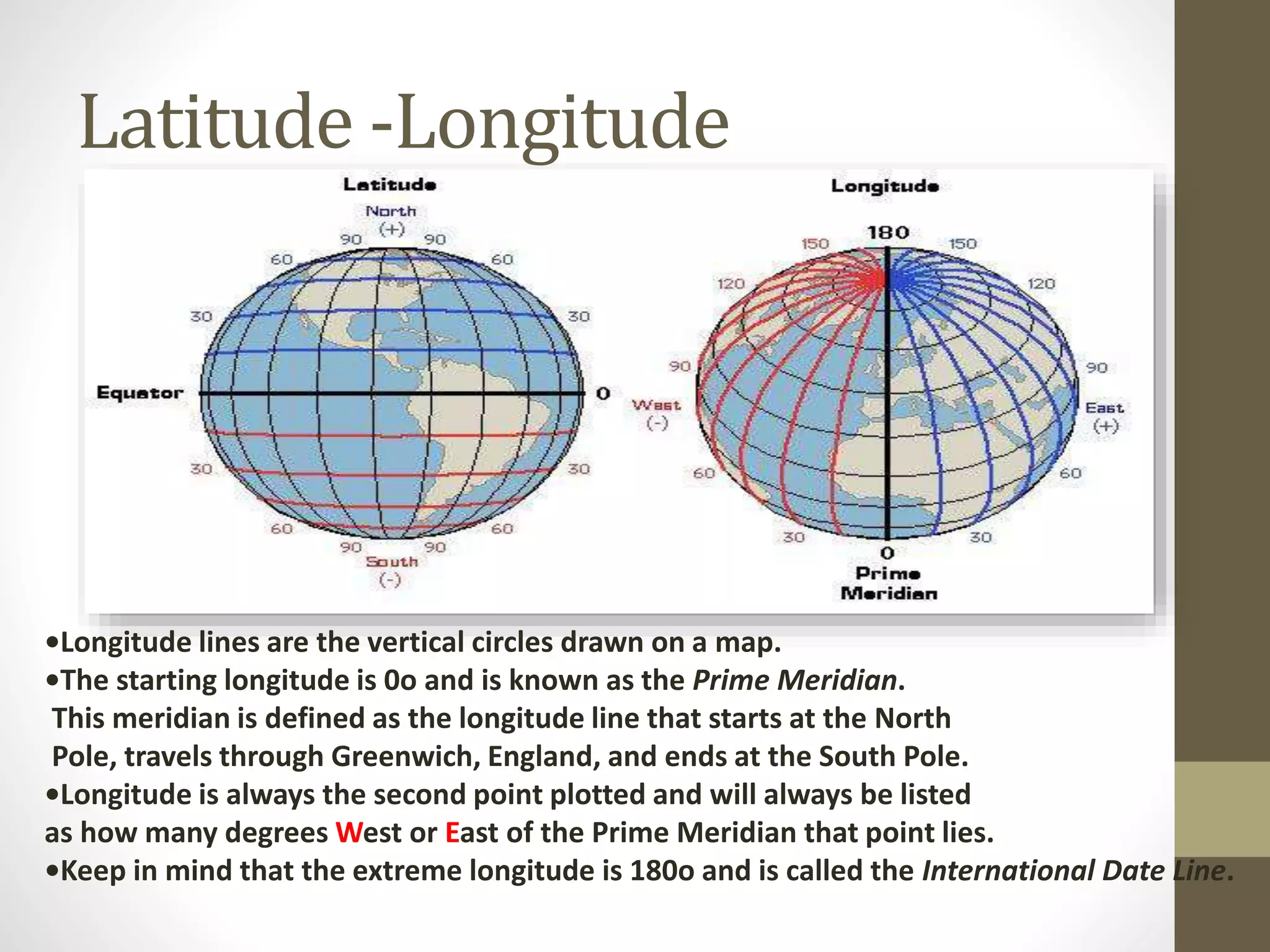
•Latitude lines are the horizontal circles drawn on a globe.
•The starting latitude is 0o and is known as the Equator.
•Latitude is always the first point plotted and will always be listed as how many degrees
North OR South of the Equator that point lies.
•Keep in mind that the two extreme latitudes are the North Pole (90oN)
and the South Pole (90oS).
The Prime Meridian
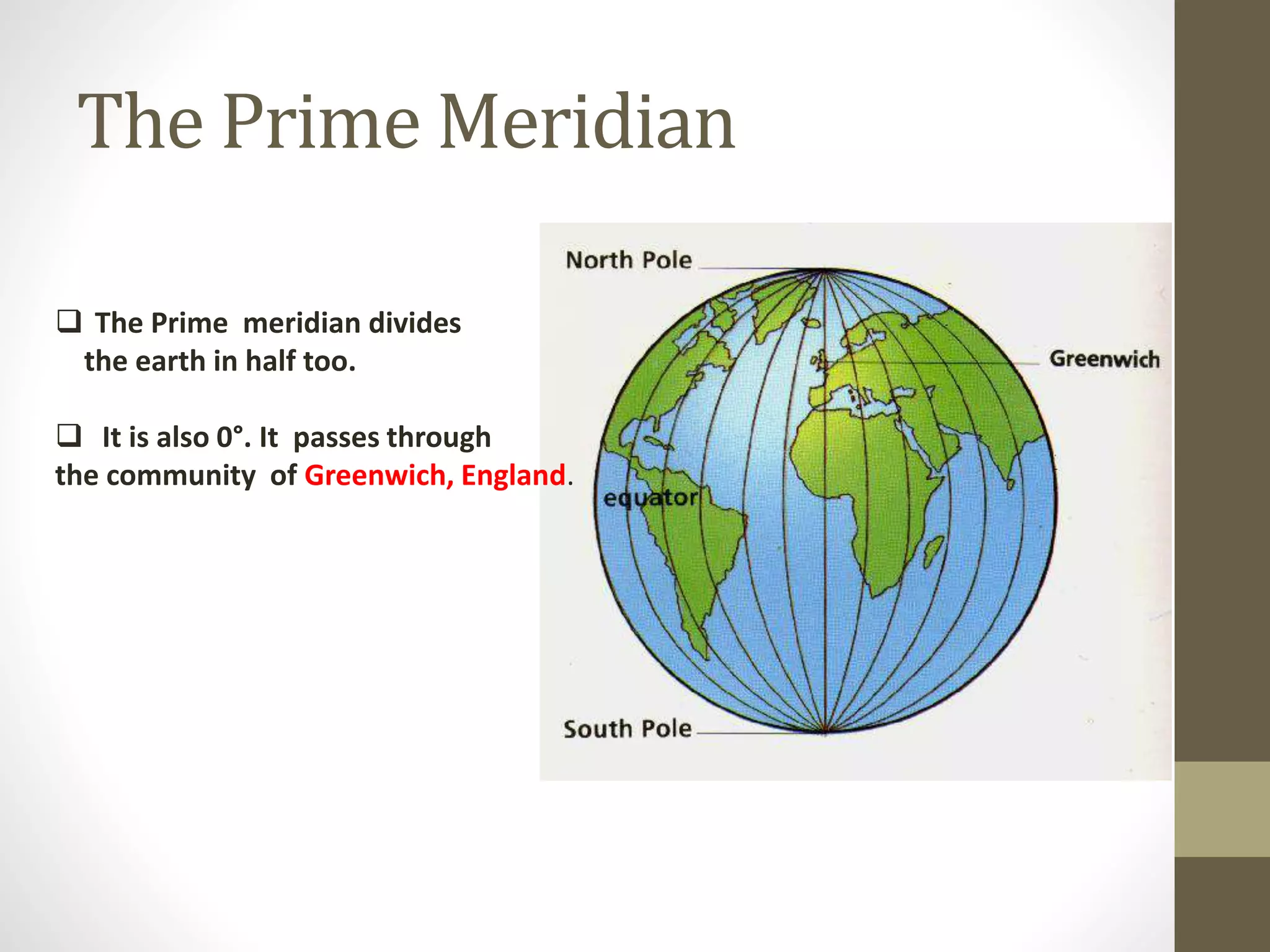
 The Prime meridian divides
the earth in half too.
 It is also 0°. It passes through
the community of Greenwich, England.
The International Date Line
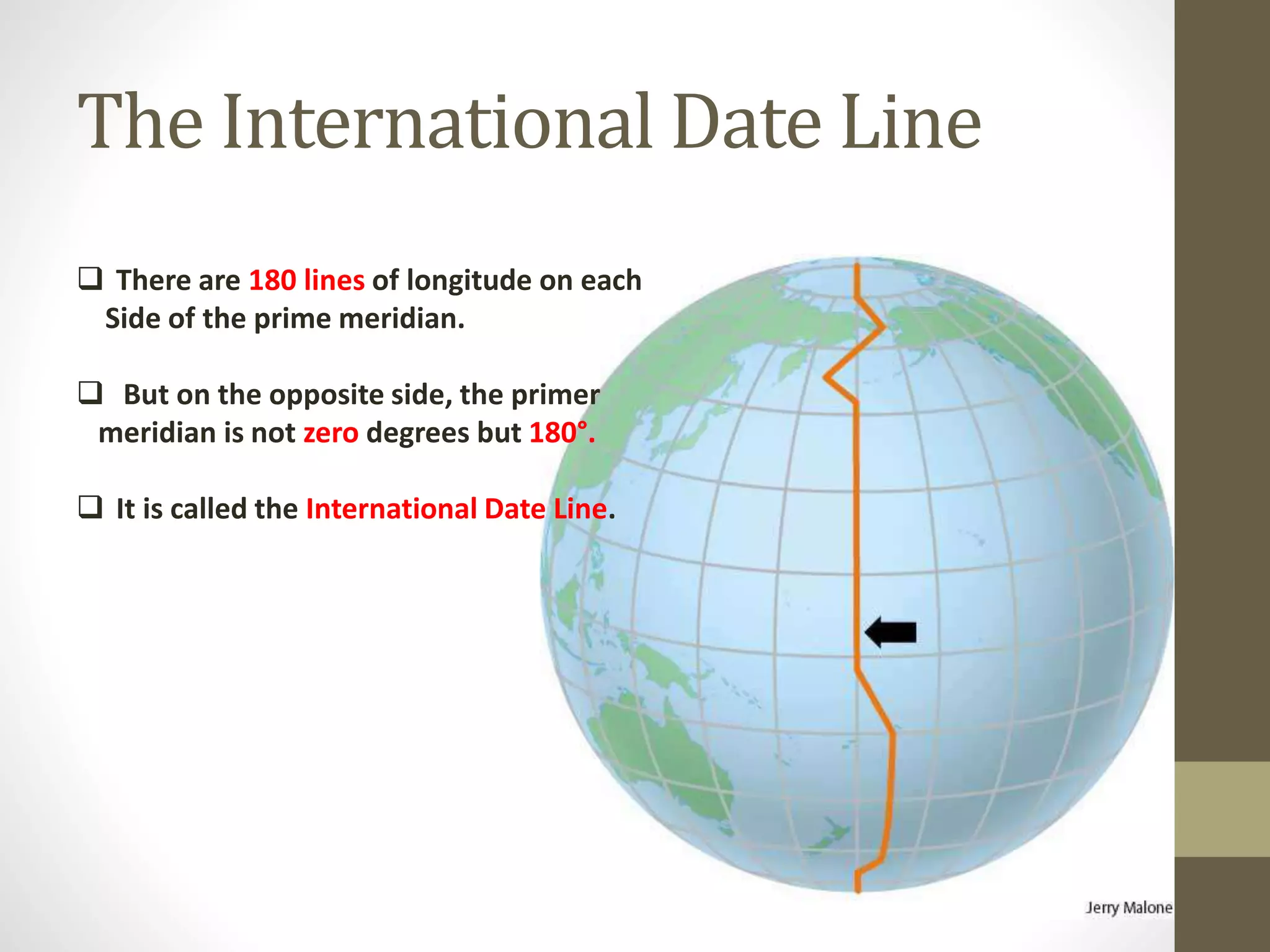
 There are 180 lines of longitude on each
Side of the prime meridian.
 But on the opposite side, the primer
meridian is not zero degrees but 180°.
 It is called the International Date Line.
Latitude -Longitude
•Longitude lines are the vertical circles drawn on a map.
•The starting longitude is 0o and is known as the Prime Meridian.
This meridian is defined as the longitude line that starts at the North
Pole, travels through Greenwich, England, and ends at the South Pole.
•Longitude is always the second point plotted and will always be listed
as how many degrees West or East of the Prime Meridian that point lies.
•Keep in mind that the extreme longitude is 180o and is called the International Date Line.
Latitude -Longitude
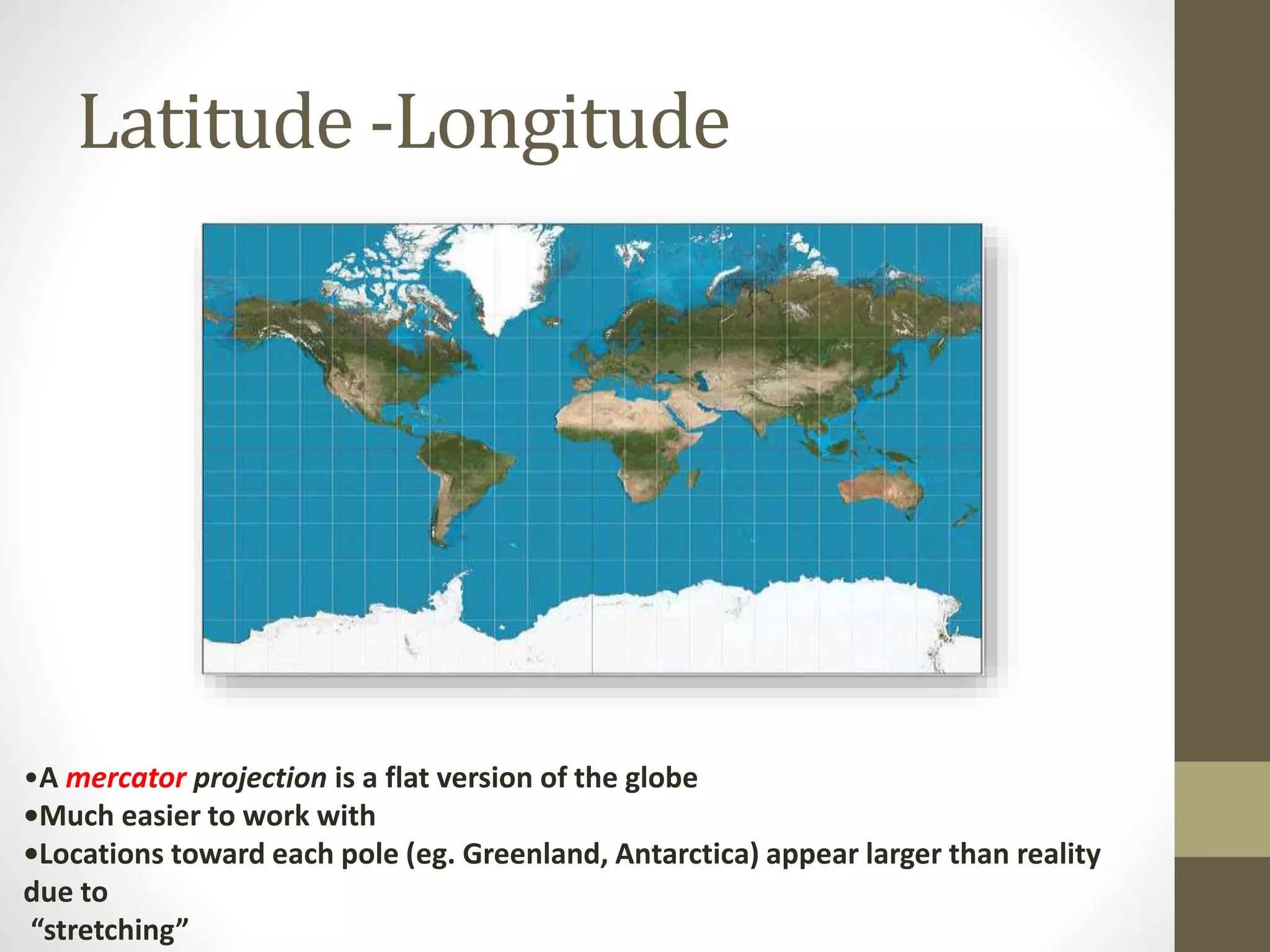
•A mercator projection is a flat version of the globe
•Much easier to work with
•Locations toward each pole (eg. Greenland, Antarctica) appear larger than reality
due to
“stretching”
Latitude -Longitude
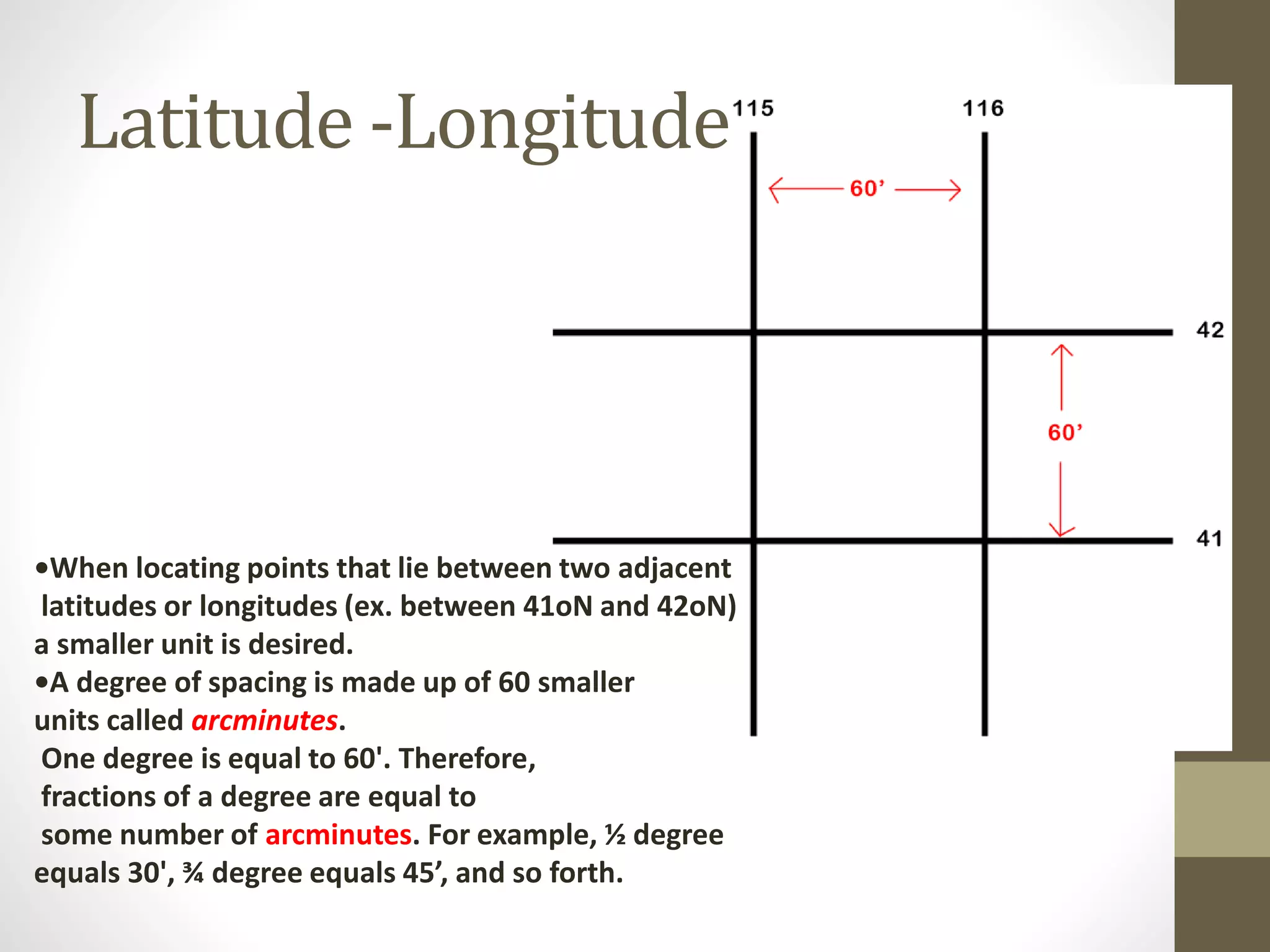
•When locating points that lie between two adjacent
latitudes or longitudes (ex. between 41oN and 42oN)
a smaller unit is desired.
•A degree of spacing is made up of 60 smaller
units called arcminutes.
One degree is equal to 60'. Therefore,
fractions of a degree are equal to
some number of arcminutes. For example, ½ degree
equals 30', ¾ degree equals 45’, and so forth.
Latitude -Longitude
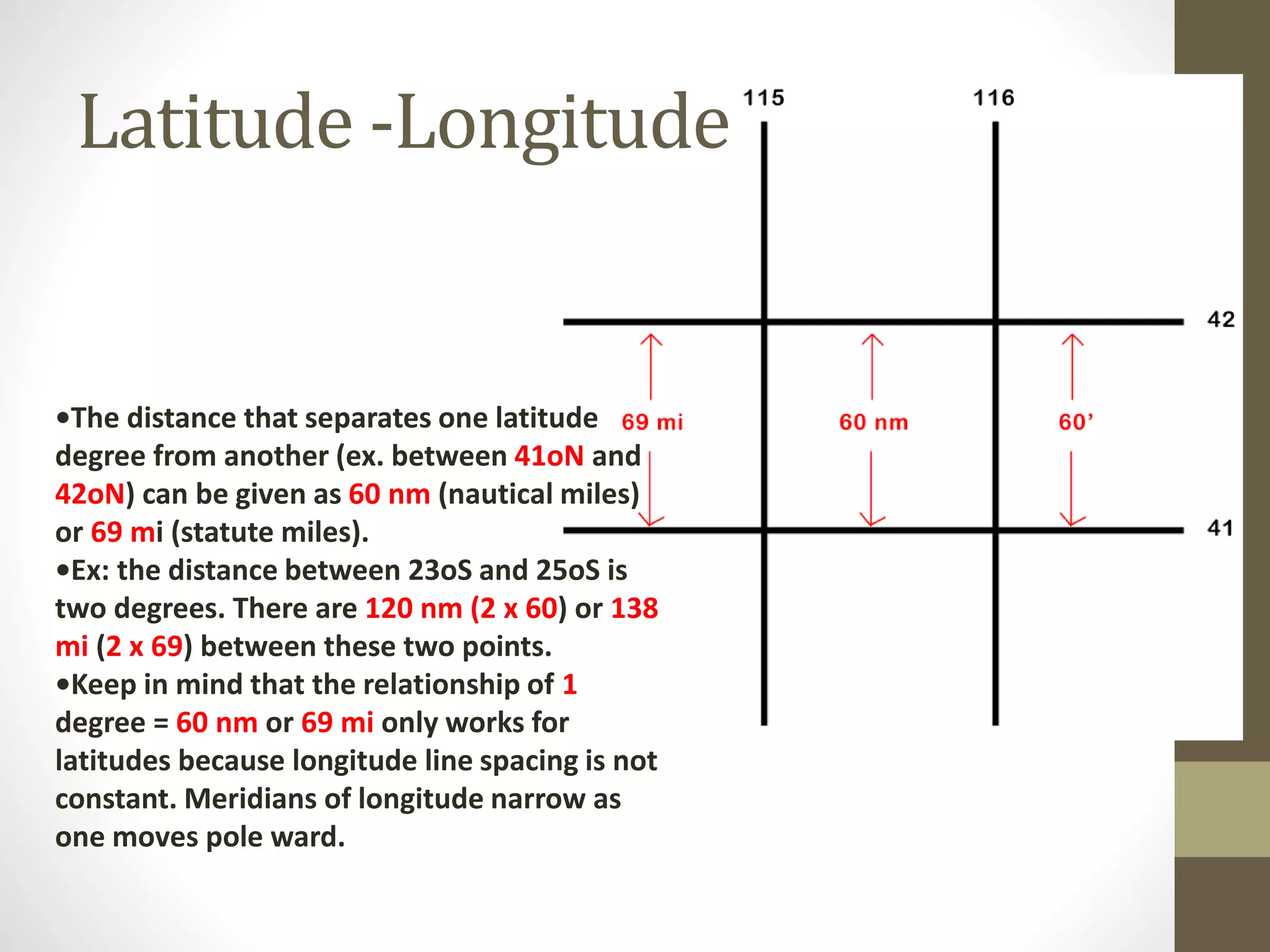
•The distance that separates one latitude
degree from another (ex. between 41oN and
42oN) can be given as 60 nm (nautical miles)
or 69 mi (statute miles).
•Ex: the distance between 23oS and 25oS is
two degrees. There are 120 nm (2 x 60) or 138
mi (2 x 69) between these two points.
•Keep in mind that the relationship of 1
degree = 60 nm or 69 mi only works for
latitudes because longitude line spacing is not
constant. Meridians of longitude narrow as
one moves pole ward.
Latitude -Longitude
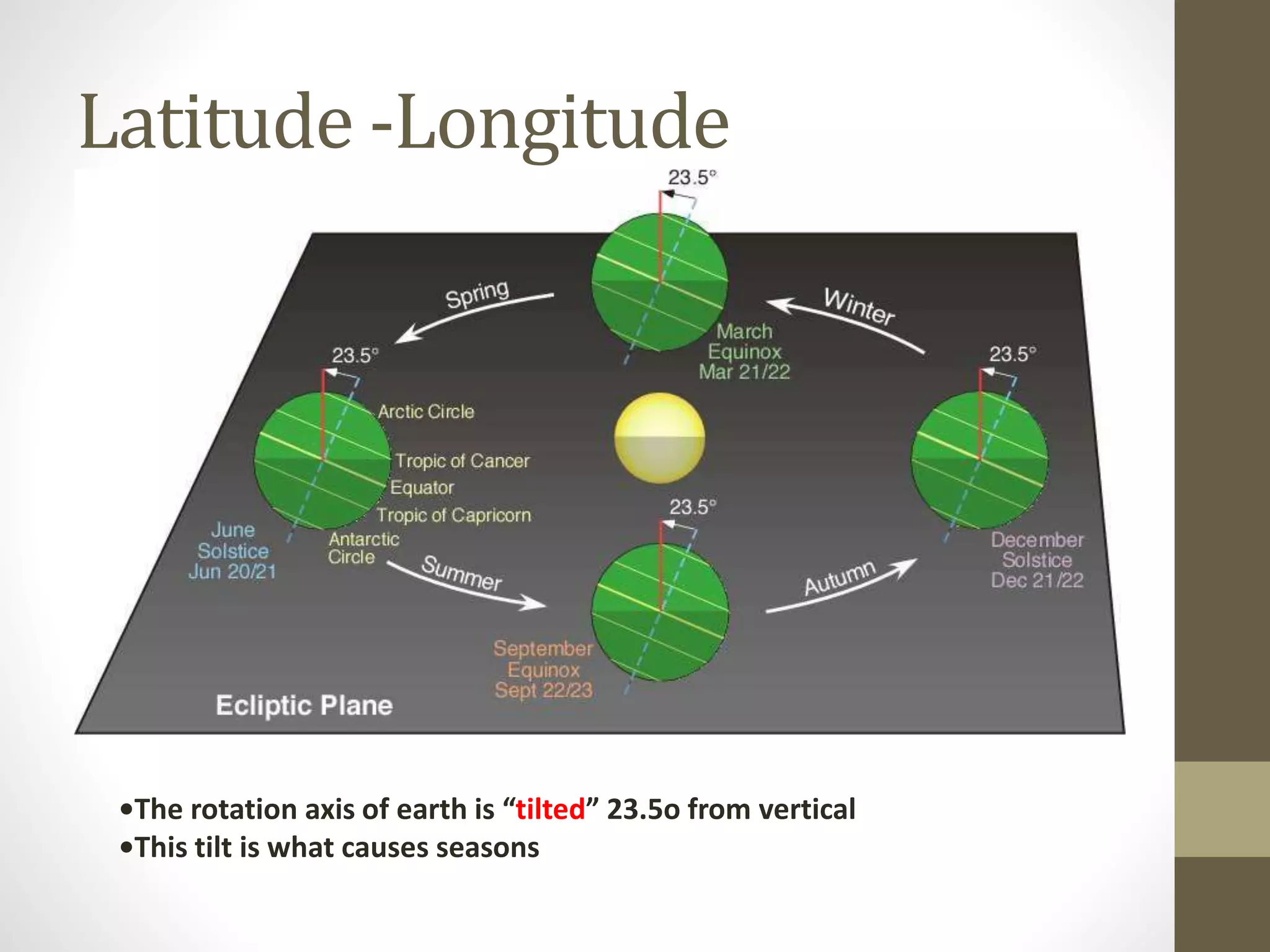
•The rotation axis of earth is “tilted” 23.5o from vertical
•This tilt is what causes seasons
Latitude -Longitude
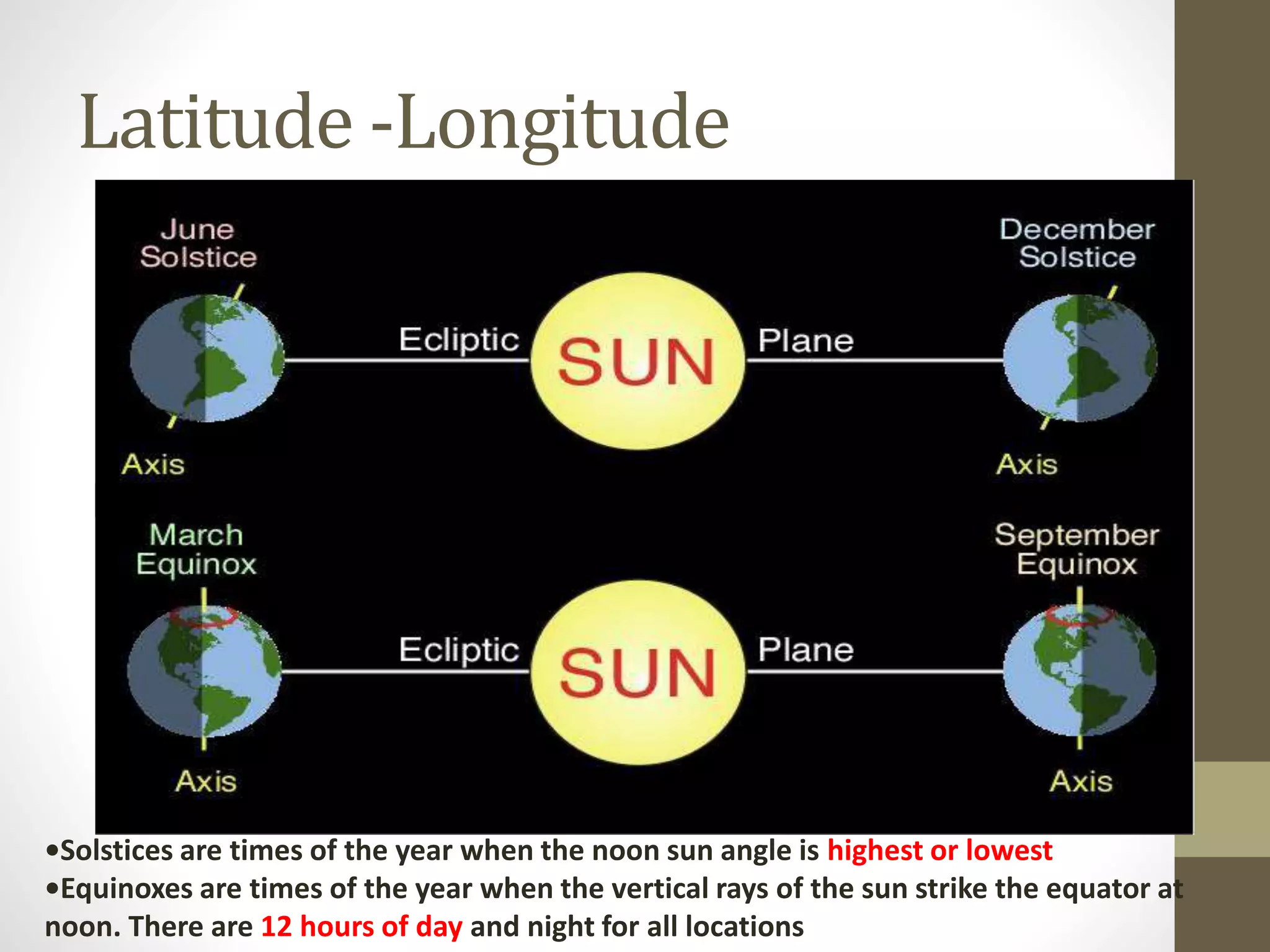
•Solstices are times of the year when the noon sun angle is highest or lowest
•Equinoxes are times of the year when the vertical rays of the sun strike the equator at
noon. There are 12 hours of day and night for all locations
Latitude -Longitude
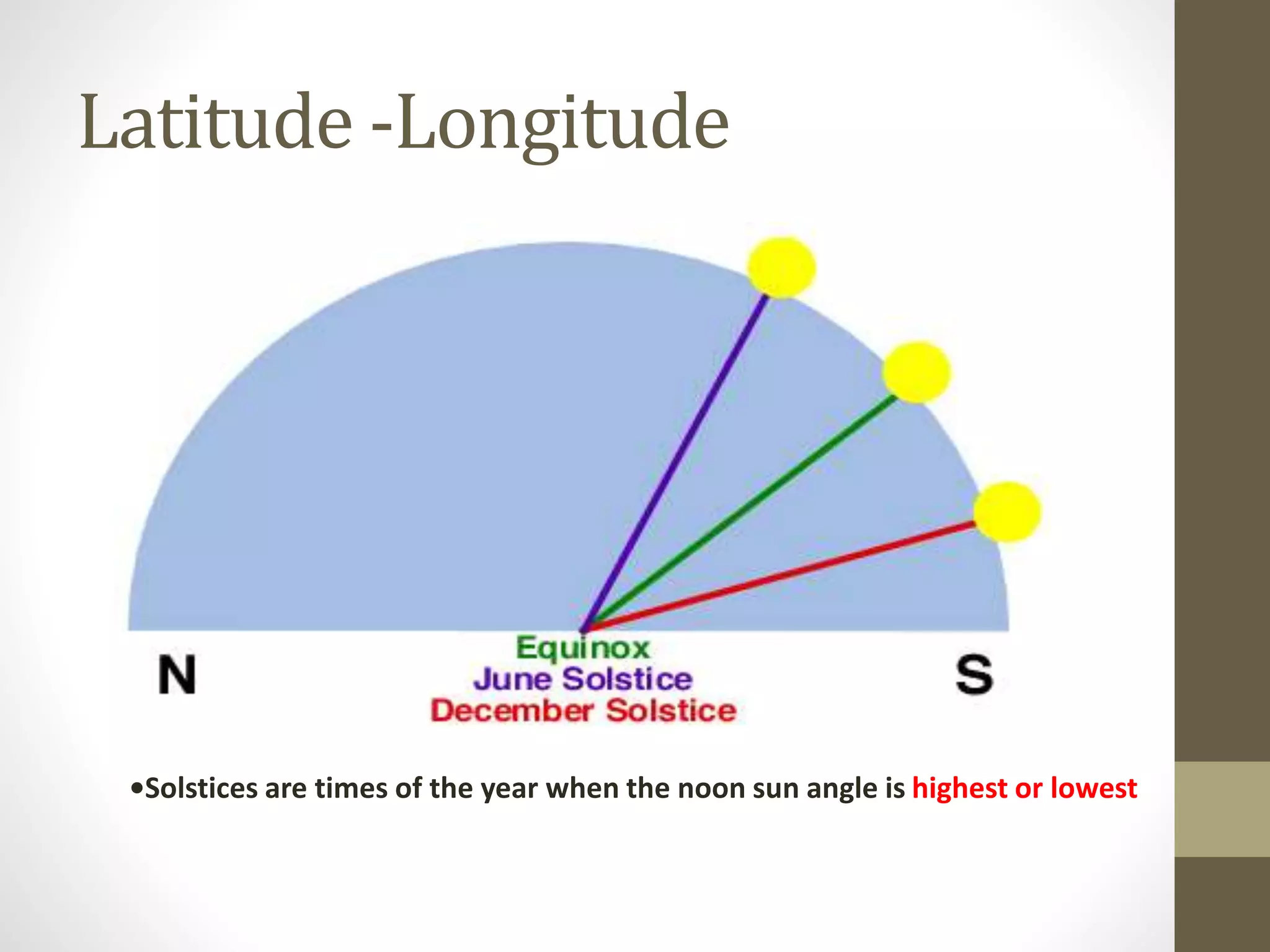
•Solstices are times of the year when the noon sun angle is highest or lowest
Latitude -Longitude
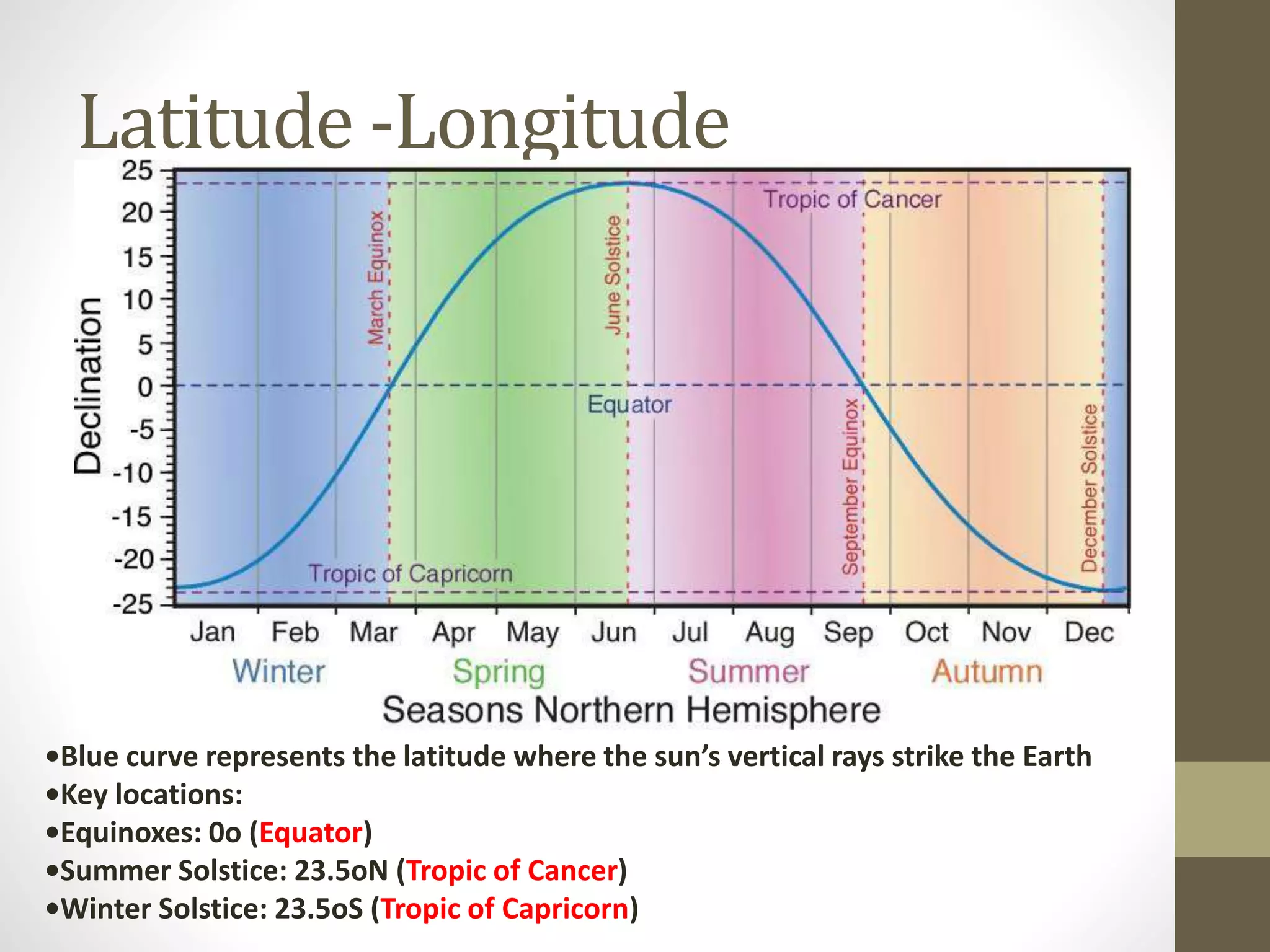
•Blue curve represents the latitude where the sun’s vertical rays strike the Earth
•Key locations:
•Equinoxes: 0o (Equator)
•Summer Solstice: 23.5oN (Tropic of Cancer)
•Winter Solstice: 23.5oS (Tropic of Capricorn)
Latitude -Longitude
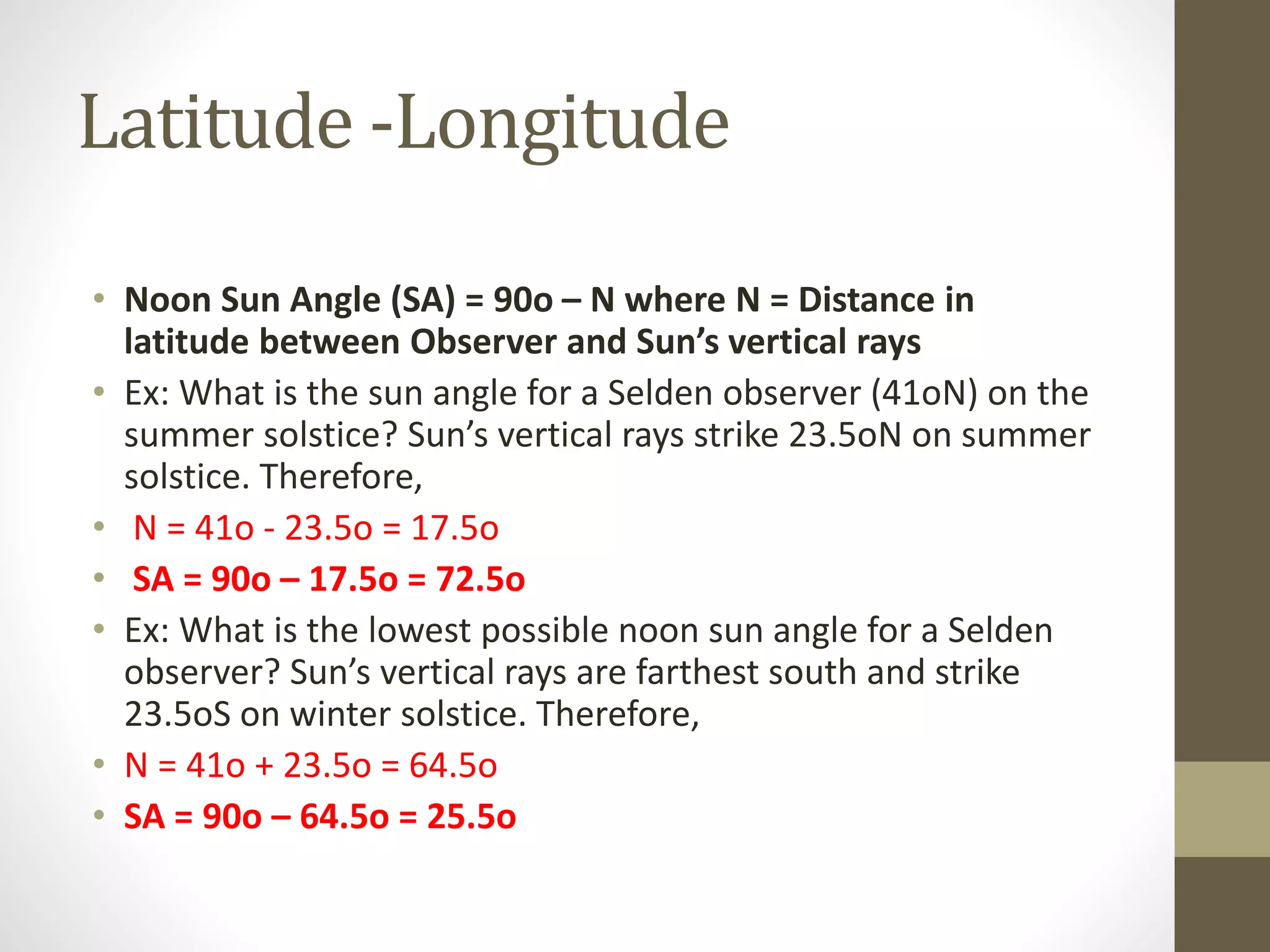
• Noon Sun Angle (SA) = 90o – N where N = Distance in
latitude between Observer and Sun’s vertical rays
• Ex: What is the sun angle for a Selden observer (41oN) on the
summer solstice? Sun’s vertical rays strike 23.5oN on summer
solstice. Therefore,
• N = 41o - 23.5o = 17.5o
• SA = 90o – 17.5o = 72.5o
• Ex: What is the lowest possible noon sun angle for a Selden
observer? Sun’s vertical rays are farthest south and strike
23.5oS on winter solstice. Therefore,
• N = 41o + 23.5o = 64.5o
• SA = 90o – 64.5o = 25.5o

Prime Meridian,Equator, Latitude and longitude

  • 1.
    Presented to :Sir Engr LATIF JAN Presented by : NIK JAMAL ID : 5370 Meridian Equator, Latitude and longitude
  • 2.
    Contains What is thePrime Meridian? What is the Equator ? What is the Latitude? What is the longitude?  What are the North and South Latitudes? What are the East and West Longitudes? The International Date Line.
  • 3.
    What is Latitude? •Latitude is defined as a measurement of distance in degrees north and south of the equator • The word latitude is derived from the Latin word, “latus”,meaning “wide.”
  • 4.
    What is Latitude? There are 90 degrees of latitude from the equator to each of the poles, north and south.  Latitude lines are parallel, that is they are the same distance apart  These lines are sometimes referred to as parallels
  • 5.
    The Equator  Theequator is the longest of all lines of latitude  It divides the earth in half and is measured as 0° (Zero degrees).
  • 6.
    North and SouthLatitudes  Positions on latitude lines above the equator are called “north” and are in the northern hemisphere.  Positions on latitude lines below the equator are called “south” and are in the southern hemisphere
  • 7.
    What is Longitude? Longitude is defined as measurement of distance in degrees east or west of the prime meridian.  The word longitude is derived from the Latin word, “longus”, meaning “length.”
  • 8.
    What is Longitude? The Prime Meridian, as do all other lines of longitude, pass through the north and south pole.  They make the earth look like a peeled orange.
  • 9.
    East and WestLongitudes  Longitude lines to the left of the prime Meridian give locations west, in the western hemisphere.  Longitude lines to the right of the primer meridian give locations east, in the eastern hemisphere.
  • 10.
    Latitude -Longitude •Latitude linesare the horizontal circles drawn on a globe. •The starting latitude is 0o and is known as the Equator. •Latitude is always the first point plotted and will always be listed as how many degrees North OR South of the Equator that point lies. •Keep in mind that the two extreme latitudes are the North Pole (90oN) and the South Pole (90oS).
  • 11.
    The Prime Meridian The Prime meridian divides the earth in half too.  It is also 0°. It passes through the community of Greenwich, England.
  • 12.
    The International DateLine  There are 180 lines of longitude on each Side of the prime meridian.  But on the opposite side, the primer meridian is not zero degrees but 180°.  It is called the International Date Line.
  • 13.
    Latitude -Longitude •Longitude linesare the vertical circles drawn on a map. •The starting longitude is 0o and is known as the Prime Meridian. This meridian is defined as the longitude line that starts at the North Pole, travels through Greenwich, England, and ends at the South Pole. •Longitude is always the second point plotted and will always be listed as how many degrees West or East of the Prime Meridian that point lies. •Keep in mind that the extreme longitude is 180o and is called the International Date Line.
  • 14.
    Latitude -Longitude •A mercatorprojection is a flat version of the globe •Much easier to work with •Locations toward each pole (eg. Greenland, Antarctica) appear larger than reality due to “stretching”
  • 15.
    Latitude -Longitude •When locatingpoints that lie between two adjacent latitudes or longitudes (ex. between 41oN and 42oN) a smaller unit is desired. •A degree of spacing is made up of 60 smaller units called arcminutes. One degree is equal to 60'. Therefore, fractions of a degree are equal to some number of arcminutes. For example, ½ degree equals 30', ¾ degree equals 45’, and so forth.
  • 16.
    Latitude -Longitude •The distancethat separates one latitude degree from another (ex. between 41oN and 42oN) can be given as 60 nm (nautical miles) or 69 mi (statute miles). •Ex: the distance between 23oS and 25oS is two degrees. There are 120 nm (2 x 60) or 138 mi (2 x 69) between these two points. •Keep in mind that the relationship of 1 degree = 60 nm or 69 mi only works for latitudes because longitude line spacing is not constant. Meridians of longitude narrow as one moves pole ward.
  • 17.
    Latitude -Longitude •The rotationaxis of earth is “tilted” 23.5o from vertical •This tilt is what causes seasons
  • 18.
    Latitude -Longitude •Solstices aretimes of the year when the noon sun angle is highest or lowest •Equinoxes are times of the year when the vertical rays of the sun strike the equator at noon. There are 12 hours of day and night for all locations
  • 19.
    Latitude -Longitude •Solstices aretimes of the year when the noon sun angle is highest or lowest
  • 20.
    Latitude -Longitude •Blue curverepresents the latitude where the sun’s vertical rays strike the Earth •Key locations: •Equinoxes: 0o (Equator) •Summer Solstice: 23.5oN (Tropic of Cancer) •Winter Solstice: 23.5oS (Tropic of Capricorn)
  • 21.
    Latitude -Longitude • NoonSun Angle (SA) = 90o – N where N = Distance in latitude between Observer and Sun’s vertical rays • Ex: What is the sun angle for a Selden observer (41oN) on the summer solstice? Sun’s vertical rays strike 23.5oN on summer solstice. Therefore, • N = 41o - 23.5o = 17.5o • SA = 90o – 17.5o = 72.5o • Ex: What is the lowest possible noon sun angle for a Selden observer? Sun’s vertical rays are farthest south and strike 23.5oS on winter solstice. Therefore, • N = 41o + 23.5o = 64.5o • SA = 90o – 64.5o = 25.5o