WWeeaatthheerr CCoonnddiittiioonnss
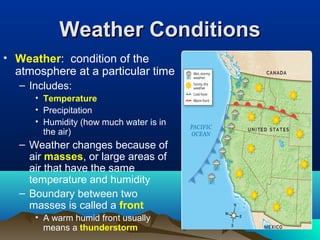
•Weather: condition of the
atmosphere at a particular time
– Includes:
• Temperature
• Precipitation
• Humidity (how much water is in
the air)
– Weather changes because of
air masses, or large areas of
air that have the same
temperature and humidity
– Boundary between two
masses is called a front
• A warm humid front usually
means a thunderstorm
3.
CClliimmaattee EElleemmeennttss
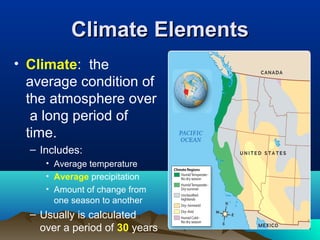
•Climate: the
average condition of
the atmosphere over
a long period of
time.
– Includes:
• Average temperature
• Average precipitation
• Amount of change from
one season to another
– Usually is calculated
over a period of 30 years
WWeeaatthheerr oorr CClliimmaattee??
• It snowed a lot in January this year.
– Weather
• Summers are usually hot and rainy and
winters are cool but dry.
– Climate
• It is usually hot and dry here in the
summer.
– Climate
6.
• Nebraska receivesan average rainfall of 30
cm per year.
– Climate
• Last night we received 6 inches of snow.
– Weather
• It’s a beautiful day—warm and sunny.
– Weather
FFaaccttoorr ##11:: SSUUNN//LLAATTIITTUUDDEE
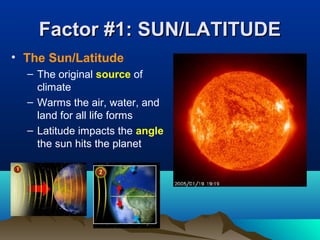
• The Sun/Latitude
– The original source of
climate
– Warms the air, water, and
land for all life forms
– Latitude impacts the angle
the sun hits the planet
9.
FFaaccttoorr ##22:: OOcceeaannCCuurrrreennttss
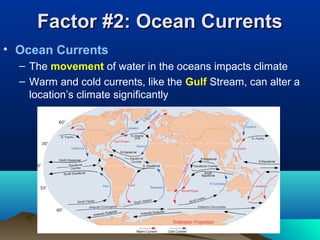
• Ocean Currents
– The movement of water in the oceans impacts climate
– Warm and cold currents, like the Gulf Stream, can alter a
location’s climate significantly
10.
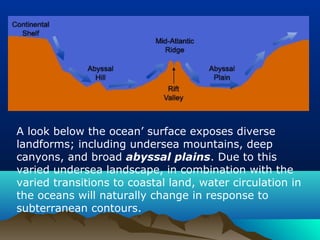
A look belowthe ocean’ surface exposes diverse
landforms; including undersea mountains, deep
canyons, and broad abyssal plains. Due to this
varied undersea landscape, in combination with the
varied transitions to coastal land, water circulation in
the oceans will naturally change in response to
subterranean contours.
11.
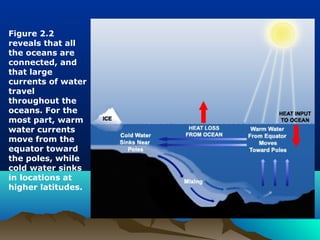
Figure 2.2
revealsthat all
the oceans are
connected, and
that large
currents of water
travel
throughout the
oceans. For the
most part, warm
water currents
move from the
equator toward
the poles, while
cold water sinks
in locations at
higher latitudes.
12.
FFaaccttoorr ##33:: WWIINNDD
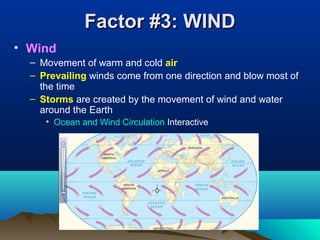
• Wind
– Movement of warm and cold air
– Prevailing winds come from one direction and blow most of
the time
– Storms are created by the movement of wind and water
around the Earth
• Ocean and Wind Circulation Interactive
13.
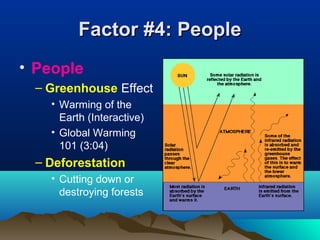
FFaaccttoorr ##44:: PPeeooppllee
• People
– Greenhouse Effect
• Warming of the
Earth (Interactive)
• Global Warming
101 (3:04)
– Deforestation
• Cutting down or
destroying forests
14.
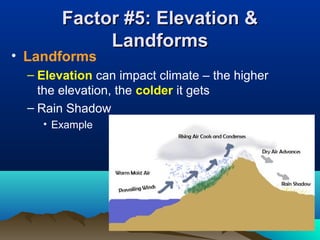
FFaaccttoorr ##55:: EElleevvaattiioonn&&
LLaannddffoorrmmss
• Landforms
– Elevation can impact climate – the higher
the elevation, the colder it gets
– Rain Shadow
• Example
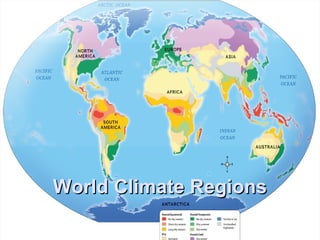
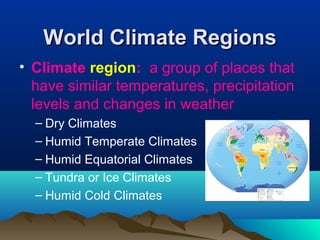
WWoorrlldd CClliimmaattee RReeggiioonnss
• Climate region: a group of places that
have similar temperatures, precipitation
levels and changes in weather
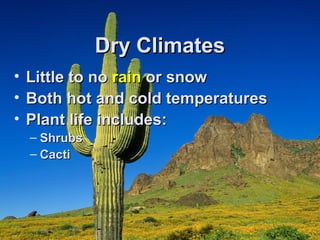
– Dry Climates
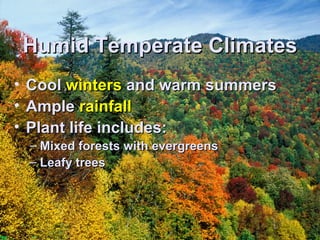
– Humid Temperate Climates
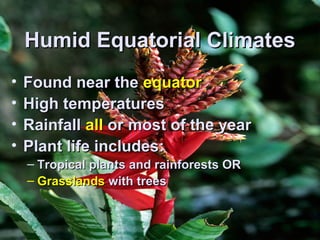
– Humid Equatorial Climates
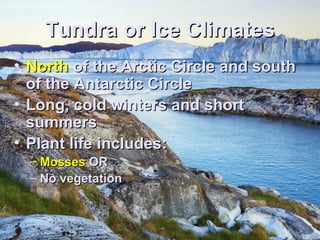
– Tundra or Ice Climates
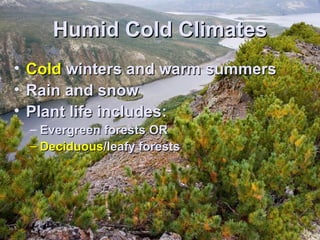
– Humid Cold Climates