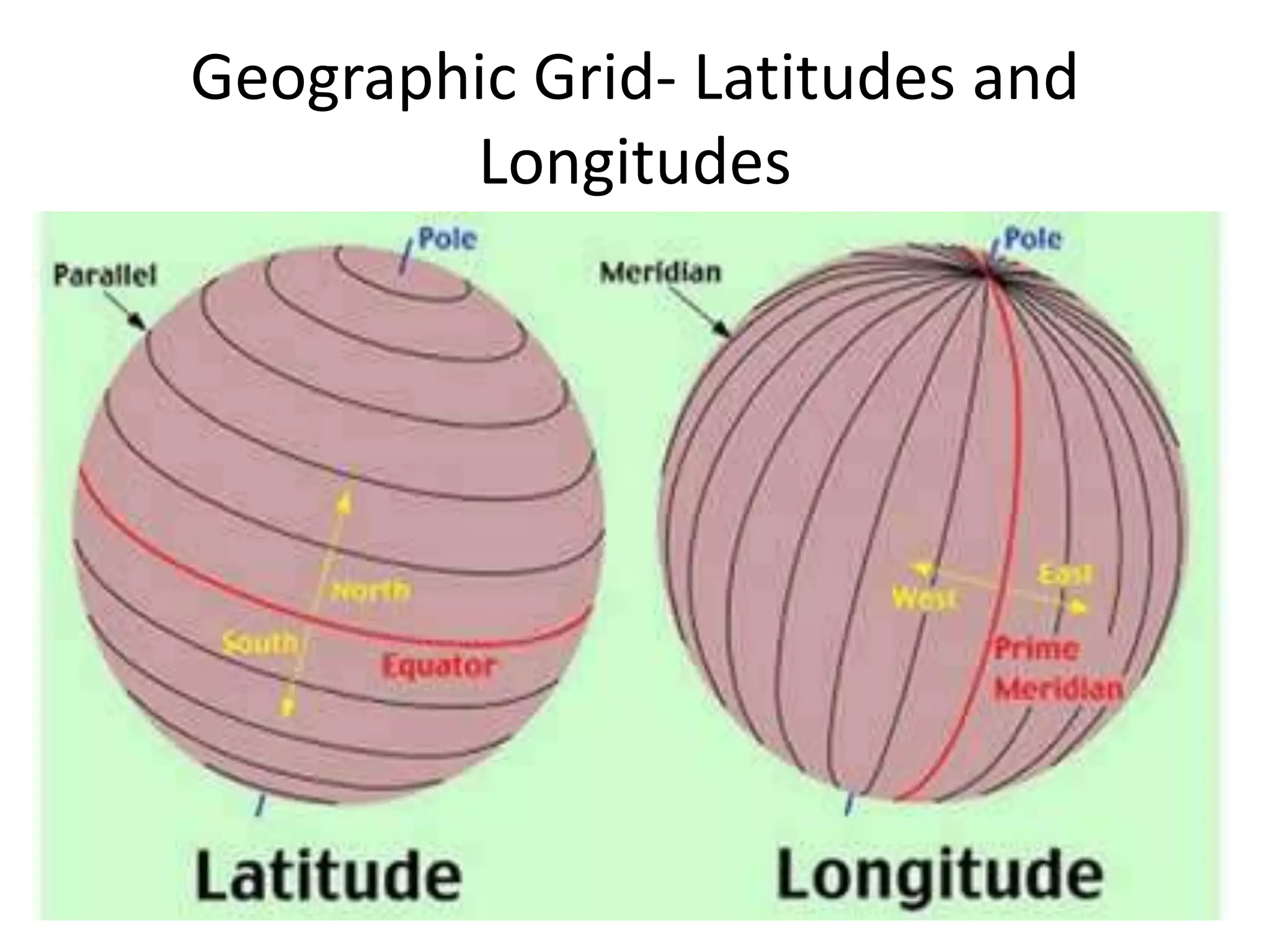
Geographic Grid- Latitudes and
Longitudes
The Geographic Grid
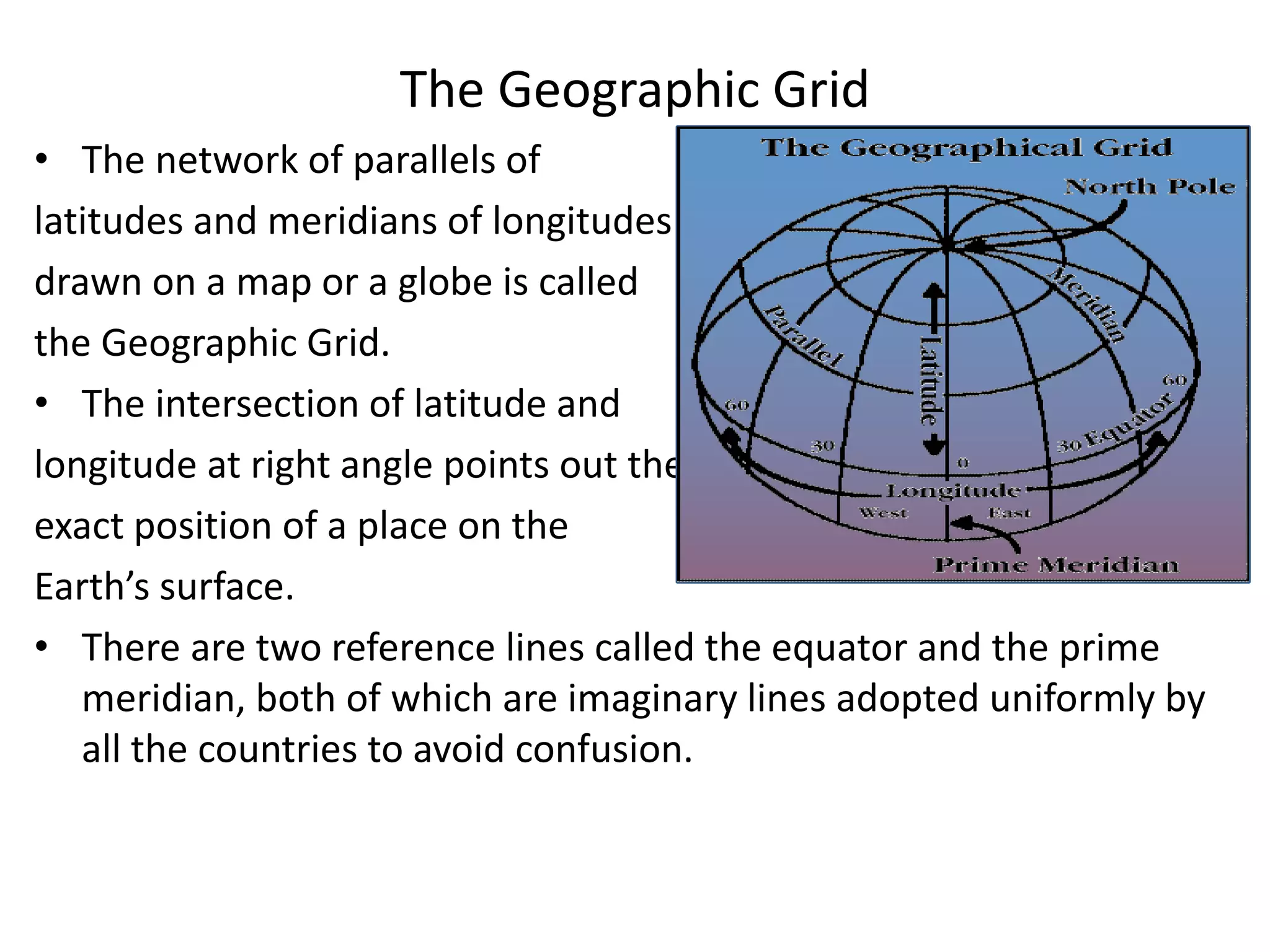
• The network of parallels of
latitudes and meridians of longitudes
drawn on a map or a globe is called
the Geographic Grid.
• The intersection of latitude and
longitude at right angle points out the
exact position of a place on the
Earth’s surface.
• There are two reference lines called the equator and the prime
meridian, both of which are imaginary lines adopted uniformly by
all the countries to avoid confusion.
Latitudes
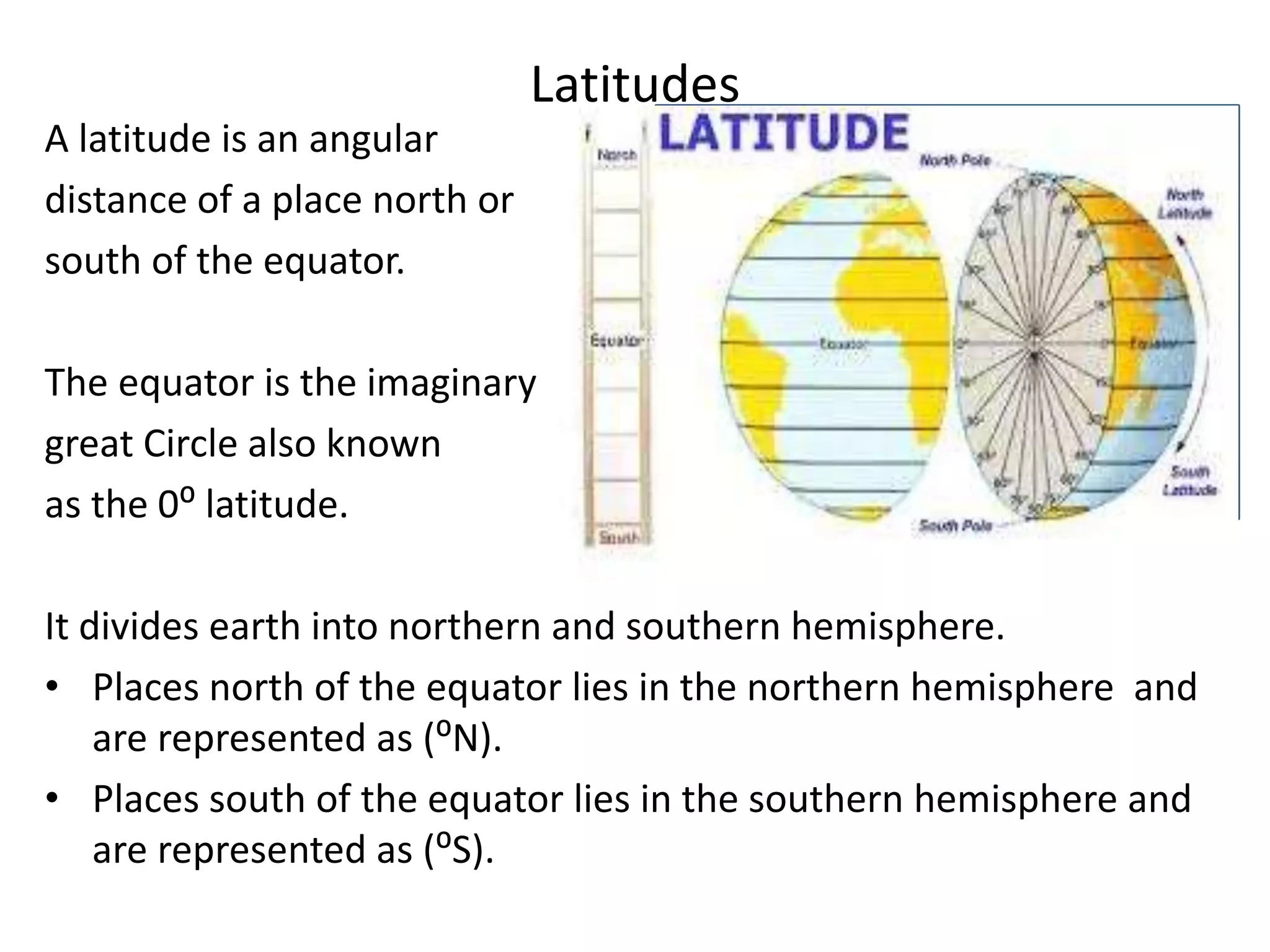
A latitude is an angular
distance of a place north or
south of the equator.
The equator is the imaginary
great Circle also known
as the 0⁰ latitude.
It divides earth into northern and southern hemisphere.
• Places north of the equator lies in the northern hemisphere and
are represented as (⁰N).
• Places south of the equator lies in the southern hemisphere and
are represented as (⁰S).
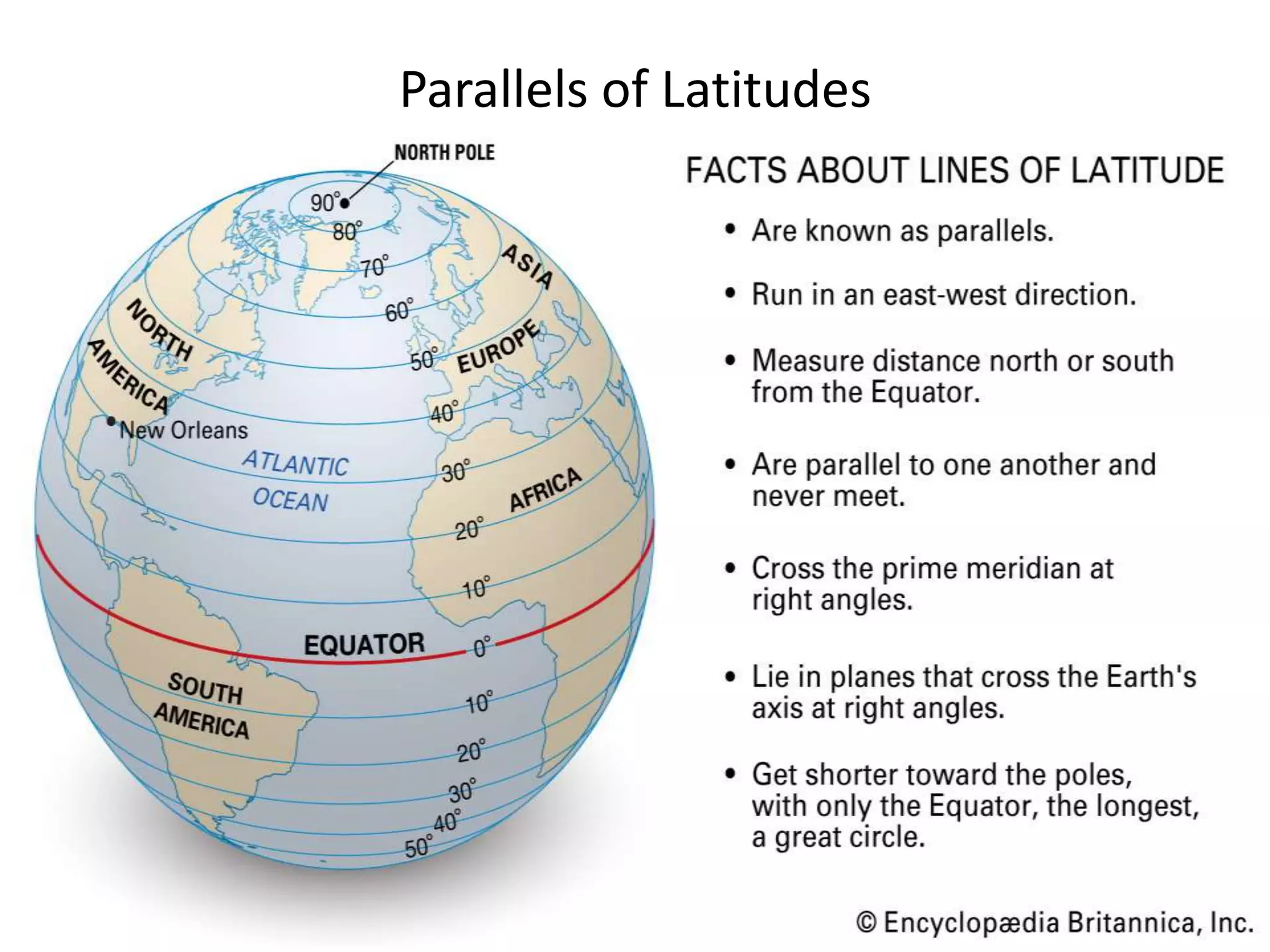
Parallels of Latitudes
Latitude
North Pole
South Pole
Lines of
latitude are
numbered
from 0° at the
equator to
90° N.L. at the
North Pole.
Lines of
latitude are
numbered
from 0° at
the equator
to 90° S.L. at
the South
Pole.
]
[
90 80
70
60
50
40
20
30
10
90
80
70
60
50
40
20
10
30
Latitude
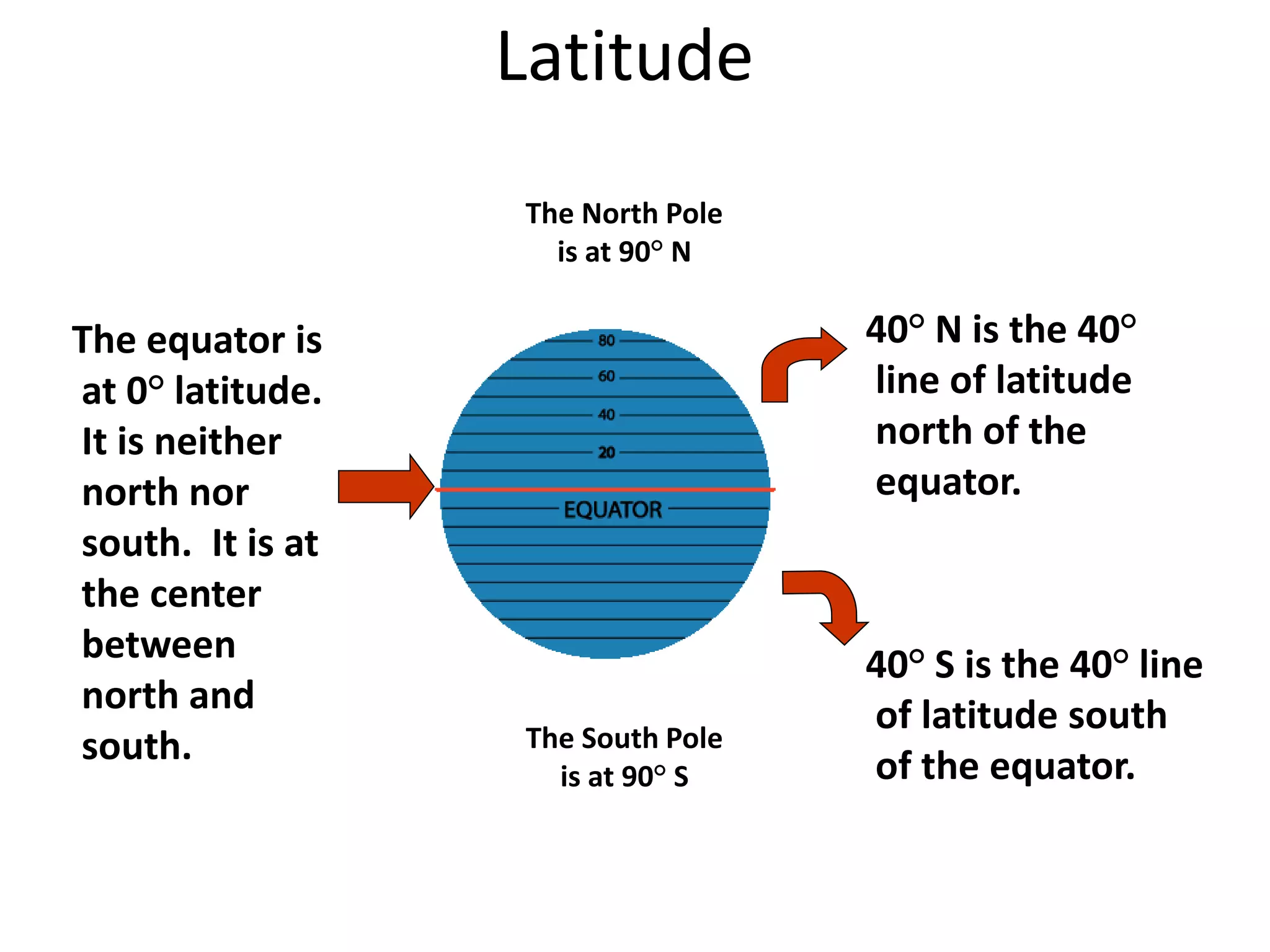
The North Pole
is at 90° N
The South Pole
is at 90° S
The equator is
at 0° latitude.
It is neither
north nor
south. It is at
the center
between
north and
south.
40° N is the 40°
line of latitude
north of the
equator.
40° S is the 40° line
of latitude south
of the equator.
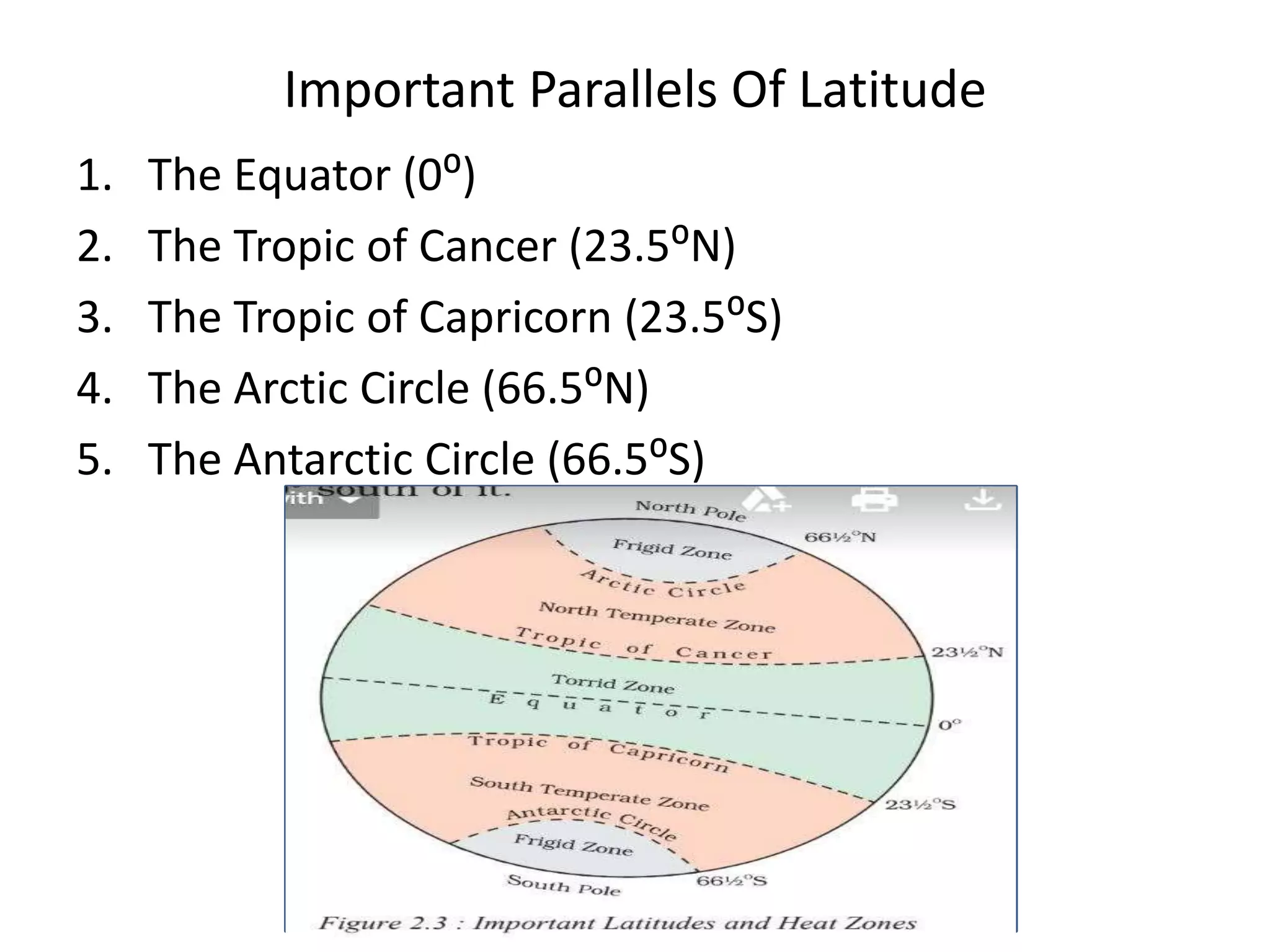
Important Parallels Of Latitude
1. The Equator (0⁰)
2. The Tropic of Cancer (23.5⁰N)
3. The Tropic of Capricorn (23.5⁰S)
4. The Arctic Circle (66.5⁰N)
5. The Antarctic Circle (66.5⁰S)
Meridians Of Longitude
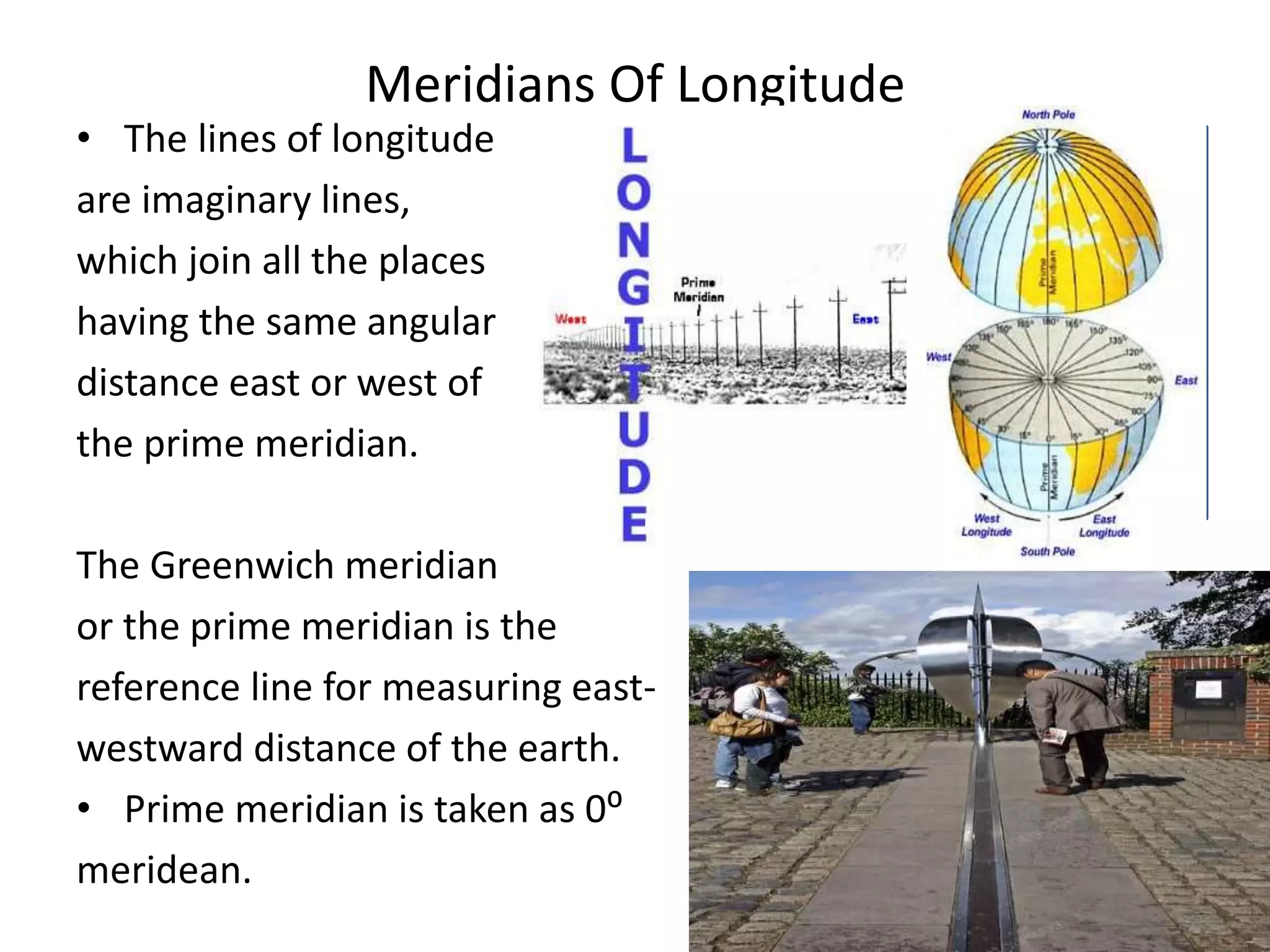
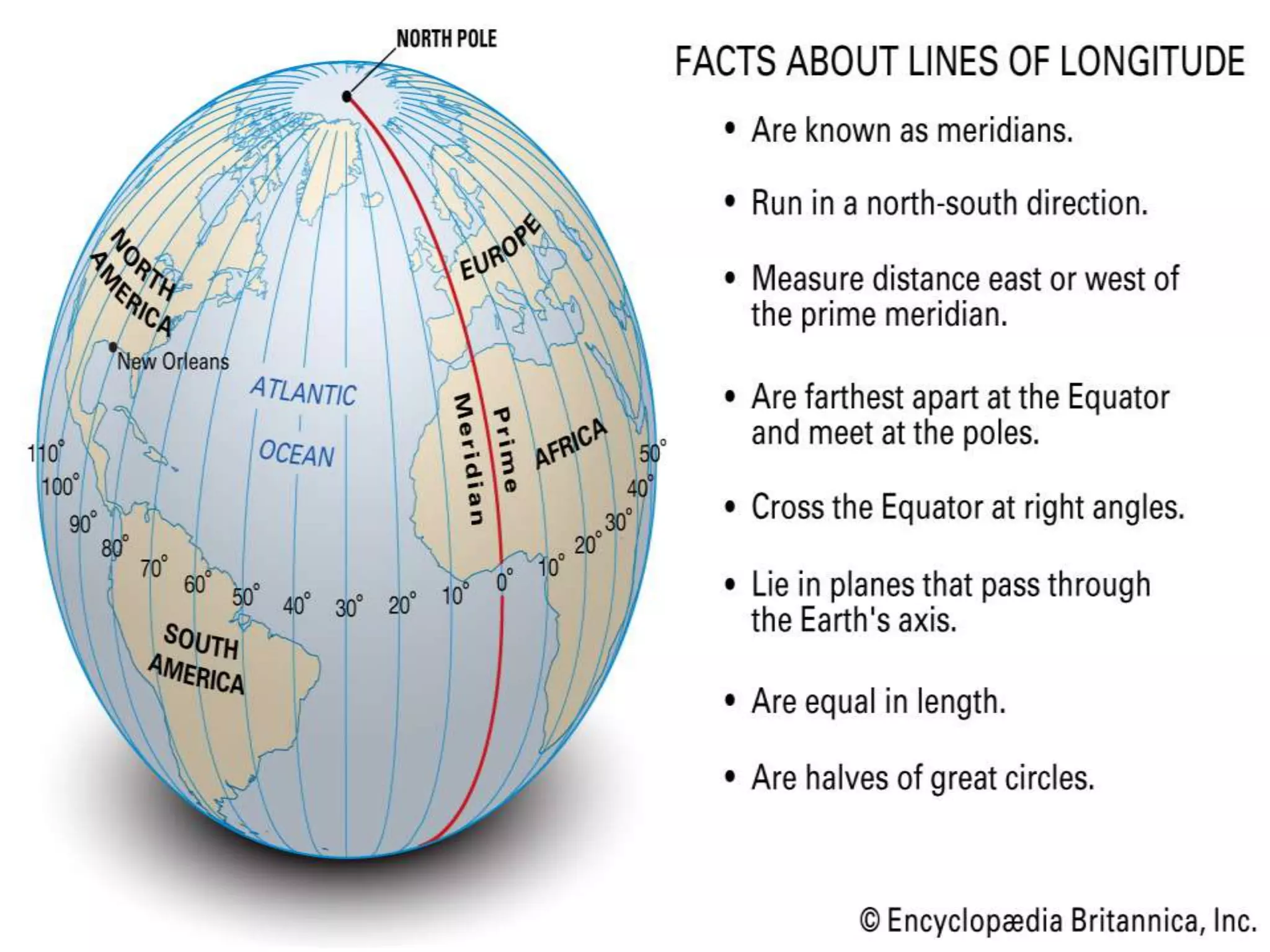
• The lines of longitude
are imaginary lines,
which join all the places
having the same angular
distance east or west of
the prime meridian.
The Greenwich meridian
or the prime meridian is the
reference line for measuring east-
westward distance of the earth.
• Prime meridian is taken as 0⁰
meridean.
Prime Meridian
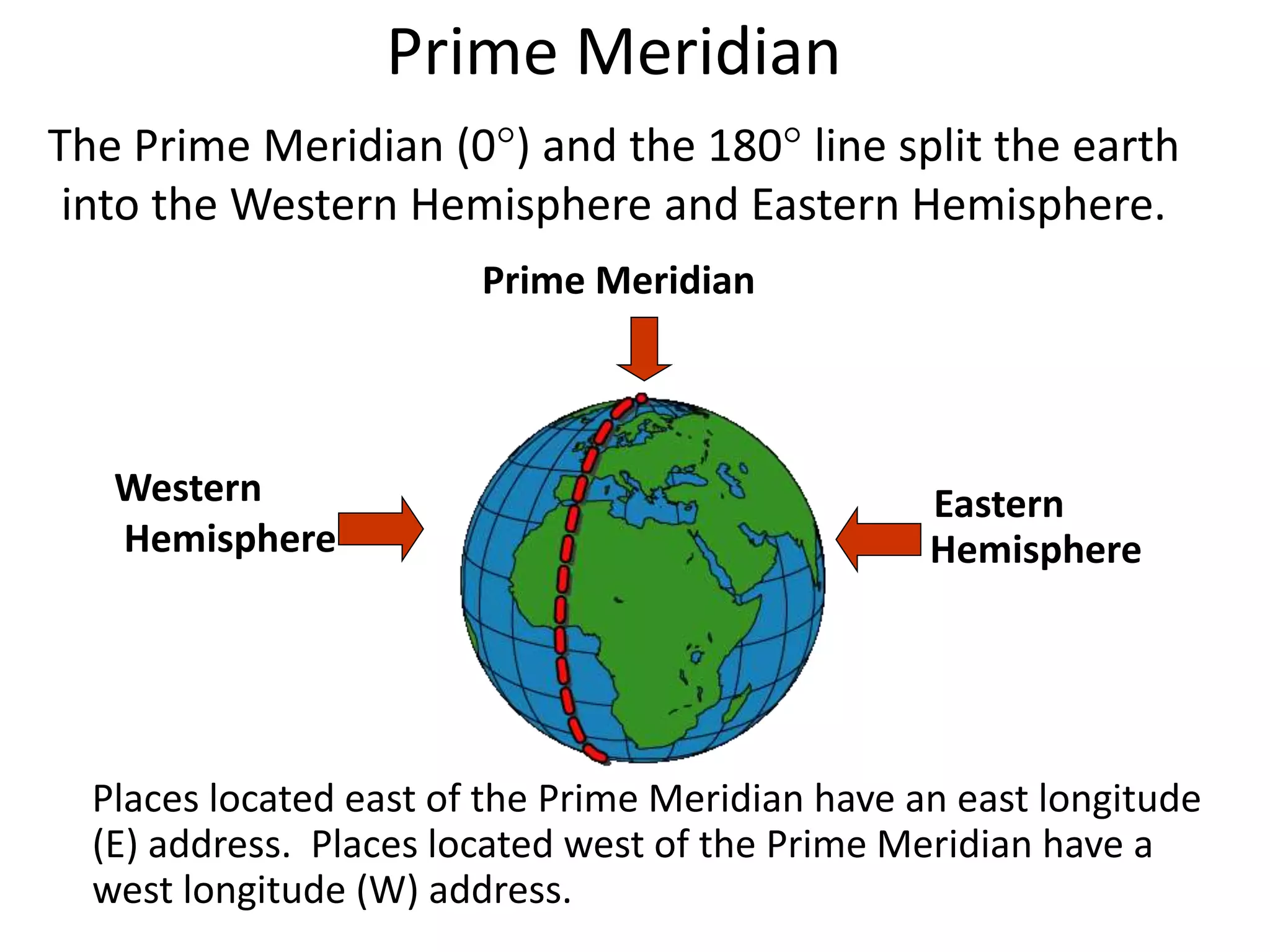
The Prime Meridian (0°) and the 180° line split the earth
into the Western Hemisphere and Eastern Hemisphere.
Prime Meridian
Western
Hemisphere
Eastern
Hemisphere
Places located east of the Prime Meridian have an east longitude
(E) address. Places located west of the Prime Meridian have a
west longitude (W) address.
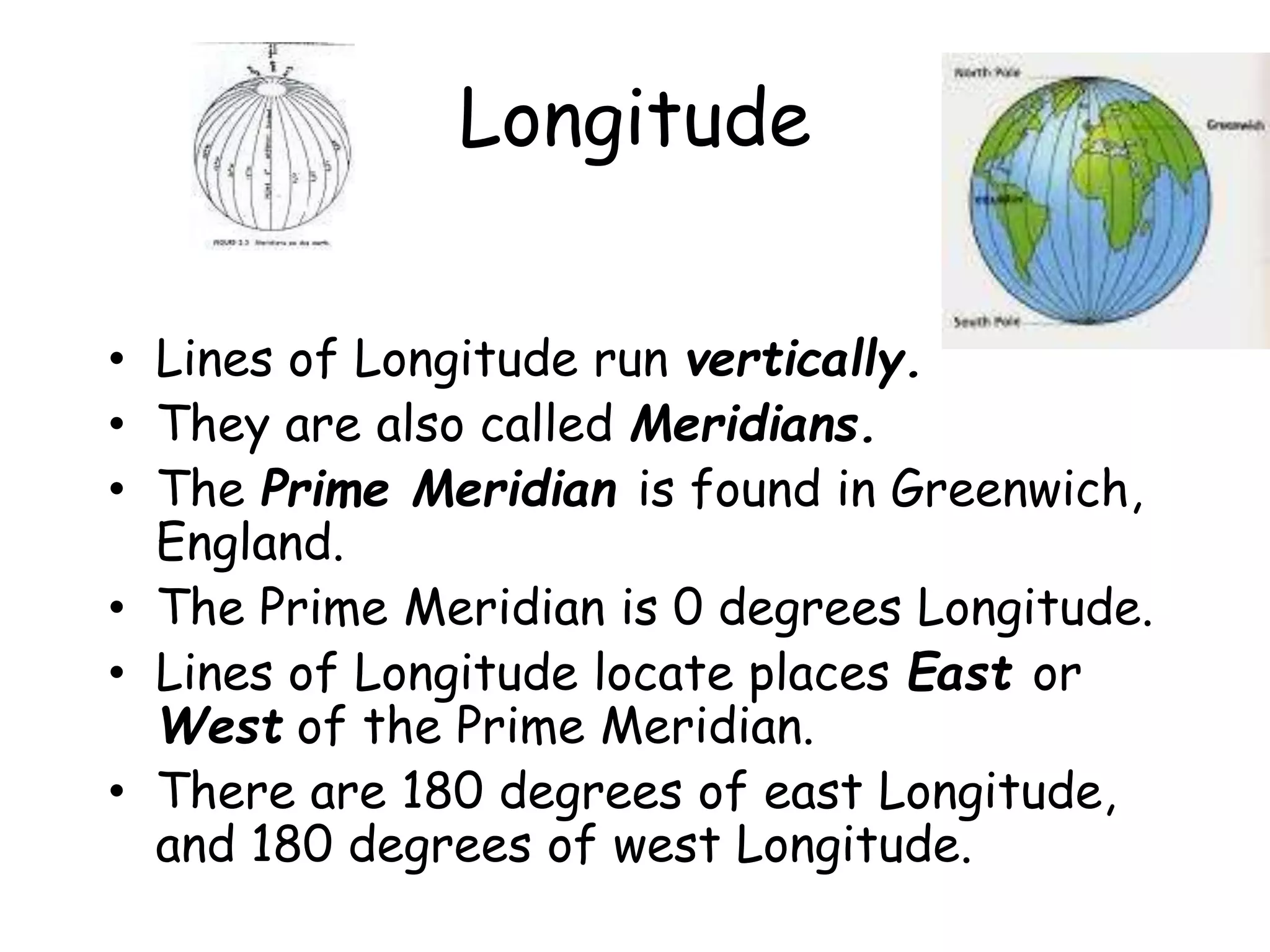
Longitude
• Lines of Longitude run vertically.
• They are also called Meridians.
• The Prime Meridian is found in Greenwich,
England.
• The Prime Meridian is 0 degrees Longitude.
• Lines of Longitude locate places East or
West of the Prime Meridian.
• There are 180 degrees of east Longitude,
and 180 degrees of west Longitude.
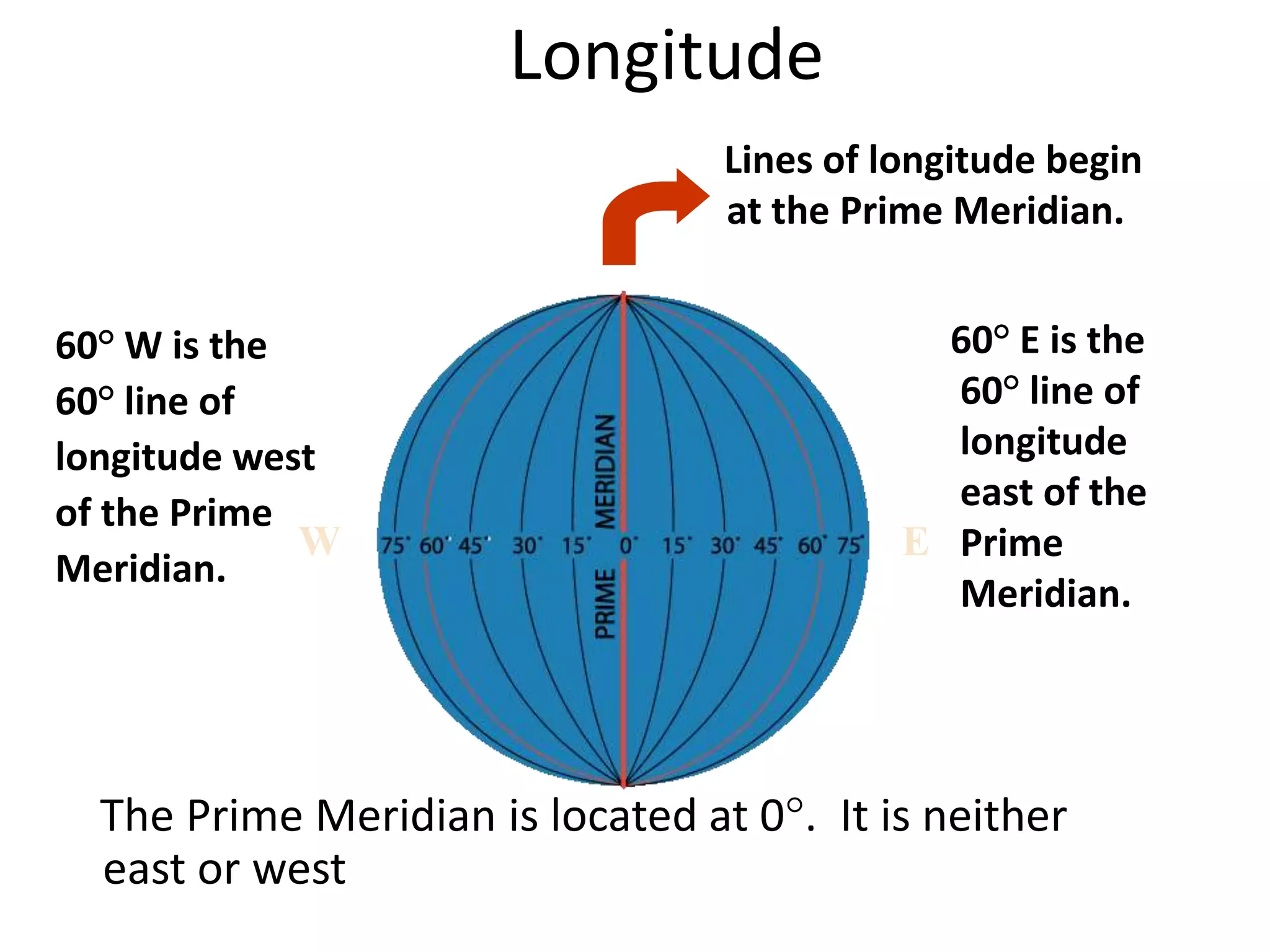
Longitude
Lines of longitude begin
at the Prime Meridian.
60° W is the
60° line of
longitude west
of the Prime
Meridian.
The Prime Meridian is located at 0°. It is neither
east or west
60° E is the
60° line of
longitude
east of the
Prime
Meridian.
W E
LONGITUDE AND TIME
• The world rotates (spins) 360° in 24 hours.
360° / 24 hours = 15° per hour
• The world has 24 time zones, each l5° apart.
THERE IS A 1 HOUR TIME DIFFERENCE FOR EVERY
15° OF LONGITUDE
• Time zones are broad strips that measure 15 degrees wide.
• Time zones differ from their neighboring time zones by 1 hour.
• The lines of longitudes are used to find the time of any place.
• The earth takes 24 hrs to complete one rotation of 360⁰. This
gives rise to a time difference of [(24*60)/ 360] = 4min for one
degree of longitude.
• Therefore ,
1. A time difference of four min has to be added for each 1⁰ of
longitude towards the east.
2. A time difference of four min has to be subtracted for each 1⁰ of
longitude towards west.
Local time:
the time of a place recognized by the mid-day sun is called the loca’
time. All the places located along a particular longitude (from
north pole to south pole) face the overhead sun at the same
time.
Standard Time:
The local time of the central meridian is taken as the standard
time for the whole country or a large area.
• A large area may be crossed by many meridians of longitude,
it means they may have many local times. It would be very
difficult for people to keep on setting their watches according
to local time of the place.
• To avoid such difficulties and confusion, the local time of a
central meridian is taken as the standard time for the whole
country or a large area.
Indian Standard Time (I.S.T.):
The 82.5⁰ E longitude is selected as the central meridian of India
which passes through Prayagraj and is known as the standard
meridian of India.
Greenwich Mean Time:
• The local time of the Greenwich meridian also known as the
prime meridian is considered as the standard time for the
whole world is called the Greenwich Mean Time or G.M.T.
• All the countries for international travel follow it.
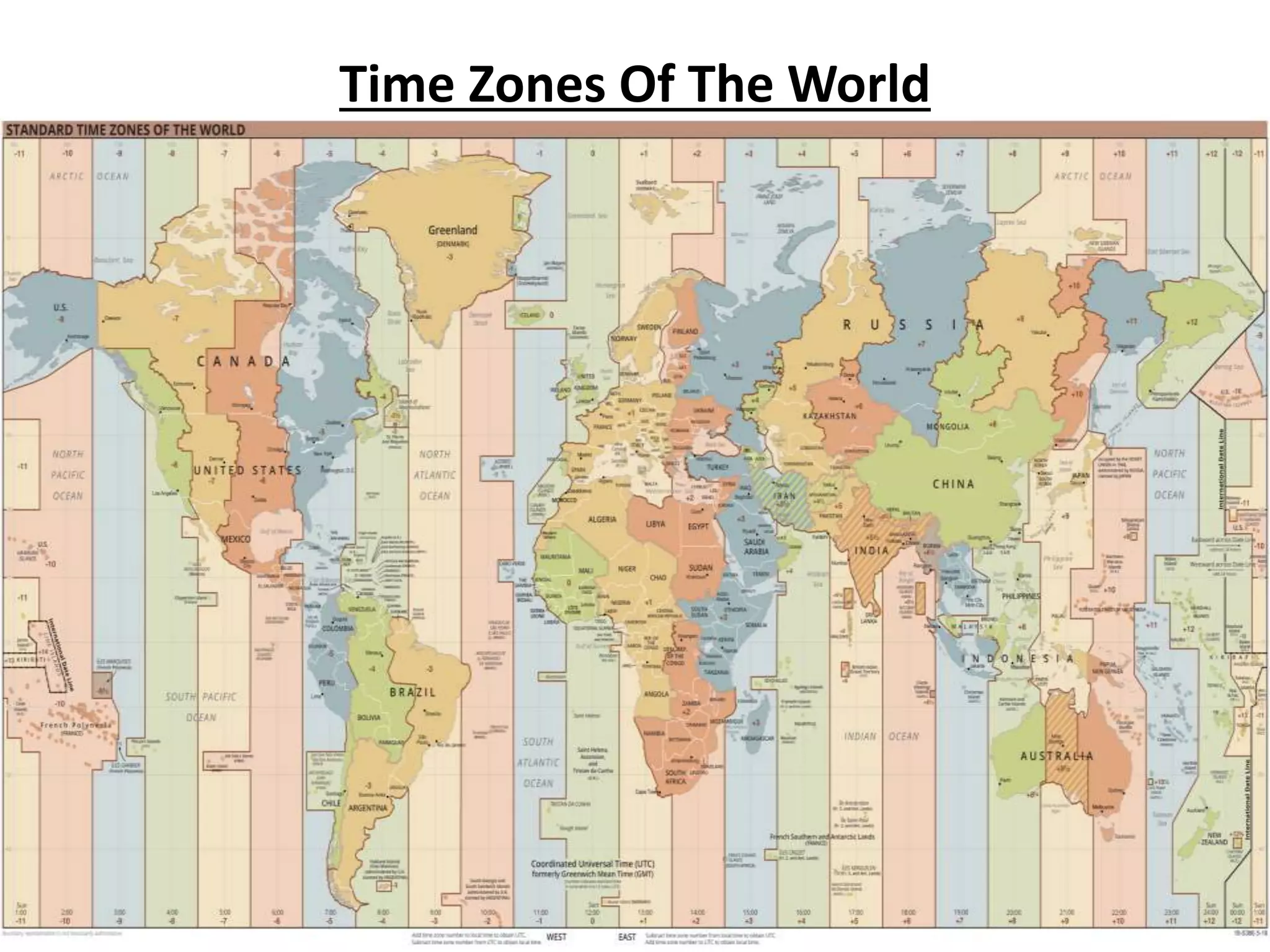
Time zones:
• Some countries like Russia, Canada, and USA have large
longitudinal extension where if a single time is followed as
standard time, it will create lot of problems.
• So to avoid such confusion, the countries having large east-
west extension have to follow more than one time zones. For
example , Canada and USA have 6 time zones.
Time Zones Of The World
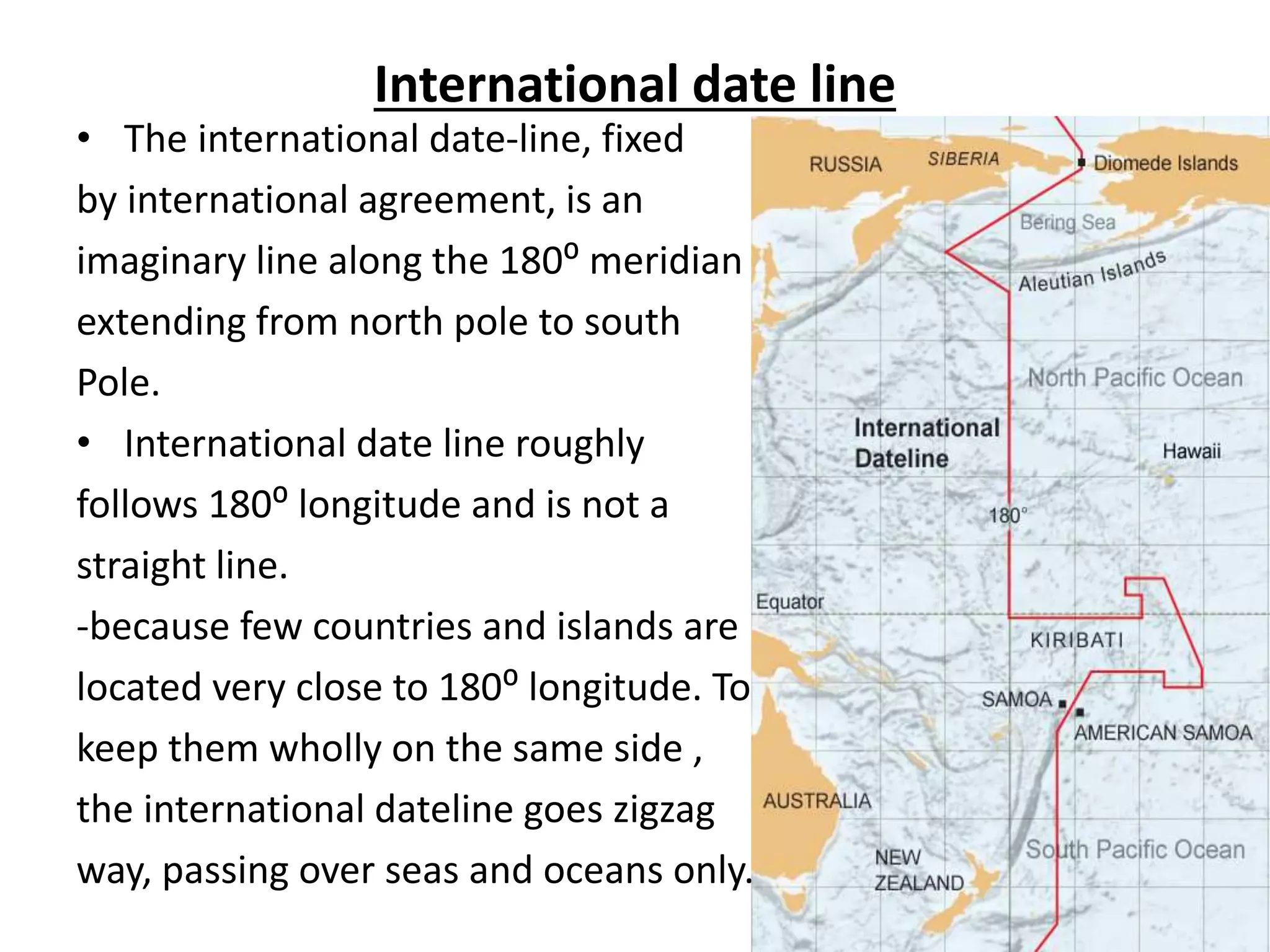
International date line
• The international date-line, fixed
by international agreement, is an
imaginary line along the 180⁰ meridian
extending from north pole to south
Pole.
• International date line roughly
follows 180⁰ longitude and is not a
straight line.
-because few countries and islands are
located very close to 180⁰ longitude. To
keep them wholly on the same side ,
the international dateline goes zigzag
way, passing over seas and oceans only.
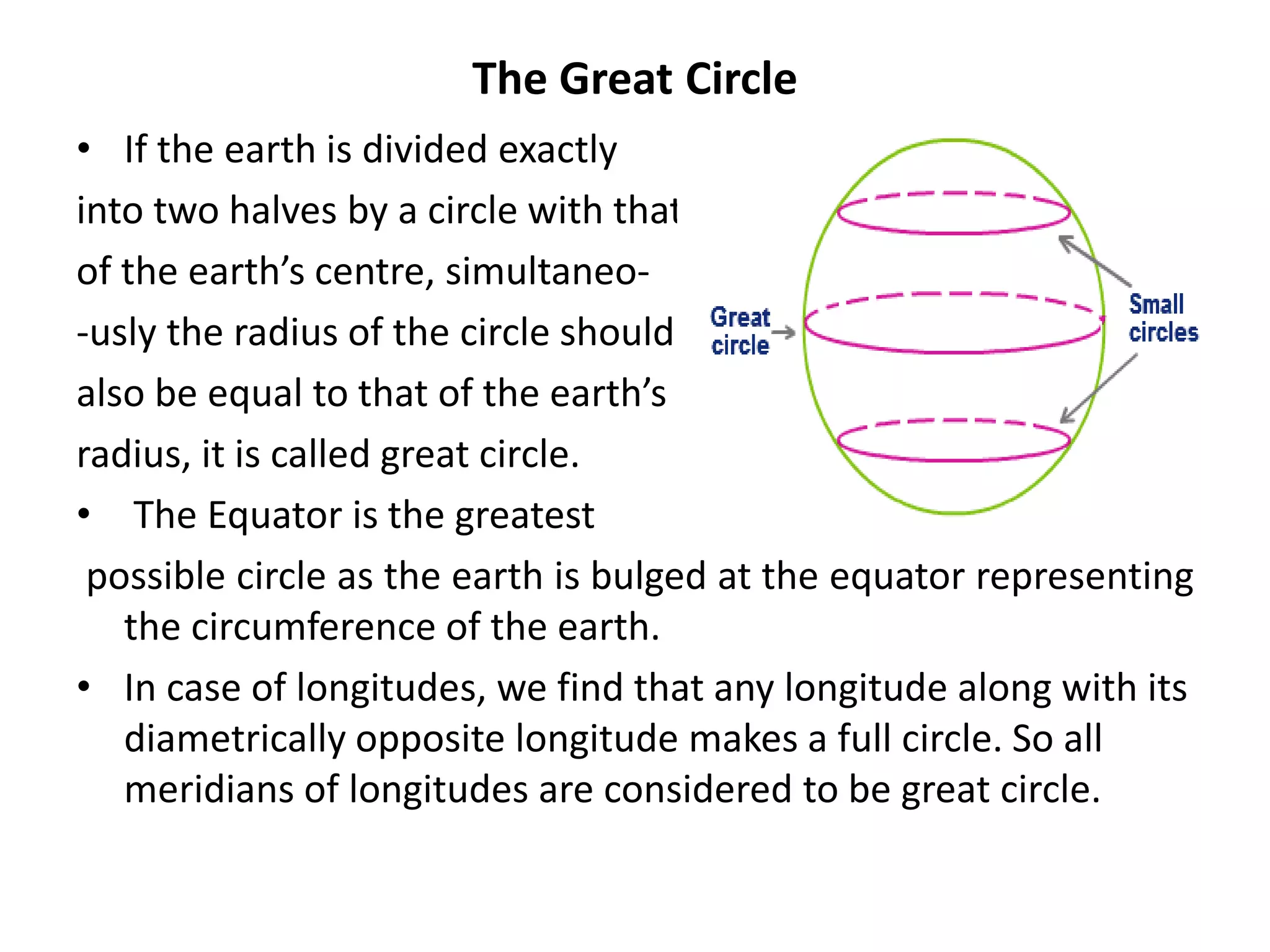
The Great Circle
• If the earth is divided exactly
into two halves by a circle with that
of the earth’s centre, simultaneo-
-usly the radius of the circle should
also be equal to that of the earth’s
radius, it is called great circle.
• The Equator is the greatest
possible circle as the earth is bulged at the equator representing
the circumference of the earth.
• In case of longitudes, we find that any longitude along with its
diametrically opposite longitude makes a full circle. So all
meridians of longitudes are considered to be great circle.
Importance Of The Great Circle
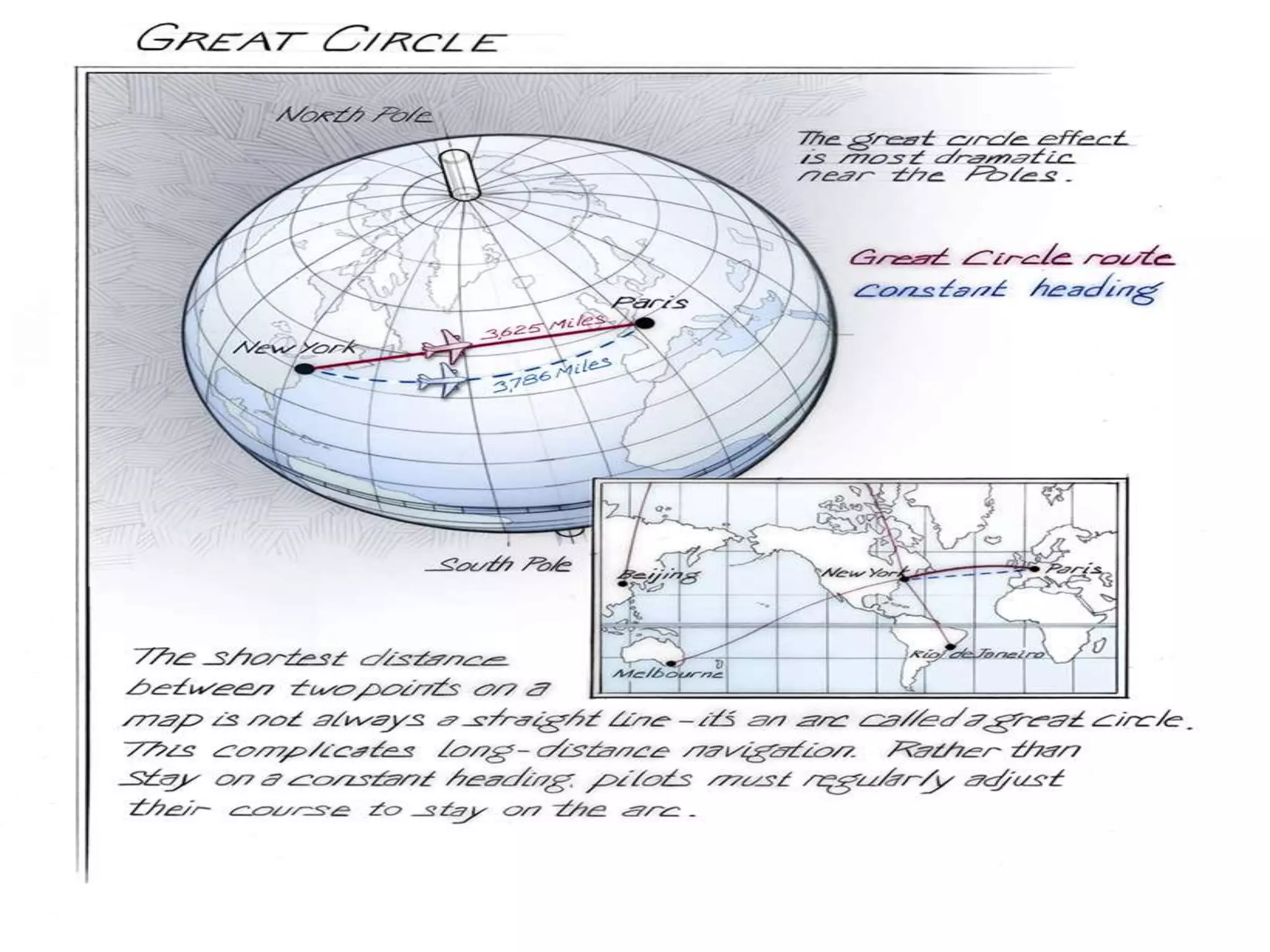
• The shortest route between any two places on the earth is always
prefered by the navigators and aviators. A route along the arc of a
great circle provides the shortest possible route which saves fuel,
time, and expenditure.
• There are special great circle charts used by the navigators on
which these routes are shown as straight lines. As far as possible,
the ships and aircrafts follow these routes to make their journey
economical.
• Sometimes, some countries do not allow the aircrafts to fly over
their airspace, so the aircrafts have to deviates from these routes.
Geographic grid  latitudes and longitudes made by Ravi Bharti

Geographic grid latitudes and longitudes made by Ravi Bharti

  • 1.
  • 2.
    The Geographic Grid •The network of parallels of latitudes and meridians of longitudes drawn on a map or a globe is called the Geographic Grid. • The intersection of latitude and longitude at right angle points out the exact position of a place on the Earth’s surface. • There are two reference lines called the equator and the prime meridian, both of which are imaginary lines adopted uniformly by all the countries to avoid confusion.
  • 3.
    Latitudes A latitude isan angular distance of a place north or south of the equator. The equator is the imaginary great Circle also known as the 0⁰ latitude. It divides earth into northern and southern hemisphere. • Places north of the equator lies in the northern hemisphere and are represented as (⁰N). • Places south of the equator lies in the southern hemisphere and are represented as (⁰S).
  • 4.
  • 5.
    Latitude North Pole South Pole Linesof latitude are numbered from 0° at the equator to 90° N.L. at the North Pole. Lines of latitude are numbered from 0° at the equator to 90° S.L. at the South Pole. ] [ 90 80 70 60 50 40 20 30 10 90 80 70 60 50 40 20 10 30
  • 6.
    Latitude The North Pole isat 90° N The South Pole is at 90° S The equator is at 0° latitude. It is neither north nor south. It is at the center between north and south. 40° N is the 40° line of latitude north of the equator. 40° S is the 40° line of latitude south of the equator.
  • 7.
    Important Parallels OfLatitude 1. The Equator (0⁰) 2. The Tropic of Cancer (23.5⁰N) 3. The Tropic of Capricorn (23.5⁰S) 4. The Arctic Circle (66.5⁰N) 5. The Antarctic Circle (66.5⁰S)
  • 8.
    Meridians Of Longitude •The lines of longitude are imaginary lines, which join all the places having the same angular distance east or west of the prime meridian. The Greenwich meridian or the prime meridian is the reference line for measuring east- westward distance of the earth. • Prime meridian is taken as 0⁰ meridean.
  • 9.
    Prime Meridian The PrimeMeridian (0°) and the 180° line split the earth into the Western Hemisphere and Eastern Hemisphere. Prime Meridian Western Hemisphere Eastern Hemisphere Places located east of the Prime Meridian have an east longitude (E) address. Places located west of the Prime Meridian have a west longitude (W) address.
  • 10.
    Longitude • Lines ofLongitude run vertically. • They are also called Meridians. • The Prime Meridian is found in Greenwich, England. • The Prime Meridian is 0 degrees Longitude. • Lines of Longitude locate places East or West of the Prime Meridian. • There are 180 degrees of east Longitude, and 180 degrees of west Longitude.
  • 12.
    Longitude Lines of longitudebegin at the Prime Meridian. 60° W is the 60° line of longitude west of the Prime Meridian. The Prime Meridian is located at 0°. It is neither east or west 60° E is the 60° line of longitude east of the Prime Meridian. W E
  • 13.
    LONGITUDE AND TIME •The world rotates (spins) 360° in 24 hours. 360° / 24 hours = 15° per hour • The world has 24 time zones, each l5° apart. THERE IS A 1 HOUR TIME DIFFERENCE FOR EVERY 15° OF LONGITUDE • Time zones are broad strips that measure 15 degrees wide. • Time zones differ from their neighboring time zones by 1 hour. • The lines of longitudes are used to find the time of any place.
  • 14.
    • The earthtakes 24 hrs to complete one rotation of 360⁰. This gives rise to a time difference of [(24*60)/ 360] = 4min for one degree of longitude. • Therefore , 1. A time difference of four min has to be added for each 1⁰ of longitude towards the east. 2. A time difference of four min has to be subtracted for each 1⁰ of longitude towards west. Local time: the time of a place recognized by the mid-day sun is called the loca’ time. All the places located along a particular longitude (from north pole to south pole) face the overhead sun at the same time.
  • 15.
    Standard Time: The localtime of the central meridian is taken as the standard time for the whole country or a large area. • A large area may be crossed by many meridians of longitude, it means they may have many local times. It would be very difficult for people to keep on setting their watches according to local time of the place. • To avoid such difficulties and confusion, the local time of a central meridian is taken as the standard time for the whole country or a large area. Indian Standard Time (I.S.T.): The 82.5⁰ E longitude is selected as the central meridian of India which passes through Prayagraj and is known as the standard meridian of India.
  • 16.
    Greenwich Mean Time: •The local time of the Greenwich meridian also known as the prime meridian is considered as the standard time for the whole world is called the Greenwich Mean Time or G.M.T. • All the countries for international travel follow it. Time zones: • Some countries like Russia, Canada, and USA have large longitudinal extension where if a single time is followed as standard time, it will create lot of problems. • So to avoid such confusion, the countries having large east- west extension have to follow more than one time zones. For example , Canada and USA have 6 time zones.
  • 17.
    Time Zones OfThe World
  • 18.
    International date line •The international date-line, fixed by international agreement, is an imaginary line along the 180⁰ meridian extending from north pole to south Pole. • International date line roughly follows 180⁰ longitude and is not a straight line. -because few countries and islands are located very close to 180⁰ longitude. To keep them wholly on the same side , the international dateline goes zigzag way, passing over seas and oceans only.
  • 19.
    The Great Circle •If the earth is divided exactly into two halves by a circle with that of the earth’s centre, simultaneo- -usly the radius of the circle should also be equal to that of the earth’s radius, it is called great circle. • The Equator is the greatest possible circle as the earth is bulged at the equator representing the circumference of the earth. • In case of longitudes, we find that any longitude along with its diametrically opposite longitude makes a full circle. So all meridians of longitudes are considered to be great circle.
  • 20.
    Importance Of TheGreat Circle • The shortest route between any two places on the earth is always prefered by the navigators and aviators. A route along the arc of a great circle provides the shortest possible route which saves fuel, time, and expenditure. • There are special great circle charts used by the navigators on which these routes are shown as straight lines. As far as possible, the ships and aircrafts follow these routes to make their journey economical. • Sometimes, some countries do not allow the aircrafts to fly over their airspace, so the aircrafts have to deviates from these routes.