

HA NOI UNIVERSITY OF SCIENCE AND TECHNOLOGY
**** ADVANCED TRAINING PROGRAM ****

OVERVIEWS OF INDEPENDENT STUDY:

SYNTHESIS OF ZnO-TiO2 CORESHELL
NANOSTRUCTURES BY HYDROTHERMAL
METHOD
Name : Hoàng Văn Tiến
Class : MSE-K54
ID Student : 20092697
Instructor : Dr. Nguyễn Duy Hùng-AIST
OUTLINE :
• Why i choose this topic?

• ZnO-TiO2 overviews
• Hydrothermal methods
• Process of researching
• Analysis method
• Results and discussions
• Summary
WHY I CHOOSE THIS TOPIC ?
Types of solar cell :
- Buried contact solar cell
• Cadmium telluride solar cell

• Copper indium gallium
selenide solar cells
• Dye-sensitized solar cell

• Gallium arsenide germanium
solar cell
• Hybrid solar cell
• - Organic solar cell

- Nanocrystal solar cell
- Plasmonic solar cell
- Plastic solar cell
- Polycrystalline solar cell
- Polymer solar cell
- Quantum dot solar cell
- Solid-state solar cell
- Thin film solar cell
- Monocrystalline solar cell
- Multijunction solar cell
- ……………………….
WHY I CHOOSE THIS TOPIC ?
• Harmful organic compounds in the ecological unit are the main concern
for the scientific society, which is causative agent of water pollution and
severe contamination of the environment. Waste-water containing organic
dyes (organicpollutants) inhibit sunlight penetration which
suppressesphotosynthetic reaction.
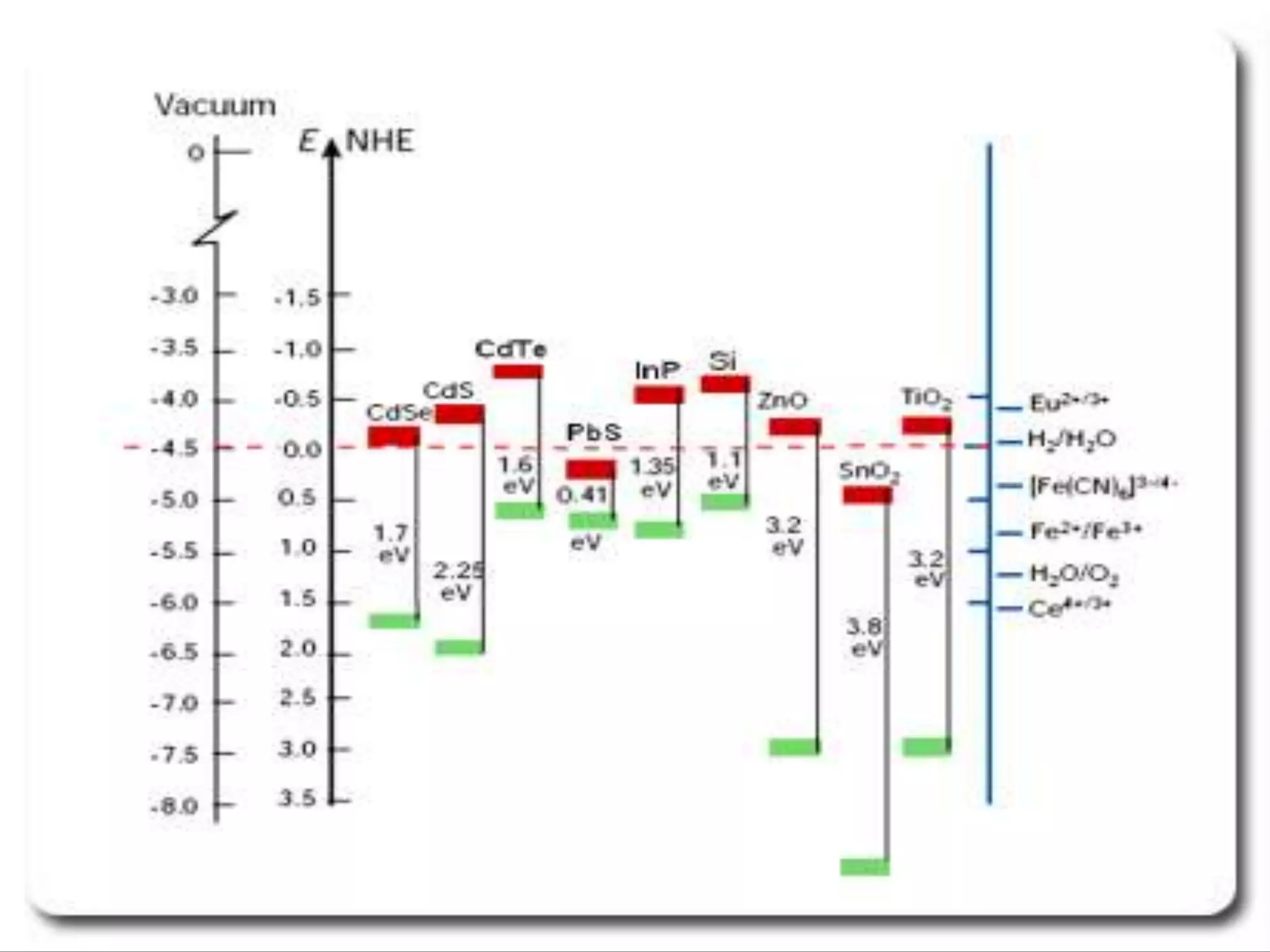
• Metal oxide semi-conducting nano materials have been proven to be very
efficient photocatalysts for the degradation of organic dye pollutants with
the help of solar light. In particular, TiO2 and ZnO are the most versatile
semiconductor oxides with applications across a wide range from
cosmetics to air purification.
• However, the poor consumption of solar energy and the short diffusion
length of photogenerated exciton are the two key factors restrictive to
further improvement of photocatalytic efficiency

develop new and efficient sunlight-sensitive
photocatalysts.

• 
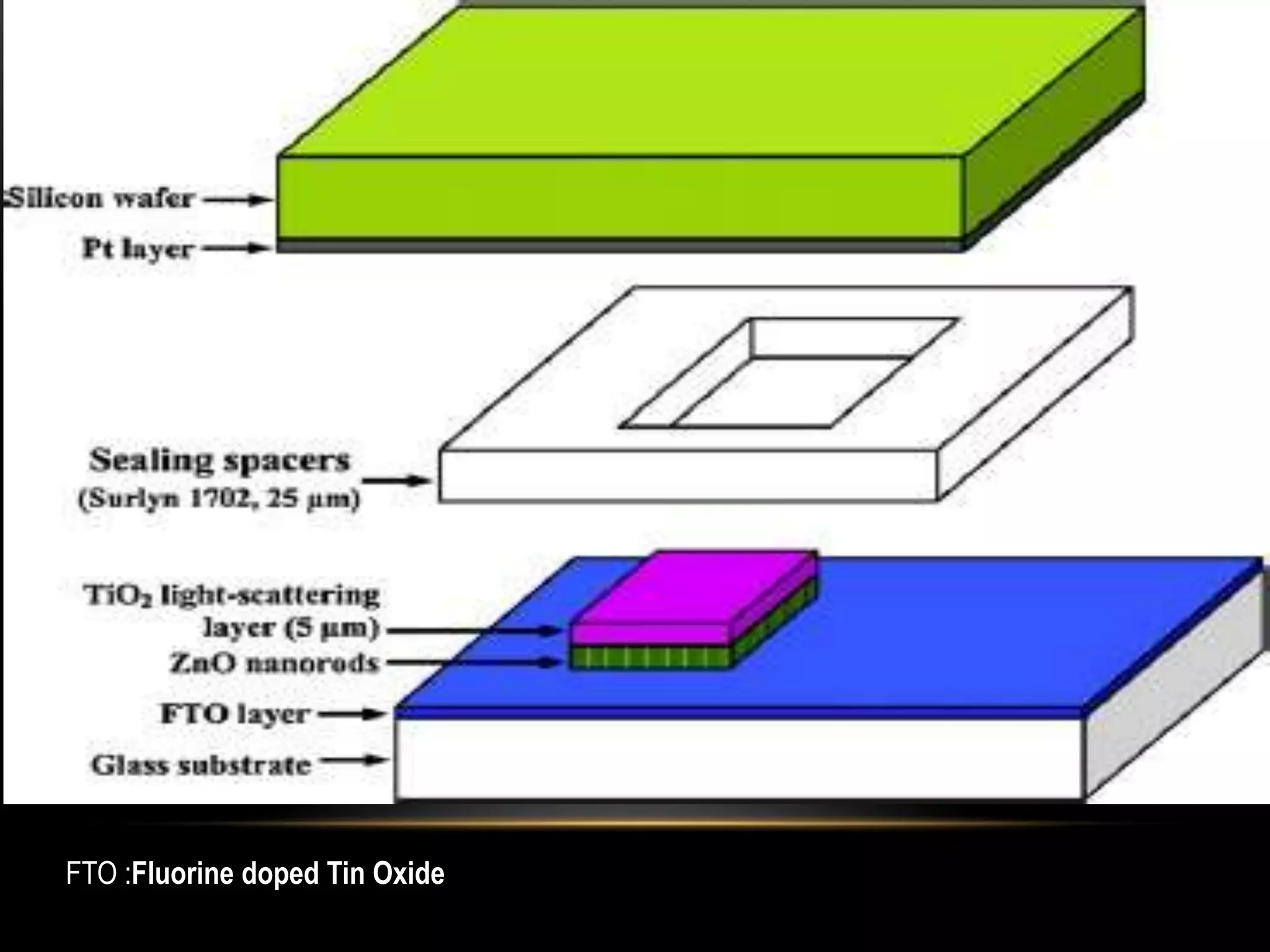
FTO :Fluorine doped Tin Oxide
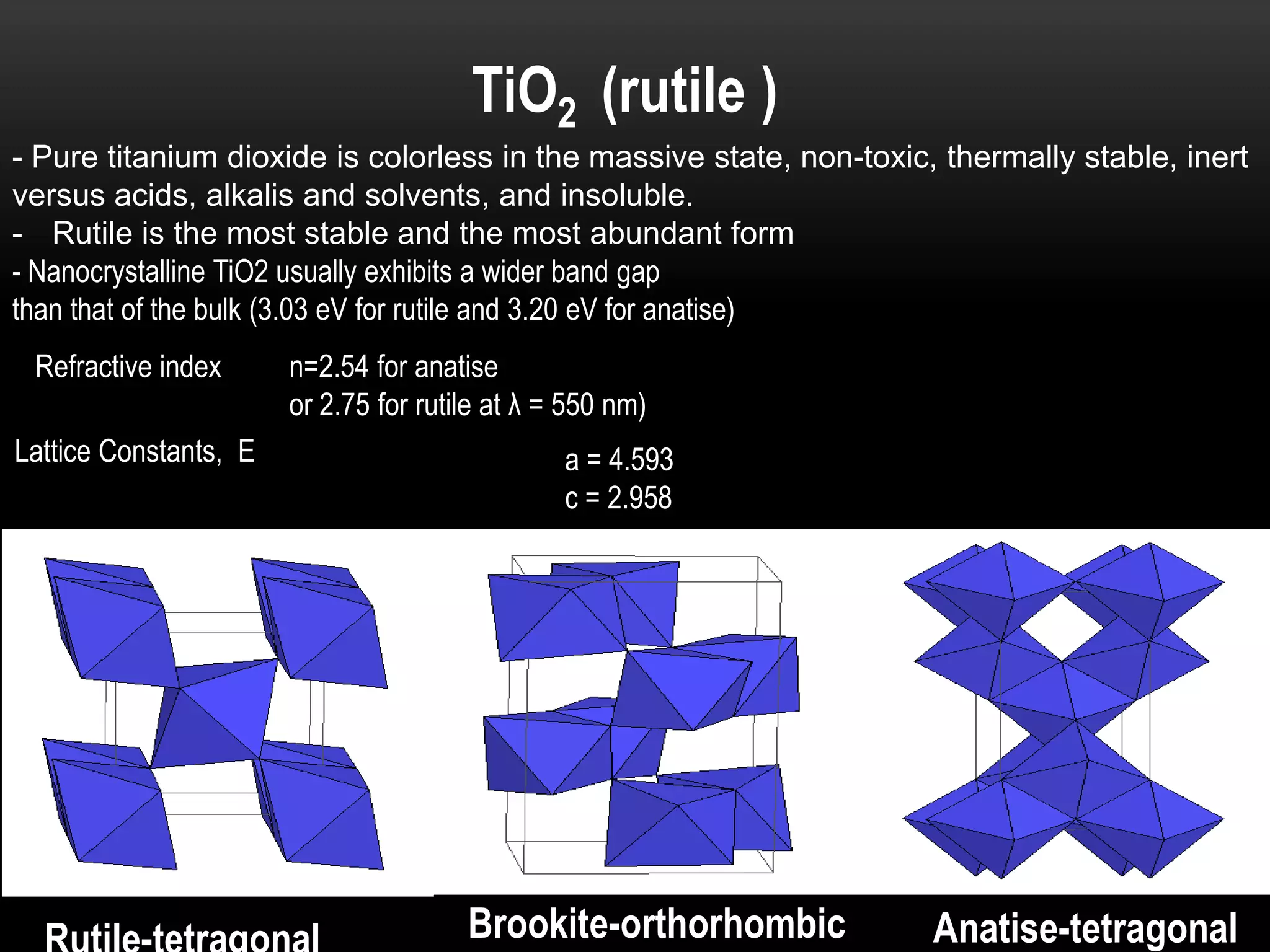
TiO2 (rutile )
- Pure titanium dioxide is colorless in the massive state, non-toxic, thermally stable, inert
versus acids, alkalis and solvents, and insoluble.
- Rutile is the most stable and the most abundant form
- Nanocrystalline TiO2 usually exhibits a wider band gap
than that of the bulk (3.03 eV for rutile and 3.20 eV for anatise)

Refractive index
Lattice Constants, Е

n=2.54 for anatise
or 2.75 for rutile at λ = 550 nm)
a = 4.593
c = 2.958

Brookite-orthorhombic

Anatise-tetragonal
HYDROTHERMAL METHODS
• The term “hydrothermal” usually refers to any heterogeneous reaction in
the presence of aqueous solvents or mineralizers under high pressure
and temperature conditions to dissolve and recrystallize materials that are
relatively insoluble under ordinary conditions.
• Uses : A large number of compounds belonging to practically all classes
have been synthesized under hydrothermal conditions: elements, simple
and complex oxides , tungstates , molybdates , carbonates, silicates ,
germanates etc. Hydrothermal synthesis is commonly used to grow
synthetic quartz , gems and other single crystals with commercial value.
EXPERIMENTALPROCEDURE
• Growth of ZnO nanorods array
• Deposition of TiO 2 shells on ZnO nanorods
• Materials characterization

• X‐ray diffraction (XRD) used to phase characterization and crystalline
size,
• Scanning electron microscopy (SEM) to morphology and
microstructure investigations.

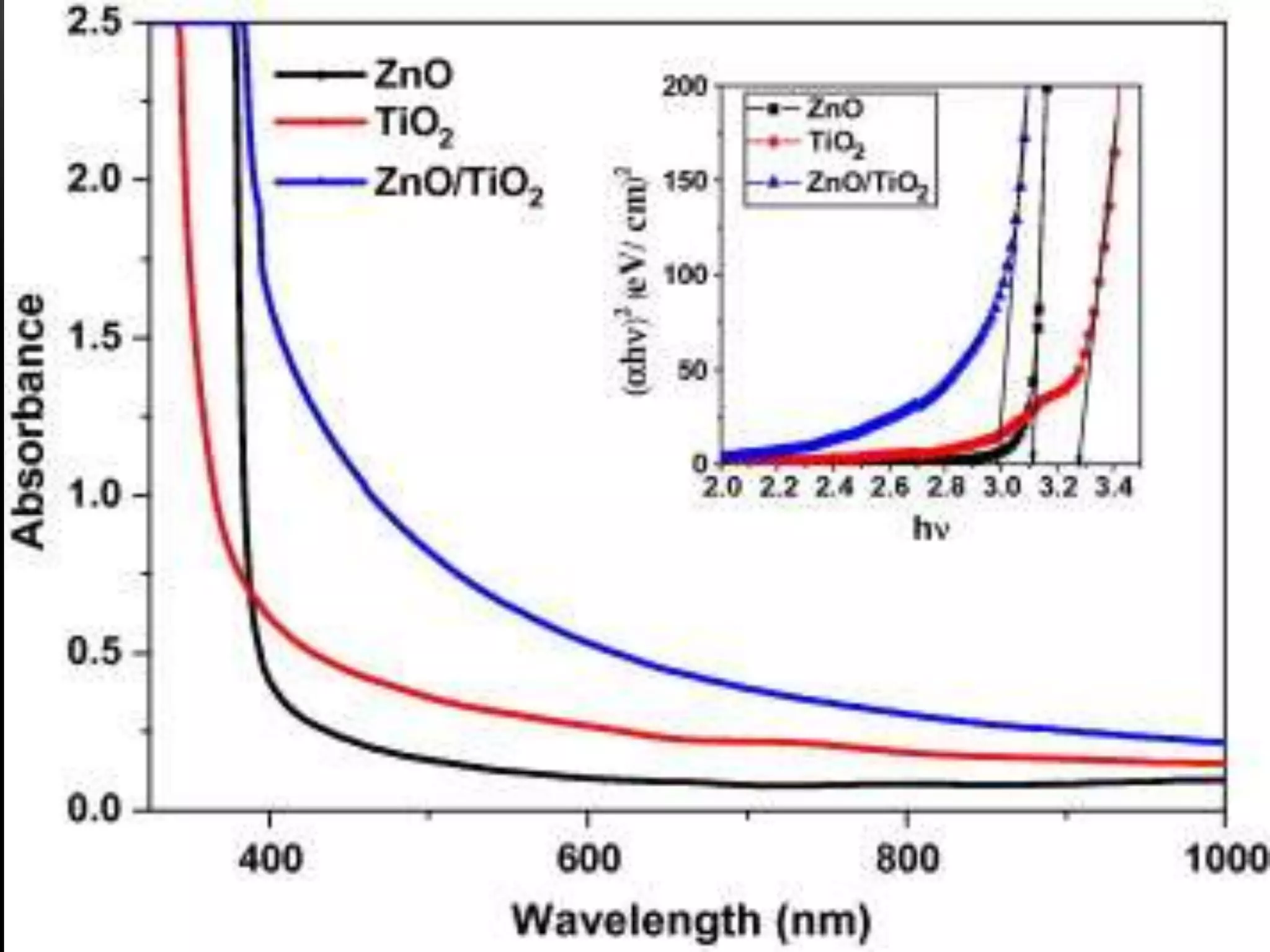
• Diffusive UV‐visible‐NIR spectrometry to band gap calculations
• Solar cell fabrication and testing
GROWTH OF ZNO NANORODS ARRAY
• Process :
- Substrate preparation
- Growth ZnO nanorod
• Prepare :
-Zn(COOCH3)2.2H2O
- Zn(NO3)2 .6H2O
- DI water
-Dimethylformamide (DMF):
(CH3)2NC(O)H
-hexamethylenetetramine C6H12N4
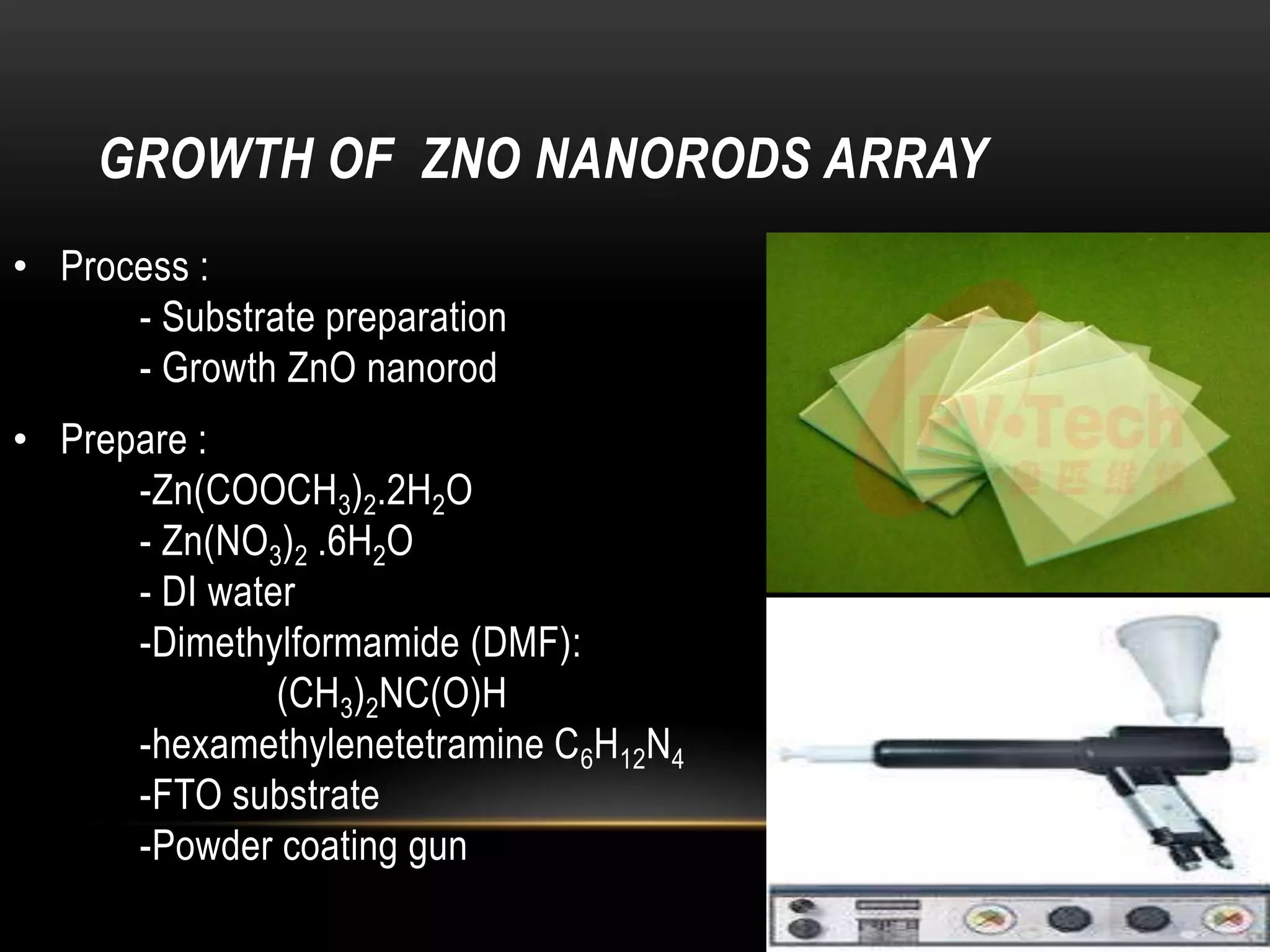
-FTO substrate
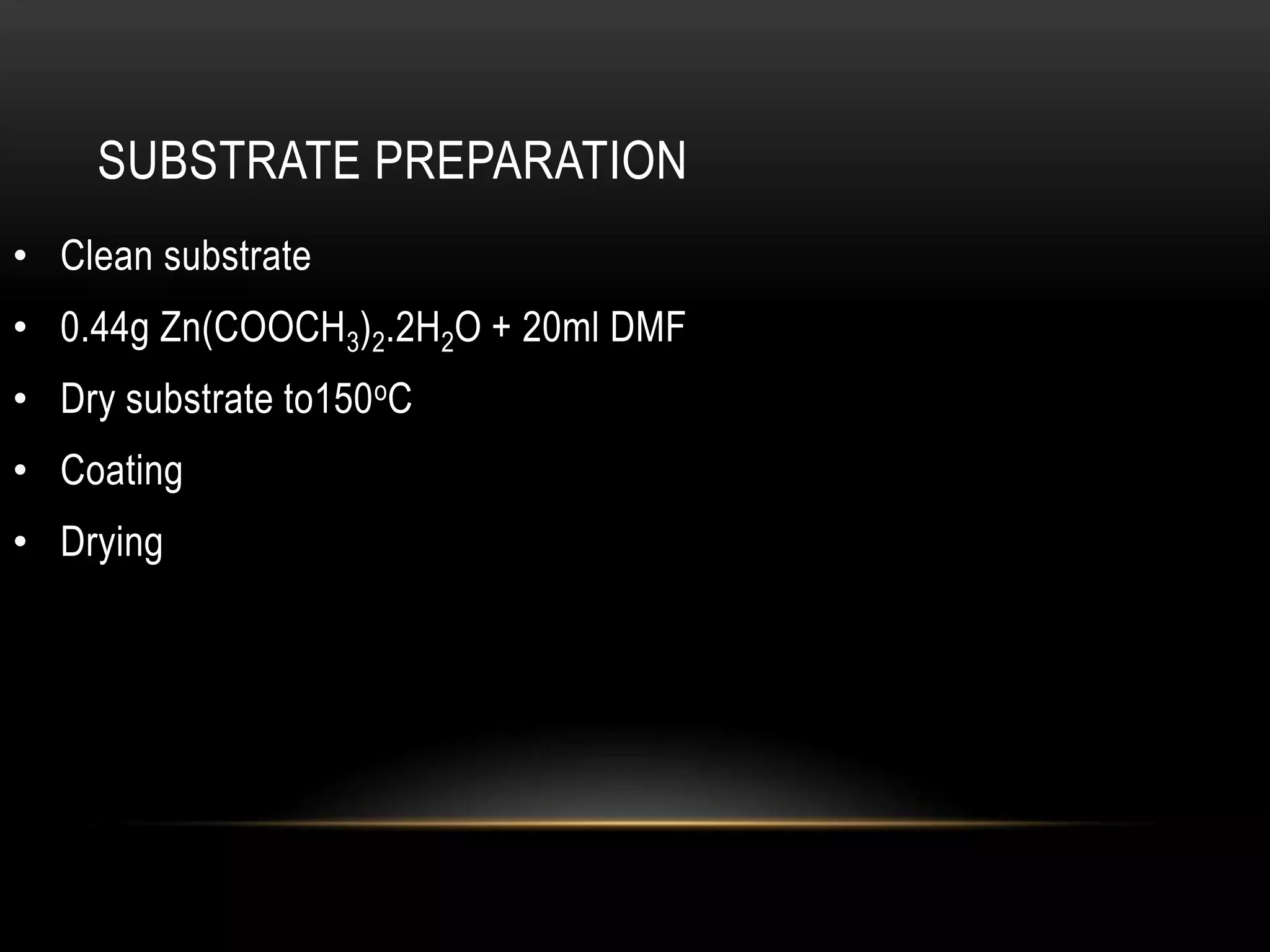
-Powder coating gun
SUBSTRATE PREPARATION
• Clean substrate

• 0.44g Zn(COOCH3)2.2H2O + 20ml DMF
• Dry substrate to150 oC
• Coating

• Drying
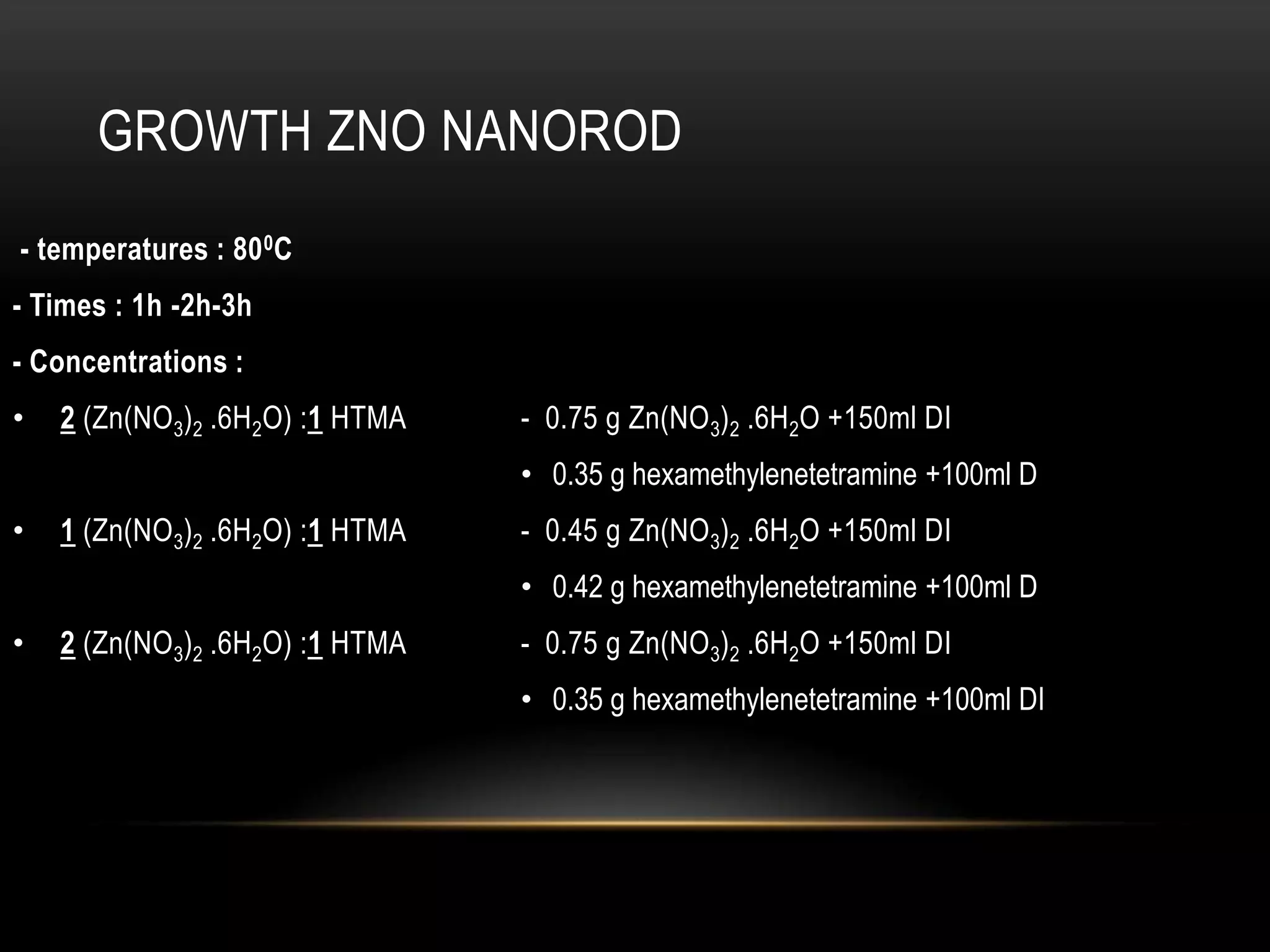
GROWTH ZNO NANOROD
- temperatures : 80 0C
- Times : 1h -2h-3h
- Concentrations :
•

2 (Zn(NO3)2 .6H2O) :1 HTMA

- 0.75 g Zn(NO 3)2 .6H2O +150ml DI
• 0.35 g hexamethylenetetramine +100ml D

•

1 (Zn(NO3)2 .6H2O) :1 HTMA

- 0.45 g Zn(NO 3)2 .6H2O +150ml DI
• 0.42 g hexamethylenetetramine +100ml D

•

2 (Zn(NO3)2 .6H2O) :1 HTMA

- 0.75 g Zn(NO 3)2 .6H2O +150ml DI
• 0.35 g hexamethylenetetramine +100ml DI
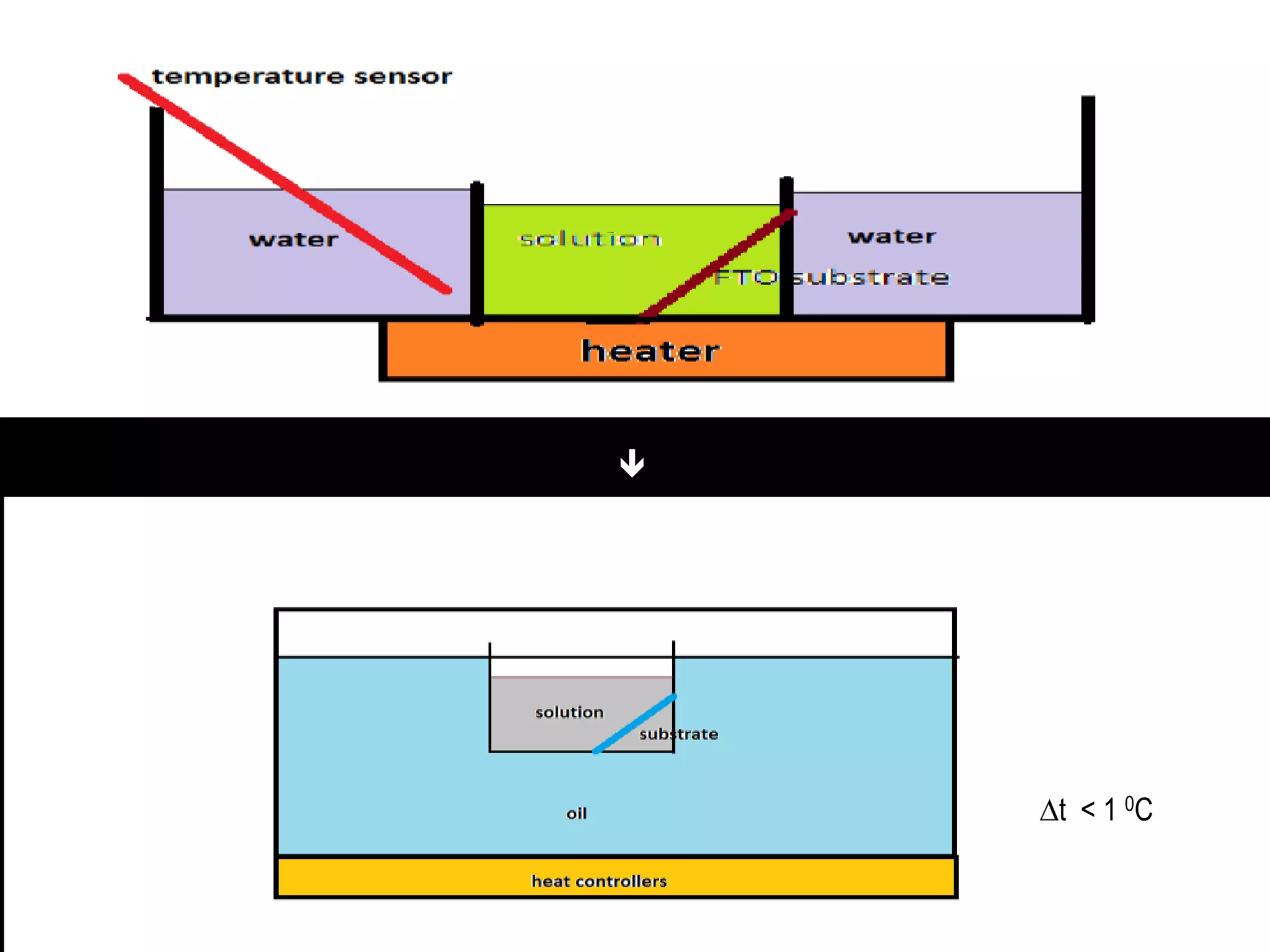

∆t < 1 0C
Heat controllers
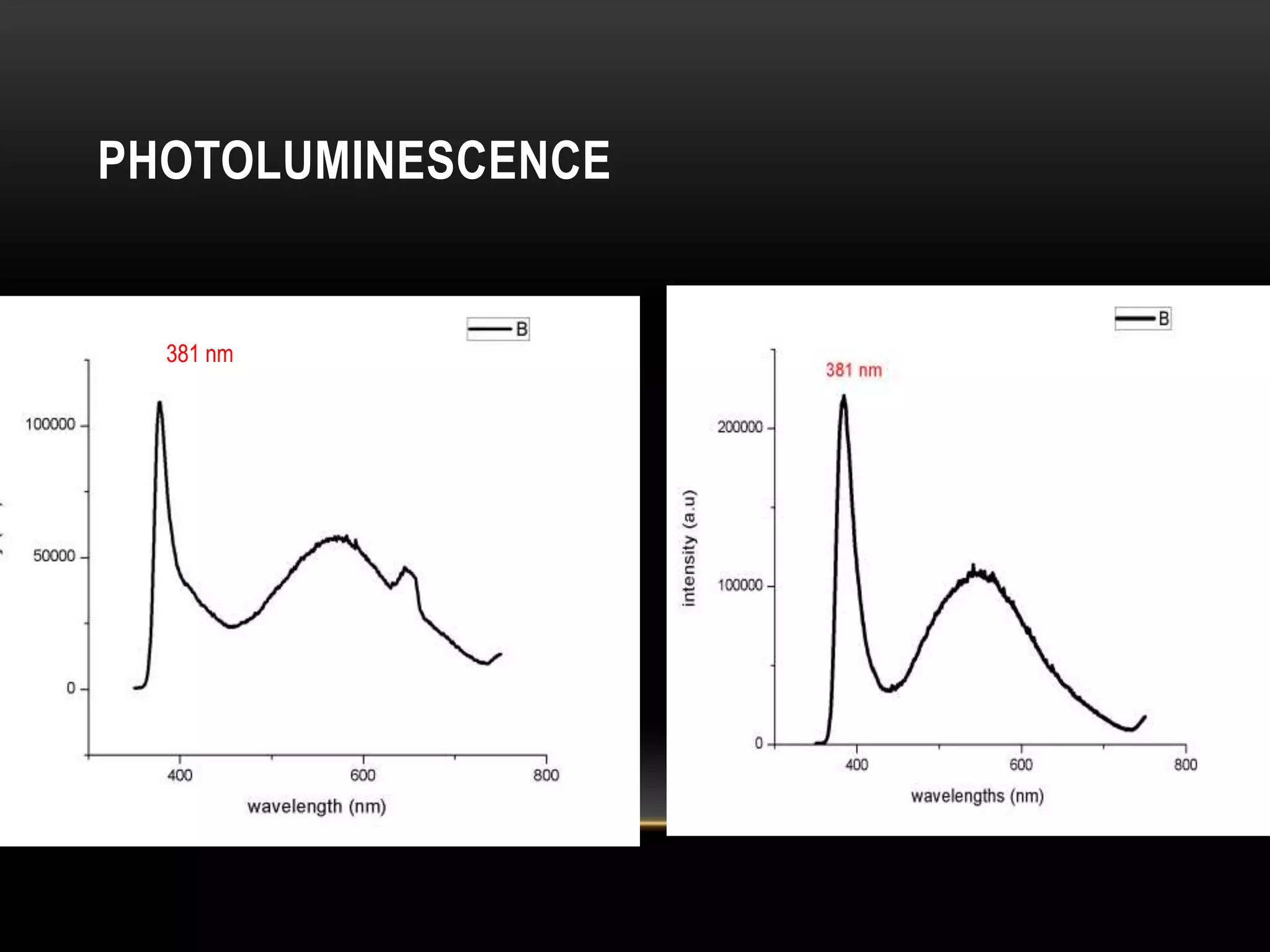
PHOTOLUMINESCENCE

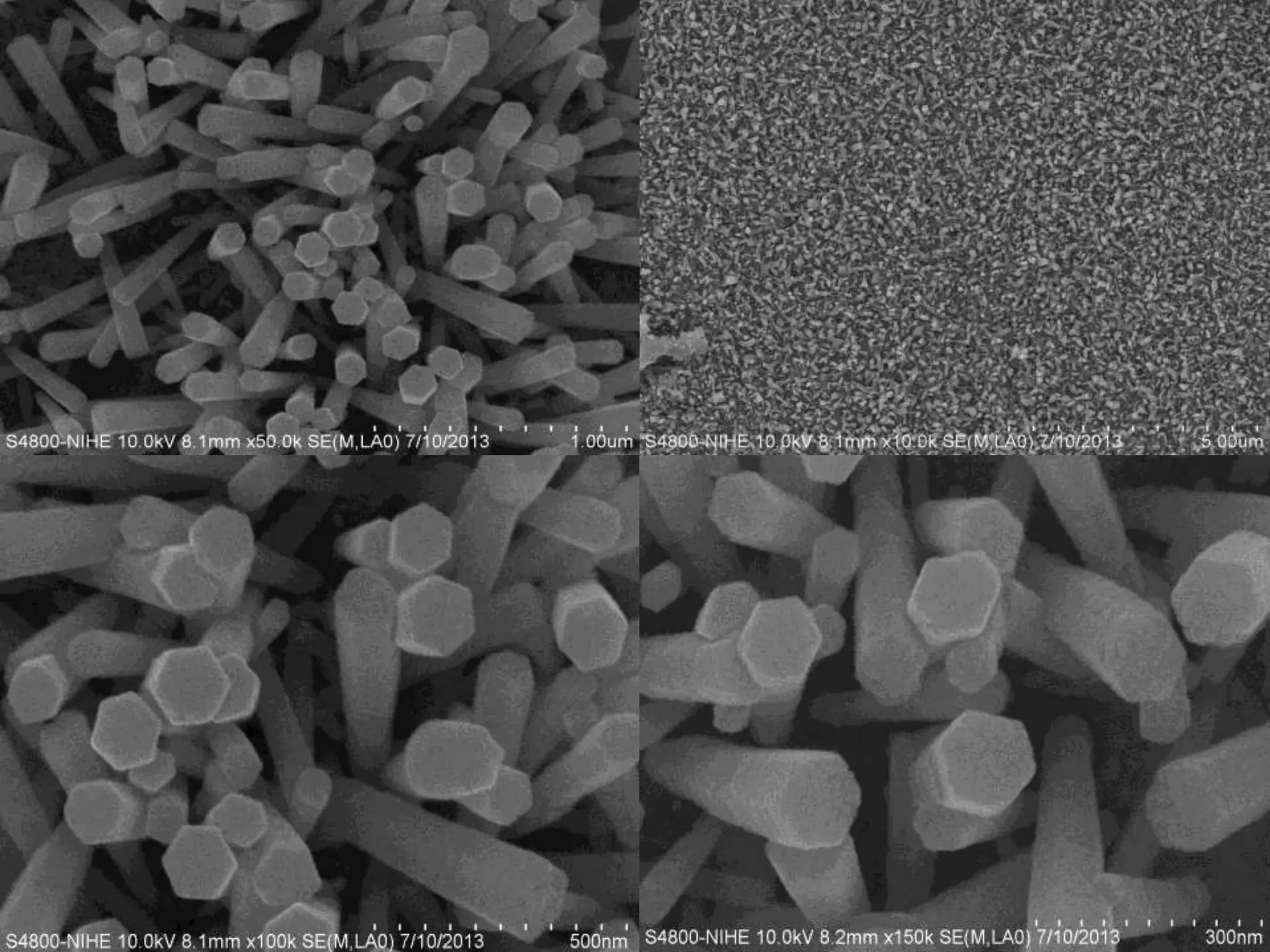
381 nm
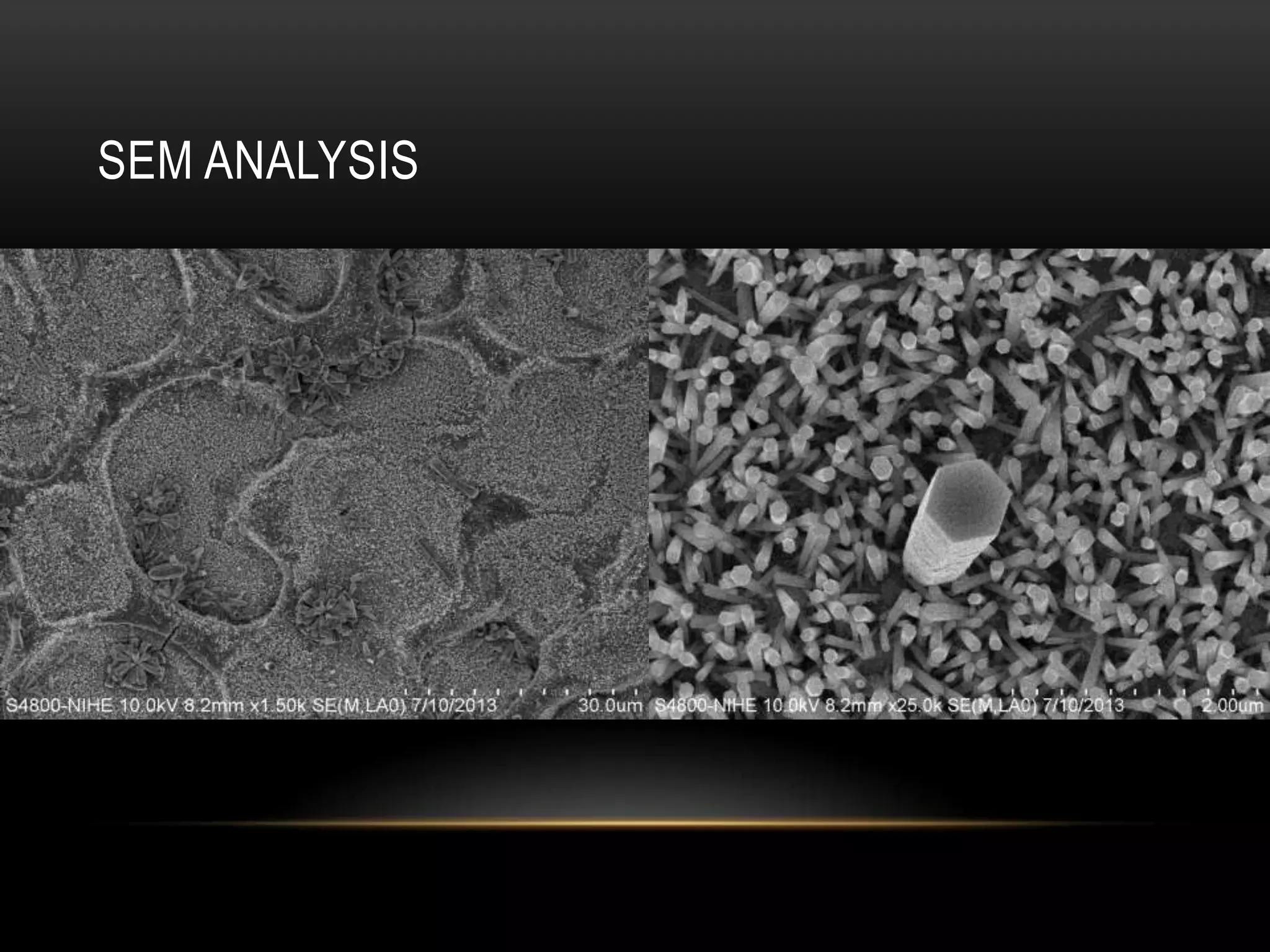
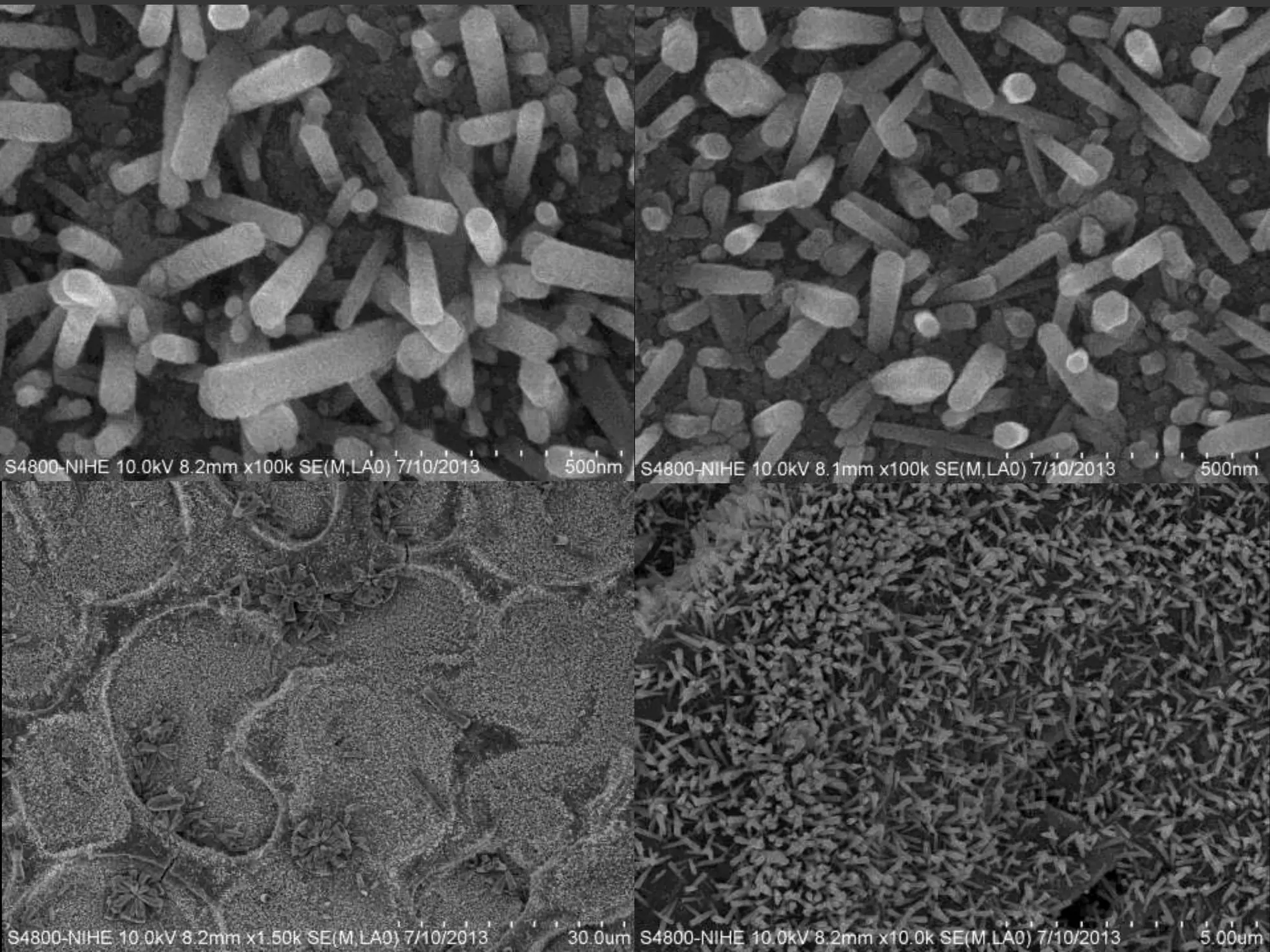
SEM ANALYSIS
DEPOSITION OF TIO 2 SHELLS ON ZNO
NANORODS
•

Preparations :
• ZnO nanorods on FTO substrate

Zno tio2 coreshell

  • 1.
    HA NOI UNIVERSITYOF SCIENCE AND TECHNOLOGY **** ADVANCED TRAINING PROGRAM **** OVERVIEWS OF INDEPENDENT STUDY: SYNTHESIS OF ZnO-TiO2 CORESHELL NANOSTRUCTURES BY HYDROTHERMAL METHOD Name : Hoàng Văn Tiến Class : MSE-K54 ID Student : 20092697 Instructor : Dr. Nguyễn Duy Hùng-AIST
  • 2.
    OUTLINE : • Whyi choose this topic? • ZnO-TiO2 overviews • Hydrothermal methods • Process of researching • Analysis method • Results and discussions • Summary
  • 3.
    WHY I CHOOSETHIS TOPIC ? Types of solar cell : - Buried contact solar cell • Cadmium telluride solar cell • Copper indium gallium selenide solar cells • Dye-sensitized solar cell • Gallium arsenide germanium solar cell • Hybrid solar cell • - Organic solar cell - Nanocrystal solar cell - Plasmonic solar cell - Plastic solar cell - Polycrystalline solar cell - Polymer solar cell - Quantum dot solar cell - Solid-state solar cell - Thin film solar cell - Monocrystalline solar cell - Multijunction solar cell - ……………………….
  • 4.
    WHY I CHOOSETHIS TOPIC ? • Harmful organic compounds in the ecological unit are the main concern for the scientific society, which is causative agent of water pollution and severe contamination of the environment. Waste-water containing organic dyes (organicpollutants) inhibit sunlight penetration which suppressesphotosynthetic reaction. • Metal oxide semi-conducting nano materials have been proven to be very efficient photocatalysts for the degradation of organic dye pollutants with the help of solar light. In particular, TiO2 and ZnO are the most versatile semiconductor oxides with applications across a wide range from cosmetics to air purification. • However, the poor consumption of solar energy and the short diffusion length of photogenerated exciton are the two key factors restrictive to further improvement of photocatalytic efficiency develop new and efficient sunlight-sensitive photocatalysts. • 
  • 5.
  • 7.
    TiO2 (rutile ) -Pure titanium dioxide is colorless in the massive state, non-toxic, thermally stable, inert versus acids, alkalis and solvents, and insoluble. - Rutile is the most stable and the most abundant form - Nanocrystalline TiO2 usually exhibits a wider band gap than that of the bulk (3.03 eV for rutile and 3.20 eV for anatise) Refractive index Lattice Constants, Е n=2.54 for anatise or 2.75 for rutile at λ = 550 nm) a = 4.593 c = 2.958 Brookite-orthorhombic Anatise-tetragonal
  • 10.
    HYDROTHERMAL METHODS • Theterm “hydrothermal” usually refers to any heterogeneous reaction in the presence of aqueous solvents or mineralizers under high pressure and temperature conditions to dissolve and recrystallize materials that are relatively insoluble under ordinary conditions. • Uses : A large number of compounds belonging to practically all classes have been synthesized under hydrothermal conditions: elements, simple and complex oxides , tungstates , molybdates , carbonates, silicates , germanates etc. Hydrothermal synthesis is commonly used to grow synthetic quartz , gems and other single crystals with commercial value.
  • 12.
    EXPERIMENTALPROCEDURE • Growth ofZnO nanorods array • Deposition of TiO 2 shells on ZnO nanorods • Materials characterization • X‐ray diffraction (XRD) used to phase characterization and crystalline size, • Scanning electron microscopy (SEM) to morphology and microstructure investigations. • Diffusive UV‐visible‐NIR spectrometry to band gap calculations • Solar cell fabrication and testing
  • 13.
    GROWTH OF ZNONANORODS ARRAY • Process : - Substrate preparation - Growth ZnO nanorod • Prepare : -Zn(COOCH3)2.2H2O - Zn(NO3)2 .6H2O - DI water -Dimethylformamide (DMF): (CH3)2NC(O)H -hexamethylenetetramine C6H12N4 -FTO substrate -Powder coating gun
  • 14.
    SUBSTRATE PREPARATION • Cleansubstrate • 0.44g Zn(COOCH3)2.2H2O + 20ml DMF • Dry substrate to150 oC • Coating • Drying
  • 15.
    GROWTH ZNO NANOROD -temperatures : 80 0C - Times : 1h -2h-3h - Concentrations : • 2 (Zn(NO3)2 .6H2O) :1 HTMA - 0.75 g Zn(NO 3)2 .6H2O +150ml DI • 0.35 g hexamethylenetetramine +100ml D • 1 (Zn(NO3)2 .6H2O) :1 HTMA - 0.45 g Zn(NO 3)2 .6H2O +150ml DI • 0.42 g hexamethylenetetramine +100ml D • 2 (Zn(NO3)2 .6H2O) :1 HTMA - 0.75 g Zn(NO 3)2 .6H2O +150ml DI • 0.35 g hexamethylenetetramine +100ml DI
  • 16.
     ∆t < 10C Heat controllers
  • 17.
  • 18.
  • 21.
    DEPOSITION OF TIO2 SHELLS ON ZNO NANORODS • Preparations : • ZnO nanorods on FTO substrate

Editor's Notes

  • #2 Guidance : sựhướngdẫn
  • #6 Overall peak power conversion efficiency for current DSSCs is about 11%Current record for prototypes lies at 15%Dresden, Germany, January 16, 2013 – Heliatek GmbH, the leader in organic solar films, today announced a record breaking 12.0% cell efficiency for its organic solar cells. This world record, established in cooperation with the University of Ulm and TU Dresden, was measured by the accredited testing facility SGS. The measurement campaign at SGS also validated the superior low light and high temperature performances of organic photovoltaics (OPV) compared to traditional solar technologies.
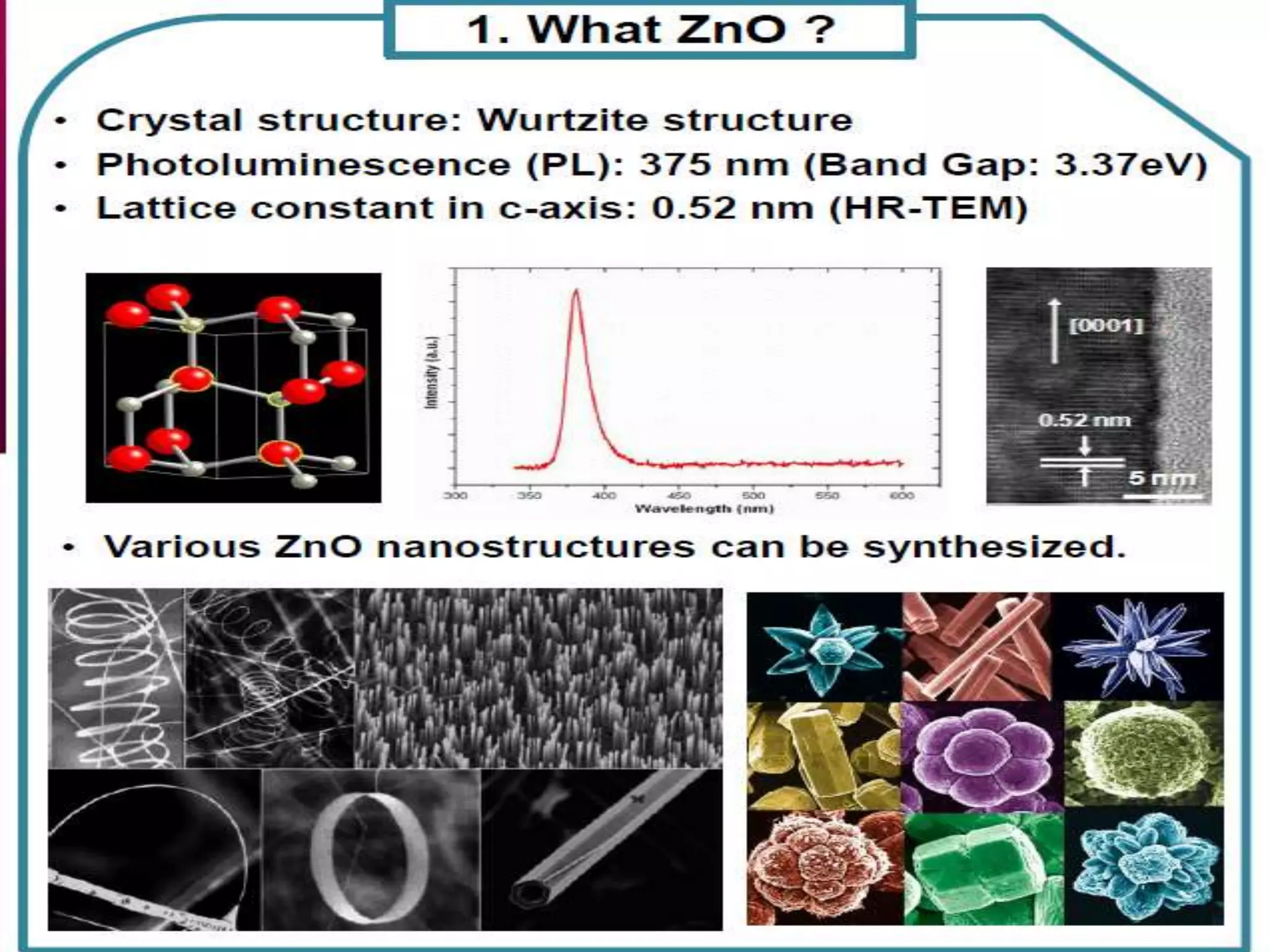
  • #7 Wurtzite :Hexagonal structures, same as CdSe, GaN…..
  • #8 refractive index (n=2.54 for anataseor 2.75 for rutile at 􀀁 = 550 nm)