Seminar: Fuel cells


  Class: Materials Science Engineering
  Teacher : Phạ m Ngọ c Diệ u Quỳnh
  Student: Hoàng Văn Tiế n
                                         Hanoi 6-6-2012
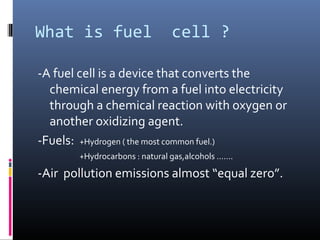
What is fuel                    cell ?

-A fuel cell is a device that converts the
  chemical energy from a fuel into electricity
  through a chemical reaction with oxygen or
  another oxidizing agent.
-Fuels: +Hydrogen ( the most common fuel.)
       +Hydrocarbons : natural gas,alcohols ..…..

-Air pollution emissions almost “equal zero”.
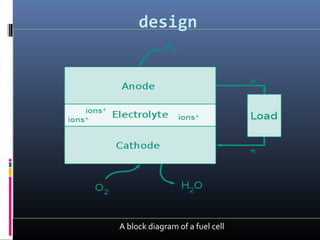
design


A block diagram of a fuel cell
clasification

Based on types of electrolyte:
 polymer electrolyte membrand fuel cell
 alkaline fuel cell
 phosphoric acid fuel cell
 molten carbonat fuel cell
 solid oxides fuel cell
Case study: polymer electrolite membran fuel cell (PEMFC)
reactions
-Anode :       H2 --- 2H+ +2e-
  *E =0 VSHE (standard hidrogen electrode)


-Cathode:      1/2O2 +2H+ +2e- --->H2O
  *E0=1.229 VSHE


Overall reaction:     H2 +1/2O2 -- H2O
  *E0=1.229 VSHE
Electrochemical Aspects
-The standard free energy change of the fuel cell reaction is
  indicated by the equation :
                     ∆G = –nFE-
The value of ∆G corresponding :
       *∆G= −229 kJ/mol,
       *n = 2,
       *F = 96500 C/g.mole electron,
   ⇒ E = 1.229 V.

The enthalpy change ∆H for a fuel cell reaction:
             ∆H = –nFEt
-Nernst equation :
  E = E0+ (RT/2F) ln [PH2/PH2O] + (RT/2F) ln [PO2 1/2]
Thermodynamic Principles
-The maximum electrical work obtainable in a fuel cell
  operating at constant temperature and pressure is
  given by the change in the Gibbs free energy of the
  electrochemical reaction:
                  W = ∆G = –nFE

-The difference between ∆G and ∆H is proportional to
  the change in entropy ∆S:
                  ∆G = ∆H – T∆S
 The effect of temperature and pressure on
   the cell potential:


− ∆V: change in volume,
   ∆S : entropy change,
   E :cell poten-tial,
   T:temperature,
   P :reactant gas pressure,
   n :the number of electrons transferred,
   F: Faraday’s constant.
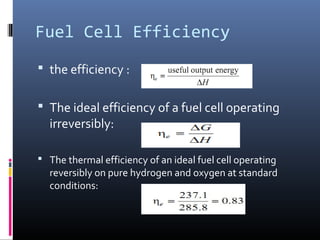
Fuel Cell Efficiency
 the efficiency :


 The ideal efficiency of a fuel cell operating
  irreversibly:

 The thermal efficiency of an ideal fuel cell operating
  reversibly on pure hydrogen and oxygen at standard
  conditions:
 The thermal efficiency of the fuel cell ( in
  terms of the actual cell voltage):


 Based on the higher heating value of
  hydrogen:
Advantages and
disadvantages
Applicaions
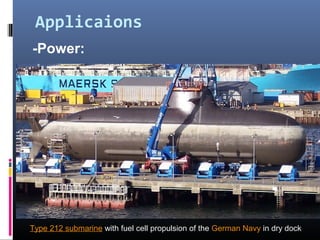
-Power:


Type 212 submarine with fuel cell propulsion of the German Navy in dry dock
Other applications
 Providing power for base stations or cell sites
 Distributed generation
 An uninterrupted power supply (UPS)
 Base load power plants
 Fuel cell APU for Refuse Collection Vehicle
 Hybrid vehicles, pairing the fuel cell with either an ICE or a battery.
 Notebook computers for applications where AC charging may not be
   readily available.
 Portable charging docks for small electronics (e.g. a belt clip that
   charges your cell phones or PDA).
 Smartphones, laptops and tablets.
 Small heating appliances.
References

 www.wikipedia.org
 Nice, Karim and Strickland,Jonathan. "How
  Fuel Cells Work: Polymer Exchange
  Membrane Fuel Cells". How Stuff Works,
  accessed August 4, 2011
 www.fuelcells.org
 www.fuelcellenergy.com
 onlinelibrary.wiley.com
Fuel cell

Fuel cell

  • 1.
    Seminar: Fuel cells Class: Materials Science Engineering Teacher : Phạ m Ngọ c Diệ u Quỳnh Student: Hoàng Văn Tiế n Hanoi 6-6-2012
  • 3.
    What is fuel cell ? -A fuel cell is a device that converts the chemical energy from a fuel into electricity through a chemical reaction with oxygen or another oxidizing agent. -Fuels: +Hydrogen ( the most common fuel.) +Hydrocarbons : natural gas,alcohols ..….. -Air pollution emissions almost “equal zero”.
  • 4.
    design A block diagramof a fuel cell
  • 5.
    clasification Based on typesof electrolyte:  polymer electrolyte membrand fuel cell  alkaline fuel cell  phosphoric acid fuel cell  molten carbonat fuel cell  solid oxides fuel cell
  • 6.
    Case study: polymerelectrolite membran fuel cell (PEMFC)
  • 8.
    reactions -Anode : H2 --- 2H+ +2e- *E =0 VSHE (standard hidrogen electrode) -Cathode: 1/2O2 +2H+ +2e- --->H2O *E0=1.229 VSHE Overall reaction: H2 +1/2O2 -- H2O *E0=1.229 VSHE
  • 9.
    Electrochemical Aspects -The standardfree energy change of the fuel cell reaction is indicated by the equation : ∆G = –nFE- The value of ∆G corresponding : *∆G= −229 kJ/mol, *n = 2, *F = 96500 C/g.mole electron, ⇒ E = 1.229 V. The enthalpy change ∆H for a fuel cell reaction: ∆H = –nFEt -Nernst equation : E = E0+ (RT/2F) ln [PH2/PH2O] + (RT/2F) ln [PO2 1/2]
  • 10.
    Thermodynamic Principles -The maximumelectrical work obtainable in a fuel cell operating at constant temperature and pressure is given by the change in the Gibbs free energy of the electrochemical reaction: W = ∆G = –nFE -The difference between ∆G and ∆H is proportional to the change in entropy ∆S: ∆G = ∆H – T∆S
  • 11.
     The effectof temperature and pressure on the cell potential: − ∆V: change in volume, ∆S : entropy change, E :cell poten-tial, T:temperature, P :reactant gas pressure, n :the number of electrons transferred, F: Faraday’s constant.
  • 12.
    Fuel Cell Efficiency the efficiency :  The ideal efficiency of a fuel cell operating irreversibly:  The thermal efficiency of an ideal fuel cell operating reversibly on pure hydrogen and oxygen at standard conditions:
  • 13.
     The thermalefficiency of the fuel cell ( in terms of the actual cell voltage):  Based on the higher heating value of hydrogen:
  • 14.
  • 15.
    Applicaions -Power: Type 212 submarinewith fuel cell propulsion of the German Navy in dry dock
  • 18.
    Other applications  Providingpower for base stations or cell sites  Distributed generation  An uninterrupted power supply (UPS)  Base load power plants  Fuel cell APU for Refuse Collection Vehicle  Hybrid vehicles, pairing the fuel cell with either an ICE or a battery.  Notebook computers for applications where AC charging may not be readily available.  Portable charging docks for small electronics (e.g. a belt clip that charges your cell phones or PDA).  Smartphones, laptops and tablets.  Small heating appliances.
  • 19.
    References  www.wikipedia.org  Nice,Karim and Strickland,Jonathan. "How Fuel Cells Work: Polymer Exchange Membrane Fuel Cells". How Stuff Works, accessed August 4, 2011  www.fuelcells.org  www.fuelcellenergy.com  onlinelibrary.wiley.com

Editor's Notes

  • #5 Fuel cells come in many varieties; however, they all work in the same general manner. They are made up of three adjacent segments: the anode , the electrolyte , and the cathode . Two chemical reactions occur at the interfaces of the three different segments. The net result of the two reactions is that fuel is consumed, water or carbon dioxide is created, and an electric current is created, which can be used to power electrical devices, normally referred to as the load. Lớp thứ nhất là  điện cực  nhiên liệu (cực dương), lớp thứ hai là  chất điện phân  dẫn  ion  và lớp thứ ba là điện cực khí ôxy (cực âm). Hai điện cực được làm bằng  chất dẫn điện  ( kim loại ,  than chì , ...). Chất điện phân được dùng là nhiều chất khác nhau tùy thuộc vào loại của tế bào nhiên liệu, có loại ở  thể rắn , có loại ở  thể lỏng  và có cấu trúc  màng . Vì một tế bào riêng lẻ chỉ tạo được một  điện thế  rất thấp cho nên tùy theo điện thế cần dùng nhiều tế bào riêng lẻ được nối kế tiếp vào nhau, tức là chồng lên nhau. Người ta thường gọi một lớp chồng lên nhau như vậy là stack. Ngoài ra, hệ thống đầy đủ cần có các thiết bị phụ trợ như máy nén, máy bơm, để cung cấp các khí đầu vào, máy trao đổi nhiệt, hệ thống kiểm tra các yêu cầu, sự chắc chắn của sự vận hành máy, hệ thống dự trữ và điều chế nhiên liệu.
  • #8 The junction of dissimilar materials (n and p type silicon) creates a voltage Energy from sunlight knocks out electrons, creating a electron and a hole in the junction Connecting both sides to an external circuit causes current to flow Khi một  photon  chạm vào mảnh  silic , một trong hai điều sau sẽ xảy ra: Photon truyền trực xuyên qua mảnh silic. Điều này thường xảy ra khi năng lượng của photon thấp hơn năng lượng đủ để đưa các hạt electron lên mức năng lượng cao hơn. Năng lượng của photon được hấp thụ bởi silic. Điều này thường xảy ra khi năng lượng của photon lớn hơn năng lượng để đưa electron lên mức năng lượng cao hơn.
  • #9 Các proton mới được thành lập thấm qua màng điện phân polymer phía cực âm. Các electron di chuyển dọc theo bên ngoài mạch tải phía cực âm của MEA, do đó tạo ra hiện tại đầu ra của các tế bào nhiên liệu. Trong khi đó, một dòng khí oxy được chuyển giao cho phía cực âm của các MEA. Ở phía cathode các phân tử oxy phản ứng với các proton thấm nhuần thông qua màng polymer điện phân và electron đến thông qua các mạch điện bên ngoài để tạo thành phân tử nước The newly formed protons permeate through the polymer electrolyte membrane to the cathode side. The electrons travel along an external load circuit to the cathode side of the MEA, thus creating the current output of the fuel cell. Meanwhile, a stream of oxygen is delivered to the cathode side of the MEA. At the cathode side oxygen molecules react with the protons permeating through the polymer electrolyte membrane and the electrons arriving through the external circuit to form water molecules
  • #10 The standard free energy change of the fuel cell reaction is indicated by the equation ∆ G = –nFE (2.2) Where ∆G is the free energy change, n is the number of moles of electrons in-volved, E is the reversible potential, and F is Faraday’s constant. If the reactants and the products are in their standard states, the equation can be represented as ∆ G0 = –nFE0 (2.3) The value of ∆G corresponding to (2.1) is −229 kJ/mol, n = 2, F = 96500 C/g.mole electron, and hence the calculated value of E is 1.229 V. The enthalpy change ∆H for a fuel cell reaction indicates the entire heat re-leased by the reaction at constant pressure. The fuel cell potential in accordance with ∆H is defined as the thermo-neutral potential, Et, ∆ H = –nFEt (2.4) where Et has a value of 1.48 VThe standard free energy change of the fuel cell reaction is indicated by the equation ∆ G = –nFE (2.2) Where ∆G is the free energy change, n is the number of moles of electrons in-volved, E is the reversible potential, and F is Faraday’s constant. If the reactants and the products are in their standard states, the equation can be represented as ∆ G0 = –nFE0 (2.3) The value of ∆G corresponding to (2.1) is −229 kJ/mol, n = 2, F = 96500 C/g.mole electron, and hence the calculated value of E is 1.229 V. The enthalpy change ∆H for a fuel cell reaction indicates the entire heat re-leased by the reaction at constant pressure. The fuel cell potential in accordance with ∆H is defined as the thermo-neutral potential, Et, ∆ H = –nFEt (2.4) where Et has a value of 1.48 V
  • #16 Type 212 submarine  with fuel cell propulsion of the German Navy in dry dock