Linear Optics vs Non Linear Optics
Linear optics- ‘Optics of weak light’:
  Light is deflected or delayed but its frequency is
  unchanged.
   Superposition principle holds

Non-Linear optics-‘Optics of intense light’:
 We are concerned with the effects that light itself induces
 as it propagates through the medium.
  Superposition principle not valid
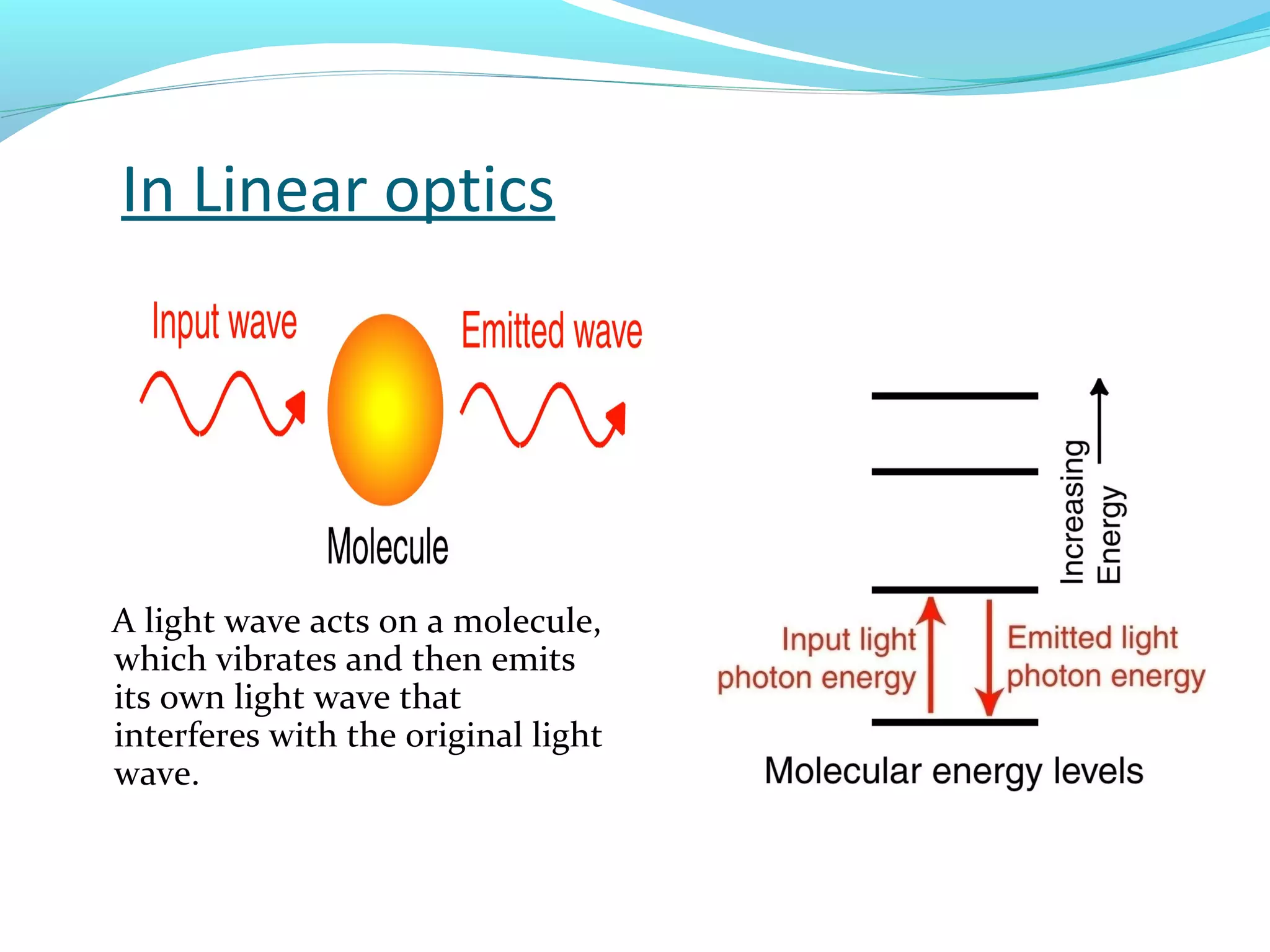
In Linear optics


A light wave acts on a molecule,
which vibrates and then emits
its own light wave that
interferes with the original light
wave.
In Non-Linear Optics


                       If irradiance is high enough
                       vibrations at all frequencies
                       corresponding to all energy
                       differences between populated
                       states are produced.
OPTICS – A LIGHT MATTER
INTERACTION

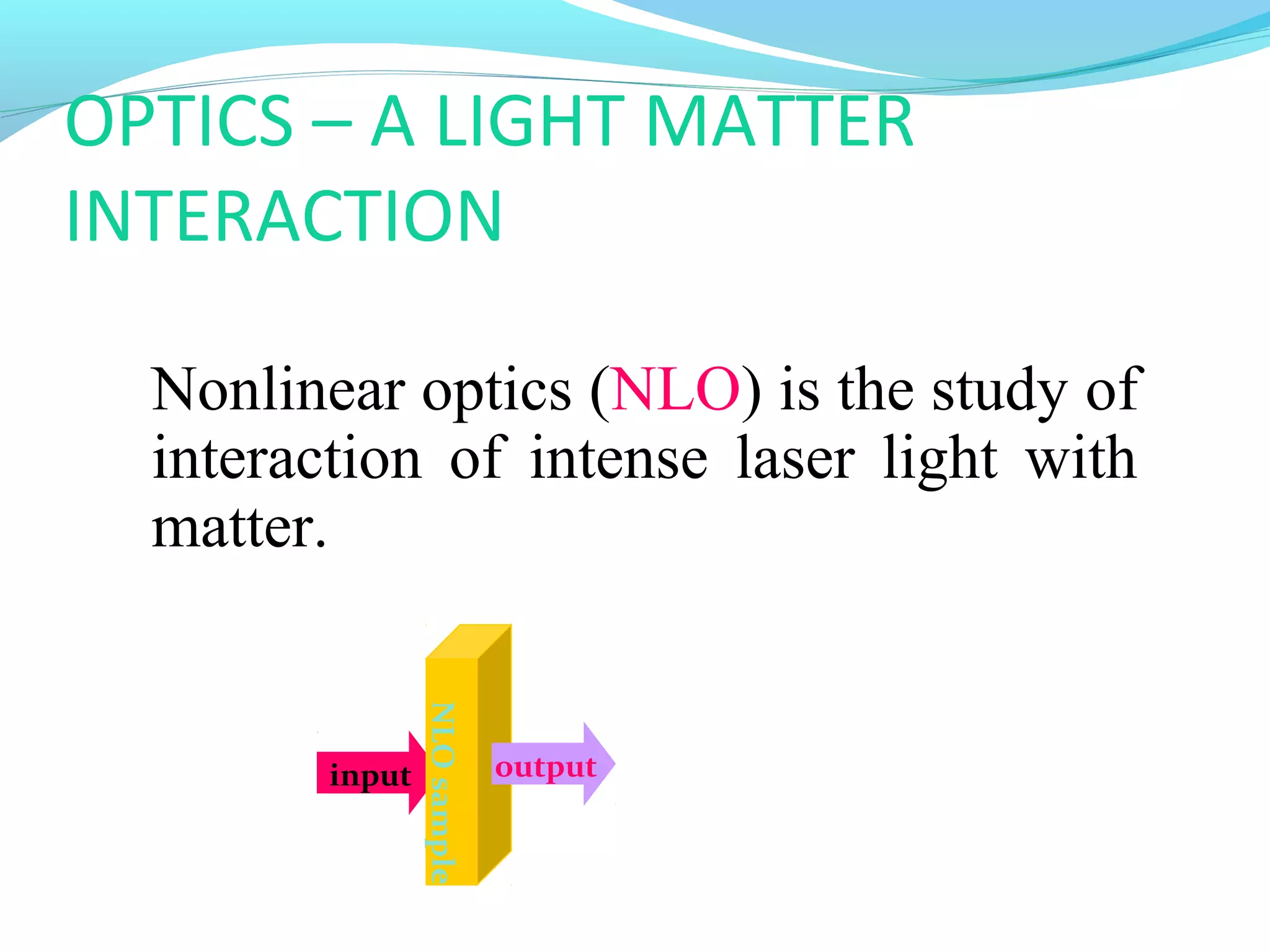
  Nonlinear optics (NLO) is the study of
  interaction of intense laser light with
  matter.
                 NLO sample


         input                output
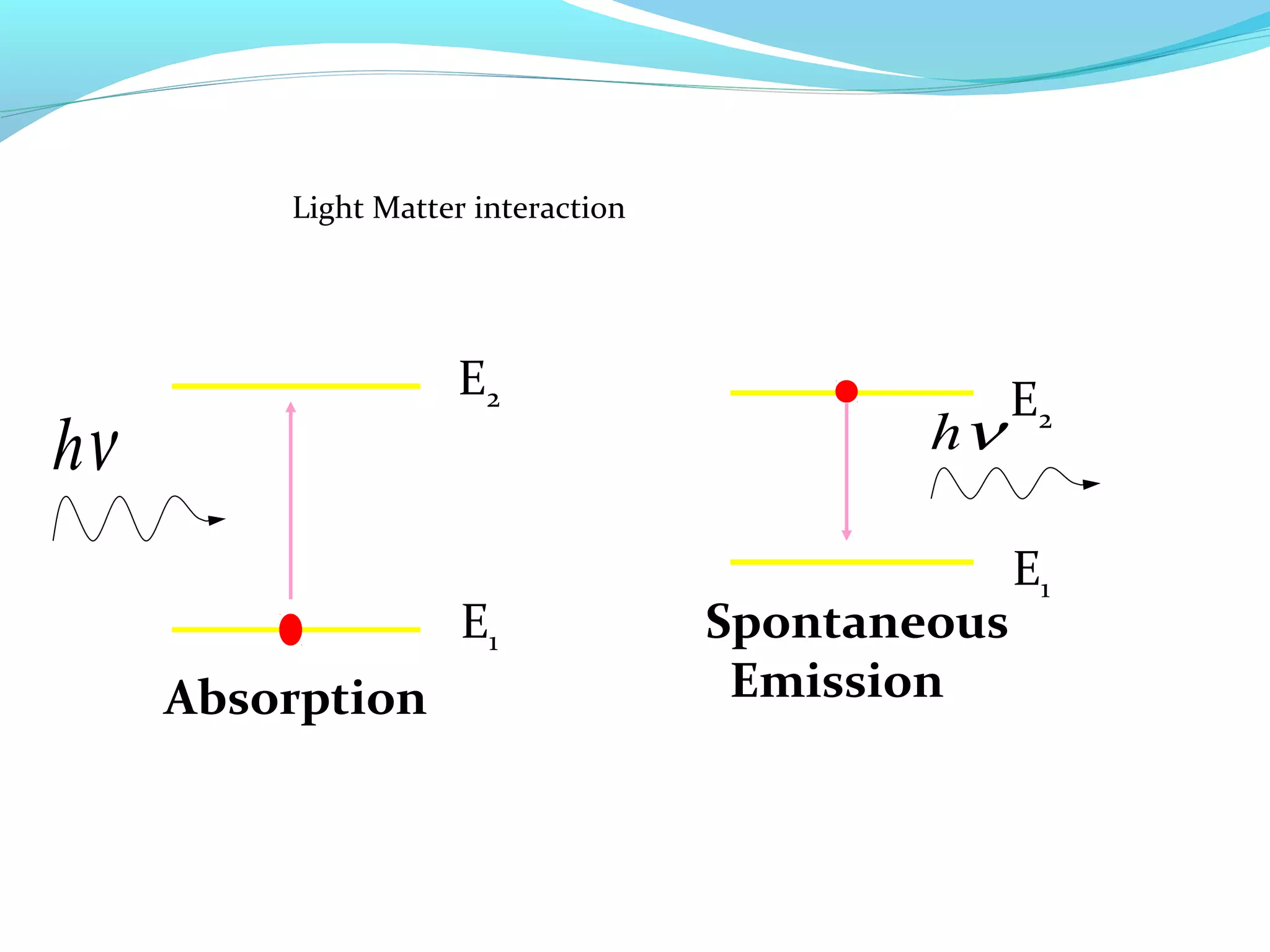
Light Matter interaction


                    E2                            E2
hν                                          hν

                                                  E1
                     E1             Spontaneous
     Absorption                      Emission
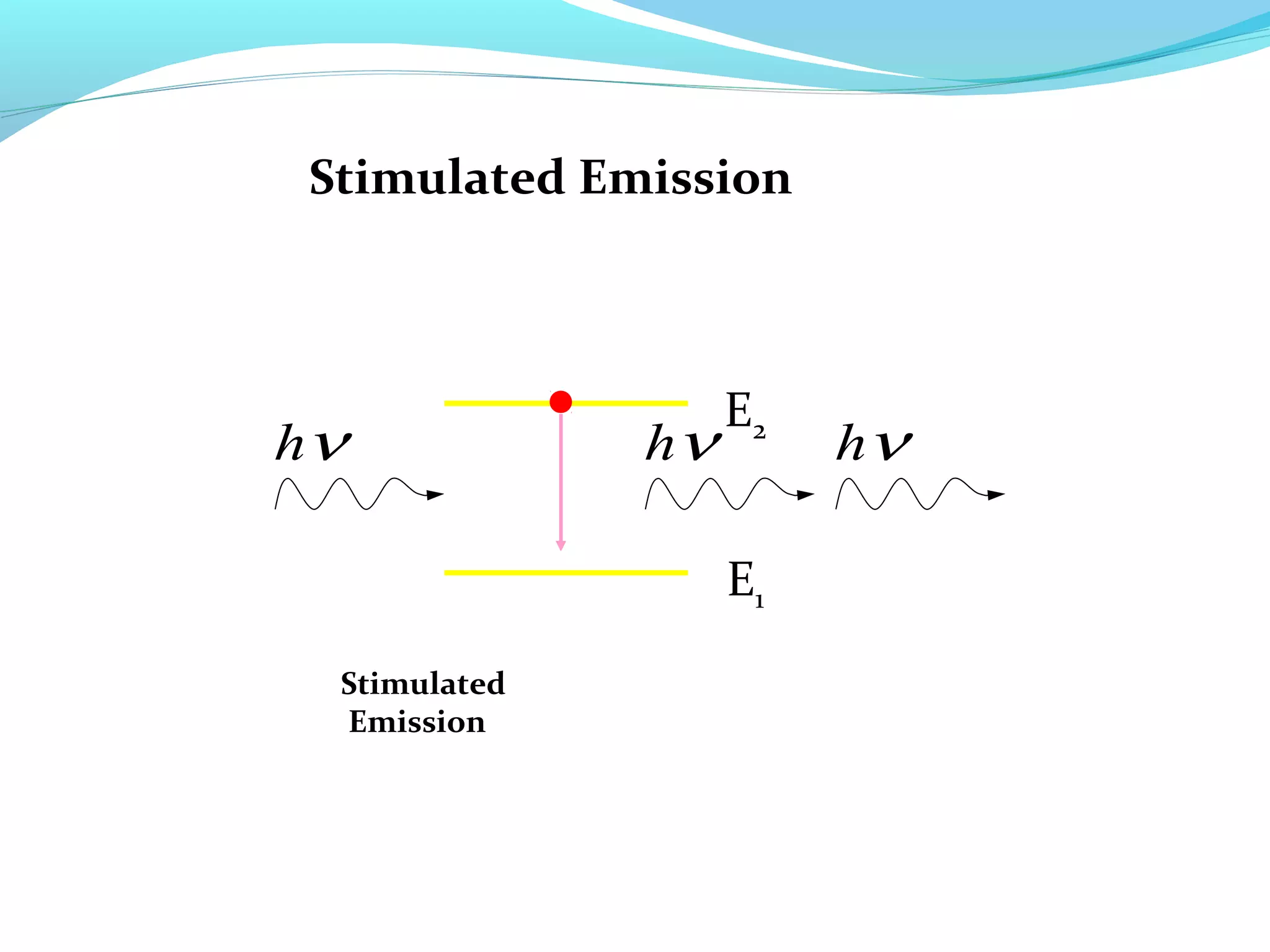
Stimulated Emission


                   E2
hν            hν        hν

                   E1
 Stimulated
 Emission
m
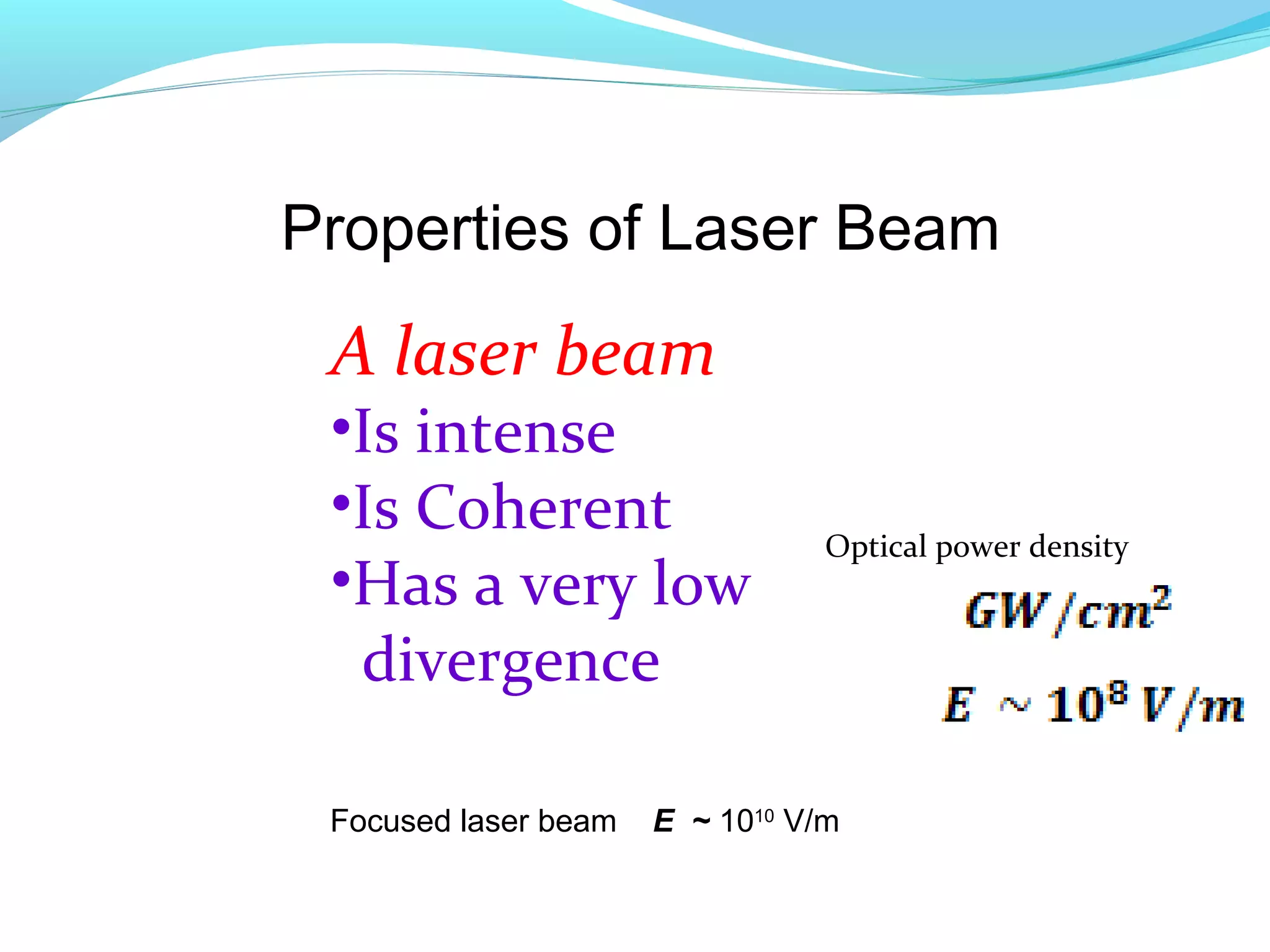
Properties of Laser Beam
 A laser beam
 •Is intense
 •Is Coherent                    Optical power density
 •Has a very low
  divergence

 Focused laser beam   E ~ 1010 V/m
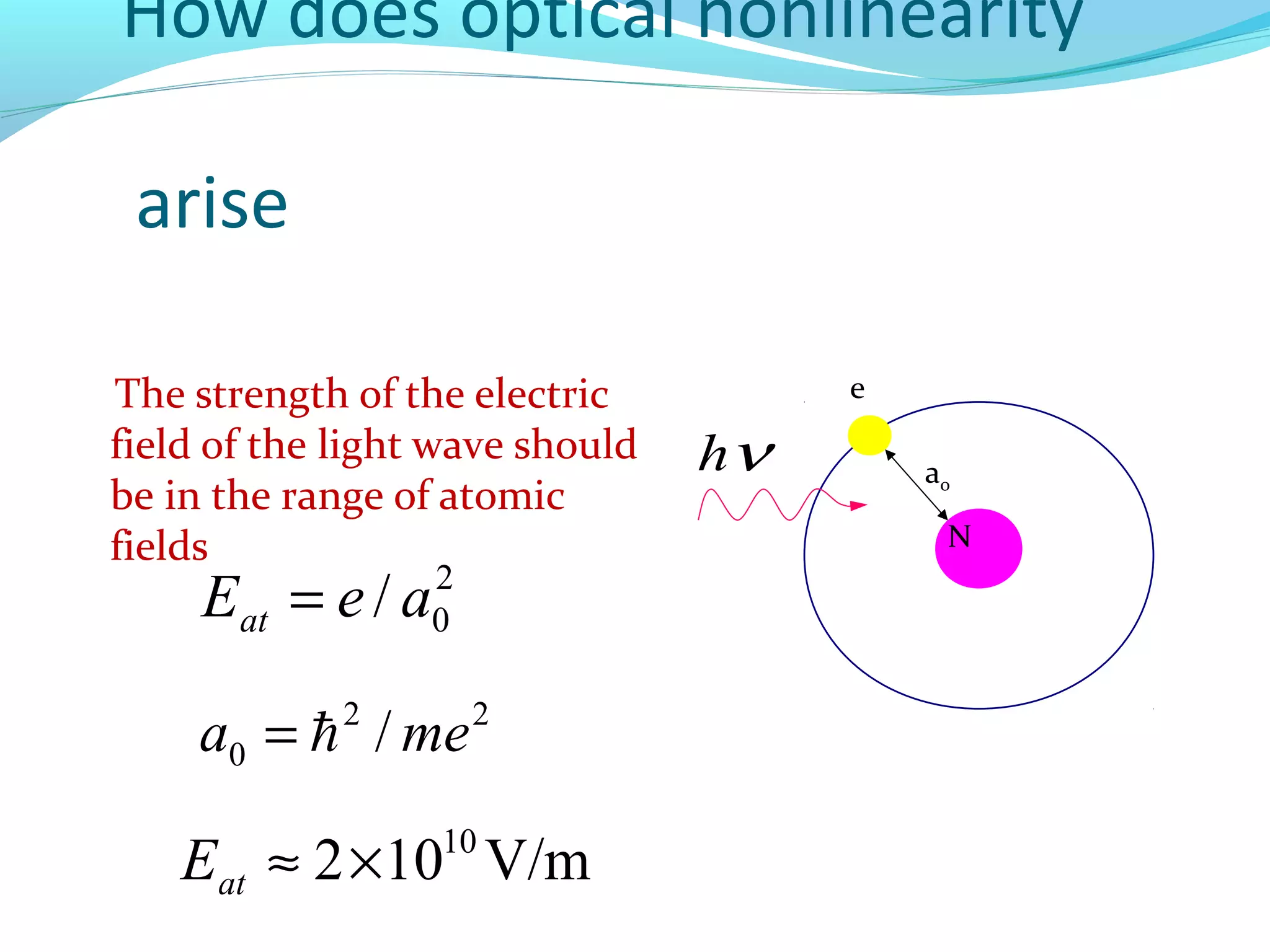
How does optical nonlinearity

 arise

The strength of the electric          e
field of the light wave should   hν       a0
be in the range of atomic
fields                                     N

     Eat = e / a   2
                   0


     a0 =  / me
             2         2


    Eat ≈ 2 ×10 V/m10
Optical Nonlinearity
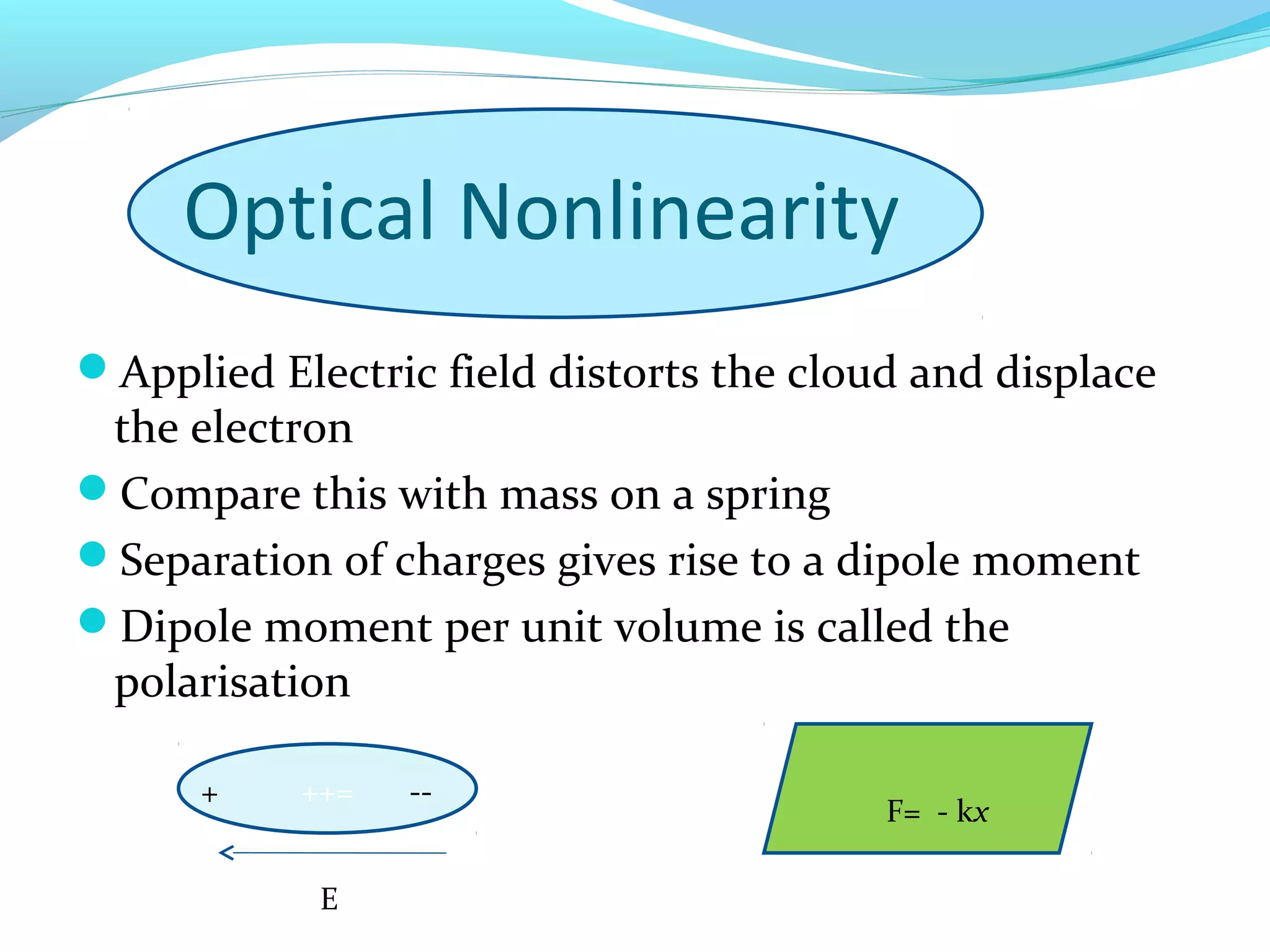
Applied Electric field distorts the cloud and displace
 the electron
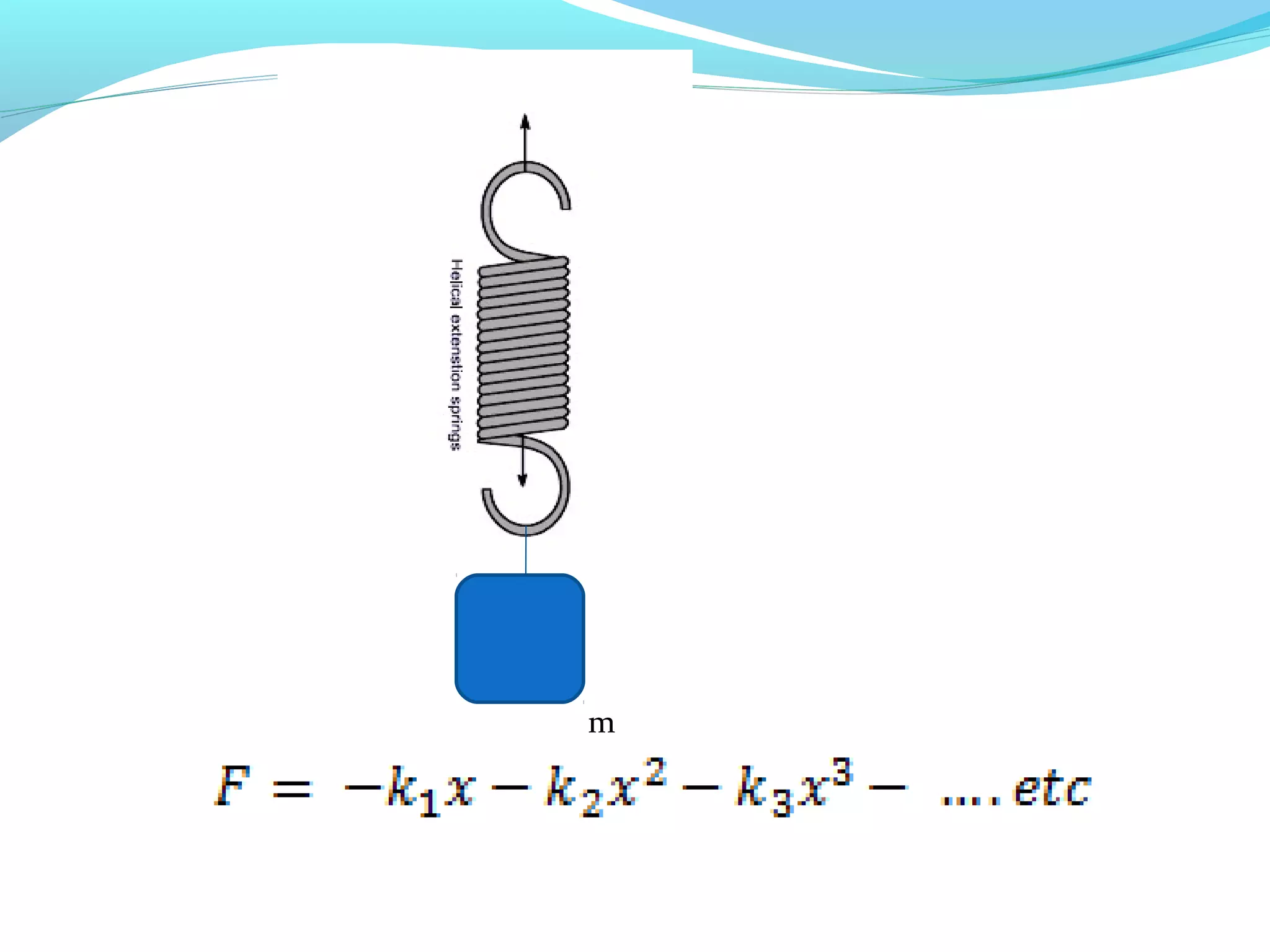
Compare this with mass on a spring
Separation of charges gives rise to a dipole moment
Dipole moment per unit volume is called the
 polarisation

      +    ++=   --
                                         F= - kx

            E
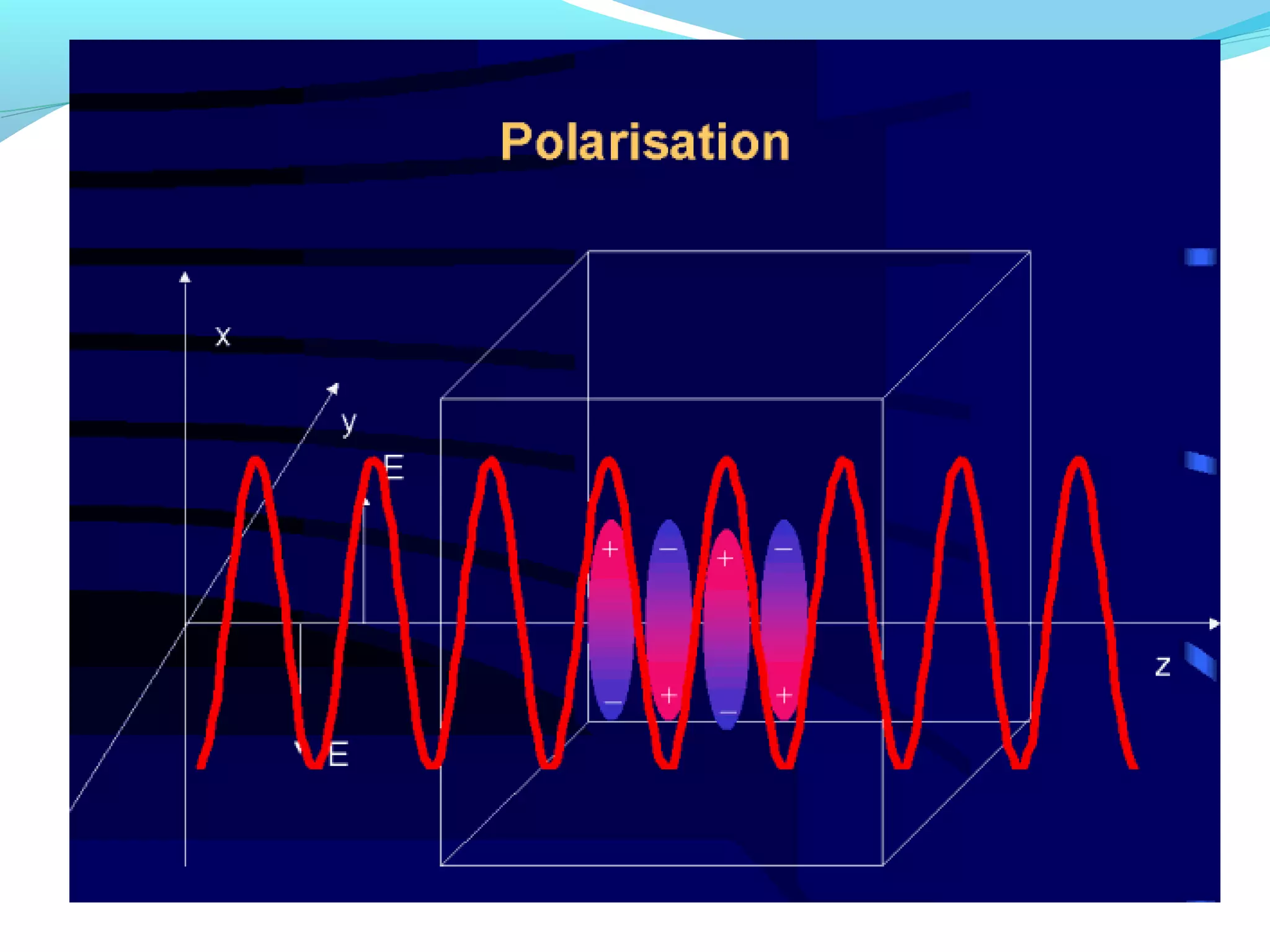
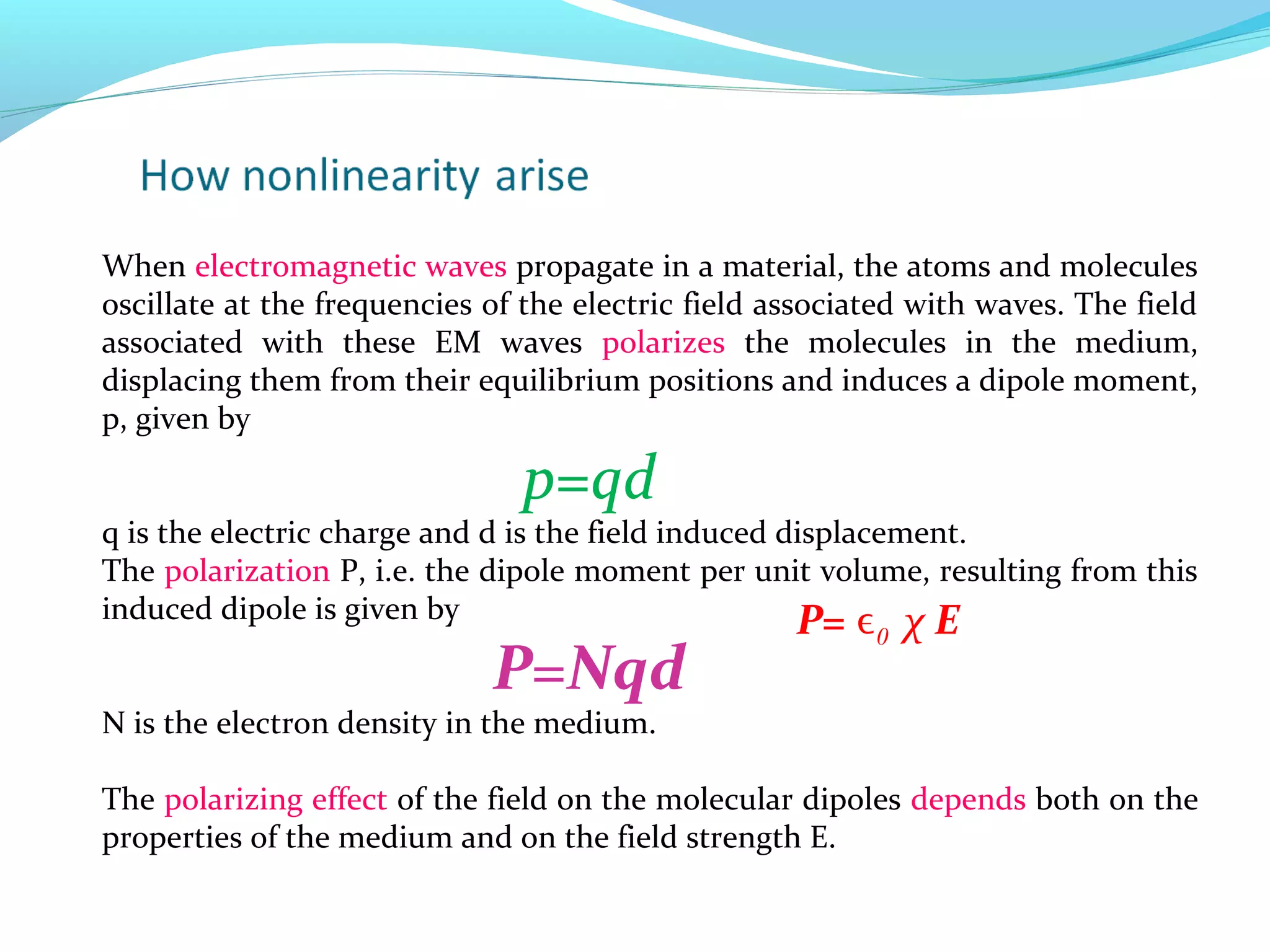
When electromagnetic waves propagate in a material, the atoms and molecules
oscillate at the frequencies of the electric field associated with waves. The field
associated with these EM waves polarizes the molecules in the medium,
displacing them from their equilibrium positions and induces a dipole moment,
p, given by

                               p=qd
q is the electric charge and d is the field induced displacement.
The polarization P, i.e. the dipole moment per unit volume, resulting from this
induced dipole is given by                           P= ϵ χ E
                                                          0
                             P=Nqd
N is the electron density in the medium.

The polarizing effect of the field on the molecular dipoles depends both on the
properties of the medium and on the field strength E.
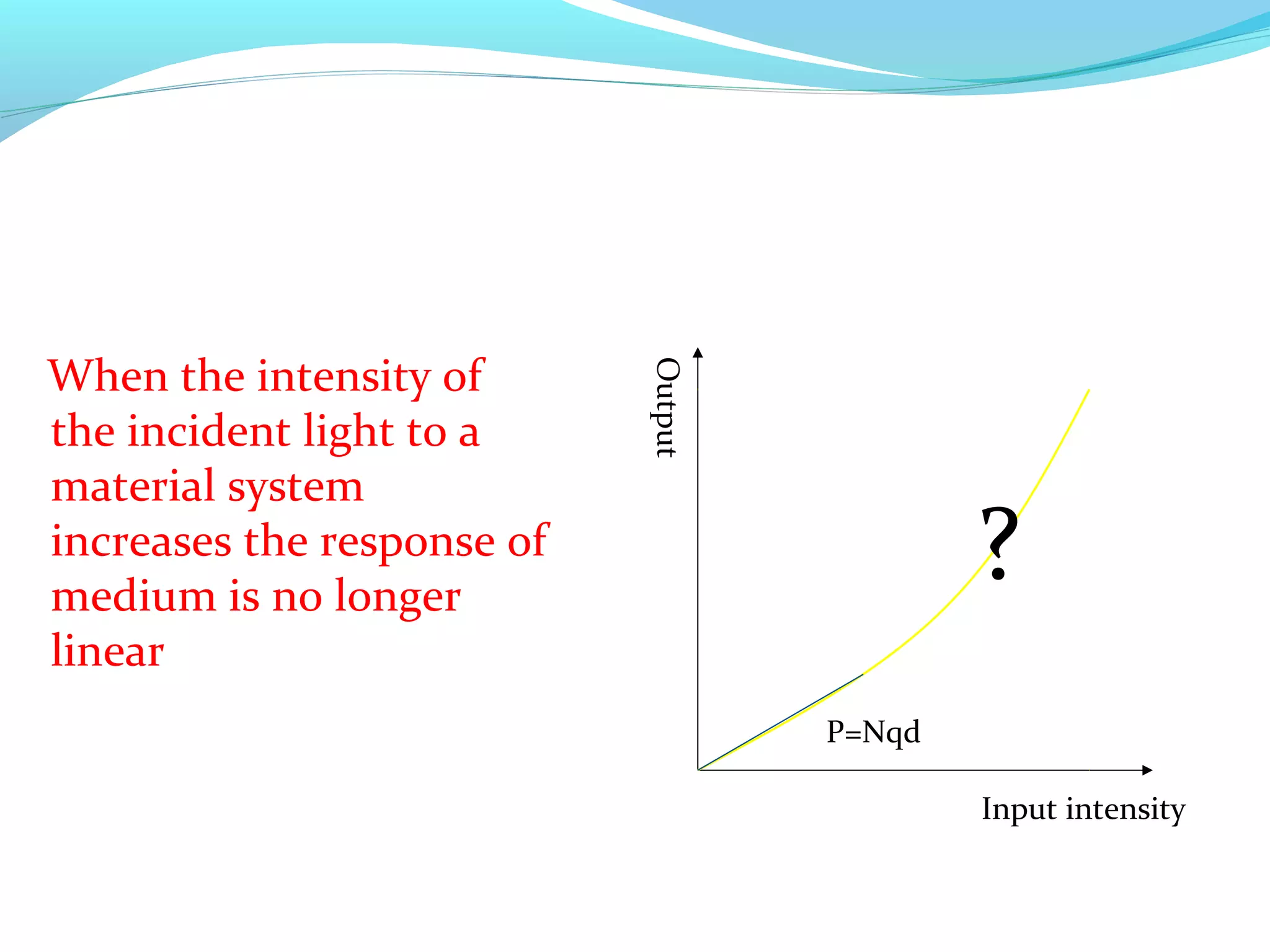
When the intensity of


                            Output
the incident light to a
material system
increases the response of
medium is no longer
                                             ?
linear
                                     P=Nqd

                                             Input intensity
Like loaded spring


                F= -kx
m


                      P= ϵ0 χ E

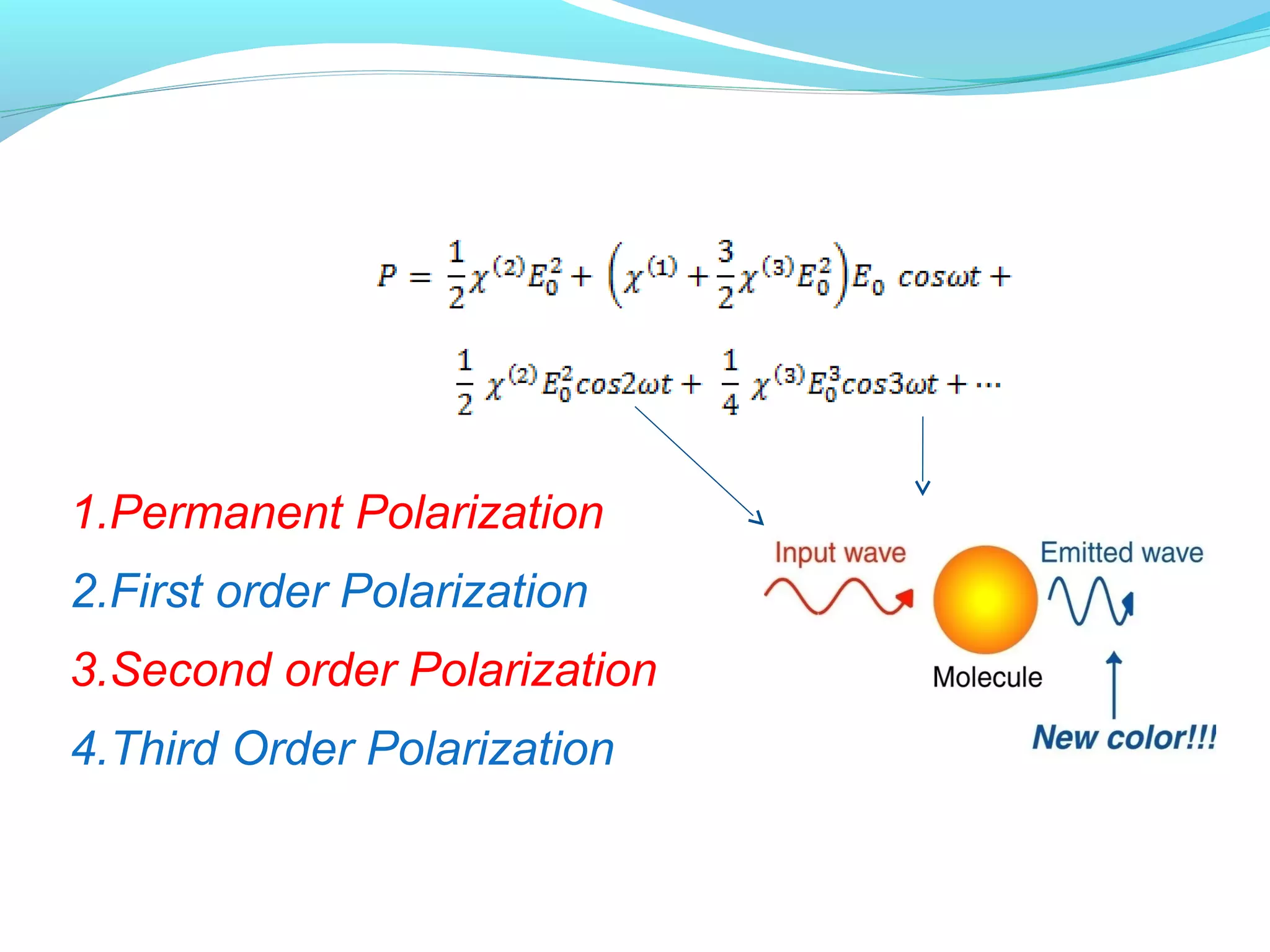
P = ε 0  χ (1) E + χ (2) E 2 + χ (3) E 3 + ...
                                              

         E = Eo cosωt
1.Permanent Polarization
2.First order Polarization
3.Second order Polarization
4.Third Order Polarization
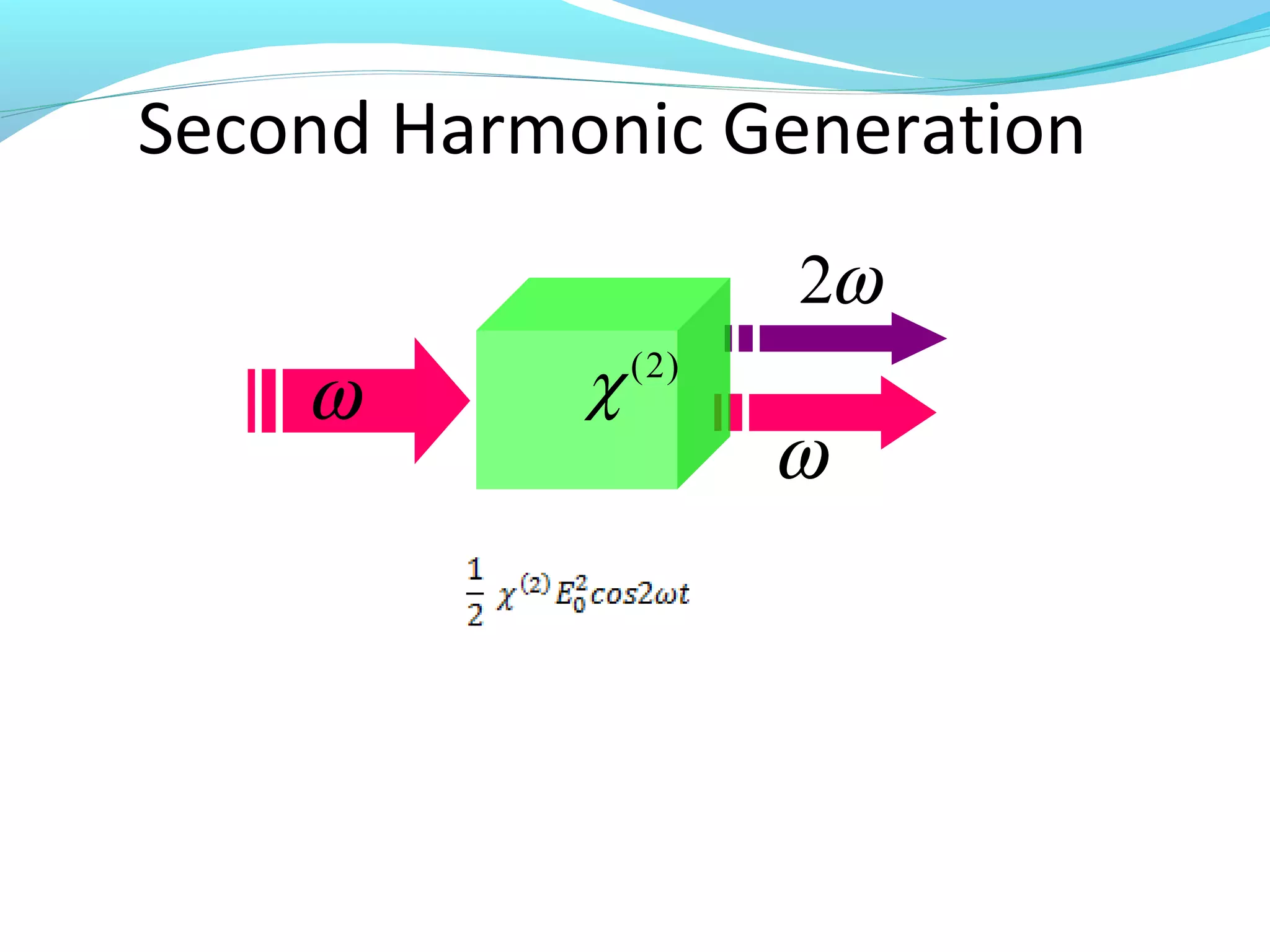
Second Harmonic Generation
                       2ω
    ω       χ   ( 2)

                       ω
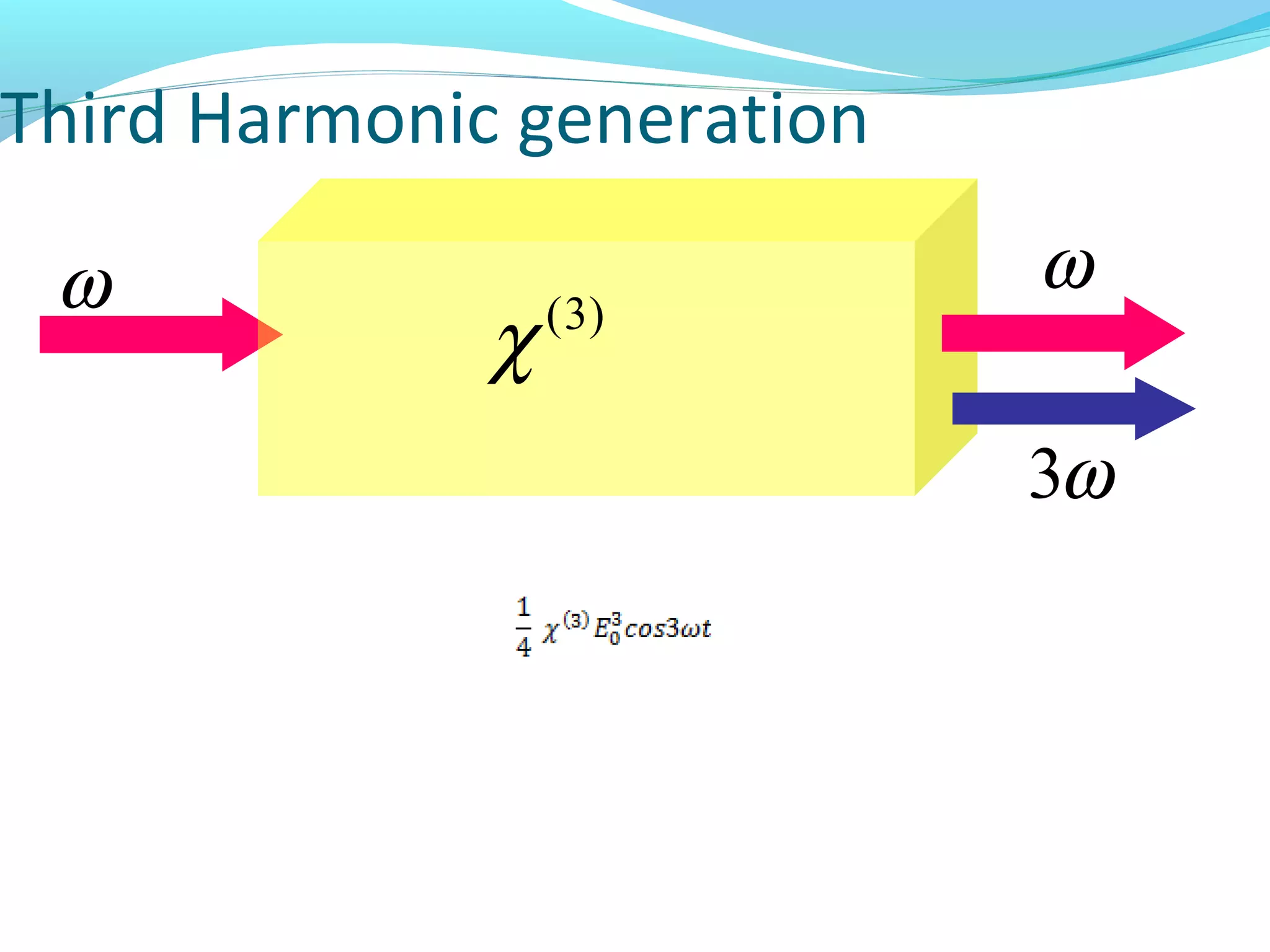
Third Harmonic generation

 ω                          ω
              χ   ( 3)


                            3ω
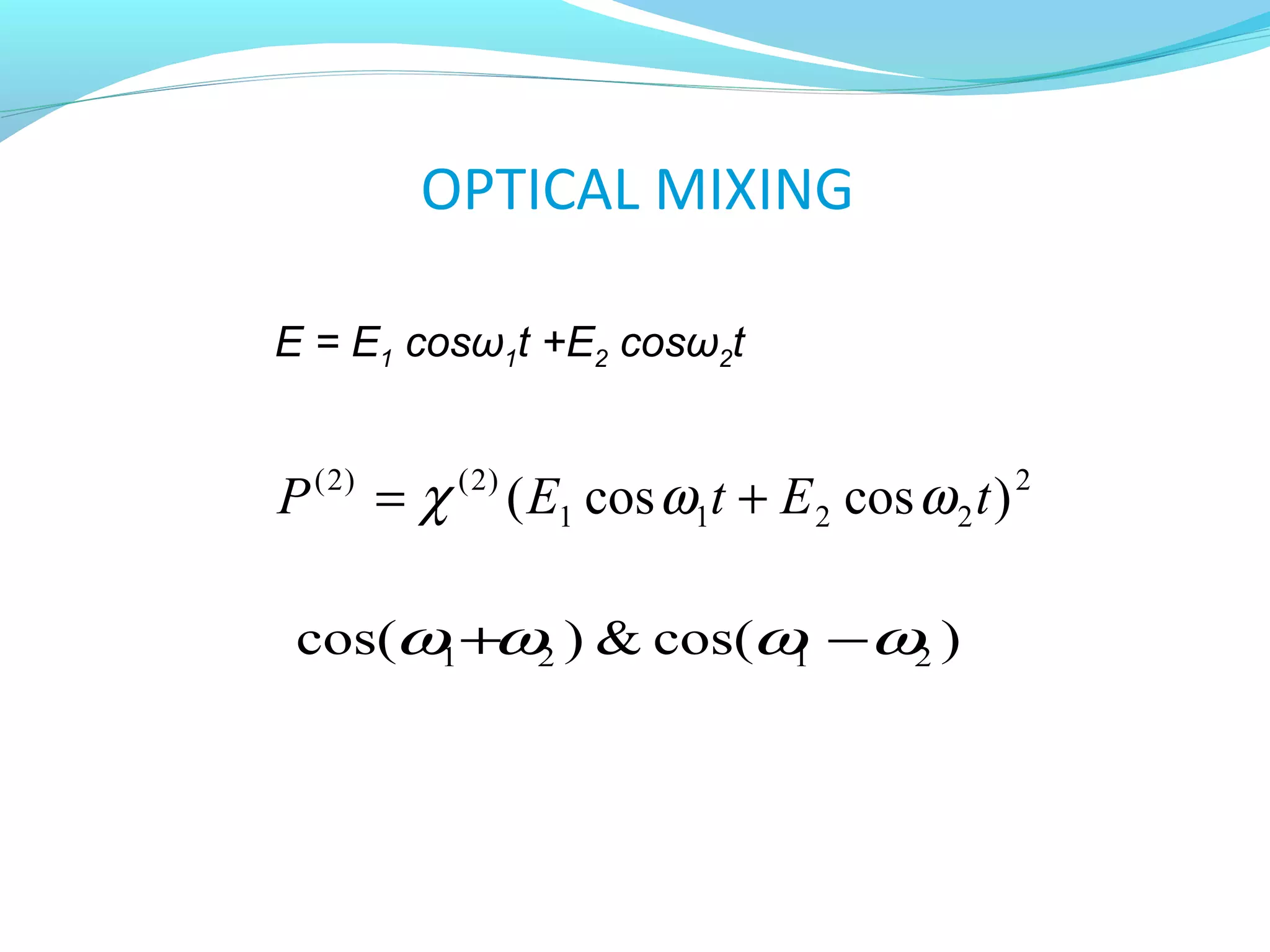
OPTICAL MIXING

E = E1 cosω1t +E2 cosω2t


P ( 2 ) = χ ( 2) ( E1 cos ω1t + E 2 cos ω 2 t ) 2

 cos(ω1 +ω2 ) & cos(ω −ω2 )
                     1
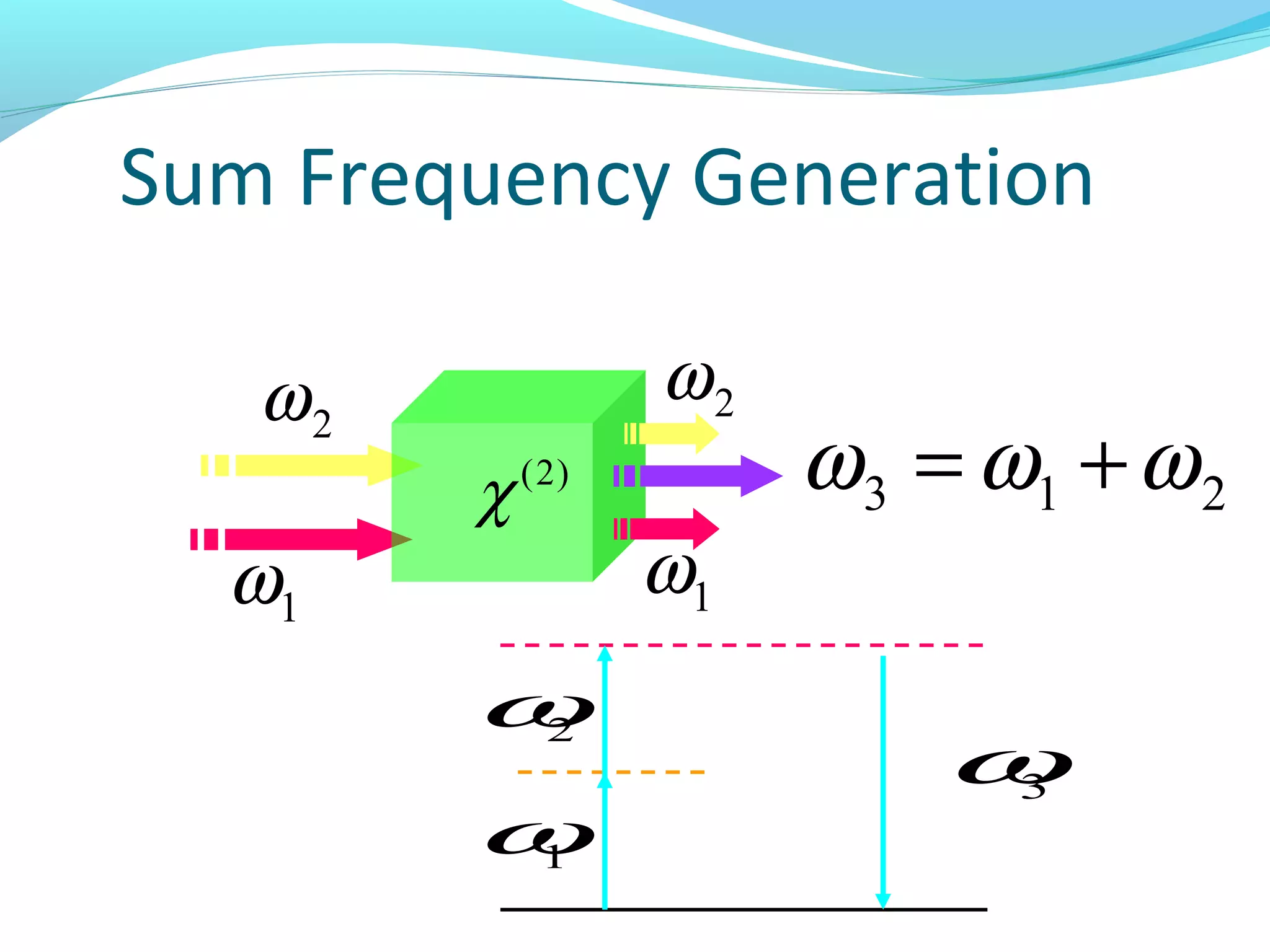
Sum Frequency Generation

   ω2              ω2
        χ   ( 2)        ω 3 = ω1 + ω 2
  ω1               ω1
        ω
                            ω
         2
                             3
        ω1
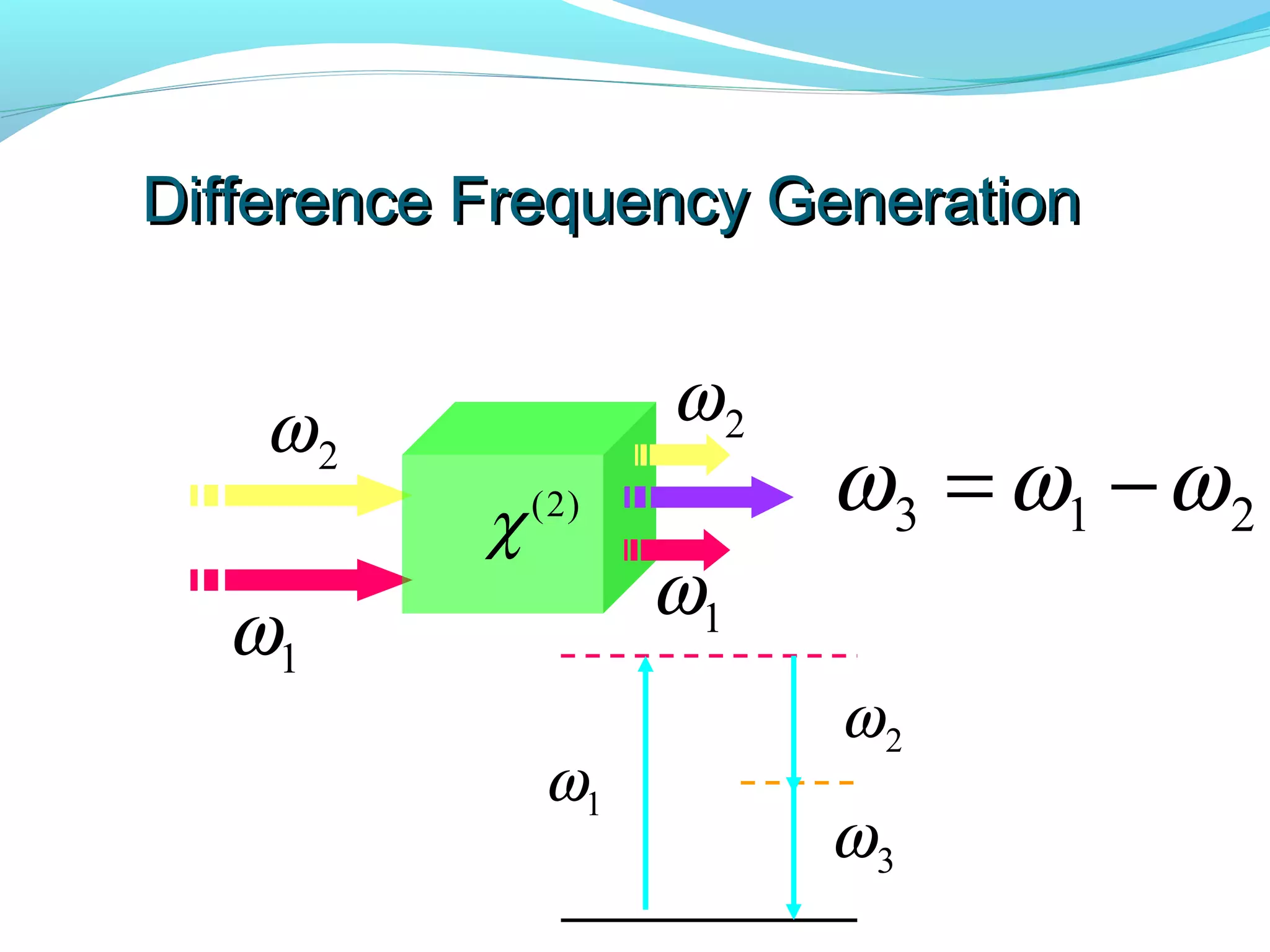
Difference Frequency Generation


    ω2                ω2
           χ   ( 2)        ω 3 = ω1 − ω 2
                      ω1
  ω1
                           ω2
                ω1
                           ω3
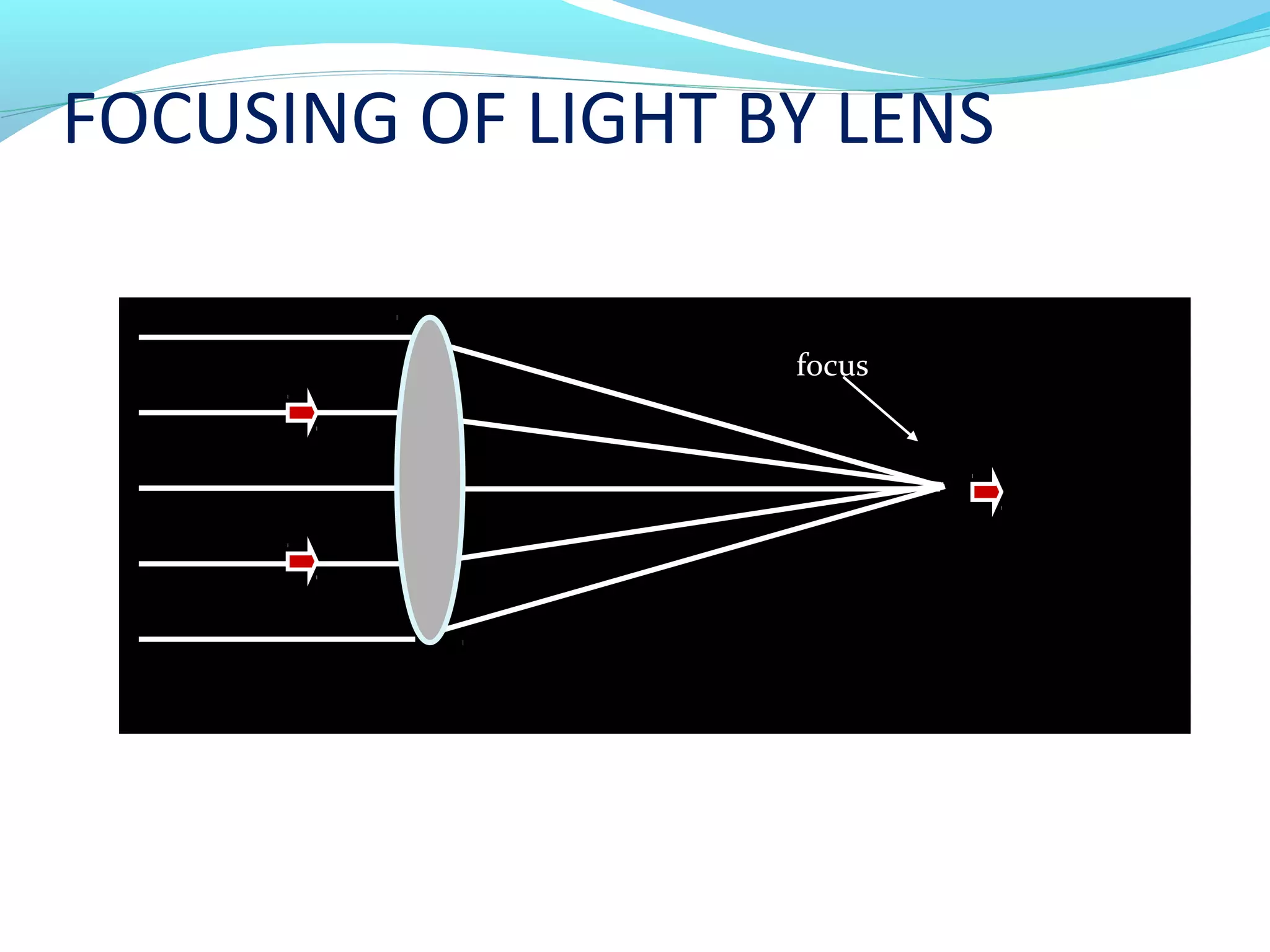
FOCUSING OF LIGHT BY LENS

                   focus
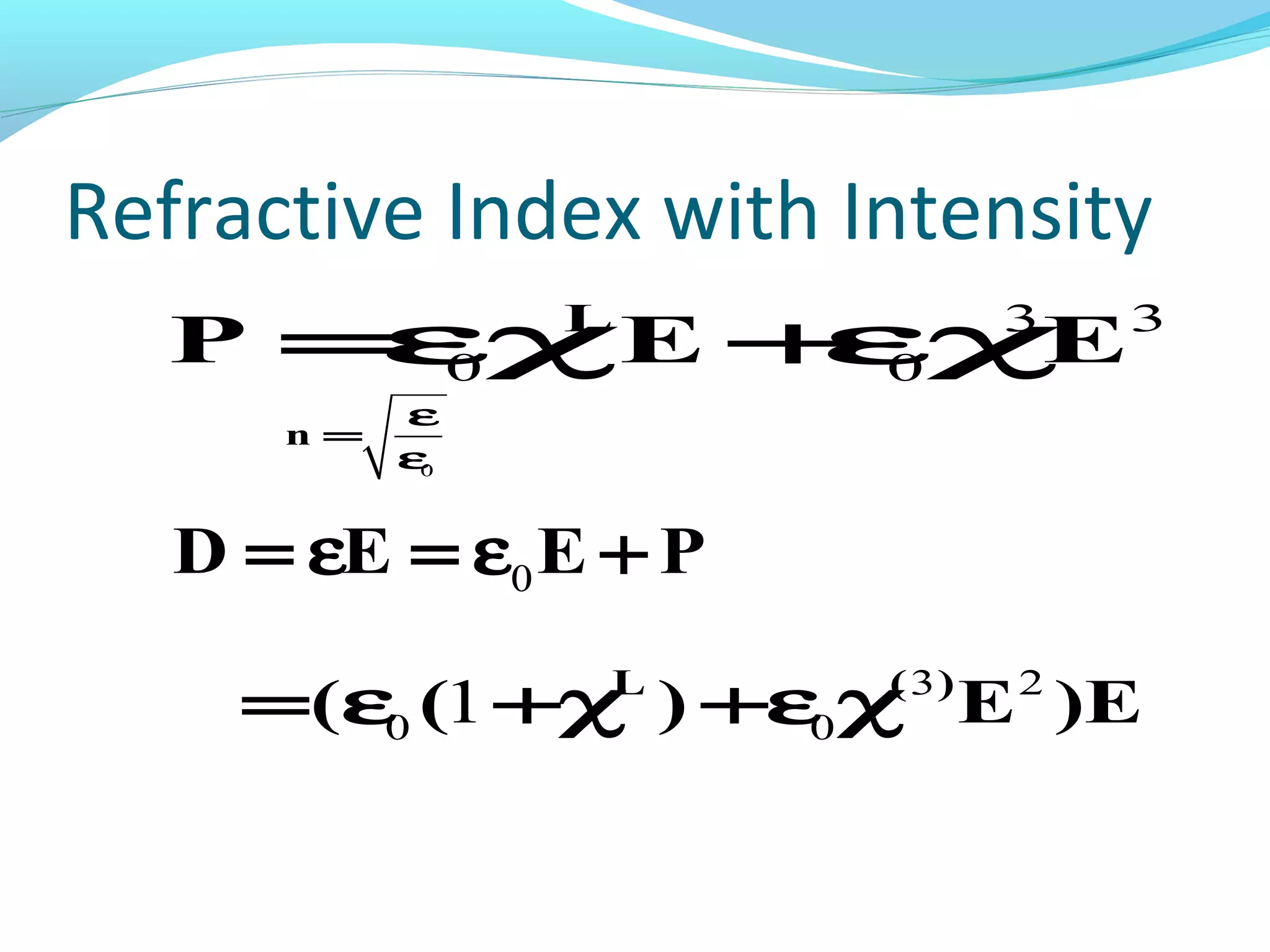
Refractive Index with Intensity
  P = 0
     εχE + 0
          εχ E  L             3   3

           ε
      n=
           ε0


   D = εE = ε0 E + P

     =( ε0 (1 +χ ) +ε0 χ E )E
                 L     ( 3)   2
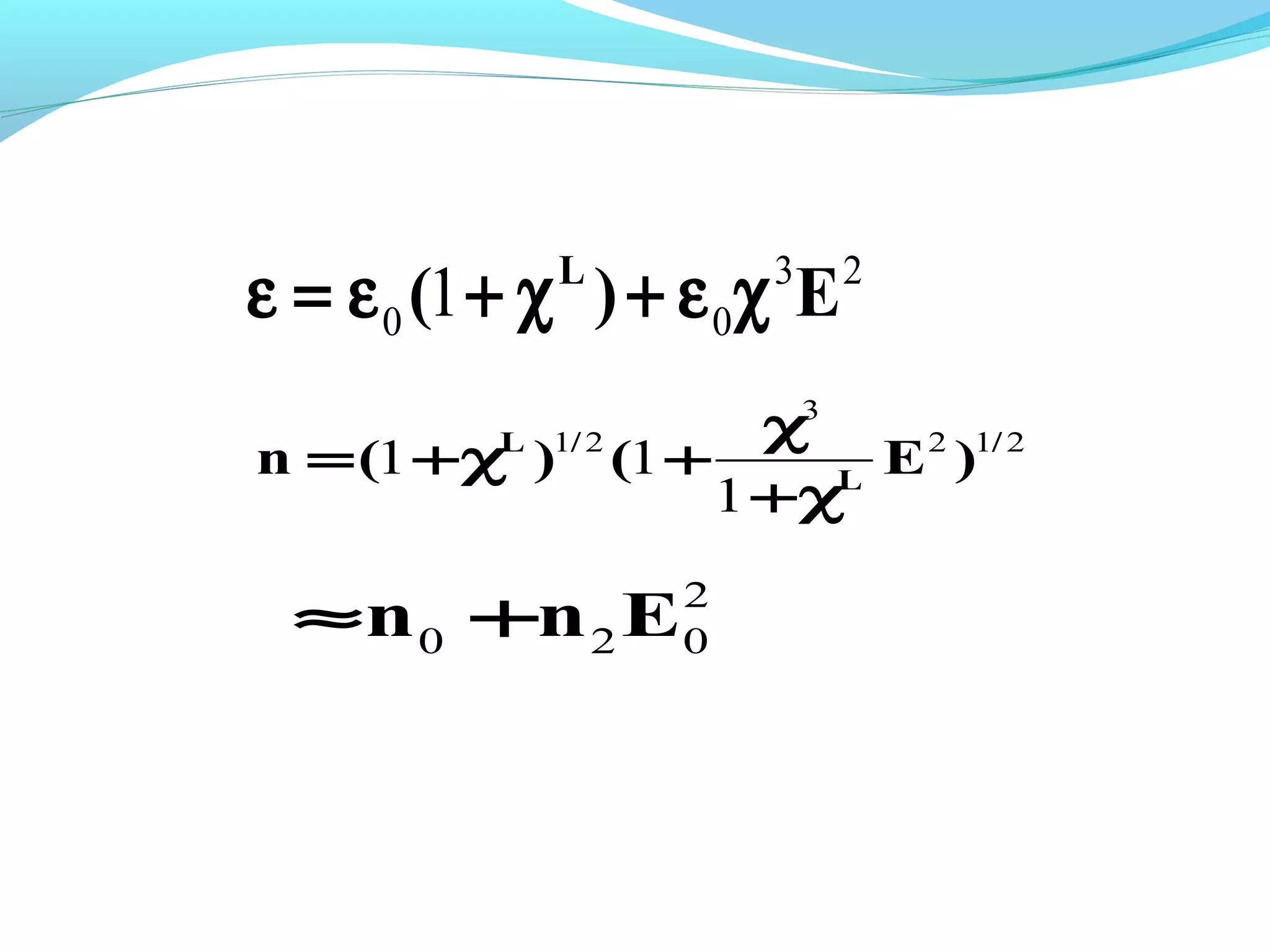
ε = ε 0 (1 + χ ) + ε 0χ E
              L         3   2


                        χ3
n = (1 +χL )1/ 2 (1 +       E 2 )1/ 2
                      1 +χL

 ≈n 0 +n 2 E        2
                    0
Nonlinear Refractive Index

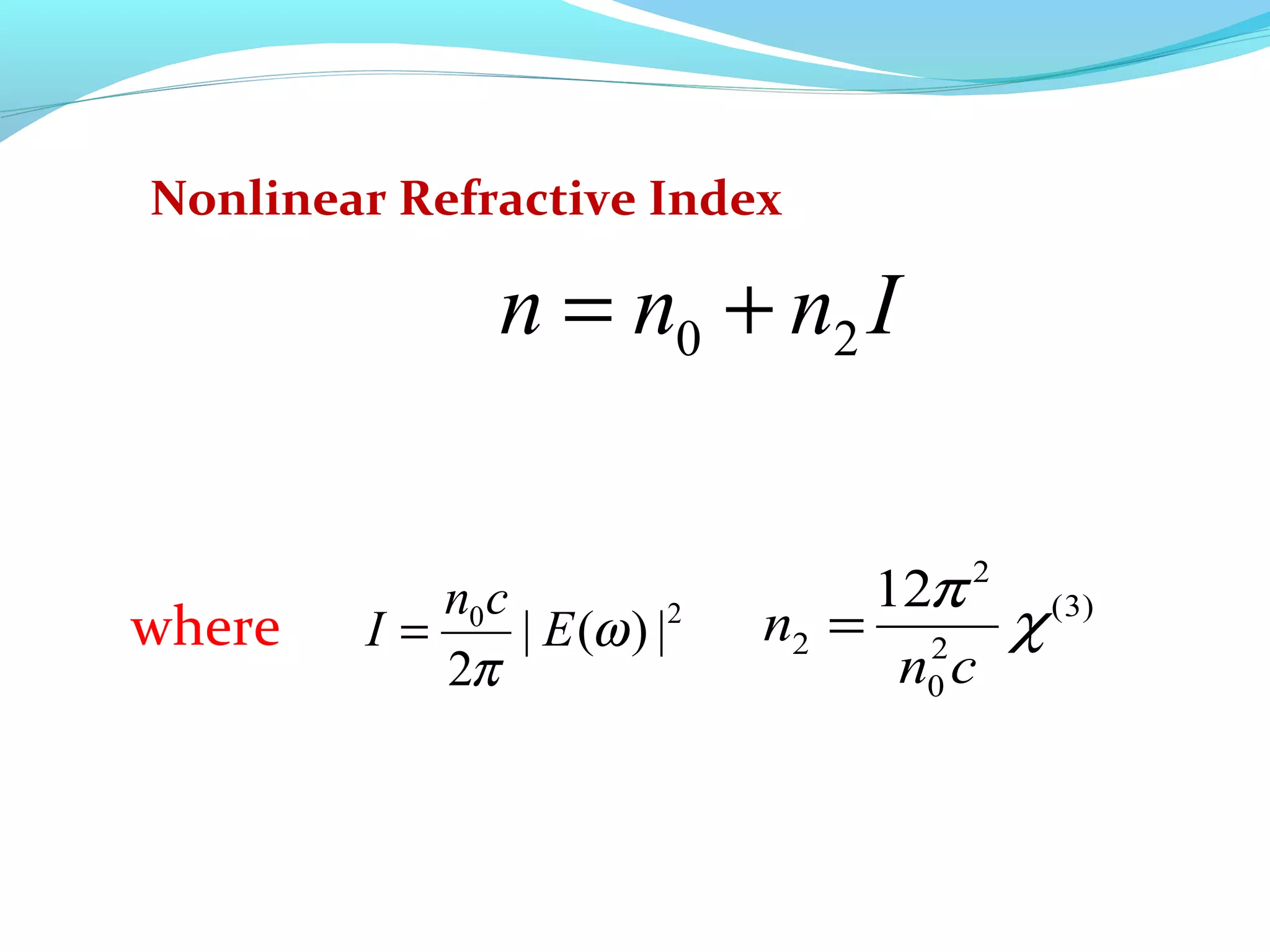
                n = n0 + n2 I


           n0 c                   12π 2 (3)
where   I=      | E (ω ) |2   n2 = 2 χ
           2π                      n0 c
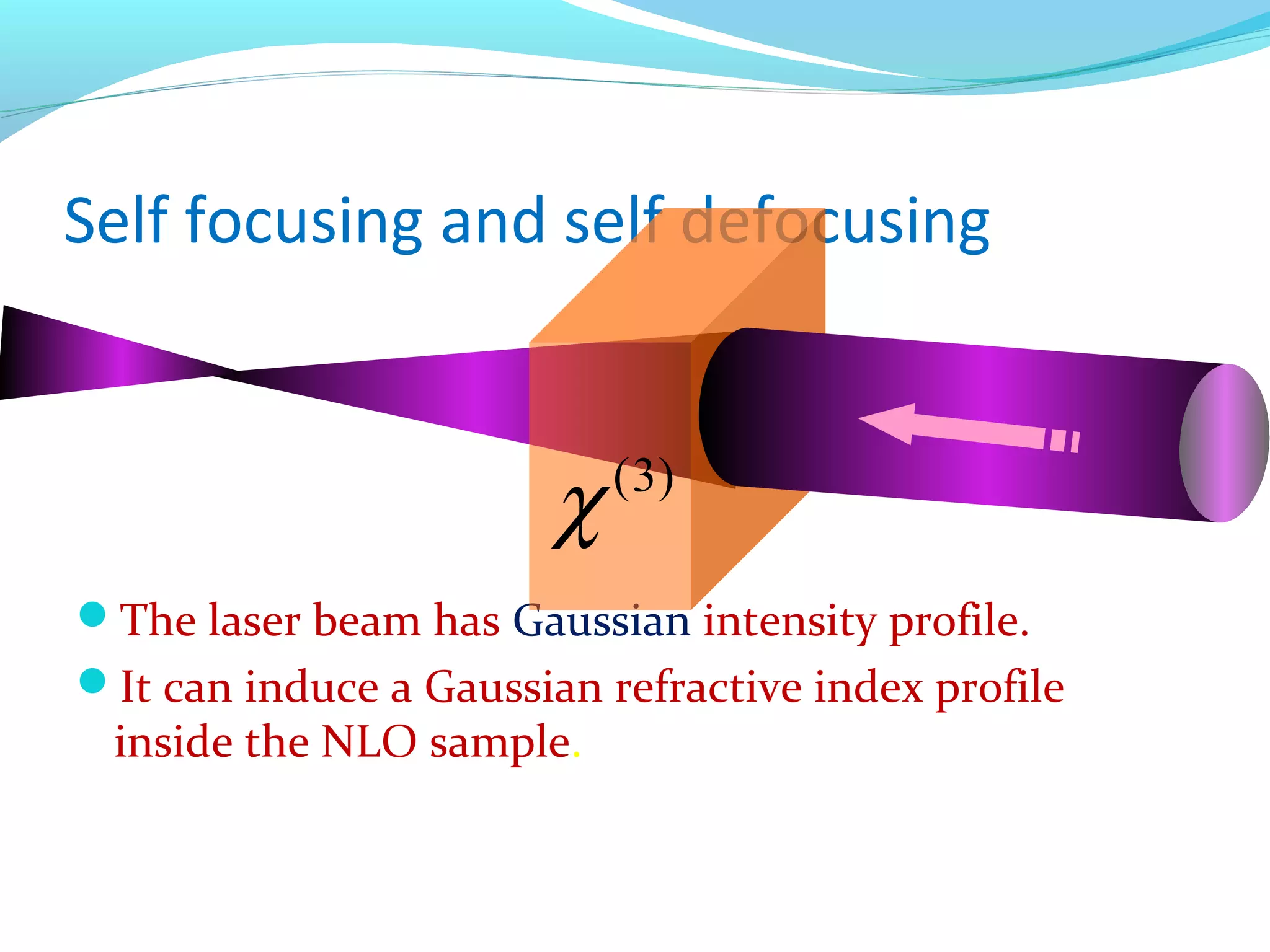
Self focusing and self defocusing


                        χ   ( 3)

The laser beam has Gaussian intensity profile.
It can induce a Gaussian refractive index profile
 inside the NLO sample.
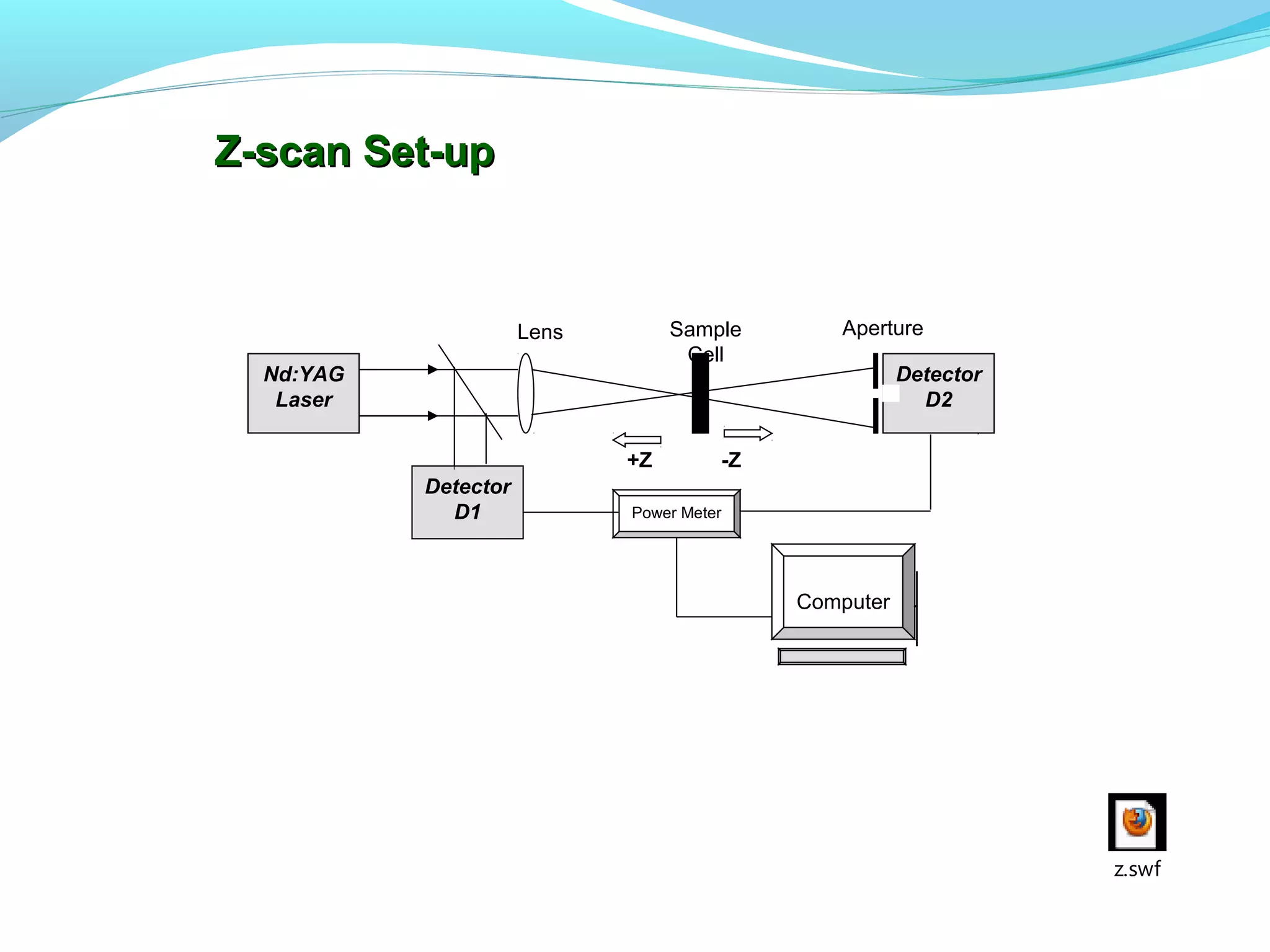
Z-scan Set-up


                      Lens        Sample       Aperture
                                   Cell
  Nd:YAG                                               Detector
   Laser                                                 D2

                             +Z        -Z
           Detector
             D1              Power Meter


                                            Computer


                                                                  z.swf
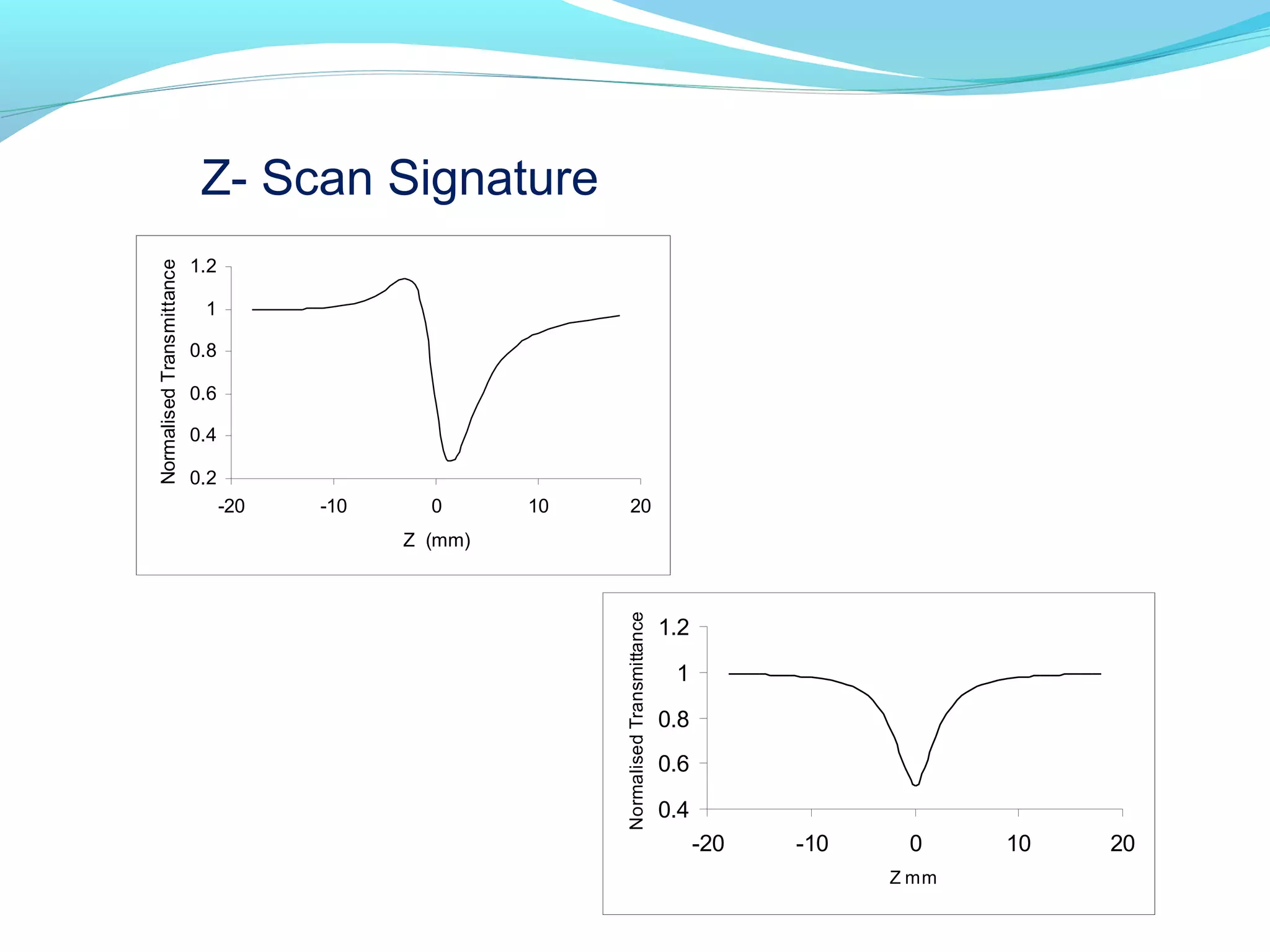
Z- Scan Signature
                           1.2
Normalised Transmittance


                            1

                           0.8

                           0.6

                           0.4

                           0.2
                                 -20   -10     0      10       20
                                             Z (mm)


                                                           Normalised Transmittance   1.2

                                                                                       1

                                                                                      0.8
                                                                                      0.6

                                                                                      0.4
                                                                                            -20   -10    0     10   20
                                                                                                        Z mm
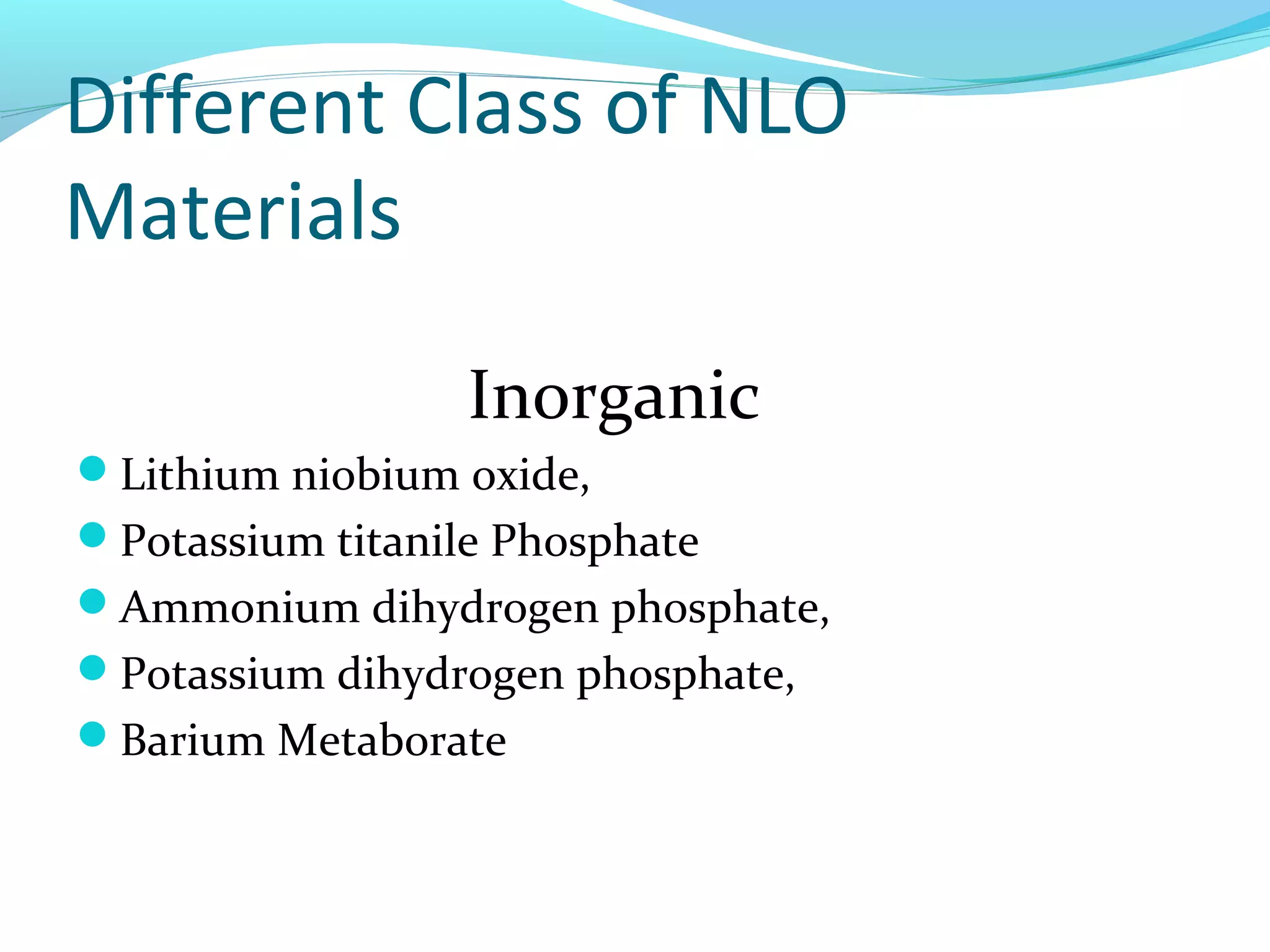
Different Class of NLO
Materials

                  Inorganic
Lithium niobium oxide,
Potassium titanile Phosphate
Ammonium dihydrogen phosphate,
Potassium dihydrogen phosphate,
Barium Metaborate
Organics Materials
Low cost
Ease of fabrication
Integrating in to a single devices
Easy to do fine tuning of its NLO properties by
 turning its Chemical structure
Low dielectric constant
Inherent synthetic flexibility
High optical damage threshold
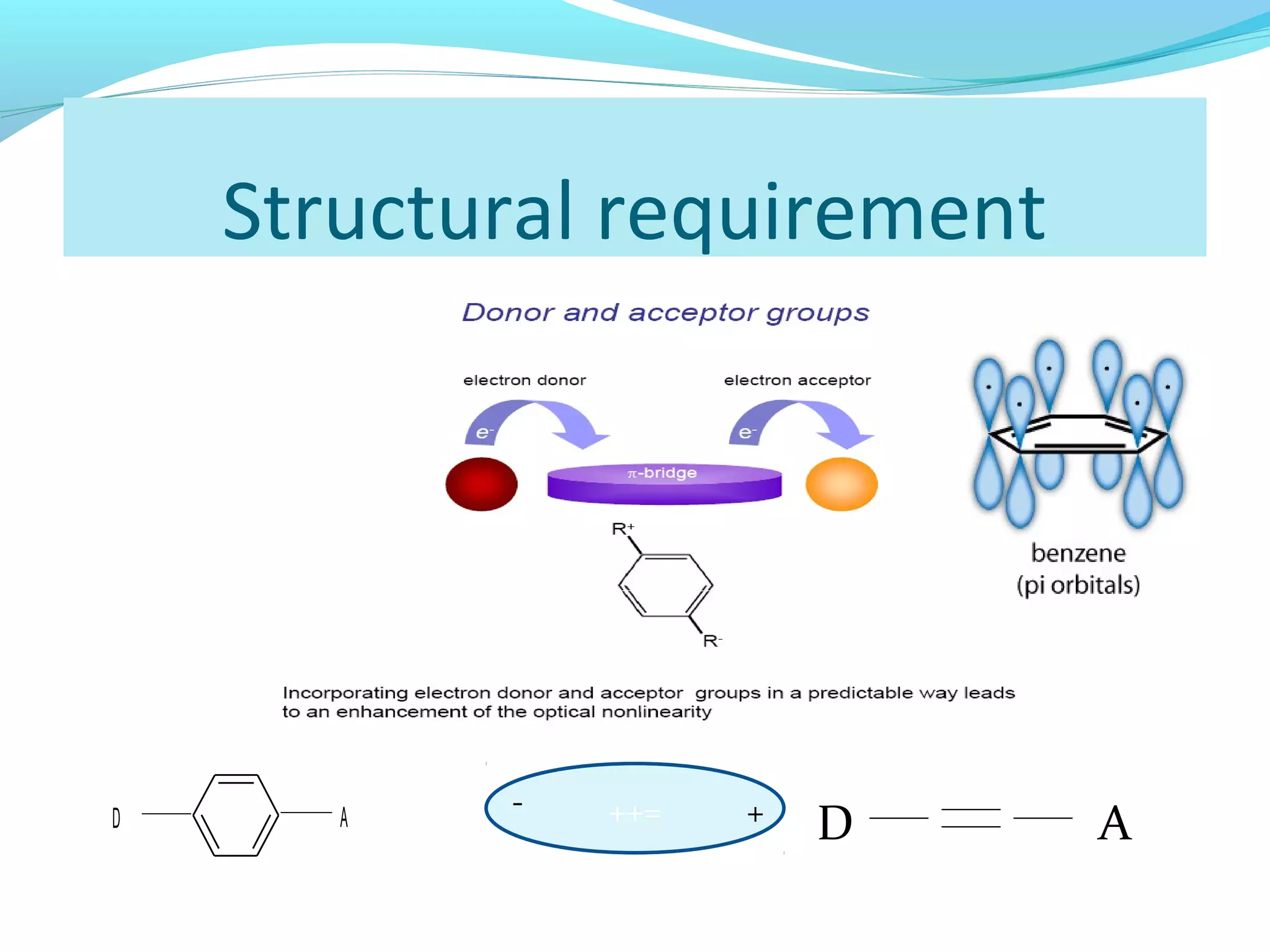
Structural requirement


           -
               ++=   +
D      A                 D   A
Enhancement of NLO response
     Science 281 (1998) 1653

TNLO enhancement by
   Increase conjugation length
   Create D-π-A- π -D structure
   A- π -D- π –A structure
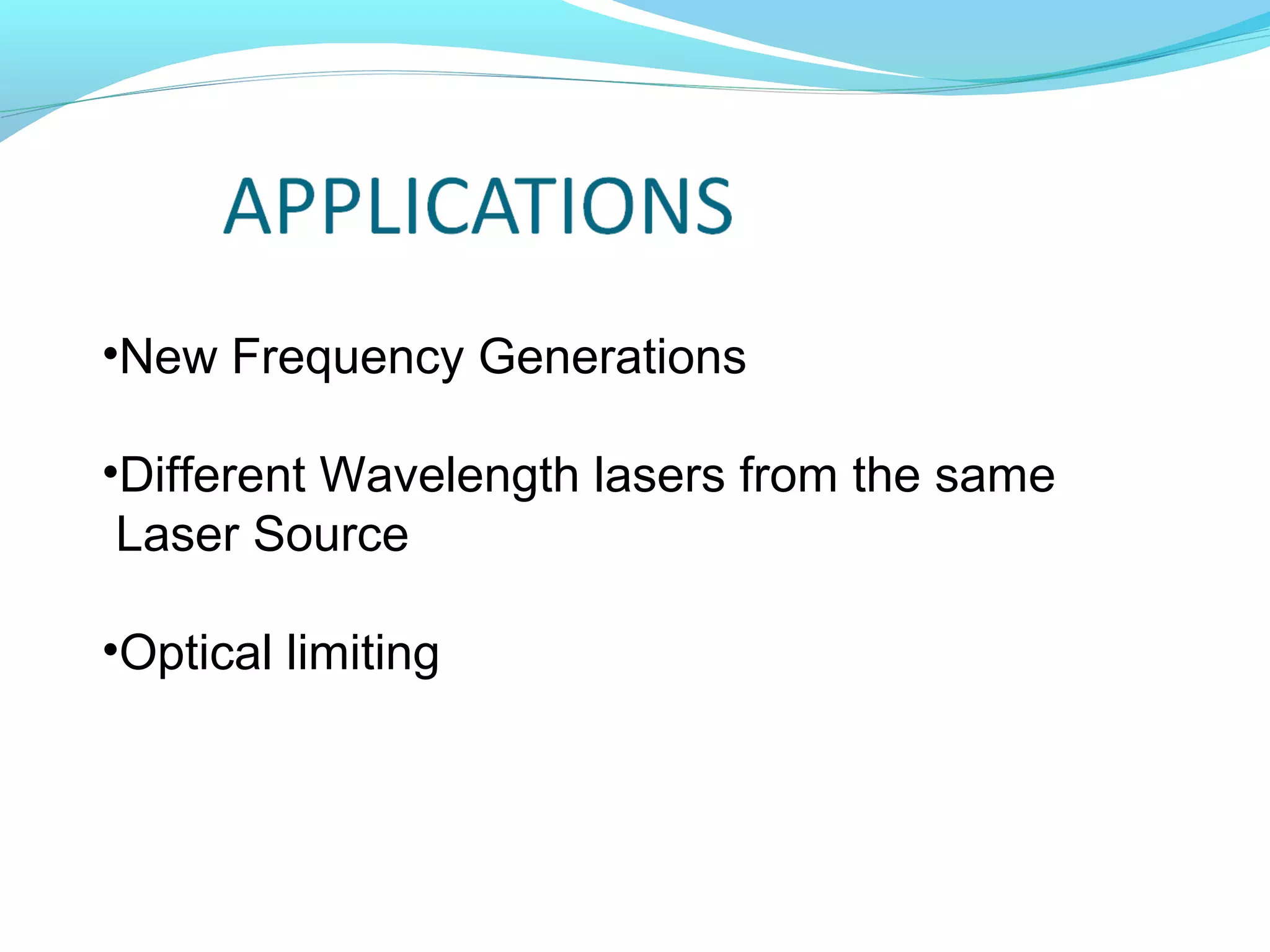
•New Frequency Generations

•Different Wavelength lasers from the same
 Laser Source

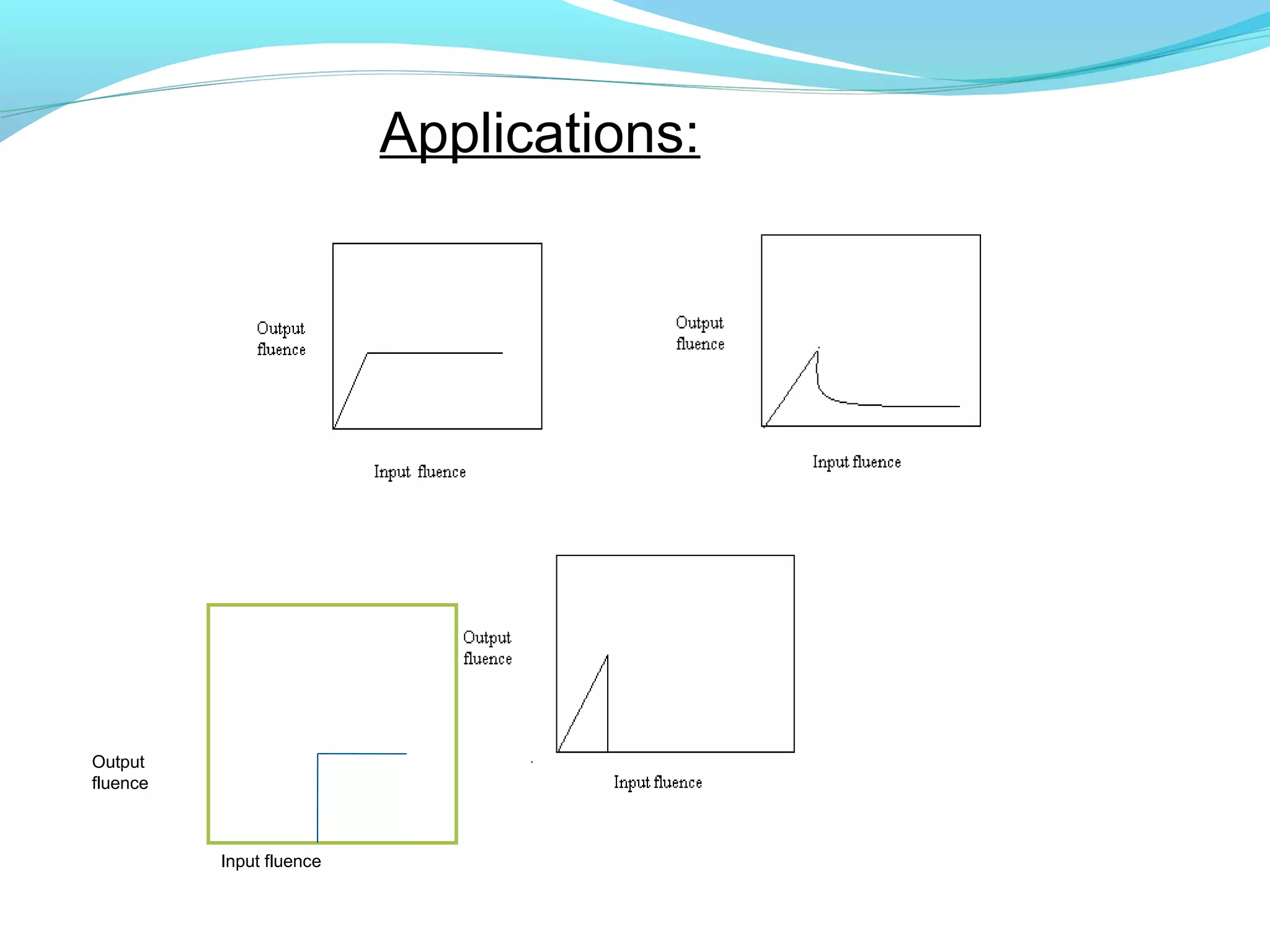
•Optical limiting
Applications:


Output
fluence


          Input fluence
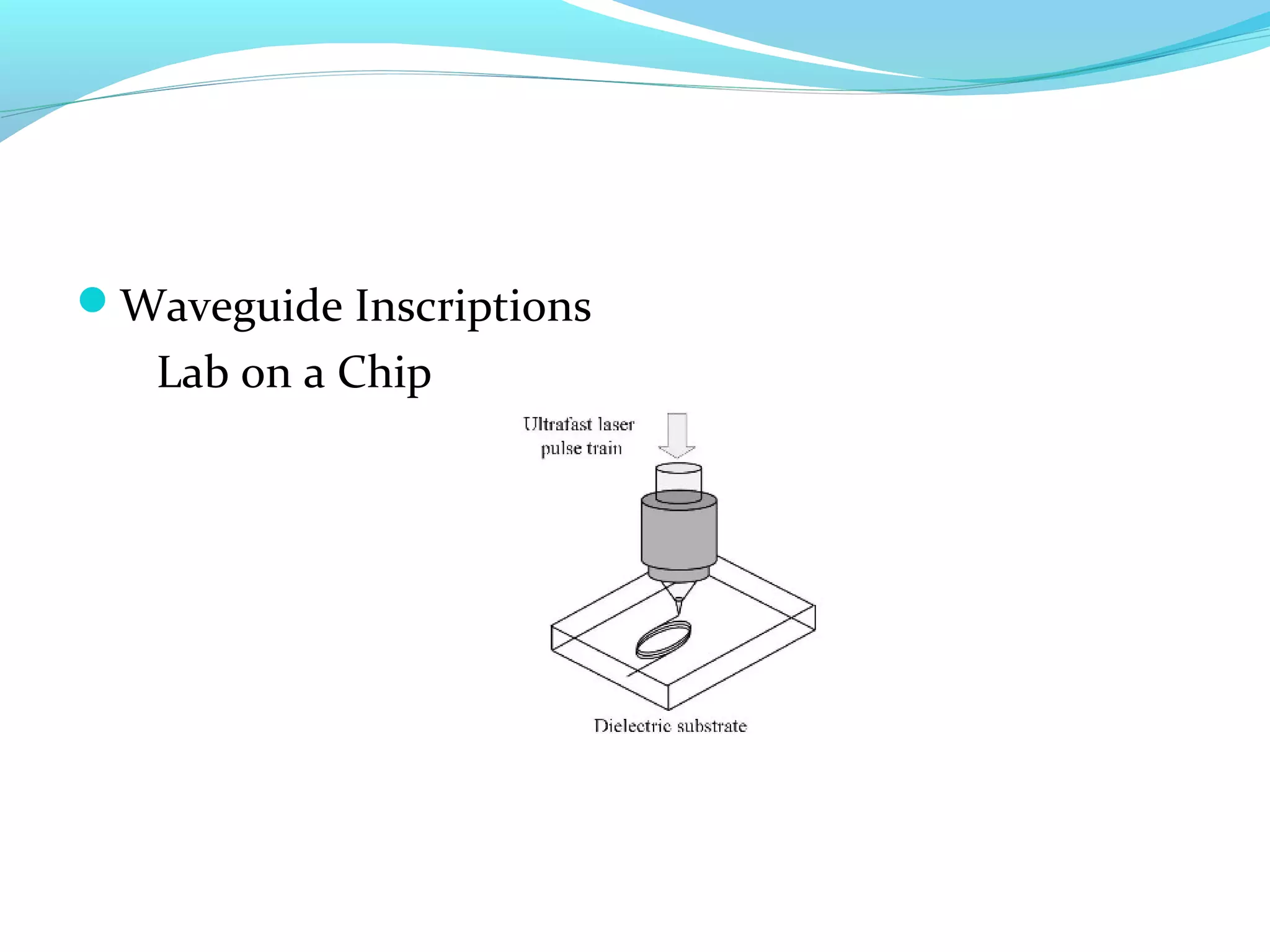
Waveguide Inscriptions
   Lab on a Chip
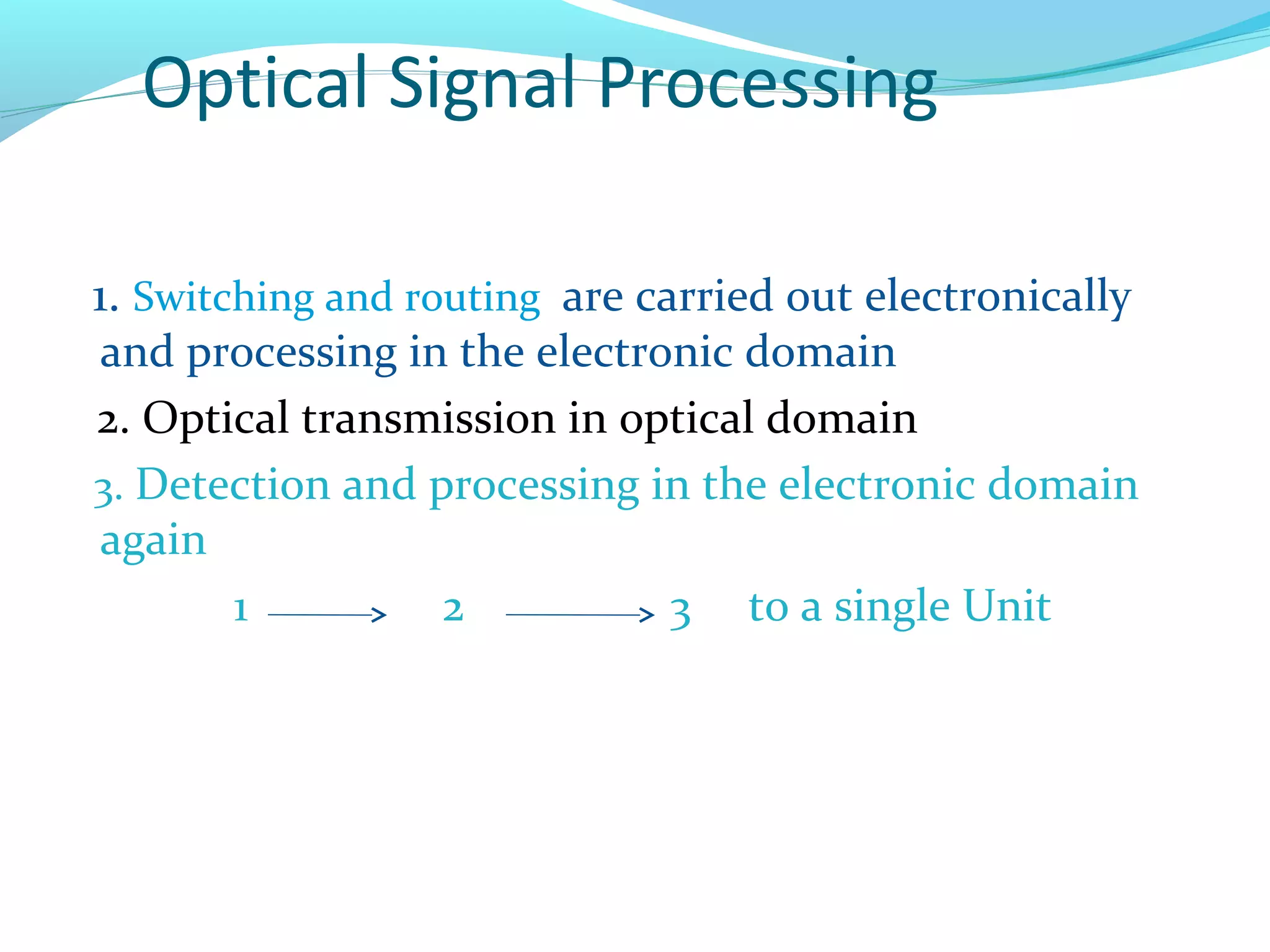
Optical Signal Processing

1. Switching and routing are carried out electronically
and processing in the electronic domain
2. Optical transmission in optical domain
3. Detection and processing in the electronic domain
again
       1          2          3 to a single Unit

non linear optics

  • 1.
    Linear Optics vsNon Linear Optics Linear optics- ‘Optics of weak light’: Light is deflected or delayed but its frequency is unchanged. Superposition principle holds Non-Linear optics-‘Optics of intense light’: We are concerned with the effects that light itself induces as it propagates through the medium. Superposition principle not valid
  • 2.
    In Linear optics Alight wave acts on a molecule, which vibrates and then emits its own light wave that interferes with the original light wave.
  • 3.
    In Non-Linear Optics If irradiance is high enough vibrations at all frequencies corresponding to all energy differences between populated states are produced.
  • 4.
    OPTICS – ALIGHT MATTER INTERACTION Nonlinear optics (NLO) is the study of interaction of intense laser light with matter. NLO sample input output
  • 5.
    Light Matter interaction E2 E2 hν hν E1 E1 Spontaneous Absorption Emission
  • 6.
    Stimulated Emission E2 hν hν hν E1 Stimulated Emission
  • 7.
  • 8.
    Properties of LaserBeam A laser beam •Is intense •Is Coherent Optical power density •Has a very low divergence Focused laser beam E ~ 1010 V/m
  • 9.
    How does opticalnonlinearity arise The strength of the electric e field of the light wave should hν a0 be in the range of atomic fields N Eat = e / a 2 0 a0 =  / me 2 2 Eat ≈ 2 ×10 V/m10
  • 10.
    Optical Nonlinearity Applied Electricfield distorts the cloud and displace the electron Compare this with mass on a spring Separation of charges gives rise to a dipole moment Dipole moment per unit volume is called the polarisation + ++= -- F= - kx E
  • 12.
    When electromagnetic wavespropagate in a material, the atoms and molecules oscillate at the frequencies of the electric field associated with waves. The field associated with these EM waves polarizes the molecules in the medium, displacing them from their equilibrium positions and induces a dipole moment, p, given by p=qd q is the electric charge and d is the field induced displacement. The polarization P, i.e. the dipole moment per unit volume, resulting from this induced dipole is given by P= ϵ χ E 0 P=Nqd N is the electron density in the medium. The polarizing effect of the field on the molecular dipoles depends both on the properties of the medium and on the field strength E.
  • 13.
    When the intensityof Output the incident light to a material system increases the response of medium is no longer ? linear P=Nqd Input intensity
  • 14.
    Like loaded spring F= -kx m P= ϵ0 χ E P = ε 0  χ (1) E + χ (2) E 2 + χ (3) E 3 + ...   E = Eo cosωt
  • 15.
    1.Permanent Polarization 2.First orderPolarization 3.Second order Polarization 4.Third Order Polarization
  • 16.
    Second Harmonic Generation 2ω ω χ ( 2) ω
  • 17.
    Third Harmonic generation ω ω χ ( 3) 3ω
  • 18.
    OPTICAL MIXING E =E1 cosω1t +E2 cosω2t P ( 2 ) = χ ( 2) ( E1 cos ω1t + E 2 cos ω 2 t ) 2 cos(ω1 +ω2 ) & cos(ω −ω2 ) 1
  • 19.
    Sum Frequency Generation ω2 ω2 χ ( 2) ω 3 = ω1 + ω 2 ω1 ω1 ω ω 2 3 ω1
  • 20.
    Difference Frequency Generation ω2 ω2 χ ( 2) ω 3 = ω1 − ω 2 ω1 ω1 ω2 ω1 ω3
  • 21.
    FOCUSING OF LIGHTBY LENS focus
  • 22.
    Refractive Index withIntensity P = 0 εχE + 0 εχ E L 3 3 ε n= ε0 D = εE = ε0 E + P =( ε0 (1 +χ ) +ε0 χ E )E L ( 3) 2
  • 23.
    ε = ε0 (1 + χ ) + ε 0χ E L 3 2 χ3 n = (1 +χL )1/ 2 (1 + E 2 )1/ 2 1 +χL ≈n 0 +n 2 E 2 0
  • 24.
    Nonlinear Refractive Index n = n0 + n2 I n0 c 12π 2 (3) where I= | E (ω ) |2 n2 = 2 χ 2π n0 c
  • 25.
    Self focusing andself defocusing χ ( 3) The laser beam has Gaussian intensity profile. It can induce a Gaussian refractive index profile inside the NLO sample.
  • 26.
    Z-scan Set-up Lens Sample Aperture Cell Nd:YAG Detector Laser D2 +Z -Z Detector D1 Power Meter Computer z.swf
  • 27.
    Z- Scan Signature 1.2 Normalised Transmittance 1 0.8 0.6 0.4 0.2 -20 -10 0 10 20 Z (mm) Normalised Transmittance 1.2 1 0.8 0.6 0.4 -20 -10 0 10 20 Z mm
  • 28.
    Different Class ofNLO Materials Inorganic Lithium niobium oxide, Potassium titanile Phosphate Ammonium dihydrogen phosphate, Potassium dihydrogen phosphate, Barium Metaborate
  • 29.
    Organics Materials Low cost Easeof fabrication Integrating in to a single devices Easy to do fine tuning of its NLO properties by turning its Chemical structure Low dielectric constant Inherent synthetic flexibility High optical damage threshold
  • 30.
    Structural requirement - ++= + D A D A
  • 31.
    Enhancement of NLOresponse Science 281 (1998) 1653 TNLO enhancement by  Increase conjugation length  Create D-π-A- π -D structure  A- π -D- π –A structure
  • 32.
    •New Frequency Generations •DifferentWavelength lasers from the same Laser Source •Optical limiting
  • 33.
  • 34.
  • 35.
    Optical Signal Processing 1.Switching and routing are carried out electronically and processing in the electronic domain 2. Optical transmission in optical domain 3. Detection and processing in the electronic domain again 1 2 3 to a single Unit