Metal Organic Chemical
Vapour Deposition
Abu Syed Md. Jannatul Islam
Lecturer, Dept. of EEE, KUET, BD
1
Department of Electrical and Electronic Engineering
Khulna University of Engineering & Technology
Khulna-9203
2
MOCVD/OMVPE/OMCVD/MOVPE
 MOCVD stands for Metal-Organic Chemical Vapour Deposition.
 MOCVD is a technique that used to grow/deposit thin solid films,
usually semiconductors, on solid substrates (wafers) using organo
metallic compounds as sources.
 The films grown by MOCVD are mainly used for the fabrication of
electronic and optoelectronic devices.
 The electronic and optoelectronic devices produced by MOCVD are
used in cell phones , optical communication, optical storage (CD,
DVD), traffic lights, bill boards (LEDs), lighting and solar cells.
 Using MOCVD we can build up many layers, each of a precisely
controlled thickness, to create a material which has specific optical
and electrical properties.
3
 Epitaxial films can be grown from solid, liquid, or gas phases. It is
easier to control the growth rate in gas phase Epitaxy by controlling
the flow of gases.
 High grown layers quality, Highest flexibility
 Faster growth rate than MBE, can be a few microns per hour;
 Multi-wafer capability easily achievable. Different materials can be
grown in the same system.
 Doping uniformity/reproducibility, Economically advantageous.
 High throughput and no ultra high vacuum needed (compared to
MBE),
 Precision in deposition thickness and possible sharp interfaces
growth –thus, it is very suitable for hetero-structures, e.g., multi
quantum wells (MQW)
 Higher temperature growth; growth process is thermodynamically
favorable
Why MOCVD?
4
 Many materials that we wish to deposit have very low vapour
pressures and thus are difficult to transport via gases
 Not abruptable process as MBE due to gas flow issues
 Human Hazard, that is, Toxic and corrosive gases are to be handled
 High temperatures
 Complex processes
 Carbon contamination and unintentional Hydrogen incorporation are
sometimes a problem
MOCVD Disadvantages
5
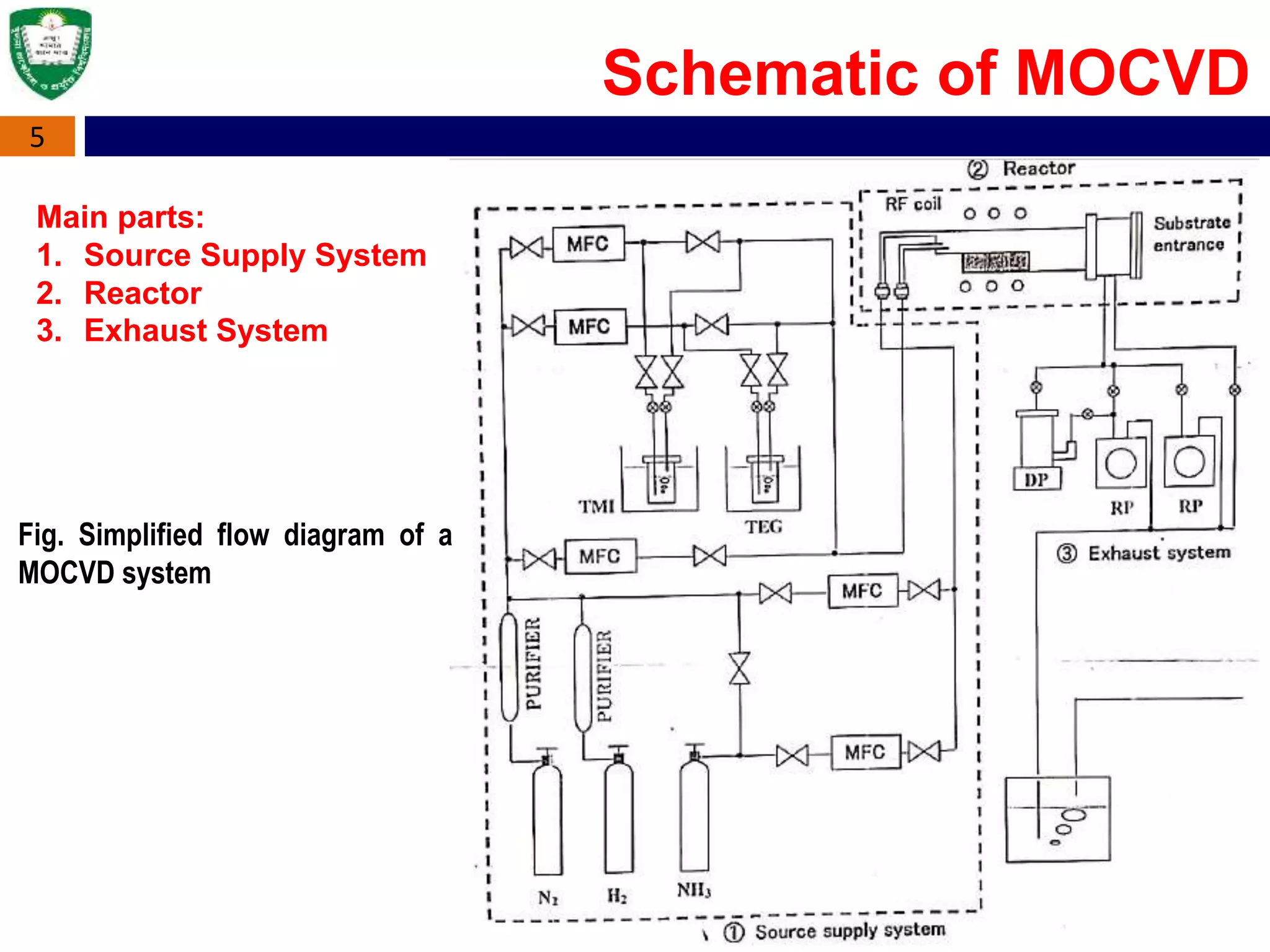
Schematic of MOCVD
Fig. Simplified flow diagram of a
MOCVD system
Main parts:
1. Source Supply System
2. Reactor
3. Exhaust System
6
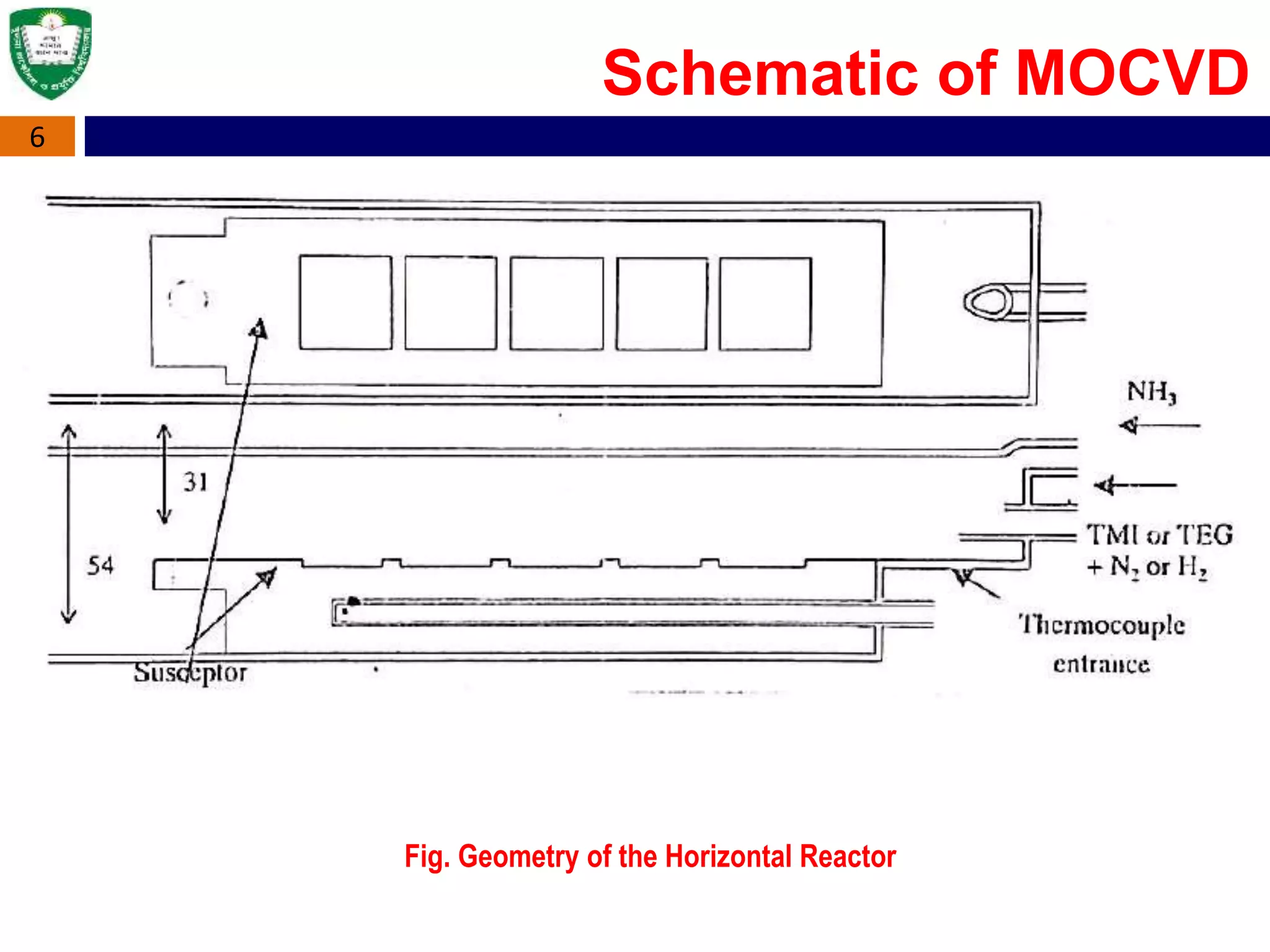
Schematic of MOCVD
Fig. Geometry of the Horizontal Reactor
7
Schematic of MOCVD
8
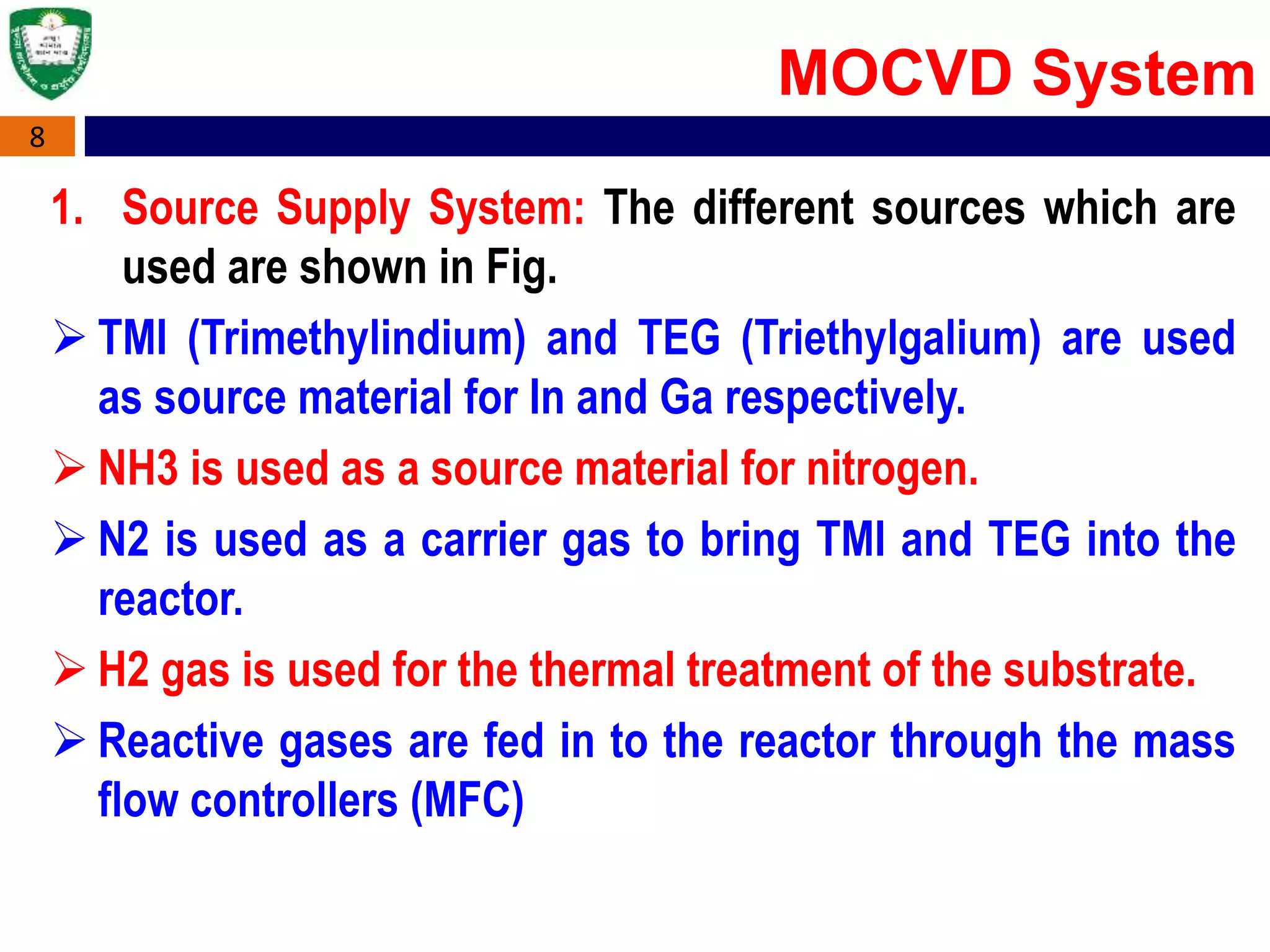
MOCVD System
1. Source Supply System: The different sources which are
used are shown in Fig.
 TMI (Trimethylindium) and TEG (Triethylgalium) are used
as source material for In and Ga respectively.
 NH3 is used as a source material for nitrogen.
 N2 is used as a carrier gas to bring TMI and TEG into the
reactor.
 H2 gas is used for the thermal treatment of the substrate.
 Reactive gases are fed in to the reactor through the mass
flow controllers (MFC)
9
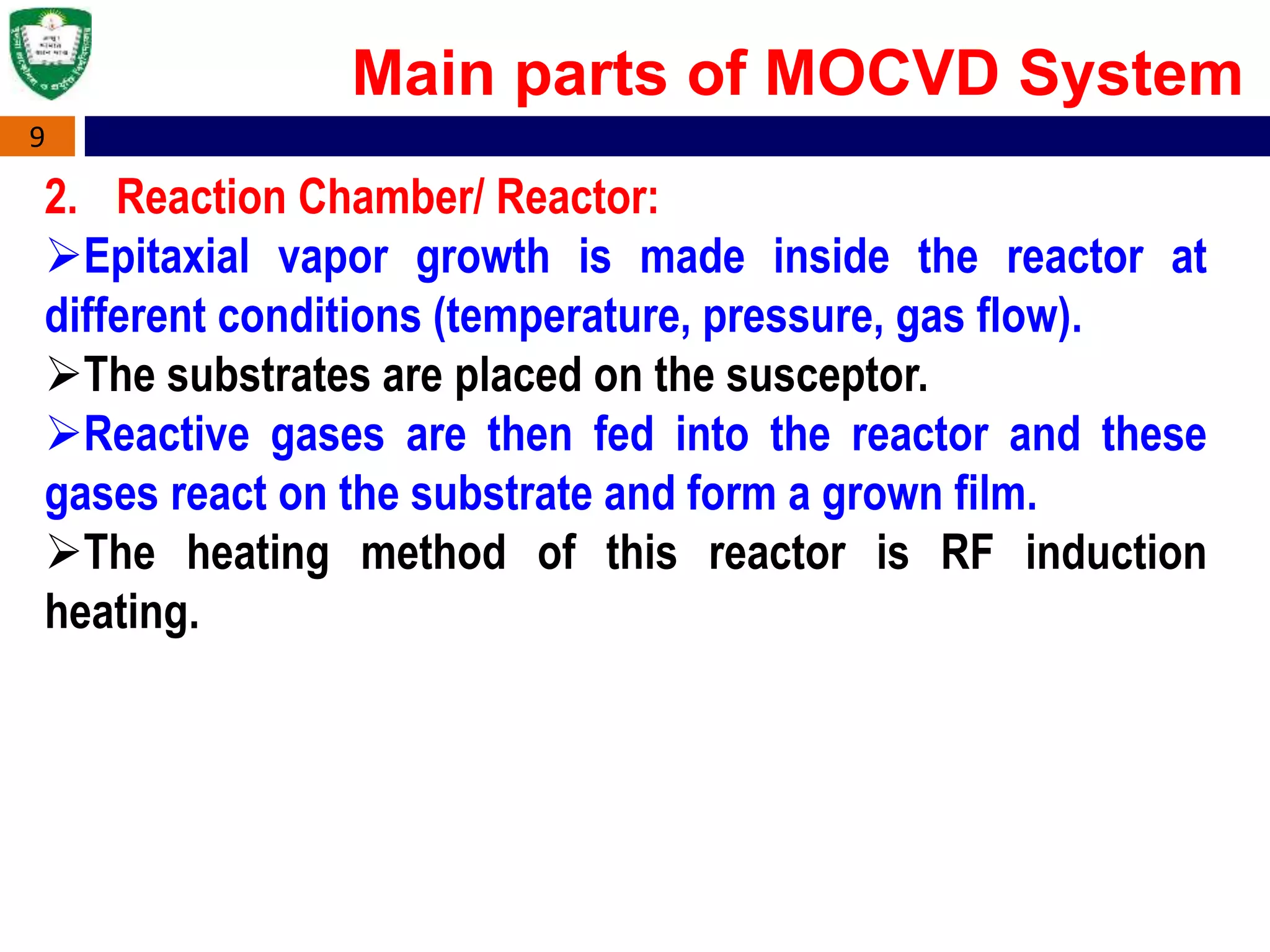
Main parts of MOCVD System
2. Reaction Chamber/ Reactor:
Epitaxial vapor growth is made inside the reactor at
different conditions (temperature, pressure, gas flow).
The substrates are placed on the susceptor.
Reactive gases are then fed into the reactor and these
gases react on the substrate and form a grown film.
The heating method of this reactor is RF induction
heating.
10
MOCVD System
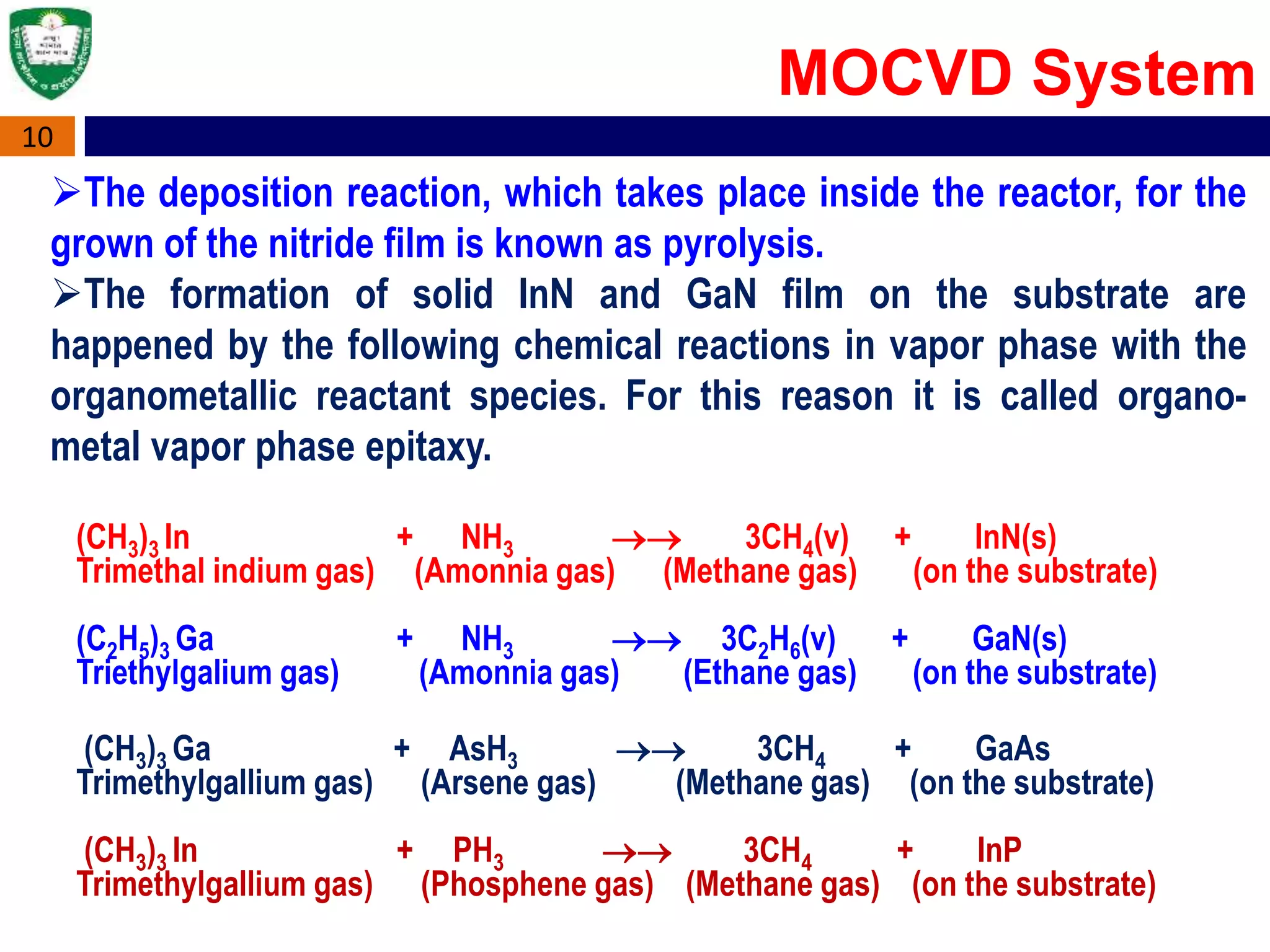
The deposition reaction, which takes place inside the reactor, for the
grown of the nitride film is known as pyrolysis.
The formation of solid InN and GaN film on the substrate are
happened by the following chemical reactions in vapor phase with the
organometallic reactant species. For this reason it is called organo-
metal vapor phase epitaxy.
(CH3)3 In + NH3  3CH4(v) + InN(s)
Trimethal indium gas) (Amonnia gas) (Methane gas) (on the substrate)
(C2H5)3 Ga + NH3  3C2H6(v) + GaN(s)
Triethylgalium gas) (Amonnia gas) (Ethane gas) (on the substrate)
(CH3)3 Ga + AsH3  3CH4 + GaAs
Trimethylgallium gas) (Arsene gas) (Methane gas) (on the substrate)
(CH3)3 In + PH3  3CH4 + InP
Trimethylgallium gas) (Phosphene gas) (Methane gas) (on the substrate)
11
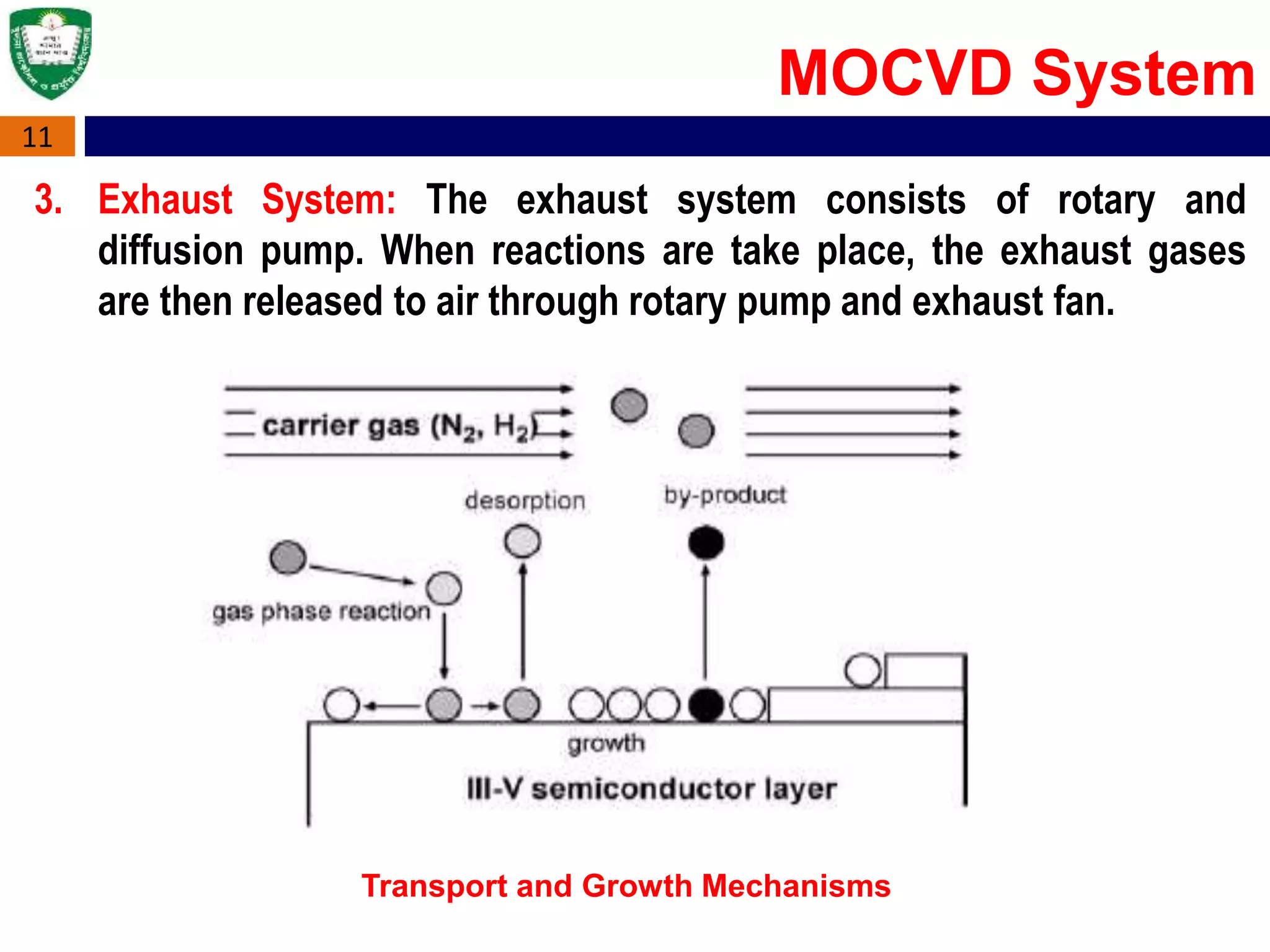
3. Exhaust System: The exhaust system consists of rotary and
diffusion pump. When reactions are take place, the exhaust gases
are then released to air through rotary pump and exhaust fan.
Transport and Growth Mechanisms
MOCVD System
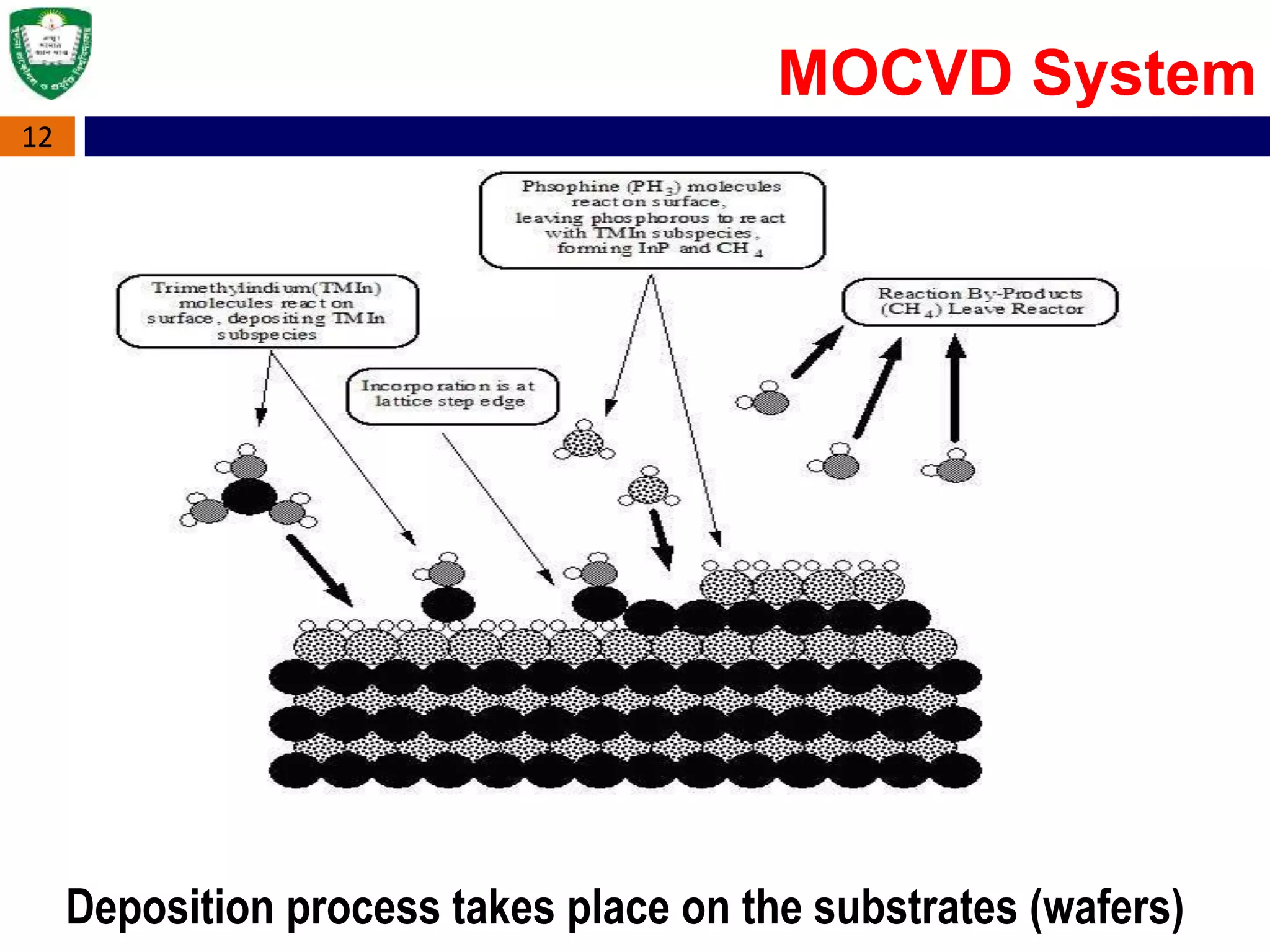
12
Deposition process takes place on the substrates (wafers)
MOCVD System
13
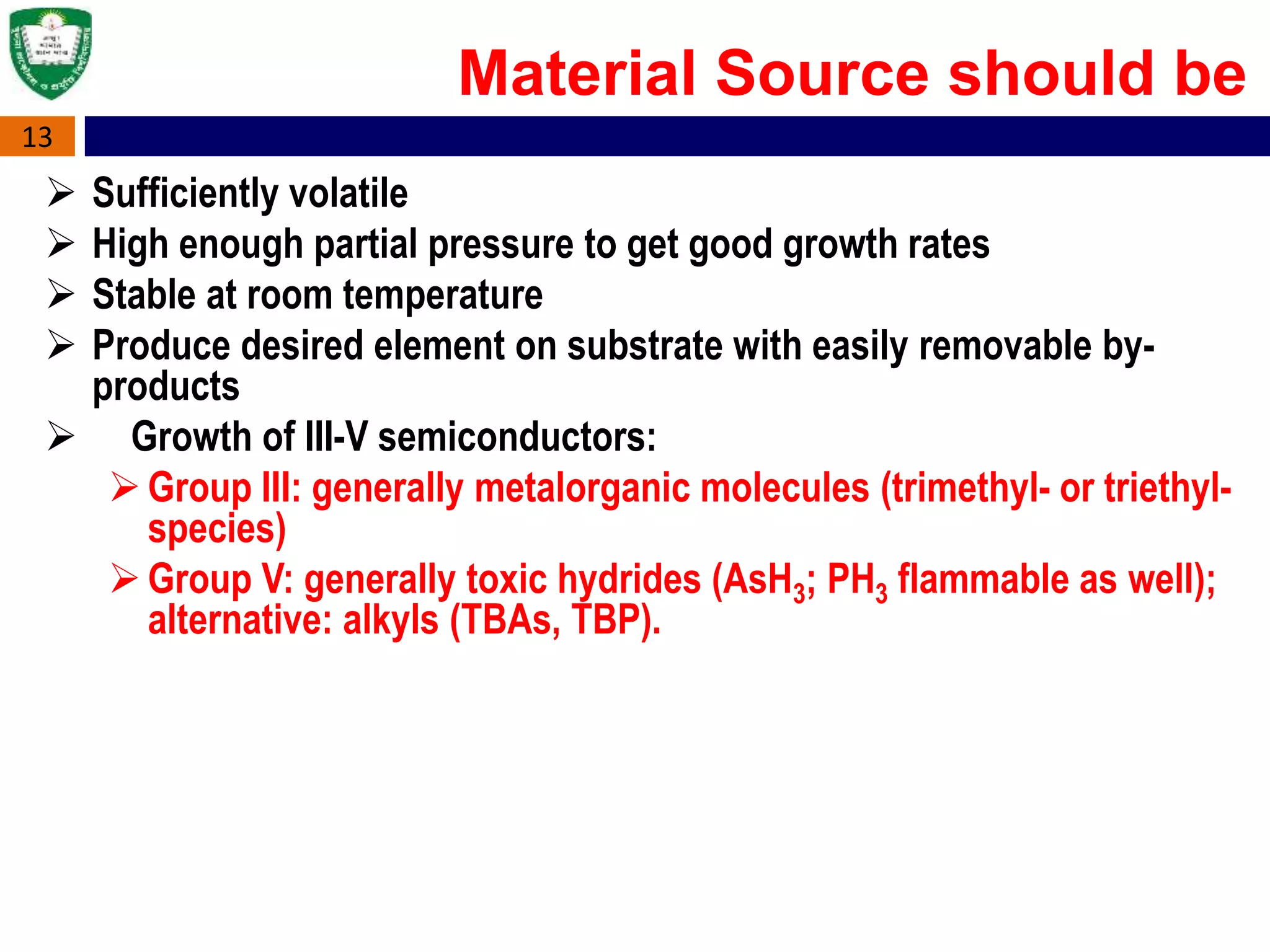
 Sufficiently volatile
 High enough partial pressure to get good growth rates
 Stable at room temperature
 Produce desired element on substrate with easily removable by-
products
 Growth of III-V semiconductors:
Group III: generally metalorganic molecules (trimethyl- or triethyl-
species)
Group V: generally toxic hydrides (AsH3; PH3 flammable as well);
alternative: alkyls (TBAs, TBP).
Material Source should be
14
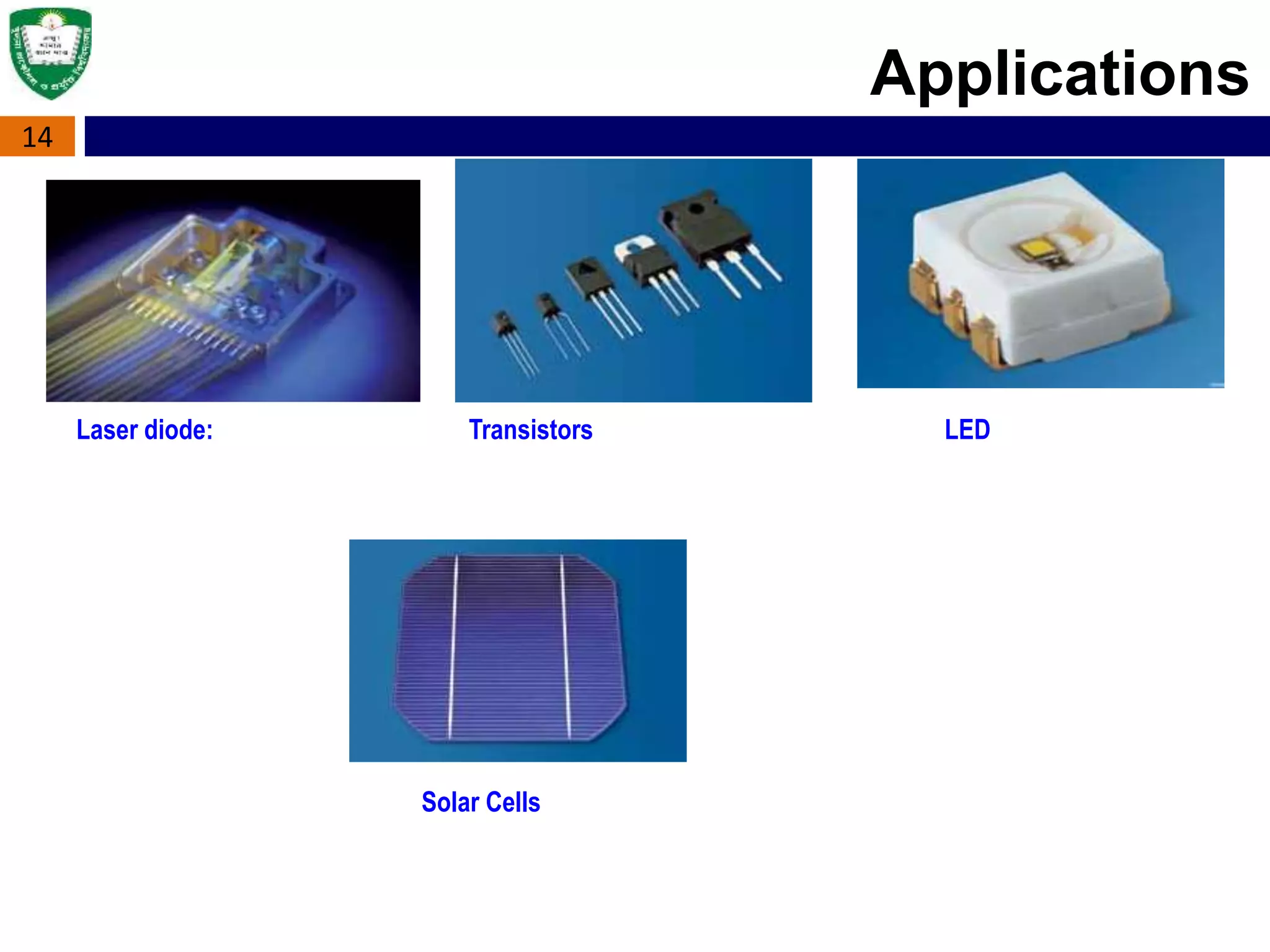
Laser diode: Transistors LED
Solar Cells
Applications

METAL ORGANIC CHEMICAL VAPOR DEPOSITION- MOCVD--ABU SYED KUET

  • 1.
    Metal Organic Chemical VapourDeposition Abu Syed Md. Jannatul Islam Lecturer, Dept. of EEE, KUET, BD 1 Department of Electrical and Electronic Engineering Khulna University of Engineering & Technology Khulna-9203
  • 2.
    2 MOCVD/OMVPE/OMCVD/MOVPE  MOCVD standsfor Metal-Organic Chemical Vapour Deposition.  MOCVD is a technique that used to grow/deposit thin solid films, usually semiconductors, on solid substrates (wafers) using organo metallic compounds as sources.  The films grown by MOCVD are mainly used for the fabrication of electronic and optoelectronic devices.  The electronic and optoelectronic devices produced by MOCVD are used in cell phones , optical communication, optical storage (CD, DVD), traffic lights, bill boards (LEDs), lighting and solar cells.  Using MOCVD we can build up many layers, each of a precisely controlled thickness, to create a material which has specific optical and electrical properties.
  • 3.
    3  Epitaxial filmscan be grown from solid, liquid, or gas phases. It is easier to control the growth rate in gas phase Epitaxy by controlling the flow of gases.  High grown layers quality, Highest flexibility  Faster growth rate than MBE, can be a few microns per hour;  Multi-wafer capability easily achievable. Different materials can be grown in the same system.  Doping uniformity/reproducibility, Economically advantageous.  High throughput and no ultra high vacuum needed (compared to MBE),  Precision in deposition thickness and possible sharp interfaces growth –thus, it is very suitable for hetero-structures, e.g., multi quantum wells (MQW)  Higher temperature growth; growth process is thermodynamically favorable Why MOCVD?
  • 4.
    4  Many materialsthat we wish to deposit have very low vapour pressures and thus are difficult to transport via gases  Not abruptable process as MBE due to gas flow issues  Human Hazard, that is, Toxic and corrosive gases are to be handled  High temperatures  Complex processes  Carbon contamination and unintentional Hydrogen incorporation are sometimes a problem MOCVD Disadvantages
  • 5.
    5 Schematic of MOCVD Fig.Simplified flow diagram of a MOCVD system Main parts: 1. Source Supply System 2. Reactor 3. Exhaust System
  • 6.
    6 Schematic of MOCVD Fig.Geometry of the Horizontal Reactor
  • 7.
  • 8.
    8 MOCVD System 1. SourceSupply System: The different sources which are used are shown in Fig.  TMI (Trimethylindium) and TEG (Triethylgalium) are used as source material for In and Ga respectively.  NH3 is used as a source material for nitrogen.  N2 is used as a carrier gas to bring TMI and TEG into the reactor.  H2 gas is used for the thermal treatment of the substrate.  Reactive gases are fed in to the reactor through the mass flow controllers (MFC)
  • 9.
    9 Main parts ofMOCVD System 2. Reaction Chamber/ Reactor: Epitaxial vapor growth is made inside the reactor at different conditions (temperature, pressure, gas flow). The substrates are placed on the susceptor. Reactive gases are then fed into the reactor and these gases react on the substrate and form a grown film. The heating method of this reactor is RF induction heating.
  • 10.
    10 MOCVD System The depositionreaction, which takes place inside the reactor, for the grown of the nitride film is known as pyrolysis. The formation of solid InN and GaN film on the substrate are happened by the following chemical reactions in vapor phase with the organometallic reactant species. For this reason it is called organo- metal vapor phase epitaxy. (CH3)3 In + NH3  3CH4(v) + InN(s) Trimethal indium gas) (Amonnia gas) (Methane gas) (on the substrate) (C2H5)3 Ga + NH3  3C2H6(v) + GaN(s) Triethylgalium gas) (Amonnia gas) (Ethane gas) (on the substrate) (CH3)3 Ga + AsH3  3CH4 + GaAs Trimethylgallium gas) (Arsene gas) (Methane gas) (on the substrate) (CH3)3 In + PH3  3CH4 + InP Trimethylgallium gas) (Phosphene gas) (Methane gas) (on the substrate)
  • 11.
    11 3. Exhaust System:The exhaust system consists of rotary and diffusion pump. When reactions are take place, the exhaust gases are then released to air through rotary pump and exhaust fan. Transport and Growth Mechanisms MOCVD System
  • 12.
    12 Deposition process takesplace on the substrates (wafers) MOCVD System
  • 13.
    13  Sufficiently volatile High enough partial pressure to get good growth rates  Stable at room temperature  Produce desired element on substrate with easily removable by- products  Growth of III-V semiconductors: Group III: generally metalorganic molecules (trimethyl- or triethyl- species) Group V: generally toxic hydrides (AsH3; PH3 flammable as well); alternative: alkyls (TBAs, TBP). Material Source should be
  • 14.
    14 Laser diode: TransistorsLED Solar Cells Applications